

 Back
Back
Unless Gov. Newsom blocks the bill, it will legalize plug-in solar in one of the world’s biggest economies. But the rules are more restrictive than some hoped for.
Californians could soon put solar panel kits on balconies and in backyards to lower their electric bills — without utility approval.
On Wednesday, state lawmakers passed the Plug and Play Solar Act (Senate Bill 868) to legalize balcony solar, a form of DIY clean energy that’s taken off in Germany. The bill, which garnered bipartisan support, now heads to the desk of Democratic Gov. Gavin Newsom. His office declined to say if he’ll sign or veto it within the 30-day deadline; if he does neither, it would still become law and take effect Jan. 1, 2027.
“Imagine being able to reduce your annual electric bill by $400, which is what is estimated here, simply by plugging in one of these devices and leaving it in the sun,” state Sen. Scott Wiener (D), who wrote the bill, said at a Monday press conference on the legislation. “This is a level of convenience in terms of installation and energy savings that we have not seen before.”
Balcony solar kits, already sold by a few businesses in the U.S., put home solar in the hands of millions of renters and homeowners who can’t have panels installed on their roofs. The portable panels push power into a standard 120-volt wall outlet; that electricity then flows to the nearest power-hungry devices, such as the fridge, computer, Wi-Fi router, lights, and air conditioner.
If enacted, California’s legislation would allow households to install plug-in solar systems sized up to 1,200 watts per residence without the costly and potentially time-consuming utility interconnection process that’s required for larger rooftop arrays. Even a 400-watt system can cover roughly 14% of an apartment’s energy use, according to the Environmental Working Group, a nonprofit that advocated for the bill.
The Golden State’s embrace of balcony solar follows a tsunami of support nationwide. More than half of states have considered plug-in solar legislation in the last year, and so far, eight have adopted balcony solar laws: Colorado, Connecticut, Maine, Maryland, New Hampshire, Utah, Vermont, and Virginia. New York passed a bill in June, but boosters are still on tenterhooks as to whether Gov. Kathy Hochul (D) will sign it.
“California is going to have a huge impact on this market,” said Cora Stryker, co-founder of plug-in solar nonprofit Bright Saver. The state’s economy is the largest and among the fastest growing in the nation. “Manufacturers are going to see this and seize upon the opportunity.”
The bad news: Households won’t be able to get plug-in solar that meets the bill’s requirements right away. The state would allow only balcony solar kits that have been certified safe to use by a nationally recognized testing laboratory. One of these organizations, safety company UL Solutions, began testing plug-in systems this year under its new standard, UL 3700, but no product has yet earned certification.
The rule is more restrictive than those adopted by some other states. For example, Utah and Maryland require that the individual kit components pass safety standards, rather than the entire system, according to Stryker.
Stryker said she’s worried that California’s stringent approach could put a damper on balcony solar’s growth in the state in the near term, especially for renters. In its current form, the UL 3700 standard still requires an electrician to get involved, the opposite of plug and play. Still, Bernadette Del Chiaro, the Environmental Working Group’s senior vice president for California, said she expects the standard to evolve to include DIY systems as soon as next year.
Another wrinkle: The legislation includes an expiration date, which the state’s largest utility, Pacific Gas and Electric, appears to have lobbied for. On Jan. 1, 2030, Californians will no longer be able to install plug-in solar without first getting their utility’s sign off.
“We would expect the Legislature to reconsider that sunset in 2028 and at the latest 2029,” Del Chiaro said.
Wiener believes, despite its challenges, the plug-in solar bill will be transformative for Californians. “Balcony solar is incredibly important,” Wiener told Canary Media. “This is a way to lower people’s cost of living when people need relief. … I’m glad that we’re finally making it happen.”
For nearly two decades, the state has sought to bring wind turbines to its breezy northern reaches. Now it’s one step closer to realizing the vision.
For nearly two decades, Maine has tried to build utility-scale wind in the northern reaches of the state. On Tuesday morning, utility regulators brought that vision a little closer to reality, choosing an 800-megawatt wind farm proposal and a 1.2-gigawatt transmission line plan from the bids it received earlier this year.
“I think we now have a pair of projects that are incredibly likely to be built,” said Philip Bartlett, chair of the Maine Public Utilities Commission, during Tuesday’s deliberations.
The commission was tasked with choosing both a clean-generation development for Aroostook County, along the Canadian border, and a transmission project that would shuttle the power to the rest of New England. The panel picked a plan for an onshore wind farm, proposed by developer Clearway Energy, and a transmission line proposed by Avangrid, the parent company of utility Central Maine Power. The selection of the wind project is contingent on the transmission line getting built.
The developments are expected to generate some $400 million in net benefits for Maine consumers over the life of the projects, and create more than 2,500 full-time jobs during construction. The wind farm could lower by 10% the amount of oil — one of the costliest and dirtiest fuels — burned in New England power plants in the winter, Commissioner Carolyn Gilbert said.
“Maine ratepayers are significantly better off for this effort,” she said.
Maine set its first target for land-based and offshore wind in 2008. Aroostook County, a region with lots of open space and particularly robust winds, has long been the focus of these efforts. For years, however, these plans failed to get traction, largely because the region is so isolated from the rest of the New England grid. The cost and difficulty of building new transmission was a significant part of the reason previous plans fizzled in 2016 and 2023.
This time around, Maine went into the process with the support of other New England states.
Connecticut, Massachusetts, Rhode Island, and Vermont all struck an agreement to share the cost of the transmission line. Maine utility customers will pay for less than 11% of the total cost.
The six New England states are also set to share the cost of a second transmission project that will strengthen the connection between the planned wind farm and the rest of the region. In March 2025, at the recommendation of all these states’ governors, Independent System Operator New England issued a request for proposals for transmission infrastructure linking central Maine to the rest of the grid. The grid operator announced its preferred project in July, and is now accepting public comments.
This level of cooperation is, perhaps, unprecedented, Commissioner Patrick Scully said during deliberations.
“I’ve not seen anything like this in the United States,” he said. “I think this effort deserves national attention and provides a model for other regions to work collaboratively to meet common energy, climate, and reliability goals.”
The region’s other states also considered the bids for energy generation, though there haven’t yet been any announcements about whether they will choose to procure power from the wind farm.
While environmental and economic development advocates are optimistic about the selections, they note that previous plans have floundered. There are still many more important milestones to come, including financing, permitting, and construction, said Francis Pullaro, president of clean-energy industry association Renew Northeast. Project planners may also need to navigate public reaction to the proposal. The last major transmission line built through Maine sparked an outcry that led to years of delay and more than $500 million in added cost for ratepayers.
The federal environment for wind-energy development is also more difficult than ever. President Donald Trump has eliminated tax credits for wind projects and directed agencies including the Defense Department to freeze permitting for wind, though courts have ruled against these moves. The attacks have been especially devastating for ambitious plans to build offshore wind in New England, raising the stakes of developing onshore resources in Aroostook and elsewhere in the region.
Still, Pullaro is already looking ahead. The 800-MW wind project will leave room for another 400 MW of power to travel on the new planned transmission line, and Aroostook has plenty of wind.
“We have a lot of untapped potential up there,” he said. “I think there’s a real opportunity here to keep the momentum going.”
Extreme weather spiked power demand just as nuclear, gas, and coal plants had to reduce their output. Solar and batteries helped keep people cool.
Repeated record-breaking heat waves cooked the European continent this summer, delivering the region’s hottest June on record. A simultaneous, though possibly related, drought shriveled rivers to record lows. In addition to their impact on public health, the dual crises put pressure on Europe’s energy system: Wind power struggled under stagnant conditions created by heat waves, and “thermal” power plants — nuclear, gas, and coal plants — had to reduce their output as European waterways warmed and dried, taking away water used for their cooling systems.
Solar power proved the only major energy source that performed better than normal during Europe’s summer of extremes, experts found. When paired with batteries, it helped supply thousands of AC units during historic hot conditions.
Scientists are still trying to understand why so many recurring heat waves materialized this summer, but studies have found that individual heat events are more likely and more intense because of climate change. The intensity of the June heat wave that scorched Western Europe was roughly 200 times more likely in today’s fossil fuel–warmed climate than it would have been two decades ago, one study found. As the continent continues to warm and Europeans install more cooling systems to cope — just 23% of households currently have access to or use air conditioning — experts say this summer provides lessons for the future.
Extreme temperatures in late June bumped up Italy’s power demand by 28% compared to the previous week, according to the energy think tank Ember. In France, that number was 14%. Electricity and natural gas prices spiked in evening hours as demand grew highest and solar generation ended, with some prices hitting their highest levels since the 2022–23 winter gas crisis following Russia’s invasion of Ukraine.
As demand and prices were climbing, power generation in some areas was falling. In the United Kingdom, five gas plants reduced their output by a combined 2.5 gigawatts in generation because heat reduced their cooling systems’ effectiveness. At the same time, heat-induced low wind speeds halved the country’s typical wind farm generation in June.
Historic dryness dropped river levels across Europe: England and Wales reported their driest July on record, while water levels in the Danube River in central and Eastern Europe reached record lows, exposing World War II shipwrecks and prehistoric relics. Europe’s hydropower production hit its lowest July level in a decade, and multiple countries curtailed nuclear power generation as warm, low rivers threatened water supplies for cooling. France lost 18% of its nuclear capacity to “environmental factors” in mid-July, Ember found, extending a trend of summertime nuclear outages that has plagued the country in recent years. French nuclear plants often use river water as a vital component of their cooling systems, drawing the water in at natural temperatures and then discharging it back into the rivers slightly warmer. Because French law caps the temperature of this discharged water to protect aquatic life, plants must reduce cooling operations and related power generation when the intake water from rivers is already warm because of heat waves or drought.
But where these sources faltered, solar shone through. European heat waves tend to deliver optimal conditions for solar power: clear, sunny days. Europe’s solar panels produced 17% more power during the summer’s heat waves than they normally do, stabilizing the grid as afternoon cooling demand climbed, according to Ember. Battery systems helped deliver this solar power into the evening hours, when heat still lingered and air conditioners cranked to allow households to sleep.
“The next challenge is the evening period. Temperatures often remain high after sunset and AC demand can stay elevated, even as solar production declines,” said Walburga Hemetsberger, CEO of SolarPower Europe, an industry group. “This is why battery storage is becoming such an important part of the energy transition.”
For as much as this summer’s extreme heat strained Europe’s grid, the continent’s cooling demand has a lot of room to grow: About half of households in Italy and Spain have air conditioning, and a quarter in France — compared with 90% in the United States.
“There are places where we just can’t do without it now,” Marine Tondelier, national secretary of the Ecologist Party, said this June, a reversal in the party’s long-standing argument against air conditioning because of its greenhouse gas emissions.
France’s state-owned utility plans to spend over $10 billion to adapt its nuclear and hydropower plants to warmer temperatures and lower water availability over the next 15 years, including investments in equipment that cools the water nuclear plants discharge into rivers so that it complies with environmental standards. But adapting to that new demand could also take new generation and storage, especially as grids simultaneously increase demand from data centers.
Solar and batteries have already been growing at a breakneck pace across Europe, with 36 gigawatt-hours installed in 2025, a 48% increase over new additions the previous year. Battery installations saw their 12th straight year of growth in 2025, according to industry group SolarPower Europe.
“Extreme price spikes during heat waves are a blaring signal for regulatory changes that increase power system flexibility,” said Beatrice Petrovich, a senior energy analyst covering Europe at Ember. “Treating this summer as a turning point for energy storage would be an opportunity to remove existing barriers.”
Lakes Mead and Powell have sunk to unprecedented lows, jeopardizing their generation capabilities — but drought persists in the Northeast, too.
The U.S. depends on hydroelectric power — and ever-worsening drought is threatening its supply.
The western half of the country has faced a water crisis for years, and things have only gotten more dire in 2026. Rocky Mountain states didn’t get much precipitation this past winter, and a steamy spring quickly melted what little snowpack there was.
Now, the Colorado River is suffering the consequences. Lake Mead and Lake Powell — the nation’s two largest reservoirs, held in by the Hoover and Glen Canyon dams, respectively — both reached record-low water levels this month. Those reservoirs hold crucial supplies of water for drinking and farming throughout the West, and when they’re full, can produce more than 3 GW of power.
Current water levels in both Mead and Powell are too low to produce anywhere near that much power. And the Bureau of Reclamation, which manages water levels in both reservoirs, projects there’s a slim but real chance that they could sink too low to produce any power at some point next year.
As big as they are, these two dams provide only a small portion of the Southwest’s total electricity supply. But drought, exacerbated by climate change, is challenging dozens of other hydropower plants throughout the West — and across North America. Hydro provides nearly all the power in Quebec, but the Canadian province is stuck in a yearslong drought that has diminished its generation capacity.
That’s not just a problem for Canada. The Northeastern U.S. brought two huge transmission lines into operation this year to carry Canadian hydropower into New England and New York City. But plagued by outages and drought conditions, those lines have transported far less power than expected into the U.S., casting doubt on whether Canada’s once-abundant hydropower can be the clean energy savior the Northeast hoped it would be.
Trump’s cabinet cheerleads battery projects
The Trump administration may be trying to take down clean energy, but it’s cheering batteries on.
This week, South Korea–based company LG Energy Solution opened a battery manufacturing facility in Lansing, Michigan, and Interior Secretary Doug Burgum was there to celebrate. As Claire Hao reports, the project was originally a joint venture between LG and General Motors, but a waning EV market led GM to pull out. LG now solely owns the facility, and half of the cells it produces will go to storage, while the other half will go to Toyota to put in EVs.
Another battery-boosting event this week also had a special guest from President Donald Trump’s cabinet. Energy Secretary Chris Wright joined Maine Republican leaders to tout the construction of Form Energy’s grid-scale battery storage project on the site of a former paper mill.
Despite slashing funding for other clean energy projects, the White House has largely preserved incentives and money for battery storage.
Pennsylvania wants data centers to bring their own energy
As I wrote last week, pretty much every governor looking to be reelected this fall is cracking down on data centers, and Pennsylvania Gov. Josh Shapiro (D) is no exception.
This week, Shapiro issued an executive order requiring that data centers meet “stringent” energy use, economic, and community engagement standards if they want to secure expedited permits. And as Jeff St. John reports, the announcement explicitly follows through on PJM Interconnection’s call for member states to help the grid operator rein in data center power demand. Under Shapiro’s order, data centers that want an fast-tracked grid connection will either have to secure their own power or face potential curtailment when the grid is stressed.
PJM is struggling to keep up with rising demand in its region, and its power prices are increasing as more and more data centers look to come online. Shapiro’s order is a step toward the bring-your-own-clean-energy policies that grid experts have named as a potential solution to data center demand.
Data center dreaming: OpenAI announces plans to develop a 10-GW data center complex in Ohio, which will be powered by a 9.2-GW gas plant built and owned by the U.S. government — two projects of unprecedented size and questionable feasibility. (Wall Street Journal)
Heat pump high-rises: More than half of apartment buildings constructed in the U.S. last year included ultraefficient heat pumps, and new home construction is close to passing that milestone, too. (Canary Media)
Geothermal road map: A new report lays out how state policies can help next-generation geothermal companies secure the financing they need to take off. (Canary Media)
Homegrown solar: U.S. solar manufacturer Qcells, which recently brought the entire panel production process into its Georgia factory, could benefit from the Trump administration’s latest round of tariffs on polysilicon imports. (Grist)
Clean heat revolution: Three projects in Boston and Cambridge, Massachusetts, aim to tap heat from the ocean and rivers to provide heating and cooling to major institutions and replace natural gas. (Canary Media)
Power hour: Xavier Becerra (D), California’s top gubernatorial candidate, proposes giving residents two hours of free power every day in a move that could shift grid demand to when solar power generation is high. (Canary Media)
Despite Trump’s attacks on renewables, it’s the same old story so far this year: The U.S. is building lots of solar and storage and a little bit of everything else.
It’s a tough time to build renewable energy in the U.S.
In 2026 alone, the Trump administration has phased out tax credits, frozen clean-energy permitting, and issued tariffs certain to raise the cost of solar — while continuing to take lazy and misleading swipes at renewables.
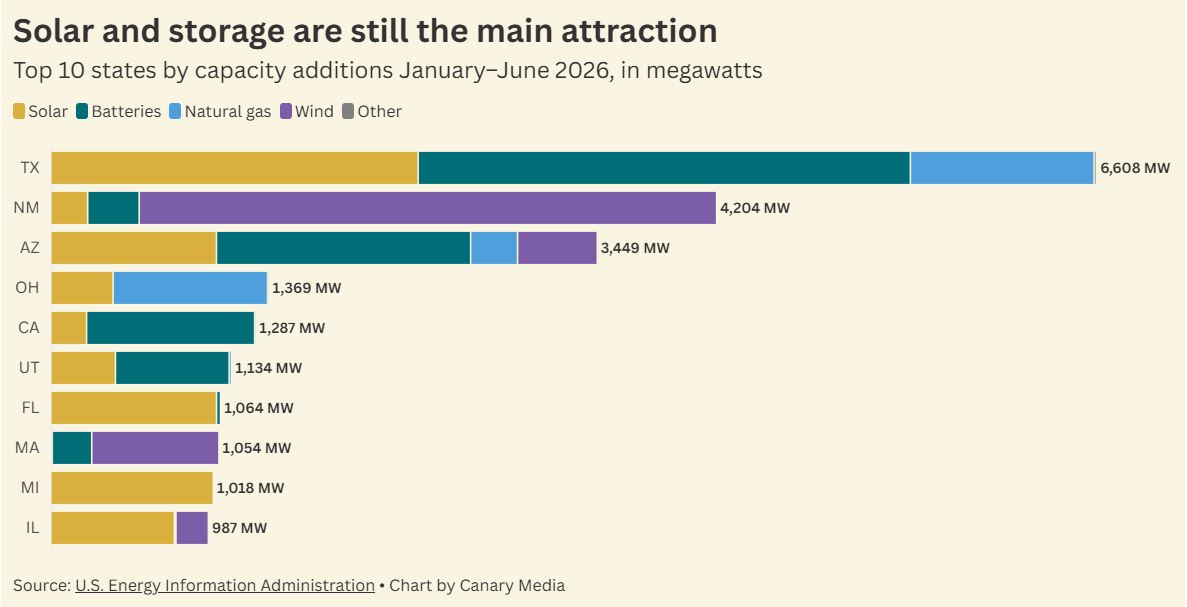
And yet 90% of what was built in the first half of this year is either solar, storage, or wind power, per U.S. Energy Information Administration data.
In fact, solar and batteries alone made up more than two-thirds of all new capacity added to the grid between January and June. As one analyst told Inside Climate News in a story parsing this same data, solar-plus-storage has become the grid’s “workhorse.”
Texas, of course, has led the way in building solar and energy storage — and in overall power plant construction. New Mexico, powered by the gigantic 3.65-gigawatt SunZia wind project that was completed in June, added the next-most overall capacity. (Yes, for those keeping track, that is the largest wind project in America turning on despite President Donald Trump’s vow to block all wind construction during his second term.) Arizona’s continuing solar-plus-storage boom boosted it to the third spot.
It’s no surprise that renewables are leading the way in 2026. It’s a trend that’s persisted for the last few years.
The Trump administration has proved unable to change that, although his tariffs and tax credit cuts have made clean energy more expensive to build. But costlier renewables are still cheaper than fossil fuels, not to mention free of the carbon emissions that are baking the planet.
If bold plans to fuel the AI race with natural gas actually materialize, it’s possible that gas could challenge renewables’ dominance. After all, Amazon and OpenAI plan to build individual gas-fired facilities that could, on their own, eclipse the total amount of gas built across all of the U.S. last year.
But those monster gas plants are far from a done deal. What’s more certain, whatever becomes of the grand plans to build more gas, is that solar and storage will continue to soar.
American solar manufacturers are navigating shifting federal policies on tariffs and tax credits, all while demand for their product continues to grow.
This story was originally published by Grist. Sign up for Grist’s weekly newsletter here.
Inside the vast Qcells factory in Cartersville, Georgia, workers — and a bevy of robots — move ultrathin slices of polysilicon through a lengthy series of machines and chemical baths to get what are known as cells.
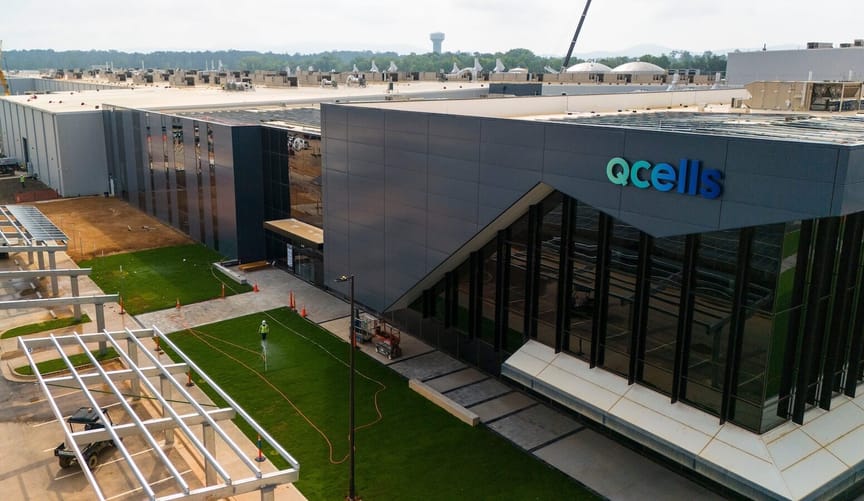
“The $2.5 billion, the 3.5 million gallons of water, the 90 megawatts of power, the 60 tons of chemicals on-site, and all of the football fields’ worth of infrastructure you’ve seen is to arrive at this,” said Scott Bell of Qcells, holding up one of the paper-thin blue cells.
It’s the basic building block of a solar panel.
In June, the plant, about an hour northwest of Atlanta, began its expansion from assembling the major components of solar panels to bringing the whole production process under one roof. It’s a major milestone for the U.S. solar industry. China has dominated solar panel manufacturing since the 2010s, flooding the global market with far cheaper panels than anyone else could make. For a host of reasons — national security, labor practices, job creation — the U.S. is trying to bring back domestic production.
In its latest move, the Trump administration plans to levy new tariffs and impose minimum import prices on polysilicon, the key ingredient for solar cells. The new measures go into effect in December.
“Having the full supply chain is critical,” said solar manufacturing expert Ben Damiani, chief technology officer at Atlanta-based solar developer Cherry Street Energy. Moving that supply chain to the U.S., he said, hasn’t been a smooth road. “Probably the biggest hindrance has been the constant change of our own policies.”
The Biden administration took a carrot approach to attracting solar panel makers: The 2022 Inflation Reduction Act included tax credit bonuses for solar projects that used U.S.-made panels. Qcells, a South Korean firm, has said those incentives were a major reason they built their Cartersville plant.
The Trump administration, by contrast, is taking a stick approach. While last year’s One Big Beautiful Bill Act, or OBBBA, revoked most of the tax credits, it also made solar equipment from certain countries — including China — ineligible for the few tax credits that remain. That, along with the new tariffs, may help a U.S. manufacturer like Qcells compete with Chinese imports, which are now more expensive.
The two policy approaches have the same ultimate goal, according to researcher Coco Zhang of the banking and investment firm ING. But it’s been whiplash for companies.
Following Trump’s latest executive actions, Qcells is still likely able to find a way to be successful, Zhang said. But Qcells has already made a multibillion-dollar investment in its brand-new facility that took more than three years to come online. For other companies with less capital and poorer timing, the supply-side incentives for domestic production may not be enough — especially when the policies could completely change again.
As a part of the OBBBA, the Trump administration closed the IRA loophole that had left room for China-based solar companies to simply set up shop in the U.S., which, according to Zhang, may go further still toward rooting out Chinese competition. In the long run, she’s optimistic that the U.S. solar panel industry can complete its shift to domestic production. But because the rules discouraging foreign ownership cut deeper into the supply chain, those restrictions and the policy back-and-forth could make things harder to navigate in the short term, she said.
The short-term outlook is complicated for those buying solar panels, too. The phaseout of federal clean energy tax credits removed a major incentive to develop new solar projects, and the Trump administration has taken steps to cancel federal funding for clean energy projects and add new hurdles for solar and wind installations on federal land. The courts have blocked or reversed some of those actions, but the delays add costs and uncertainties even for projects that do ultimately move forward.
In the first quarter of this year, clean energy advocacy group E2 tracked nearly $13 billion in abandoned investments in solar, wind, and battery projects. But some $18 billion in new projects were announced as companies scrambled to meet the deadline of the expiring tax credits. While the new tariffs and price controls on polysilicon could help U.S. manufacturers compete to supply the solar developments that remain, they could also drive up costs for developers, Zhang said, and “limited U.S. supply means many will still depend on imports and face higher costs.”
But industry experts maintain that solar isn’t going anywhere. It’s still one of the cheapest sources of electricity at a time when energy demand is growing fast. Solar panels are also readily available, while gas turbines are backordered for years. Solar and storage made up 90% of new power added to the U.S. grid in the first quarter of the year, according to the Solar Energy Industries Association.
“We absolutely should make solar, right? Like it is the fastest deployed, lowest cost foreseeable,” said Damiani. “Solar will be, for the next hundred years, a good portion of our energy.”
The questions, experts agreed, aren’t whether solar development will keep happening, but how quickly, how much it will cost, and who — and where — will make the solar panels.
Offshore wind farms not only pose no threat — they provide national security benefits, in addition boosting the grid and economy, according to military experts.
When the Trump administration issued stop-work orders on all five offshore wind projects under construction late last year, it offered one justification: The turbines could compromise national security.
Experts were immediately critical of this assertion, not least because it came after months of unrelenting hostility toward the offshore wind industry from President Donald Trump. Plus, it’s standard practice for the U.S. Department of Defense to assess offshore wind projects, and each one under construction had been thoroughly vetted.
Now, some military experts are going even further, arguing not only that offshore wind poses no threat but that building it can bolster security.
“Offshore wind is not a national security threat — it is a national security imperative,” said Dave Belote, a retired U.S. Air Force colonel and CEO of renewable energy consultancy Dare Strategies, at the National Conservative Energy Summit in Boston this week.
Belote was among a panel of energy experts with U.S. military backgrounds who said the Trump administration’s national security rationale is just plain wrong.
The courts have unanimously ruled against Trump’s stop-work orders, allowing work to resume on all five offshore wind projects. Three are now sending power to the grid. On Thursday, a court ruled against the Trump administration’s use of similar justifications to halt the permitting of more than 150 land-based wind projects, too.
In fact, experts said, offshore wind is vital to national security.
In the near future, for example, the U.S. military is likely to encounter wind turbines in and near the waters off China, where offshore wind is being built at a rapid pace. American wind farms, the panel said, should be considered vital training grounds where radar operators can learn to distinguish spinning blades from other objects, and submarine crews can practice navigating the underwater obstacles created by turbine foundations.
“You don’t get that unless you have an environment where you can practice that first,” said Kirk Lippold, a retired U.S. Navy commander who is now an outspoken advocate for clean energy and energy security.
He also pointed to countries including Belgium and Poland that are using turbines as platforms for additional radar sensors that can improve the ability to detect threats.

The panel also dismissed the Trump administration’s stated qualms about turbine blades making it harder to detect hostile drones. During the original federal approval process, any required national security mitigations were identified and agreed to. And software and well-trained operators can tell the difference between turbine blades and other equipment on radar, Lippold said.
“From a national security perspective, what the administration is saying just doesn’t hold water,” he said.
For supporters of offshore wind, of course, the national security question has always been a red herring. Planned wind farms have long been the cornerstone of the Northeast’s decarbonization and grid reliability goals. The installations already in operation — Vineyard Wind off Massachusetts, South Fork Wind near Long Island, and Revolution Wind off Rhode Island — have helped keep the grid going with emissions-free electricity during heat waves and cold snaps.
There are other benefits as well. Hosting a land-based facility like an offshore wind port can have an economic impact equivalent to an auto manufacturing facility, said John Szoka, CEO of summit host the Conservative Energy Network and a retired Army lieutenant colonel. And the turbine foundations can create valuable habitats for fish and other marine life, he noted.
The panel’s comments give support to those who say Trump’s ostensible security concerns are just a last-ditch effort to kill the offshore wind industry he has been steadily weakening since he took office. Only 6 gigawatts of offshore wind are expected to be completed by 2035, per BloombergNEF — far fewer than the 39 GW the research firm anticipated in 2024.
Trump’s argument, Belote said, strained credulity from the beginning. The area slated for the five offshore wind farms targeted by the stop-work orders amounts to 0.016% of the total area of the Atlantic continental shelf, he said, noting that such a small area could not compromise an entire nation’s security.
“It was ludicrous on its face,” he said.
An update was made on Aug. 6, 2026, after Judge Karin Immergut of the U.S. District Court for the District of Oregon ruled that the Department of Defense must restart reviews for wind projects.
A federal judge issued yet another blow to Trump’s war on wind, ruling that the Defense Department must resume its review of onshore wind permit applications.
The U.S. Department of Defense has for months refused to conduct routine military evaluations of proposed onshore wind farms, creating a de facto moratorium on the clean energy source at a time of exploding electricity demand.
On Thursday, a federal judge appointed by President Donald Trump ordered the agency to resume its reviews — and put an end to that freeze on wind projects. The preliminary injunction requires the DoD to report to the court on its progress every 30 days while the legal case proceeds.
“The court just stopped the Trump administration from misusing a long-standing review process to block the clean, affordable power that Americans need,” Phelps Turner, senior attorney, U.S. Clean Energy, at Environmental Defense Fund, said in a statement. “For months, wind projects capable of supplying millions of homes and businesses with low-cost power have been needlessly obstructed, as electricity costs and demand soar.”
The DoD delays, which began in August 2025 and ramped up to an outright halt this spring, have affected more than 155 projects across 21 states. The Trump administration has cited national security claims to justify this freeze, echoing arguments it made when stopping work on five offshore wind farms late last year. Those stop-work orders were all rejected by the courts.
The renewable energy groups that brought the suit contend that the freeze was never about national security — it was about furthering Trump’s war on wind energy.
Demand for electricity is rising quickly as data centers clamor to connect to the grid. This mad dash for power threatens to drive further increases in electricity costs, which have already ballooned under Trump despite his campaign pledge to cut bills in half.
Wind energy could help ease those rising costs: The energy source already supplied 10% of U.S. electricity last year, and onshore wind is the cheapest form of energy generation to build, according to investment bank Lazard.
Nevertheless, Trump has doggedly pursued a different campaign promise: blocking all wind farm construction.
His administration has fallen short of that dramatic goal — in fact, in June, the largest wind farm in the U.S. went online — but it has notched successes, too.
The administration has crushed the offshore wind industry, with the exception of the five installations off the East Coast. It ripped away tax credits for wind developers in last year’s sweeping One Big Beautiful Bill Act. And in August of last year, it scrapped the beleaguered Lava Ridge Wind Project, a 1-gigawatt onshore wind project that the Biden administration had approved for construction on public lands in southern Idaho.
The DoD freeze is not the first time the Trump administration has used agency reviews to create delays for wind developers.
Last July, the Interior Department created a “choke point” for permitting new wind and solar projects on federal lands by insisting that Interior Secretary Doug Burgum personally sign off on certain permit approvals. In April, a federal judge ordered the Interior Department to lift its blockade while a lawsuit led by industry groups makes its way through court, though the agency appealed the decision in June.
These delays have real stakes. Wind developers that hit certain construction milestones before July 4, 2026, locked in federal tax credits before they expired. But they need to finish construction within four years to receive those discounts.
Further delays, whether from the DoD or from another tactic at a different agency, could cause developers to miss those deadlines — and put projects on shaky financial ground.
ScottishPower’s Whitelee onshore wind farm could double its capacity with far fewer turbines. It’s an example of how much wind technology has improved.
It’s almost an ironclad law: Over time, wind turbines get taller, better, and more cost-effective.
A new proposed project in the U.K. demonstrates that. ScottishPower recently announced its intention to repower the U.K.’s largest onshore wind farm, a process that will involve replacing old turbines with state-of-the-art new ones. Once that is done, the wind farm will produce twice as much power with almost half the number of turbines.
The Whitelee wind facility, near Glasgow, was completed in 2008. The developers installed 140 turbines that stood 360 feet tall at the highest blade tip and could generate 2.3 megawatts each. By 2013, the site had been expanded with 3-MW turbines that stood 459 feet. Since then, Whitelee has produced up to 539 MW from its 215 turbines, storing some of that in a 50-MW battery on-site.
If the forthcoming upgrade gets regulatory signoff, the old turbines will be taken down and in their place will rise 124 new ones, measuring 787 feet tall and producing around 7 MW apiece. Collectively, they will be able to generate more than 1 gigawatt of carbon-free power when the wind blows fiercely.
“Repowering allows SPR [ScottishPower Renewables] to reuse existing site infrastructure and take advantage of new technologies resulting in increased electricity generation and ultimately, increased security of supply,” the company noted in a scoping document.
It’s a striking example of how far this clean energy technology has advanced in recent decades. Modern turbines have pushed to incrementally higher heights and broader wingspans, allowing them to generate far more electricity than their predecessors — and to do so at a cheaper unit price. This evolution supports onshore wind’s position as the cheapest of all the electricity sources on an unsubsidized basis, per the latest analysis by the financial advisory firm Lazard.
Repowerings like Whitelee’s could help the U.K. and the European Union shore up their energy security as the natural gas supply chain remains in war-torn upheaval. And while the U.S. government currently seeks to thwart this affordable energy source, there are signs that repowerings could add significant capacity in the coming years.
The main appeal of repowering is to access the much greater clean power generation — but there are other benefits, too.
“It doesn’t take twice as long to service a turbine that’s twice as big, and you don’t have to do two foundations — you only need to do one,” said Kaj Skov Nielsen, a longtime wind power specialist who helped set up the control system at Whitelee.
Installing a new turbine also gives project owners an easy opportunity to add state-of-the-art sensors, Nielsen said. New sensors can detect birds and bats and slow the blades’ rotation to protect them. Others can spot potential mechanical issues, like debris that could cause problems in the gearbox, before they become catastrophic.
Older turbines have control systems that can stop the blades if they detect a fault. Newer systems can slow the rotation to a safe level based on the specific fault that is happening, Nielsen said, eking out more generation without endangering the equipment — “it’s a totally different game.”
That’s not to say repowering is easy. Larger equipment may exceed the weight limits on the roads and bridges to the project site, or height limits on underpasses along the route, Nielsen noted. Developers need to weigh the cost of upgrading that transportation infrastructure against the alternative of shipping in pieces and assembling them on-site, which adds more work on the back end. A developer also needs to strengthen foundations to support the weight of much larger turbines.
ScottishPower still needs consent from the Scottish ministers for the repowering, so it will go through a detailed assessment for impacts on the community and the environment. The repowering project has two big advantages in that process, compared with a brand-new project: It already secured permission to build many more turbines on the same land, and it would upgrade capacity without expanding into undeveloped countryside.
ScottishPower, for its part, has tried to make Whitelee welcoming to the broader community. The energy company acquired the site after it had been used for commercial logging and has invested in wide-scale restoration of the underlying peatland ecosystem. People can bike or hike around the premises, take guided bus tours, and enjoy the views from a visitor center that touts its “delicious cakes” from local vendors. The power company markets it with the hashtag #MoreThanAWindfarm.
Turbines of the size proposed for Whitelee have just started getting installed around the world, said BloombergNEF wind analyst Harrison Sholler. Chinese manufacturers have been pushing the boundaries of onshore turbine size, but those units are typically shut out of Europe and the U.S. because of geopolitical concerns. Instead, developers in those regions turn to manufacturers including Siemens Gamesa, Vestas, and Nordex, all of which now sell 7-MW onshore wind turbines; or GE, which has onshore models up to 6 MW.
A project in Brazil’s Bahia state installed a new 7-MW turbine last fall, touting it as the largest onshore turbine in the Americas.
“It’s established technology in the sense that they’re not that different from a 6-MW turbine, for example,” Sholler said. “They’re considered by the industry to be proven at scale.”
The U.S. might not have any turbines that big yet, but it does have plenty of installed turbines of the smaller vintage that ScottishPower seeks to replace. The U.S. average onshore wind turbine capacity has steadily ticked up from 0.8 MW in 2000 to 1.8 MW in 2010 to 3.5 MW in 2024, per the most recent accounting by Lawrence Berkeley National Laboratory. The country’s first 6-MW-turbine project came online that year in Oklahoma.
Of the 86 GW of new wind capacity BNEF expects the U.S. to build over the next decade, 10 GW will come from repowering, said Sholler. “Towards the early to mid-2030s, we expect repowering activity to ramp up as some of the larger wind farms are reaching the end of their operational life,” he noted.
BNEF expects the Northwest and Midwest will build the most repowered wind capacity in the next 10 years, with significant capacity popping up in Texas, California, and the mid-Atlantic. In California, repowerings will provide pretty much all new onshore wind capacity in that period, Sholler said, because all the good sites for onshore wind farms got developed decades ago, starting when the state initiated a subsidy in the 1980s.
That said, the largest U.S. repowering on BNEF’s radar for the next decade clocks in at just over 200 MW, a far cry from the projected 1 GW at the refurbished Whitelee.
“I don’t think we’re at the stage of market maturity where we’re starting to see those larger-scale projects start to repower in the U.S.” Sholler said. “But we will get there eventually.”
Illinois community solar incentives spurred plans to put 60 arrays on top of Public Storage facilities in the state. So far, 10 are online.
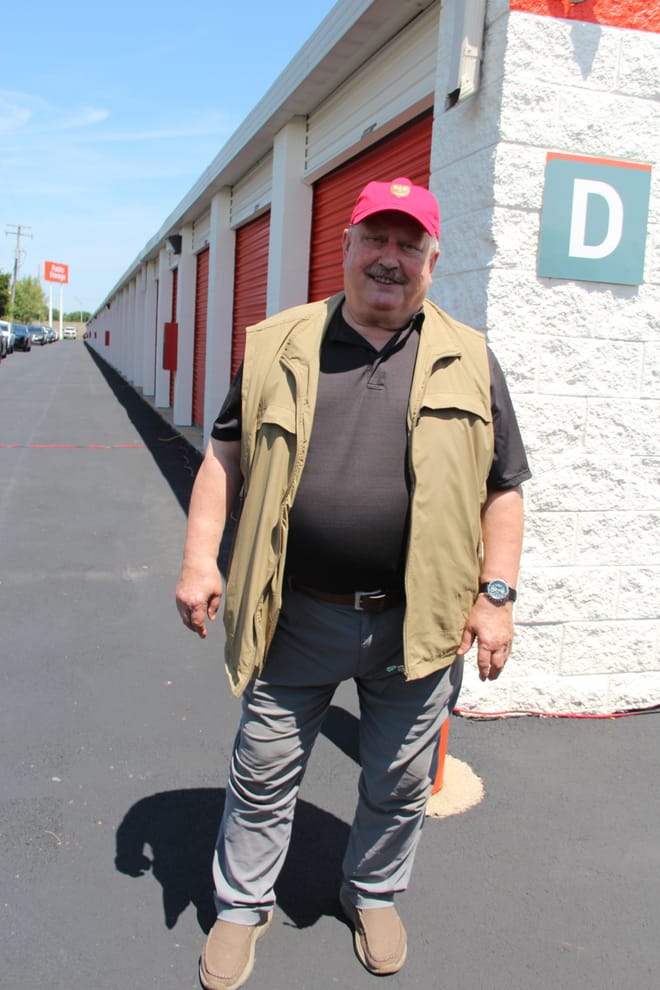
Krzysztof Wasowicz, mayor of Justice, Illinois, has some concerns about solar: that it takes up farmland and enriches China. But he’s all-in on the community solar array that was recently deployed at a Public Storage facility in his village, a suburb of Chicago.
The panels are located on otherwise unused roof space and could provide significant savings for Illinoisans who subscribe to the project, while also helping the state meet its goal of 100% clean power by 2050.
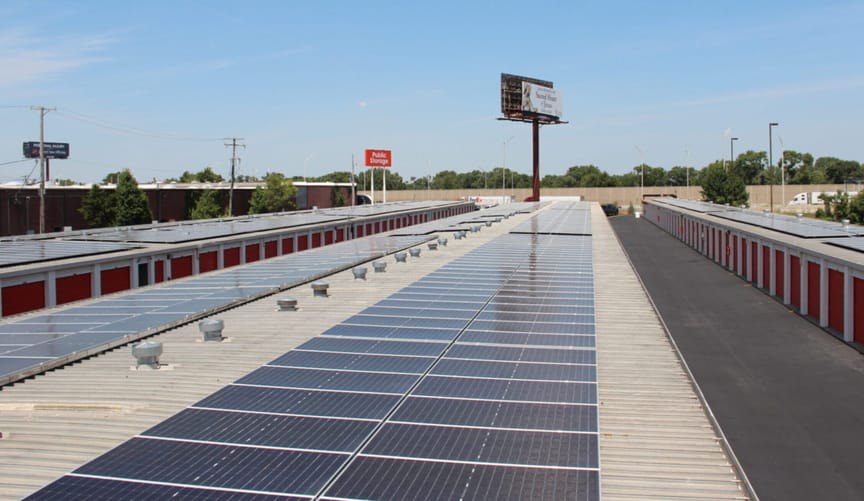
“This creates more opportunities for people, job creation, and revenue that can be taxed by our state,” said Wasowicz, who has been mayor of Justice, home to about 12,000 people, since 2007. “This is going to be an excellent addition to this village.”
The 763-kilowatt array, which went online in March, is one of 60 planned projects for the rooftops of Public Storage facilities in Illinois. Ten such projects are now online, and once completed, the portfolio will cover 5 million square feet of roof space, provide 44 megawatts of solar capacity, deliver $36 million total savings, and create 300 construction jobs, according to Solar Landscape, a leading developer of rooftop community solar sites nationwide.
Only a fraction of industrial and commercial roof space is currently used for solar, because those projects are generally more expensive to build and interconnect than ground-mounted arrays in rural areas. But thanks to new incentives, developers, utilities, and building owners nationwide are increasingly considering the possibilities.
Federal data analyzed by the solar company Lumen Energy found that commercial, industrial, and school rooftops could host enough panels to provide 581 gigawatts of power, nearly enough to meet the entire country’s energy demand. Cook County, Illinois, which includes Justice, is among the metropolitan areas with the greatest potential, that analysis found.
Mark Schottinger, president and chief legal officer of Solar Landscape, said that working with large companies like Public Storage allows his company to deploy rooftop projects quickly at multiple sites.
“The beauty of commercial-industrial real estate is the speed and scalability,” he said, noting that major logistics, storage, and big-box companies “have millions of square feet around the country.”
Community solar allows households, businesses, and organizations to reap savings and support clean energy even if they can’t have their own solar panels. By subscribing to a community solar array, customers get credit on their energy bill for a portion of the solar power generated.
Illinois is among the nation’s leaders in community solar capacity, according to the Solar Energy Industries Association, with more installed than even California. It is among the two dozen states that have laws enabling community solar, which typically leads to more arrays than in states without specific policies.
Illinois’ 2016 clean energy law created generous incentives for community solar, leading to a boom in projects of up to 2 MW each. An energy law passed last fall made the incentives available for projects of up to 10 MW.
Most of the state’s community solar has been built on rural land or industrial brownfields. About a fifth of the arrays are on rooftops, with the rest being ground-mounted. The rooftop arrays are concentrated in the Chicago area, and rooftops are an increasing priority for community solar, according to Paul Kovacs, project execution manager for distributed energy resources for utility ComEd, which serves northern Illinois.
At a July 30 event promoting the Justice project, Melissa Washington, ComEd’s senior vice president for government relations and external affairs, called rooftop community solar “an elegant solution” for deploying clean energy to meet rising demand.
She listed three mandates for the utility: supplying power to businesses and residents, keeping electricity affordable, and addressing climate change — a necessity underscored by violent storms three days earlier that had left many ComEd customers without power.
Rooftop community solar, she said, “checks the box for every single one of those three critical priorities.” The utility plans to have over 400 community solar arrays in service by the end of this year, she added. Kovacs said about 100 of those will be on rooftops.
In a typical setup, a company like Solar Landscape develops and owns the array and collects revenue from incentives and subscribers. Those subscribers get savings on their energy bills, the property owner hosting the panels gets lease payments, and the utility gets credit toward renewable energy mandates. The utility works with the developer to make any upgrades needed to connect the array to the grid, which the developer pays for so that costs are not passed on to ratepayers.
The Public Storage projects are part of Illinois’ Community-Driven Community Solar program, meant to incentivize solar arrays whose subscribers are predominantly local households and small businesses or nonprofits, as opposed to a few large subscribers hogging the savings.
Under state law, owners of community solar can sell renewable energy credits to utilities for revenue that makes the financing equation more favorable for all the partners involved. The incentives are awarded through a highly competitive process, and proposals gain points for being in designated low-income or environmental justice census tracts, having a large proportion of local subscribers, involving the community in design and planning, and hiring through the state’s workforce training programs, among other factors. The community solar credits are also worth $5 more per megawatt-hour for rooftop installations.
The Justice project earned points for making charitable contributions and for hosting a workforce training program in conjunction with the New Jersey–based training and education nonprofit STEP-UP Solar, according to Solar Landscape marketing director Samantha Kanipe.
State incentive programs are critical to facilitating community solar development since the expiration of federal tax credits under the Trump administration’s 2025 spending bill, advocates note. Meanwhile, arrays on industrial and commercial sites, like the Public Storage ones, can still qualify for federal tax credits if they are operational by the end of 2027, or if they started construction by July 4 of this year.
“We began construction on a ton of projects before July 4,” including all the Public Storage ones, said Schottinger of Solar Landscape, noting that his company can build an array like the one in Justice in about six months.
He said his company and other solar developers are still in the “early innings” of using rooftops for community solar. But, “it’s growing exponentially,” he added. “There’s a lot of blank space out there.”


.svg)
