

 Back
Back
A bipartisan group of senators has a plan to speed up energy permits to meet rising demand, but data center backlash and environmental rollbacks are sticking points.
Senators are looking toward the Capitol doors as they prepare to head home and campaign for the midterms. Meanwhile, a group of them has been scrambling to reach a deal that some analysts believe is critical to meet the country’s energy needs.
A bipartisan group of senators says it has come closer than ever before to reaching a long-desired permitting reform bill, which would make it easier to build new energy projects. Many consider the issue urgent as electricity demand surges across the country, partly because of the tech industry’s massive buildout of data centers.
“America’s energy demand is surging due to advanced technology and manufacturing, but our outdated federal permitting process remains a massive barrier to building the infrastructure we need to stay competitive,” said Marsha Blackburn, a Republican senator from Tennessee, in an August press release.
But the bill’s reception among the public is uncertain due in part to a PR problem: Data centers are a “toxic” subject for voters, according to Alex Lundry, president of D.C.-based public opinion research firm Redbud Consulting. In recent polls, Democrats, Republicans, and independents strongly oppose data centers being built in their communities.
“If you phrase permitting reform as serving data centers, the polling results get way worse,” Lundry said. This is putting legislators, many of whom are up for reelection in November, in a bind: They want to make it easier to build more electrical infrastructure, which facilitates the data center boom, but don’t want voters to think it’s about data centers.
The potential bill represents one of the few points of agreement for Republicans and Democrats in Washington, which is that energy permitting is broken.
Complicated studies on project impacts, lengthy reviews by different federal agencies, and legal battles from environmental groups and project opponents constantly delay all kinds of energy projects, industry leaders say.
Lawmakers have tried for years to reform the permitting process, most recently with the failed Energy Permitting Reform Act of 2024, which made it out of committee but never got a full Senate vote. Now, lawmakers from both parties say growing power demand has given the new attempt more momentum than any previous effort. The highest-ranking members of both parties in the Senate’s two energy-related committees are negotiating the bill’s language.
President Donald Trump has signaled he would stop blocking renewable energy projects in order to entice Democrats toward a deal on the bill. Democrats have worried that even if they make it easier to build renewables in law, the White House could continue making it impossible in practice, with some Democrats indicating that these worries have stalled the bill’s progress.
“I appreciate very much what the Trump administration has done to move in this direction, but in order to brief colleagues on what this really means, we need just a bit more clarity on exactly what return to regular order for wind and solar projects looks like,” Senator Sheldon Whitehouse, the top Democrat on the Senate Environment and Public Works Committee, told reporters this week. “So that’s still to be done, but that I think can happen in fairly short order.”
Politico reported that the senators intend to finish hammering out the bill after the midterm elections, when it could compete with other legislation for attention, especially if Republicans lose control of Congress.
The draft bill’s contents are not public, but stakeholders expect it would make building energy projects easier by reducing the potential environmental and social effects of a project that government agencies must consider when issuing a permit; loosening Clean Water Act and Endangered Species Act requirements that slow down transmission line and pipeline permits; and making successfully obtained permits less vulnerable to lawsuits after they’re issued.
Such a bill would ease the path to construction for renewable and fossil fuel projects alike — especially solar and natural gas, the power sources with the most momentum. Solar power and batteries account for almost 80 percent of the new power generation expected to be built in the United States in 2026, while natural gas was the largest single source of electricity used in 2025, with projections for continued growth. Natural gas in particular has become a go-to power source for data centers, which are projected to use a lot of it in the next decade.
Unsurprisingly, both the solar and the gas industries support permitting reform. Tim Pawlenty, president of the Solar Energy Industry Association, has said the country would be “constipated” without it.
A colossal surge in electricity demand has long been expected in the United States, even before Big Tech started its data center buildout. Americans are “electrifying” their lives with heat pumps, electrical appliances, and electric vehicles, all important for reducing emissions. The country has also squeezed most of the benefits out of energy-saving light bulbs and other fixtures, which had kept electricity use flat by reducing power needs as they spread during the 2010s. Added to all that, the United States aims to draw more manufacturing to its shores, which requires electricity if successful. But data centers are accelerating and intensifying the power-demand spike, and straining grids and supply chains. Data center developers like Google have helped lobby for permitting reform.
Environmental groups like the Natural Resources Defense Council want to speed up renewable energy development without weakening bedrock environmental laws; NRDC executives have called for land-use plans that make it easier to site renewable energy projects while protecting local ecosystems. But Democratic legislators are considering compromising on environmental protections to support renewable energy and keep grids reliable. Meanwhile, Republicans, many of whom deny the severity of climate change, want to power new economic growth.
There is another reason legislators in both parties are keen to build, build, build: Many are anxious that hobbling data centers, and the AI systems they enable, will allow China to become economically and militarily stronger than the United States. Trump administration officials, legislators from both parties, and energy industry leaders speaking at the Clean Energy Week conference in Washington, D.C., in mid-September called on America to be “competitive” and “dominant” through energy buildout.
“While Communist China cuts corners to get ahead, a mountain of red tape has America fighting the energy war with one hand tied behind our backs,” said Senator Rick Scott, a Republican, in a statement last month.
But Lundry, the pollster, warned that these sentiments are losing popularity among voters. “Being competitive with China used to be an effective message, but it isn’t anymore,” Lundry said.
Instead, Lundry recommended framing permitting reform as a boost for clean power. Lundry’s firm, Redbud, found in a September poll that 71 percent of respondents agreed that “making renewable energy a bigger part of the country’s energy supply is the right move.” Bringing down energy costs is also likely a big win with voters, the survey showed, with 70 percent of respondents saying their energy bills have gone up in the last year.
Action in the other house of Congress makes it clear that lawmakers are well aware of the public’s antipathy toward data centers and fear about rising energy costs. A few days before senators said they were nearly finished with their permitting draft, the House of Representatives passed a bill calling on states (but not requiring them) to force data centers to pay for their own electricity generation. The bill is meant to help shield regular people from rising bills as data centers gobble up power. That bill is now stalled in the Senate, where some Democrats say it’s too soft-handed.
Longtime EV pioneer James Worden turns his vision to the water, with sun-and-battery-powered vessels customizable for ferry routes, tourist cruises, and water taxis.
The TruSolar20, all straight lines and right angles, was not the sleekest vessel on the Charles River when I visited at the end of August. Once I climbed aboard with inventor James Worden and we pulled away from the Massachusetts Institute of Technology’s sailing pavilion, it quickly became clear that the boat’s shape isn’t its only distinction.

There was no exhaust pricking our lungs as we sped up, and the only noises were the breeze and the strains of the “Pirates of the Caribbean” soundtrack, a favorite of Worden’s, coming from the onboard speakers. Most notable, perhaps, was the canopy over our heads, composed of six 425-watt solar panels that provided all the power the 20-foot-long boat needed to cruise along at about five miles per hour, even on a mostly cloudy day.
In sunnier weather, the boat reaches eight miles per hour on sun power alone and can run indefinitely at that rate. If it taps into the power stored in its battery, it can get close to 14 miles per hour. After sunset, a full battery keeps the vessel moving at a slower speed all night.
“We are sure that when people experience this, they’ll be really excited about it,” Worden said, steering the boat back toward MIT, his alma mater.
He’s banking on it, in fact. The TruSolar20 is the first design by Worden’s solar boat startup, Worden Marine. The prototype, named Anita in honor of Worden’s wife and partner in innovation, who died in 2023, first hit the water in 2024. A second model, the TruSolar40, is twice as long, half again as wide, and topped with 12 solar panels. This larger version will be enclosed, unlike its younger sibling, and the ends have been made more streamlined, reducing the boxiness of the original. Both boats can be built customized for ferry routes, river tours, and other recreational or small commercial uses.
Worden is an innovator and entrepreneur with a long history in solar-powered vehicles, dating to the mid-1980s, when he won the Massachusetts state science fair by building a wood-and-cardboard solar-powered go-kart. A few years later, at MIT, he helped start the school’s Solar Electric Vehicle Team, then went on to found solar EV company Solectria with Anita. Later, the pair spun out Solectria Renewables, a company specializing in photovoltaic inverters.
The company was acquired in 2014, and Worden stayed on as co-CEO until 2017. Soon afterward, he began mulling the possibilities of sun-powered boating and started planning in earnest about four years ago, he said. His priority was always to design a zero-emissions boat from the ground up, rather than adapting existing vessels to work with solar power.
“That’s when I went down into the basement and really started sketching and researching,” he said.
Environmental impact is not an afterthought for Worden. He still drives a 1994 Solectria electric car, and Worden Marine is headquartered in a net-positive, geothermally heated renovated barn in North Andover, Massachusetts.

To maximize the emissions impact of his latest invention, however, he needs people to buy his boats. So his other major focus is building a sustainable business to get his climate-friendly technology out on the water. Worden Marine hasn’t closed any sales yet, but is talking with several possible customers, Worden said.
“It has to be a business or it’s not going to last very long,” he said. “First and foremost, it’s the experience, the technology, the environment. The business will follow.”
To keep the boats affordable, he turned to commercially available solar panels that cost about 20 cents per watt of capacity. The hull was engineered using carbon fiber and Kevlar to make sure it is both lightweight and strong. The larger TruSolar40, fully fitted out, will weigh just 9,000 pounds, so light for a vessel this size that when Worden went to buy a trailer for it, the vendor was initially confused by the number.
Buyers will be able to configure the final product to their needs. Seats can be organized to hold up to 16 passengers for ferry service. The TruSolar40 will not be the first solar-driven commercial vessel on the water — in 2018, the first Coast Guard–approved sun-powered boat started carrying passengers along the Hudson River — but they remain rarities.
Early on in the development process, Worden had the luck of meeting a retired U.S. Coast Guard captain who familiarized him with the standards a boat must comply with to be certified for commercial operations. So before the final designs were even drafted, Worden was working with the Coast Guard to ensure his vessel would meet the requirements.
Radar will be an option for navigating through misty conditions. There will be enough room to add a bar or a small bathroom, Worden said. A deck could be built off the back to allow for swimming, and there’s even enough space for a small grill.
“Our real technology is what’s above our head and under our feet,” Worden said. “You can put whatever you want in between. We’ll make it fun, too.”
Copper’s Charlie 2.0, to be manufactured by appliance giant Miele, comes with a battery that lets homes ditch the fossil fumes without an expensive electric upgrade.
On Thursday, Copper, creator of the first induction stove with a built-in battery, launched the next generation of its superefficient electric range: the Charlie 2.0.
The plug-and-play appliance is designed to make it easier to ditch fossil-fueled cooking, and the Charlie 2.0 is more powerful than its predecessor, making meals quicker to cook, according to the Berkeley, California–based startup. Each of the new version’s four burners can draw 3,000 watts, a 7% improvement, and its oven preheats to 350 degrees Fahrenheit in about four minutes — that’s more than four times quicker than many gas ovens.

Plus, the new model can be plugged into both 120-volt and 240-volt outlets, unlike classic Charlie’s 120-volt limit. The update will make Copper’s product a better fit for a wider range of homes, according to Sam Calisch, the company’s CEO and co-founder.
The 50-employee startup, which has raised $38 million to date, also announced on Thursday that global appliance maker Miele will manufacture the Charlie 2.0 at its first U.S. plant in Opelika, Alabama. The factory already churns out Miele ranges and ovens.
“We love [Miele’s] commitment to quality,” said Mitchell Heinrich, Copper’s vice president of product. The new partnership “gives us the opportunity to really learn from the best out there.”
This is the first time that Miele, established in Germany in 1899 and winner of multiple design awards, has produced another brand’s appliance, according to Copper.
“The US is a strategically important growth market for Miele,” Uwe Brunkhorst, senior vice president of business for its cooking unit, said in a statement. “Our partnership with Copper now adds new technology capabilities … creating opportunities for new products and future business areas.”
Plenty of reasons are motivating households to put fossil gas in the past. Gas stoves pollute the air with toxic carbon monoxide, nitrogen oxides, and carcinogens that harm health, especially kids’. Induction, which heats pans directly with electromagnetism rather than flames, is faster, safer to use, and easier to clean. A growing number of renowned chefs, from Samin Nosrat, author of the award-winning cookbook “Salt, Fat, Acid, Heat” to Christopher Kimball, culinary media magnate of Milk Street, are choosing induction to whip up their mouthwatering dishes.
But switching from gas to conventional electric systems can be costly. Whereas a gas stove typically hooks up to a gas line and plugs into a 120-volt outlet, an electric induction or resistance range usually plugs into a 240-volt socket, because of its higher power needs. Adding the outlet would require an electrician. An induction stove can even trigger an electrical service upgrade — a gut punch of an expense that can cost anywhere from $2,000 to $30,000.
To sidestep that electrification hurdle and help the more than 40 million households cooking with gas make the switch, startups Copper, Impulse Labs, and Electra Research have incorporated batteries into their induction stoves, which can sip power from a 120-volt outlet and provide the bursts of energy needed for cooking. While the Charlie 2.0 starts at $6,799, thousands more than a top-rated non-battery induction stove, its simpler installation can make it the cheaper option. Its 5-kilowatt-hour battery also helps in a power outage; per Copper, it’s got enough energy to scramble more than 300 eggs.
Copper says it has sold thousands of units and has partner installers in several major cities. Earlier this month, the startup launched its first retail partnership with Royal Green Appliance. And last year, New York authorities contracted Copper as part of a $32 million initiative to design, test, and install 10,000 plug-in stoves in New York City public housing, pending a successful 100-unit pilot slated to start next year.
“We’re continuing to install Charlie in homes and multifamily buildings across the country,” Calisch said. “And the new Charlie is purpose-built to meet that growing demand with more power, performance, and flexibility.”
California’s Democratic candidate for governor, Xavier Becerra, is borrowing a page from Australia with a new plan to give state residents free electricity during certain parts of the day.
Last week, Becerra unveiled a proposal to offer up to two free hours of electricity per day, starting with low-income families. He estimates it could save households about $1,000 per year.
The idea could find traction with restive voters in the Golden State. Power prices in California have risen by 46% in the last decade, the largest increase in the nation. And energy affordability has become a top issue at the ballot box nationwide.
The program, which he calls “Power Hour,” aims to help Californians soak up more of the state’s copious solar energy.
“We produce so much solar energy … that oftentimes in the afternoon we can’t make use of all of it, and so it essentially goes to waste,” Becerra said at a Politico event last week. Solar power can become so abundant that wholesale electricity prices dip into the negative, meaning that producers will pay others to take the excess off their hands. The state throws away what it can’t consume or store for later with batteries.
Becerra’s plan could send a strong market signal to consumers to take full advantage of the state’s solar riches, he explained to his California audience. “The best way to get you to readapt, to recalibrate, is to tell you the best time for you to use electricity today,” he said, giving as an example a free-power period between 1 p.m. and 3 p.m.
Some energy retailers in Australia started offering free-power plans years ago to take advantage of the solar power flooding the grid.
Thanks to a push from the Aussie federal government, now millions more can access the scheme, known as Solar Sharer. As of last month, households with smart meters in three of the country’s six states can sign up for rate plans that offer free power in the middle of the day. For example, in New South Wales and Queensland, the energy bonanza is from 11 a.m. to 2 p.m.
The no-cost energy is capped at 24 kilowatt-hours per day — enough to cover the energy needs of a household of five, according to the Australian government. Anything beyond that the utility charges for.
While free power sounds like a great deal, it’s important to note that these plans don’t automatically guarantee lower electricity bills. Outside the free-power period, utilities can set higher-than-average rates to recoup costs — sometimes, much higher.
One of the largest retail providers in Australia, AGL, which serves more than 4 million customers, has a free-power plan with a peak rate that’s almost twice what it charges under its standard plan. The federal government provides an online tool to help consumers figure out whether switching to a plan with free power will actually save them money.
People who can shift a lot of their energy demand to the free period or cache the zero-cost power for later will benefit most. The Australian government is making that easier to do by providing a 30% discount on home batteries. (The U.S. had a similar incentive, a federal tax credit, until the Republican-held Congress and President Donald Trump axed it last year.)
More than half a million home batteries have been installed under the Aussie program. And thanks to cheap, high-tech electric vehicles out of China, households increasingly have battery behemoths in their driveways. EVs now make up a quarter of new car sales on the continent.
Existing California programs could give Becerra’s plan a big boost. Qualified households could get a generous home-battery incentive of up to $1,100 per kilowatt-hour. And the state is rolling out a $3,500 EV rebate for first-time buyers.
Some experts doubt a free-power program can be as effective in California as it is shaping up to be in Australia.
“I applaud the intent here to change human behavior,” said Saul Griffith, CEO of Otherlab and founder of electrification advocacy nonprofits Rewiring America, Rewiring Australia, and Rewiring New Zealand. “But unless this [plan] really goes along with more comprehensive electricity market and pricing reform, it may not mean that much.”
Electricity could be far more affordable if Americans unleashed clean, cheap, distributed power, Griffith contends. But to do that, “you have to break the single-utility monopoly model,” he said.
Severin Borenstein, faculty director of the Energy Institute at the University of California, Berkeley’s Haas School of Business, also had a mixed reaction to Becerra’s plan.
“I do think this would be a step in the right direction, making electricity prices more accurately convey the cost of supplying the electricity in a given hour,” Borenstein said in an email. “But it would require making up the revenue shortfall somehow, which I fear would be done by raising prices in other hours.”
The vast majority of what utilities charge customers for is not the electricity itself but fixed system costs, according to Borenstein. “Those costs would still need to be covered,” he noted.
If elected, Becerra can’t implement his plan by fiat. He said he would work with the public utility commission, utilities, and other stakeholders to realize his plan within his first year in office.
Despite the uncertainties, Michael Rochmes, policy and advocacy manager at the nonprofit U.S. Green Building Council California, is excited to see Becerra’s Power Hour take shape.
The prevailing narrative has been that electricity is expensive, and costs are ballooning faster than inflation, he said. But that story leaves out how renewables and battery storage can deliver “long-term energy abundance,” Rochmes noted. “If this idea can break through and get people who aren’t in the energy space to start to understand the benefits of electrification, load shifting, battery storage, and renewable energy, I think this is a huge win.”
A U.S. appeals court upheld the first-in-the-nation measure, which will slash smog-forming emissions from certain gas-fueled boilers and heaters in the region.
Southern California’s landmark rule to slash emissions from industrial heating sources just notched a major victory in court.
The region has some of the worst air quality in the U.S., and the gas-fueled boilers and water heaters that serve its factories and large buildings are a key culprit.
In 2024, air quality regulators passed a first-in-the-nation rule to clean up those dirty sources. Since then, opponents of the measure — including gas-appliance makers and trade groups for pipefitters and building contractors — have tried repeatedly to quash it. But last week, the U.S. Ninth Circuit Court of Appeals upheld the regulation, which is meant to spur a shift toward clean, electrified technologies.
The standard, which took effect in January despite the legal challenge, gradually eliminates emissions of nitrogen oxides (NOx) from more than 1 million gas appliances across Greater Los Angeles.
“It was a big win for folks who breathe air in Southern California,” Candice Youngblood, a senior attorney for Earthjustice, which intervened to defend the rule in court, said by phone. “The court fully understood how important this rule is to saving lives.”
The South Coast Air Quality Management District set limits on NOx emissions for light-industrial and commercial boilers, steam generators, and process heaters, as well as residential pool heaters and tankless water heaters. The rules currently affect small units installed in new buildings, but they’ll broaden in scope until covering new high-temperature units installed in existing buildings in 2033. Existing gas equipment must be replaced with zero-emission units once it reaches a certain age, or at the end of its useful life, depending on the appliance.
A spokesperson for the South Coast air district stressed that the rule does not ban gas appliances but rather regulates emissions. The agency said it “remains committed to developing technology-neutral solutions that protect public health, reduce harmful nitrogen oxide (NOx) emissions, and move the region closer to meeting federal air quality standards.”
The measure is ultimately expected to reduce pollution by 5.6 tons of NOx per day — the same as halving smog-forming emissions from cars in the air district, where more than 17 million people live.

Yet the policy is likely to make an impact well beyond the four-county region. Proponents say a major goal of setting the zero-emission standard is to signal to heat pump manufacturers and other clean technology suppliers to start ramping up production — which could benefit industrial electrification efforts elsewhere by driving down appliance costs.
The Ninth Circuit’s ruling comes as California is pushing to decarbonize all corners of its $4.3 trillion economy. Manufacturing facilities are responsible for more than one-fifth of annual greenhouse gas emissions in the state, making them the largest source after transportation.
Last year, Democratic Gov. Gavin Newsom signed a law, Assembly Bill 1280, that expands incentive programs to help manufacturers install industrial heat pumps, thermal storage systems, and other electrified equipment. Utilities and state lawmakers are also developing new electricity rate structures that would lower the cost of operating electric appliances.
Such efforts are meant to address the financial challenges that can come with switching to electric appliances in industrial settings. Cleaner alternatives, such as heat pumps and electric boilers, are typically more expensive up front. Electricity is often far more expensive as a fuel than natural gas, especially for large industrial users — an issue that’s true in California as well in other parts of the country, including the Upper Midwest and Northeast.
If policies can help overcome those hurdles, industrial firms stand to reap significant economic benefits by reducing their exposure to volatile fossil fuel prices, making their operations more efficient, and lowering their energy bills over time. All told, electrifying the entire U.S. industrial sector could generate around $471 billion in total economic growth through 2035, according to a recent analysis by the Renewable Thermal Collaborative and the Industrial Heat Pump Alliance.
California is well positioned to capture some of those benefits, given its existing climate policies and high levels of industrial activity. The state could see over $31 billion from the construction, installation, and manufacturing of electrified technologies, as well as indirect effects from growing supply chains, the report said. That’s even accounting for the expected decline in economic activity and job losses from gas-equipment makers and service providers.
The gas industry, however, sees the Golden State’s electrification push as a threat.
Last year, Southern California Gas, the nation’s largest gas-distribution utility, helped sink the air district’s separate plan to push households away from gas-burning space and water heaters and toward electric heat pumps. Rinnai America, which manufactures gas appliances, has led the legal fight against the zero-emission standards for boilers and water heaters.
In July 2025, a U.S. district court upheld the clean boiler rules, rejecting opponents’ argument that the measure conflicts with the federal Energy Policy and Conservation Act and thus isn’t valid. Rinnai and other plaintiffs have continued to fight the policy, resulting in the Ninth Circuit’s July 2 decision to affirm the district court’s earlier ruling.
The opposition will still have a chance to challenge the policy again, by asking the Ninth Circuit to review its ruling, Youngblood said. In the meantime, Southern California regulators are preparing to propose a new set of rules for larger commercial and industrial systems in the region, which the agency staff aims to present to its board by the end of this year.
Startup Electra is outfitting induction stoves with slender batteries that enable the electric appliances to be plugged into a standard outlet — and help the grid.
BROOKLYN, N.Y. — When the startup Electra Research launched four years ago, its founders set out to hook more batteries up to the electric grid. Energy storage is key to balancing the coming and going of wind and solar power, and it can help reduce strain on the electricity system during the busiest hours.
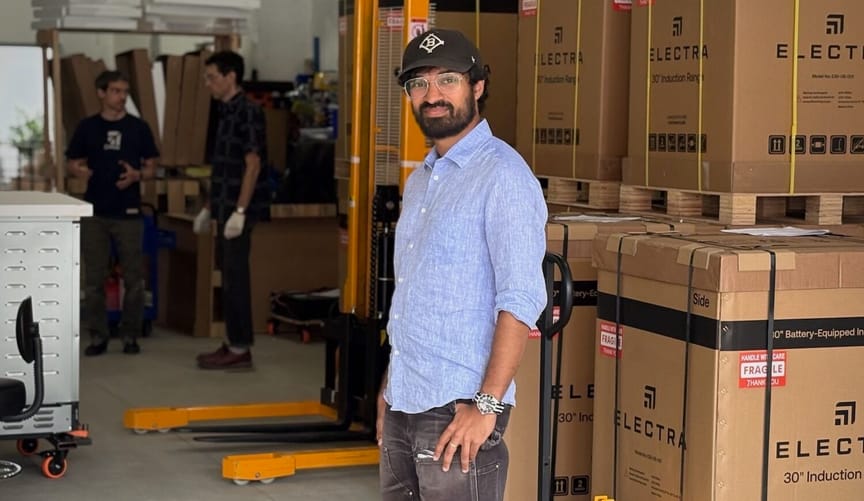
But with the line to plug into the grid being very, very long, Electra opted for a faster route: It would put batteries directly in people’s homes, only with a twist. Instead of installing whole-home backup storage, the firm would pair smaller batteries with energy-intensive appliances. The goal was to help people clean up their homes, reduce energy use — and add some useful capacity to the broader electricity system.
“It became clear that the straightforward thing to do is to colocate a battery with the biggest loads in the house, which are water heating, refrigeration, HVAC, and cooking,” Bert Muthalaly, Electra’s CEO, told me from the startup’s new warehouse in Brooklyn.
“And when you look at it that way, there is one that people care about,” he said. “People love their stoves.”
Today, Electra makes battery-powered induction stoves, which it began shipping to U.S. customers in April. The startup recently gave me a first look at its operation on the edge of Brooklyn’s Bushwick neighborhood, where the glass-fronted warehouse sits somewhere between a pickle-packing plant and a kitchen-supply distributor.
When I visited on a cloudy day in late June, Alexia Avina was rewiring a 305-pound appliance to connect a slender battery pack, which replaces the drawer that holds broiler trays and pans. Electra does the metalwork for its stoves in China and final assembly at the Brooklyn facility, turning them into energy-storing, Wi-Fi-enabled devices — ones that won’t fill your kitchen with harmful pollution by burning natural gas.
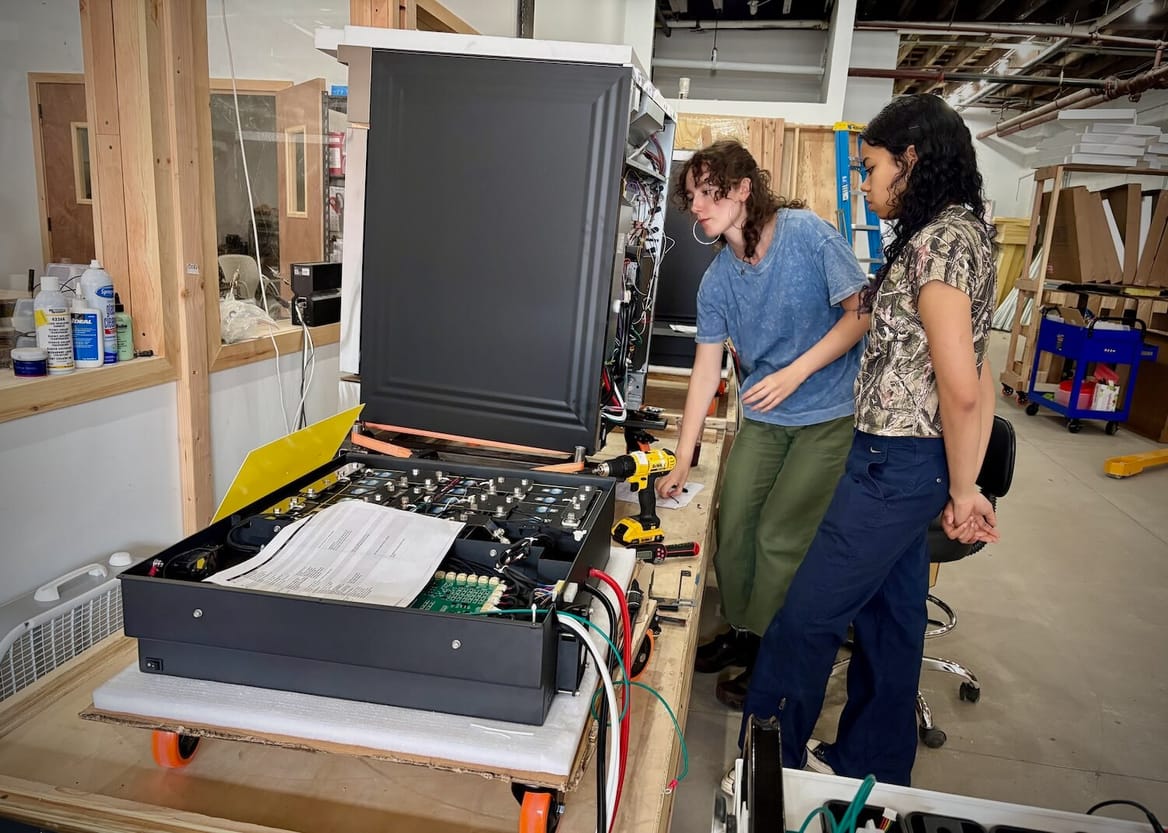
Avina joined the team in May, having mainly worked in restaurants and as a musician before training with Electra’s engineers to outfit the stoves. “It’s been cool to learn something totally different,” she said later while standing next to stacks of stoves packed in cardboard boxes. “It’s rare to have hands-on opportunities like this.”
Unlike many induction stoves on the market, Electra’s model can plug into a standard 120-volt outlet and draw power to charge a 5-kilowatt-hour battery. The induction cooktop heats pans directly using electromagnetism, while the oven cooks food using electric-resistance elements.
Customers can choose to turn their batteries into helpful grid tools. With its software partners, Electra directs the batteries to charge up during the most beneficial times — for example, when solar power production is most abundant — and to discharge power during the grid’s peak demand periods. Electra estimates its appliance uses roughly 80% less peak power than a typical electric-resistance stove.
The company now employs nearly two dozen people, eight of whom work on the Brooklyn production line. It’s self-funded but declined to share financial details.
Electra’s appliances are hitting the market at a time when induction cooking is becoming increasingly popular in American kitchens. The technology cooks faster and more efficiently than gas and traditional electric appliances, and, unlike gas stoves, it doesn’t release pollutants that can harm people’s health. Although federal rebates for electrification expired early under the Trump administration, some states and utilities still offer incentives to help defray the upfront cost of going electric.
Electra’s induction stove costs $3,999. That’s more than triple the price of Wirecutter’s highest-rated electric range — although because that model uses 240 volts, it might require upgrading a home’s electrical panel, rewiring the kitchen, or hiring electricians to hook it up. All that can add thousands of dollars to the final bill. Electra says its unit avoids those added costs and, thanks to its battery, can even operate for several meals in a blackout.
The plug-in-ready approach is similar to that of Copper and Impulse Labs, two leading companies in the niche but growing category of battery-powered induction ranges (who, as it happens, are suing each other). California-based Copper has sold over 1,000 units, and it was awarded $32 million last year to design, test, and install 10,000 of its stoves in New York City public housing facilities. Electra says it designed its own model for that same competition.
The startup began receiving stoves from China around three months ago. Electra has since shipped 75 of its appliances from Brooklyn to customers across the United States, and it plans to send out thousands more by the end of this year. Early data show that people who cook frequently are still using only about a fifth of the battery’s power per day, which bodes well for the lithium iron phosphate device’s longevity, Muthalaly said.
The company is also developing a pilot program with the city of Burbank, California, to help residents electrify their kitchens. And it’s partnering with a property owner closer to home, in the Bronx, to equip an 80-unit apartment building with its stoves. In both California and New York, local building codes are effectively pushing natural gas appliances out of new buildings in order to reduce carbon emissions and improve air quality, raising the incentive for households to explore options like Electra’s.

Muthalaly described Electra as a “climate research lab,” and the company continues to refine and develop its stove technology. Greg Shakar, an electrical engineer on staff, was testing a unit for electromagnetic “noise,” or unwanted radio interference, when I walked through the side of the warehouse dedicated to R&D.
But as orders pick up, Muthalaly said the company is constantly evaluating which parts of the assembly process should remain in-house or should move overseas for higher-volume, lower-cost manufacturing.
“We’re thinking about this as an experiment,” Muthalaly said of the Brooklyn operation. “We’re going slow, but we’re learning from each install. And it’s getting smoother and smoother.”
A correction was made on July 6, 2026: This story originally stated that the battery sits beneath the drawer that holds broiler trays and pans, when in fact it replaces the drawer.
New York City’s green building laws are pushing developers toward cleaner technologies — even as state policymakers backtrack on climate change targets.
NEW YORK CITY — Manhattan is teeming with skyscrapers that seem to reach into the clouds. But a gleaming commercial building near the Hudson River is more impressive for how it stretches down into the dirt.
Beneath the floors of 555 Greenwich St. are 68 geothermal energy piles that run nearly 120 feet deep, dodging utility pipes and tunnels that crisscross the busy urban underground. During the sweltering summer, the long vertical piles collect heat from the 16-story building and dump it into the earth, cooling the offices above. In the chillier months, the equipment retrieves that warmth to keep the rooms cozy.
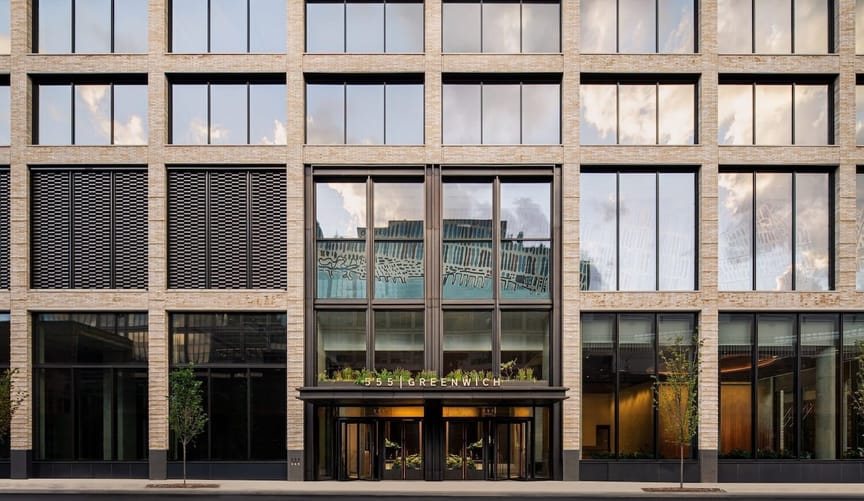
The geothermal system is a key reason why 555 Greenwich can operate without using fossil fuels, making it the city’s first commercial office building to hit that milestone. That’s according to the owner, Hudson Square Properties, which is a joint venture of the real estate company Hines, Trinity Church NYC, and the investment arm of Norway’s sovereign wealth fund.
The building, which finished construction in 2023, should be able to meet half of its heating and cooling needs from geothermal when fully occupied, said Jason Alderman, senior managing director and head of New York at Hines. The other half will be met primarily by the two enormous air-source heat pumps sitting on the rooftop, which overlooks the city’s most iconic towers and the green edges of Central Park.
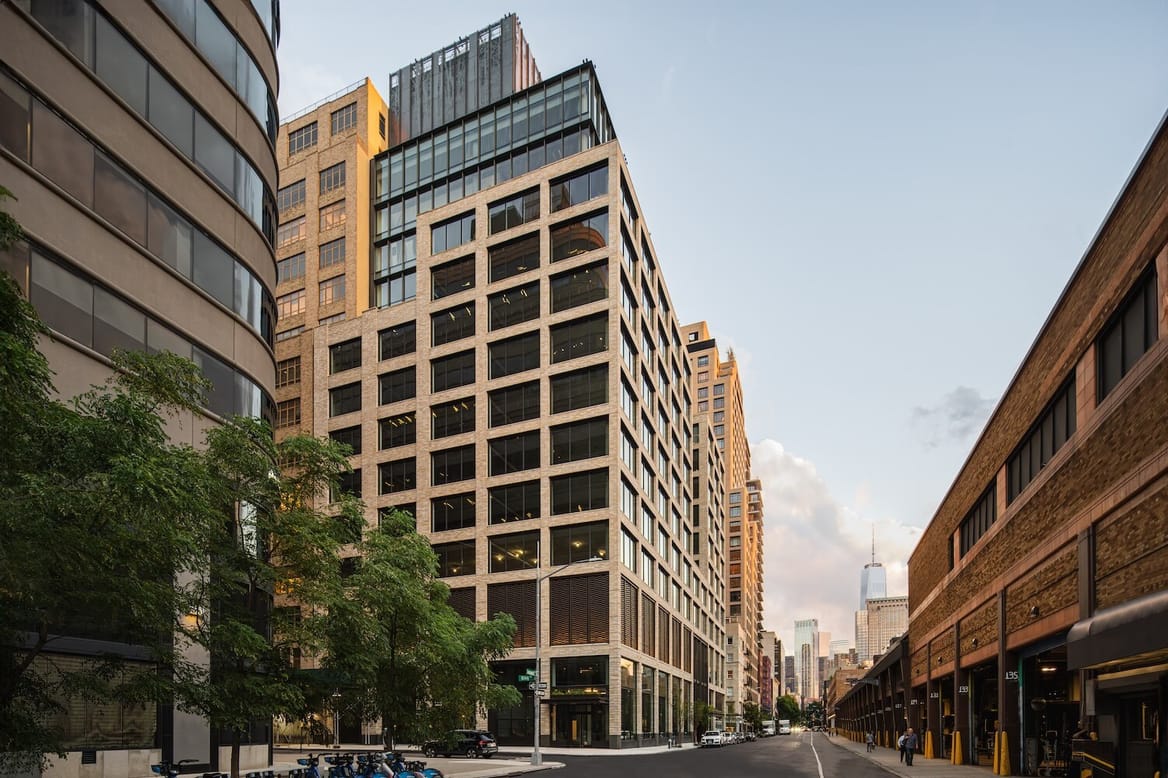
When I visited the 270,000-square-foot property in early June, Alderman explained that the fossil fuel–free building is a reflection of both New York City’s aggressive climate change policies and the partners’ own ambitions for a highly efficient, carbon-cutting design.
“We wanted to think outside of the box and help set the standard for what others can do,” he said.
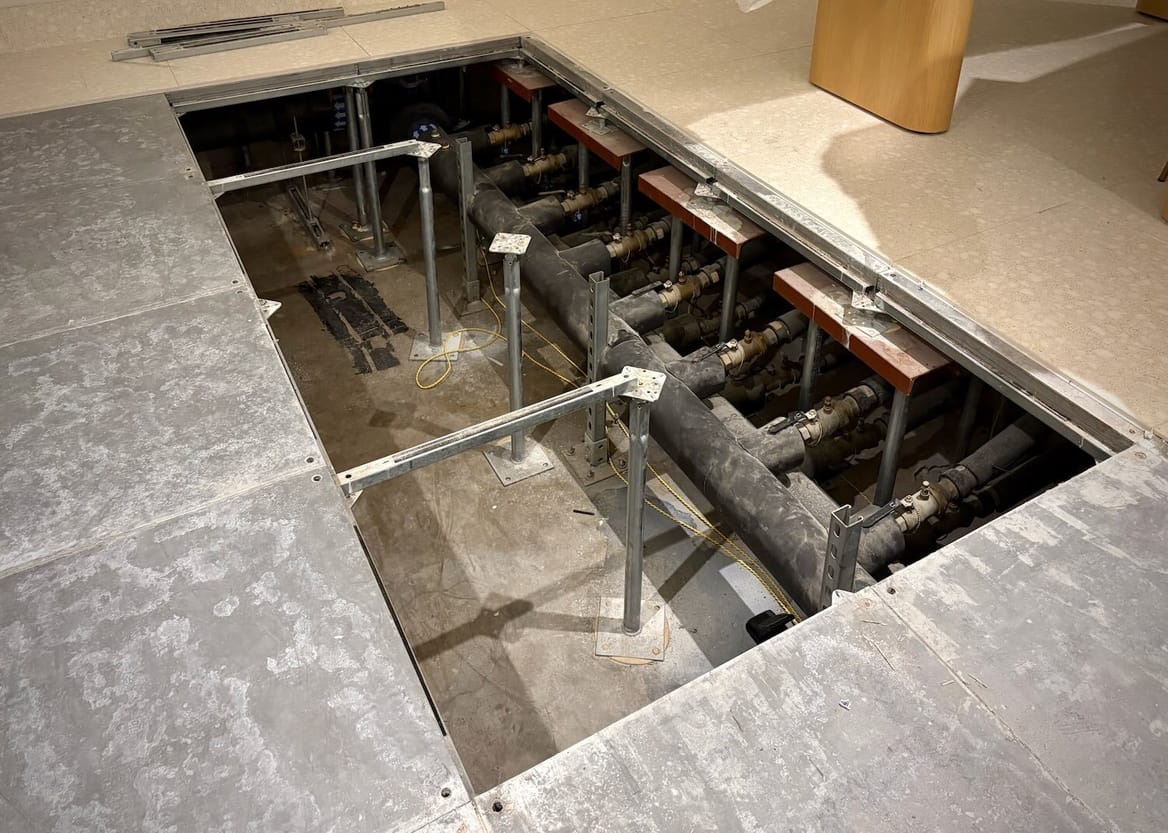
We were standing beside the only visible part of the geothermal system: an array of small, dusty pipes peeking out from the partially finished floor of a forthcoming restaurant. In a nearby utility room, I saw control boxes managed by the company Endurant Energy, which monitors temperatures in the underground geothermal piles to determine whether it’s more efficient for the building to grab heat from the earth or run the heat pumps on the roof.
On days when the geothermal setup can produce more energy than needed, it pipes the excess heat directly into its sister property, a nearly century-old Art Deco edifice on 345 Hudson St. The developers recently renovated the older building and combined it with 555 Greenwich to make a single 1.2-million-square-foot office complex in lower Manhattan.
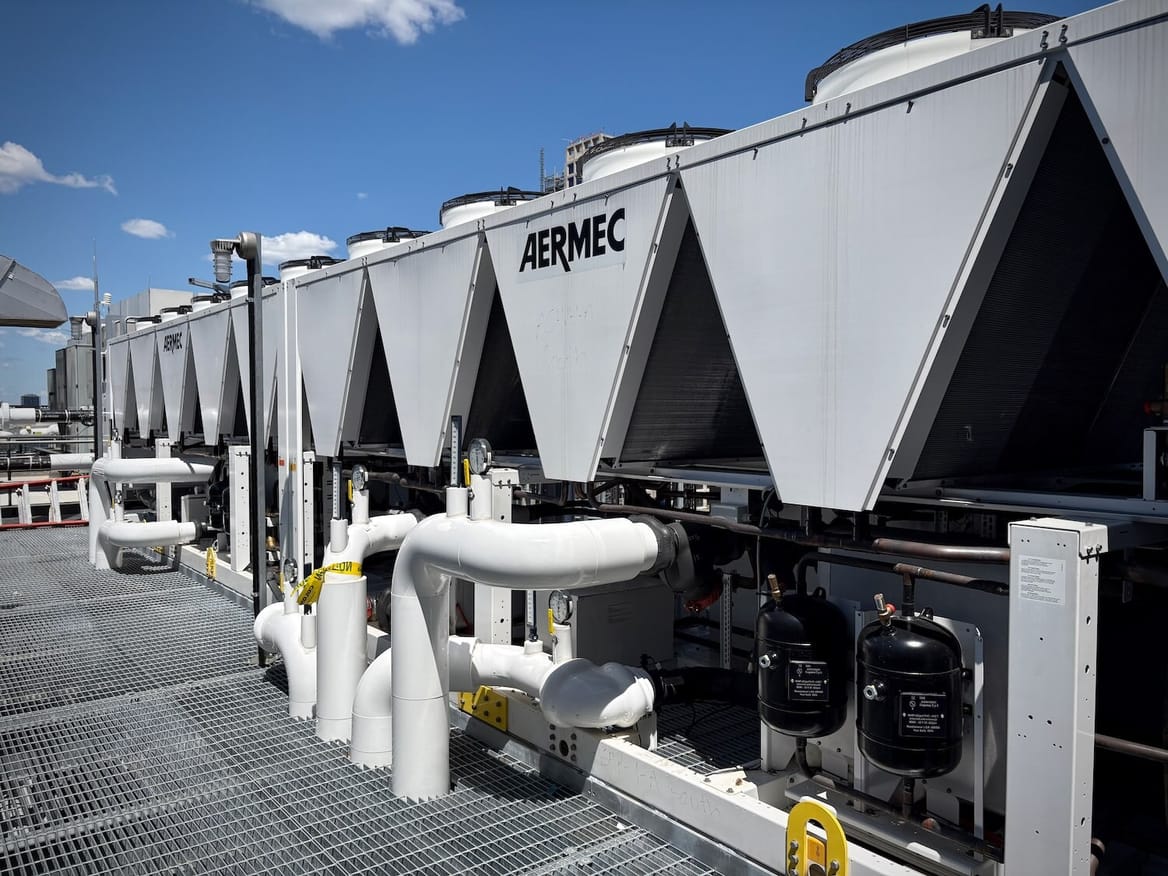
The newer property uses 40% less energy than typical top-quality office buildings and well exceeds New York City’s 2030 climate targets, according to its owners. The older property, which is still transitioning to an all-electric energy system, is on track to reduce its carbon emissions by 90% within the next decade.
Geothermal heating and cooling systems are steadily proliferating beneath the city’s newest buildings, despite the complex engineering challenges and expensive installation costs. Property owners are looking to not just comply with regulations but also to generate long-term energy savings by avoiding natural gas.
Buildings account for more than two-thirds of New York City’s greenhouse gas emissions. Since 2019, city leaders have adopted laws to rein in that planet-warming pollution.
Local Law 154 prohibits the use of fossil fuels in most new construction and will start applying to high-rise buildings in 2027. Local Law 97 requires most buildings over 25,000 square feet, whether new or old, to meet escalating energy-efficiency and emissions standards, with stricter limits set to take effect in 2030.
The city’s deadlines are approaching at a time when New York state is abandoning its most ambitious climate targets. In late May, Gov. Kathy Hochul, a Democrat, signed a budget bill that effectively vaporizes a 2030 mandate to curb statewide emissions by 40% from 1990 levels, replacing the target with a watered-down goal that critics fear will slow the state’s buildout of clean energy technologies.
The rollback at the state level is causing some doubt within the city’s real estate sector about whether the building-decarbonization timelines are really as firm as they seem, experts say.
“When there’s a lack of clarity, it makes it a challenge for building owners to pull the trigger” on efficiency and electrification projects, said Laura Bendayan, director of strategic partnerships at Entech. The NYC-based firm helps buildings optimize their existing boiler systems to reduce energy bills and lower emissions.
“We always recommend that [owners] be ahead of the game,” she added. “But there’s this sense of uncertainty that you can’t take away.”
Hudson Square Properties, for its part, says it’s pushing ahead with its no-fossil-fuels approach in both of its buildings.
During my visit, Alderman led me to the top of the newer building, showing me the controls for the radiant heating and cooling system, which circulates chilled or warm water through tubing beneath every floor. This technology provides a “baseline comfort level” and supplements the larger geothermal system, he said. Vents above our heads draw fresh outdoor air into the building, a step that helps lower the structure’s overall energy use by taking strain off the HVAC equipment.
From there, we walked through a heavy set of doors leading into the old building. The highest of 345 Hudson’s 17 floors is a cavernous empty room that originally housed massive printing presses, whose humming sounds and ink smells filled the neighborhood until the 1980s.
The developers are working floor by floor to phase out the existing gas-fueled heaters and boilers and replace them with a kind of thermal energy network. A labyrinth of pipes circulates water throughout the building; heat pumps can then tap into or reject heat from this system to keep occupants comfortable.
“You’re trying to reuse all of the energy that you’ve brought into the building, in the different places where it’s needed,” Alderman said. It’s the complete opposite of New York City’s district steam system, which gets rid of excess heat by piping clouds of vapor out onto the streets.

The 345 Hudson retrofit won a $5 million grant from the New York State Energy Research and Development Authority, as part of the Empire Building Challenge, which advances low-carbon retrofits in the state’s tallest buildings. The developers also raised more than $30 million in private funding for the project.
New York state’s retrenchment from ambitious climate policies might wind up undermining some of those efforts. As buildings shift toward using all-electric technologies, the level of emissions reductions they achieve will largely depend on how clean the electric grid is, said Kelly Dougherty, president of FirstService Energy, a New York–based firm that helps manage energy systems for residential buildings.
“If it’s rolled back any further, then we may have some issues,” Dougherty said about New York state’s landmark climate law. Still, “a lot of work has been done on reducing greenhouse gas emissions in the city,” she added. “I don’t think it’s going to go away.”
At the end of our tour, standing on an enviable rooftop patio, Alderman said he’ll be watching to see how the two buildings perform as they fill up with tenants and operate over time. As of now, his firm estimates that 555 Greenwich alone should save around $3 million over 15 years in avoided energy bills.
“I hope we can prove to ourselves and to others some of the long-term operating-cost savings — and that people will look to these as examples of what can be accomplished,” he said.
The Trump admin’s new rules block Americans from accessing rebates for electric heat pumps if they previously had oil, natural gas, or propane systems.
This article originally appeared on Inside Climate News, a nonprofit, nonpartisan news organization that covers climate, energy, and the environment. Sign up for their newsletter.
Federal energy efficiency rebate programs will no longer cover a switch from fossil fuels to electricity for heating, according to long-awaited guidance from the Department of Energy.
The department published an update on how it will implement consumer programs with $8.8 billion in funding. The new provisions include eliminating use of diversity, equity, and inclusion considerations, among other changes.
This follows legal challenges after President Donald Trump issued an executive order last year, upon returning to office, canceling the release of funds from President Joe Biden’s Inflation Reduction Act, including rebates for home energy efficiency. A coalition of states successfully sued to restore the funding, obtaining an injunction in March 2025.
States have been waiting for the Department of Energy to reopen funding, a process that begins with this latest publication.
Clean energy and environmental advocates said the guidance was overdue and severely flawed.
Tony Sirna, deputy policy director for Evergreen Action, said it’s “flatly illegal” to eliminate funding for electrification through an agency’s guidance rather than passing a new law. “This is a deliberate effort to deny relief to millions of families at the exact moment they need it the most,” he said in a statement.
The guidance, dated May 29 and announced in a news release on June 1, covers the $4.3 billion Home Owner Managing Energy Savings, or HOMES, program and the $4.5 billion High-Efficiency Electric Home Rebate, or HEEHR, program, with additional guidance for Indian tribes participating in HEEHR.
The HOMES program provides up to $8,000 for households to make energy-efficient upgrades, including insulation, air sealing, heating and cooling equipment, water heaters, duct sealing, appliances, and lighting, according to the Department of Energy. The upgrades must reduce energy use by at least 20 percent to be eligible.
The HEEHR program provides up to $14,000 in rebates per household, which retailers and contractors can offer at the point of sale, and can be used for qualifying efficient electric equipment and appliances.
Congress and the Biden administration designed the programs to ensure that low-income and other disadvantaged households received a significant share of the benefits. The new guidance is changing this focus, citing the Trump administration’s opposition to considering diversity, equity, and inclusion in federal spending and the elimination of Biden’s Justice40 environmental justice initiative.
The guidance also eliminates the programs’ support for shifting from oil, gas, or other fossil fuels to electricity for home heating. Now, households can only get funding for heat pumps for new construction or if they already have electric heat, as opposed to the previous rules that encouraged people to switch away from fossil fuels.
Another change is that the Department of Energy now requires households to upgrade their insulation and air sealing before using rebates for new appliances.
Reaction was mostly negative from groups that push for improvements in energy efficiency.
“It’s a very standard playbook to incentivize fossil fuel companies and provide a lifeline to them,” said Srinidhi Sampath Kumar, director of the Sierra Club’s clean heat campaign, about the limits on fuel switching. “It’s absolutely been done in bad faith.”
Mark Kresowik, senior policy director for the American Council for an Energy-Efficient Economy, said in a statement that the programs “will help families make energy-saving improvements that lower their utility bills,” but he lamented the new limits on the programs.
The guidance is “a fundamental departure” from the intent of the programs, said Sam Friesen, managing director for buildings at Fresh Energy, a Minnesota-based environmental advocacy group. He added that the changes will muddy the waters for consumers who were making plans under the old rules and now need to follow the new ones.
Robin Yochum, buildings program director for the Southwest Energy Efficiency Project, a regional nonprofit based in Colorado, said she is pleased to see this step to implement the programs but is concerned about limits on fuel shifting.
“While there are certainly many electrically heated homes that deserve efficiency upgrades, helping households transition from propane, fuel oil, and natural gas to highly efficient electric technologies was one of the most transformative aspects of the original program design,” she said in an email.
Asked for a response, a Department of Energy spokesperson had this comment: “The Department of Energy has released common-sense revisions to program guidance to align requirements more closely with statutory requirements, advance affordability, ensure good stewardship of taxpayer dollars, and empower grantees to tailor their programs to local contexts and residents’ needs.”
State programs administer the money but the federal government must approve the state plans before the funds are released. Most states plus the District of Columbia have had at least some of their plans approved, as shown in a May 18 update from Atlas Public Policy.
Some already paid rebates based on the initial rules under the Biden administration. Those states now have three months to modify their programs to comply with the new guidance going forward.
South Dakota has declined to participate, and Idaho’s legislature has taken action to stop participating.
Consumers can contact their state energy offices to get more information about program availability.
The region is finalizing its first-in-the-nation rule to limit the sale of polluting gas water heaters, which will take effect next year.
In 2023, the San Francisco Bay Area’s air district passed first-in-the-nation rules setting zero-emissions limits on home heating systems and water heaters. Now, the agency is working to address affordability concerns ahead of the water-heater rule’s finalization this year — and defuse calls from some regulators to scrap the policy altogether.
In their current form, the regulations would effectively prohibit the sale of gas appliances, beginning with water heaters in 2027 and then furnaces in 2029. Gas appliances spew noxious compounds, including nitrogen oxides (NOx) that contribute to the region’s smog. Pollution from furnaces and water heaters leads to as many as 85 early deaths in the community each year, the air district estimates. Those deaths, combined with illnesses and hospital visits, take a financial toll of up to $890 million annually.
But clean alternatives — zero-emissions heat pumps and heat-pump water heaters — are typically more expensive up front, even if they can save thousands of dollars on energy bills over time. From the beginning, Bay Area regulators, the majority of whom are elected city and county officials, vowed to institute the groundbreaking requirements with care.
The air district is now hammering out the details for implementing the water-heater rule, including a plan to offer one-time exemptions to low-income households and those with space and electrical constraints. Staff members, who are separate from the voting board and developed the proposal, estimate that the exemptions could apply to 38% of water-heater installations. They’ve also proposed delaying implementation by nine months, from January 2027 to October 2027, to set up the exemption system.
Several members of the agency’s board are seeking more drastic changes.
Eight of the 18 board directors in attendance at the body’s May 13 meeting expressed a desire to further delay the policy’s implementation date — or roll it back and make adoption of electric equipment voluntary instead. The board has a total of 24 directors.
“I just think it’s the wrong time to do this. … What’s the top-of-mind issue right now? It’s affordability,” said Alameda County Supervisor David Haubert, a board member in favor of loosening the rules. “It’s affordability of food, it’s affordability of electricity, it’s affordability of gas.”
Bay Area regulators have tightened NOx-emissions standards for water and space heaters for over 30 years. The municipalities of Berkeley, Emeryville, Los Altos Hills, Oakland, and San Francisco have passed local resolutions in favor of the latest appliance rules.
A majority of the board voiced their continued support for the water-heater standard, given gas-fired equipment’s insidious threats to public health.
“When we talk about affordability, let’s talk about the affordability of asthma,” said chair Lynda Hopkins, supervisor of Sonoma County, who supports the standards with the exemptions.
“Let’s talk about the affordability of premature death and heart disease, missed work, missed sports practices, missed school … [which also has] social and emotional costs,” she noted. “We have communities who are essentially living with generational trauma because they experience disproportionate health impacts.”
The board is expected to vote on the finalized rule language this October.
Its decision could inform state-level regulations taking shape in California and Maryland. Both are actively considering clean-heater rules, while eight other states have committed to exploring zero-emissions standards in the future: Connecticut, Hawaii, Massachusetts, New York, Oregon, Pennsylvania, Rhode Island, and Washington. Last year, after a flood of opposition speculated to be fake, Southern California’s air district decided to hold off on adopting similar zero-emissions appliance rules of its own.
“The Bay Area will set an example for other air districts,” said Joseph Wachunas, senior project manager at decarbonization nonprofit New Buildings Institute.

According to the district’s analysis, heat-pump water heater installation costs $7,000 on average, or twice as much as putting in gas equipment. Local and state incentives are available to help close the $3,500 gap — or, in some cases, install zero-emissions water heaters for free.
For a substantial minority of households, switching to a heat-pump water heater could still be cost-prohibitive for myriad reasons. These appliances are typically larger than gas options and may not fit in tight spaces. Because heat-pump devices harvest thermal energy from the air, they typically need at least 700 cubic feet, which not all properties are ready to accommodate. And while evidence suggests that most households can electrify on 100 amps, a fraction might need an electrical service upgrade that could add $2,000 to $30,000 to the installation cost.
When these circumstances make heat-pump water heaters unaffordable, the air district’s staff members have proposed making exceptions.
“If you have to move a wall, you’re going to be able to get that exemption. If you have to upgrade your panel, you’re going to get that exemption,” said Greg Nudd, deputy executive officer of policy at the district. After installing a gas water heater, “you would have the lifetime of that piece of equipment to address those problems.”
The tech is also becoming more accessible. “When we started this process several years ago, there were no 120-volt heat-pump water heaters,” said board director John Gioia, supervisor of Contra Costa County. “There are now two on the market” that plug into standard outlets.
Clean air advocates called the exemption approach reasonable.
“The Bay Area Air District has done a good job at addressing the real-world concerns that people have brought up,” said Tony Sirna, deputy policy director for buildings at climate advocacy group Evergreen Action. “We want to reduce pollution, but we know that that’s not going to be successful if the rule doesn’t work for the people of the Bay Area.”
More than 60% of homes in the region will still be required to adhere to the standard, “which will drastically reduce pollution and put us on track to transitioning to clean air and clean energy,” Sirna said.
Even though some regulators would suspend the appliance rules outright, Sirna said he’s confident that the majority will carry the water-heater standard across the finish line this fall. “The flexibility exemptions that are being proposed,” he noted, “really address all the concerns that were being raised.”
Policies to transition buildings off polluting fossil gas are holding up in federal courts across the U.S. That’s a big win for local governments looking to spur electrification, given that these types of regulations suffered a major setback just a few years ago.
In 2023, the 9th U.S. Circuit Court of Appeals struck down Berkeley, California’s pioneering ban on gas hookups in new buildings. A panel of three federal judges sided with the California Restaurant Association in its assertion that the ordinance conflicted with the federal Energy Policy and Conservation Act, a 1975 law that prevents cities and states from setting appliance efficiency standards that differ from those of the U.S. government.
Even at the time, the decision was controversial. Eleven other 9th Circuit judges signed on to a dissenting opinion — an unusual move — to inoculate judges of future suits against, in their view, the case’s flawed reasoning.
Indeed, building developers, appliance manufacturers, and others pushing for fossil fuels — including the Trump administration — have since used the same legal argument in 13 other lawsuits against cities, counties, states, and an air district. These cases — in California, Colorado, Illinois, Maryland, New Jersey, New York, Washington state, and Washington, D.C. — challenge local rules that require all-electric new buildings, mandate existing structures to taper energy consumption or emissions over time, or set zero-emissions appliance standards in an effort to reduce air pollution.
“Industry has really gone on a spree,” said Daniel Carpenter-Gold, senior staff attorney for climate justice at the Public Health Law Center, a nonprofit affiliate of the Mitchell Hamline School of Law in St. Paul, Minnesota. Most of the suits, he noted, are being argued by one of two law firms: Reichman Jorgensen Lehman & Feldberg, which spearheaded the Berkeley case, or Baker Botts. “A lot of the language is verbatim from one case to the next.”
In all six post-Berkeley cases for which federal judges have weighed the EPCA argument, they’ve rejected it and upheld pro-electrification standards.
“There is a clear consensus among the courts that have ruled on the issue that the 9th Circuit’s decision in [Califo

Last month, U.S. district court judges handed down victories to local jurisdictions in three cases — two in Maryland and one in Washington, D.C.
The rulings “have sent a clear message: states and local governments can be confident to move forward with the range of decarbonization and electrification programs,” Tim Oberleiton, senior attorney for the nonprofit environmental law group Earthjustice, said in a statement.
These policies are crucial to curb carbon pollution from buildings, which accounts for about one-third of U.S. emissions, especially as the Trump administration works to prop up fossil fuels. Efficient electric appliances also improve local air quality, can provide greater comfort, and typically lower energy bills.
In the Berkeley case, the legal question centered on whether the city, by prohibiting gas infrastructure, can essentially dial down gas appliances’ energy use to zero, or whether that power rests with the federal government, because it sets appliance efficiency standards.
After the three-judge panel decided the latter, Judge Michelle Friedland argued in the dissenting opinion that the U.S. government’s authority to set energy conservation standards doesn’t preempt states from choosing the type of energy, and thus appliances, they use.
“EPCA’s preemption provision guarantees uniform appliance efficiency standards. It does not create a consumer right to use any covered appliance,” she wrote.
Federal judges continue to poke holes in the notion that EPCA precludes pro-electrification policies.
Judge Paula Xinis of the District of Maryland in National Association of Home Builders v. Montgomery County, which challenges an electric buildings law, pointed out that EPCA’s requirement that appliances be tested for their energy use prior to sale would be impossible if “energy use” were interpreted the way plaintiffs claimed: at the site of installation.
Judge Percy Anderson of the Central District of California in Rinnai America Corp. v. South Coast Air Quality Management District, a case against regulators’ zero-emissions standards for water heaters, wrote that “there is no reason to believe that Congress ever intended or even contemplated that the EPCA would preempt emission regulations designed to combat air pollution.”
And Judge Ana Reyes of the District of Columbia in National Association of Home Builders v. District of Columbia took a gastronomical approach to demonstrate EPCA’s narrow scope.
“Consider a hypothetical federal law that defines the point of use as restaurants, sets a national tortilla chips-to-salsa ratio of 2 grams for every 3 grams, and preempts states from regulating that ratio,” she wrote in her decision. “No one would say that because Congress set a chips-to-salsa ratio, it intended to ensure that every restaurant has a right to sell chips and salsa. And a state regulation prohibiting French restaurants from serving chips and salsa would not be preempted because it would operate in an entirely different regulatory space, preserving French cuisine — one that happens also to affect chips and salsa availability.”
In other words, because EPCA was only ever meant to ensure appliances adhered to the same energy-efficiency standards (akin to chips-and-salsa ratios) across states, it can’t nullify local climate and air-quality laws that may limit the use of those appliances.
Industry opponents paint local electrification policies as anti-consumer choice. But these are public health regulations meant to protect homebuyers and renters from appliance decisions often made by builders and landlords, according to Carpenter-Gold.
“These governments are just trying to help people live healthier lives,” he said.
Five of six cases ruled on their merits have now been appealed to the higher circuit courts, along with a case in Washington state that was dismissed on grounds unrelated to how EPCA is interpreted. One suit brought by the Trump administration’s Department of Justice was voluntarily dropped after the two small California towns it concerned amended their building standards to nix electrification requirements. Five remaining cases are still pending in the district courts.
The Supreme Court, which hears few cases in general, is unlikely to take up any of the EPCA-based lawsuits, according to Carpenter-Gold. He doubts that the justices will consider it worth their time, given the consensus in the district courts, he added.
“The weight of authority is clearly on one side.”


.svg)
