

 Back
Back
Rhode Island Gov. Dan McKee is the first Democrat targeted by the Invest in Tomorrow Coalition, which has notched wins against clean energy foes in GOP primaries.
The troubled reelection campaign of Rhode Island Gov. Dan McKee is facing a new obstacle: a super PAC determined to take down foes of clean energy.
The Invest in Tomorrow Coalition has declared McKee its first Democratic target, following campaigns against three Republican primary candidates, all of whom lost their races. The political action committee announced this week that it is spending $500,000 to air ads opposing McKee in advance of the Sept. 9 Democratic primary. The campaign will be run by the state-level political action committee Invest in America’s Future.
McKee has repeatedly linked rising utility bills to clean energy. His budget proposal this spring included measures that would have delayed the state’s transition to 100% renewable energy by nearly two decades and slashed energy-efficiency spending by more than 20%. State lawmakers in June blocked these efforts, but a few weeks later McKee vetoed legislation that would have required owners of large buildings to track and report their energy use.
“We are on a mission to ensure that there are consequences for politicians in both parties who scapegoat renewable energy for their own failures,” said Invest in America’s Future spokesperson Chris Coffey. “McKee might believe that blaming clean energy is a convenient way to deflect responsibility for Rhode Island’s affordability crisis, but by the time primary day comes around, we will ensure that every single Rhode Islander knows exactly where the buck stops.”
McKee’s chances at keeping his seat were already shaky, with a recent poll putting him 38 percentage points behind his primary challenger, former CVS executive Helena Foulkes. His lack of support has largely been attributed to the hasty closure in 2023 of the Washington Bridge, a major span in the tiny state, and the long delay before rebuilding began.
Invest in Tomorrow, however, wants its involvement to send a message: Oppose clean energy and we will do everything we can to oppose you.
Invest in Tomorrow was founded after the Trump administration — with the help of congressional Republicans — unraveled clean-energy incentives created by the Inflation Reduction Act. Its goal is to threaten clean energy opponents with the kind of electoral consequences long wielded by the gun lobby and oil interests.
The group’s first three targets were all congressional Republicans: Rep. Chip Roy, who was running for state attorney general in Texas; Rep. Andy Ogles, who was seeking reelection in Tennessee; and Rep. Ralph Norman, whom ITC targeted in his bid for South Carolina’s Republican gubernatorial nomination in June and then again in the recent race for the late Sen. Lindsey Graham’s seat. All three lost their races.
The ads ITC pays for generally do not reflect the group’s focus on climate and clean energy issues. Instead, it deploys messages it thinks will be most effective against an individual candidate. Ads opposing Roy painted him as insufficiently loyal to President Donald Trump, for example. The spots running against McKee accuse him of mismanaging the Washington Bridge closure and of doing financial favors for his donors.
McKee is not the only Democratic governor to consider tempering climate commitments in the face of high prices and anxious constituents. Most prominently, New York Gov. Kathy Hochul has rolled back the state’s once-ambitious emissions-reduction goals.
McKee, however, has been perhaps the most pugnacious on the topic. He declared in July that anyone who argues against his proposals wants residents to have higher bills and is “advocating for their own personal self-interests.”
“If you wanted to take an action to show the Democratic governors that they need to get in line on the issue of climate, McKee is a good choice,” said Christian Roselund, a leader with nonprofit advocacy group Climate Action Rhode Island. “I’ve been trying to find a Democratic governor with a worse record on the climate than Dan McKee, and I’m not sure there is one.”
The Trump administration has a year to issue updated energy conservation standards for the homes, a move that would especially help the rural South.
A sweeping federal housing bill that became law last Saturday contains some big benefits for Americans poised to buy or rent new manufactured homes — the same families who often struggle to make ends meet and can least afford the rising cost of heating fuel and electricity.
The 21st Century ROAD to Housing Act — a rare feat of bipartisanship in Washington, D.C. — gives the Trump administration one year to issue updated minimum energy-efficiency standards for the construction of manufactured homes, which account for about one in 10 new houses across the country and are especially prevalent in the U.S. South.
The provisions on prefabricated housing mark a surprising turnaround on energy policy.
In January, the Republican-led U.S. House of Representatives, with the support of dozens of Democrats, passed a bill to rescind new efficiency codes for manufactured homes — and instead lock in place 30-year-old standards for insulation, window and door sealing, ventilation, and other features. But during months of negotiations on the housing package, the Senate, also controlled by Republicans, fought to preserve the new codes. The final legislation passed the House last month with just 32 “no” votes.
The forthcoming standards — if they’re as strong as energy-efficiency advocates hope — will be crucial for Southern households.
Of the 4.7 million prefab homes delivered nationwide in recent decades, more than half are in 10 Southern states. Texas leads the country, with nearly 600,000 units, and North Carolina is second, with over 330,000, the U.S. Census shows. The “East South Central” region, which spans from Kentucky to Alabama, has the highest concentration of manufactured homes in the country, at 9.3%.
The dwellings are exempt from state and local energy codes, and older models are notoriously energy inefficient, with thin insulation, drafty windows and doors, and often outdated modes of heating and cooling.
“It’s easy to see, with an older … home, a $300 or $400 heating bill in the wintertime,” said Brad Rouse, executive director of the Asheville, North Carolina–based Energy Savers Network, which works to install energy-savings measures for modest-income households in the region.
High monthly costs tend to be especially difficult for manufactured home residents to handle: Their median income is $40,000, less than half that of families living in site-built houses. The Southeast, meanwhile, is the most energy-burdened region in the country, with one in three households struggling to pay their energy bills.
Residents of modular homes often “don’t have money left over,” Rouse said. “To have high winter heating and cooling bills can really hit them pretty hard in the pocketbook.”
The recently passed law includes two major provisions to unleash more manufactured housing across the country, said Mark Kresowik, senior policy director at the American Council for an Energy-Efficient Economy.
One is the reauthorization of a grant program to help families replace older non–site-built houses, including those constructed before the U.S. Department of Housing and Urban Development had any efficiency standards whatsoever.
“If you go from a pre–HUD Code home,” Kresowik said, to a gold-standard version like those being built in Vermont, “you’re talking about potentially a 50% reduction in the energy use inside that home. That’s huge.”
The law also removes a mandate that manufactured houses, once widely called “trailers,” be built on a permanent steel chassis that allows them to be transported. Some 90% of such homes never move after their initial setup.
As housing manufacturers retool their facilities according to the new chassis rule, they also have an opportunity to make adjustments to account for upcoming efficiency requirements, Kresowik said.
“This is the perfect time to also update those factories to deliver lower-cost homes to live in,” he said.
The U.S. Department of Housing and Urban Development last updated standards for manufactured homes in 1994. In 2007, a bipartisan law required the Department of Energy to issue more protective rules, aligned with model standards for site-built homes. In 2022, the Biden administration finally complied, but those criteria never went into effect, and Trump paused them indefinitely last summer.
Last week’s housing law doesn’t repeal the DOE requirement adopted in 2007. But it does specify that only HUD can promulgate and enforce efficiency rules, and says the agency must do so in a year’s time. It also mandates new standards every three years.
Under the 2022 proposal, the average double-wide home was expected to cost $4,222 more up front, a figure that would be offset in less than five years in the form of lower energy bills. For single-wide units, the additional up-front costs were pegged at $660, which households would recoup within one year.
Some half of all manufactured homes are already built well above the minimum code. Yet the industry has long resisted new rules, and the second Trump administration has been hostile to energy efficiency efforts. So advocates like Kresowik have their work cut out for them to push HUD to devise standards that are at least as strong as those proposed four years ago.
“In this moment where voters have clearly communicated that lowering their costs is a top priority, this would be a thing that HUD can do,” Kresowik said. “[Updated standards] should deliver tremendous energy savings and cost savings. They should lower the cost to live inside a manufactured home.”
A nation-leading program that encourages superefficient manufactured homes is underway in Vermont, and will produce significant energy savings for residents.
Vermont just got its biggest delivery of superefficient manufactured homes — the latest example of how a pioneering state program can lower energy bills for residents of this type of affordable housing.
The all-electric, heat-pump-equipped homes slash energy use by more than half compared with new conventional manufactured homes. To achieve that feat, each meets the exacting specifications under the Advanced Manufactured Home program, which was created by the state’s energy-efficiency utility Efficiency Vermont in 2024.
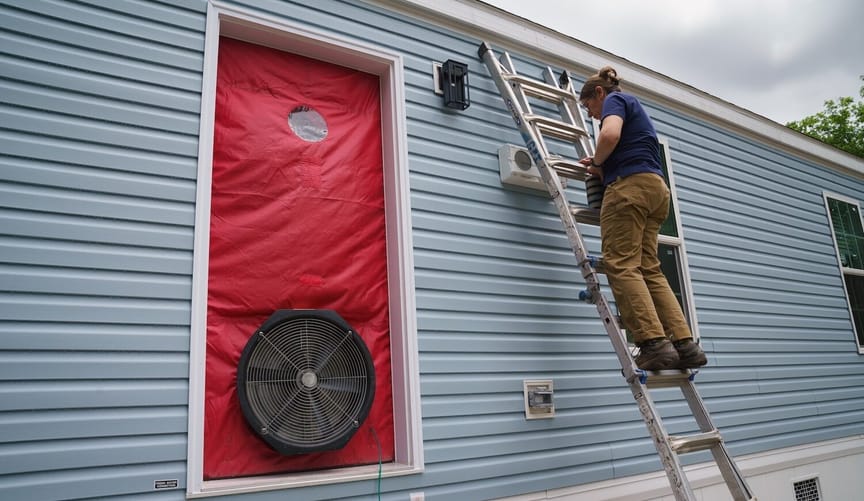
The standards aren’t mandatory; it’s up to the federal government to regulate the efficiency of manufactured homes. Instead, Vermont’s initiative certifies best-in-class options that will help the state meet its housing and climate goals — and offers a $3,000-per-unit incentive for the builders who opt in.
This month, manufacturer Titan Homes has been installing 18 of these prefabricated buildings at the largest manufactured-home park in Vermont, Tri-Park Cooperative Housing in Brattleboro. Residents who live in the floodplain and have suffered home damage in past storms will become the new occupants.
Including this latest batch, Titan Homes, based in New York, and Clayton Lewistown in Pennsylvania, have together built more than 30 units that have been installed around the state. Any Vermonter can purchase an Advanced Manufactured Home and work with Efficiency Vermont to get one.
When residents move in, they’ll enjoy much lower utility bills. Older manufactured homes are notoriously inefficient, and those of any vintage are difficult to weatherize after leaving the factory. In Vermont, the structures are typically heated with costly and polluting fuel oil or propane, driving average energy bills to about $4,000 annually, according to Efficiency Vermont.
Though they cost more up front, certified Advanced homes can save residents about $2,700 per year on energy bills over existing manufactured homes on average, and more than $1,300 over new manufactured homes built to the U.S. Department of Housing and Urban Development’s current standards, according to Peter Schneider, principal engineering consultant at VEIC, the nonprofit that operates Efficiency Vermont.
That’s a significant difference. While the median income for occupants of site-built single-family homes is $85,000, it’s $40,000 for manufactured home dwellers, said Mark Kresowik, senior policy director at the American Council for an Energy-Efficient Economy, a nonprofit research organization.
“These families are facing some of the most acute stresses and pain of making decisions about whether to pay their energy bill or their home loan or put food on the table or buy medicine,” he said. “Their energy bills shouldn’t put them back in the streets or back into a rental.”
Vermont’s Advanced homes “are setting a benchmark for the rest of the country,” Kresowik said.
The utility’s program pushes some of the most energy-efficient manufactured homes in the country, going beyond a comparable definition set at the federal level.
Once called mobile or trailer homes, manufactured homes make up 7% of new housing. On average, they sell for about a third of the price of site-built homes, or $123,000, according to federal data.
Under the Biden administration, the Department of Energy developed standards to certify what it called “Zero Energy Ready Homes,” including one for manufactured homes. (The program under the Trump DOE is now called “Efficient New Homes.”) This rubric requires a slew of efficiency measures, but also allows for gas furnaces and water heaters, which take two to four times the energy required by their heat-pump counterparts. Homes that meet or exceed these standards allowed the builder to qualify for the up to $5,000-per-unit New Energy Efficient Home Credit, or 45L, although that incentive expires tomorrow.
Kresowik isn’t aware of any other standard outside of Efficiency Vermont’s that outdoes the DOE’s, he said.
Soon, however, the entire nation may have stricter requirements for manufactured homes — if not as stringent as those in Vermont.
Last week, U.S. lawmakers passed a sweeping bipartisan housing bill that President Donald Trump then abruptly announced he wouldn’t sign until the passage of a voting reform bill. As of Monday, the legislation remained in limbo.
If the 21st Century ROAD to Housing Act becomes law, it will change regulations around manufactured homes in two big ways. First, by ditching a requirement that they be built on a permanent steel chassis, a 10- to 12-inch-deep metal frame that’s used for transport. And second, by making them more energy efficient. The bill would require HUD to set a new efficiency standard within a year of the bill being signed into law, and at least every three years thereafter. The agency set the current standard more than three decades ago.
Efficiency Vermont’s Advanced homes come with a smorgasbord of efficiency improvements over conventional options: more insulation in the floors, the walls, and ceiling; ultraefficient windows and doors; programmable thermostats; tighter air seals and ductwork under the floors in the structure’s belly; Energy Star appliances; a cold-climate ducted heat-pump system that heats, cools, and dehumidifies; a heat-pump water heater; a solar-ready roof; and continuous fresh air via an energy recovery ventilator.
These features add up to a residence that dramatically reduces indoor air pollution and is more comfortable and resilient than those with fossil fuel heating, Schneider points out.
Manufactured homes meeting the standard do cost more, though: about $21,000 over an average new HUD-baseline unit. Still, assuming a 6% interest rate on a 30-year mortgage and including utility bills, the total cost of owning an Advanced home is about the same as owning a much less efficient one that relies on fossil fuels, Schneider calculates.
Moreover, “that’s at today’s energy costs,” he said. Schneider expects fossil fuel prices to continue to grow at a much faster pace than electricity prices, enabling the energy savings in an Advanced home to further offset the higher monthly mortgage payments.
Plus, most of today’s premium stems from the fact that manufacturers are installing the heat pumps and energy recovery ventilators on-site rather than at the factory. “As the market transforms and in-factory heat pump installation becomes more common, that will significantly lower the cost of an all-electric manufactured home,” Schneider said.
Like much of the country, Vermont is in a housing crunch. The Green Mountain State is likely to need roughly 30,000 new homes by 2029. Meanwhile, the pace of construction has been slow and the costs high.
Manufactured homes could help relieve some of the pent-up pressure for new housing. To give them a boost, the state has several programs, such as the Rapid Response Mobile Home Infill Program and the new initiative Move-In Vermont.
“We’re seeing investments in affordable housing funding going to manufactured housing programs more than we ever have,” said Schneider, who’s working with administrators to incorporate the Advanced Manufactured Homes standard. “I feel like that’s just going to grow.”
With the federal 21st Century ROAD to Housing Act, HUD has a chance to make the same opportunity available across the country.
“The question is simply: Is HUD going to do that? Are [HUD’s new] standards going to ensure that people moving into these homes can actually afford their energy bills?” said Kresowik with the American Council for an Energy-Efficient Economy. “Vermont is showing it can be done.”
Earlier this year, the House proposed $1B in cuts to the state’s nation-leading efficiency program. The Senate rejected that idea in a sweeping new energy bill.
The Massachusetts Senate on Wednesday unveiled its long-awaited energy legislation, a wide-ranging bill that touches on dozens of topics from plug-in solar to renewable energy procurement. Sponsors say the measures could save consumers some $14 billion over the next 10 years.
Perhaps most notable, however, is what isn’t in the 150-page bill: The Senate left out an extremely controversial $1 billion cut to the state’s nation-leading energy-efficiency programming found in the House version.
“It’s huge,” said Larry Chretien, executive director of Green Energy Consumers Alliance, an advocacy group in Massachusetts and Rhode Island. “We were very upset when the House did it, and we are equally as happy now that it’s not in the Senate bill.”
The House’s proposed $1 billion cut represents about 22% of the three-year, $4.5 billion budget for Mass Save, the state’s energy-efficiency program, which provides rebates and incentives for insulation, weatherization, and efficient appliances. But the impact would be more severe than those numbers suggest: By the time the bill was implemented, the current energy efficiency plan would be nearly two-thirds complete. The cuts would come almost entirely from the final year’s programming, essentially bringing it to a standstill, advocates said.
Proponents of the cuts argue they are necessary because they offer a direct way to reduce utility bills in Massachusetts, which has some of the highest energy costs in the nation. But climate, consumer, and housing advocates said the cuts would offer only minimal relief to consumers in the short term.
Money spent on Mass Save now yields significant benefits down the road. From 2016 to 2024, Mass Save’s investment of about $8 billion in energy efficiency prevented some $16 billion in increased energy costs, according to an analysis from climate nonprofit Acadia Center. That’s even before public health and environmental benefits are considered.
“This is a program that is cost-effective, and it saves ratepayers money, even if they’ve never used the program,” said Kyle Murray, Acadia Center’s director of state program implementation.
There’s still no guarantee that funding will be preserved. The full Senate is set to debate the bill on July 1. The House and Senate will then have to hammer out the differences between their versions, leaving room for cuts to make it into the final proposal.
However, Democratic Sen. Michael Barrett, chair of the Joint Committee on Telecommunications, Utilities and Energy, and a major voice on climate and energy issues in the legislature, said there is little appetite for any Mass Save cuts among his colleagues.
“The Senate doesn’t want any of it gone,” he told Canary Media. “We think our constituents can tell the difference between a cost and an investment.”
The bill also proposes a range of measures intended to chip away at the thorny problems driving up energy costs in the state.
“This is a process where $100 million here and a $100 million there adds up after a while,” Barrett said. “You have to go after all the sources of overspending and overcharging in these big complex systems.”
One provision would allow individual cities and towns to ban competitive electric suppliers, companies that have often used questionable means to sign up customers for expensive contracts they don’t fully understand. Other measures would authorize the use of plug-in solar systems, allow money from the Regional Greenhouse Gas Initiative’s cap-and-trade auctions to be used for EV incentives, and stop utilities from passing on certain promotional and lobbying costs to customers.
The bill would also phase out the Gas System Enhancement Program, an initiative that allows natural gas companies to recover their costs more quickly for repairing aging and leak-prone gas pipes. These expenses are passed on to consumers over fewer years, which means higher fees on each bill, an approach that doesn’t make sense anymore, Barrett said.
“We don’t think we should have to pay bonuses forever to a system that is supposed to keep us safe for the regular prices,” he said.
This latest bill has its origins in legislation that Democratic Gov. Maura Healey proposed in May 2025. Her package, which she contended would save residents some $10 billion over 10 years, had a hearing in June that year, but went no further.
Many of the ideas it included were revived in the fall, in a bill sponsored by Democratic Rep. Mark Cusack. His bill echoed many of Healey’s proposals but also included provisions he said were needed to rein in soaring energy costs. He proposed reinstating rebates for natural gas heating systems, making the state’s 2030 emissions-reduction target nonbinding, and slashing energy-efficiency spending by $330 million through the end of 2027.
Climate and consumer advocates immediately and adamantly opposed the measure, saying a cut of that size would eviscerate Mass Save without offering consumers any meaningful savings, now or in the future. Still, the bill advanced to the House Ways and Means Committee, where the proposed cut to efficiency programming was tripled in a proposal released in February, much to the dismay of opponents.
The new Senate version, supporters said, takes a deeper dive into some of the less obvious cost drivers, rather than looking for a big, simple answer.
“Everyone wishes there was a switch they could flip to make energy prices get cheap,” Acadia Center’s Murray said. “That’s not how it works.”
A handful of Democratic-led states are targeting energy-efficiency programs in an attempt to provide relief on soaring utility bills.
It’s surprising, given the broad support energy-efficiency programs have among Democrats — and the fact that these incentives produce energy savings that benefit both the climate and all consumers. The short-term savings may be tempting, advocates say, but chasing them is misguided.
“The subject of affordability is a serious one across many states across the country. People are hurting, and energy costs are too high,” said Forest Bradley-Wright, state and utility director for the American Council for an Energy-Efficient Economy. “Energy efficiency did not cause the energy affordability crisis, and the problem can’t be solved by cutting energy efficiency.”
It’s the equivalent of trying to slash your grocery bill by eating out at restaurants more often, he said.
Maryland lawmakers earlier this month passed a sprawling package aimed at improving energy affordability, which Gov. Wes Moore is expected to sign into law. One of the legislation’s major provisions calls for lowering the state’s emissions-reduction targets through 2035, thus shrinking the amount utilities must spend on efficiency programs that help reduce carbon pollution. Proponents say the measures will save residents at least $150 per year.
A wide-ranging Massachusetts energy affordability bill would cut $1 billion in spending from the final year of the state’s three-year, $4.5 billion energy-efficiency budget. State utility regulators already ordered a $500 million reduction in the plan last year.
In Rhode Island, Gov. Dan McKee’s proposed budget calls for capping the state’s next three-year energy-efficiency plan at $75 million per year, a notable drop from the $95 million recently approved for 2026.
Champions of these proposals say they offer ways to directly and quickly get residents immediate savings. The energy-efficiency programs are paid for by fees charged to customers’ bills, so if you shrink the program, you shrink the bills, the thinking goes. And every dollar counts, they say, when prices are rising so much, so quickly.
Opponents, however, say efficiency programs actually save everyone money in the long run — and even in the short run for households that take advantage of the incentives. The proposed cuts, therefore, are a misguided attempt at a quick fix that will only make things worse down the road, say many climate and consumer advocates.
If these arguments about long-term gains are accurate — and plenty of reports suggest they are — then why are lawmakers in states dominated by Democrats embracing the idea of scaling back energy efficiency? And why aren’t constituents rallying to push their elected officials to preserve long-term savings? We found three likely reasons.
It’s not easy to lower energy costs.
A monthly electricity bill includes multiple components: There’s the costs for the power supply and the wires, poles, and substations needed to carry that energy; the guaranteed profit for utilities; and the fees that pay for programs like energy efficiency.
Lowering the cost of the power supply would be an immense, long-term effort at the crossroads of public policy, politics, and technology, all made even more uncertain by fluctuations in the global energy markets. The massive transmission and distribution system needs maintenance and upgrades to operate properly, making it difficult — and incredibly slow — to lower costs on that portion of the bill.
“These costs are technically and legally problematic to unwind,” Bradley-Wright said.
Lawmakers, however, can do something about fees by trimming the budgets of the programs they fund. The savings from this approach are generally modest. The promised decrease in Maryland breaks down to about $12.50 per month, only part of which comes from efficiency reductions. Rhode Island’s cuts would shave a few dollars per month off the average bill.
The savings would appear quickly, however. Maryland lawmakers, for example, say they expect consumers to see the difference in their bills within months.
“The thing about surcharges like this is, it is one of our most direct tools,” said Maryland Del. Marc Korman (D), a supporter of his state’s legislation. “We don’t want to forsake all efforts at energy efficiency, but we want to try to provide a little bit of relief for some time if we can.”
If you haven’t taken advantage of an energy-efficiency incentive, it’s easy to feel like you are paying for someone else to save money when you hear about the incentive your co-worker is getting to switch from oil to a heat pump.
That’s not the whole story, though. Efficiency programs benefit the entire system — not just direct participants, although these long-term systemic savings are largely invisible. The programs reduce demand on the grid, which means utilities don’t have to pay as much — or charge customers as much — to maintain and upgrade their infrastructure. Lower grid demand can also curtail the need for dirtier and costlier sources of power, like oil or coal.
From 2016 to 2024, for example, Massachusetts spent about $8 billion through its Mass Save energy-efficiency programming. That investment led to $16 billion in savings and reduced costs — not including the health and environmental benefits — according to analysis from the Acadia Center. But these mechanisms operate entirely unseen. It’s a tough combination: Consumers see the fee on their bill but not the process by which efficiency programs help slow price increases.
“This kind of distance from the effectiveness of these programs is probably a big barrier,” said Anandita Sabherwal, a research associate at Princeton University’s Behavioral Science for Policy Lab.
The economics of energy is exceptionally complex, and the widely varied messages coming from elected leaders, regulators, utilities, and our cash-strapped neighbors can make it hard to pin down reality: Am I paying more for energy efficiency than I am benefiting from it? Are these programs just feel-good measures that do nothing for my bottom line?
So when lawmakers, federal officials, and that guy in the community Facebook group all start questioning efficiency programs, constituents might not know what to think — or what to ask of their elected representatives.
These dynamics certainly come into play when Democratic leaders — traditionally the driving force behind energy efficiency and clean energy spending — start to scapegoat such programs. In Massachusetts, Rep. Mark Cusack (D), the sponsor of the affordability bill, suggested that Mass Save was using its money ineffectively, saying the proposed $1 billion cut would affect only the “bloated” marketing and administration budget, not consumer incentives. It’s a contention firmly disputed by advocates, but the claim still has an impact.
“It can be a very demotivating experience for citizens,” Sabherwal said. “It might lead them to choose the short-term benefit.”
Carole and Alan Balzer have called the town of Talent home since 1998. They met in college in nearby Ashland and never left southwestern Oregon. They love the small-town life and the bucolic setting of orchards, vineyards, and ranches.
On the morning of Sept. 8, 2020, Carole was at work a few towns away when she heard that a fire had ignited in a grassy field in Ashland. Like most people living in the Rogue Valley, the Balzers were used to seasonal drought and the occasional wildfire in the surrounding hills. But that summer had been brutally dry, and every bit of vegetation was parched.
Carole called Alan, who was at their house without a car.
“Do you think I should come home?” she asked.
She never got there. Fueled by unusually strong winds, the fire roared northwest along the valley’s Bear Creek corridor. Alan had just enough time to gather their cat, a computer, and a box of photos before evacuating with a neighbor.
The fire destroyed the Balzers’ home and most of their neighborhood, along with portions of Ashland, Talent, Phoenix, and Medford. Carole didn’t go back to her property until volunteers from Samaritan’s Purse were cleaning up the site a few weeks later.
“They found the three parts of my flute, but of course it was destroyed,” Carole recalls. “They gave me a chair to sit in, and I just started bawling.”
The Almeda Fire burned approximately 3,000 acres and damaged more than 3,000 structures; over 2,500 of those were residences. Nearly 40 percent of the students in the Phoenix-Talent School District were displaced from their homes.
The Balzers were among thousands of people who had to find temporary housing after the fire. They were lucky — with the help of friends, they found a rental in Ashland.
Five other big conflagrations and a number of smaller fires also swept through Oregon that September weekend in 2020. Collectively, the “Labor Day Fires” burned over 1 million acres, destroyed more than 5,000 structures, and killed at least nine people. It was the most expensive disaster in Oregon’s history; afterward, the state faced the monumental task of helping residents and businesses rebuild.
In early 2021, the Oregon Legislature voted to temporarily relax building codes — mandatory construction standards usually determined by states and updated once every three years. These codes include energy-efficiency standards, which set minimum levels of performance for windows, insulation, heating and cooling systems, and other equipment.
With Oregon’s postfire legislation, buildings replacing those constructed before 2008 were required to meet the 2008 codes, while buildings replacing those from after 2008 had to comply with the codes that were in effect at the time of the original construction. It’s a strategy that jurisdictions in California and Colorado have also employed after devastating wildfires.
Though meant to make rebuilding easier and more affordable, weakening energy-efficiency standards in particular has long-term consequences.
The Oregon Department of Energy estimates that an average new home built to the state’s 2021 residential code is 30% to 35% more energy efficient than a similar home built to the 2008 code. Buildings are collectively responsible for 40% of energy use in the United States, so these codes are an important way to lower greenhouse gas emissions and help Oregon meet its ambitious climate targets. Moreover, reducing energy use lowers costs for individual households and businesses, and it stabilizes power supplies, which helps avoid the construction of new power plants and keeps utility costs lower overall.
Given these benefits, the Oregon Department of Energy looked for ways to encourage residents to prioritize energy efficiency as they rebuilt.
“We allowed people to build to energy-efficiency standards in the past, but we also put on the table incentives to encourage them to build to contemporary standards,” says state Rep. Pam Marsh, a Democrat whose district encompasses southern Jackson County, where the Almeda Fire occurred.
Money for these programs happened to be available. Oregon had received pandemic relief funding through the American Rescue Plan Act of 2021, the $1.9 trillion Covid-19 relief package that directed federal funds to state, local, and tribal governments to mitigate public health and economic impacts.
Meanwhile, Energy Trust of Oregon, a nonprofit that supports energy-efficiency programs and is funded by utility customers, worked closely with the state and officials in fire-affected communities. They revamped existing programs to make them work for fire victims, adding incentives to promote energy-efficient redevelopment.
A lot was available “to encourage people to try to build in the most efficient and fire-resilient way possible,” Marsh says.
With the extra support, a large number of developers, builders, and homeowners ended up prioritizing both wildfire resilience and energy efficiency. Five years after the disaster, many of the new homes in the Almeda Fire footprint, including the Balzers’ residence, are among the most energy efficient in the country. This carrots-instead-of-sticks approach to rebuilding could serve as a model for other states grappling not only with how to build back after disasters but also with how to prevent such disasters from happening again.
On the morning of Sept. 8, Charlie Hamilton was driving south on Interstate 5 when he noticed a puff of smoke near an Ashland subdivision his company, Suncrest Homes, had helped build. He raced over; to his relief, the neighborhood had escaped the fire.
“Later that day, the phone started ringing,” Hamilton says.
Suncrest Homes has been building residences in Ashland and Talent since the early 1990s. For over a decade, every project has met the standards of Earth Advantage, a national green building program.
“We had to get all our subs trained, and it’s a little bit more expensive,” Hamilton says. “But it is such a better house, and it’s so much more efficient — for the homeowner and their utility bills — that it’s worth a little bit of extra effort and a little bit of extra cost.”
Immediately after the Almeda Fire, Hamilton called the Balzers, who were old family friends, to see if he could help.
“We said, ‘Yeah, maybe you could build a house for us,’” Alan Balzer says.
Kasey Hamilton, who runs Suncrest Homes with her father, Charlie, helped the Balzers and many former clients who had also lost homes apply to Oregon’s Fire Hardening Grant Program. A partnership between the state building codes division and Oregon counties, this program offered rebates for fire-resistant siding and roofing, ember-resistant vents that help keep sparks out of attics, and other measures that make homes more resistant to wildfire damage.
She helped families obtain additional rebates through the Energy Efficient Wildfire Rebuilding Incentive program, which the Oregon Department of Energy created in the wake of the fires. It offered $3,000 for a home rebuilt to the current code and $6,000 for one rebuilt to an above-code standard. For low- and moderate-income households, the incentives jumped to $7,500 and $15,000, respectively.
Meanwhile, Suncrest Homes was able to take advantage of boosted incentives through Energy Trust of Oregon’s energy performance score program, EPS New Construction. The company had long participated in the program, which offers rebates to builders who implement energy-efficient measures. A third-party verifier inspects a home and tests for air leakage and duct tightness to determine its EPS score; the lower the score, the more efficient — and the greater the incentive.
The boosted incentives were designed to encourage developers to rebuild homes that were lost in the Labor Day Fires as efficiently as possible.
“The incentive we had for going up and above code was doubled, and that’s where we saw a lot of uptake,” says Scott Leonard, residential program manager at Energy Trust.
A team from the nonprofit worked with the Jackson County Long-Term Recovery Group to create new bonus incentives for measures that also hardened rebuilt homes to wildfire.
“Here in Jackson County, we were really interested in not just energy-efficiency recovery, but what are the energy-efficiency measures that also have fire-resilience features,” says Karen Chase, senior community strategies manager at Energy Trust and a member of the Long-Term Recovery Group board of directors. After extensive modeling, Energy Trust landed on three factors that save energy while protecting homes from fire: triple-pane windows, exterior rigid insulation, and unvented attics.
There’s a strong overlap between energy efficiency and fire resilience. Windows, for example, transfer heat readily and are responsible for about half the energy loss in a typical home. Triple-pane windows are 40% more efficient than double-pane options and are more likely to stay intact during a wildfire, preventing fire and heat from penetrating the structure.
Suncrest Homes has taken advantage of the boosted EPS incentives in all 35 homes it has rebuilt in the fire zone.
“We basically stopped building any homes outside of fire rebuilds for two years,” Charlie Hamilton says. “I will say the single most rewarding thing I’ve ever done in my career is to hand keys back to somebody who’s lost everything.”
The Balzers’ new home was the very first to be rebuilt in the Almeda Fire zone. Their backyard, landscaped with native plants, includes a swale that captures stormwater. They avoided planting any vegetation next to the house — one of several “firewise” steps that should make their home much less vulnerable to fire.
Their house has an electric, ductless “mini-split” heating and cooling system and heat-recovery ventilator, which ensures an adequate fresh-air exchange, and a superefficient electric heat-pump water heater — typical in all Suncrest Homes. (Suncrest does occasionally specify gas-fired tankless water heaters, as Energy Trust EPS incentives for builders are funded by both gas and electric utility customers and thus are “fuel agnostic.”)
“The incentives reward the builder for choosing more-efficient equipment and better fixtures,” says Fred Gant, a local energy rater for the EPS program. The EPS score also helped verify that homes qualified for the Oregon Department of Energy incentives. “Our Energy Trust program manager worked very closely with ODOE to qualify those homes,” he says. So far, Gant has rated 220 homes in the fire zone — an impressive number, considering the size of the region.
“One of the things that helped Energy Trust connect with the rebuild was that we had so many EPS builders already working with us in the Rogue Valley,” Chase says. “And through this process, more builders signed up to work with us.”
Chase recommends that other communities invest in recruiting and training skilled energy raters. That way, when disaster strikes, knowledgeable experts are in place.
“Fred already knew what to do. He just showed up, and that’s why it worked so well,” says Chase. “To have this many highly energy-efficient homes in one community may make it one of the most energy-efficient cities in the country. It really is the epitome of ‘build back better.’”
These days, it’s hard to believe that the Balzers’ Talent neighborhood — with its new homes, neat yards, and fresh landscaping — was an ash-covered moonscape just five years ago.
Single-family homes have been rebuilt far more quickly than other types of residences that burned down in the Almeda Fire. Homeowners with good insurance coverage were able to replace their houses, sometimes with larger dwellings that had better floor plans and features they had always wanted. Having witnessed the total destruction wrought by the fire, they were motivated to rebuild in ways that enhance resilience, and many were able to take advantage of the available incentives.
But half the dwellings lost in the Almeda fire were manufactured homes, many of which housed some of the valley’s most vulnerable people: seniors, low-income households, and Latine residents, including farmworkers. Many of these units were underinsured or not insured at all.
“Housing was already a problem in the Rogue Valley,” Chase says. “Disasters bring to bear in such stark ways where we are weakest.”
Kathy Kali was a manager and a resident at Bear Creek Mobile Home Park, a 71-unit park nestled along Bear Creek in far-north Ashland, when the fire broke out. She was home with her kids when she first noticed smoke billowing to the south. Before long, she was helping neighbors evacuate.
While she knocked on doors, her husband wrangled the kids and the cats. “We ended up sleeping in our car with two teenagers and two cats in a parking lot in Canyonville near the casino,” Kali says.
All but three of the park’s units burned.
Kali and her husband had insurance that covered nearly six months of temporary housing, and they were eventually able to put a down payment on a duplex. But she estimates that only about a quarter of the park’s homes were insured.
“It was so shocking for me to see the discrepancy between our situation and [that of] many of my former neighbors,” she says.
Soon after the disaster, Kali began working for the Almeda Fire Zone Captains, a network of community leaders who connected fire survivors with resources. She helped Bear Creek residents find emergency housing assistance and apply for grants to replace their lost units — and simply listened as they shared their traumatic stories of the fire.
Even before the Labor Day Fires, Oregon Housing and Community Services, Energy Trust, and other partners had identified the energy-savings opportunity of replacing old, leaky, mold-prone manufactured homes with new, efficient ones. Over half the state’s inventory of manufactured homes was built before 1976, when the federal government began regulating standards for this housing type. Oregon Housing and Community Services expanded the Manufactured Home Replacement Program in 2021 to better accommodate wildfire victims.
Then in 2024, Oregon Housing and Community Services launched the federally funded Homeowner Assistance and Reconstruction Program. To take advantage of these resources, replacement manufactured homes had to meet the standards of the Northwest Energy-Efficiency Manufactured Housing Program. In addition, Energy Trust offered generous incentives for replacement manufactured homes that met those standards and Energy Star standards.
Kali estimates that she has helped 25 people obtain various grant funding. At Bear Creek Mobile Home Park, around 30 of the burned units were replaced within two years, even as many other parks lay vacant.
“It basically got rebuilt faster than any of the other mobile home parks because they had advocacy — they had me and a hands-on owner who was supportive,” says Kali, who now works as a real estate agent. In contrast, many of the residents in parks with absentee or corporate landlords “got dispersed and had no way to know about the resources,” she says.
The uneven recovery of the manufactured home sector has frustrated residents, lawmakers, and advocates. Still, there are some other standout success stories.
After the Almeda Fire destroyed all but 10 units of Talent Mobile Estates, two residents there formed a nonprofit called Coalición Fortaleza to help the park reemerge as the Talent Community Cooperative, a resident-owned manufactured home community. They partnered with Casa of Oregon, an affordable-housing developer, to help residents collectively purchase the land and rebuild.
Casa used a $7.5 million loan to buy the land from the private company that owned it. Portland-based Salazar Architect took on master planning and hosted design workshops to engage residents.
The project was largely funded through Oregon Housing and Community Services, which coordinated the purchase and installation of the new manufactured homes. Because the homes met Energy Star standards, they qualified for Energy Trust incentives of $10,000 for a single-wide or $15,000 for a double-wide.
The homes have noncombustible siding, ember-resistant vents, multipane windows, and other features that make them both more efficient and resilient.
Peter Hainley, Casa’s executive director, stresses that a project like the Talent Community Cooperative is possible only because of coordinated funding.
“So much of this is controlled by money,” Hainley says. “The legislature came through pretty quickly because there was the flood of money coming from the federal government — not because of these [fire] disasters, but because of the pandemic.”
The Balzers like to joke that their new home is a kitchen with a house designed around it. Since energy efficiency is part of the package in a Suncrest Home, the couple didn’t have to research high-performance windows or HVAC equipment. Instead, they focused on the custom features they really wanted, like wainscoting and a large kitchen island.
The built-in energy-efficiency will keep them comfortable and buffer them from skyrocketing utility rates for as long as they remain in their home. But it’s not just the Balzers who will benefit. Collectively, energy-efficient construction makes communities more resilient and helps mitigate climate change by lowering energy demand across the board.
It’s a lesson that other jurisdictions might bear in mind. Weakened building codes may make it easier to rebuild, but they don’t help homeowners, communities, or states in the long run. In some cases, the rollbacks don’t even save money. For example, after the devastating Los Angeles wildfires in January 2025, the city’s mayor exempted fire rebuilds from a city ordinance that requires new buildings to be all-electric. A recent report shows that all-electric construction is more affordable, not to mention healthier for occupants.
With enough funding and the right political will, incentives can help ensure that the burden of rebuilding to high energy-efficiency standards doesn’t fall on homeowners and builders who can’t afford the extra cost. States should consider such incentives as an investment in the future.
As climate change worsens, massive disasters like the Almeda Fire will keep happening. Cities, counties, and states will have to help communities rebuild equitably and thoughtfully in ways that are affordable and that ensure homes are less likely to burn down again. High-performance, energy-efficient construction is a key strategy for both responding to and mitigating these disasters — especially since those who live in fire-prone areas are reluctant to leave the places they call home.
Carole Balzer admits she gets anxious now whenever there’s a red-flag warning in the summer. But she and Alan have never considered moving away from the Rogue Valley.
“We have a lot of close friends — that’s what’s keeping us here,” she says. “Plus, it’s a beautiful area.”
The U.S. House just voted to cancel efficiency standards for new manufactured homes — a move that could hit especially hard in the Southeast, where such housing is common and energy insecurity is high.
The measure would rescind 2022 criteria for insulation, air sealing, and other energy-saving features in prefabricated, or mobile, homes, restoring weaker standards more than 30 years old. The legislation comes as utility bills are rising fast nationwide — and if it is passed by the Senate and signed into law, it could cost households in double-wide houses hundreds more per year in increased electricity costs.
“The very first energy bill that the House of Representatives passed this year would increase energy costs on some of the households and families in the United States that are most struggling to make ends meet,” said Mark Kresowik, senior policy director with the American Council for an Energy-Efficient Economy. “This will have more harmful impacts in the Southeast than anywhere else in the country.”
Of the 4.7 million prefab homes delivered nationwide in recent decades, more than half are in just 10 southern states. Texas leads the country, with nearly 600,000 units, and North Carolina is second, with over 330,000, according to the U.S. Census.
Manufactured homes are exempt from state and local energy codes, and older models are notoriously energy inefficient, with thin insulation, drafty windows and doors, and often outdated modes of heating and cooling. Those who live in manufactured homes also tend to have less income than those in site-built varieties, making these needlessly high energy costs even harder to handle.
“Utility costs can be in the several hundred dollars for folks in a manufactured house,” said Claire Williamson, senior energy policy advocate at the North Carolina Justice Center, which advocates for low-income families. She added that “$300, $400, even $500 a month in peak costs is not trivial.”
The prefabricated homes exacerbate energy insecurity in the Southeast, which is the most energy-burdened region in the country: One in three households in the region struggles to pay their utility bills, according to the Southeast Energy Efficiency Alliance.
The U.S. Department of Housing and Urban Development last updated standards for manufactured homes in 1994. In 2007, a bipartisan law directed the Department of Energy to issue more protective rules. In 2022, the Biden administration finally did so, but the new criteria were paused last summer by the Trump administration.
The Manufactured Housing Institute, the trade group for prefabricated home builders, has long fought against the stricter standards, which it argues are too costly, confusing, and bureaucratic.
The bipartisan bill that passed the House last week largely gives the builders what they want, restoring the 1994 standards and preventing the Department of Energy from ever issuing stronger rules.
The 2022 rules were expected to cost an average of $4,222 per double-wide home up front but pay for themselves in the form of lower energy bills in less than five years. For single-wide units, the additional up-front costs were pegged at $660, which households would recoup within one year.
“This is so clearly about the homebuilder special interests,” Williamson said, “and has nothing to do with ensuring better, more affordable housing for people.”
About half of all factory-made homes are already built to efficiency standards that are much stricter than those rescinded by the House, said Grant Beck, vice president of strategic partnerships at Next Step Network, a Kentucky-based nonprofit that supports ownership of prefab homes.
This fact shows that better-built manufactured homes can benefit the industry and consumers alike, say affordability advocates, far better than the bill that’s now before the Senate.
“We understand that we’re in an affordability crisis, particularly with relation to housing and first-time home buyers trying to enter the market,” Beck said. “However, the lower purchase price on a home for a family is eroded if they’re unable to make monthly payments due to high and rising energy costs.”
Funding for Rhode Island’s energy-efficiency programs could be cut by more than $42 million next year in an effort to rein in residents’ soaring power bills. That rollback would deprive the state of more than $90 million in benefits and potentially eliminate hundreds of jobs while creating only modest up-front savings, a new analysis finds.
Rhode Island Energy, the utility that administers the state’s energy-efficiency offerings, has proposed to slash spending on that front by 18% compared to last year and more than 30% compared to the budget originally projected in the nonbinding three-year plan introduced in 2023. If approved, the cuts will save the average household $1.87 per month, according to Rhode Island Energy.
The result of these changes, according to climate action nonprofit Acadia Center, would be more expensive electricity and more exposure to volatile natural gas prices in the long run.
“Energy efficiency is a tool for suppressing supply costs, for suppressing infrastructure costs in the long-term,” said Emily Koo, Acadia Center’s program director for Rhode Island and one of the authors of the group’s analysis. “I am not seeing our leaders think beyond the immediate.”
Rhode Island has traditionally been a leader in energy-efficiency programming. Over the past 15 years, the state has repeatedly placed among the top 10 states in the American Council for an Energy-Efficient Economy’s annual energy-efficiency scorecard. Since 2009, the state has spent more than $2 billion on efficiency incentives and services, yielding more than $6 billion in environmental and social benefits.
Now, however, the dynamics of energy markets are creating new obstacles. Nationwide, electricity costs have gone up at twice the rate of inflation over the past year, and gas prices have increased by more than four times the inflation rate. Rhode Island, like other New England states, has the added difficulty of already having some of the highest electricity rates in the country. Add in cold Northeastern winters, and the state is girding for an expensive season ahead.
As in neighboring states, regulators, elected officials, and utilities in Rhode Island are scrambling for ways to provide some relief for residents and businesses. These efforts have increasingly looked to the bill fees that fund renewable energy incentives and energy-efficiency programs as possible targets for quick, if small, bill reductions. In Maine, for example, leaders from both sides of the aisle have sought to lower incentives for customers and community solar developments that send power back to the grid, and in Massachusetts, utility regulators ordered energy-efficiency administrators to cut $500 million from a planned $5 billion three-year budget.
Now, Rhode Island Energy is proposing rollbacks of its own, saying that its latest plan prioritizes customer affordability. The company has the support of the Rhode Island Division of Public Utilities and Carriers, which points to the growth in accounts with overdue utility bills to bolster its argument that the changes will provide needed relief to consumers.
“There is simply a financial limit as to how much cost the ratepayers can bear,” the department wrote in its public comments on the proposal.
Advocates, however, say the approach is short-sighted.
“This is weaker. It’s a retreat,” said Larry Chretien, executive director of the nonprofit Green Energy Consumers Alliance, which opposes the proposed cuts. “It just feeds into the narrative — that we don’t accept — that ratepayers aren’t seeing benefits from energy efficiency.”
Rhode Island’s energy-efficiency offerings include home energy assessments, weatherization services, rebates on energy-saving appliances and heating and cooling systems, and contractor training. Residents and businesses that take advantage of these programs generally save money by reducing their energy use.
The programs also create savings for the average consumer, whether or not they participate. Because the improvements slow energy consumption, they allow utilities to build less pricey infrastructure, the cost of which is passed on to customers. Efficiency measures can also lower peak demand, reducing the need to buy costlier, dirtier power from peaker plants. In Rhode Island, efficiency programs lowered electricity use 5% between 2005 and 2024; without these interventions, use would have increased 15%, according to an annual state report.
Advocates, therefore, argue that Rhode Island Energy’s plan to shrink energy-efficiency spending won’t actually result in more affordable power in the long run.
“You spend money on energy efficiency or you’re going to spend even more money on power supply,” said Forest Bradley-Wright, state and utility director for the American Council for an Energy-Efficient Economy.
Acadia Center’s analysis also finds that more than 800 jobs in the energy-efficiency sector could be at risk if the cuts are adopted.
The draft plan has been through multiple iterations; the most recent version was released on Sept. 5. The state energy-efficiency council is expected to vote on the proposal at its Sept. 25 meeting. The plan will then go to utility regulators for final approval.
Advocates say they intend to keep pushing for high funding levels until the process concludes.
“The benefits we’re experiencing today are already translating into lower bills,” Bradley-Wright said. “There’s a track record of success, but let’s not take it for granted.”
Talia Boyd was spending over $300 a month to keep her home just outside Asheville, North Carolina, cool this summer. It was an enormous sum for the single-wide trailer she shares with her baby daughter and teenage son.
“We constantly kept ceiling fans going, and I had to get AC units,” she said — multiple ones that ran 24/7 to replace the cold air seeping out from gaps around the windows.
But now, the air leaks have been sealed, a door has been replaced, and a new heat pump has been installed — all at no cost to Boyd. Her monthly utility bill from Duke Energy has been cut in half, she said.
The improvements are thanks to Energy Savers Network, a small nonprofit that serves Buncombe County, where Boyd lives, along with neighboring counties Henderson, Haywood, and Madison.
“They really came out and they helped,” said Boyd, who works in home health care. “They talked. They took measurements. They walked through the whole trailer. I really appreciate the help, and I would love to spread the word.”
Boyd’s home is among the roughly 1,400 that Energy Savers Network has assisted with weatherization since its inception in late 2016. Across the state in the same time frame, thousands of other households have received similar services, mostly from community action agencies deploying federal dollars.
But Boyd’s story is somewhat unique. She’s in a smaller subset of people who’ve benefited from a Duke initiative meant not just to aid the energy burdened in times of crisis, but to permanently reduce their electricity use through home efficiency improvements.
And with politicians at the state and national levels turning against the clean energy transition in low-income communities and elsewhere, Boyd’s experience is rare good news that advocates hope can continue to be replicated.
Energy Savers Network found Boyd through Duke’s Customer Assistance Program. Part of a side deal the utility struck in 2023 to lessen the blow of its rate hikes, the program offers a monthly credit of up to $42 on bills for households at or below 150% of the federal poverty level — about $50,000 for a family of four.
In 2024, Duke began automatically providing the credit to any customers who’d benefited in the prior year from one of two buckets of federal aid: the Crisis Intervention Program, designed to prevent or reverse life-threatening emergencies like utility shutoffs, or the Low-Income Energy Assistance Program, which offers one-time payments to help households with heating bills.
North Carolina’s Department of Health and Human Services manages the two funds and has a data-sharing agreement with Duke, which then enrolls customers in its program — a process that has minimized administrative expenses such as vetting participants for eligibility.
And though in its first year the bill assistance benefited less than half the number of households forecast, experts say that’s because funding for the two buckets of federal aid dropped, not because the need isn’t great. Advocates remain bullish about the prospect for Duke to serve 100,000 customers or more annually.
Totaling over $500 for a year, the bill credit alone is vital for families struggling to make ends meet, aid groups say.
But Boyd’s case demonstrates the full potential of the Customer Assistance Program: Virtually every household receiving help gets referred to a local entity that can assess homes and perform free efficiency upgrades, reducing energy burdens beyond the 12 months of financial aid.
The brainchild and passion project of former financial and utility consultant Brad Rouse, Energy Savers has undergone a few iterations over its nine years of existence. Its throughline is providing energy-efficiency retrofits, usually in a day’s time, via a team of volunteers guided by a professional.
When everything is running smoothly, that means the group can perform upgrades — such as adding insulation and sealing air leaks — for at least three homes a week, according to Rouse. But in its early years, Energy Savers sometimes struggled to meet that mark.
“The problem is we had a lot of client cancellations,” said Rouse, who today serves as Energy Savers’ executive director. If they were last-minute, the group didn’t always have a backup client ready to take advantage of assembled volunteers and staff. In that case, Rouse said, “we lose the day.”
But now, the organization has almost eliminated that problem. “The Duke Customer Assistance referral is one big reason why,” he said.
That’s because the utility sends so many referrals that it’s easier to find clients who will be ready by the time the Energy Savers team arrives, reducing the likelihood of cancellations. And when a client does fall through, there’s a waiting list ready to be tapped.
The group identifies households in need through multiple channels, including farmers markets, community events, and word of mouth. But its largest source of referrals these days is the Customer Assistance Program, said Steffi Rausch, director of operations.
“We send out a bulk mailing to [potential clients] first and then we try to follow up with phone calls to get them scheduled,” Rausch said.
Boyd, for instance, first got help paying her utility bills through Asheville Buncombe Community Christian Ministry, which accessed one of the federal crisis assistance funds for her. She was soon enrolled in Duke’s $42 bill-credit program and then referred to Energy Savers. “They popped up at my doorstep,” Boyd said.
In the last 11 months, 26% of Energy Savers’ referrals have come from the Duke Customer Assistance Program, according to Rausch. So far, 36 of those referred families have made it through the weatherization process.
“I’m very impressed with Duke at this point,” Rausch said. The utility, which funds the majority of the services provided by Energy Savers, always makes sure the group gets reimbursed, she said. “We’ve never been stuck with the bill.”
To be sure, Duke and advocates for low-income customers are still working out kinks in the bill-credit scheme. One challenge is waning funding for the two federal crisis assistance initiatives that are used to automatically enroll individuals in the Customer Assistance Program. Another hurdle is connecting the dots for recipients, who often don’t realize they’re getting the bill credit or that they’re getting referred to groups like Energy Savers.
Most of all, advocates are mindful that the Customer Assistance Program is in the middle of a three-year pilot phase, and they want to extend it one way or another — as a feature of Duke’s next three-year rate increase, as a condition of the merger of the company’s two North Carolina utilities, or as part of some other case before state regulators.
Boyd knows as well as advocates that the need for long-lasting energy savings is substantial. She’s now trying to get help for her 93-year-old Aunt Viola, whose electricity bill tops $400 a month.
“It’s only her in the house,“ Boyd said. “She could really use this program.”


.svg)
