

 Back
Back
Founded by a former public-housing resident, the 548 Foundation provides training, stipends, and support to build Black generational wealth through clean energy.
CHICAGO — On a beautiful fall Saturday morning on the South Side of Chicago, the Life Center Church of God in Christ thrummed with excitement. The pews were packed with over a thousand people dressed in their best — including more than a hundred in black graduation caps and gowns.

CHICAGO — On a beautiful fall Saturday morning on the South Side of Chicago, the Life Center Church of God in Christ thrummed with excitement. The pews were packed with over a thousand people dressed in their best — including more than a hundred in black graduation caps and gowns.
Before praying, Pastor Torrey L. Barrett invited the crowd to “turn it up,” so people cheered, danced, and waved hats in the air.
Though the sun streaming in the stained-glass windows was bright, the scene was not what might typically come to mind when one thinks about a solar industry gathering.
Instead of discussions of policy and technology, this was all celebration, music, and joy. And the people in the church were overwhelmingly African American, whereas the solar industry workforce is predominantly white.
But solar was the reason for the celebration. The 548 Foundation was commemorating the fact that its solar industry training program has now served more people than the number in its name, and is on track to reach 700 graduates by the end of the year. Participants are largely from the South and West sides of Chicago, disproportionately lower-income and African American communities whose residents have largely been left out of the clean energy economy.
The foundation was the brainchild of A.J. Patton, who grew up in a public-housing unit numbered 548 in Terre Haute, Indiana. Patton said his commitment to community empowerment and energy justice was sparked by the year — 1999 — that his family spent boiling water on an electric stove for baths, since his mother couldn’t afford a $400 gas bill.
I first met Patton in 2019, soon after he cofounded the startup 548 Capital LLC with his childhood friend from that same housing development, Erica Johnson, who was by then working in construction risk management for New York City’s housing authority. Their goal was to leverage renewable and energy-efficiency incentives to create affordable housing in marginalized Chicago neighborhoods, without contributing to the gentrification and displacement that often coincides with outside investment.
I was struck by Patton’s bold confidence and the large scale of their plans. He had quit a promising career in investment banking to focus on 548, entering a Chicago affordable-housing scene notorious for bureaucracy, cronyism, and challenges like the dilapidated state of buildings in low-income communities.
At the graduation, Patton described his path after launching the startup.
Their company acquired and renovated a six-flat apartment building, and soon more properties followed. They were “cutting folks’ bills,” Patton explained, but the people “swinging the hammers” on the building upgrades and solar panel installations did not reflect the local residents. When he pressed contractors to hire a more diverse workforce, he said he heard things like, “You know your people, they ain’t on time, they ain’t safe.”
That, Patton said, was the genesis of the 548 Foundation, a nonprofit that has now hosted 51 three-month training sessions in solar installation and related electrical and carpentry work, as well as basic life and job skills.

In 2021 Illinois passed a law focused on driving equity in the clean energy workforce as well as in the deployment of solar arrays. It provided funding for workforce training programs and incentives for solar developers to hire employees meeting equity criteria, including those from low-income neighborhoods and people with histories in foster care or the criminal justice system.
The 548 Foundation began offering trainings through the state workforce-development program in 2023, said Patton, and now the foundation holds multiple sessions each year in Chicago and the suburbs of Aurora, Elgin, and Waukegan, home to large Latino immigrant and African American populations. Another Chicago session will begin this month.
Under the state program, students get a stipend along with support to help them overcome barriers like child care and car trouble. The programs feature not only technical instruction but basic skills from math to resume-writing. Wraparound services help trainees with mental health, housing, and other needs. Across Illinois, these offerings have been crucial to helping people not only acquire skills and certifications but get and keep jobs, according to Patton and other workforce-development leaders.
In August 2024, I attended a job fair that 548 put on for their graduates. There, multiple solar employers did interviews that they said would promptly result in job offers, and instructors revealed some of the secrets to their success. They noted that the supportive services continue after graduation — trainees can keep coming back to 548 staff and affiliates for aid and advice. And the instructors work hard to prepare their charges for all the nuances of the job. For example, they role-play conflict mediation and start hands-on classes at 6 a.m., when work in the field often begins — so the participants can build routines around early-morning child care and other family responsibilities.
At the graduation, Patton touted the program’s results, and how it has dispelled stereotypes about Chicago’s Black communities.
“They said we didn’t want to work. Somehow, we have a 500-person waiting list to get in this program. Then they said we weren’t smart enough to learn this stuff. We have a 70% graduation rate, 700 graduates. Then they said the market wasn’t ready for us. Meanwhile, we have a 68% placement rate. Our students get jobs within 33 days of graduation. They’re averaging $68,000 a year. So while others are talking, we work. That’s what we do.”
He warned graduates to stay focused on their goals and careers despite such prejudice, as well as potential “distractions,” like friends who just want to party or long-lost relatives who suddenly appear to borrow money.
The cautionary notes soon dissolved into applause and music, as it was time for the diplomas. Instructors from different cohorts came to the pulpit to read the names of their trainees. Each graduate shook hands in a long receiving line including Patton and various elected officials, while people cheered loudly from the pews.
“I’m super proud of her!” enthused Natane Brown after dashing into the aisle to embrace her sister, Asia Bell.
After the ceremony the crowd spilled onto the sidewalk, where graduates were showered with flowers and balloons and posed for photos with family and friends.
Graduate Anthony Legorreta hoisted his young nephew in his arms as his relatives crowded. “This was most definitely a life-changing experience,” he said.
Fellow graduate Kelvin Davis said he loved the hands-on installation training, but sees himself “doing something toward desk work” in the solar industry – “not so much the physicality.”
“They were very open to whoever wants to learn. It’s an open door for the community,” said Davis of the program.
Graduate Mikah Allen doesn’t necessarily see himself working in solar at all. He prefers iron work and construction, and the links with trade union apprenticeships embedded in the training should help with that too. The state recently revamped the clean energy curriculum to prepare workers for a wider range of careers, given the current volatility of some clean energy industries.
At the graduation, Pastor Barrett described 548’s classes as part of the quest to build generational wealth in disenfranchised Black communities. He shared how his grandfather came to Chicago from the cotton fields of Mississippi with a third-grade education, and through a labor union job was able to buy a home and raise a family, including Barrett’s father, a renowned gospel singer, pastor, and civil rights activist.
“We come from neighborhoods that people write off,” Barrett said. “But you all have changed the trajectory not only of yourselves but of the community.” He predicted that “the next generation of contractors, the next generation of developers, the next generation of millionaires is sitting right in this room.”
At a time when discussion of the American solar industry often revolves around slashed federal incentives, troubled supply chains, and projects blocked by community opposition, the scene in the church that morning provided an inspiring and refreshing antidote. It was a reminder that even in the face of great challenges, clean energy can help improve not only the climate but individuals’ lives.
“You have people here who have just come home from prison, who have been left off to the side in society,” Patton told me outside the church, between congratulating graduates with caps and diplomas in hand. “Now they’re crossing the threshold. What you saw today was hope. That gets you a long way.”
Before replacing gas service lines, utilities will need to offer customers a financial incentive to electrify instead, thanks to a new law.
When one of the nation’s biggest investor-owned utilities, Pacific Gas and Electric, wanted to replace Merrian Borgeson’s aging gas service line in Berkeley, California, she asked the company not to do it.
Borgeson, who is the California policy director for climate and energy at the nonprofit Natural Resources Defense Council, explained that the repair wasn’t necessary: She was in the process of fully electrifying her home and would be replacing her stove — the only gas appliance left in the house — with an induction version during an upcoming kitchen remodel. At that point, she planned to request that the gas line be shut off.
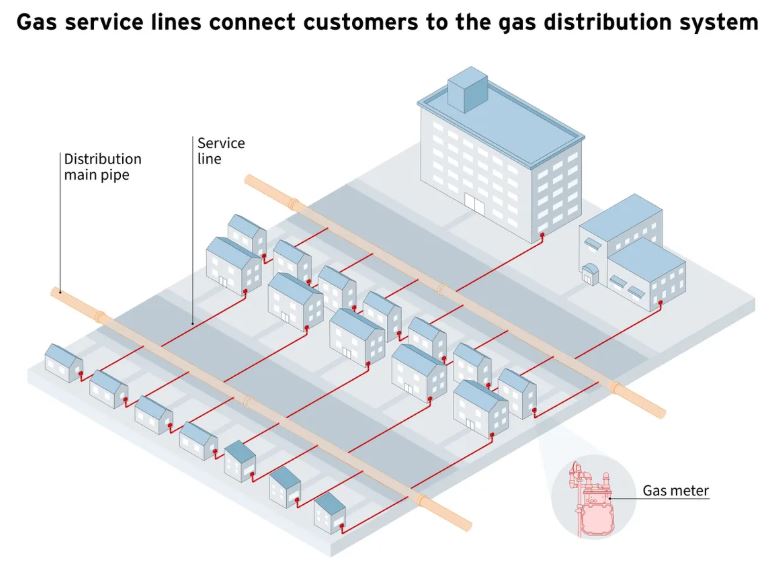
But PG&E told her it couldn’t wait. That week, the utility dug up her yard and swapped in a new pipe to send gas from the distribution main line to her home.
Borgeson wasn’t charged for the service — at least not directly. The upgrade, which in PG&E’s service area typically costs $20,000 to $30,000, plus interest and operation and maintenance costs, gets paid for by all gas customers over the life of the infrastructure.
A few years later, the new pipe sits unused in the ground.
“Now, I have no gas in my house,” Borgeson said. “But the customers all around me are paying for that pipeline for the next 50 years.”
Soon, Californians will have the choice that Borgeson did not.
A new law, the Home Energy Choice Act (Assembly Bill 2313), will require utilities to give households scheduled for a service line replacement the option of getting the new line or taking a financial incentive potentially worth several thousand dollars to get off gas instead. Crucially, the incentive to switch to all-electric equipment such as a heat pump, induction range, and heat-pump water heater, will be less than the cost to replace the line, resulting in savings that will be shared among all gas customers.
The law “sends a very clear message that California is no longer going to invest millions of dollars in gas infrastructure without considering the future,” said Borgeson, who advocated for the bill. “It’s this huge signal of where the state is headed.”
The Natural Resources Defense Council has calculated that PG&E’s gas customers could save a total of $20 million if the utility gave 1,000 households a $17,500 incentive apiece rather than replacing their service lines. For context, PG&E replaces about 15,000 service lines annually.
If similar programs were instituted across the country, the savings could rival Biden-era investments in home electrification. Utilities spend upward of $7 billion per year on service line replacements, according to clean energy nonprofit RMI.
The policy will help push the state closer to its goal of a carbon-neutral economy by 2045; however, the version that passed was less ambitious than what was introduced, according to Brandon García, California director at industry association Advanced Energy United. Revisions included programs being capped at 1% of a utility’s customers and the law expiring Jan. 1, 2035, though it could be renewed before then.
“AB 2313 was a very difficult bill to get through the Legislature, so I’m very excited that it will soon give Californians the opportunity to decide what energy is powering their home and provide financial support if they choose to transition away from natural gas,” Assemblymember Marc Berman, who authored the bill, said by email. “When homeowners opt to electrify, the utility avoids additional investments in fossil fuel infrastructure that will eventually become a stranded asset, and this saves all ratepayers money long-term.”
Utilities San Diego Gas and Electric and SoCalGas opposed the bill, arguing that it would result in an unfair cost shift: As some customers stop using gas, those remaining could be left bearing outsized costs to maintain the system. While that is an issue writ large for the transition off of fossil fuels, and one the state needs to address, this law “is instead about trying to encourage people to leave at the exact time when they are saving money for everyone else by leaving,” said Kiki Velez, equitable gas transition lead at the Natural Resources Defense Council.
With the new legislation, California becomes the third jurisdiction to authorize the pipeline replacement alternative approach — and the first to do so statewide. In 2024, New York utility Con Edison launched its initiative, the Energy Exchange Program, which offers eligible households up to $20,000 to electrify. Other New York utilities are following suit, Velez said. And in July, the Colorado Public Utilities Commission authorized Xcel Energy to create a similar program, which she expects could launch within a few months.
In California, the next step is for the Public Utilities Commission to create a detailed framework for utilities to follow, including incentive levels, with larger amounts for customers in disadvantaged communities. Then utilities will have until Jan. 1, 2028, for their individual proposed programs to be approved.
One yet-to-be-determined detail is how much notice utilities will give residents whose pipes they want to replace. “I think the worst case is you don’t hear about [the incentive] until the last minute,” Borgeson said. RMI recommends utilities alert residents one to five years ahead — at the point when it is scheduling the service line replacements.
Other states are looking to emulate California with bills of their own, Velez said, pointing to Illinois, Maryland, Minnesota, Oregon, and Washington. “Folks are already reaching out a lot about how they can bring it to their state,” she said.
In California, the bigger electrification incentives for disadvantaged communities will provide a much-needed boost to clean energy equity, García noted. “As someone who grew up in those kinds of neighborhoods as a low-income person, I want to make sure that everyone has access to [all-electric] technology.”
Demand for the climate-friendly HVAC tech has persisted even after Republicans killed incentives, with 2026 set to be another good year for the sector.
America’s demand for heat pumps isn’t going away just because federal incentives did.
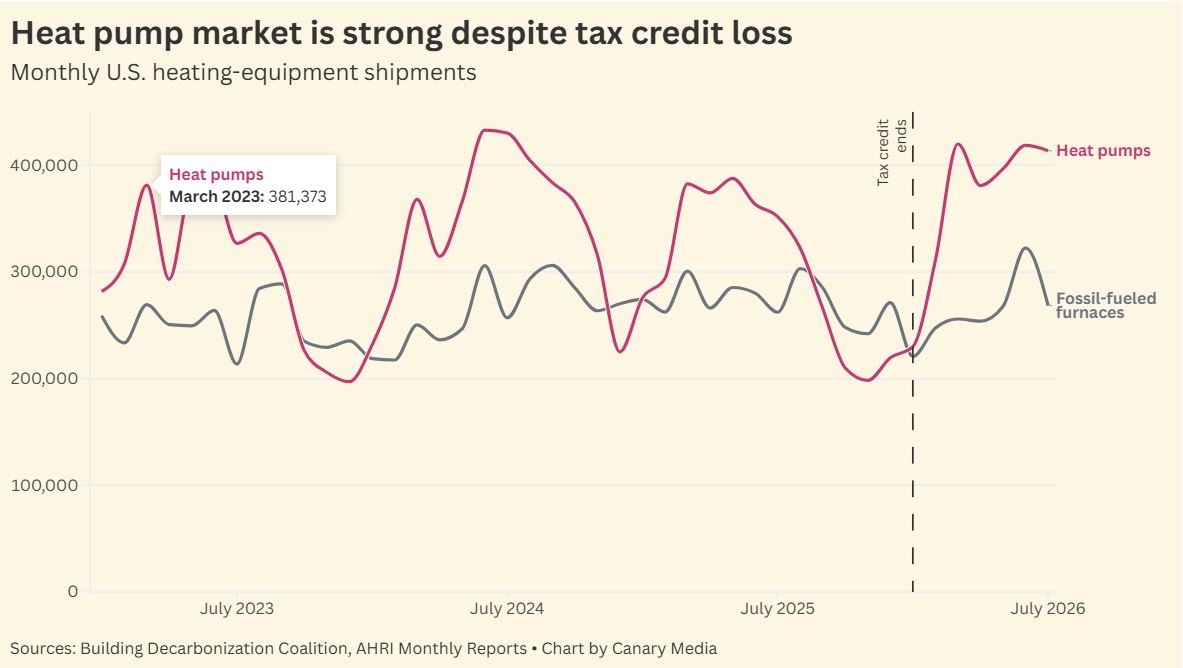
Shipments of heat pumps stayed strong in the first half of 2026, and the tech is on track to match or exceed its best year, according to a recent report from the Building Decarbonization Coalition. The nonprofit relies on data from the Air-Conditioning, Heating, and Refrigeration Institute, a trade group that represents most of the U.S. market.
America’s demand for heat pumps isn’t going away just because federal incentives did.
Shipments of heat pumps stayed strong in the first half of 2026, and the tech is on track to match or exceed its best year, according to a recent report from the Building Decarbonization Coalition. The nonprofit relies on data from the Air-Conditioning, Heating, and Refrigeration Institute, a trade group that represents most of the U.S. market.
This is in spite of the fact that President Donald Trump and Republicans in Congress ripped away tax credits that helped households afford heat pumps — which can both cool and warm homes and wean buildings off polluting gas furnaces — as well as rooftop solar, batteries, and other clean energy tech. The 25C tax credit for heat pumps, which shaved up to $2,000 off the price tag, expired at the end of 2025 — seven years earlier than the Biden administration’s deadline.
So what gives? It could be that the tax credit was never a determining factor for most people getting heat pumps — a hypothesis put forth by Lucas Davis, a business professor at the University of California, Berkeley.
“I suspect most households adopted heat pumps without ever knowing anything about the credit, or didn’t learn about the tax credit until months later when filing their taxes,” he wrote in a blog post earlier this year, noting that previous research shows heat pump adoption in the U.S. is driven by geography, climate, and electricity prices. “It may simply be that these factors are much more important than subsidies for driving adoption behavior.” Contractors repeatedly told ACHR News, an industry publication, that they were usually the ones bringing up the tax credit to customers, not vice versa.
Meanwhile, households in some parts of the U.S. can still access state and utility incentives for heat pumps, and many local governments continue to plow ahead with ordinances that encourage households to ditch fossil fuels. Plus, contractors have gotten more familiar with heat pumps in recent years.
Unfortunately, other technologies haven’t been as resilient: The rooftop solar sector has shown signs of struggle in the post-tax-credit era, as has the electric vehicle market.
So, heat pumps are a bright spot. Barring a dramatic shift in consumer behavior, 2026 is set to be a very good year for the tech. Keep an eye out for the final tally.
The $4.3 billion deal will add 890 megawatts by upgrading equipment, but the U.S. needs to build — and restart — reactors to spur a true nuclear renaissance.
The Trump administration wants to add 5 gigawatts of carbon-free nuclear power capacity by 2029 without deploying a single new reactor. An announcement this week by the United States’ biggest nuclear power plant operator brings that lofty goal a bit closer to reality.
On Tuesday, Constellation Energy said it would partner with Google to add 890 megawatts of generating capacity at 11 existing nuclear plants across the PJM Interconnection, the country’s biggest and most capacity-constrained electricity market. The 20-year deal is similar to a smaller deal Constellation and Meta announced last year to add 30 MW at another one of its plants and a third agreement between Georgia Power and Google to add 96 MW at two nuclear power stations in the Peach State.
All three initiatives involve power uprates, wherein power plant owners upgrade turbines, steam generators, digital control systems, and other nonnuclear infrastructure to boost energy output faster and at a fraction of the cost of building a new reactor from the ground up.
Constellation expects to finish its first Google-backed uprate by 2028 and complete the entire batch in the early 2030s, Constellation spokesperson Paul Adams told Canary Media. One project will add 348 MW of generating capacity to Constellation’s 2,317-MW Limerick nuclear plant near Philadelphia, while the 2,327-MW Salem plant in southern New Jersey will get a 97-MW boost, Adams said.
“Each plant is different, so the scale of the projects and what is being done varies plant to plant,” Adams said. “The generic way to describe it is that we will be adding new and more efficient equipment and technology that will allow us to get more megawatts from the same plant.”
The budget for the entire initiative tops $4.3 billion, or just over $4,800 per kilowatt, Constellation says.
That’s significantly more than the cost of utility-scale solar with energy storage, a new combined-cycle gas plant, or Constellation’s own $1.6 billion effort to restart the undamaged reactor at the Pennsylvania power plant formerly known as Three Mile Island, which the company took offline for economic reasons in 2019.
On the other hand, it’s less than half the per-kilowatt expense Georgia Power and its corporate parent, Southern Co., incurred to bring two gigawatt-scale reactors online a few years ago. Plant Vogtle Units 3 and 4 were seven years behind schedule and cost more than double the original $14 billion budget.
“For the near term, uprates are the fastest, most practical and cost-effective ways to add reliable, clean nuclear capacity,” said Judi Greenwald, president and CEO of the Nuclear Innovation Alliance, a pro-nuclear “think-and-do tank.”
Once complete, Constellation’s expanded facilities will pump out carbon-free electrons almost without interruption. According to the Department of Energy, U.S. nuclear power plants have an average capacity factor of 92.3%, meaning they run at maximum rated output more than nine of every 10 hours. Combined-cycle gas plants average 59.9%, wind farms clock in at 34.3%, solar installations at 23.4%, and gas peaker plants at just 17.2%, the DOE says.
With electricity demand expected to increase more than 5% annually over the next 10 years across its 13-state footprint, and retail power prices expected to rise as much as 60% by 2030, PJM says it welcomes new capacity, even at a premium price.
“We need all the megawatts of electricity supply we can get to meet growing demand. Additional supply addresses both the reliability needs of the system and eases upward price pressure,” Jeff Shields, a spokesperson for the nonprofit grid operator, said in an email.
The Constellation uprates have supporters among the region’s solar, wind, and energy storage companies, too — in part because the project’s 20-year power purchase agreement is familiar to utility-scale renewables developers who’ve marketed clean power to tech companies for years.
“Long-term revenue agreements like this are essential to deploy new generation across all resource types: nuclear, solar, wind, storage, gas, and so on in PJM,” said Evan Vaughan, executive director of MAREC Action, a trade group for renewables developers and operators in the mid-Atlantic region.
Vaughan suggested there’s room for everyone to grow in a region with 67 million inhabitants and tens of gigawatts of new data center capacity expected to come online in the next 10 years. The combination of uprates and new renewable capacity is a potentially potent one, he said.
“Greenfielding of new resources remains a challenge for large, centralized power plant [developers],” Vaughan said. “Solar, wind, and storage continue to represent a large share of greenfield deployment in PJM.”
Despite state and local permitting rules in Ohio and other PJM states that clean energy advocates say unfairly benefit thermal generators, Vaughan may be right to see long-term tailwinds for renewables in the grid operator’s territory and beyond.
Constellation’s uprate announcement came one day after the DOE unveiled a $4.2 billion loan to extend the lives of three nuclear plants owned by Vistra, a Constellation competitor, in Pennsylvania and Ohio. The loan will also underwrite 433 MW of previously announced uprates at the plants, with Meta as the offtaker.
Those two deals represent the lion’s share of potential uprates in PJM and a significant chunk of the estimated 3 GW to 5 GW of uprate potential nationwide, Julien Dumoulin-Smith, a senior energy-sector analyst for the investment bank Jefferies, said in a client note Wednesday.
The longer-term and more lucrative play for independent power producers like Constellation and Vistra — which own huge amounts of centralized generation but aren’t regulated like utilities — is to ink deals with large tech companies for more scalable forms of clean, firm capacity, Dumoulin-Smith said. Constellation said as much in its announcement with Google, he added.
“The big debate was never about whether IPPs could contract nuclear uprates, as this is [a] truly unique asset class with only 3-5GW available,” Dumoulin-Smith said. “The core question remains as to whether IPPs can pair up [existing generation] with capacity-only resources like battery and demand response, both of which have been explicitly called out in the [Constellation] announcement Tuesday.”
Hyperscalers are also backing two of the three nuclear reactor restarts announced so far: Microsoft at the 835-MW Three Mile Island plant, which Constellation rechristened as the Crane Clean Energy Center; and Google at the 615-MW Duane Arnold Generating Station in Iowa. Both are set to power back up before the end of the decade.
“These announcements show how both the public and private sectors are committed to expanding nuclear generation capacity,” Greenwald said, referring to the Constellation and Vistra announcements this week. “They also reinforce the need for a broader portfolio that includes uprates, reactor restarts, and new construction.”
But the math is clear: Uprates and restarts alone won’t power the American nuclear renaissance the Trump administration claims is underway. Most of the 300 GW of new nuclear capacity Trump wants to bring online by 2050 will have to come from new reactors — likely at a much higher cost.
Three brothers wanted to use some land for solar, batteries, and cattle grazing. First they had to convince local officials — and the community — to allow batteries.
The soil in northwest Iowa is so fertile it’s referred to as “black gold.”
“It’s incredibly rich, wonderful topsoil from thousands of years of silty deposits from the Missouri River,” said Luke Seaberg, a researcher at Iowa State University’s extension program. So rich that some counties restrict development on land that scores especially high on the state’s official Corn Suitability Rating.
The Smith family has been farming that soil for six generations in Cherokee County, population 11,000. But the corn market has been depressed lately, prompting the three Smith brothers to consider other uses for a 160-acre parcel, 10% of their farmland. Looking at rising beef prices and the region’s ballooning energy demand, they landed on an idea: Graze cows amid rows of solar panels.
“We’re trying to diversify into another revenue stream. The cattle business is really good right now, and grain has been not as good,” Mark Smith told me over the phone, as he drove across the state for his son’s high school football game. “With solar, we can put cornfields back to pasture. Solar revenue plus cattle revenue makes it work.”
But to loft the solar panels up above the butting heads of grazing cattle costs more than a regular solar installation; indeed, this type of agrivoltaics only recently entered commercial-scale use, at a 40-acre, 3-megawatt site in Tennessee developed by Silicon Ranch. To mitigate the extra cost, the Smiths want to pair 30 megawatts of cattle-friendly solar capacity with a 25-megawatt/100-megawatt-hour battery composed of modular containerized units covering about an acre and a half.

The Smith brothers’ desire to install batteries on their land, though, set them on a collision course with local authorities. When the county supervisors heard of the plan, they approved an indefinite moratorium on March 24, blocking any battery projects in the county. Similar bans are popping up around the country as communities grapple with the real and perceived risks of lithium-ion batteries, which rose from obscurity over the last decade and now constitute the largest source of on-demand power getting built in the U.S.
In many counties, this story ends with the battery moratorium, stymieing new emissions-free power capacity at a time when everyone from climate advocates to AI giants to the Trump administration wants to see more batteries get built. But the Smiths found an ally in Supervisor Shane Bellefy, the lone vote against the moratorium.
Together, they set out to flip the county back to a place that lets landowners decide what to do on their acreage. Within just five months, they succeeded.
Iowa subscribes to the “home rule” philosophy, whereby the state constitution leaves many decisions up to city or county governments, Seaberg said. But even those local authorities typically take a hands-off approach. The state’s “right to farm” law blocks local governments from regulating what landowners choose to grow or raise on their farmland. Some rural counties don’t even have a zoning code.
“Your nearest neighbor might be 5 or 10 miles down the road,” Seaberg explained. “The general policy of county supervisors was, folks can do what they want to do with their land.”
That attitude started to shift after the onshore wind boom came to Iowa in the early 2000s. The state has since added 13 gigawatts and remains the nation’s top state for share of wind energy produced. But in some rural counties, the nonexistent zoning code enabled a frenzy of development that “left a bad taste in their mouths,” Seaberg said. Now some counties have added land use regulations — but only for wind and solar.
In Cherokee County, an earlier proposed 900-acre solar project prompted the supervisors to throw up a solar moratorium last year. But they subsequently worked through their concerns with the technology and adopted an ordinance allowing large-scale solar, with some restrictions.
The March 2026 battery moratorium, though, would block the Smiths’ project, jeopardizing tens of millions of dollars in financing that the developers had lined up from investment banks.
The Smiths might have had a case to challenge the moratorium on procedural grounds, since it passed without the usual multiple readings and lacked a specified time frame. But instead, they opted for persuasion.
After the moratorium was approved, it fell to the county zoning board to compose a long-term ordinance to govern battery development. That body held a public meeting in May where the Smiths testified about their plans. The family also invited Seaberg to answer the community’s questions about battery technology based on Iowa State University’s independent research.
The Smiths explained what they wanted to build on their land in partnership with energy developer Nomad Infrastructure. The Indiana-based firm has considerable experience constructing solar and battery projects, and one brother, Thomas Smith, works there as an engineer.
They had gotten permission from the local rural electric cooperative, Mark Smith noted, to transmit the generation over the wires and sell it in the broader regional grid, run by the Midcontinent Independent System Operator. The MISO grid has very high rates of wind and solar production, but batteries are just starting to proliferate there. Meanwhile, data center expansion is driving up electricity demand in the region to never-before-seen heights, making for auspicious conditions to sell on-demand power from a battery.
Bellefy, who works as a banker, pitched his fellow supervisors on the economic potential of allowing the project to move forward. The Smith installation would involve investing upwards of $80 million, which could generate $60,000 to $80,000 in new county tax revenue annually, Bellefy estimated.
“Land in Iowa is our No. 1 asset. It’s a row-crop state, cow-calf operations — it’s what we do,” he said. “We don’t have the ability in certain areas, especially in rural Iowa, to just attract skyscrapers or 400-people housing developments.”
The zoning board initially proposed wide-ranging setbacks to limit where batteries could go. Bellefy explained that such rules would reduce the business prospects of such projects, which would, in turn, cut the expected tax revenue for the county. He also appealed for humility from his fellow supervisors when it came to passing judgment on something that other people might know more about.
“If the financial institution is fine with it, and the insurance institution is fine with insuring it, I know that their regulations are way heavier than ours,” he said. “If they’re OK with it, and they’re willing to put their skin on the line, how are we going to justify we’re smarter than them?”
In making his case, Bellefy leaned on the guidance of a conservative nonprofit group, the Private Property Rights Institute, which supports local leaders who protect landowners’ rights, particularly in efforts to build critical infrastructure and housing. The group launched in 2024 and supported 165 candidates in elections that year, including Bellefy, and is working on nearly 200 races in this year’s cycle.
“We want to get rid of regulations,” said Charlie Kolean, the conservative political strategist who serves as the group’s executive director. “If people own their property and they’re going to operate on it responsibly, they should be able to build what they want on their property.”
Kolean declined to name his funders but described them as “people who want to have this critical infrastructure built.”
Bellefy still had to assuage his colleagues’ concerns over battery safety. Grid batteries have burned in fires that are extremely difficult to put out once lithium-ion cells heat up and start a chain reaction. Most infamously, the massive battery plant that Vistra built in Moss Landing, California, forced a local evacuation during a lengthy conflagration in early 2025; a second fire sprang up there last month among the stranded battery packs that workers had been laboriously removing from the damaged structure.
Seaberg conducted a workshop on battery fundamentals for the board in February and returned for the May meeting, explaining how the battery industry’s safety standards — and failure rate — have improved since the era of the Moss Landing installation. Grid batteries today mostly use the safer lithium-iron-phosphate chemistry. They adhere to safety codes that did not exist when the first Moss Landing facility was installed. And they place batteries in modular containers to prevent fire from spreading if it does break out.
In running these informational workshops around the state, Seaberg said, he typically fields some fears that “stem from a misunderstanding of the material or easily debunkable misinformation.” But the vast majority of questions have to do with the local ramifications of a technology that hasn’t been seen yet in the vicinity — like what a plume of battery smoke could mean for a nearby hog-farming operation or whether local responders have the right tools to handle a fire.
The fire chief also dispelled some of the concerns that had been circulating, Bellefy said.
Ultimately, the supervisors got on board, approving a workable battery ordinance on Aug. 26 in a 5–0 vote.
It’s hard to overturn a moratorium like that, Kolean noted. But Bellefy’s engagement with the community and fellow supervisors helped produce “a very good success case” that “paved the way for something to be getting built.” Once they secure the necessary permissions, the Smiths hope to turn the parcel over to grass in the spring and start installing solar and batteries next fall.
Bellefy, for his part, was excited to see his community embracing an entrepreneurial spirit while maintaining their traditional values.
“We’re blue-collar people — we raise them up right, as we try to say, with good Christian values, and you know our work ethic is strong,” he said. “This started with family farms that have been around for hundreds of years, that have been handed down generation over generation. And to have that type of innovation, I think, is a really neat story in Cherokee County.”
Transmission lines are hard to build — but they can’t take forever. A new law holds utilities accountable for delays that are holding back gigawatts of clean energy.
Welcome back to California Wire! This week, I want to dive into a topic that’s both timely and timeless: transmission lines, and how long it takes to build them. California’s lagging grid buildout is holding back gigawatts of clean energy from connecting to the state’s grid. Policymakers and regulators have largely punted on the issue, creating a deficit that will take years to recover from, but they are finally taking some baby steps to address it.
To be clear, major power lines are notoriously difficult to build everywhere, not just in California. That’s why a big chunk of the permitting bill that emerged from the U.S. Senate last week is focused on lifting obstacles to new transmission. We’ll see where that goes.
But California’s climate targets make its transmission problems particularly acute. The state must add 7 to 8 gigawatts of capacity a year for the next two decades to meet those targets — roughly double its current pace of growth. And it won’t be able to do that without more power lines.
Of course, California knows it needs more transmission. The state grid operator has approved just under $28 billion in new projects over the past five years. But the major utilities are lagging on the follow-through.
Nearly 22 GW of renewable generation and battery installations “depend on transmission projects that have already experienced a delay in coming online,” according to a November 2025 report from the California Public Utilities Commission. Of those, 13.2 GW “have already been delayed or are at risk of delay due to delayed transmission project timelines.”
Last week, California Gov. Gavin Newsom signed legislation that will apply pressure to investor-owned utilities and independent transmission developers to start making progress on these projects. Assembly Bill 2493 orders them to submit project schedules for major transmission upgrades that require a CPUC permit. It also creates a new transmission development monitor position within the CPUC to check whether utilities and developers are on track. If they aren’t, the CPUC must order them to undertake “remedial actions.”
The goal is not to punish utilities, but “simply to provide more oversight,” said Alex Jackson, executive director of American Clean Power–California, the state branch of the trade group American Clean Power Association, which sponsored the bill along with the Union of Concerned Scientists.
“Every part of the state’s energy planning system depends on utilities getting these projects done on time,” he said. “And right now, which projects move forward on what timeline is exclusively the province of the utilities.”
At the very least, clean energy and battery developers would like to have some advance notice on which transmission upgrades are being delayed so that they can plan accordingly. Too often, developers find out quite late in their project’s development cycle that a long-promised, necessary upgrade has been postponed or even canceled.
I spoke to one clean energy developer who described working on a project based “on the assumption there would be a substation upgrade completed in late 2026 or early 2027. That’s what had been on the list for years.
“Then we got an email, late on a Friday afternoon, telling us the upgrade would be delayed five years or more,” said the developer, who asked not to be named to avoid drawing the ire of the utility responsible for the delay.
“We want to continue to put this issue in front of policymakers,” he said. “It’s a down-in-the-weeds, energy-nerd issue. But the devil’s in the details — and these kinds of details are snarling the system.”
Transmission is one of those problems that puts politicians in a bind, particularly at a time of rising utility costs. Nobody wants a big power line in their backyard. And while the long-term benefits of expanding transmission grids are well proven, building them does impose near-term costs on utility customers. But failing to tackle the barriers to building more transmission in the 2010s is what has led to the current clean energy logjam across much of the country. If we don’t want to face even worse logjams 10 years down the line, we’d better get to work now.
Last week, I wrote a story about Newsom’s unexpected decision to sign into law a series of bills aimed at making virtual power plants a bigger part of the state’s grid. Senate Bill 905 and Senate Bill 913 instruct state utility and energy regulators to create pathways for rooftop solar–charged batteries, EV chargers, smart thermostats, controllable appliances, and other devices that Californians are buying and installing in homes and businesses to help reduce the cost of meeting growing electricity demand on the state’s overburdened power grid. For an outgoing governor who vetoed a bunch of VPP bills last year, it’s a welcome change. So is Newsom’s signature on SB 868, which means California is the latest state to make DIY solar systems, known as balcony solar, street legal, so to speak.
California just filed its latest legal challenge against the Trump administration’s assault on the state’s vehicle emissions and fuel economy regulations. Friday’s lawsuit from Attorney General Rob Bonta and 26 states, counties, and cities is in response to new rules from the U.S. Department of Transportation and National Highway Traffic Safety Administration that would sharply reduce federal fuel economy standards for cars and light trucks. California has also filed suit to block efforts by the Trump administration and Republicans in Congress to rescind the state’s legal authority to set its own vehicle emissions standards and mandate the end of sales of gasoline-fueled vehicles in the state by 2035.
The lawsuits underscore California’s outsize role in setting vehicle standards that influence the U.S. market as a whole. A legal victory for the state won’t just protect its own residents. As my colleagues Wendy Becktold and Ysabelle Kempe wrote, the Trump administration’s own assessment finds that its plan to gut fuel economy standards means consumers will pay more for fuel than the estimated savings on the new, less-efficient cars.
Wondering just how long it takes to build a new transmission line, and how many of them actually get built? This chart from a 2025 report by the CPUC’s Public Advocates Office tracks the status of transmission projects approved since 2000. As you can see, just under half of those projects have actually been built and turned on since then.

Do you live in the San Francisco Bay Area? Do you read California Wire? Do you want to chat with me and also meet other people who share your California energy and climate interests? On Wednesday, Oct. 14, at around 6 p.m., I’ll be hanging out with Canary Media Managing Editor Wendy Becktold at Drake’s Dealership in downtown Oakland. (Drake’s is a great brewpub with outdoor seating, not a used-car lot, in case you were wondering.) It’ll be a super-casual affair, with great food, great drinks, and great conversation. Come on by!
You can also catch me, along with many climate and energy luminaries, at our much bigger Canary Live Bay Area event on Nov. 10 in Berkeley. Hope to see you there!
This weekend, my wife and I went to all three days of the Hardly Strictly Bluegrass festival, held annually in San Francisco’s Golden Gate Park. Man, what a lineup! We caught Tyler Ballgame, Los Lobos, My Morning Jacket, Aaron Lee Tasjan, Gillian Welch and David Rawlings, Rilo Kiley, Jesse Welles, and, to close out a perfect weekend, Robert Plant with a truly majestic power folk backing band. Lily the corgi doesn’t like crowds, so we left her at home. She was not happy about that, as you can see from our parting photo on Saturday morning. (We do love to see her pop up in our front door window to greet us when we get home, though.)

Dangerous amounts of heat and air pollution swirl in most commercial kitchens — even when the stoves are off. Switching to electric appliances helps protect workers.
In restaurant kitchens around the U.S., cooks are toiling away to create mouthwatering meals, from bibimbap to spaghetti puttanesca.
But their own stomachs may be roiling.
That’s what Christopher Galarza, a longtime chef and co-founder of sustainable kitchen certification company EcoChef, experienced firsthand back when he worked in gas-fired commercial kitchens. Much of the heat goes into not the food, but the air and workers’ bodies.
“I can’t tell you how many times … we throw up and get back to work,” Galarza said. Cooking with gas creates such a combination of dry and wet heat that “no matter where you turn, you’re being assaulted by that.”
When he finally cooked in an all-electric kitchen, it was a revelation, Galarza said. “For the first time in my career I was able to do what I loved — and not feel like I’m dying.”
A new peer-reviewed study backs the experiences of Galarza and other cooks with data. Published Tuesday in Environmental Research Letters, the analysis is, the authors believe, the first in the U.S. to quantify just how different conditions are between commercial kitchens using fossil fuels — gas and propane — and those harnessing only electricity.
The top-line finding: Fossil-fueled equipment generates dangerous amounts of air pollution and heat in kitchens, despite their commercial-grade ventilation. All-electric equipment doesn’t.
For the estimated 15.7 million U.S. food service workers, the results provide much-needed insight on “what it is we’re exposing ourselves to,” said Galarza, a study co-author who recruited most of the commercial kitchens for the research. More than three-quarters of restaurants in the U.S. burn gas, according to a 2022 survey by the National Restaurant Association Research Group.
Twenty-seven kitchens from California, New York, and Pennsylvania participated in the study; three were all-electric, while the rest used fossil fuel. They served American, Chinese, French, Italian, baked goods, pizza, and other dishes, and their settings ranged from mom-and-pop to Michelin-starred restaurants, along with higher education and senior facilities.
Researchers from PSE Healthy Energy, Stanford University, and New York University set up instruments to measure kitchen temperatures and pollutant concentrations. Plastic tubes ran from gas analyzers to a handful of spots around the facility, sniffing the air during and after workdays for up to a week.
What they caught was disturbing, if not surprising.
The majority of gas- and propane-fired kitchens reached maximum temperatures above 90 degrees Fahrenheit. That exceeds the Occupational Safety and Health Administration’s stalled proposal of an 80°F indoor high-heat threshold, which would trigger 15-minute breaks every two hours. Galarza said he has experienced broiling temperatures greater than 130℉.
Nitrogen dioxide (NO2), a toxic byproduct of combustion that inflames the lungs and increases the risk of asthma, was also in the air. Seventy percent of fossil-fueled kitchens had NO2 concentrations that surpassed what’s considered safe by the Environmental Protection Agency and the World Health Organization. By contrast, electric kitchens had the lowest NO2 levels, never exceeding even a tenth of the WHO limit.
Gas stoves kept pumping out pollution even when turned off: About a third of fossil-fueled kitchens produced NO2 levels outside of business hours that exceeded health standards. The culprit was pilot lights.
“You have all these little fires going [in] the appliances overnight in the kitchen with the ventilation off,” said Drew Michanowicz, principal scientist at PSE Healthy Energy and a study co-author. In mixed-use buildings with restaurants on the ground floor, emissions could be migrating into nearby apartments.
“That pollution has to go somewhere,” Michanowicz said.
Carbon monoxide — a poison that can cause nausea, headaches, and disorientation — and benzene, a carcinogen known to raise the risk of leukemia, were also occasionally found at unsafe levels in some fossil-fueled kitchens. Electric kitchens again had the lowest levels of these compounds, and they stayed under safety guidelines.
“This study from PSE Healthy Energy makes clear that transitioning to fully electric kitchens can help protect the health of the people who work in them every day,” said Panama Bartholomy, executive director at the nonprofit Building Decarbonization Coalition. “We need policies, incentives, and other support that make electrification accessible to the industry.”
California currently leads the U.S. in policies encouraging commercial kitchens to electrify, according to the coalition. The state’s building energy standard requires new commercial kitchens be electric-ready, built with the wiring, outlets, and electrical capacity to allow kitchen owners to avoid having to make costly retrofits later. The Golden State has also created protections for indoor workers under heat stress, as have Maryland, Minnesota, Nevada, Oregon, and Washington, indirectly incentivizing all-electric kitchens. Utilities in California — and a few elsewhere — also offer rebates for more efficient commercial kitchen equipment, including electric options.
Galarza is seeing more chefs realize the other benefits of fossil-free appliances: the power, speed, and consistency of induction cooking; the reduced cleaning time and air-conditioning costs; and the improved mental health of workers, he said.
The new study’s results could catalyze the clean-cooking transition, Galarza noted. “The people who are bankrolling these kitchens — like the CFOs of these large hotel chains and these big conglomerate restaurants — those people need to understand what it is they’re putting their people in front of.”
Millions of electric motors run inside the country’s buildings, often inefficiently. Variable frequency drives can slash motors’ power use and reduce grid strain.
America’s energy supply crunch is driving a surge of federal and private investment in new electricity generation — from polluting gas turbines to cleaner developments like solar farms and geothermal plants. But gigawatts of power are already available for the taking across the U.S. economy in the form of wasted energy from an unexpected source: motors.
Some 50 million electric motors drive the fans, pumps, and compressors found in virtually every factory and building. Together, they gobble enough electricity to equal nearly a third of total U.S. power demand. Often, the motors use far more energy than they actually need to keep America’s machines humming.
Companies can install devices known as variable frequency drives, or VFDs, to make motors run super efficiently. Yet adoption remains relatively low, in part because of the perceived hassle of retrofitting equipment and because they’re typically not required. On average, only 16% of motor systems at industrial facilities and 4% of commercial-sector motors use VFDs, according to a 2021 market report by Lawrence Berkeley National Laboratory.
However, there are now more reasons than ever to equip the nation’s motors with power-saving devices, energy experts and device manufacturers say. They’re urging federal agencies, utilities, and deep-pocked tech giants to spur a wider rollout of VFDs through financial incentives and efficiency standards.
For one, slashing motors’ power use would free up grid capacity for large electricity users like data centers and electric vehicles, they argue. It would help curb costs for factories that are switching from fossil-fueled heating systems to electrified, motor-based solutions like heat pumps — all at a time when industrial power prices are climbing fast. Plus, VFD technology has become far more sophisticated and less expensive to install than earlier iterations.
“This is low-hanging fruit that gives a lot [of energy] back and is reasonably simple,” Nik Sawe, a senior policy analyst at the nonpartisan think tank Energy Innovation, said of the technology.
Energy-wise, the main problem with electric motors is that they’re always running at full capacity. Consider an office building, which empties out in the evening. The heating, ventilation, and air-conditioning system can wind down in those hours, with dampers and valves restricting the flow of cold or hot air. But the motors and fans that drive the whole setup are still working in the background, wasting energy.
VFDs are electronic controllers with temperature sensors that continually adjust the speed of motors, automatically ramping up or down to match demand. The technology, which is also called adjustable speed drives, has the potential to curb a motor’s energy use by around 40% to 60%, said Neal Elliott, director emeritus of the American Council for an Energy-Efficient Economy.
All those energy reductions add up. Toyota, for example, installed VFDs on over 200 motors inside the HVAC system at its auto manufacturing plant in Georgetown, Kentucky, as part of a $1.25 million pilot project in 2015. The automaker saved more than $700,000 in annual electricity costs thanks to the VFDs, and it continues to use the technology at other manufacturing facilities across the U.S., the company said by email.
“We’ve known for many, many years that there’s a huge opportunity for energy savings by varying the speed of the motor,” said Elliott, who noted that he literally wrote the book on energy-efficient motor systems in 2002.
Certain aspects of the technology have historically held the drives back since they debuted in the late 1960s. Measuring the flow of water, air, refrigerant — whatever is moving through the system that the motors are driving — was for decades an expensive engineering process. Accurately controlling motors to deliver the right amount of juice, at just the right time, faced similar issues.
But recent advances in sensors and machine-learning algorithms have significantly slashed the cost and complexity of using drives, Elliott said. Modern VFDs have also benefited from the increased production of advanced power chips that are used in high-voltage applications such as electric vehicles and solar power inverters.
Another long-standing challenge has been that commercial and industrial building developers often prioritize reducing up-front costs over netting long-term energy savings, and so don’t always build to the highest efficiency levels, said Zack Valdez, senior director of regulatory and industry affairs at the National Electrical Manufacturers Association, whose members include drive and motor makers.
“If the facility that you’re putting it into doesn’t require it, then oftentimes people will overlook [VFDs], because they’re just trying to build to a minimum set of energy requirements,” he said. And if companies don’t install drives from the start, they’re likely less inclined to take time to retrofit an operating system.
The trade association recently launched a pilot program with manufacturers, utilities, and energy-efficiency groups to collect real-world data about how VFDs reduce motors’ electricity use and lower utility bills. The goal is to demonstrate how the technology can benefit not only individual facilities but also the wider grid — giving utilities a concrete reason to provide rebates for industrial customers.
Proponents say they hope the results will help the U.S. Department of Energy shape future efficiency measures and incentives that encourage adoption of the drives, including in federally owned buildings. Despite the Trump administration’s open hostility toward home appliance and equipment mandates, agency staff have apparently been receptive to discussing solutions that could meet the soaring power needs of data centers.
“If you added a drive to all the motors that are out there, you could provide [power for] up to five years of data center growth without having to build any new generation,” said Kirk Anderson, director of government relations and public affairs for ABB. The global manufacturing giant makes VFDs domestically near Milwaukee.
Anderson floated the idea of having tech companies help pay for factory owners to install VFDs to free up room on the grid. After all, hyperscalers are already spending many billions of dollars to revive shuttered nuclear plants, support next-generation geothermal projects, deploy fleets of grid-scale batteries, and supercharge the buildout of gas turbines and power plants.
“Instead of ‘bring your own power,’ it should be ‘offset your own power,’” he said, referring to a growing effort by states to get data centers to secure their own power resources and prevent rising costs for regular customers.
Michael Reckamp, the director of enterprise strategy for Danfoss Drives, North America, another VFD manufacturer, said that despite the traditionally low adoption rates, the technology has gained some momentum in recent years among factories and buildings as rising electricity costs and other grid-wide challenges make it harder to justify wasting energy.
Still, “it hasn’t permeated enough to get everyone utilizing it,” he said. “In the current situation, where we’re having so many issues with grids, brownouts, and now data centers wanting to take the load, I think there should be a renewed focus on putting drives out there to really reduce the stress on the grid and improve energy savings.”
State law AB 130 has stalled local building efficiency rules for up to nearly a year, hampering progress on climate goals.
More than a dozen California cities and counties have been trying for months to get climate-forward building standards enacted. But they’ve been caught in regulatory purgatory thanks to legislation meant to address the state’s affordable housing crisis.
Last year, in an effort to ease development, California hit the brakes on updates to state and local building codes meant to make buildings safer and more efficient. But the law that established the six-year moratorium, Assembly Bill 130, left some exceptions for local governments — including a narrow legal pathway to adopt emissions-cutting rules to support their preexisting climate goals.
Since the pause went into effect Oct. 1, 2025, 21 cities and counties have passed such building ordinances. These “reach codes” go beyond the state’s energy-efficiency standards in encouraging building owners to ditch fossil fuels. For example, 14 localities have adopted rules to incentivize households to replace broken one-way air conditioners with two-way heat pumps, which provide both heating and cooling. The approach nudges homes toward electrified heating, since when the furnace dies, the installed heat pump is ready to take its place.
Reach codes have the potential to be among “the most impactful ordinances” that local agencies can adopt to tackle climate change, said Anthony Eulo, senior manager of public sector services for Silicon Valley Clean Energy, a public energy agency.
Localities must get the green light from the California Building Standards Commission, followed by a thumbs-up from the state energy commission, before they can implement those codes. But as of Friday, the Building Standards Commission has yet to approve 17 proposed reach codes from 15 jurisdictions, including Alameda, Glendale, Marin County, Palo Alto, and San Luis Obispo. Some have been waiting nearly a year.
In the past, the commission’s vetting process took days, not months, Eulo said.
The Building Standards Commission, which must ensure ordinances meet AB 130’s complex exemption requirements, said it has approved seven reach codes over the last year. But the 17 pending ordinances “contain more complex amendments and are still under review,” the agency said. “We hope to begin issuing response letters soon.” In the last year, the commission has processed 440 ordinances out of about 500 received.
At the commission’s last meeting on Aug. 25, city and county representatives and building decarbonization advocates expressed their frustration at the unusual delay, which is holding them back from reducing noxious pollution from gas appliances.
“Alameda cannot achieve its urgent climate goals and protect the health and safety of our residents without these foundational policies,” Danielle Mieler, the city’s sustainability and resilience manager, said at the meeting.
The delay hampers California’s own goals. Decarbonizing buildings, which account for a quarter of its planet-heating emissions, is key to hitting the state’s climate targets, among them reducing emissions by 40% below 1990 levels by the end of the decade.
Local officials and advocates contend that the ordinances should qualify for an AB 130 exemption, as they align with jurisdictions’ previously adopted greenhouse-gas reduction strategies as part of state-mandated general plans, per the law. Exempted updates are allowed to encourage all-electric appliances so long as they allow for “mixed-fuel” construction — meaning they don’t outright ban the use of fossil fuels.
This stipulation ensures new ordinances don’t run afoul of a controversial federal court decision: In 2023, three Ninth Circuit judges ruled that Berkeley, California’s 2019 ban on gas hookups in new buildings conflicted with a federal appliance energy-efficiency law. (That argument, backed by real estate developers and the appliance industry, is flailing in courts elsewhere across the country.)
“These reach codes have been very heavily vetted by their own city attorneys before moving forward at the local level,” Serena Pelka, senior policy advocate at the San Diego–based nonprofit Climate Action Campaign, told Canary Media. “So we are very confident that all of the reach codes presented to the commission should be able to move forward.”
Alameda code amendments “meet the standard for exception to AB 130,” Mieler told the commission. Her city and others have also worked to address any outstanding concerns. “We responded to additional questions posed by the commission about our ordinance in February, but have still yet to receive a decision.”
The questions, reviewed by Canary Media, asked jurisdictions to clarify exactly how their ordinances meet AB 130’s exemption requirements. Mieler has not received any follow-up questions from the commission, she told Canary Media.
The delay is having a chilling effect on decarbonization efforts in other cities and counties across California, according to Colleen Corrigan, sustainability and resilience policy manager at San Francisco Bay Area Urban Planning Research Association, a nonprofit that works with dozens of local governments on housing, transportation, and climate policy issues. Several jurisdictions “are considering code adoption locally but have paused their processes due to uncertainty brought on by these delays,” she said at the meeting.
AB 130 was never meant to block local efforts to reduce greenhouse gas emissions, Corrigan noted. “We’ve spoken with leadership in the Legislature and the governor’s office, both of whom assume that the language in AB 130 cleared a path for building decarbonization and climate resilience updates,” she said. “But this has not been the case.”
A correction was made on Oct. 8, 2026: This story has been updated to identify Climate Action Campaign as the San Diego–based organization, not the national coalition with the same name.
Politicians talk about the energy affordability crisis but don’t always grapple with the root causes — or the solutions. Here’s the lowdown.
Election season is heating up, and while fewer candidates are mentioning climate change, everyone seems to be talking about energy affordability.
The topic defined the contests for governor in Virginia and New Jersey, and the usually sleepy election for utility regulators in Georgia. In all those cases, Democrats won.
Since then, the cost of energy has only become more salient. Oil prices are up around 60% since the start of the year, due to disruptions to the flow of Middle Eastern oil stemming from the war with Iran. Diesel prices have risen even further.
Americans are also seeing record-high power bills. Utilities so far this year have asked for more than $18 billion in rate increases, according to a survey by the consumer advocacy group PowerLines, setting up 2026 to potentially beat 2025 for the most utility rate requests on record.
Political candidates this fall have taken note and started talking more about energy costs. But often, they frame the issue in politically expedient terms — blaming the opposing party or data centers — that fail to grapple with the root causes, which are complex and nuanced. To help you navigate election-season talking points, here’s a rundown of the causes of — and some promising solutions to — the energy affordability crisis.
To hear some critics tell it, skyrocketing energy bills begin and end with the man in the White House. The problem with this account is that energy costs have been rising steadily for years in response to structural problems unrelated to the executive branch.
“Frankly, this is an issue that’s been impacting a significant chunk of the American population long before it entered the broader national media and political discourse,” Charles Hua, executive director of PowerLines, said in a recent virtual discussion on the topic hosted by Canary Media and Covering Climate Now.
Key among them, the physical grid infrastructure to deliver electricity needs major upkeep pretty much everywhere. Additionally, Hua noted, natural disasters like fires, hurricanes, and winter storms (many of which are attributable to climate change) are threatening the grid in increasingly devastating ways.
On top of that, the rise in interest rates since the early 2020s has made it more expensive to finance new grid infrastructure. And key pieces of equipment have gotten harder to obtain, like the high-voltage transformers needed for large power plants and transmission upgrades. That drives up construction timelines and costs.
Structural issues aside, the president’s policies do impact energy bills. Let’s start with fuel prices.
Trump’s war with Iran has throttled the flow of oil and gas through the Strait of Hormuz. The average price of a gallon of gasoline has jumped to $4.36 from around $3 at the start of the year. Diesel surged to an all-time high of $6.53 per gallon in late September. This has hit Hawaii particularly hard, because most of that state’s electricity comes from burning oil.
“Something that a lot of folks don’t know is that when fuel prices spike, oftentimes those costs are actually directly passed on to utility customers,” Hua said. “Utility companies don’t make a profit; they don’t make a loss. That just gets straight passed through.”
On the mainland, more power comes from natural gas than any other source, and domestic supplies of that commodity haven’t surged like oil did. On the other hand, oil-derivative heating fuel is on track to financially punish the nearly 5 million households that need it to keep their homes warm once winter arrives.
Before Trump launched the war, his 2025 budget law stripped consumer tax credits that could have helped people avoid higher fuel costs by switching to electric vehicles or electric heat pumps, and to save on their electric bills by installing rooftop solar. The administration also froze billions of dollars previously appropriated by Congress to install clean energy in low-income communities.
Furthermore, the president’s sweeping global tariffs have made numerous materials needed for the U.S. energy system — like copper, steel, and batteries — more expensive.
And by asserting emergency powers, Trump’s Department of Energy has forced seven coal plants to stay open past their planned retirement dates. The orders put the cost of the coal plant extensions onto consumers in the grid regions served by those plants, which in some cases were physically unable to produce power. A court recently ruled that the first of these orders was illegal.
It’s impossible to know how long the Iran war will constrain global energy supplies. But Trump has made several other decisions that will push up domestic energy costs for years to come.
His administration has attempted to block all new offshore wind development and succeeded in paying off several developers to abandon projects on the Atlantic Coast and commit to fossil-fuel plants instead. This executive-branch interference in the energy market will deprive the Eastern Seaboard of significant fuel-free power production for many years to come; that densely populated region has few ready alternatives for large-scale power plant construction.
Onshore wind and solar installers have maintained a healthy cadence thus far into the presidency, reflecting the industry’s strong outlook several years ago. Some 93% of new power plant capacity built this year will come from solar, batteries, and wind.
But the current administration has jeopardized the future pipeline by holding up permits for projects that touch on public lands or require sign-off from the Pentagon. Onshore wind and solar are the cheapest sources of generation on an unsubsidized basis, per an analysis by Lazard, so holding up those projects deprives customers of more affordable sources of electricity.
Strong decarbonization measures don’t always make energy affordable.
Policy researcher Leah Stokes recounted in a recent Atlantic article how carbon pricing, long favored by economists as an elegant way to reduce emissions, “proved to be a political disaster” in nations that enacted it. “Voters turn out not to like policies designed to make energy more expensive,” she noted.
Other policies more effectively tackle climate and affordability. Energy-efficiency measures reduce customer cost and emissions, often with favorable return on investment. But many states fund these with extra charges on utility bills, and even some Democratic-led states have targeted these surcharges to score quick political points.
The clean energy tax credits passed by President Joe Biden avoided bloating energy bills by subsidizing clean energy construction from the federal tax code. But Trump eliminated many of those incentives, and restoring them at the federal level is not realistic for the time being.
The current political environment puts the onus on climate hawk politicians to champion policies that cut carbon and bills at the same time.
Not coincidentally, the most successful climate policy trend this year has been the legalization of plug-in solar, which empowers customers to simply connect their own solar panels to their wall sockets, lowering their utility bills while expanding clean energy production. Nine states enacted laws this year to codify the rules for plug-in solar, up from just Utah last year.
Can plug-in solar decarbonize the whole economy? No. Plug-in installations generally are too small to cover a typical American household’s energy usage. Still, it’s climate policy that lets consumers take tangible action to protect themselves from utility bill inflation.
At the federal level, a bipartisan permitting reform bill could be on the verge of passing — for the umpteenth time. Such a policy could make it faster and cheaper to build transmission lines that carry renewable production from ideal, often remote spots to the places where energy gets consumed.
Americans of all political persuasions are finding common ground in their antipathy to new AI data center construction. Politicians are scrambling to get on the right side of this populist uprising, and one way to do that is by preventing data centers from passing on energy costs to regular consumers.
Typically, when monopoly utilities build wires and power plants, they charge the capital costs to their customers, with an added margin kept for corporate profits. Utilities now have the chance to build a lot more of that infrastructure as data center developers rush to connect to the grid. That alone could pile more costs on consumers, but the AI boom poses a deeper threat: If an AI company walks away early or goes out of business, the general public could be stuck paying for the new power plants built for it.
Some utility leaders handle this tension by negotiating with AI titans in secret, to cut deals without public scrutiny. But there are ways to make sure consumers are protected from extra costs.
Some states and utilities have required that data center companies pay for new clean energy construction before they can hook up to the grid. Oregonian customers are getting a free grid battery from Aligned Data Centers. Minnesotans will receive a vast clean energy portfolio courtesy of Google. Michigan’s largest utility will fulfill its energy-storage target thanks to batteries paid for by Oracle, which is outfitting a massive data center in Saline Township on behalf of the Stargate consortium.
Those investments were designed to ensure new data centers do not overwhelm local grids at times of peak demand. Outside peak hours, the data centers will buy a ton of electricity, paying into the shared infrastructure that has already been built. That dynamic could lead to lower rates for regular customers — indeed, Michigan utility DTE promised a two-year reprieve from rate increases if it gets the revenue it expects from the Stargate project.
A blanket ban on data centers could minimize the costs that they impose on voters. But carefully crafted data center deals could tap the immense spending of the biggest AI companies for grid investment that benefits consumers.
Disclosure: Charles Hua is a member of Canary Media’s board of directors. The board has no influence over Canary Media’s reporting.


.svg)
