

 Back
Back
Newsom’s 8-year term as California’s governor is drawing to an end. Here’s how he helped — and hindered — the state’s energy transition.
Gavin Newsom’s eight-year run as California’s Democratic governor — and as self-styled U.S. climate change warrior — comes to an end in January. At this pivotal moment for the state’s clean energy transition, it’s worth reflecting on how he’s lived up to his clean energy commitments and what kind of climate legacy he leaves for his successor.
Under Newsom’s leadership, California has built gigawatts of new clean energy to keep up with its mandate to achieve 100% renewable and carbon-free power by 2045. The state has added millions of electric vehicles to its roads, and committed to end the sale of gasoline-fueled cars by 2035. And it has instituted policies aimed at protecting the environment and communities from industrial and fossil fuel pollution.
But Newsom has also taken heat for backsliding on his environmental justice promises, particularly during his second term. Many critics blame this shift on his unwillingness to take on major oil, gas, and utility interests, even as household energy costs — and corporate profits — have soared.
“I’m a hard grader — I’d give him a B,” said Dan Kammen, a noted climate scientist and longtime professor at the University of California, Berkeley, who is now Bloomberg Distinguished Professor of Energy and Climate Justice at Johns Hopkins University.
Kammen faults Newsom for not acting as aggressively as he could have to curb fossil fuel use or raise the cost of emitting carbon dioxide under the state’s cap-and-invest regime. But he thinks those flaws have been counterbalanced by the governor’s successes in shepherding the growth of technologies at the core of the global transition to a clean electric economy.
In particular, California’s “solar and energy storage and EV story is amazing,” Kammen said.
The state has far more electric vehicles, far more utility-scale solar, and a staggeringly larger fleet of batteries now than it did when Newsom took office.
Significantly, California has hit these clean energy marks while growing its economy, proving that clean energy can coexist with prosperity. That, in turn, has strengthened Newsom’s credibility as the de facto U.S. climate representative in the face of the Trump administration’s depredations.
Newsom’s out-front and early opposition to the Trump administration has earned accolades even from those who think his record on climate is weak. “He was the leading Trump critic before anyone,” Kammen said, “and you cannot overstate how important that was.”
Still, Newsom has fallen short on his ambitions. His 2022 “climate commitment” to spend $54 billion over five years has been steadily eroded to cover shortfalls in state revenues. And he dealt with a series of emergencies in ways that strengthened the hand of fossil fuel interests and the states’ biggest utilities.
Under his watch, air regulators responded to oil companies’ threats to close refineries and send prices at the pump soaring by weakening the state’s carbon cap-and-trade program. In addition, California has continued to subsidize biofuels that experts say cannot be scaled up to decarbonize the transportation sector without adding more carbon emissions than they reduce.
If anything, Newsom’s wins have thrown his failures into greater relief, said Barry Vesser, chief program officer at The Climate Center, a California nonprofit think tank.
“He’s such a complicated person in terms of his climate legacy,” Vesser said. “Truly, he’s done some remarkable things, and truly he’s missed some tremendous opportunities.”
Newsom’s failure to embrace small-scale distributed solar and batteries encapsulates one of the biggest missed opportunities. Time after time, his administration has hampered efforts to harness these resources to help the California grid when they threaten the state’s politically powerful utilities.
“On distributed energy, he’s been pretty uniformly bad,” Vesser said. “And this is a place where California is completely poised to demonstrate a model for the rest of the world that can help with affordability, with reliability, with resilience, and with clean supply.”
In 2023, the California Public Utilities Commission, whose five members were appointed by Newsom, gutted the rooftop-solar net-metering regime that over two decades had boosted the state’s rooftop and distributed solar fleet to a nation-leading 20-plus gigawatts. The abrupt cuts to solar compensation for customers of the state’s three major investor-owned utilities — Pacific Gas & Electric, Southern California Edison, and San Diego Gas & Electric — were a huge setback for the rooftop solar industry, although supporters of the subsidy clawback say the market has since recovered.
Many environmentalists and energy economists argued the cuts were both justified and necessary to end incentives that rewarded wealthy homeowners while shifting the cost of maintaining the grid onto everyone else. But the California Public Utilities Commission has increasingly strained this underlying cost-shift logic to undermine solar programs for schools, farms, and apartments, as well as to reject a widely supported plan to boost community-scale solar and battery systems.
Newsom has also personally intervened to block policies that would enlist consumer technologies to mitigate growing stress on utility grids. He has vetoed not just bills to restore rooftop solar credits to schools, but also ones aimed at creating virtual power plants out of the batteries and electric vehicles that Californians lead the country in buying. Those VPPS could help reduce reliance on polluting gas plants whose sole purpose is to provide power in rare moments of peak electricity demand.
Those are puzzling decisions from a governor who “sees himself as so tech-forward,” said Arnab Pal, executive director of Deploy Action, a nonprofit that promotes distributed energy to combat rising electricity costs. “He missed the technological revolutions that are happening in the energy space,” Pal said. Instead, Newsom “listened to utilities and stuck with the traditional approach.”
But that business-as-usual utility model is now faltering under the weight of the costs it is pushing onto Californians. Lawmakers have continued to introduce bills meant to make better use of VPPs, including two that are on Newsom’s desk awaiting signature or veto this month.
Even Severin Borenstein, faculty director of the Energy Institute at UC Berkeley’s Haas School of Business and one of the most prominent proponents of cutting rooftop solar subsidies, recognizes the value of using distributed energy resources to curb the cost of overbuilding grids.
“The grid is only very constrained less than 100 hours a year,” he said. “That’s when you’re imposing a cost by using electricity, but the rest of the time we’re not.”
Finding a way to reduce those costs will be critical, he said. Over the past quarter century, the rates charged by California’s major investor-owned utilities have risen far faster than inflation. The surge accelerated in the past half decade or so, pushing up typical household rates to roughly twice the U.S. average, even as utilities have reported record profits.
Expensive electricity is a major barrier to getting households to switch to electric cars and heat pumps, and getting industries to swap out fossil-fueled furnaces and boilers for cleaner grid-powered alternatives. It’s also a serious burden for the nearly one in five California households struggling to pay their utility bills.
Tamping down utility costs isn’t easy, particularly when demand for electricity is rising. But there’s also no politically viable way to achieve the transition without tackling the problem, Kammen said.
“You’re not going to solve climate without integrating justice. And you’re not going to solve justice without making clean and reliable and affordable energy available to everyone,” he said.
To be clear, California’s electricity affordability crisis isn’t Newsom’s fault, Kammen said. Even his harshest critics concede that he was dealt a tough hand, having to confront one emergency after another during his governorship.
Roughly three weeks after Newsom was sworn into office in January 2019, Pacific Gas & Electric, the state’s biggest utility and a key supporter of his political rise, filed for Chapter 11 bankruptcy protection. The utility had been staggering under the weight of tens of billions of dollars of liabilities after a poorly maintained transmission line sparked the state’s deadliest wildfire.
Newsom ushered through a deal, both unpopular and largely viewed as the best available option at the time, that allowed PG&E to emerge from bankruptcy in July 2020. But it also committed the Newsom administration to a status quo approach to managing the state’s politically powerful utilities, rather than pressing the advantage to institute more radical reforms.
“There were people calling for a statewide publicly owned grid — you’d basically wipe out the regulated monopoly utility model,” said Vesser of The Climate Center. That would have been a truly radical option — “but there was a lot you could do before you got” to a public takeover “to add new reforms,” he said. Instead, “he just passed bills and bailed [the utilities] out.”
Then, close on the heels of PG&E’s restructuring, California underwent another energy emergency: rolling blackouts triggered by heat waves, which strained the grid past its limit. Newsom responded with a series of all-of-the-above emergency actions. He authorized the use of more dirty diesel generators and aging gas peaker plants. He ordered regulators to issue procurements driving a massive expansion of clean energy and batteries. And he launched programs that pay customers with batteries, EV chargers, and other fast-responding devices to earn money for turning their spare capacity to serve grid needs.
But in the years since, the Newsom administration has withdrawn support for the more innovative customer-facing parts of that portfolio. Most notably, it has nearly eliminated funding for the state’s most successful VPP program to date, the Demand Side Grid Support program, which has enlisted more than 500 megawatts of customer-owned, grid-relieving batteries.
Newsom has also sought to retain some of the more questionable parts of the state’s core centralized energy portfolio. He pushed to postpone the long-planned closure of PG&E’s Diablo Canyon nuclear power plant despite significant concerns over the costs and safety risks. And the California Public Utilities Commission delayed closure of the Aliso Canyon underground fossil-gas storage site, despite Newsom’s pledge to shutter it after a massive leak over four months in 2015 and 2016, because it supplies power needed during times of high electricity demand.
To Michael O’Boyle, senior director of policy and strategy at think tank Energy Innovation, these decisions reflect a pattern of reactive policymaking. During the grid emergencies of 2020 and 2022, “there was a collective sense in California that the grid was falling apart,” he said. But as milder weather and rising battery capacity have eased peak grid pressures, Newsom’s interventions have given way to “trying to preserve the existing structure of investor-owned utilities,” he said — even as “public faith in the institution of investor-owned utilities has degraded.”
California regulators have good reason to be leery of obstructing steady increases in utility grid investments, even as utilities’ regulated profits on those investments have boomed. But wildfire threats in particular have become a black hole of utility spending, driving the lion’s share of near-term rate increases.
Ultimately, Newsom may have simply kicked the can down the road — to California’s next governor. The final legislative session of Newsom’s tenure recently ended with lawmakers rejecting a plan to insulate the state’s major utilities from potentially ruinous wildfire liability. The next day, PG&E unveiled a strategic review, meant to reverse a precipitous slide in its share price, that included deferring $2 billion in capital investments for 2027. Such a drastic reduction could crimp its ability to meet grid expansion and clean-energy interconnection goals.
In a sense, PG&E has Newsom over a barrel — just as it did when he first took the reins.
California’s next governor will have no quick fixes for these problems. Xavier Becerra, the Democratic nominee and presumptive frontrunner for the November election, has put forth some politically attractive plans, like offering two hours of free electricity per day supplied by the state’s surplus of afternoon solar power.
A new report compiling input from 20 California energy experts highlights that addressing rising energy costs will likely take longer than any single governor’s tenure. But that hard work is vital if California leaders are to convince skeptics that clean energy progress and affordable power can coexist.
“California rates went up much faster than inflation, and faster than the rest of the country, under Gavin Newsom’s leadership,” said Energy Innovation’s O’Boyle, one of the contributors to the report. That had nothing to do with California’s clean energy transition, however. Renewables and batteries are the cheapest form of new energy available. “California has to get this right to prevent false narratives from waylaying the state’s clean energy goals,” he said.
If California can find a way to use clean technology to meet its climate needs while controlling costs, that could drive a greater global climate impact than whatever the state does to reduce emissions within its own borders, the Energy Institute’s Borenstein said. After all, California is responsible for less than 1% of global emissions, which means “the point is not to hit a particular number. The point is to do something that’s scalable,” he said. “The rest of the world has to see us and say ‘What California has done is doable; that’s something we should look into’ versus ‘That’s what caused the affordability crisis.’”
At the start of 2026, only Utah had legalized plug-in solar. Eight other states have followed suit in an effort to help people lower their sky-high energy bills.
Summer is only just coming to a close, but this year’s top clean energy trendsetter is already clear.
At the start of 2026, you may never have even heard of balcony solar. The panels have long been staples in Germany, where residents quite literally hang them off their balconies and plug them into standard wall outlets, cutting their use of power from the grid and their electric bills. But in the U.S., only one state — Utah — had explicitly legalized use of the tech as of the beginning of this year.
It turns out balcony solar was just waiting for its moment in the sun — a moment that arrived in 2026 as Americans searched for ways to reduce their skyrocketing power bills.
More than two dozen state legislatures had introduced balcony solar bills as of February, and several started legalizing the systems throughout the year. Virginia became the second state to allow plug-in panels in April, and Colorado and states across the Northeast soon followed suit. Today, nine states have balcony solar laws on the books, and three have passed bills that await their governors’ signatures.
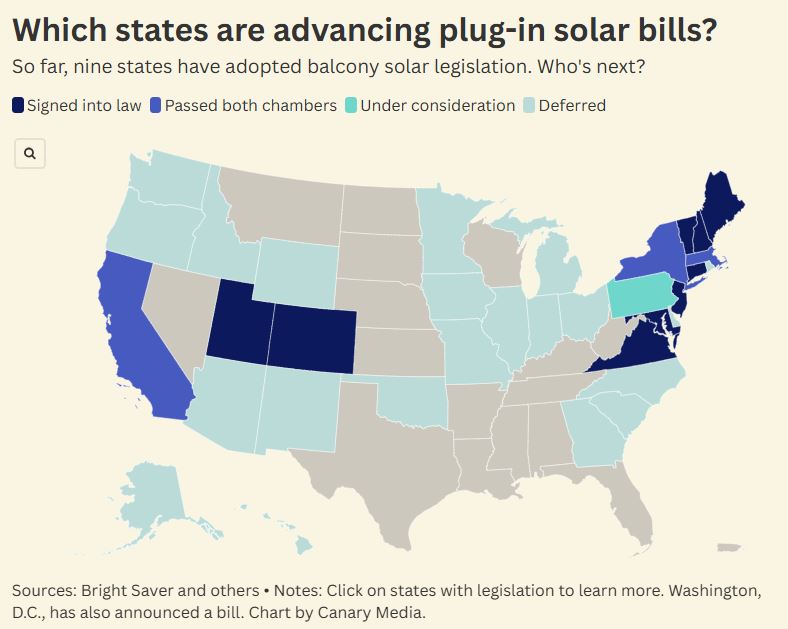
The above map is set to keep changing in the coming months as state legislatures that deferred their measures start new sessions and get back to work.
Still, even if you do live in a balcony solar–supporting state, you can’t simply run out to an Ikea to buy panels like you can in Germany. Just a few vendors are selling plug-in panel kits in the U.S., given the nuances of state and federal electrical codes. Only time will tell if American solar makers decide to get in the game — and which state will be the next to join the plug-in panel crew.
Bipartisan love for a nuclear renaissance
America is coming around on nuclear power. Case in point? Both the Trump administration and Democrats in California are backing the industry’s resurgence.
This week, the Trump administration closed its third loan to help a shuttered nuclear power plant fire back up, offering up to $1.9 billion to NextEra Energy as the firm restarts Iowa’s Duane Arnold Energy Center.
Meanwhile in California, leaders are rethinking the state’s ban on reactor construction and considering whether to stop its only operational nuclear plant from shutting down in the first place. The Diablo Canyon plant was supposed to cease operations in 2025, but California lawmakers already extended its life once, through 2030, and may let it run through 2045. The effort has support from the Trump administration, too, with the DOE awarding utility Pacific Gas & Electric $271 million to help it keep Diablo Canyon operating.
Carbon capture finally moves forward in Europe
Two major carbon capture facilities came online in Europe this week — big steps forward for an industry that has floundered around the world.
The first facility, Europe’s largest of its kind, opened at Yara International’s ammonia plant in the Netherlands. The system will capture and liquefy as much as 800,000 metric tons of carbon dioxide each year, which will be transported and stored beneath the seabed off Norway. A second, smaller carbon capture setup meanwhile opened in Germany. Cool Planet Technologies built the facility at a cement plant owned by materials giant Holcim, where it’ll capture as much as 10,000 metric tons of carbon dioxide annually to be reused in other industries.
Still, despite these wins, carbon capture firms have a long road ahead as they grapple with high costs, environmental and landowner opposition, and doubts about the tech’s viability as a climate solution.
On the bright side: The U.S. solar industry installed 11.4 GW of capacity in the second quarter of the year, up 43% from the previous quarter and 45% from a year earlier as the industry raced to take advantage of soon-to-expire federal incentives. (SEIA)
Clean spending falters: The pace of global investment in cleantech is leveling off after years of steady expansion, with spending dropping 17% in the first half of 2026 compared to the same period last year. (Clean Investment Monitor)
Bad news for batteries: The Trump administration’s vague executive order cracking down on foreign-made grid components could pose problems for the U.S. battery storage industry, which has thrived despite federal clean energy attacks. (Canary Media)
Look who’s back: Global coal demand is on track to rise again this year as war in the Middle East shakes up oil and gas markets and a powerful El Niño increases the need for cooling power. (IEA)
Lost in translation: A new poll finds that 57% of American voters say renewable energy advocates exaggerate just how cheap wind and solar power generation has become — but less than a third cite clean energy as a driver of higher power bills. (Heatmap)
Virginia’s climate choice: While Virginia hasn’t backtracked on its ambitious emissions goals, unlike some other states, a top utility’s plans for a major gas plant could make meeting the targets impossible. (Canary Media)
The solar-plus-storage project faced no opposition despite growing pushback to clean energy in the state — likely because of its brownfield location.
Clean energy scored a rare win in Ohio last month when state regulators unanimously approved a permit for 149 megawatts of solar and 149 MW of battery storage at the Hamden Energy site in Vinton County, located in the southeast quadrant of the state.
In contrast to most of the state’s solar permitting cases, no parties in the case opposed the project, proposed by developer Recurrent Energy, at the Ohio Power Siting Board — largely because it will be built on reclaimed coal mine land.
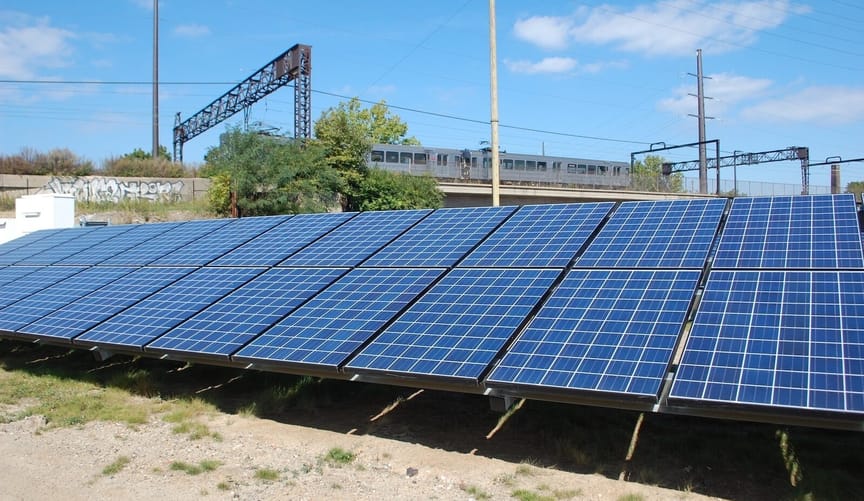
“Developing a solar project on reclaimed land is an excellent opportunity to harvest another one of the area’s abundant resources to power Ohio while providing supplemental tax revenue to support a legacy energy community,” said Ali Trunzo, a senior development manager for Recurrent Energy.
Like much of the rest of Appalachian Ohio, Vinton County has a history of hosting extractive industries — particularly coal, iron, and clay — whose production has plummeted over the last century. Although its economy has grown over the past 20 years, roughly 19% of the county’s residents live in poverty.
The county’s board of commissioners did not block the project, which they could have done under a 2021 law that erected extra hurdles for solar and wind power, but not fossil fuel generation.
Opponents of other solar farms in Ohio have frequently raised concerns about projects taking farmland out of use, although solar occupies less land than golf courses in the state and can coexist with some farming practices.
Projects on former mine lands and industrial brownfields, like Recurrent’s, tend to draw less opposition, although they have their trade-offs. Namely, they can be more expensive to develop than greenfields because of conditions at the location and the need to accommodate remediation, according to RMI, a clean energy think tank.
Trunzo declined to provide cost information about Recurrent’s Hamden Energy project, although she noted that specialized methods and equipment may need to be used to adapt to the site’s soils and terrain.
The roughly 25 people who commented in the case docket or spoke at a June 10 local hearing voiced mixed opinions. The most common concern was whether ongoing reclamation would be finished before construction started on the solar and battery project.
That remediation work is the responsibility of Cheyenne Resources, which holds the surface mining permit for the property, confirmed Andy Chow, a spokesperson for the Ohio Department of Natural Resources. Recurrent Energy has agreed to begin construction only after reclamation is done.
The Recurrent project is not the first coal-to-solar farm greenlit by the state. Regulators approved the Vinton Solar Energy Center in 2018, and the project remains under construction by developer Invenergy. Other states are siting solar at former mine lands as well.
More projects will likely follow in Ohio because of recent policy changes.
Under a 2025 law, House Bill 15, former mine lands and industrial brownfields are eligible for treatment as priority investment areas. Ohio has more than 70,000 acres that might fit that definition, RMI data shows. Rules from the Ohio Department of Development for designating such places took effect two months ago. Agency spokesperson Brian Bohnert told Canary Media the state has started to identify its first areas under the program. One of the two sites designated through late August includes both former coal mine land and an industrial site.
“The reuse of former mining land for new energy production is a win-win for Ohio consumers and the environment,” said Rebecca Mellino, associate director of climate and energy policy for The Nature Conservancy.
The Nature Conservancy’s view, Mellino said, is that HB 15 not only creates priority areas but also lets counties host solar on former mine sites and brownfields despite exclusions that might otherwise apply under Senate Bill 52, the 2021 enactment that added hurdles for renewable energy developments.
In many cases, solar energy is cheaper and can come online quicker than natural gas generation. Yet as projections call for the state’s electricity demand to grow, clean energy developers continue to face bans or project vetoes under SB 52. Beyond the statute’s terms, state regulators have often blocked projects on the basis of unanimous local government opposition, regardless of whether opponents’ arguments were based on opinion or grounded in fact.
A bill passed by the Ohio Senate this spring could make it even harder, if not impossible, for many solar and wind projects to get built. SB 294 is now in the Ohio House of Representatives.
“Projects like Hamden Energy are vital to bringing sustainable, affordable, and dependable energy online,” said Chris Tavenor, general counsel for the Ohio Environmental Council, which was a party in the case.
But, Tavenor cautioned, “without reform to the energy siting process, energy costs will remain high, and we will continue to see energy prices rise along with demand. We acknowledge this win, while also recognizing that we have much more work ahead.”
Roanoke City Public Schools is building the state’s first solar-plus-storage systems to keep emergency shelters going during extreme weather and cut down on costs.
As climate change intensifies, communities around the country are looking for ways to better prepare for extreme weather, from ice storms to heat waves. In Roanoke, Virginia, nestled in the Blue Ridge Mountains, that starts with the schools.
For years, the Roanoke City Public Schools district has been installing solar panels to lower electricity bills, minimize its carbon footprint, and teach students about clean tech. Now, the district is set to be the first in the state to invest in storage, with a solar-and-battery-powered microgrid at each of its two high schools, which double as official disaster shelters.
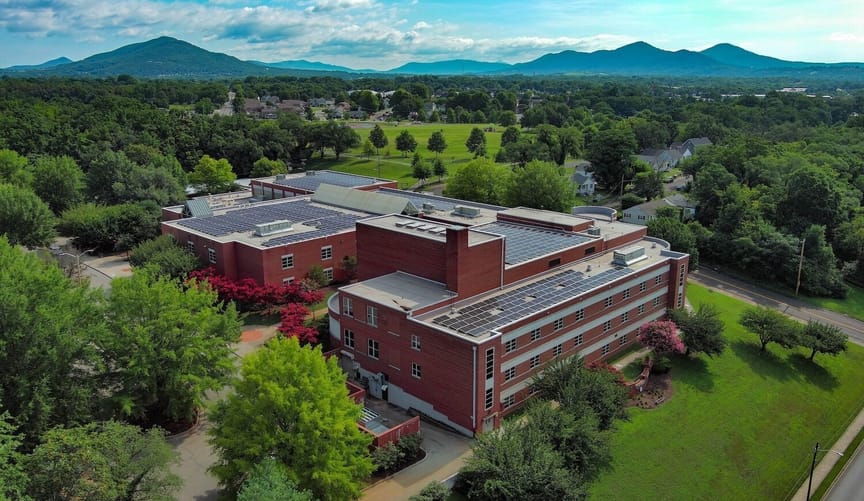
“They’ll run on the battery until such time as it’s discharged,” said Jeff Shawver, senior director of school plants for Roanoke City Public Schools. “Then the diesel generators are cut on. Then, the next day, the sun comes up, and you start charging the battery again. It just keeps the cycle going.”
Due to be installed by the end of the year, the storage systems will be among just a handful of batteries at school buildings around the country, according to Generation180, a national nonprofit headquartered up the interstate in Charlottesville. The dearth of sustainable microgrids at schools is problematic in the wake of natural disaster, since they account for 60% of all FEMA-designated relief shelters in Virginia and half of those nationwide.
“Schools are also the hubs where citizens vote, where groups gather, and now increasingly where neighbors need to huddle or seek shelter during emergencies,” said Tish Tablan, senior program director at the nonprofit and a former teacher. “So they’re just critical parts of our communities.”
The microgrid is funded partially by a grant from the state’s Department of Emergency Management and a donation from commercial solar installer Secure Solar Futures. “The grant has been around for a few years,” Tablan said. “They are the first to utilize it for a solar microgrid instead of diesel.”
The school district’s foray into batteries fits with its track record on solar. Serving some 14,000 students, the district leads the state on solar energy installations among schools, with nearly 9.4 megawatts planned for or already atop 29 rooftops and other sites.
The solar arrays are poised to cover 44% of the schools’ energy needs, cutting the school system’s electric bills by more than $22 million over 35 years. Because many installations come with new roofs, they’ll also help the district avoid $24 million in capital costs.
“We’re going to end up with most of our schools with at least a 25-year warranty on the roofs,” Shawver said. “For any facility manager, trust me: That’s a happy day for that person.”
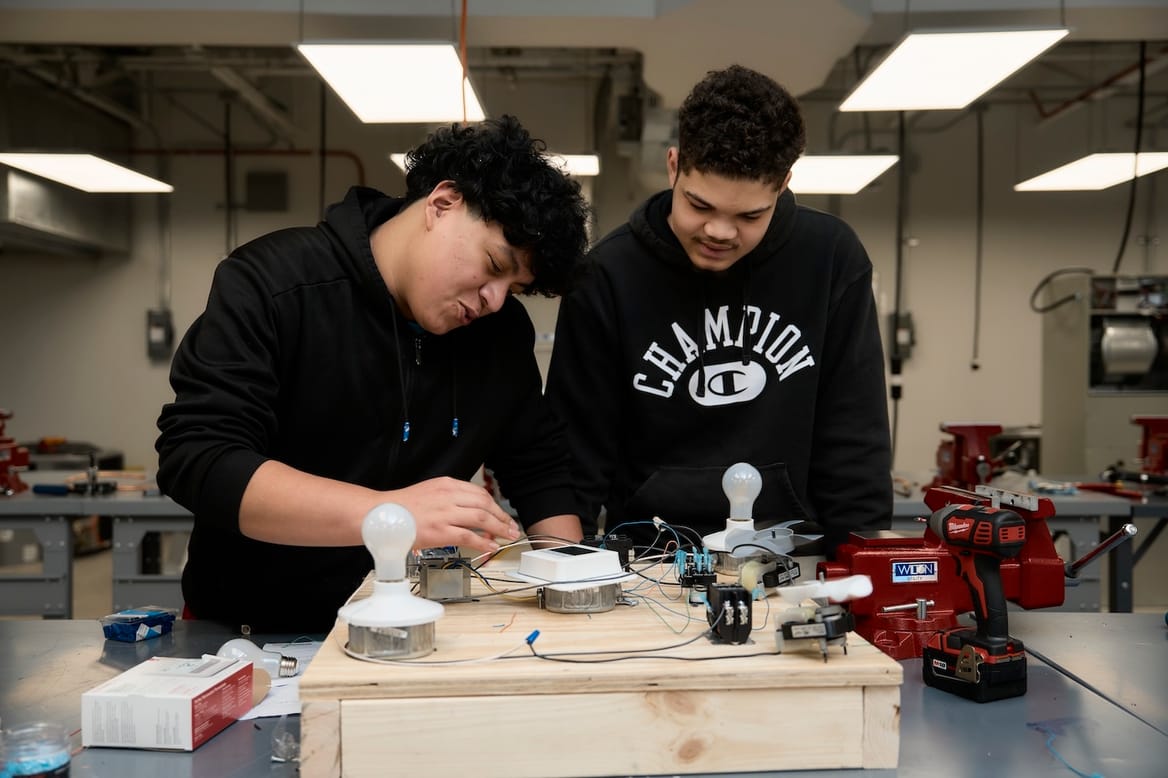
The installations also enable hands-on training for teachers and students in clean energy careers and technical educaton, and help minimize its climate footprint.
“It all works in tandem,” said Claire Mitzel, communications director for Roanoke City Public Schools. “We want our schools to be safe. We want them to be sustainable. We want our students to have access to high-quality learning environments.”
With their vast square footage, ample flat roof space, and relatively low energy needs after the sun goes down, schools are well suited for solar arrays. But installations didn’t really take off in Virginia until this decade, when schools got the ability to buy power from third parties other than investor-owned utilities, as well as the chance to sell excess solar power back to the grid.
“That’s what makes it doable,” said Shawver, who began negotiations with utility Appalachian Power back in 2018. “It’s been a long journey for us.”
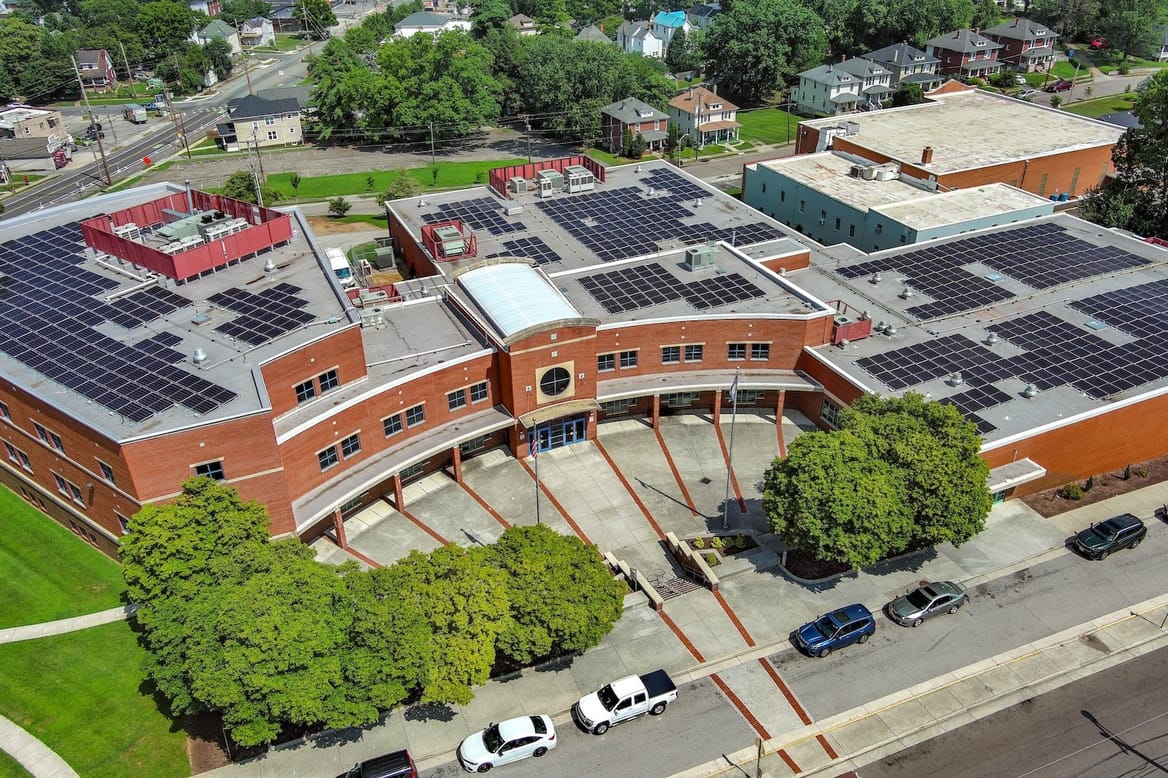
Today, Virginia’s K–12 schools rank 8th in the nation for solar power capacity, according to Generation180, with 83 megawatts on 236 campuses — the vast majority of installations owned by third-party companies. Nearly half the state’s solar-powered schools came online after 2020, when the solar-school-friendly policies were cemented in the Virginia Clean Economy Act.
Still, there’s plenty of room for growth — especially as electricity rates rise in the data center capital of the world. Generation180 data shows that California is far and away the national leader when it comes to solar on schools, with almost 900 megawatts. New Jersey, whose population is similar to Virginia’s, has the second-most school-solar capacity, with over 300 megawatts — three and a half times the amount in Old Dominion.
State leaders could take their cues from California, which requires all new school buildings to be equipped with solar and storage. And they could provide more funds, as Maryland, Massachusetts, and Pennsylvania do, for schools to invest in solar arrays.
But even without such support, Virginia schools have a big opportunity to install more sustainable microgrids. Tablan notes that the state grant program that Roanoke is using to help pay for its storage system is taking applications now.
“They just opened up a new round of funding,” she said. “They have $2.5 million available for fiscal year ’27.”
China has more solar capacity online than coal capacity. It’s a remarkable milestone, but the fossil fuel still generates far more electricity than solar does.
Solar is beating coal in China. Sorta. But also not at all.
Let me explain.
An eye-popping new chart made the rounds this week. It shows a line representing solar energy in China rising improbably over the last decade, until at last it overtakes another line that represents the nation’s vast coal fleet. One article featuring this chart came with the following headline: “Solar surpasses coal in China, becomes top power source.”
This is exactly the type of chart a person concerned about climate change could hope to see — one that would have defied the imagination of analysts and onlookers even a few years ago. It proves that the nation has been taking serious steps to clean up its coal-heavy grid, contra those who use China’s enormous emissions to justify climate complacency elsewhere.
But it’s also a bit misleading. While there’s nothing wrong with the data — solar really has overtaken coal in terms of capacity — the story is more complicated than a tidy chart can express.
To understand why, you’ll have to bear with some technical definitions. Capacity is the key word here: It’s a measure of the absolute maximum output a power plant can produce. But plants don’t run at full tilt, and experts use a metric called capacity factor to express how much electricity a facility actually produces compared with its potential output.
In China, coal has an average capacity factor of around 50%. Solar’s is only 14%.
That means China still generates way, way more electricity from coal than from solar panels, even though solar’s capacity now outweighs coal’s. At current capacity factors, China’s solar fleet would need to be about 3.5 times bigger than its coal fleet in order to generate more electricity.
The yawning gap between capacity and generation is, in part, the result of physical differences between coal and solar. You might have heard that solar only works during the day?
But in China, a big piece of the story is also underutilization. The country has built solar — and wind — so quickly that it is struggling to metabolize the renewable energy sources into its grid. The nation doesn’t have enough power lines to bring electricity to where it’s needed, or enough batteries to absorb all the energy that isn’t immediately used.
Due largely to these constraints, China had to curtail — or leave unused — more than one-quarter of its wind and solar power in the first half of this year. As a result, 360 terawatt-hours of carbon-free power went to waste, an amount larger than the U.K.’s entire electricity use last year.
So, yes, solar has won the capacity race in China, and that is a truly remarkable milestone. But the real race — the one that measures actual electrons generated — is still coal’s to lose.
1.5 degrees is off the table without carbon removal
The United Nations warned this week that the world will soon surpass the 1.5 degree Celsius warming target set by the Paris Agreement. This was evident to climate scientists monitoring the situation, but nevertheless marks a symbolic — and grim — milestone for efforts to mitigate the worst effects of climate change.
Now, the U.N. says, the only way to stay below the 1.5 degree threshold is to pull vast amounts of carbon dioxide out of the atmosphere and bury it underground. Large-scale carbon removal and sequestration is a largely unproven practice, and one that lacks a clear economic logic — the industry today rests largely on corporate benevolence from the likes of Microsoft, Stripe, Shopify, and other major companies. If the approach is technically capable of scaling up, it will still likely require government support to reach the levels the U.N. says are necessary.
Carbon removal may eventually save the day. Or it may not. What’s certain, however, is that the world needs to radically reduce the use of fossil fuels — and build a lot more carbon-free energy and vehicles.
California wraps up a chaotic legislative session
State lawmakers in California, which often sets the pace for climate policy in the U.S., passed dozens of energy and climate bills this session — including several we’ve reported on targeting
These bills, and many others, now head to Democratic Gov. Gavin Newsom’s desk.
But perhaps the more important story is what didn’t pass this year. The biggest deal: the collapse of last-minute efforts to reform the regulations that expose California utilities to potentially ruinous wildfire liability. Other notable legislative misses: Lawmakers were unable to secure funding for the state’s most successful virtual power plant — or to save about $200 million for a program that helps schools upgrade HVAC systems. —Jeff St. John
Want more California updates? Sign up for Jeff’s new newsletter, California Wire.
Guzzling less gas: China’s oil consumption dropped by 9% in the second quarter of this year compared with the same period in 2025 as more residents turned to EVs and public transit amid the war in Iran, causing overall emissions to fall by 1%. (Carbon Brief)
Battery boon: A new study shows that EV batteries last longer than expected, retaining about 90% of their original capacity even after more than 90,000 miles. (InsideEVs)
Battery boom: The U.S. built a record 20.2 GWh of battery storage in the second quarter of 2026, with most of that capacity coming from utility-scale installations. (Canary Media)
Let’s make a deal: Democratic governors are increasingly urging data center developers to offer community benefit agreements as backlash to their construction expands. (Politico)
Garden State solar: New Jersey Gov. Mikie Sherrill (D) signs a law officially authorizing residents to use plug-in solar panels, joining eight other states. (Gothamist, Canary Media)
Geothermal growth: Next-generation geothermal company Fervo Energy signs a major deal with Google, which will purchase nearly 400 MW of power from its Cape Station project in Utah. (Canary Media)
Fighting dirty for clean energy: A super PAC is fighting dirty on behalf of clean energy during this primary season — and is now targeting its first Democrat after a string of successes in GOP primaries. (Canary Media, Canary Media)
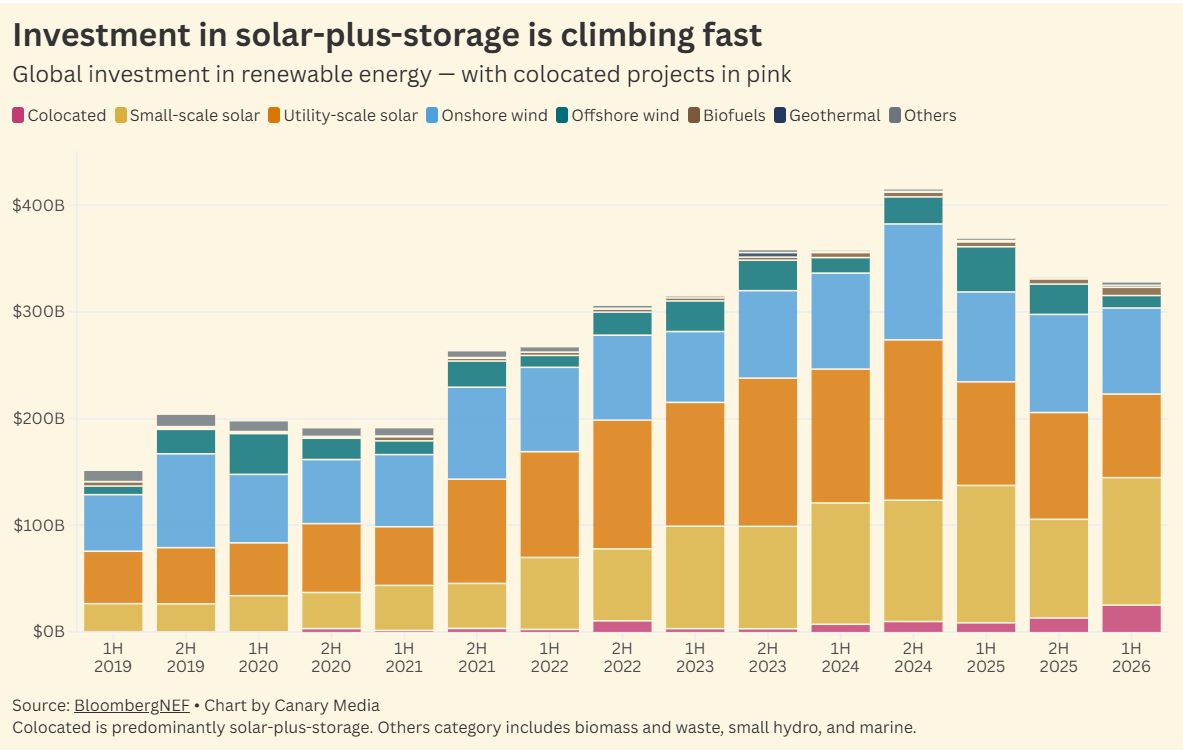
Investors spent a record amount in the first half of 2026 on projects that combine renewable energy — mostly solar — with batteries.
Peanut butter and jelly. Batman and Robin. Solar and storage. Some things just go together, and that’s why investors around the world are pouring more and more money into projects that pair rows of solar panels with boxes of grid batteries on the same site.
Colocated renewable energy projects attracted a record $25 billion of investment in the first half of 2026, according to new global data from BloombergNEF. While that category includes any combination of solar, wind, and storage, it’s dominated by solar-plus-storage.
The $25 billion is nearly double the previous record, set in the second half of 2025 — a jump that reflects the rapidly growing interest in batteries.
Solar’s biggest weakness is its up-and-down power generation. Solar farms produce no power at night (duh) and a ton of energy on sunny afternoons — fluctuations that often don’t align with demand. Adding storage to the mix helps solve that problem, allowing a project to act more like a traditional on-demand power plant that ramps up or down depending on power prices and the grid’s energy needs.
BNEF notes that the U.S. is one of the leading countries when it comes to investment in colocated solar-plus-storage. That makes sense: The grid battery sector is thriving in the U.S., just notching its best quarter ever for installations as the cost of battery cells falls and developers get more comfortable with the tech. Nearly half the storage capacity added last quarter was built alongside solar farms.
Although global spending on colocated projects jumped, the sector accounts for a relatively small chunk of overall renewable energy investment — a topline figure that stayed stagnant between the first half of this year and the second half of 2025. Investment in offshore wind, in particular, plummeted over that time period, with BNEF noting that factors like poor auction results in Denmark and Germany cut into the number of projects able to close financing in recent months.
Still, BNEF concludes that “the numbers show that the broader growth story for renewables remains intact.” But in order to bring down planet-baking pollution even as demand for energy spikes, the world will need overall clean-energy investment — not just that for colocated projects — to grow fast.
As an anchor tenant for several off-site arrays in development, the center will help spur investment and educate residents on the benefits of shared solar.
The Obama Presidential Center, which opened on Chicago’s South Side in June, features a museum full of mementos to democracy and the famous family, native prairie landscaping, an indoor basketball court, and other amenities. It will also be powered entirely by clean energy. Solar panels sit on the roof and on a garden pavilion, and a geothermal system heats and cools the complex. But the bulk of its power will be produced by community solar — the center will pay a set “subscription” fee to arrays located off-site.

The Obama Presidential Center will be the anchor tenant for several community solar projects that the Chicago-based company Reactivate is in the process of developing, slated to go online in 2027. Reliable anchor tenants are crucial to the success of community solar: They pay for large amounts — often 40% to 50% — of a project’s output, and can be key to persuading banks or other lenders to help finance a community solar array. The center’s subscription will cover about 6 gigawatt-hours of solar power annually, enough, along with its rooftop panels, for the entire campus.
The Obama Foundation, which runs the center, says community solar is a way to make clean energy accessible to renters, residents in multifamily housing, and those who aren’t able to afford or install solar panels on their own properties. That includes many people who live on Chicago’s South Side, where Obama cut his teeth as a community organizer decades ago.
Community solar delivers significant bill savings to households, especially in Illinois, where a state program guarantees robust benefits to low-income participants.
But in order to reap these savings, residents need to sign up. And too few of the people in marginalized neighborhoods who could benefit most do so, many solar advocates say.
Obama Foundation CEO Valerie Jarrett and Reactivate CEO Utopia Hill hope the Obama Presidential Center’s foray into community solar will raise awareness of, and trust in, the model so that it can help more residents struggling with their energy bills on the South Side and beyond.
They also expect the Obama Presidential Center will set an example for other mission-driven nonprofit organizations and companies to become anchor tenants.
“The foundation sought to use its buying power to catalyze the development of new renewable-energy generation sources,” Jarrett said.
“It is the foundation’s hope that this partnership with Reactivate will encourage other equity-focused organizations to consider community solar as a cost-effective way of procuring renewable energy.”
While Reactivate and other community solar developers in Illinois have signed up thousands of subscribers for their projects, they agree that people are often skeptical of the concept — especially in low-income and Black communities that have sometimes been targeted by predatory lenders and other unscrupulous businesses. Illinois lawmakers and consumer watchdogs, for example, have long struggled to rein in retail electric suppliers that offer residents energy plans under terms that end up being exploitative.

Hill, who grew up in a working-class Chicago suburb, said that people often respond to an offer of guaranteed savings with “What’s the catch?”
“There is no catch. It’s just an opportunity,” Hill said. “Having a well-established name [with the Obama Presidential Center] will hopefully help people understand that community solar is a real program that will provide savings.”
A series of Illinois state clean energy laws created robust incentives for community solar development, with particularly generous support for low-income residents and those in environmental justice communities, who are guaranteed savings equal to at least half of the value of the energy generated from their solar subscription.
The program has spurred the installation of community solar arrays located in and serving communities like Waukegan in northern Illinois, a heavily industrial area where community solar built on a landfill provides clean energy and savings to about 1,000 households and the local school district.
A community solar project developed by Reactivate — which focuses on marginalized and underserved communities — in a Chicago suburb provided a total of $186,000 in savings last year to its 650 subscribers, 44% of whom earn less than $20,000 a year.
Mercy Housing, a national nonprofit affordable housing developer, is the anchor tenant for two Reactivate community solar projects that went online in 2024.
The benefits go to two Chicago-area Mercy buildings, with 96 and 65 living units. Mercy Housing senior environmental analyst Max Stewart said they’ve seen significant savings on energy bills, money that can be reinvested into energy efficiency or resident services, and help keep affordable housing projects sustainable. He noted that it can be hard to find organizations willing to make such a big commitment to community solar.
The opportunities available to anchor tenants should get “more awareness,” Stewart said. “It always helps to have someone leading the way.”
Interior is using tax dollars to pay firms to ditch offshore wind leases and invest in fossil fuels instead. California just became the eighth state to sue to stop it.
The Trump administration has agreed to fork over nearly $4 billion since the spring to get major energy firms to abandon a dozen leases for U.S. offshore wind projects.
The controversial maneuver to return lease payments to developers — often in exchange for their investing in fossil fuels — is part of President Donald Trump’s broader strategy to stymie the clean energy resource, which coastal states have been depending on to meet their growing need for reliable and affordable electricity. The buyouts began as Trump’s earlier efforts to halt in-progress offshore wind farms largely failed under scrutiny from federal judges.
Now the unprecedented lease-refund approach is increasingly facing legal blowback of its own. Late last week, California became the eighth state to challenge the practice, arguing that it jeopardizes the state’s investments and resulting jobs in offshore wind.
The U.S. offshore wind industry had already been struggling before Trump began issuing stop-work orders, freezing permitting, and rolling back tax credits. High inflation, rising interest rates, and supply-chain constraints in recent years threatened to derail a handful of projects along America’s coastlines.
That’s why it’s all the more bizarre that the federal government is proactively paying developers to walk away from beleaguered, undeveloped projects, James Sallee, a business professor at the University of California, Berkeley, recently argued in the Energy Institute Blog. He likened the buyouts to spending billions in taxpayer dollars “to shoot a corpse.”
But for states that were banking on gigawatts of offshore wind power to shore up their grids and hoping the industry could rebound after Trump leaves office in 2029, the agreements are like salt in their wounds — particularly given the deals’ legally questionable nature. Here’s the latest on states’ legal challenges and congressional pushback.
California’s new lawsuit focuses on the agreement between the U.S. Department of the Interior and the company Golden State Wind, which paid $120 million in 2022 to lease waters along California’s Central Coast through a competitive bidding process.
Golden State Wind had planned to develop a 2-gigawatt offshore wind farm using floating turbine technologies in a large swath near Morro Bay. The company is owned by Ocean Winds North America — a joint venture of the European firms Engie and EDP Renewables — and the U.K. offshore wind developer Reventus Power.
In late April, Interior said it would return the $120 million to Golden State Wind. In exchange, the developer agreed to invest the same amount of money in U.S. liquified natural gas facilities and other fossil-fuel projects. Ocean Winds also struck a similar deal that month to get back the $765 million it paid to lease water for Bluepoint Wind, a fixed-bottom project near New York and New Jersey.
California’s challenge — filed by state Attorney General Rob Bonta (D) and the California Energy Commission — asks a federal court to strike down the agreement with Golden State Wind, saying the deal is “blatantly unlawful.”
Offshore wind experts and former Interior officials have previously questioned whether Interior’s Bureau of Ocean Energy Management has the legal authority to return the funds it collects from leasing federally controlled waters. They noted that when oil major Royal Dutch Shell relinquished its offshore leases near Alaska in 2022, the company simply ate the $2.1 billion loss.
California raises the same concerns in its lawsuit and claims Interior improperly tapped the federal Judgment Fund, which Congress intended to be used to settle lawsuits, not to pay for voluntary agreements like this one.
“Offshore wind presents an opportunity for our state to scale up an innovative new clean energy industry that reduces pollution while providing new jobs and investment for the people of our state,” David Hochschild, chair of the California Energy Commission, said in an Aug. 28 news release. “We will not let the Trump administration’s reckless actions turn back the clock.”
Interior has separately moved to cancel and refund two other offshore wind leases in California, with the developers Invenergy and RWE, though neither were named in the lawsuit.
In announcing the legal challenge last week, California Attorney General Bonta accused the Trump administration of using the buyouts to “line the pockets of their Big Oil donors.”
A day earlier, The Washington Post broke the news that another offshore-wind deal with German energy firm RWE will generate a giant payday for one of Trump’s neighbors near Mar-a-Lago.
In early August, Interior agreed to hand over $1.22 billion to RWE to give up its leases off the coasts of California, Louisiana, and New York. As part of the deal, RWE said it would spend $900 million on a stake in a huge Louisiana liquefied natural gas terminal — a stake it’s buying from a private equity fund run by Michael Dorrell, one of Trump’s million-dollar donors, who owns a mansion near the president’s Florida estate.
The administration told the newspaper that it had no involvement in the decision to pick the Louisiana gas project, and RWE said it made its investment plans independently. But for critics of the lease agreements, the revelation only solidified their suspicions. California Rep. Jared Huffman, the top Democrat on the House Natural Resources Committee, said he would expand an ongoing probe of the deals to include the ties to Dorrell’s firm.
“In writing and to their faces when I meet with these energy company CEOs, I am telling them, ‘You better tell your shareholders we are coming for that money,’” he told The Washington Post. “I would not even cash the check.”
As the legal fight heats up in California, an ongoing challenge on the East Coast continues to play out in court.
Earlier this summer, New York and six other Democratic-led states sued Interior over its $795 million agreement with the French energy giant TotalEnergies. In March, the company became the first developer to reach such an arrangement with the government — creating a “blueprint” for other offshore wind leaseholders to follow, according to the lawsuit.
Under the deal, TotalEnergies agreed to forfeit its lease for a large area near New York and New Jersey, where it had aimed to develop over 3 GW of offshore wind power to provide clean electricity for more than a million homes across the two states. Five New England states were also slated to benefit from the wind farm, since they regularly import energy from New York.
In exchange for ditching the project, Interior said it would “reimburse” the developer for the $795 million it paid in a 2022 auction, funds that TotalEnergies promised to invest in fossil fuel projects. At the same time, the company signed a similar, separate deal to cancel the $133 million lease for its planned 1-GW Carolina Long Bay project near North Carolina.
Similar to California, the seven East Coast states argued the New York–New Jersey lease cancellation was “arbitrary and capricious,” since the administration didn’t follow proper procedures or provide a clear reason for striking the agreement, along with violating the Judgment Fund Act. The challenge is still moving through the early procedural stages in a D.C. federal court.
While the eastern states are hoping for a much larger expansion of offshore wind, the few projects they do have are already benefiting the region’s grid — including during recent heat waves and brutal cold snaps. Even with the Trump administration’s attacks, at least a few more gigawatts are slated to come online in the coming years.
Teaming up to buy solar can get residents deep discounts. Virginia is the first to try a statewide campaign as utility bills rise and data centers stress the grid.
Last month, Virginia became the first state in the country to launch a bulk-purchasing campaign for rooftop solar — a move that promises to bring down the cost of installing panels for households across Old Dominion.

The idea behind the program, called Switch Together, is simple: Solar panels come cheaper by the dozen. Trusted solar installers can pool demand to purchase equipment in bulk and pass the discounts on to participants.
Solar United Neighbors, the nonprofit running the initiative, has for years used this model on a local scale in communities around the U.S. But it’s now expanding statewide in Virginia at the urging of the office of Gov. Abigail Spanberger, a Democrat, who is looking for ways to lower energy bills as utilities jack up rates in the world’s data center capital. Rooftop solar both slashes power costs for homes that install it and can drive down expenses for utility customers at large.
“If more people go solar, that’s less strain on the grid, and there’s less need to build costly infrastructure that the entire rate base would actually pay for,” said Brandon Praileau, SUN’s Virginia program director, who joined the group in 2023 after rooftop solar helped his church in Norfolk cut utility bills by a quarter.
The state is not providing any funding for Switch Together, though its partnership promises to amplify the reach of the bulk-purchasing effort, which is focused on solar but also offers residents access to cheaper home batteries, EV chargers, and, in some locations, heat pumps.
Since Spanberger announced the initiative in July, more than 4,300 residents, small businesses, and nonprofits have put their names down to receive more details, and 120 have signed contracts, according to SUN.
The campaign is set to end Oct. 15. By the time the bulk-purchasing drive is over, Praileau expects those figures will swell to 5,000 requests for info and about 500 signed contracts. “We’re talking about a utility-scale amount of solar with those numbers,” he said. “Almost 4 megawatts.”
The rooftop panels are expected to cut $2,200 off the average annual utility bill. Exactly how much households save on installation varies across the state, but it ranges from 20% to 30% off — vital discounts after the Trump administration and Republicans in Congress killed the 30% federal tax credit for households investing in renewable energy.
Over the years, SUN has backed a variety of bulk-purchase models, including recruiting potential participants on its own. But lately, SUN’s secret sauce involves a partnership with local governments, whose seal of approval lends credibility and whose outreach encourages more would-be solar owners.
In Richmond, for instance, a SUN-only campaign resulted in about 20 new solar rooftops. A second push for bulk sign-ups that included mailers from the local government led to about three times as many households adding rooftop panels.
“That level of direct marketing has proved to be the whole difference-maker,” Praileau said.
The success of SUN’s efforts in the D.C. metro area, which includes northern Virginia, drew the attention of Josephus Allmond, a longtime environmental lawyer in the state who now serves as Spanberger’s chief energy officer. “We thought we could drive deeper savings if we opened up the whole state,” Allmond said at an event in Charlottesville last month. “So that’s what we did.”

While the governor’s endorsement is crucial, the expansion is easier said than done: Finding enough trusted rooftop solar companies in every nook and cranny of the state is one limiting factor. For now, only “extreme southwest Virginia” is left out of the campaign that spans 100 counties and cities, Praileau said, since SUN couldn’t vet installers there in time for this year’s rollout. But he believes that will change by next year, when Switch Together hopes to conduct another drive in partnership with the state.
Helping residents go solar through bulk purchasing is just one piece of SUN’s mission; the group also works to bring solar owners together to fight for clean energy policies. That’s part of why Praileau is encouraged by the breadth of sign-ups.
“We’re seeing interest across the entire commonwealth, from places where you would not expect people to be looking for solar,” he said, such as the politically conservative Shenandoah Valley and the New River Valley. “That wide spectrum just goes to show how interested Virginians are at lowering their energy costs.”
While Virginia is unique in some ways, plenty of other states face similar challenges of rising electricity costs and crushing demand from data centers. They, too, could roll out voluntary bulk-purchasing efforts.
“We’re definitely taking note of what works best, of best practices, so that we can offer a road map for others to be able to duplicate networks like this,” Praileau said. “I think this is ultimately a model for any state.”
Analysts are trying to measure the damage President Trump has done to the energy transition so far — and determine where federal climate policy should go from here.
Glass half-empty or glass half-full?
The classic question is now gripping the policy wonks who are trying to measure the damage President Donald Trump has inflicted on the U.S. energy transition — and to figure out what direction to take climate policy from here.
In July, the MIT Center for Energy and Environmental Policy Research released a report arguing that, when it comes to cutting emissions from the electricity sector, the glass remains half full despite Trump’s policies. Report author Lily Bermel found that U.S. power sector emissions are still on track to decline substantially by 2035.
Other analysts and energy modelers are more pessimistic. Amanda Levin of the Natural Resources Defense Council published a rebuttal in Heatmap this week, highlighting a recent peer-reviewed study and modeling from Energy Innovation that finds the U.S. will achieve less than half of the emissions reductions it would have under Biden-era policies. (To be clear: Those are economywide figures, while Bermel is focused on the power sector.)
Let’s state the obvious: No one really knows how full or empty the glass is. The factors that will make or break the next decade of the energy transition are incredibly hard to model.
Right now, clean energy is booming. Yes, Trump eliminated tax credits for wind and solar, but lots of projects were able to grandfather in their incentives so long as they finish construction in four years. Most modelers expect clean-energy deployment to look pretty healthy until 2030, though it’s possible Trump’s persistent efforts to stymie permitting for solar and especially wind will lead to more cancellations.
But after 2030, as Canary Media’s Julian Spector put it in a July article on the Rhodium Group’s analysis of this question, all bets are off.
The range of possibilities in Rhodium’s report is astonishing: In the most optimistic of its three scenarios, the U.S. continues building clean power at the blazing speed of roughly 53 gigawatts per year from 2030 to 2040. In the most pessimistic scenario, in which Rhodium assumes lower natural gas prices and higher clean energy costs, renewable additions drop to an average of just 3 GW per year. There’s also the wild card of data centers, which are driving big but uncertain demand for new gas power plants.
The early 2030s are the hinge years. And their outcomes depend on a medley of unknowable future market forces — and on the results of the 2028 U.S. presidential election.
That brings us to the second leg of this debate: Given where the energy transition is at, what should Democrats do if they regain power in 2029?
Bermel argues that the Dems should forget about reinstating the tax credits for mature wind and solar tech. In her view, it’s time to move on and prioritize permitting reform as well as efforts to boost earlier-stage “clean firm” tech like geothermal and advanced nuclear.
Levin at NRDC agrees that permitting reform should be a priority. But she makes the case that wind and solar tax credits are still important because they guarantee that these carbon-free technologies will beat fossil fuels — namely gas — on price. Plus, tax credits mean utility customers pay less for large-scale clean energy projects, which is crucial as bills rise and Trump’s policies make renewables more expensive.
That last point about affordability has been echoed by some in the industry. Kevin Smith, CEO of the clean energy developer Cypress Creek Renewables, made a similar case during a recent conference. “We can compete without tax credits right now,” he said of clean energy companies. “The issue is affordability. And I think the Democrats will start pushing tax credits as an affordability issue, and they may have a point.”
Tesla’s solar roof shingles are officially toast
Nearly a decade ago, Elon Musk borrowed the set of “Desperate Housewives” to show off Tesla’s newest product: solar-generating tiles that cover a rooftop like shingles. Tesla would be putting the solar tiles on 1,000 roofs a week by 2020, Musk predicted at the time. But by the time 2022 rolled around, Tesla had only installed about 3,000 solar roofs, and the tiles only made up 0.17% of residential solar capacity installed in the U.S. that year.
Now, as Julian Spector and Dan McCarthy report, Tesla is discontinuing its solar shingles, and will instead double down on traditional solar panels. The company recently announced plans to build a $10.1 billion solar cell factory in Texas that it says will be able to churn out 100 GW of integrated solar panels each year.
That would be a huge deal — if it happens. Altogether, every solar factory in the U.S. can only make a combined 65 GW of panels each year, so Tesla would have to take its manufacturing capacity through the roof to make that happen.
Clean energy is on track for a war-spurred milestone
Despite stagnant investment, renewables are still on track to hit a global milestone in 2026.
According to a fresh BloombergNEF analysis, the world invested about $327.5 billion into solar, wind, and other renewable energy sources in the first six months of 2026 — about the same amount as in the second half of 2025. Investment in standalone utility-scale solar power actually shrank to its lowest level in years, but investment in solar-plus-storage hit a record of more than $25 billion, while residential solar investment also skyrocketed.
While coal power generation has rebounded this year amid oil and gas shortages spurred by the war in Iran, clean power sources are expected to produce more electricity than coal for the first time ever this year, the International Energy Agency estimates — and surging demand for rooftop solar is a big reason why.
Trump’s electrical blackout: President Donald Trump bans the “acquisition, importation, transfer, or installation” of foreign-made bulk-power electrical equipment from certain countries, though the DOE will first have to determine targeted equipment’s risk before the order can bar their import. (Project Finance)
The Army goes nuclear: The U.S. Army plans to award up to $2.2 billion to five companies to build small nuclear reactors at military bases around the country, with Antares Nuclear, General Atomics, and Westinghouse among the awardees. (New York Times, Axios)
Canada fights back: Ontario Premier Doug Ford threatens to slow or halt power exports to the U.S. in response to the Trump administration’s new tariffs on a range of Canadian goods. (Utility Dive)
Data-center gas-plant update: Around 189 gigawatts of natural gas capacity to power data centers has been announced, entered pre-construction, or started being built, up from 97 GW at the end of last year. (Heatmap, Global Energy Monitor)
Wind’s Maine event: After nearly two decades spent trying to build utility-scale wind power in its far northern reaches, Maine has finally approved an 800-MW array and a 1.2-GW transmission line that will be built near the Canadian border. (Canary Media)
Not-so-public comment: The U.S. EPA looks to eliminate a federal requirement that states seek public input on applications for air pollution permits for data centers and other industrial facilities. (New York Times)
Solar saves Europe’s summer: Europe has seen record heat and drought this year that has jeopardized power production from nuclear, fossil fuel, and wind sources, but solar performed better than normal and helped keep ACs running amid sky-high temperatures. (Grist)


.svg)
