

 Back
Back
OIL & GAS: After a judge ends the Biden administration’s pause on new liquefied natural gas projects, observers say the 6-month delay may end up being “little more than a speed bump” for the growing industry, as it didn’t affect terminals under construction and only delayed a few projects. (Grist)
ALSO:
STORAGE: A national clean energy group releases a model ordinance for local governments to use for regulating the permitting, siting, safety and decommissioning of energy storage systems. (Utility Dive)
EMISSIONS: Google says its greenhouse gas emissions have jumped 48% over the past five years, in part because of its implementation of AI. (The Guardian)
WIND: Federal officials give their approval for the 2.8 GW Atlantic Shores project, the first offshore wind facility in New Jersey. (Power Technology, NJ Biz)
SOLAR: The U.S. Supreme Court orders a lower court to reconsider a 2023 ruling affirming federal regulators’ approval of a solar-plus-storage facility in Montana after overturning the Chevron deference doctrine. (E&E News)
ELECTRIC VEHICLES:
CARBON CAPTURE: A Western governors group’s decarbonization report calls for pioneering industrial and natural carbon capture and sequestration efforts, but says little about reducing fossil fuel burning or transitioning to clean energy. (Inside Climate News)
PIPELINES: North Dakota Gov. Doug Burgum could play a key role in deciding whether a carbon pipeline can move forward, as his political profile rises and he balances donor influence and landowner opposition. (CNN)
COAL: Unprecedented federal funding from the Bipartisan Infrastructure Law is helping Southwest Virginia diversify its economy through redevelopment of abandoned mine land sites. (Virginia Mercury)
GEOTHERMAL: A Colorado report predicts state investment will spur industry to develop several utility-scale geothermal electricity plants in coming years. (Colorado Sun)
EMISSIONS: Amid ongoing consideration of Duke Energy’s plan to meet North Carolina’s carbon emission goals, the state consumer advocate criticizes the utility for failing to leverage a federal loan program to save ratepayers hundreds of millions and build more clean energy. (Energy News Network)
ALSO:
OVERSIGHT: The U.S. Supreme Court declines to take up a case challenging the statewide election of Georgia’s energy regulators, essentially clearing the way for elections to resume in 2025. (Associated Press)
GRID:
OIL & GAS:
SOLAR: A Virginia county planning board recommends against approving a solar farm on 2,000 acres. (WCYB)
COAL: Alabama residents complain that a mining company and public officials are ignoring their concerns about a growing underground coal mine with a lengthy list of safety violations that culminated in a fatal explosion in March. (Inside Climate News)
WIND:
ELECTRIFICATION: The mayor of Miami-Dade County, Florida, announces Miami will be the first major cruise port on the Eastern Seaboard to implement shore power, which allows cruise ships to cut their engines and plug into landside electrical power. (Miami’s Community News)
OVERSIGHT: Virginia Gov. Glenn Youngkin announces the expansion of a website to give the public more information about pending permits at six agencies, including the state’s energy and environmental regulation departments. (Virginia Mercury)
COMMENTARY:
CLEAN ENERGY: Renewable energy developers in Ohio are pessimistic about accessing Inflation Reduction Act tax credits as they attempt to overcome fossil fuel-backed groups’ misinformation and burdensome state regulations. (Floodlight)
ALSO:
SOLAR:
WIND: Two central Wisconsin towns are being sued for overly strict wind energy rules that challengers say are more restrictive than state regulations. (WPR)
ELECTRIC VEHICLES: Michigan school districts report initial technological challenges with electric school buses, though supporters say a pilot program is gathering key usage data. (MLive)
CARBON CAPTURE: The developer of a large carbon capture project at a North Dakota coal plant delays a final decision on construction as costs increase and regulatory concerns grow. (E&E News, subscription)
PIPELINES:
OIL & GAS: Unregulated gas certification programs that aim to help the fossil fuel industry label natural gas as a clean fuel are a “greenwashing scam,” according to a new report from environmental groups. (Inside Climate News)
UTILITIES: A federal administrative law judge rules that a North Dakota electric cooperative should return $471 million to customers for costs that shouldn’t have been included in rates for a non-utility coal gasification plant. (KFGO)
BIOFUELS: Environmental groups want the federal government to require large biofuel plants to install air pollution monitoring devices and tighten the enforcement of air pollution permits. (MLive)
HYDROELECTRIC: A southern Minnesota hydroelectric dam is in “imminent failure condition” as high river levels caused water to breach the side of the facility and wash away a nearby substation. (MPR News)
OIL & GAS: Federal regulators approve the $10 billion Calcasieu Pass 2 liquified natural gas export terminal in Louisiana despite the Biden administration’s pause on permitting such projects; the company says it’s still waiting for approval to export the fuel. (Floodlight)
ALSO: Virginia residents protest potential construction of a 1,000 MW gas-fired power plant, although a Dominion Energy official says it hasn’t yet finalized its decision where to build the project. (WRIC)
CLIMATE: An Alabama grant program to strengthen roofs to lower insurance premiums and stave off a climate-related withdrawal by insurance companies has become a model that’s been replicated by at least five other states. (Stateline)
SOLAR:
NUCLEAR:
HYDROGEN:
EMISSIONS: The U.S. Supreme Court pauses the U.S. EPA’s planned “good neighbor” rule to reduce the amount of smog that crosses state lines, which was challenged by West Virginia, Indiana, Ohio and industry groups. (Texas Tribune)
PIPELINES: A firm files a lawsuit by 35 Oklahoma landowners to force a pipeline company to clean up their properties. (KWTV)
OVERSIGHT:
COAL: An energy company tells Texas regulators it plans to restart a 779 MW coal-fired unit that’s been down since March for maintenance. (Reuters)
GRID:
CLEAN ENERGY: An Oklahoma economic development authority receives $100,000 in federal funding to attract clean energy companies. (KWTV)
COMMENTARY: A West Virginia lawmaker touts the state’s oil and gas industry along with the potential for carbon capture and hydrogen projects. (Charleston Gazette-Mail)
A new analysis says Vermont is not on track to meet its 2025 target for reducing greenhouse gas emissions, with declines in thermal fossil fuel use driven mostly — though not entirely — by warming winters.
The study, released last month by the Vermont nonprofit Energy Action Network, also shows signs of progress: Though rising temperatures are still the main driver of lower heating fuel sales, weatherization and electric heat pump adoption are starting to have a greater impact.
“Vermont’s efforts… are, ironically, being aided by the very global heating that we are working to do our part to help minimize,” the study says. “Relying on warmer winters to reduce emissions from fossil heating fuel use is not a sustainable strategy. … What [the warming trend] means for temperatures — and therefore fuel use — in any given year is still subject to variation and unpredictability.”
Like most other New England states, Vermont relies heavily on heating oil and, to a lesser degree, propane and utility gas, to heat buildings. This makes the building sector a close second to transportation in terms of the biggest contributors to planet-warming emissions in Vermont and many of its neighbors.
Vermont’s statutory climate targets, adopted in 2020, aim to cut these emissions by 26% below 2005 levels by next year, with higher targets in the coming decades.
“It’s technically possible” that Vermont will meet its thermal emissions goal for next year, but “at this point, primarily dependent on how warm or cold the fall and early winter heating season is at the end of 2024,” EAN executive director Jared Duval said. The transportation sector would need to see a nearly unprecedented one-year decline.
On the whole, EAN says it’s “exceedingly unlikely” that Vermont will meet its 2025 goal.
EAN found that heat pump adoption and weatherization are not happening fast enough, and what’s more, the current trend sets Vermont up for a Pyrrhic victory at best: Rising temperatures in the upcoming heating season would have to be at least as pronounced as in last year’s record-warm winter in order to reduce fuel use enough to meet the 2025 target for the thermal sector.
Either way, warming alone won’t get Vermont to its 2030 target of a 40% drop in emissions over 1990 levels, Duval said. The state wants to end up at an 80% reduction by 2050.
“The only durable way to reduce emissions in line with our science-based commitments is to increase the scale and pace of non-fossil fuel heating solutions and transportation solutions,” he said.
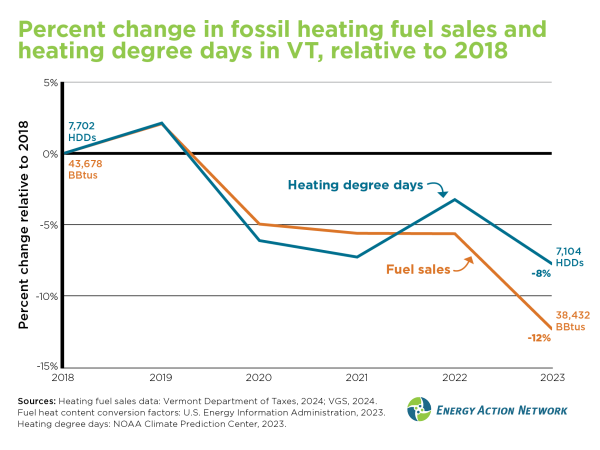
The EAN study found that fuel sales tend to decline alongside heating degree days: a measurement of days when it’s cold enough to kick on the heat. Vermont is seeing fewer of these days overall as temperatures warm.
“The reduction in fossil heating fuel sales as winters have been warming is not surprising,” Duval said. “Historically, fossil heating fuel use and therefore greenhouse gas emissions have largely tracked with heating demand, with warmer winters corresponding with less fossil fuel use and colder winters with more fossil fuel use. The good news is that’s not the whole story.”
In recent years, he said, fuel sales have begun to “decouple” from the warming trend to which they were once more closely linked. From 2018 to 2023, EAN found that Vermont fuel sales declined 12% while heating degree days only declined 8%.
“Fossil heating fuel sales are declining even more than you would expect just from warmer winters alone,” Duval said. “And that’s because many non-fossil fuel heating solutions are being adopted.”
From 2018 to 2022, EAN found, Vermont saw a 34% increase in weatherization projects and more than 50,000 more cold-climate heat pumps installed in homes and businesses, with a 3.3% increase in the number of homes that said they use electricity as their primary heating fuel.
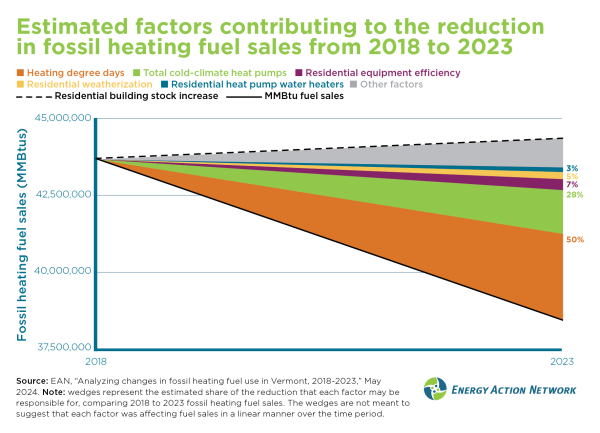
The upshot: The number of cold days explains 50% of Vermont’s declining fuel use from 2018 to 2023, while heat pump growth explains as much as 28% and other efficient upgrades explain a further 15%. The remaining 7% of the decline couldn’t easily be broken down and could partly be from people shifting to wood heat during periods of high fuel prices, Duval said.
“In order to achieve thermal sector emissions reduction targets without relying primarily on an abnormal amount of winter warming, significantly more displacement and/or replacement of fossil heating fuel… will be necessary,” the study says. Upgrades like heat pumps will lead to more sustainable emissions cuts, it says, “no matter what the weather-dependent heating needs in Vermont will be going forward.”
EAN is nonpartisan and doesn’t take policy positions, but research analyst Lena Stier said this data suggests that expanding Vermont’s energy workforce and tackling heat pumps and weatherization in tandem would spur faster progress on emissions cuts, while keeping costs low.
EAN based its estimates of fuel use and emissions impacts from heat pumps on the official assumptions of a state-approved technical manual, which Duval said may be overly optimistic. But Stier said the reality could differ.
“We’ve heard anecdotally that a lot of people who have installed heat pumps in their homes… are kind of primarily using them for cooling in the summer,” she said. “So our kind of assumption is that, in reality, it would be a smaller share of that (fossil fuel use) reduction coming from heat pumps.”
While fuel use declined overall in the study period, he said this came mostly from people using less heating oil specifically — propane sales actually increased in the same period.
Duval noted that propane is cheaper than oil on paper, but actually costs more to use because it generates heat less efficiently than oil does.
“Once you look at that, then heat pumps become that much more attractive,” he said.
Editor’s note: This story has been updated for clarity.
COAL: Stalled efforts to redevelop a former coal plant property in Indiana reflect a broader struggle for local officials who face legal obstacles when seeking to repurpose contaminated power plant sites. (Inside Climate News)
ALSO: An Iowa Environmental Council study says pollution from two MidAmerican coal plants over a 20-year period caused 165 premature deaths and higher rates of asthma, COPD and heart disease. (Radio Iowa)
PIPELINES: After Iowa legislation to limit the use of eminent domain for carbon capture pipelines fails for a third straight year, lawmakers and activists vow to try again next year. (Cedar Rapids Gazette)
ELECTRIC VEHICLES: General Motors will stop producing the Chevrolet Malibu and invest $390 million in a Kansas assembly plant to make more electric vehicles. (Reuters)
FOSSIL FUELS: Ohio House lawmakers pass a bill allowing a facility that burns coal to produce coke used in the steelmaking process to claim renewable energy credits. (Cleveland.com, subscription)
CLEAN TECH: Researchers at a national laboratory in Iowa are researching ways to convert non-recyclable plastic into fuels, oils and other materials. (Iowa Capital Dispatch)
GRID:
SOLAR:
CLIMATE: Michigan becomes the latest state to propose a constitutional amendment to enshrine clean water, air, soil and a stable climate as a fundamental right, which in some states has led to limits on oil and gas drilling. (Planet Detroit)
EFFICIENCY:
COMMENTARY: An Ohio farmer says the East Palestine train derailment that damaged his property also opened his eyes to the benefits of clean energy and a proposed community solar bill. (Columbus Dispatch)
CLIMATE: California Gov. Gavin Newsom unveils a climate plan that would see the state leverage more than 50 million acres of its land to optimize carbon absorption and reduce wildfire risk. (Los Angeles Times)
ALSO: A Wyoming city and tribal nation seek federal greenhouse gas emissions-reduction funds for solar projects, microgrids and electric vehicles after the state refused to apply for the grants. (Inside Climate News)
UTILITIES: California lawmakers kill legislation that would have tightened regulations prohibiting utilities from spending ratepayer funds on advertising or lobbying. (Associated Press)
SOLAR:
WIND: The federal Bureau of Land Management extends the public scoping period for the proposed 600 MW Jackalope wind facility in Wyoming. (Cheyenne Post)
EFFICIENCY: Honolulu officials plan to extend efficiency measures to 80 additional facilities after they saved the city $2.7 million in utility costs last year. (KHON)
CLEAN ENERGY: Utah cities scramble to find clean energy sources after Rocky Mountain Power decided to postpone its planned coal-generation phaseout. (Salt Lake Tribune)
TRANSPORTATION:
WIND: The federal Bureau of Land Management extends the public scoping period for the proposed 600 MW Jackalope wind facility in Wyoming. (Cheyenne Post)
BATTERIES: Colorado’s economic development commission approves $1.1 million in incentives for a proposed sodium-ion battery manufacturing facility in the northeastern part of the state. (Greeley Tribune)
LITHIUM: California advocates file a lawsuit challenging a proposed direct lithium extraction operation at the Salton Sea, saying the county’s review downplays the project’s water use and other environmental impacts. (inewsource)
COAL: Federal regulators indicate they will nullify a new Montana law loosening water quality standards for coal mines because it is weaker than federal rules. (Montana Free Press)
OIL & GAS: The federal Bureau of Land Management seeks public input on a proposal to revoke oil and gas leases on 6,000 acres in the Permian Basin that are the target of an environmentalists’ lawsuit. (KRQE)
OIL & GAS: The Biden administration finalizes rules raising royalty rates and reclamation bond amounts for oil and gas drilling on federal land, drawing mixed reactions from industry and advocates. (High Country News)
ALSO: Arguments begin in New Mexico advocates’ lawsuit accusing the state’s fossil fuel-friendly policies of failing to protect residents from oil and gas pollution. (NM Political Report)
TRANSITION:
SOLAR:
UTILITIES:
ELECTRIC VEHICLES: A California startup trains workers and develops software aimed at facilitating public electric vehicle charger maintenance and repair. (Los Angeles Times)
ELECTRIFICATION: Colorado launches an online calculator aimed at helping residents navigate home electrification incentives. (CPR)
TRANSPORTATION:
NUCLEAR: Federal regulators deny a developer’s claims they had greenlit a proposed nuclear microreactor project in Montana. (Billings Gazette)
COAL: Investors look to use coal from a Wyoming mine as feedstock for manufacturing cosmetics and fertilizer, as well as other non-combustion applications. (Cowboy State Daily)
CLIMATE: Unmitigated climate change and continued burning of fossil fuels would cost the world an estimated $38 trillion in damages by 2050, six times the cost of transitioning to clean energy and curbing warming, according to a peer-reviewed study. (Axios)
ALSO:
ELECTRIC VEHICLES:
WIND: The offshore wind industry is recovering after a series of project cancellations and setbacks last year, but experts warn rising inflation, an insufficient supply chain, and other challenges remain. (CNN)
MATERIALS: The United Nations estimates that 62 million tons of e-waste went to landfills in 2022, including hard-to-come-by metals essential to solar panels, electric vehicle batteries, and other clean energy components. (Grist)
SOLAR:
GRID:
ENVIRONMENTAL JUSTICE:
INDUSTRY: The U.S. Department of Energy announces $28 million in grants for research aimed at decarbonizing steel production. (Canary Media)
COAL: Democratic U.S. senators in Virginia and West Virginia applaud a new federal rule to more tightly regulate silica dust, which factors into black lung disease. (Bluefield Daily Telegraph)
COMMENTARY: Michigan regulators’ denial of a utility’s request to recoup expenses from uneconomic coal plants sets an example for other states, clean energy policy advocates write. (RMI)
OIL & GAS: The Biden administration blocks new oil and gas drilling on 13 million acres of the 23-million-acre federal petroleum reserve in the Alaskan Arctic; the ban will not affect the controversial Willow project. (Associated Press)
ALSO:
PUBLIC LANDS:
COAL: California researchers find coal train dust significantly affects the health of people living near rail lines, with underserved communities bearing a disproportionate burden of the impacts. (news release)
UTILITIES:
GRID: California utilities and energy agencies seek $2 billion in federal funding to increase statewide transmission capacity and streamline clean energy interconnections. (Reuters)
WIND: A Washington state energy siting council recommends approval of a scaled-back version of the proposed Horse Heaven Hills wind facility in endangered hawk habitat in the southern part of the state. (Crosscut)
SOLAR:
STORAGE: A 300 MW battery energy storage system comes online on federal land in southern California. (Solar Industry)
GEOTHERMAL: The federal Bureau of Land Management greenlights a geothermal exploratory drilling project in northern Nevada. (news release)
ELECTRIC VEHICLES: Disneyland plans to replace gasoline-powered cars with fully electric vehicles at its Autopia attraction by fall 2026. (Los Angeles Times)


.svg)
