

 Back
Back
A Michigan nuclear plant is looking to make history not once but twice over: First by restarting a reactor shuttered in 2022 and second with newly solidified plans to build the nation’s first small modular reactors.
Holtec International — the nuclear company best known for decommissioning shuttered plants and manufacturing the canisters that store spent fuel — bought the Palisades nuclear plant on the southeastern shore of Lake Michigan a month after utility giant Entergy took the financially troubled single-reactor facility offline.
Last year, the Department of Energy’s Loan Programs Office finalized a deal to give Holtec $1.52 billion to bring the 55-year-old, 800-megawatt pressurized water reactor back online. The company wants to plug the facility back into the grid by the end of this year.
Now Holtec plans to nearly double the electricity output from Palisades by building two of its own small modular reactors, or SMRs, at the site.
On Tuesday, top executives gathered at the facility in Covert Township, Michigan, to unveil blueprints for adding a pair of its proprietary SMR-300s and announce Hyundai Engineering and Construction Co. — the South Korean firm already working with the Florida-based Holtec to develop its 300-MW units internationally — as its partner in the debut U.S. project. Completing the reactor would be a first not just for the country but the company. While Holtec has disassembled reactors, it has yet to build one, much less its own design.
“If we can’t do it, I don’t know who else is going to do it,” Rick Springman, the president of Holtec’s Global Clean Energy Opportunities division, told Canary Media ahead of the event. “I really think we can be the horse America can ride to a clean-energy future and to enable AI and everything else we want to do in this global competition.”
First, Holtec will need the Nuclear Regulatory Commission’s approval of its reactor design.
So far, the U.S. federal regulator has only approved one SMR, Oregon-based NuScale Power’s 50 MW unit. The first plant designed around NuScale’s reactors, a 720 MW station built on property owned by the Idaho National Laboratory to provide power to ratepayers in Utah, was scrapped in November 2023 amid rising costs.
2024 marked a breakout year for nuclear power in the U.S., as Congress passed new legislation to streamline reactor regulations, Microsoft put up $16 billion to reopen the mothballed unit at Pennsylvania’s Three Mile Island, and SMR developers lined up major deals with Amazon and Google.
Yet no SMR developer got the green light from the NRC to become the nation’s second certified design.
“Most of our competitors are essentially offering the technology but don’t want to take any risk,” Springman said.
In other words, those developers will design and license the technology and make money off the intellectual property, he said, but utilities and construction firms must provide the financing, time, and materials.
“You have this stagnation where no one wants to stand behind the project,” Springman said. “Enter Holtec. We can manufacture the parts, build the plant, and arrange the financing for the project. We can also manage the spent fuel … and we can decommission the plant at end of life. We can do the entire spectrum of the project. There’s no U.S. company that can offer all of that.”
Holtec is betting its decades of manufacturing know-how, experience managing complex nuclear projects, and early engagement with federal regulators will secure approval fast enough to construct both its SMRs in the next five years — a breakneck speed by the standards of reactor construction.
The only two new reactors built from scratch in the U.S. in decades were completed at the Alvin W. Vogtle Electric Generating Plant in northern Georgia last spring. The pair of 1,100 MW Westinghouse AP1000s followed the NRC’s part 52 combined licensing pathway, which granted approval to build and operate the reactors. While the approach was meant to get the units online faster than the traditional licensing process, the design tweaks that needed to be made during the first-of-a-kind build required repeatedly going back to the NRC for approvals that delayed the project and helped drive it billions of dollars over budget.
Instead, Holtec said it would follow the traditional part 50 process, which requires the company to obtain the construction and operating licenses separately.
“We prefer part 50 because we believe on a first-of-a-kind project, there’s less regulatory risk and more flexibility in that process to allow for learnings during construction,” Springman said.
Holtec started talks with the NRC five years ago and “over the last three years really stepped up engagement” by submitting white papers and topical reports, he said.
The company said it plans to submit the first part of its construction permit application in the first quarter of 2026 and the second part in the second quarter of 2027, then apply for an operating license in the first three months of 2029.
Thanks to conversations already underway, Springman said, Holtec will have incorporated the NRC’s feedback into its application by the time it submits paperwork. “They know it’s coming, and we have reduced risk from a regulatory perspective,” he said.
Already, Holtec updated the design of its SMR, nearly doubling the output of the proposed machine from 160 MW to the 300 MW model the company is now planning to build. Research by the Massachusetts Institute of Technology suggests the cheapest reactor to build in the U.S. next, however, would be another AP1000, since the design is settled and the size allows power-plant owners to benefit from economies of scale.
“I love the idea of restoring nuclear operation to sites that have lost it, and I love even more building new reactors where we had fewer,” said Mark Nelson, a nuclear engineer and founder of the consultancy Radiant Energy Group. “It’ll be interesting to see whether the right size of reactor is smaller or larger in the future.”
Despite some pushback from antinuclear groups, the project is gaining local political backing. In December, the board of commissioners in Michigan’s Van Buren County voted to support construction of the SMRs.
“I’m thrilled — it’d be historic,” said Shawn Connors, 69, a retired technical publisher who grew up in Kalamazoo, owns a condo in South Haven, about five miles north of the Palisades plant, and now volunteers as an advocate for nuclear power. “Palisades might become the focus of the world because this is where you can have the old [pressurized water reactor] operating and two new SMRs operating right next to it. You’ve got the old and the new right there together.”
This is the first article in our four-part series “Boon or bane: What will data centers do to the grid?”
In January, Virginia lawmakers unveiled a raft of legislation aimed at putting some guardrails on a data center industry whose insatiable hunger for electricity threatens to overwhelm the grid.
As the home of the world’s densest data center hub, Virginia is on the vanguard of dealing with these challenges. But the state is far from alone in a country where data center investments may exceed $1 trillion by mid-2029, driven in large part by “hyperscalers” with aggressive AI goals, like Amazon, Google, Meta, and Microsoft.
“If we fail to act, the unchecked growth of the data center industry will leave Virginia’s families, will leave their businesses, footing the bill for infrastructure costs, enduring environmental degradation, and facing escalating energy rates,” state Sen. Russet Perry, a Democrat representing Loudoun County, the heart of Virginia’s “Data Center Alley,” told reporters at the state capitol in Richmond last month. “The status quo is not sustainable.”
Perry’s position is backed by data. A December report commissioned by Virginia’s legislature found that a buildout of data centers to meet “unconstrained demand” would double the state’s electricity consumption by 2033 and nearly triple it by 2040.
To meet the report’s unconstrained scenario, Virginia would need to erect twice as many solar farms per year by 2040 as it did in 2024, build more wind farms than all the state’s current offshore wind plans combined, and install three times more battery storage than Dominion Energy, the state’s biggest utility, now intends to build.
Even then, Virginia would need to double current power imports from other states. And it would still need to build new fossil-gas power plants, which would undermine a state clean energy mandate. Meeting just half the unconstrained demand would require building seven new 1.5-gigawatt gas plants by 2040. That’s nearly twice the 5.9 gigawatts’ worth of gas plants Dominion now plans to build by 2039, a proposal that is already under attack by environmental and consumer groups.
But Perry and her colleagues face an uphill battle in their bid to more closely regulate data center growth. Data centers are big business in Virginia. Gov. Glenn Youngkin, a Republican, has called for the state to “continue to be the data center capital of the world,” citing the up to 74,000 jobs, $9.1 billion in GDP, and billions more in local revenue the industry brings. Most of the proposed data center bills, which include mandates to study how new data centers could impose additional costs on other utility customers and worsen grid reliability, have failed to move forward in the state legislature as of mid-February.
Still, policymakers can’t avoid their responsibility to “make sure that residential customers aren’t necessarily bearing the burden” of data center growth, Michael Webert, a Republican in Virginia’s House of Delegates who’s sponsoring one of the data center bills, said during last month’s press conference.
From the mid-Atlantic down to Texas, tech giants and data center developers are demanding more power as soon as possible. If utilities, regulators, and policymakers move too rashly in response, they could unleash a surge in fossil-gas power-plant construction that will drive up consumer energy costs — and set back progress on shifting to carbon-free energy.
But this outcome is not inevitable. With some foresight, the data center boom can actually help — rather than hurt — the nation’s already stressed-out grid. Data center developers can make choices right now that will lower grid costs and power-system emissions.
And it just so happens that these solutions could also afford developers an advantage, allowing them to pay less for interconnection and power, win social license for their AI products, and possibly plug their data centers into the grid faster than their competitors can.
When it comes to the grid, the nation faces a computational crossroads: Down one road lie greater costs, slower interconnection, and higher emissions. Down the other lies cheaper, cleaner, faster power that could benefit everyone.
After decades with virtually no increase in U.S. electricity demand, data centers are driving tens of gigawatts of power demand growth in some parts of the country, according to a December analysis from the consultancy Grid Strategies.
Providing that much power would require “billions of dollars of capital and billions of dollars of consumer costs,” said Abe Silverman, an attorney, energy consultant, and research scholar at Johns Hopkins University who has held senior policy positions at state and federal energy regulators and was an executive at the utility NRG Energy.
Utilities, regulators, and everyday customers have good reason to ask if the costs are worth it — because that’s far from clear right now, he said.
A fair amount of this growth is coming from data centers meant to serve well-established and solidly growing commercial demands, such as data storage, cloud computing, e-commerce, streaming video, and other internet services.
But the past two years have seen an explosion of power demand from sectors with far less certain futures.
A significant, if opaque, portion is coming from cryptocurrency mining operations, notoriously unstable and fickle businesses that can quickly pick up and move to new locations in search of cheaper power. The most startling increases, however, are for AI, a technology that may hold immense promise but that doesn’t yet have a proven sustainable business model, raising questions about the durability of the industry’s power needs.
Hundreds of billions of dollars in near-term AI investments are in the works from Amazon, Google, Meta, and Microsoft as well as private equity and infrastructure investors. Some of their announcements strain the limits of belief. Late last month, the CEOs of OpenAI, Oracle, and SoftBank joined President Donald Trump to unveil plans to invest $500 billion in AI data centers over the next four years — half of what the private equity firm Blackstone estimates will be invested in U.S. AI in total by 2030.
Beyond financial viability, these plans face physical limits. At least under current rules, power plants and grid infrastructure simply can’t be built fast enough to provide what data center developers say they need.
Bold data center ambitions have already collided with reality in Virginia.
“It used to take three to four years to get power to build a new data center in Loudoun County,” in Virginia’s Data Center Alley, said Chris Gladwin, CEO of data analytics software company Ocient, which works on more efficient computing for data centers. Today it “takes six to seven years — and growing.”
Similar constraints are emerging in other data center hot spots.
The utility Arizona Public Service forecasts that data centers will account for half of new power demand through 2038. In Texas, data centers will make up roughly half the forecasted new customers that are set to cause summer peak demand to nearly double by 2030. Georgia Power, that state’s biggest utility, has since 2023 tripled its load forecast over the coming decade, with nearly all of that load growth set to come from the projected demands of large power customers including data centers.
These saturated conditions are pushing developers into new markets, as the below chart from the energy consultancy Wood Mackenzie shows.
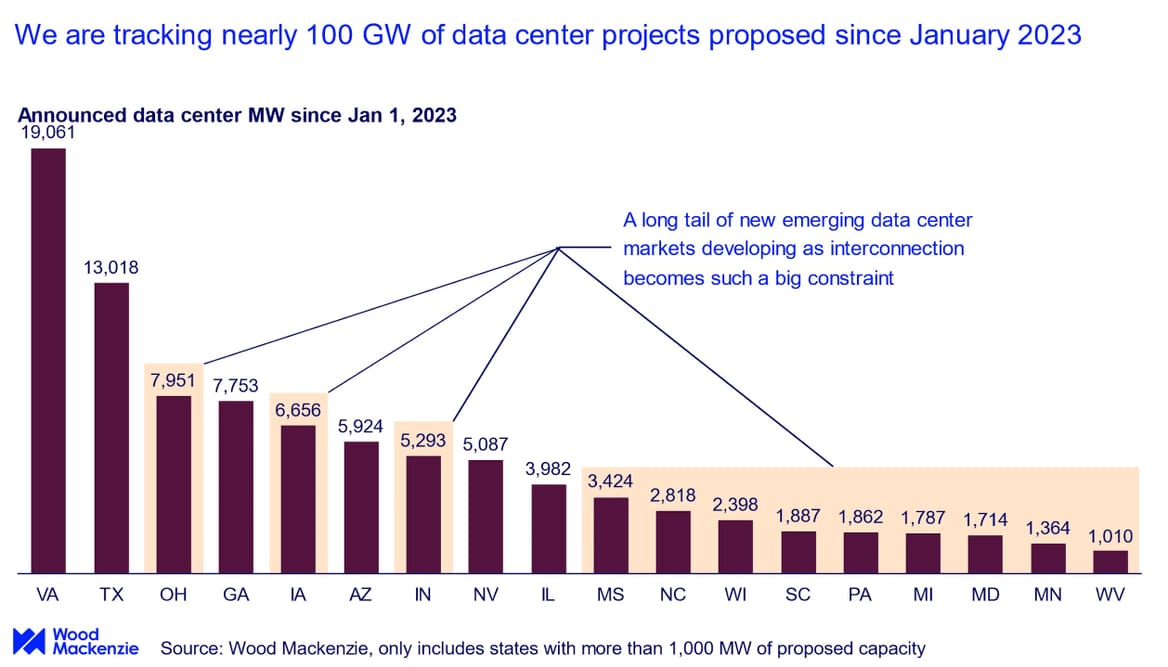
“There’s more demand at once seeking to connect to the system than can be supplied,” Chris Seiple, vice chairman of Wood Mackenzie’s power and renewables group, said in a December interview.
Of that demand growth, only a fraction can be met by building new solar and wind farms, Seiple added. And “unfortunately, those additions aren’t necessarily happening where a lot of the demand growth is happening, and they don’t happen in the right hours,” he said.
Seiple is referring to data centers’ need for reliable round-the-clock power, and utilities’ responsibility to provide it, including at moments of peak demand, usually during hot summers and cold winters. A lot of the money utilities spend goes toward building the power plants and grid infrastructure needed to meet those demand peaks.
Where renewables fall short, other resources like carbon-free hydropower, nuclear, geothermal, or clean-powered batteries could technically be built to serve at least a large portion of data center demand. But that’s generally not what’s playing out on the ground.
Instead, the data center boom is shaping up to be a huge boon for fossil-gas power plants. Investment bank Goldman Sachs predicts that powering AI will require $50 billion in new power-generation investment by 2030: 40% of it from renewables and 60% from fossil gas.
Even tech firms with clean energy goals, like Amazon, Google, Meta, and Microsoft, are having trouble squaring their soaring power needs with their professed climate commitments.
Over the past decade, those four companies have secured roughly 40 GW of U.S. clean power capacity, according to research firm BNEF. But in the past four years, their growing use of grid power, which is often generated using plenty of fossil gas, has pushed emissions in the wrong direction. Google has seen a 48% increase since 2019, and Microsoft a 29% jump since 2020.
The inability to match growing demand with more clean power isn’t entirely these hyperscalers’ fault. Yearslong wait times have prevented hundreds of gigawatts of solar and wind farms and batteries from connecting to congested U.S. power grids.
Tech firms are also pursuing “clean firm” sources of power. Amazon, Google, Meta, and Microsoft have pledged to develop (or restart) nuclear power plants, and Google has worked with advanced-geothermal-power startup Fervo Energy. But these options can’t be brought online or scaled up quickly enough to meet short-term power needs.
“The data center buildout, especially now with AI, is creating somewhat of a chaotic situation,” said James West, head of sustainable technologies and clean-energy research at investment banking advisory firm Evercore ISI. Hyperscalers are “foregoing some of their sustainability targets a bit, at least near-term.”
And many data center customers and developers are indifferent to clean energy; they simply seek whatever resource can get their facility online first, whether to churn out cryptocurrency or win an advantage in the AI race.
Utilities that have sought for years to win regulatory approval for new gas plants have seized on data center load forecasts as a new rationale.
A recent analysis from Frontier Group, the research arm of the nonprofit Public Interest Network, tallied at least 10.8 GW of new gas-fired power plants being planned by utilities, and at least 9.1 GW of fossil-fuel power plants whose closures have been or are at risk of being delayed, to meet projected demand.
In Nebraska, the Omaha Public Power District has delayed plans to close a 1950s-era coal plant after Google and Meta opened data centers in its territory. Last year, Ohio-based utility FirstEnergy abandoned a pledge to end coal use by 2030 after grid operator PJM chose it to build a transmission line that would carry power from two of its West Virginia coal plants to supply northern Virginia.
“This surge in data centers, and the projected increases over the next 10 years in the electricity demand for them, is really already contributing to a slowdown in the transition to clean energy,” said Quentin Good, policy analyst with Frontier Group.
In some cases, tech companies oppose these fossil-fuel expansion plans.
Georgia Power last month asked regulators to allow it to delay retirement of three coal-fired plants and build new gas-fired power plants to meet a forecasted 8 GW of new demand through 2030. A trade group representing tech giants, which is also negotiating with the utility to allow data centers to secure more of their own clean power, was among those that criticized the move for failing to consider cleaner options.
But in other instances, data center developers are direct participants.
In Louisiana, for example, Meta has paired a $10 billion AI data center with utility Entergy’s plan to spend $3.2 billion on 1.5 GW’s worth of new fossil-gas power plants.
State officials have praised the project’s economic benefits, and Meta has pledged to secure clean power to match its 2 GW of power consumption and to work with Entergy to develop 1.5 GW of solar power. But environmental and consumer advocates fear the 15-year power agreement between Meta and Entergy has too many loopholes and could leave customers bearing future costs, both economic and environmental.
“In 15 years, Meta could just walk away, and there would be three new gas plants that everyone else in the state would have to pay for,” said Logan Atkinson Burke, executive director of the nonprofit Alliance for Affordable Energy. The group is demanding more state scrutiny of the deal and has joined other watchdog groups in challenging Entergy’s plan to avoid a state-mandated competitive bidding process to build the gas plants.
In other cases, AI data center developers appear to be making little effort to coordinate with utilities. In Memphis, Tennessee, a data center being built by xAI, the AI company launched by Elon Musk, was kept secret from city council members and community groups until its June 2024 unveiling.
In the absence of adequate grid service from Memphis’ municipal utility, the site has been burning gas in mobile generators exempt from local air-quality regulations, despite concerns from residents of lower-income communities already burdened by industrial air pollution.
In December, xAI announced a tenfold increase in the site’s computing capacity — a move that the nonprofit Southern Alliance for Clean Energy estimates will increase its power demand from 150 MW to 1 GW, or roughly a third of the entire city’s peak demand.
The nonprofit had hoped that “Musk would use his engineering expertise to bring Tesla megapacks [batteries] with solar and storage capability to make this facility a model of clean, renewable energy,” its executive director, Stephen Smith, wrote in a blog post. But now, the project seems more like “a classic bait and switch.”
If gas plants are built as planned to power data centers, dreams of decarbonizing the grid in the near future are essentially out the window.
But data centers don’t need to be powered by fossil fuels; it’s not a foregone conclusion.
As Frontier Group’s Good noted during last month’s Public Interest Network webinar, “The outcome depends on policy, and the increase in demand is by no means inevitable.”
It’s up to regulators to sort this out, said Silverman of Johns Hopkins University. “There are all these tradeoffs with data centers. If we’re asking society to make tradeoffs, I think society has a right to demand something from data centers.”
That’s what the Virginia lawmakers proposing new data center bills said they were trying to do. Two of the bills would order state regulators to study whether other customers are bearing the costs of data center demand — a risk highlighted by the legislature’s December report, which found unconstrained growth could increase average monthly utility bills by 25% by 2040. Those bills are likely to be taken up in conference committee next month.
Other bills would give local governments power to review noise, water, and land-use impacts of data centers seeking to be sited in the state, require that data centers improve energy efficiency, and mandate quarterly reports of water and energy consumption.
Another sought to require that proposed new data centers undergo review by state utility regulators to ensure they won’t pose grid reliability problems. Democratic Delegate Josh Thomas, the bill’s sponsor, said that’s needed to manage the risks of unexamined load growth. Without that kind of check, “we could have rolling blackouts. We could have natural gas plants coming online every 18 months,” he said.
But that bill was rejected in a committee hearing last month, after opponents, including representatives of rural counties eager for economic development, warned it could alienate an industry that’s bringing billions of dollars per year to the state’s economy.
Data center developers have the ability to minimize or even help drive down power system costs and carbon emissions. They can work with utilities and regulators to bring more clean energy and batteries onto the grid or at data centers themselves. They can manage their demand to reduce grid strains and lower the costs of the infrastructure needed to serve them. And in so doing, they could secure scarce grid capacity in places where utilities are otherwise struggling to serve them.
The question is, will they? Silverman emphasized that utilities and regulators must treat grid reliability as their No. 1 priority. “But when we get down to the next level, are we going to prioritize affordability, which is very important for low-income customers? Are we going to prioritize meeting clean energy goals? Or are we going to prioritize maximizing data center expansion?” he asked.
Given the pressure to support an industry that’s seen as essential to U.S. economic growth and international competitiveness, Silverman worries that those priorities aren’t being properly balanced today. “We’re moving forward making investments assuming we know the answer — and it’s not like if we’re wrong, we’re getting that money back.”
In part 2 of this series, Canary Media reports on a key problem with data center plans: It’s near impossible to know how much they’ll impact the grid.
When solar developers look to build big projects on farmland, the same arguments tend to come up: The array will waste useful agricultural tracts, ruin views, and sully the pastoral character of the rural community, public commenters say.
In Ohio, a state where these debates have long played out, comments like that have even led the state’s power siting board to block projects. These sentiments, in Ohio and beyond, are sometimes motivated by misinformation from anti-solar groups, including organizations with fossil fuel industry ties.
But as one solar developer recently found, hundreds of negative comments don’t necessarily mean hundreds of people oppose a project, Kathiann Kowalski reported this week for Canary Media.
The Ohio Power Siting Board received more than 2,500 comments about the Grange Solar Grazing Center, which aims to bring solar and sheep together on a 2,570-acre plot in the state’s Logan County. When the project’s developer took a closer look at the feedback, it found 16 individuals had collectively submitted more than 140 of those comments, most of them opposing the project. When accounting for repeats, the company found that 80% of individual commenters actually back the solar array.
Supportive commenters said they expect the Grange project to bring jobs and public funding to the county. A 2023 report from the Purdue Center for Regional Development verified that solar projects typically create short-term construction jobs, bring in tax revenue, and help raise farmers’ land values.
Taking a step back, it’s worth noting that more than three-quarters of Americans support expanding solar, per a May 2024 survey from Pew Research Center. That includes 64% of Republicans — though the group has soured on the energy source in recent years.
Mass layoffs hit the Energy Department
The Trump administration closed last week with a big — but not totally unexpected — blow to the U.S. Energy Department workforce. As many as 2,000 probationary DOE employees were laid off, ending what one staffer described to Latitude Media as a “weird, quiet limbo” following President Donald Trump’s inauguration.
But the layoff didn’t last long for a group of employees at the Bonneville Power Administration. About 30 workers who maintain power lines and other infrastructure at the Pacific Northwest grid operator were asked back just days later, a union leader told Politico.
Clean energy smashed a record last year
The U.S. added a whopping 48.2 GW of new utility-scale solar, wind, and battery storage capacity in 2024, an increase of 47% from the year before, according to new research by energy data firm Cleanview. Texas led the way on solar and wind and was the runner-up on battery installations after California. Still, fossil fuels remain responsible for more than half of the country’s electricity generation — and the Trump presidency is likely to slow clean energy development this year. Akielly Hu breaks down the whole report for Canary Media here.
Green bank clawback: The new head of the U.S. Environmental Protection Agency wants to claw back $20 billion in federal green bank funding that was meant to help low-income communities build solar arrays, deploy electric school buses, and otherwise implement clean energy. (Canary Media)
Electric truck breakdown: Electric and fuel-cell truck startup Nikola, once valued more than Ford at $30 billion, files for bankruptcy protection after failing to raise money or find a buyer. (CNBC)
Rural clean energy freeze: Farmers across the country are taking a hit from the federal funding freeze as money stops flowing to a program supporting clean energy installations and energy-efficiency upgrades for agricultural and rural businesses. (Associated Press)
Sustainable jet fuel resumes takeoff: The Trump administration finalized a $1.44 billion loan for a sustainable aviation fuel refinery in Montana, a first since it paused all deals made by the Energy Department’s Loan Programs Office under Biden. (Canary Media)
Derailing environmental justice: Advocates call out the Trump administration for shutting down the federal government’s environmental justice departments, saying the decision will“create challenges and impacts that will last well beyond the current administration.” (Inside Climate News)
Cutting carbon in construction: As the federal government drops its commitment to buying lower-carbon building materials, several states are forming coalitions and ramping up their efforts. (Canary Media)
Offshore wind blowback: President Trump’s executive order halting offshore wind permitting could make it difficult or impossible for several Northeastern states to reach their ambitious climate goals. (Washington Post)
Dive deeper: A conservative group that once opposed Dominion Energy’s major Virginia offshore wind farm is now encouraging the project to go ahead, saying that halting it could put ratepayers on the hook for $6 billion already spent. (Canary Media)
Can tariffs clean up steel? A U.S. steel industry advocate cheers Trump’s 25% tariff on imports, saying those imposed during the last Trump administration spurred $20 billion in investment to modernize, decarbonize, and electrify the industry. (E&E News)
Cutting fossil fuels out of transportation and buildings will mean embracing electric vehicles and equipping homes and offices with heat pumps. But cleaning up these sectors will take much more than tackling their energy supply — it’ll also require eliminating carbon emissions that come from producing the materials that roads and buildings are made of.
A growing number of states are starting to do just that, with policies that take a more holistic view of the climate challenge.
Nine states have enacted Buy Clean laws to boost demand for lower-carbon steel, concrete, asphalt, glass, and other industrial products. California enacted the nation’s first such policy in 2017, followed in subsequent years by Oregon, Colorado, Washington, New York, New Jersey, Maryland, Minnesota, and Massachusetts. Agencies in other states are starting to adopt similar strategies, including by collecting emissions data about products used in public works projects.
“We’ve [historically] invested a lot in policies to improve the energy efficiency of buildings,” said Hanna Waterstrat, director of the Washington State Department of Commerce’s state efficiency and environmental performance office. “But the footprint of the materials — from the manufacture, transport, installation, maintenance, and disposal — can actually be the equivalent of, or bigger than, the entire greenhouse-gas footprint of operating a building through its lifetime.”
The so-called embodied carbon in construction projects represents a significant share of the world’s annual emissions, with an estimated 11% coming from materials used in buildings alone. That’s largely because manufacturers consume huge amounts of fossil fuels to make products like steel and cement. State authorities and companies have tended to overlook these emissions when assessing the climate impact of, say, a new office tower or highway.
“That’s been a gap in the land of climate and energy policy so far,” said Waterstrat, who leads her department’s efforts to implement Washington’s Buy Clean and Buy Fair strategy.
Until last month, the states working to shrink that policy gap had a powerful partner in the federal government.
The Biden administration launched the Federal-State Buy Clean Partnership in 2023 to build upon existing efforts and accelerate the U.S. market for cleaner construction materials. Federal agencies designated billions of dollars in climate funding to help state governments and contractors track emissions and to enable domestic manufacturers to decarbonize their operations.
President Donald Trump has since abandoned the federal Buy Clean strategy and is attempting to rescind related grant programs. The about-face will undoubtedly delay a deep transformation of the country’s construction sector. But state agencies and industry associations say they’re forging ahead — guided by their own laws and commitments to slash embodied carbon.
“Buy Clean is a great example of how states and other nonfederal actors can continue to press forward on climate action, regardless of what the federal government does,” said Casey Katims, executive director of the U.S. Climate Alliance, a bipartisan coalition of two dozen governors.
The group is working to maintain collaboration among the 13 states that joined the federal-state Buy Clean initiative, and in recent weeks it has downloaded the datasets, analytical tools, and other relevant resources that the Trump administration could wipe from the internet. Katims noted that the alliance formed under similar circumstances in 2017, after Trump withdrew the U.S. from the Paris climate agreement for the first time.
“It’s quite literally in our DNA to sustain climate work at the state level,” he said.
The broader Buy Clean vision is to harness the government’s massive purchasing power to jump-start the private market for low-carbon industrial materials. Companies bidding to construct new public buildings or bridges must show they can not only compete on cost but also on the carbon intensity of their concrete or steel, which in turn creates demand for more cleanly produced products.
Today, states are largely still laying the foundation for this future reality.
The first place many agencies start is by requiring suppliers to furnish environmental product declarations. EPDs, which are often likened to climate nutrition labels, provide granular data about the emissions associated with extracting, manufacturing, and transporting individual materials. Defining criteria for individual products involves lengthy discussions between state authorities and industry groups. The EPDs themselves can cost companies thousands of dollars and dozens of hours to complete.
In 2021, the Washington State Legislature commissioned a pilot study to collect data about both the environmental impacts and labor standards related to materials used in five state construction projects. Three years later, the state adopted its Buy Clean and Buy Fair law, which requires state agencies and public universities to report on the impacts of concrete, wood, and steel products purchased for new state-owned building projects.
Waterstrat said her team has since developed specifications and language for companies to follow to ease the process of bidding on projects. Her office is also working on a database for EPDs to show the carbon intensity of the materials the state procures and to inform future policymaking. Eventually, the idea is to set limits around products’ carbon footprints — but for now, the state’s law doesn’t call for that.
“Just having that knowledge and data is really the first step in understanding what your procurement choices are,” Waterstrat said, adding that she’s “hopeful it will lead project owners to select lower-carbon materials.”
A handful of states that are gathering EPDs also require construction products to meet certain emissions thresholds, which are known as global warming potential limits.
In 2022, California’s Buy Clean policy began requiring that four categories — structural steel, concrete reinforcing steel, flat glass, and insulation — used in public works projects meet GWP limits equal to or below the industry average. The Buy Clean Colorado Act similarly calls for setting industry-average thresholds for three types of steel, as well as asphalt, concrete, glass, and wood used in new state projects from January 2024 on. Next year, Colorado’s Office of the State Architect will review those limits and report to the Legislature on the program’s progress.
New York, for its part, set GWP standards in 2023 for concrete mixes used in all state building and transportation projects, making it the first state to do so. The Buy Clean Concrete guidelines, which began as voluntary, became mandatory last month. The current threshold is equivalent to 150% of the emissions for average concrete mixes in the eastern U.S. The idea is to create a policy that’s initially attainable not just for major manufacturers but also “mom-and-pop concrete plants” in rural parts of the state “for whom this is all fairly new,” said Mariane Jang, a senior policy advisor on the resiliency and sustainability team in New York state’s Office of General Services.
However, starting in 2027, the limits will progressively lower to reflect ongoing efforts to slash emissions from cement and concrete production. In the meantime, “the aim is to do more capacity-building and to engage even those smaller companies to prepare them for the upcoming changes,” Jang said.
The ability to gather accurate data from many disparate suppliers is essential to achieving the ultimate goal of Buy Clean: slashing embodied carbon from construction materials.
That work will potentially get harder if the Trump administration succeeds in its attempts to claw back congressionally mandated climate and energy spending.
Among the funding stuck in political purgatory is a nearly $160 million grant program by the Environmental Protection Agency to help dozens of businesses develop “high-quality” EPDs for 14 material categories.
The National Asphalt Pavement Association was selected last year to receive $10 million of that funding, which hasn’t yet made it out the door, according to Richard Willis, who manages the organization’s team that works on engineering and sustainability issues. The industry association has developed widely used software that helps asphalt-mix producers develop and publish EPDs for individual plants and mixtures. But using the tool costs companies around $3,000 to $6,000 per plant.
Willis said the EPA funding would be used to reduce costs and other barriers for asphalt-mix producers while helping fill in the “data gaps” from the businesses that supply additives. The contents of asphalt pavement — made from aggregate and a liquid petroleum-based binder — can vary widely depending on the local climate and the types of ingredients available nearby.
“Asphalt is about as local of a material as it gets,” Willis said. That makes it tricky to create robust EPDs using general industry information or to develop plans for curbing emissions at a given plant.
A $1.2 billion program from the Federal Highway Administration is similarly ensnared in Trump’s funding freeze. In November, the FHWA selected transportation agencies in 37 states; Washington, D.C.; and Puerto Rico to receive grants to help them study, track, and ultimately purchase cleaner materials for roads and highways.
New York was tapped to receive $31.9 million, though because the funding wasn’t legally obligated before Trump took office, it’s unclear if the state will ever actually get it, said Bruce Barkevich, who is vice president of the New York Construction Materials Association, a trade group representing producers of asphalt, aggregate, and ready-mix concrete in the state.
The timing of the grant would’ve been especially helpful for New York manufacturers and suppliers working to develop EPDs. State construction projects that use over 8,000 short tons of asphalt are now required to gather such data; projects of all sizes will have to do the same starting in 2026. New York’s policy, Executive Order 22, also requires agencies to report the quantities of concrete mixes, five types of steel products, and three types of glass products procured for state projects and provide EPDs when available.
“Even with that [funding uncertainty], we’re not losing the emphasis on sustainable pavements and low-carbon materials, because we’re in New York state — we have laws on the books,” Barkevich said. He added that companies and agencies in the state have worked together for years to curb emissions from asphalt production, including by reducing temperatures used in asphalt-mixing plants and incorporating more recycled material.
Emily Rubenstein, the deputy commissioner for resiliency and sustainability in New York state’s Office of General Services, said her team continues to press ahead with the state’s Buy Clean strategy, including by hosting public webinars, meeting with industry, and training staff in various state agencies. The office is also currently analyzing embodied-carbon data from state projects with the goal of identifying future pathways for reducing embodied carbon.
“This work takes a village, and we’ve been thrilled with how both supporting agencies and industries have been in [backing] the transition,” she said, adding that she’s also glad the U.S. Climate Alliance has picked up the mantle of organizing states.
In New York and other Buy Clean states, program leaders said they’re still meeting quarterly through the climate alliance and trading notes to learn from each other’s experiences. Such collaboration is especially pertinent now that the biggest player in the game — the federal government — is stepping back, said Ted Fertik, vice president for manufacturing and industrial policy at the BlueGreen Alliance, a coalition of labor unions and environmental groups.
“There’s a broad recognition that, in most cases, one state’s procurement is probably not sufficient to drive large-scale shifts in production processes,” Fertik said. “So there will need to be more intentional efforts around harmonizing [state efforts] to drive decarbonization.”
Connecticut could become the latest state to pursue networked geothermal systems as a way of cutting greenhouse gas emissions, improving public health, and reducing energy cost burdens for residents.
State lawmakers are considering a bill, HB 6929, that would create a grant and loan program to support development of geothermal networks, which tap into energy stored in the earth to deliver heating and cooling to multiple buildings in one neighborhood.
“Thermal energy networks are an incredibly exciting technological breakthrough,” said Samantha Dynowski, state director of the Sierra Club’s Connecticut chapter, testifying in favor of the bill during a Tuesday hearing before the Legislature’s Joint Committee on Energy and Technology.
The bill enjoys wide support from environmental advocates, community leaders, and business interests. Several parties are pushing for changes they say would make even more of an impact, such as requiring utilities to propose pilot projects, following the example of New York, which included such a mandate in a 2022 law.
Also, as drafted, the bill does not specify a funding mechanism for the grant and loan program it would create. Several stakeholders have suggested adding language that authorizes the state to issue a bond to fund the program.
“It’s a one-time capital investment that would yield long-term environmental and economic benefits,” said Connor Yakaitis, deputy director of the Connecticut League of Conservation Voters, who also suggested a budget of $20 million for the program.
Advocates point to the emissions reductions the systems can achieve. More than 40% of the state’s households burn heating oil to stay warm, and another 37% use natural gas; meanwhile, the only emissions associated with geothermal heat come from generating the electricity used to run the heat pumps installed in buildings across the system.
Geothermal networks can also save customers money because the energy underground is free and ground-source heat pumps use far less electricity than air-source heat pumps or electric resistance heat. In Framingham, Massachusetts, the country’s first utility-scale geothermal network is projected to cut some customers’ heating bills by as much as 75% this winter, testified Eric Bosworth, clean technologies manager for Eversource, which built and owns the project.
The adoption of geothermal networks can also help utilities — and their workers — transfer skills into a new field as energy systems transition away from natural gas, supporters said.
“They have experience and expertise that can be leveraged,” Bosworth said, noting that gas industry workers constructed much of the Framingham system.
Geothermal heat pumps have been around for more than 100 years, but the idea of using the equipment to serve dozens of homes connected in a loop first started to catch on in 2017, when Massachusetts energy transition nonprofit HEET began pitching it to utilities. They were interested, and in June 2024, Eversource brought the Framingham system online. Today the network serves 135 residential and commercial customers in the city of Framingham. National Grid is also in the process of developing a system in Boston.
Other states have seen the promise in geothermal networks, too. Six states in addition to New York and Massachusetts have passed legislation supporting utility construction of thermal energy networks, according to the Building Decarbonization Coalition, and some 22 to 27 pilot projects have been proposed to regulators nationwide.
In Connecticut, environmental groups have been discussing the geothermal possibilities with utilities for a few years, said Shannon Laun, the Conservation Law Foundation’s vice president for Connecticut. Eversource has shown interest in developing a pilot project and taken preliminary steps to seek approval to proceed, but specific legislation supporting geothermal networks would be more likely to galvanize action from utilities, she said.
“We’re starting to see some new momentum with this bill,” Laun said.
Canary Media’s Electrified Life column shares real-world tales, tips, and insights to demystify what individuals can do to shift their homes and lives to clean electric power.
Kathy Palmer was intrigued when her neighbor, an environmental lawyer she’d met while volunteering on a Minneapolis climate committee, sang the praises of the new heat pump he had installed in his home.
Now, Palmer is enjoying the warmth of her own heat pump.
For the past three decades, the 72-year-old retired educator has relied on a fossil-gas boiler system to heat her two-story stucco home in Minneapolis — first via cast-iron radiators and then through radiant flooring as well.
That system was sluggish, said the resident of the coldest major city in the continental U.S., where the temperature falls below 0 degrees Fahrenheit more than 20 days out of the year. Palmer often needed to wait an hour or more for the boiler to warm up her home.
She couldn’t afford to replace her entire gas system, but she realized a heat pump could supplement it. Her new heat pump — a 3-ton Daikin model that delivers heat at nearly its maximum output down to 5˚F and works at a reduced capacity at -13ˆF and lower — has been a revelation. The two wall-mounted air handling units rev up in one minute to bathe a space with warm air. Give them 10 to 15 minutes, and they make a chilly room comfortable, she said. “It’s wonderful to have that happen so quickly.”
Palmer is just one of the tens of thousands of U.S. residents who have installed heat pumps in recent years. The technology is crucial for kicking fossil fuels out of homes and has proved again and again that it works even in bitingly cold climates. Maine has rebated more than 175,000 heat pumps for space heating since 2014. And Vermont installed more than 10,700 heat pumps through its rebate program last year alone. (Minnesota utilities will make heat-pump rebate data publicly available starting in April 2025, a spokesperson of the community-based nonprofit Center for Energy and Environment told me.)
Heat pumps now consistently outsell gas furnaces in the U.S., but they’re still relatively rare in homes across the country. Only about 14% of U.S. households use heat pumps as their primary heating tech, according to the Department of Energy.
But all heating system sales need to be heat pumps by 2035 to decarbonize the economy by 2050, per electrification nonprofit Rewiring America. In Minnesota alone, heat-pump sales will have to climb to more than 100,000 per year by 2030 to reach state climate goals, according to a June 2024 study by Synapse Energy Economics and commissioned by the coalition Clean Heat Minnesota.
Since August, Palmer’s heat-pump system has delivered comfort, efficiency, greater peace of mind, and lower bills.
Because heat pumps are two-in-one heaters and air conditioners, she has abundant cooling for the first time, allowing her to ditch the clunky and less-efficient window AC units she used before.
And since heat-pump systems are modular, she now has different heating zones that can be independently controlled. Palmer is a widow and empty-nester, so there’s no need to always heat the whole house. The system, which provides heat to some rooms through vents and others via wall-mounted units, allows her to heat just the rooms she’s using, reducing her energy consumption. “I really love having the different zones,” she said.
Another detail that factored into her decision to get a heat pump: Having one will boost her home’s resale value. According to a 2020 study in the journal Nature, homes with heat pumps sell for at least $10,000 more than those without, on average. Nick Bender, the contractor with more than 25 years of heat-pump experience who designed Palmer’s system, noted that Minneapolis homes with air conditioning command a premium of $20,000 to over $30,000.
Palmer’s heat pump also reduces her family’s exposure to toxic pollutants emitted by burning gas. She noted that access to clean air is particularly important for her daughter who has asthma.
What’s more, Palmer is thrilled to be taking action to help fight climate change, the effects of which she’s already feeling. She and her family spend a lot of time outside in northern Minnesota’s shimmering Boundary Waters, she told me. In 2023 and 2024, choking smoke from wildfires in Canada made worse by climate change was a “wake-up call,” Palmer said. “If we can’t be outside enjoying the summers here, then that’s really impacting my life and also my granddaughters’ lives.”
In Minnesota, switching to a cold-climate heat pump can make a huge difference in annual household emissions, cutting them by an estimated 8.2 metric tons of CO₂ equivalent per year, according to a 2024 study by the National Renewable Energy Laboratory. That’s like not driving a car in the U.S. for nearly two years.
If Minnesota fulfills its commitment to get 100% clean power by 2040, the emissions savings from switching to a heat pump could be even greater.
Palmer’s heat-pump system cost about $25,000, but two big incentives lowered the sticker price: the $2,000 federal tax credit and a $1,600 rebate from utility Xcel Energy.
Installing an AC-only system would have cost around as much, according to Bender. In fact, incentives typically make it “a little cheaper to put in the heat pump than the AC” for Minnesota homes broadly.
Thanks to a utility incentive, Palmer will reap ongoing savings. Xcel drops the electricity rate for households with electric heating from 11 cents per kilowatt-hour to 8 cents per kilowatt-hour — a 27% discount — on all the electricity they use during the heating season of October through May.
Perhaps most importantly, the heat pump has significantly reduced how much Palmer uses her 30-year-old gas boiler system.“I didn’t turn on my radiators until December,” Palmer said. “Usually in Minnesota, I would have turned them on in September.”
Bender expects the heat pump to save Palmer $500 to $800 annually. “In these older homes, there’s a lot of savings to be had” because of how inefficient existing systems can be, he said.
Looking ahead, Palmer is considering going to an all-electric heat system. The lowest-cost option in that scenario would likely entail taking out the boiler and radiators, installing ducts, upgrading the electrical panel, adding more heat-pump equipment, and using electric-resistance heat strips for extra heat on demand — at a potential cost of $35,000 to $40,000, Bender said. However, Palmer would avoid spending $15,000 on a replacement boiler, he pointed out. She’d also be able to take advantage of incentives for such a project, which are currently a whopping $7,100 for someone living in Minneapolis.
Going all-electric tends to be easier in newer homes, Bender said. In a 1980s Minneapolis home with ductwork and a 200-amp panel, for example, choosing an all-electric system over a hybrid gas-and-electric system may cost just $2,000 to $3,000 more.
As for Palmer, her new heat-pump system is already attracting notice in her social circle, she said. One intrigued friend recently swung by to check it out for himself.
This article was originally published on Jan. 24, 2025 and updated on Feb. 20, 2025 with shipment data for all of last year.
Heat pumps just keep getting hotter. The über-efficient, emissions-free appliance outsold gas furnaces in 2024 — and by a bigger margin than ever.
According to shipment data from the industry trade group Air-Conditioning, Heating, and Refrigeration Institute, Americans bought 32% more air-source heat pumps than the next-most-popular heating appliance, gas furnaces, last year. That smashes 2023’s record-setting lead of 21%.

To be sure, the data comes with a notable caveat. Heat pumps outsold gas furnaces, but that doesn’t necessarily mean more households are choosing heat pumps over gas heating; homes often need multiple heat-pump units to replace a single fossil fuel–fired appliance.
Still, heat pumps have clear momentum. In fact, the market has been gravitating in this cleaner direction over the past two decades, said Russell Unger, who leads work on decarbonizing buildings at climate think tank RMI. “There’s just been this long-term, consistent trend.”
It’s not hard to see why. Electric heat pumps have massive comfort, climate, and health benefits. They’re essentially two-way air conditioners that can both heat and cool building interiors, are routinely three to four times as efficient as fossil-fuel systems, and are one of the most effective ways an individual can reduce their planet-warming pollution. In many cases, heat pumps can also save you money.
The building sector accounts for 35% of U.S. emissions. To decarbonize the economy by 2050 — the Paris Agreement goal the U.S. signed on to before President Donald Trump withdrew from the accord last month — heat pumps need to rapidly make up 100% of heating system sales, per modeling by electrification nonprofit Rewiring America.
Asked whether heat pump growth is strong enough to hit climate targets, Unger said, “We’d like it to be faster.”
Still, “I’ll go with a little slower and durable,” he said. “If we saw [the market] jump over a really short period, I would be biting my nails.” Unger has been reassured to see “steady, reliable increases” instead. “That feels on brand for the building industry.”
Unger pointed out that consumers don’t change home heating appliances as frequently as cars, a nod to the recent growth of electric vehicle sales. Contractors are also apt to move cautiously because they want to be sure that a technology will work for their business model before committing to it.
A medley of factors are causing heat pump sales to grow, according to experts Canary Media spoke to. Firstly, consumers and contractors are gaining more familiarity with the tech and having better experiences, Unger said.
Advances in heat pump technology have made it well-suited to some of the coldest climes in the U.S. Just look to Maine; heat pumps proved so popular there that the wintry state blew past its 2025 installation goal two years ahead of schedule. Certain heat pump models can work well below -22 degrees Fahrenheit. And the tech’s performance keeps getting better.
Plus, many states and local jurisdictions are pushing hard for heat pumps.
In 2023, 25 governors signed on to install 20 million of the clean heating machines by 2030. Last year, nine states — California, Colorado, Maine, Maryland, Massachusetts, New Jersey, New York, Oregon, and Rhode Island — raised the stakes by pledging that heat pumps will make up at least 65% of residential heating and cooling equipment sales by the end of the decade. California’s new energy code also encourages builders to install heat pumps instead of gas heating. And the San Francisco Bay Area will make heat pumps the de facto choice when it bars new gas furnaces starting in 2029.
Federal and local incentives are also helping people afford heat pumps. Installation costs for these systems are on average $17,000 to $30,000, depending on many factors including local climate and home insulation, per Rewiring America.
The Inflation Reduction Act, the most ambitious climate legislation in history, gave Americans state-distributed home energy rebates of up to $8,000 as well as a $2,000 federal tax credit to defray the costs of getting a heat pump. But how long these incentives might last under the Trump administration is an open question.
Thanks to steady growth in heat pump sales thus far, the U.S. is now among the top countries quickly transitioning from oil and gas heating to heat pumps, said Kevin Carbonnier, building technology market expert at the nonprofit Building Decarbonization Coalition.
What will it take to drive heat pump sales even higher in the U.S.? Stakeholders need to educate consumers and provide resources to make switching as easy and compelling as possible, said Wael Kanj, senior research associate at Rewiring America. Seeing the most recent data, “We know that we’re moving in the right direction.”
A new analysis shows that a clear majority of people submitting comments on a planned central Ohio solar farm support the project — a stark contrast with how opponents have portrayed public sentiment.
Open Road Renewables, the developer seeking a permit to build the Grange Solar Grazing Center in Logan County, reviewed more than 2,500 comments submitted to the Ohio Power Siting Board through Feb. 11 regarding its permitting case. After accounting for repeat commenters who submitted multiple times, the company found 80% of commenters expressed support for its project.
A project’s popularity is a potential factor in site permit decisions, but how regulators use that information is the subject of a pending case before the Ohio Supreme Court. Until the question of how state regulators should measure “public interest” is resolved, solar advocates and developers say it’s critical to closely examine public comments before drawing conclusions.
“Anyone can file 10 different comments, but if you’re using that to determine public opinion, just based on nominally how many comments there are, that’s kind of missing the mark,” said Doug Herling, vice president for Open Road Renewables.
Herling took issue with people “gaming” the system, submitting multiple comments to make it appear that the project has more naysayers. The company’s analysis identified more than 600 repeat comments that should not be considered in attempts to quantify support or opposition to the project. As of early February, it found 16 individuals who collectively submitted more than 140 comments, mostly opposing Grange Solar.
Solar opponents, some with ties to fossil fuel groups, have used town halls and other forums to portray utility-scale solar projects as deeply unpopular in rural Ohio. Sustained opposition has led developers to drop plans for at least four large solar developments in Ohio within the past 15 months. Nationally, research released last June by Columbia University’s Sabin Center for Climate Change Law documents hundreds of renewable energy projects facing significant opposition across 47 states.
Permitting in Ohio has become especially contentious since passage of a 2021 law that adds hurdles for siting most wind and solar projects over 50 megawatts. Under the law, counties can block new utility-scale projects before they even get to the state siting board. The law doesn’t apply to fossil fuel or nuclear power projects.
The 2021 law exempts Grange Solar and some other projects because they were already in grid operator PJM’s queue when the law took effect. However, Grange Solar isn’t exempt from a provision in the law calling for two local ad hoc board members to join the state siting board’s seven voting members when it deliberates on the project.
Ohio law requires any new generation project to meet eight criteria. They include consideration of impacts on the environment, water conservation, and agricultural land. Other factors include whether a facility “will serve the interests of electric system economy and reliability” and “the public interest, convenience, and necessity.”
Ohio statutes don’t spell out what “public interest” means, and the power siting board declined environmental advocates’ requests to define the term when other rule revisions took effect last year.
Yet the board has denied multiple permit applications for solar projects based entirely or primarily on a large percentage of public comments or local governments opposing them. The developer in one such case, Vesper Energy, challenged the siting board’s popularity-contest approach in denying its Kingwood Solar project. The case is now before the Ohio Supreme Court, with oral arguments set for March 13.
That backdrop prompted Open Road Renewables to take a closer look at the comments in the Grange Solar case.
“Given that the siting board puts a weight on local public opinion and any resolutions made by local public bodies, we just felt it deserved that scrutiny,” Herling said.
The company submitted an initial analysis of public comments through Feb. 4 and found three-quarters of 806 unique commenters in the docket favored the project, compared with one-fourth in opposition. Among the commenters within Logan County, supporters still outnumbered opponents by about two to one.
A flurry of filings more than doubled the total number of comments, and the developer prepared an updated analysis through Feb. 11. Among nearly 2,000 commenters, supporters outnumbered opponents four to one. Opinion was more divided within Logan County, but allies still exceeded critics, Open Road Renewables’ most recent analysis said.

Supporters’ reasons for backing the project include jobs and economic benefits. Commenters also approved of the company’s commitment to minimizing impacts on the environment while preserving soil and drainage and screening panels from public view.
“The economic impact is undeniable — jobs for our neighbors and much-needed funding for our schools and public services,” wrote Russells Point resident Sharon Devault in a Jan. 10 comment. “Misinformation about solar energy concerns me. Let’s base decisions on facts, not fear.”
“I support solar energy because of the price of fossil fuels and the problems with them,” said Logan County resident Roger Blank in a Dec. 10 comment.
Some supporting commenters also dismissed project foes’ claims that Grange Solar would hurt tourism in the area. A Jan. 13 comment by Sharon Lenhart said they would continue to visit Logan County and Indian Lake. “The substantial investment in public services will likely make the area a more attractive destination,” Lenhart wrote.
The Ohio Chamber of Commerce also filed a supportive comment on the Grange Solar project, reflecting the business group’s more vocal advocacy for clean energy as a tool for economic development and grid resiliency.
Yet more comments have been submitted in the Grange Solar case, including additional duplicates and comments by opponents who have already weighed in. For example, Logan County resident Shelley Wammes contributed 14 comments in a Feb. 12 packet and another on Feb. 14. Wammes, who did not respond to questions sent via email by Canary Media, also filed 13 comments against the project last August and September.
“I am happy to see that Grange is really trying to take these things into account and recognize that there is support for this project within the community and that it shouldn’t just be outweighed by [a] few loud voices who are shouting a lot of misinformation,” said Shayna Fritz, executive director of the Ohio Conservative Energy Forum. In her view, people’s ability to lease their land for energy projects is a property rights issue.
Nolan Rutschilling, managing director of energy policy for the Ohio Environmental Council, said it’s important that state regulators consider the substance of comments, not just use them as a straw poll for measuring popularity.
Instead of just counting comments, “each perspective and comment must be considered for its substance — especially the truth of any claims — and who the comment represents,” Rutschilling said.
In another solar permitting case last summer, half the unique arguments presented during local public hearings lacked factual support, said Heidi Gorovitz Robertson, a professor at Cleveland State University College of Law who served as an expert witness for the Ohio Environmental Council.
In her view, numbers can provide a sense of the extent of support for particular arguments opposing or supporting a project. But if 1,000 people support a specific point for or against a development, that’s still just one issue for the power siting board’s consideration. An argument based on false information may not deserve weight at all. Other comments are just statements of opinion without evidentiary support, she noted.
“The value of the arguments is as important, or arguably much more important, than the numbers,” Robertson said. “All of this, of course, assumes the agency really wants to know.”
The power siting board’s staff investigation of the Grange Solar project is due by March 3, and the evidentiary hearing is set to start on April 7.
This story was first published by CalMatters.
California’s push to electrify its cars is facing a potentially serious problem: People aren’t buying electric cars fast enough.
After three straight years of strong growth, sales have stabilized in California, raising questions about whether the state will fail to meet its groundbreaking mandate banning sales of gas-powered vehicles.
About a quarter — 25.3% — of all new cars registered in California in 2024 were zero emissions, just slightly more than 25% in 2023, according to new California Energy Commission data. The flat sales follow several years of rapid growth; in 2020, only one in 13 cars sold was zero-emissions. Their share of California’s market is now three times larger than four years ago.
But the slowed pace of growth in the market puts the state’s climate and air pollution goals at risk. Under California’s mandate, approved in 2022, 35% of new 2026 car models sold by automakers must be zero-emissions. That leaves considerable ground to make up as some 2026 models begin rolling out later this year.
The requirement ramps up to 68% for 2030 models, and in 2035, California’s rule bans all sales of gasoline-powered cars.

David Simpson, who owns three car dealerships in Orange County, said he is not seeing increased demand for electric cars. While the initial rollout of some models, such as the GMC Hummer EV, did well at first, the demand did not continue. Sales of the Chevrolet Equinox and Blazer EVs do alright but aren’t strong, either, he said.
“The sales are declining,” Simpson said. “We’ve filled that gap of people who want those cars — and now they have them — and we’re not seeing a big, huge demand. I don’t see households going 100% EV.”
Dave Clegern, a spokesperson for the California Air Resources Board, which oversees the electric car mandates, said in an email that while sales of zero-emission vehicles in California are “less dramatic than in years past,” the flat sales occurred in the context of an overall plateauing of car sales last year.
Although the rules limit what automakers can sell, Californians are not required to buy electric cars. That means if consumer demand doesn’t increase, it could be a major black eye for Gov. Gavin Newsom, who has made electric cars a cornerstone of his agenda to fight climate change and clean the air. A spokesman for Newsom declined to comment.
The state mandate, however, has some flexibility, Clegern said. First of all, it’s a multi-year formula: Each manufacturer’s sales of 2026 zero-emission vehicles must be 35% of its total sales averaged for model years 2022 through 2024.
Manufacturers also can buy credits from automakers that have exceeded the target — companies that only sell electric models, such as Tesla or Rivian. To enforce compliance with California’s sales requirements, state officials could impose steep penalties of $20,000 per vehicle on manufacturers that fall short of quotas.
“Manufacturers may still be in compliance even if they do not achieve these specific sales volumes,” Clegern said.
Brian Maas, president of the California New Car Dealers Association, said automakers could seek to avoid the fines by reducing the number of gas-powered cars they send to California dealers. He said that could leave fewer options for buyers, drive up prices, and push some consumers to Nevada or Arizona to find the car they want, while others will hold on to their older, more polluting vehicles.
“We’re just not going to make the mandate as presently drafted,” so automakers will have to take action, Maas said. “The most rational is to constrain inventory.”
The auto industry group Alliance for Automotive Innovation has been raising these concerns since at least December, when it published a memo entitled “It’s gonna take a miracle: California and states with EV sales requirements.” The group warns the mandate could depress auto sales in California — as well as in other states that adopt its rules.
Last month, John Bozzella, the group’s chief executive, called California’s rules “by any measure not achievable” after President Donald Trump signed an executive order repealing federal rules promoting electric vehicles.
“There’s a saying in the auto business: You can’t get ahead of the customer,” Bozzella said.
The outgoing Biden administration’s U.S. Environmental Protection Agency granted California a waiver in December that allows the state to enforce its requirements phasing out new gas-powered cars. Many experts believe the Trump administration is likely to challenge the waiver through the courts.
Experts also anticipate that Trump could eliminate the $7,500 federal tax credit for zero-emission vehicle purchases, which would increase the cost of buying some electric cars. Newsom vowed last year to continue offering the incentive through state funding, although that promise came before Los Angeles faced devastating wildfires and the state released its fragile budget earlier this year.
Californians have purchased more than 2 million electric cars, leading the nation. The number has doubled in about two years.
But electric vehicle sales, which make up the majority of zero-emission cars, grew by only 1.1% in 2024, with 378,910 sold compared to 374,668 in 2023. Plug-in hybrids, once considered a potential alternative to a purely electric model, remained relatively stable. And sales of hydrogen-powered cars all but collapsed last year, with sales plummeting to a meager 600 in 2024 from 3,119 in 2023.
The slower growth comes amid overall market sluggishness, with all auto sales in California dipping slightly last year to 1,752,030.
Loren McDonald, chief analyst for the charging app Paren, said a major contributor is a shift in consumer demographics.
The state’s market has moved beyond early electric car adopters — affluent, environmentally motivated buyers willing to overlook challenges like limited charging infrastructure and higher costs — and into the mainstream.
He said these new buyers, often from middle-income households or who live in apartment buildings without easy access to charging, are far less forgiving when it comes to electric cars. Concerns about range, broken chargers, and upfront costs are deal-breakers.
Tesla’s market dominance has exacerbated the issue. Many left-leaning California consumers, who were once loyal to Tesla, appear to have distanced themselves because of CEO Elon Musk’s controversial public persona and alliance with Trump.
As Tesla sales have softened, dropping 11% in California last year, the decline has disproportionately affected overall EV registration data in California because of the company’s significant market share, McDonald said.
Affordability remains a crucial hurdle, though McDonald sees signs of improvement. Automakers have ramped up production, leading to competitive pricing and aggressive lease deals — many under $400 per month.
But mainstream consumers are largely unaware that electric vehicles offer long-term savings in fuel and maintenance, McDonald said, adding that better education is needed to convince consumers to take the leap, especially as electric car prices increasingly approach parity with gas-powered vehicles.
McDonald remains optimistic about 2025. The market will benefit from new electric models priced under $50,000 and technological advancements, such as faster charging and vehicle-to-home power capabilities.
One of the nation’s largest hydrogen-powered transit fleets is seeking to switch to a cleaner — and local — fuel source as part of a federally funded clean hydrogen hub.
The Stark Area Regional Transit Authority, or SARTA, provides about 5,000 daily rides to commuters in the Canton, Ohio, area. A decade after federal grants helped it purchase its first hydrogen fuel-cell buses, the authority now has 22 such vehicles, making it the country’s fourth-largest hydrogen-powered transit fleet.
The vehicles emit only water vapor and warm air as exhaust, reducing air pollution in the neighborhoods where they run. But producing and transporting hydrogen for the fuel cells can be a significant source of climate emissions, which is why SARTA is partnering with energy company Enbridge and the Appalachian Regional Clean Hydrogen Hub, or ARCH2, on a plan to make the fuel on-site with solar power.
“So it will be green,” said Kirt Conrad, SARTA’s CEO, referring to the use of renewable energy to power the production of hydrogen by splitting water.
Currently, the transit agency imports hydrogen — made from natural gas without carbon capture — by truck from Canada. Such “gray” hydrogen emits about 11 tons of carbon dioxide per ton of hydrogen produced. President Donald Trump’s threatened tariffs against Canada could also affect the cost and supply of hydrogen available to SARTA, although specific impacts are still unclear.
SARTA had already worked with Dominion Energy on a compressed natural gas fueling station before Dominion’s Ohio utility company was acquired by Enbridge. When the Biden administration announced its regional clean hydrogen hub program in 2023, SARTA and the company joined others in Ohio, West Virginia, and Pennsylvania to pitch the ARCH2 hub. The hub was among seven selected by the Department of Energy in late 2023 and was awarded up to $925 million in funding last summer.
The plan is to install roughly 1,000 solar panels on about 10 acres of recently acquired land next to SARTA’s existing hydrogen fueling facility, said Conrad. That would generate up to 1 megawatt of electricity, powering an electrolysis facility that splits water into oxygen and hydrogen. Under the project’s current scope, the equipment would produce roughly 1 ton of hydrogen per day, enough to fuel 40 SARTA buses, Conrad added.
Details could change as the project progresses, according to Enbridge spokesperson Stephanie Moore. Enbridge would own the hydrogen production and storage equipment.
Conrad estimated that the whole project will cost around $15 million, about 70% of which would come from federal funding under the 2021 bipartisan infrastructure law and other grants. It’s unclear, though, whether the Trump administration will renege on those commitments, even those which have already been formally obligated under contract.
“ARCH2 receives funding for this project through a contract issued through the U.S. Department of Energy’s Office of Clean Energy Demonstrations,” Moore said. “We have received no information outlining any modifications to that contract and therefore will continue moving forward on this project as planned.”
If the project can be completed, it will double SARTA’s supply of hydrogen, lower costs and emissions, and improve the transit system’s resiliency, Conrad said, noting that the agency has experienced occasional fuel delivery problems. Plus, domestic hydrogen production can support U.S. energy independence goals, he said.
A desire to switch to cleaner fuels and the costs per mile compared with diesel buses convinced SARTA to start buying fuel-cell buses in 2014. Today, it has 17 large buses and 5 smaller paratransit vehicles that run on fuel cells, which split hydrogen into protons and electrons and send them along separate paths. The electrons provide an electric current, while the protons wind up combining with oxygen to make water.
California has had fuel-cell buses on the road for more than two decades, and other places that have embraced the vehicles in recent years include Philadelphia’s Southeastern Pennsylvania Transportation Authority and Maryland’s Montgomery County.
Sean O’Leary, a senior researcher for the Ohio River Valley Institute, said the planned project by SARTA and Enbridge would cut greenhouse gas emissions compared with current practices.
“Green hydrogen is … a lot better than gray,” O’Leary said. However, he’s skeptical whether fuel-cell buses are the vehicles he would choose today for transit systems to reduce emissions. “I would personally rather see them go to electric buses or even biodiesel, both of which would reduce emissions more and cost a … lot less.”
Conrad said SARTA would have liked to have started out using green hydrogen, but it wasn’t available in the marketplace a decade ago. Now that the technology has advanced, he thinks it’s time to make the switch to a cleaner source of hydrogen.
“Sometimes an industry just needs time to evolve. And I think that’s what we’re starting to see now,” Conrad said.
If all proceeds well, SARTA anticipates on-site hydrogen production could start as soon as 2028.


.svg)
