

 Back
Back
Congress moved one step closer to passing President Donald Trump’s “One Big, Beautiful Bill” this week — and with that, one step closer to spiking power bills across the nation.
The bill would rapidly phase out tax credits for clean energy, slowing the construction of solar, wind, and battery projects, which made up over 90% of new electricity connected to the grid last year.
Repealing those tax credits would come at a steep cost to utility customers in every state, according to NERA analysis commissioned by the Clean Energy Buyers Association. The most impacted states could see electricity prices rise by nearly 30% by 2029.
The Senate bill passed Tuesday would require solar and wind projects to either start construction within a year of the bill’s passage or start service by the end of 2027 to receive the tax credits. Those that begin construction after this calendar year would be subject to “foreign entity of concern” restrictions so difficult to comply with that experts have said they amount to a “backdoor repeal.” Batteries, nuclear, and geothermal have a longer runway to claim the credits but would have to deal with the same unworkable foreign-entity strictures.
The bill is now being considered by House Republicans, who have set a self-imposed deadline of sending the bill to Trump’s desk by Friday. A previous version of the bill passed the House in May by just one vote.
Clean energy is the cheapest and easiest way to get power onto the grid. With demand for electricity nationwide rising due in large part to AI data centers, swiftly bringing affordable energy online is more crucial than ever.
But if tax incentives are repealed, fewer solar, wind, and storage projects will be built. Between now and 2035, the U.S. could see 57% to 72% less new clean-energy capacity come online than it would have with the tax credits in place, according to Rhodium Group. Meanwhile, new gas construction likely can’t make up the difference in the near term: Developers who want to build new gas power plants face wait times of up to five to seven years for turbines.
Rising power demand plus slower power-plant construction is a recipe for higher electricity bills.
Households and businesses in Wyoming, Illinois, and New Mexico would see the biggest jump in energy costs should the tax credits be repealed. Nationwide, electricity prices would increase by an average of 7.3% for households and 10.6% for businesses, worsening the increasingly steep energy costs Americans face.
The biggest loss, however, would be for attempts to decarbonize the U.S. power system. The Inflation Reduction Act, the U.S.’s first real stab at climate policy, had put the country nearly on track to cut carbon emissions in line with global climate commitments. Under this bill, however, U.S. efforts to move away from fossil fuels are certain to be slowed — even as the rest of the world speeds ahead toward clean power.
Canary Media’s “Electrified Life” column shares real-world tales, tips, and insights to demystify what individuals can do to shift their homes and lives to clean electric power.
As summer temperatures sizzle, are you frantically shopping for central air conditioning? Take a breather, because you could get AC functionality — and more — by opting for an increasingly popular appliance: a heat pump.
All-electric heat pumps are ACs, but better. Equipped with the ability to work in reverse, they not only dump heat outside in the summer, but can also pull heat indoors in the winter.
Heat pumps do often cost a bit more up front, but if you’re on the hunt for a new AC system anyway, the difference can be small enough that it’s worth exploring the option. After all, you could end up with AC and a shiny new heating system, to boot.
Should you join the growing share of households choosing heat pumps over mere ACs? Here are answers to key questions a prospective buyer is likely to have.
When sized right, heat pumps let you simultaneously meet your cooling needs and proactively upgrade your heating system to one that’s better for your health and, typically, your wallet in the long run.
For most households, these two-in-one appliances pay for themselves in reduced energy bills over their estimated 16-year lifetime.
Families that go from relying on expensive delivered fuels to electric heat pumps unlock the biggest cost savings: an average of $840 per year, according to electrification nonprofit Rewiring America. Households ditching gas heating can see an average of $60 in savings per year. Utility customers with access to electricity rates that favor heat pumps can save even more.
Other benefits? Heat pumps slash planet-warming pollution. Adopters report that the appliances produce more even, comfortable heat than gas systems. And unlike their fossil-fuel-burning counterparts, heat pumps don’t emit pollutants linked to asthma, cancer, and premature death.
Oh, and if you’re okay with air-handling units on your walls, a mini-split heat pump system can let you get AC without having to install pricey ductwork.
It’s tricky to find trustworthy data about the cost of central AC, home-energy marketplace EnergySage reports. But the general consensus is that heat pumps do come at a bit of a premium.
Here’s one example: In California, it costs between $900 and $1,900 more to replace a broken central AC with a heat pump instead of a conventional AC. That’s out of a median total heat-pump installation cost of $15,900, per data from the TECH Clean California program from July 2021 to April 2024.
But spending on a heat pump can mean avoiding the expense of getting a new furnace. Southern California’s air-quality agency recently found that installing a heat pump in a single-family home in the region typically costs $1,000 less than installing a gas furnace and AC.
Across the U.S., heat pump installations typically fall between $6,600 and $29,000, according to Rewiring America. That wide range is because project prices for heat pumps, like other HVAC equipment, can depend on a dizzying number of factors, including the size of your home, its energy demand, your local climate, the equipment efficiency rating, the state of your home’s electrical system, and how familiar your local labor market is with the product.
For now, there’s the Energy Efficient Home Improvement Credit, which can take up to $2,000 off your federal tax bill for a qualifying heat pump. But if Republicans’ “Big, Beautiful Bill” passes in its current form, that tax credit will disappear at the end of this year. (All the more reason to get one this summer.)
Income-qualified households can check with their state energy office about the availability of Home Energy Rebates, an $8.8 billion initiative created under the landmark 2022 Inflation Reduction Act. Details vary by state, but the law established an $8,000 incentive for a heat pump, as well as rebates for enabling updates: $2,500 for electrical wiring and $4,000 for an electrical panel upgrade. While some state programs have rolled out after being finalized under the Biden administration, others still awaiting approvals are now stuck in limbo.
Separate state and local incentives may also be available. Ask your utility, Google, and reputable heat-pump contractors in your area. Rewiring America also has a handy calculator that provides information on electrification incentives for residents in 29 states, with more soon to come, a spokesperson said.
Get at least three quotes; the EnergySage marketplace can connect you to vetted local installers so you can compare offers. Some contractors specialize in home electrification — and might offer cutting-edge strategies to navigate a heat pump transition. Utility and local incentive programs may also have lists of participating installers.
But don’t stop there. See if there’s a local electrification group — like Go Electric Colorado, Electrify Oregon, or Go Electric DMV for D.C, Maryland, and Virginia — which can connect you to resources and friendly, knowledgeable electric coaches. Typically volunteers, they can offer free advice and recommend contractors they’ve worked with.
Ideally, you don’t want to find yourself in the sticky and sometimes downright dangerous situation of needing to get your AC replaced in an emergency. But if your AC has suddenly expired, you can give yourself more time to weigh your options by getting a “micro” heat pump as a stopgap measure.
Experts recommend drafting a road map for electrification upgrades in advance. Research contractors, costs, incentives, and logistics of other upgrades, like insulation and air-sealing or electrical system updates; your future self will thank you.
To help you on your electrification journey, Rewiring America offers a free, personalized planning tool, complete with estimated energy-bill impacts.
Changing your HVAC system is a big deal — and you don’t have to figure it out on your own. Got a question or story to share about choosing a heat pump over an AC, tackling another electrification project, or fully electrifying your home? I’d love to hear it! Reach out to me at takemura@canarymedia.com; my aim is to make the energy transition easier for you. Stay cool out there!
RENO, Nev. — I was supposed to be looking at the largest energy-storage installation ever assembled from used electric-vehicle batteries, the tantalizing new side project of former Tesla Chief Technology Officer JB Straubel’s recycling juggernaut, Redwood Materials. Instead, all I saw was a dusty field strewn with oddly shaped boxes wrapped in some kind of plastic sheeting. The boxes were propped up on cinder blocks, in the manner of rusted cars in a forgotten yard. It looked a bit like a garbage dump.
My Redwood tour guide assured me, however, that we were in the right place. Underneath those white shrouds were 792 individual EV battery packs, wired up in long rows and spread across two acres on the firm’s campus outside Reno, Nevada. The plastic wrapping was meant to protect them from the dust. Nearby was a field of solar panels laid flat on the ground, making it hard to gauge just how far back they went. These panels convert sunlight to electricity and store it in the array of old car batteries, to power a miniature data center that a startup named Crusoe built in the same field as the batteries. Any surplus power flows to Redwood’s own facilities surrounding the installation.
Redwood hailed the installation as a breakthrough in the sleepy field of second-life batteries, which has been around for a while but failed to move beyond initial proofs of concept to repeated, large-scale deployments. The firm has indeed broken a record for that stunted sector, certainly in the U.S. and likely the world, delivering 63 megawatt-hours of second-life grid storage in its own backyard. That’s a very deep reservoir of storage for the diminutive onsite data center, which has just 1 megawatt of computing load. The goal is to guarantee 24/7 clean power even with days of inclement weather.
Given the initial success, Straubel sees the energy storage business as a key growth area for Redwood, which was founded in 2017 to recycle battery materials into the domestic supply chain.
“This is, in a way, a first of its kind, and to be able to have a profitable project as a first one is pretty cool,” Straubel said prior to a sunset celebration of the project, held on the desert outcropping above it. “You will absolutely see much larger deployments of this in well under a year, and we are actively engineering and working on those projects today.”
Assuming the concept scales up further, it could be a game changer for data centers that prize speedy new energy construction. But it could further reshape the clean energy transition. Dozens of startups have toiled for years to invent new batteries for long-duration storage. Redwood has already beaten them to a large-scale deployment, without inventing anything new and risky — all it took was some clever reimagining of what others viewed as waste.
Using old EV batteries to store energy for the grid makes intuitive sense. Diminished battery capacity is a bigger deal for a vehicle than it is for grid storage; stationary stuff doesn’t need to work as hard as EV batteries, and it can take up a lot more space. A battery with just 80% of its original capacity left may get plucked from a vehicle, but it can still function fine for storing solar power. In theory, these secondhand batteries should be cheaper than new ones, reducing the cost of much-needed grid storage to accompany the rise of renewables.
Yet few second-life grid storage installations exist.
Most of the people who have actually installed second-life batteries have approached it as a small-scale research project, typically grant-funded. A scrappy company called B2U Storage Solutions broke that mold in 2020, when it built an array of old packs to deliver solar power into California’s energy markets in the most lucrative evening hours. I verified that with my own eyes in 2021, since it went far beyond the sector’s accomplishments at the time. B2U has since expanded the capacity to 28 megawatt-hours, but I haven’t seen a repeat project at that scale yet (though the company did build a 12-MWh project elsewhere in California).
Another startup called Element Energy obtained a bounty of lightly used packs, quite possibly through their investor LG, which endured a billion-dollar recall for units it supplied to General Motors a few years back. Element installed a couple dozen containers in West Texas last year, filled with 53 megawatt-hours of second-life storage. Next, it plans to build a factory to mass-produce enclosures for second-life installations.
Now, Redwood has entered the scene with its sprawling Nevada installation.
All of these developers have had to grapple with the same initial challenges. They need to get their hands on old EV packs and then sort out the ones that aren’t going to catch fire. Then they have to figure out how to safely control a patchwork fleet of batteries cobbled together from several manufacturers.
Redwood immediately stands out for its ability to handily source old packs. The company is, officially, a battery recycler, and it says it receives more old batteries than any of its U.S. competitors. All week long, trucks drop off pallets of everything from toothbrush batteries to electric-truck packs, which workers sort and stash in a 32-acre open-air depot. (Redwood says the safety benefits of super-dry air outweigh any risks associated with the bludgeoning Nevada sunshine.)
“If you ever used a lithium-ion battery, it’s probably going to end up coming through here in one way, shape, or form,” Straubel said. EV packs have been shooting up as a portion of total intake, from less than 1 gigawatt-hour per year in 2023 to more than 5 now, he added.
“That’s really one of the keys, is having the scale and having the access to the partnerships and the ability to move and transact and just physically harness that much material,” Straubel said.
Another differentiator might as well be called moxie. Founder Straubel sets the tone as a clean-energy nerd who just likes to give things a shot. He tried second-life microgrids at home before making it a focus for the workplace. His engineers hacked together a universal controller box that connects to each type of EV pack and operates it according to its unique needs. When the time came to test the concept, Straubel oversaw construction of the biggest second-life storage project in the world, all in five months from clearing ground to completion. No grant applications required.
Lastly, the Redwood approach bucks conventional opinion in ways that save time and money.
The storage industry, as a rule, puts its batteries in big metal boxes. Redwood engineers saw that as unnecessary, given how painstakingly ruggedized the packs had to be for vehicular use. No big boxes means no pouring concrete pads. The approach saves on labor, time, and materials.
“There’s almost no poured concrete, frankly — it’s a very light touch on the ground,” Straubel said. “You can pick up and move everything. You can deploy it very fast. Solar was the same way. We actually used this type of architecture specifically because we could deploy it very fast.”
On the solar side, Redwood went with a company that shares the “just throw it on the ground” mentality: Erthos, a scrappy new alternative to the highly engineered trackers that eke every last electron out of the day’s solar arc. This flat-on-the-ground installation also allows a handful of cleaning robots to circumnavigate the array daily and wipe the dust away; their little headlights peeked through the night as Redwood’s celebration cast laser lights across the battery field.
Redwood launched Redwood Energy, its business line for second-life storage, at a precarious time for the battery recycling industry, which has promised to recover nearly all the useful materials from old EV batteries.
Redwood succeeded in raising nearly $2 billion in equity investment since its founding in 2017. It seems to have plenty of resources for the time being. But a leading competitor, Li-Cycle, declared bankruptcy this year after failing to raise the money to complete its recycling facility in upstate New York. Another top contender, Ascend Elements, has pushed back its timeline for a facility in Kentucky, citing delays from its anchor customer.
The actual task of economically recovering the most valuable battery materials appears to have proven harder in practice than it looked in the pitch decks. Setting aside the technical challenges, there are serious business obstacles. Many key battery commodities have fallen steeply from high prices a few years back, undercutting the value of the recycled products. And there isn’t yet a critical mass of cathode makers to sell to in the U.S., so any recovered materials are just going to generic metals markets for now.
“In a way, we started Redwood almost too early,” Straubel admitted. He was talking about how used EV packs were hard to come by a few years ago. But Redwood and the other recyclers are also now too early for the domestic EV-battery-materials market they would like to sell into.
While that market for recycled materials develops, Redwood can pull in “almost an order of magnitude” more value from its batteries by deploying them for energy storage needs.
“Every battery that we can possibly redeploy, even for as short as a few months, we see a compelling financial case to do that,” Straubel said. In fact, he noted, “This definitely has the potential to grow faster and even to contribute more revenue than the core recycling business.”
That’s somewhat jarring to hear from the battery recycling startup with the most money behind it. The investors funded a battery materials business, not a second-hand battery purveyor. But Straubel stressed that he sees the energy business as additive, not competitive with the original business.
“We’re not getting rid of that material — we’re actually keeping ownership of it,” he said. “We’re keeping the rights to recycle it, and we’re excited to recycle it when it’s done doing its second life in energy storage.”
Redwood Energy is talking with AI customers around the country, but it’s also well-positioned in a desert valley east of Reno that has become something of an industrial and telecom hub. A particularly energetic trick-or-treater could leave Redwood’s campus and knock on the doors of Google, Apple, and Switch, the owner of a fortress-like data center. Microsoft just acquired 300 acres in the neighborhood.
“Those would be logical targets,” Straubel allowed.
A clarification was made on July 7, 2025: This article has been updated to clarify that B2U built a 12-MWh second-life storage facility in California, in addition to its initial 28-MWh installation.
State legislators pushing to unravel North Carolina’s climate law say their bill will give utility Duke Energy more leeway to build new gas and nuclear power plants and save its Tar Heel customers billions of dollars.
But Gov. Josh Stein disagrees: He vetoed Senate Bill 266 on Wednesday, prompted by data showing that the legislation would cost households and slow the state’s energy buildout. The GOP-sponsored measure would repeal a requirement that Duke slash carbon pollution 70% by 2030 compared to 2005 levels, while leaving a 2050 carbon-neutrality deadline intact.
“This summer’s record heat and soaring utility bills has shown that we need to focus on lowering electricity costs for working families — not raising them,” Stein, a Democrat, said in a statement. “My job is to do everything in my power to lower costs and grow the economy. This bill fails that test.”
In issuing his veto, Stein pointed to a new study from researchers at North Carolina State University, which builds on projections from the state customer advocate, Public Staff. That modeling showed SB 266 could cause Duke to build less generation capacity over the next decade, just as electricity needs are expected to surge.
That means Duke would have to lean harder on aging plants and burn almost 40% more natural gas between 2030 and 2050, experts at N.C. State University say. Under a worst-case but plausible scenario for gas prices, customers could pay $23 billion more on their electric bills by midcentury as a result.
“As our state continues to grow, we need to diversify our energy portfolio so that we are not overly reliant on natural gas and its volatile fuel markets,” Stein said.
A complex measure that’s faced little public debate, SB 266 easily cleared both chambers of the Republican-controlled General Assembly in June with a handful of Democratic votes. With Stein’s action, advocates now turn their focus back to state lawmakers, who are on break for at least another week. The GOP has the three-fifths majority needed to override the veto in the Senate, but is one member shy of that margin in the House.
“Governor Stein is championing working families all across North Carolina who would be harmed by this new law,” said Will Scott, Southeast climate and clean energy director for the Environmental Defense Fund. “Legislators should reconsider the harmful consequences of this law for the working families in their districts.”
The N.C. State study underscores a surprising finding from Public Staff’s modeling: SB 266 does little to prepare North Carolina for ballooning electricity needs expected from an influx of data centers, manufacturers, and new residents. In fact, removing the 2030 goal would prompt Duke to build 11,700 fewer megawatts of new power plants in the next decade than its current plans.
“In talking with legislators, I found that almost all of them emphasized economic growth and the need for power generation to meet that demand,” said Scott. “But Public Staff’s analysis found that the most likely short-term impact of SB 266 is to build less new generation and storage and instead to lean harder on aging coal and gas facilities.”
The Public Staff forecast shows renewable energy would be the main short-term casualty of SB 266, just as its backers intend. By 2035, Duke would construct 7,200 fewer megawatts of solar and battery storage, and no offshore or onshore wind farms whatsoever — a 4,500-megawatt decrease compared with the status quo.
But new “always-on” nuclear and gas resources — the same ones SB 266 champions seek to promote — would also suffer. Without a near-term carbon reduction deadline, Public Staff says Duke would develop just 300 megawatts of nuclear power in the next decade, half as much as it currently plans. The utility would build 1,400 fewer megawatts of large, efficient combined-cycle gas units.
Only gas “peaker plants” — simple-cycle combustion turbines that are relatively cheap to build but expensive to operate — would become more abundant, Public Staff forecasts. Duke would build 3,800 megawatts’ worth instead of 2,100.
The model’s underlying assumptions haven’t been made public. But experts say the reason for this short-term impact is likely that without a carbon constraint, it’s simply cheaper to run existing coal and gas plants more often than it is to build new ones.
The same Public Staff study predicts that removing the 2030 target would yield $13 billion in present value in customer savings by 2050 — a figure much vaunted by SB 266 supporters.
But detractors have long pointed out that the discount comes from avoided construction costs only and doesn’t account for the price of fuel, 100% of which is passed to utility customers through a “rider” on monthly bills.
As it happens, the $23 billion in added fuel costs estimated by N.C. State translates to $13 billion in present value.
“That is a pure coincidence,” said Jeremiah Johnson, one of the researchers. “It completely negates the claimed savings.”
Duke might also have to buy more power from utilities in neighboring states to meet electricity needs, another blow to residential consumers, who under SB 266 would pay a higher fraction of those costs than they do today.
“This bill not only makes everyone’s utility bills more expensive,” Stein said, “but it also shifts the cost of electricity from large industrial users onto the backs of regular people — families will pay more so that industry pays less.”
Advocates also point to the simple public health rationale for keeping the state’s 2030 pollution-reduction goal intact. Relying on existing coal and gas plants instead of building more solar means millions of tons more climate pollution released into the atmosphere every year, plus pollutants that lead to smog and soot.
Then, there’s the commonsense argument, said Matt Abele, executive director of the North Carolina Sustainable Energy Association: “You don’t establish a 30-year goal without milestones along the way.” Achieving emissions reductions is like saving enough money for retirement — it takes planning and can’t be done in just a couple of years. “These things do not happen overnight,” he said.
Abele’s group analyzed the 24 states, plus D.C. and Puerto Rico, with zero-carbon targets around the middle of the century. Just one, Nebraska, lacks any sort of interim goal.
The reason, according to state Rep. Maria Cervania, a Democrat from Wake County who voted against SB 266? “Deadlines matter.”
At a news conference last week, she said that the 2030 goal has given “us a clear, science-based target to hold the utilities accountable. … Without it, progress slows and polluters face no urgency to act.”
An update was made on July 2, 2025: This story has been updated to reflect that Gov. Stein vetoed SB 266 after this story was published.
2025 is a pivotal moment for climate action. Countries are submitting new climate commitments, otherwise known as "nationally determined contributions" or "NDCs," that will shape the trajectory of global climate progress through 2035.
These new commitments will show how boldly countries plan to cut their greenhouse gas (GHG) emissions, transform their economies, and strengthen resilience to growing threats like extreme weather, wildfires and floods. Collectively, they will determine how far the world goes toward limiting global temperature rise and avoiding the worst climate impacts.
A few countries, such as the U.S., U.K. and Brazil, have already put forward new climate plans — and their ambition is a mixed bag. But it's still early: Many more countries, including major emitters like the EU and China, have yet to reveal their NDCs and are expected to do so in the coming months.
We analyzed the initial submissions for a snapshot of how countries' climate plans are shaping up so far and what they reveal about the road ahead.
A decade ago, the world was headed toward 3.7-4.8 degrees C (6.7-8.6 degrees F) of warming by 2100, threatening catastrophic weather, devastating biodiversity loss and widespread economic disruptions. In response, the Paris Agreement set a global goal: limit temperature rise to well below 2 degrees C (3.6 degrees F) and strive to limit it to 1.5 degrees C (2.7 degrees F), thresholds scientists say can significantly lessen climate hazards. Though some impacts are inevitable — with extreme heat, storms, fires and floods already worsening — lower levels of warming dramatically reduce their severity. Every fraction of a degree matters.
To keep the Paris Agreement's temperature goals within reach, countries agreed to submit new NDCs every five years. These national plans detail how (and how much) each country will cut emissions, how they'll adapt to climate impacts like droughts and rising seas, and what support they'll need to deliver on those efforts.
Countries have gone through two rounds of NDCs so far, in 2015 and 2020-2021, with their commitments extending through 2030.
While the latest NDCs cut emissions more deeply than those from 2015, they still fall short of the ambition needed to hold warming to 1.5 or 2 degrees C. If fully implemented (including measures that require international support), they could bring down projected warming to 2.6-2.8 degrees C (4.7-5 degrees F). And without stronger policies to meet countries' targets, the world could be heading for a far more dangerous 3.1 degrees C (5.6 degrees F) of warming by 2100.
Now the third round is underway, with countries expected to set climate targets through 2035.
These new NDCs are expected to reflect the outcomes of the 2023 Global Stocktake, which was the first comprehensive assessment of global climate progress under the Paris Agreement. In addition to bigger emissions cuts in line with holding warming to 1.5 degrees C, the Stocktake called on countries to act swiftly in areas that matter most for addressing the climate crisis — especially fossil fuels, renewables, transport and forests — and to do more to build resilience to climate impacts.
2025 NDCs are also an opportunity to align near-term climate action with longer-term goals. Over 100 countries have already pledged to reach net-zero emissions, most by around mid-century. Their new NDCs should chart a course toward achieving this.
Under the Paris Agreement's timeline, 2025 NDCs were technically due in February. As of early June, only a small proportion of countries had submitted them, covering around a quarter of global emissions.
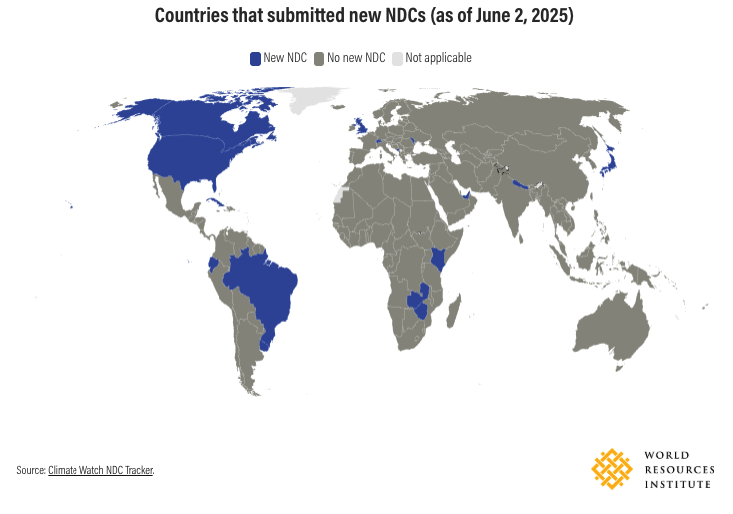
These early movers include a diverse mix of developed and developing nations from different regions and economic backgrounds.
Among the G20 — the world's largest GHG emitters — only five countries submitted new NDCs so far: Canada, Brazil, Japan, the United States and the United Kingdom. (Since submitting its NDC, the U.S. announced its intention to withdraw from the Paris Agreement.)
Several smaller and highly climate-vulnerable countries have also stepped forward, including Ecuador and Uruguay in Latin America; Kenya, Zambia and Zimbabwe in Africa; and island states such as Singapore, the Marshall Islands and the Maldives.
That means close to 90% of countries have yet to submit their new NDCs.
There are several reasons for this. The last round of NDCs was pushed back by a year due to the COVID-19 pandemic, giving countries only four years to prepare new plans. Geopolitical tensions, ongoing conflicts and security concerns have further complicated progress. Many smaller developing nations are also facing capacity constraints as they work to complete biennial climate progress reports and new national adaptation plans (NAPs), also due this year.
Most countries are now expected to present their new NDCs by the UN General Assembly in September.
Compared to previous targets, the NDCs submitted so far have made a noticeable but modest dent in the 2035 "emissions gap": the difference between where emissions need to be in 2035 to align with 1.5 degrees C and where they're expected to be under countries' new climate plans.
If fully implemented, new NDCs are projected to reduce emissions by 1.4 gigatons of carbon dioxide equivalent (GtCO2e) by 2035 when compared to 2030. Looking only at unconditional NDCs (those that don't require international support), this leaves a remaining emissions gap of 29.5 GtCO2e to hold warming to 1.5 degrees C. When conditional NDCs (those that do require international support) are included, this gap shrinks to 26.1 GtCO2e.


Much of the progress in narrowing the gap comes from major emitters that have already submitted new NDCs — most notably the U.S., Japan and Brazil. Given their large emissions profiles, their new commitments account for the majority of the reductions seen so far.
While this marks progress, it's far from what's needed to keep global warming within safe limits. Getting on track to 1.5 or even 2 degrees C would require much steeper cuts than what's currently on the table.
However, this is not the full picture.
Many of the world's largest emitters have yet to submit their 2035 targets. The remaining G20 countries alone account for about two-thirds of global GHG emissions. This makes their forthcoming NDCs especially important: The scale and ambition of these commitments could meaningfully narrow the emissions gap — or, if they fall short, leave the world locked into a trajectory that puts global temperature targets out of reach.

Among the countries that have submitted new NDCs so far, the United Kingdom stands out for its ambitious climate trajectory. Following the recommendations of its Climate Change Committee, the U.K. has set a bold target to reduce emissions 81% by 2035 from 1990 levels. This rapid decline in the coming decade would put the country on track toward its net zero goal by 2050, based on realistic rates of technology deployment and ambitious but achievable shifts in consumer and business behavior.
Other countries, such as Japan and the United States, have opted for a "linear" approach toward net zero — meaning if they drew a straight line to their net-zero target (for example, 0 GtCO2e in 2050), their 2030 and 2035 targets would fall along it, reflecting a constant decline in emissions each year. Japan aims to cut emissions 60% from 2013 levels by 2035, while the United States has pledged a 61%-66% reduction from 2005 levels by 2035.
Despite the U.S. withdrawing from the Paris Agreement, undermining climate policies and attempting to dismantle key government institutions, its NDC target may still provide a framework for climate action at the state, city and local levels, as well as for future administrations. Many of these entities have already rallied around the new NDC and are committed to making progress toward its targets.
However, the linear approach Japan and the U.S. are taking to emissions reductions — as opposed to a steeper decline this decade — risks using up a larger share of the world's carbon budget earlier and compromising global temperature targets.
Brazil presented a broader range of emissions targets in its NDC, committing to a 59%-67% reduction by 2035 from 2005 levels. These two poles represent a marked difference in ambition: A 67% reduction could put Brazil on track for climate neutrality by 2050, while a 59% reduction falls short of what's needed to meet that goal. It is unclear which trajectory the government intends to pursue, leaving Brazil's true ambition in question. The NDC also omits carbon budgets for specific sectors (such as energy, transport or agriculture), which would clarify how it plans to meet its overarching emissions goals. However, Brazil committed within its NDC to develop further plans outlining how each sector will contribute to its 2035 target.
Elsewhere, Canada made only a marginal increase to its target, shifting from a 40%-45% emissions reduction by 2030 to 45%-50% by 2035 from 2005 levels. This falls short of the recommendation from Canada's own Net-Zero Advisory Body, which called for a 50%-55% reduction by 2035 — and warned that anything below 50% risks derailing progress toward the country's legislated net-zero goal by 2050. While every increase in ambition counts, such incremental changes do not match the urgent pace of progress needed among developed and wealthy economies like Canada.

The ocean makes up nearly 70% of the planet’s surface, bursting with rich biodiversity and natural resources that are vital for both the climate and economies. Yet, beyond national coastlines, protecting much of the ocean has long been a murky endeavor.
For nearly 20 years, governments, scientists and ocean advocates have worked toward securing a global treaty to protect marine life in the ocean areas that lie beyond countries’ individual jurisdictions. These vast, mostly unregulated waters, known as the high seas, hold huge importance to the health of the planet.
Finally, in June 2023, the 193 member states of the United Nations adopted the landmark Treaty for the Conservation and Sustainable Use of Marine Biological Diversity of Areas Beyond National Jurisdiction (BBNJ agreement), under the UN Law of the Sea Convention (UNCLOS).
Though the text of what is commonly known as the “High Seas Treaty,” has been agreed, the story is far from over. By the conclusion of the third UN Ocean Conference, 51 parties had ratified the treaty with more pledging to follow, putting the treaty within reach of the 60 needed to put it into force. Once ratified, it will trigger a 120-day countdown, leading to the first Conference of Parties (BBNJ COP) that will determine how the treaty is fully implemented.
The ambition of the High Seas Treaty has always been immense. Roughly two-thirds of the ocean lies outside any single country’s jurisdiction, forming a collective space teeming with life from microscopic plankton to colossal blue whales.
The high seas are also home to lucrative natural resources, which countries and companies increasingly seek to explore and exploit, such as critical minerals needed for EV batteries and other low carbon technologies and marine genetic materials that are increasingly sought after to support pharmaceuticals, biotechnology and other innovations.
Yet, without a binding treaty, the high seas are governed patchwork-style through regional fisheries agreements, shipping conventions and scattered marine protected areas. This leaves critical gaps in protecting marine biodiversity or ensuring developing countries are also benefiting from discoveries made in international water.
When ratified, the High Seas Treaty will fill critical regulatory gaps and complement national efforts. It will help to guide regional cooperation and link seamlessly to sustainable ocean plans for national waters already being delivered by member countries of the High Level Panel for Sustainable Ocean Economy (Ocean Panel) and future plans through the 100% Alliance. Together, they will weave a comprehensive net of ocean stewardship from coastlines to open ocean.
In 2023, countries compromised on four core pillars of the BBNJ agreement:
The treaty will create a mechanism to establish marine protected areas (MPAs) and other conservation management tools on the high seas. MPAs are typically clearly defined geographical spaces, recognized, dedicated and managed, through legal or other effective means, to conserve marine biodiversity and ecosystems.
Many MPAs on the high seas already exist. For example, in 2010, six MPAs were established in the Northeast Atlantic with a total area of 286,200 square kilometers (110,502 square miles) and in 2016, the Ross Sea MPA with a total area of 1.5 million square kilometers (600,000 square miles) was established in the Southern Ocean.
The treaty will also establish a process for proposing new zones for protection via a consultation process, supported by scientific evidence.
The treaty will also establish rules for sharing financial and non-financial benefits from the commercial application of genetic material sourced from high-seas marine organisms — such as bacteria, corals or deep-sea sponges — that can be used in medicine, cosmetics, food, and biotechnology. These innovations hold huge potential benefits for human health and wellbeing.
The High Seas Treaty also supports sharing technology and knowledge developments, particularly to low-income countries that need and request it for conservation and sustainable use to ensure they participate fully in high seas governance.
The treaty will create a process for countries or companies proposing high seas activities — such as deep sea mining in areas beyond national borders — to conduct assessments and follow international standards, that can be shared transparently.
By the conclusion of UN Oceans Conference on June 13, the treaty had 136 signatories and was ratified by 51, just nine shy of the 60 parties needed to put the treaty into force. Those ratifying the treaty include island states such as Antigua and Barbuda, Barbados, Belize, Cuba, Dominica and the Maldives; the European Union and some of its members including France, Portugal and Spain; and other nations such as Chile, Norway and South Korea. (Track the signatories and parties on the UN website here.)
Starting in the early 2000s, the United Nations began informal discussions on how to close the regulatory gaps over how to manage the high seas, wrangling over how to share the benefits of its natural resources while ensuring necessary protections. But the very complexity of coordinating nearly 200 countries meant progress was often incremental, alternately buoyed by breakthroughs and bogged down by competing interests.
The slow ratification progress highlights both the strengths and limitations of international diplomacy. On the one hand, global consensus ensures that the resulting High Seas Treaty creates a single set of rules for all high-seas users. On the other hand, aligning the diverse interests of small island states, distant water fishing nations and environmental non-profit organizations is inherently time-consuming. Each negotiating text must thread the needle between these interests, with every word or comma potentially sparking months of debate.
Moreover, the decision-making processes of the UN, anchored in principles of sovereign equality and consensus-building, can struggle to keep pace with the urgent, evolving threats that marine ecosystems face: like the increasing demand for deep-sea minerals, growing plastic pollution and overfishing practices. By the time a treaty is finalized, new pressures may emerge, requiring fresh rounds of technical and legal work.
Countries, operating within their own jurisdictions — also known as exclusive economic zones, which extend 200 nautical miles from a country’s coastline — can make more immediate progress on conservation and climate initiatives. For example, Ocean Panel members are sustainably managing 100% of their national waters. The process for developing these holistic sustainable ocean plans, while not simple, has been faster than multilateral processes. Ocean Panel members are now calling on all coastal and ocean states to replicate this success in their own national waters by 2030 by joining the 100% Alliance.
At this month’s UNOC, it’s expected that many UN member states will announce either their signing or ratification of the High Seas Treaty. However, for it to be effective, it is crucial that the underlying framework and governance structures are agreed upon before coming into force. The BBNJ Preparatory Commission (BBNJ PrepCom) hopes to fill this gap: shaping the treaty operations and preparing for the first BBNJ COP.
Governments and negotiators are hoping to develop key recommendations to shape the critical elements of the treaty. This includes forming governing structures; outlining the roles and responsibilities of institutions such as those that provide data, and scientific and technical advice; creating tools and mechanisms to ensure equitable implementation of the treaty; and establishing systems to ensure funding and technical knowledge is distributed so all member states can fully participate.
The first BBNJ COP will see these recommendations brought forward and hopefully adopted. It is critical therefore that these meetings are constructive and that a consensus is reached. Only with the relevant governing and financial mechanisms in place can this High Seas Treaty go from a landmark agreement to a fully functioning international treaty that protects the global ocean.
Management of the ocean needs to be as interconnected as the ocean itself. By weaving together national actions with a robust global treaty, the world can ensure a resilient, equitable and thriving ocean for generations to come.
Editor's Note: This article was originally published on June 5, 2025 and updated on June 17,2025 to reflect new information about the countries who have signed and ratified the treaty.
This story was originally co-published by Floodlight and The Texas Tribune.
Whisper Valley is a peek into what the future could look like.
The sweeping community in the Austin, Texas, suburb of Manor is filled with modern homes, small manicured lawns, quiet streets, and rooftops outfitted with solar panels. Hidden beneath it is a network of pipes and man-made reservoirs that heat and cool hundreds of households via geothermal technology — a source that currently provides less than 1% of the U.S. electrical demand.
When completed, Whisper Valley will consist of approximately 7,500 owner-occupied and rental homes and multifamily units ranging in price from $350,000 to $750,000; three schools; 2 million square feet of commercial space; and 700 acres of park and outdoor community spaces. Habitat for Humanity is set to build affordable housing, which will hook up to the geothermal network.
Zac Turov, business development manager for EcoSmart Solutions, which runs the community’s geothermal system, says savings on utility bills for residents here with geothermal-powered heat pumps that cool and heat buildings can run up to $2,000 a year — based on a third-party-verified Home Energy Rating System.
Michael Wilt has lived in the community for six years, moving into his three-bedroom, 1,800-square-foot house during the first phase of Whisper Valley’s development.
He says he’s never had utility costs higher than $70 during the summer months or $45 a month during the winter. That doesn’t count the $60 monthly fee he pays to EcoSmart in operation fees.
“It absolutely works better than the HVAC system I had in the house that I was renting before purchasing the house,” Wilt, 47, said.
“The geothermal system was definitely part of the appeal, but really it was kind of the entire ‘agrihood’ feeling of the whole development,” he added, referring to places that are “intentional” about incorporating green infrastructure into the neighborhood and individual homes.
Developer Michael Thurman has built 30 of the more than 600 homes in this massive mixed-use development. And his company, Thurman Homes, is set to build up to 50 more.
The developer calls geothermal a commonsense way to preserve the planet by cutting the use of fossil fuels to power the homes and businesses here. Heating, cooling, and providing electricity to residential and commercial buildings accounts for about 30% of U.S. greenhouse gas emissions, according to the Environmental Protection Agency.
The community sits 15 miles northeast of Austin. It’s an area home to multiple tech companies, including Google, Tesla, Dell, Samsung, and Applied Materials.
But not all of the developers building in Whisper Valley tap into its geothermal system.
The reason, said Thurman, is money. It costs approximately $40,000 per home to install the heat pumps and hook up to the geothermal network.
“We can’t keep doing the same things,” Thurman said, referring to the imperative to cut greenhouse gas emissions. “This isn’t tough to do, but you have to have core values that make you want to do it.”
Geothermal is more expensive than other forms of renewable energy, including wind and solar, according to new estimates from the consulting firm Lazard.
“The goal is for all the developers who build here to use geothermal,” Turov said. “But it’s still a tough sale.”
Drilling advancements have expanded how and where geothermal technology can be used for heating and cooling individual buildings — and broader power generation.
“The thing is: It is hot everywhere underground,” said Drew Nelson, vice president of programs, policy, and strategy at the Houston-based, geothermal-focused nonprofit Project Innerspace. “Today, with the advances in modern drilling, we are now able to tap into that heat almost anywhere.”
The International Energy Agency (IEA) estimates there is enough next-generation geothermal potential to power the world 140 times over. And Nelson says the United States has the most potential to be a leader in the industry, with countries including China and India also having the resources to generate geothermal power.
“As more projects are implemented, costs will continue to come down,” Nelson said, noting the IEA analysis also predicts geothermal in coming years will be “competitive with solar and wind paired with battery storage.”
Using underground water reservoirs for heating and cooling or to generate electricity isn’t new. But until recently it was mostly confined to specific regions where it was easier to drill into hot water reservoirs — like in Iceland or California.
As of 2021, geothermal was concentrated in Western states, with California and Nevada accounting for more than 90% of the country’s geothermal power production, according to the National Renewable Energy Laboratory.
Geothermal is one of the cleanest ways to produce electricity. And it is the only renewable energy technology that has largely stayed out of the crosshairs of President Donald Trump, who has slashed federal support for renewable and clean energy, including wind and solar.
“One of the reasons President Trump really likes geothermal right now is that it’s all American,” said Bryant Jones, executive director of Geothermal Rising, a California-based nonprofit that advocates for the industry internationally. “It’s local. It’s a way to help rural America figure out their own economies as they transition from one technology to another.”
Geothermal tax credits — for both developers and for homeowners who install heat pumps — helped Whisper Valley thrive in its infancy.
However, industry insiders are ringing the alarms and pressuring the U.S. Congress to not eliminate clean energy tax credits and incentives included in former President Joe Biden’s Inflation Reduction Act. If those tax credits are phased out, insiders say it would cripple the industry before it has a chance to get on its feet.
While billions in federal funding for wind, solar, and other clean energy technology are on the chopping block, the budget bill mulled by Senate Republicans currently would retain tax credits for geothermal, nuclear, and hydropower projects that begin construction by 2033.
The U.S. Department of Energy did not respond to multiple requests for comment on whether it would continue to support geothermal through federal funding and tax incentives, as it did under the previous administration.
“We do need the tax credits for geothermal energy to be maintained,” Jones said. “Geothermal doesn’t have a technology problem, it has a policy problem. [It’s] been around for over 100 years, [but] it hasn’t had the policy support the way the oil and gas industry has, or the nuclear industry, and most recently, the solar and wind industry.”

Traditionally, geothermal was limited to places with naturally occurring underground hot reservoirs, usually near tectonic plates or in volcanic areas.
But evolutions in geothermal have opened the door for developers to utilize oil and gas drilling technologies which help lower costs and allow them to create their own reservoirs almost anywhere. The models fall in two categories: enhanced geothermal systems, or EGS, and closed-loop geothermal systems like the one in Whisper Valley.
With EGS systems, developers create artificial underground reservoirs through hydraulic fracturing or “fracking,” and then inject water or other fluids into a well. The water is heated as it moves through hot rocks and is then pumped up into a separate production well to generate energy.
Closed-loop systems use an underground network of sealed wells where water or fluid is pumped and heated without ever coming in direct contact with rocks. It is then piped into the homes and buildings connected to the system. These systems also cool buildings by drawing out heat during warm weather.
“The more that people learn about geothermal,” Jones said, “the more obsessed they become.”
He says geothermal’s appeal includes a low carbon footprint, reliability, and established drilling technology pioneered by the oil and gas industry. Unlike batteries and wind power, geothermal does not rely on critical minerals whose supply can be disrupted by geopolitical events.
It’s also among the more expensive energy sources because it requires specialized drilling, installation equipment, and skilled workers trained to build it all. Supporters say the industry will continue to need federal tax credits and funding to grow, especially in communities where utility bills are already unaffordable.
While many geothermal units serve just a single household, systems that serve many buildings are more affordable.
“A way to address that is through thermal energy networks, or geothermal district networks,” Jones said, referring to connecting multiple homes and buildings, which means “the cost goes down for everybody.“
He cites Framingham, Massachusetts, where one utility, Eversource, is providing geothermal energy for roughly 140 residential and commercial customers in one neighborhood. After the two-year pilot project ends, customers can return to natural gas, also known as methane, or continue using geothermal, the company says.
“We are still collecting data as we enter the start of the cooling season, but over the winter we saw strong system performance even during the January and February cold snaps,” said Olessa Stepanova, spokesperson for Eversource.
Stepanova says the company expects to have insight into energy savings from the project within a year from when each customer is connected to the geothermal system. And the utility is in final negotiations with the DOE and state to expand the network.
“This would not only demonstrate the scalability of networked geothermal systems,” she added, “but also how they become more cost-effective as they are expanded.”
Last year, the U.S. Department of Energy Geothermal Technologies Office awarded a total of $37.7 million to five cities to install district-scale geothermal heating and cooling systems.
Ann Arbor, Michigan, was awarded the most money, $10 million, which the city is using to build and operate a community geothermal system. It is projected to provide heating and cooling to 262 homes, a local elementary school, and community center in the Bryant neighborhood. The predominantly minority, lower-income area seeks to become the most sustainable neighborhood in the United States.
“It’s a neighborhood that has been disinvested in, and as we were working on our climate goals to be carbon neutral, we wanted to do that in a just and equitable way,” said Missy Stults, director of the city’s Office of Sustainability and Innovations.
Stults says some households in the community shell out up to 30% of their income on utility bills.
“We started to think about what’s a sustainable source of heating that we could look at that helps maintain affordability for everyone [and] that’s clean,” Stults said. “And so geothermal was one thing that came up, and the residents were really interested in it.”
Stults says it’ll likely be a year before the city starts drilling — and that’s only if Congress or the Trump administration keeps the federal funding in place. The city has been “sort of treading water” since Trump announced freezes on various renewable energy program spending. As of June, Stults says the grant had not been terminated, but the funding still hadn’t been allocated to move their project forward.
“Our hope is that [the project] will align with the administration’s goals,” she said. “This is American-made energy. It’s our grounds, our soil. It’s pretty powerful.”
As a selling point, Thurman uses the utility bills for his model home in Whisper Valley and compares them with other homes of the same size he built with traditional HVAC systems.
For the three-bedroom,1,800-square-foot home he built in Whisper Valley, utility bills in June and August 2023 were $42.16 and $74.54, respectively. A home the same size he built using an HVAC system had bills in those same two months of $233 and $326, respectively.
Turov says some developers have opted to build homes in Whisper Valley that use traditional HVAC systems instead of geothermal.
“Developers are reluctant to innovate, usually because it costs more, even though there are great benefits from using the technology,” he said. “We might have to make it work without [federal] subsidies, which will be a challenge but could be good for the long-term viability of the technology in the United States.”
EcoSmart Solutions successfully lobbied Texas state lawmakers for changes in state law and initiatives that can help geothermal grow there — with or without federal subsidies. They include measures that cut drilling regulations for geothermal projects, allow such systems to be added to the electric grid and pave the way for financing through bonds and “special purpose” taxing districts.
Turov explains that such districts allow developers to install infrastructure such as lights, roads, and water systems, the cost of which is then repaid by owners on their property tax bills.
“I think right now, we’re in the first adopter stage,” Turov said. “And that’ll probably still be the case for the next few years. And then I think more and more people will adopt it.”
Floodlight is a nonprofit newsroom that investigates the powers stalling climate action. The Texas Tribune is a nonprofit, nonpartisan media organization that informs Texans — and engages with them — about public policy, politics, government, and statewide issues.
See more from Canary Media’s “Chart of the week” column.
Wind and solar are on the rise worldwide — here are the 10 countries that rely on the clean-energy sources most for their electricity.
All of these countries used wind and solar to produce at least one-third of their electricity in 2024, according to a new report from the Energy Institute. For leading countries such as Denmark, Djibouti, and Lithuania, that figure was in the range of two-thirds or more.
Those numbers are much higher than the global average: Overall last year, wind and solar accounted for 15% of global power generation, up from 13% in 2023.
To be clear, China is still by far the largest producer of solar and wind energy in the world in terms of volume. The country generated 1,836 terawatt-hours of wind and solar last year. All of Europe, for comparison, generated 990 TWh over the same period. But despite that huge amount of renewable energy generation, China received a much lower share of its power from solar and wind in 2024 than the 10 countries on this list — just about 18%.
The list is mostly populated by smaller countries, but it does include some large economies like Germany and Spain. In Germany, wind and solar accounted for a combined 43% of power. In Spain, 42%. (Spain recently suffered a countrywide blackout for which its high share of renewables was blamed. The true culprit, according to a government report released last week, was poor grid planning.)
By the end of the decade, the International Energy Agency expects wind and solar together to account for nearly 30% of global electricity generation. So, while only a handful of countries boast high levels of renewable energy penetration today, many more will join their ranks in the coming years, as wind, and especially solar and batteries, get cheaper and harder to refuse.
This analysis and news roundup comes from the Canary Media Weekly newsletter. Sign up to get it every Friday.
Record-breaking heat swept across the eastern U.S. this week — and with millions of air conditioners whirring, power demand came close to breaking records too.
The ISO New England grid region, which covers most of New England, saw its second-highest power demand ever on Tuesday. In Maine, experts with the Governor’s Energy Office told the Portland Press Herald that New England would’ve beaten the record if it wasn’t for behind-the-meter solar power, like panels on rooftops and over parking lots that aren’t controlled by grid operators. But the region still had to activate fossil fuel-fired peaker plants — which worsen climate change and air quality — to meet demand in the evening.
The grid operated by PJM Interconnection, which includes New Jersey, Ohio, Pennsylvania, Virginia, and other mid-Atlantic states, also came close to breaking demand records both Monday and Tuesday. Power outages affecting thousands of homes were reported throughout the region, with utilities blaming many of them on the high temperatures.
One growing technology could’ve helped the grid manage the heat even better: battery storage. Take New England. Instead of switching on fossil-fuel peaker plants, batteries could’ve stored excess power generated during the day and discharged it when demand peaked — something numerous studies have suggested as a solution for the region. It’s a method that the grid operators for Texas and California rely on every day, as power generated when the sun is shining is stored for use when it sets.
But not every region is embracing the technology. PJM, in particular, has failed to take advantage of batteries in spite of its demand challenges, partly because it has one of the longest waits in the country to connect to the grid.
Battery storage is also threatened by the “Big, Beautiful Bill” currently making its way through Congress. While the Senate did extend a lifeline to the energy-storage industry in its version of the bill, a Wood Mackenzie/American Clean Power Association analysis out this week found that grid-battery installations could still dip as much as 29% next year if tax credit and tariff uncertainty continues.
New York envisions a nuclear future
New York Gov. Kathy Hochul (D) launched an ambitious quest this week, directing the state’s Power Authority to build a large nuclear reactor. The reason? Rising power demand.
“If we don’t increase our capacity over the next decade, we will see rolling blackouts,” Hochul warned at a press conference. “This is the best technology to meet this demand.”
New York is already home to three nuclear power plants, and until just a few years ago, it had four. The Indian Point power plant shut down in 2021 over environmental contamination concerns. But since then, New York has had trouble making up Indian Point’s lost generation capacity, leading the state to rely on more gas power — which has in turn raised greenhouse gas emissions.
In Texas, a company led by Rick Perry, former Republican governor and Trump administration energy secretary, is proposing a nuclear project of its own. Fermi America aims to build four 1-gigawatt nuclear reactors to power a massive data-center campus.
It’ll be years before either one of these proposed plants would come online. But at the very least, it’s yet more evidence of nuclear power’s rebounding popularity on both sides of the aisle.
Senate parliamentarian rescues some energy measures from the “Big, Beautiful Bill”
Some of the Senate’s efforts to roll back Biden-era energy and environmental measures were knocked down a peg this week, courtesy of the body’s parliamentarian. The nonpartisan adviser to the Senate ruled that many “Big, Beautiful Bill” provisions can’t be passed via the 50-vote budget reconciliation process, and instead will need 60 votes to pass. Senate Republicans have only 53 seats.
The parliamentarian’s critique includes a measure that would force the U.S. Postal Service to sell all 7,200 of its newly purchased EVs and scrap its charging infrastructure — a move the USPS said would cost it $1.5 billion. The parliamentarian also ruled against provisions to speed fossil-fuel project approvals, repeal the EPA’s tailpipe-emissions rules, and sell off public lands.
In response, Senate Republicans unveiled new language on Wednesday that omits the tailpipe-emissions rollback and makes other energy-related edits.
Also this week, several groups — including car dealers, energy investors, and even Georgia Republican state legislators — wrote to the Senate urging it to protect clean energy tax credits.
EV funds restored: A federal judge orders the Trump administration to release billions of dollars of frozen funding for 14 states to build a public EV charging network, but leaves out Minnesota, Vermont, and Washington, D.C., which had also sued to get funding restored. (Associated Press)
Building more batteries: LG Energy Solution cuts the ribbon on its expanded battery plant in Michigan, where it’ll now produce utility-scale battery cells that utilize lithium iron phosphate chemistry. (Canary Media)
Coal’s deadly impact: The “old man’s disease” of black lung has been affecting younger coal miners at rates not seen since the 1970s, and advocates worry cuts to federal health and mining safety offices Trump’s attempt to revitalize the mining industry could exacerbate the problem. (New York Times)
Green lawns, greener mowers: Colorado landscapers are making the transition to electric lawn equipment after new state regulations went into effect this month to help curb noxious fumes that contribute to poor air quality. (Canary Media)
Fishing for electrification: Electric boats and solar-powered processing equipment are starting to create environmental and financial benefits for Maine’s growing shellfish industry, but uncertainties around federal funding could slow progress. (Maine Monitor)
A geothermal community: A suburb of Austin, Texas, aims to power 7,500 planned homes and commercial buildings with a sprawling geothermal energy project. (Texas Tribune/Floodlight)
Weatherization paradox: Many low-income households can’t access the free, energy-saving Weatherization Assistance Program because they can’t afford to make basic but expensive repairs required for qualification. (Grist)
Steel’s cleaner future: Steelmakers planning new facilities in the U.S. are embracing a cleaner technology for purifying iron ore, which can then be used in electric furnaces to finish the steelmaking process. (Canary Media)
Massachusetts last week enacted a revamped version of its solar incentive program that developers and advocates say should keep the state’s solar industry moving forward even as the Trump administration pushes to undermine federal support for clean energy.
“In short, the program makes Massachusetts a very healthy market for solar,” said Nick d’Arbeloff, president of the Solar Energy Business Association of New England. “We’ll still be able to present a compelling case to an investor.”
The newest iteration of the Solar Massachusetts Renewable Target program — generally called SMART — makes fundamental changes to the structure of the incentives to be more responsive to market conditions. Other provisions aim to make the benefits of solar available to more low-income residents, protect valuable open space from development, and encourage placement of panels on rooftops and in parking lots.
The state filed the new rules as emergency regulations, allowing them to go into effect immediately.
The move comes just in time, according to solar developers. The previous version of SMART hasn’t been effective in quite some time, they say. While draft regulations for this newest version of SMART were first released nearly a year ago, and a final revision was expected in fall 2024, months went by without new rules.
“The uncertainty we were facing was confusing inventors, was killing projects, and could have done even more damage,” d’Arbeloff said.
In the meantime, President Donald Trump took office and Republican legislators have been working on a budget bill that seems likely to accelerate the elimination of federal renewable energy tax credits. Massachusetts solar developers became increasingly worried they would find themselves in a “valley of death,” with neither state nor federal support, at least for a time, said Ben Underwood, co-CEO of Resonant Energy, a Boston-based solar company that specializes in projects serving environmental justice communities.
Developers, therefore, heaved a sigh of relief when the new state regulations were filed. The reimagined program will start accepting applications on October 15, which will give developers a chance to get projects in place and investors lined up, even with the threat of disruption at the federal level, Underwood said.
“Now we and other members of the industry can start to plan for the incentives,” he said. “It gives us a much easier transition in case federal incentives are taken away.”
Launched in 2018, SMART pays the owners of solar systems a set rate per kilowatt of energy generated by their panels. The base rate depends on project type, location, and size. Projects advancing goals the state supports — serving low-income communities, for example, or building on a closed landfill — receive a boost, known as an “adder,” to their base rate.
The program was initially designed to lower its rates as more solar installations were built. The thinking was that, as the solar industry became more established, the cost of developing projects would go down and developers would need less financial support to be viable.
For years, SMART helped drive solar growth in the state: From 2019 to 2021, annual solar installations more than doubled. Then the Covid-19 pandemic intervened, upending supply chains and sparking inflation. At the same time, SMART compensation rates had fallen, as intended. Suddenly, the incentive payments weren’t enough to cover growing costs, and the industry took a hit. In 2024, less than half as much solar capacity was installed than in 2021.
“You were finding that the incentive level for many projects was, in fact, zero,” d’Arbeloff said.
The new rules jettison the old system of declining rates, replacing it with one that resets the compensation and program size each year, allowing the program to adjust to future unexpected market changes. Annually, the state will conduct an economic analysis that considers progress toward emissions reduction goals, regional and national solar costs, current and historic program participation rates, and land-use and protection goals, and will use the results to set compensation for the coming year. Adders will still be part of the system, and will also be adjusted annually, as needed.
“We can understand the costs, we can understand the size of the program, and we can make adjustments with ratepayers in mind,” said Elizabeth Mahony, commissioner of the Massachusetts Department of Energy Resources. “That’s really important for ratepayers and the development community — we’re going to be so nimble.”
For 2025, the program will be open to up to 450 megawatts of capacity. The base compensation rates will be set after the state completes a new economic analysis in the next few months, Mahony said.
The revised regulations also aim to increase the amount of money flowing to solar projects serving low-income residents. For a development to receive an adder as a community shared solar project, it must allocate at least 40% of the bill credits it generates to low-income households and guarantee these customers a savings of at least 20%, compared with the basic retail price.
“It represents a substantial move toward having greater value for low-income community shared solar participants,” Underwood said. “It’s really good to see that.”
The new regulations also target ongoing tensions about how best to site solar projects while still protecting wildlife habitats and agricultural land.
“We hope the way this works is it pushes folks to do more on rooftops, to do more on canopies, and to do more on previously developed land,” said Michelle Manion, vice president of policy and advocacy for the Massachusetts Audubon Society. “When it comes down to the actual numbers, then we’ll see how well it actually works.”
Certain categories of land with particular environmental value have been declared ineligible for solar development going forward. Projects built on other open spaces will have to pay a mitigation fee that will be determined by a list of factors, including the land’s carbon storage and agricultural potential, the parcel’s ecological integrity, the cumulative impact of the proposed development and others in the area, and location of the planned project relative to grid infrastructure.
“It’s a good way to be a little more strategic about siting solar,” said Erin Smith, clean grid director for the Environmental League of Massachusetts.
These measures are combined with provisions that encourage more development on the built environment. The regulations expand the definition of a solar canopy that qualifies for an adder — which was limited to projects over parking lots, canals, and pedestrian walkways — to include any array raised high enough off the ground to allow the use of the area beneath for another function. The rules also create a new category of adder for panels mounted above other equipment atop buildings, allowing more efficient use of rooftop space.
Though the emergency regulations process put the new rules into effect immediately, the state must still hold three hearings within 90 days to gather public feedback and get final approval from utility regulators. Some tweaks to the program could be coming, but state officials are confident they’ve got the basics right.
“There are quite a few projects that have been waiting for this to come out,” Mahony said. “We believe this is one of the best ways we have to build energy generation in the next few years.”


.svg)
