

 Back
Back
CALISTOGA, Calif. — A quaint northerly outpost of Napa Valley wine country, Calistoga has struggled to keep the lights on when wildfires strike the region. Now it’s got a brand-new microgrid to run the whole town for days on end without any onsite fossil fuels, just batteries and liquid hydrogen.
After disastrous conflagrations in 2017 and 2018, utility Pacific Gas & Electric began preemptively shutting off power lines to avoid sparking fires amid dangerously dry, windy conditions.
“We were the first community in all of PG&E’s network that was getting our power shut off to protect us,” said Calistoga City Council member Lisa Gift. “By 2019 we were one of the first communities to have a microgrid in all of PG&E’s network, and that was being powered by diesel generators.”
PG&E arranged a bank of truck-based diesel generators to sit in the town during fire season. When the utility cut grid power, the generators kicked on, belching smoke in a particularly beloved pocket of the 5,000-person community.
“We’re a small town, so they would come up and they’d be polluting the environment, taking up our dog park — loud, gross, noisy,” Gift recalled.
Now the diesel generators are gone and the park has been turned back over to Calistoga’s canine companions.
On a slim parcel of city land next door, publicly traded energy-storage company Energy Vault installed lithium-ion batteries and a 234-foot, reinforced-steel tank for liquid hydrogen (designed to withstand a roaring fire, should it ever come to that) that runs a bank of hydrogen fuel cells. Altogether, this compound should be able to meet Calistoga’s electricity needs without any power from the broader grid. It’s contracted to produce up to 8.5 megawatts for 48 hours, whenever PG&E shuts off grid power due to fire concerns. Refilling the hydrogen tank could let it run for several days more.
“Even though we’re taking elements — fuel cells, batteries, liquid hydrogen storage and distribution — that have been used before in commercial settings, they’re coming together for the first time as resiliency,” said Craig Horne, Energy Vault’s senior vice president for advanced energy solutions, in an interview before the project’s unveiling in early August.
Fans of hydrogen hail it as a solution to just about any entrenched decarbonization challenge, from heavy transport to steelmaking to on-demand power. But how hydrogen is produced makes a huge difference in its climate impact; seemingly clean sources can actually rack up major carbon emissions for negligible benefit. For now, the clean hydrogen economy remains largely speculative, with hardly any truly clean hydrogen being produced or any real projects using it. Many planned clean hydrogen projects have vanished without a trace, following a short-lived boom fueled by Biden-era support.
In Calistoga, Energy Vault has tapped hydrogen to deal with a very specific set of constraints — delivering energy without local emissions, over multiple days, in a tight footprint — but the cleanliness of that hydrogen is a more complicated issue than public descriptions of the microgrid suggest.
The key players all have a lot riding on the project.
Energy Vault, which previously raised several hundred million dollars in a singular bid to store energy with multi-story robotic cranes that stack blocks, wants to build a new long-duration storage business around this hydrogen microgrid showcase. Plug Power, the financially challenged hydrogen company, points to Calistoga as its largest deployment of hydrogen fuel cells (a beefy 8 megawatts, after 28 years of hard work). And PG&E has orders from regulators to add more clean energy microgrids in communities where it regularly cuts off power — Calistoga was its first delivery on that directive, after a few years of soliciting proposals and a couple more years of permitting and construction.
“Community microgrids are the future of the energy system,” said Craig Lewis, who advocates for such projects as executive director of the Clean Coalition nonprofit. The Calistoga microgrid is “a commercial-scale experiment, and I’m grateful for it.”
The results of that experiment will take time to analyze. It could unleash a new, replicable model for premium-priced community-level backup power. Or the quirkiness of the design and the murkiness of hydrogen’s supply chain and emissions could make it a quixotic outlier of questionable climate value.
The Calistoga microgrid poses an answer to the question of how to provide a few days of backup power to a small town in a small space, without worrying too much about cost. The limitations drove the design, which turned out quite unlike anything built thus far.
Energy Vault had to figure out how to pack 293 megawatt-hours of storage into just two-thirds of an acre. The lot used to hold debris from city works, like old bits of sidewalk and pipes, Horne said.
Lithium-ion batteries have proven themselves capable of storing power, be it as a Powerwall in someone’s garage or as a large-scale grid storage facility. But to store nearly 300 megawatt-hours, grid battery enclosures need more acreage than was available to lease from the city. Even if enough batteries could fit, the auxiliary power consumption for keeping them safely cooled would pose a challenge for a project that’s supposed to mostly sit around waiting for an emergency event.
Hydrogen gas can be liquefied by cooling it to ultra-low temperatures, which unlocks greater energy density. When converted back to gas and run through fuel cells, it produces a stream of electricity and no byproduct besides water vapor. That core technology powers hydrogen vehicles, though their cost and inconvenience make for a widely derided car-ownership experience. At Calistoga, the hydrogen flows directly to six Plug Power GenSure 1540 fuel cells, boxy containers with cooling units stacked on top, making them about two stories tall.
The engineers added a small lithium-ion battery (7.7 MW/11.6 MWh) to perform “black start,” the complicated and crucial task of rebooting an electrical system after a complete blackout, Horne noted. The battery also buffers the output of the system while the hydrogen gets up and running. Then the power flows to Calistoga’s grid, which, when PG&E shuts off the transmission lines, will be fully islanded from the surrounding network.
The hydrogen is stored onsite in an 80,000-gallon tank, manufactured in Minnesota by Chart Industries. The tank holds enough to power the fuel cells for about two days, but Energy Vault will try its best to keep the lights on beyond the contracted timeframe, Horne said. So the company made sure the tank can be refueled while it’s in active use.
“The task is to squeeze toothpaste into a toothpaste tube that was being squeezed,” Horne said. “That’s what we proved in our acceptance testing, running for multiple hours while the fuel cells were running and a tank trailer here in the driveway is pushing liquid hydrogen into the tank itself.”
The microgrid’s promise as a clean energy breakthrough, of course, hinges on the supply of clean hydrogen, but supply chains are barely getting started. Almost all commercial hydrogen is currently made from methane gas, a fossil fuel, through a procedure called steam methane reforming that sends the carbon dioxide byproduct straight into the atmosphere.
For hydrogen to stake any claim as a climate solution, it needs to be made without massive carbon emissions. That usually involves an alternative production method called electrolysis, which separates hydrogen from water using electricity. But this method can produce even more emissions than the dirty methane version if the electrolyzers are drawing power from the grid rather than dedicated renewable sources like solar and wind (see this previous Canary Media coverage for a detailed account of why that’s the case).
Energy Vault describes the hydrogen it’s using in Calistoga as “clean,” which Horne clarified as meeting the federal standard of no more than four kilograms of carbon dioxide emitted per kilogram of hydrogen produced. But he declined to name the source. Notably, California has subsidized hydrogen fueling stations for over a decade but still hasn’t managed to develop a clean hydrogen supply in-state. So for Calistoga’s hydrogen to be clean, it must be coming from somewhere else.
During a tour of the microgrid, Deepesh Goyal, vice president of stationary power at Plug Power, told Canary Media that Plug Power currently supplies hydrogen from its electrolyzer site in Georgia, which runs on grid power. More than half of Georgia’s electricity comes from fossil fuels, so that electrolysis incurs substantial power-plant emissions. Plug Power buys credits for clean energy supply to compensate for this, Goyal said.
To meet the highest federal standard for clean hydrogen, producers need to obtain clean power matched to their consumption on an hourly basis in the areas where they operate. Plug Power did not respond in time for publication to questions clarifying what type of credits it buys. But a spokesperson for Energy Vault told Canary Media that currently there aren’t any facilities that could supply Calistoga with liquid hydrogen from electrolysis powered by time-matched, dedicated clean electricity, and the earliest such facility is targeting completion in 2026.
Goyal also said some of Calistoga’s hydrogen comes from an unnamed partner in Las Vegas that uses renewable natural gas (RNG) as its feedstock. As it happens, legacy gas supplier Air Liquide opened a steam methane reformer in that area a few years ago to serve California’s demand. Air Liquide says it can substitute RNG for the usual methane, which would make the resulting hydrogen carbon-negative according to the convoluted calculations of California’s clean fuels bureaucracy. It’s still hydrogen made by splitting methane and releasing carbon dioxide, but it looks good on paper thanks to controversial rules that privilege certain politically connected providers of RNG.
If someone were to design a climate solution from a blank slate, they probably wouldn’t run electrolyzers on grid power in Georgia in order to load the super-cooled hydrogen onto diesel-powered tankers and haul it more than 2,800 miles to Northern California, where it will sit around almost every day awaiting a utility power outage.
“We still have to truck in that hydrogen,” said Gift. “That’s not ideal, but we were trucking in the diesel, and we were trucking in the diesel sometimes three times a day and burning that diesel.”
One incontrovertible fact is that the microgrid doesn’t combust anything onsite, so the operations within the fenceline emit almost no carbon emissions and don’t impact air quality. But it will be hard to gauge the real climate impacts of such a project until a more verifiably clean and geographically localized hydrogen supply chain develops. Several companies have said they will build truly green hydrogen production in the coming years. That task has only grown more difficult with the Trump administration’s efforts to thwart renewables development and vastly curtail clean hydrogen tax credits.
The other make-or-break variable for hydrogen-backed resilience is how much it costs. Liquid hydrogen is an expensive, specialty fuel only produced by a handful of suppliers in the U.S., and clean liquid hydrogen is even rarer.
For this first project, Energy Vault didn’t need to worry about consumer price sensitivity. The city of Calistoga isn’t paying Energy Vault for backup power: PG&E is paying the company to provide this service, out of funds socialized across the utility customer base. In fact, Calistoga is making some money, since Energy Vault leased the land from the municipality for 10 years.
The project’s total price tag has not been made public. Regulators allocated up to $46.3 million for PG&E to spend on the endeavor. Energy Vault closed $28 million in project financing this spring to support construction. (The company also said on Thursday that it has raised $300 million to launch Asset Vault, a subsidiary that will build, own, and operate storage projects, with Calistoga as one of two anchor properties.) Horne allowed that the hydrogen microgrid costs more than diesel generators up front, but argued it can be competitive in terms of operating costs, given all the hassles associated with diesel.
“We can do more and waste less, and so that’s how we can be more cost effective,” he said.
The regulatory authorization paints a different picture. The California Public Utilities Commission explicitly allowed PG&E to spend more money than the diesel generators cost in order to test a new model for cleaner resilience.
“This project was supported by a CPUC plan that said we could build a solution that costs no more than twice what it would cost to deploy diesel generation over 10 years,” said Jeremy Donnell, a senior manager for microgrid strategy and implementation at PG&E. “It’s a bit of an arbitrary marker, but that’s what was laid out, and this project did come in under that threshold.”
“But still, we have a ways to go to bring the cost down,” Donnell added. “So hopefully, through implementation of this first project, Energy Vault learned a lot, the industry learned a lot on how to integrate these solutions in future projects.”
Energy Vault hopes to improve the project economics by upgrading the site to allow regular power exports to the grid. Currently, the system is configured to only push out power when PG&E has scheduled a shutoff event; that means the microgrid sits idle almost every day of the year (and is unavailable for unforeseen outages, like if a tree falls on a key line). But with the right permissions and technical tweaks in place, Energy Vault expects to use the battery, and potentially even the hydrogen, to send power to California’s grid at particularly lucrative times.
“We can now have a viable second revenue stream outside of providing that resiliency service, without compromising our ability to provide the resiliency service,” Horne said. PG&E amended its contract this summer to clarify that Energy Vault is allowed to pursue this, provided it does not interrupt delivery of the required resilience services.
Going forward, Calistoga will serve as a showcase for Energy Vault’s new “H-Vault” product line, marketed as a high-tech option for long-duration clean energy needs. Hydrogen tanks will join gravity-based block stacking and conventional lithium-ion batteries as the company’s core offerings.
For the people of Calistoga, the project softens the upheavals of living through climate change–induced extreme weather, without all the downsides of onsite fossil fuel combustion.
“Is it absolutely perfect? No,” Gift said. “But as a society, it is about making that next best right step. And for us in our community, this was that next best right step.”
For Energy Vault and the budding hydrogen industry, the next right step will be expanding hydrogen production that’s definitively low-emissions, and closing the 2,800-mile gap between supply and demand.
Wendy Becktold contributed reporting from Calistoga.
Earlier this week, two low-carbon cement startups unveiled new partnerships with data-center developers and operators, which are looking at ways to curb the tech sector’s ballooning climate impact.
The separate announcements from Sublime Systems and Brimstone are a striking example of how businesses are pressing ahead with efforts to decarbonize essential polluting industries like cement making — even as the Trump administration guts federal programs meant to kick-start U.S. manufacturing of cleaner construction materials.
Both companies are developing novel ways of producing cement that don’t cook the planet in the process. Cement — the gluey powder mixed with sand, gravel, and water to form concrete — is responsible for roughly 8% of global carbon dioxide emissions. Nearly all cement is made today by heating carbon-rich limestone in fossil-fuel-burning kilns.
Sublime, an MIT spinout, said on Tuesday that it completed a “pilot pour” of its fossil-fuel-free cement at a data center campus in northern Virginia owned by Stack Infrastructure. Sublime’s approach involves electrically charging a bath of chemicals and calcium silicate rocks. In Virginia, the startup and its partners used the cement to make seven cubic yards of concrete mix, which was then spread over a high-traffic loading dock.
Demonstration projects like these are key to convincing the inherently cautious construction industry to embrace new approaches. “It gives us a proof point to then [do] larger-scale deployments in a few years,” Cory Waltrip, Sublime’s director of business development and strategy, told Canary Media.
Those future deployments could include facilities run by Microsoft. The tech giant recently signed a binding deal to purchase up to 622,500 metric tons of Sublime’s cement products — enough to build roughly 30 professional football stadiums — from the startup’s forthcoming manufacturing facilities. The agreement marks a massive step up for Sublime, which can currently make just 250 metric tons of cement per year at its pilot plant in Somerville, Massachusetts.
Brimstone, for its part, also announced on Tuesday that it signed a commercial agreement with Amazon. The deal allows Amazon, valued at $2 trillion, to reserve future supplies of Brimstone’s low-carbon cement, though the partners declined to provide more specific details.
Oakland, California–based Brimstone sources carbon-free rocks instead of limestone, then pulverizes those rocks and adds chemical agents to leach out valuable minerals. Certain compounds are heated in a rotary kiln to make industry-standard cement. What remains can be used as supplementary cementitious materials — which help bulk up cement mixes — or to make a key component of aluminum.
Cody Finke, Brimstone’s co-founder and CEO, said Amazon began testing Brimstone’s products about a year ago and found they worked just as well as the conventional materials used in Amazon’s buildings. Amazon will get its supply from Brimstone’s $378 million commercial demonstration plant, which is slated to be operating by the end of the decade, Finke said.
The announcements send an important signal that private-sector demand isn’t waning for cleaner construction products — despite the White House abandoning strategies and rescinding funding for using greener cement, steel, glass, and other materials in public buildings, roads, and bridges.
Melissa Hulting, director for industrial decarbonization at the Center for Climate and Energy Solutions, said she was “really excited” about the latest news from Sublime and Brimstone.
“In the absence of federal demand … it’s great to see that companies are stepping in and supporting procurement” of low-carbon cement, she said. “I’m hoping that we’ll see more companies, especially with the building up of these data centers, come in and fill that void.”
Still, green cement startups continue to face a sizable challenge in scaling up their pioneering manufacturing plants. The task is likely to be even harder now that the Department of Energy has clawed back crucial funding for industrial decarbonization initiatives.
In late May, the DOE said it was canceling over $3.7 billion in awards for two dozen projects aimed at decarbonizing everything from cement kilns and glassmaking furnaces to mac-and-cheese factories and whiskey distilleries. Sublime was slated to get up to $87 million to build its commercial-scale cement facility in Holyoke, Massachusetts. Brimstone had been awarded up to $189 million to finance the construction of its commercial plant, the site for which is still being decided.
Both Sublime and Brimstone said they’re in ongoing conversations with the DOE to try to appeal the decision. In the meantime, however, the startups are moving forward as planned with their manufacturing facilities.
Finke said Brimstone’s award cancellation felt like an “oversight, because critical materials are such an important topic for the Trump administration.” But he said that losing the federal funding doesn’t affect the company’s long-term strategy, which is focused on raising private capital. To date, the six-year-old startup has raised over $80 million from investors.
Sublime, meanwhile, has raised over $200 million since its founding in 2020, a figure that includes the DOE award. Leah Ellis, Sublime’s co-founder and CEO, said the startup remains on track to begin delivering cement to Microsoft and other customers from its Holyoke facility in 2028.
“We do think what we’re doing is aligned with the current administration’s priorities of creating jobs and investing in modernizing and onshoring manufacturing of important materials,” she said.
“Everything inside Sublime is going as well as we could hope,” Ellis added. “Nobody thought that scaling up a new cement technology would be easy, right? But that’s what we’re here for.”
San Francisco already requires most new buildings to eschew gas and run solely on electricity. Now, the metropolis is moving to ensure that substantial renovations in existing buildings are also all-electric.
Last week, the city and county’s Board of Supervisors completed the first of two votes to pass the All-Electric Major Renovations Ordinance, a climate-forward building standard that will apply to commercial and residential structures. The initial 11–0 vote was a resounding sign of approval; the final hearing is likely to occur Sept. 2, according to the San Francisco Environment Department, the agency that developed the rules.
“We can’t build the San Francisco of the future with fuel from the past,” Board of Supervisors President Rafael Mandelman said in a statement. “This legislation picks up where we left off with the All-Electric New Construction ordinance and affords us the opportunity to eliminate the use of fossil fuels in our existing buildings, improve indoor and outdoor air quality, and make San Francisco a safer, healthier, and more resilient place to live and work.”
The proposed ordinance was years in the making, but the city is now fast-tracking its approval before a new statewide pause on updates to building codes kicks in. Under the law, signed in June, San Francisco and other jurisdictions in the Golden State have only until Oct. 1 to adopt stronger building codes unless they claim an exception.
San Francisco can’t meet its climate goals unless it moves buildings away from fossil fuels. The city has vowed to slash carbon pollution by 61% from 1990 levels by 2030 and to achieve net-zero emissions by 2040 — five years faster than California as a whole. Buildings in San Francisco account for 44% of the city’s planet-warming pollution, the largest emitter after transportation, at 45%.
If enacted, the new ordinance will affect projects that are similar in scope to new construction, including additions as well as renovations that rip out mechanical systems. It won’t bear on single equipment replacements, however, like replacing a gas furnace.
The ordinance essentially “closes a loophole” in the new construction requirement, Cyndy Comerford, climate program manager at the SF Environment Department, told Canary Media. For example, on the same downtown parcel of a five-story brick building, a whopping 46-story glass edifice was recently added, she said. “That addition was allowed to have gas in it when it was a totally separate building.” The new ordinance would put a stop to similar cases in the future.
Lawmakers are leaving room for exceptions to the all-electric standard, including restaurants that use gas for cooking, buildings composed of 100% affordable housing units (with gradual compliance after July 2027), and projects that can’t get enough power from the utility in time. Building owners would seek exemptions from the SF Environment Department.
In many cases, the cost of all-electric construction is actually lower than that of mixed-fuel buildings, according to the department. Summarizing several analyses, it estimates that newly built or majorly renovated all-electric single-family homes are cheaper than conventional construction by more than $2 per square foot, on average.
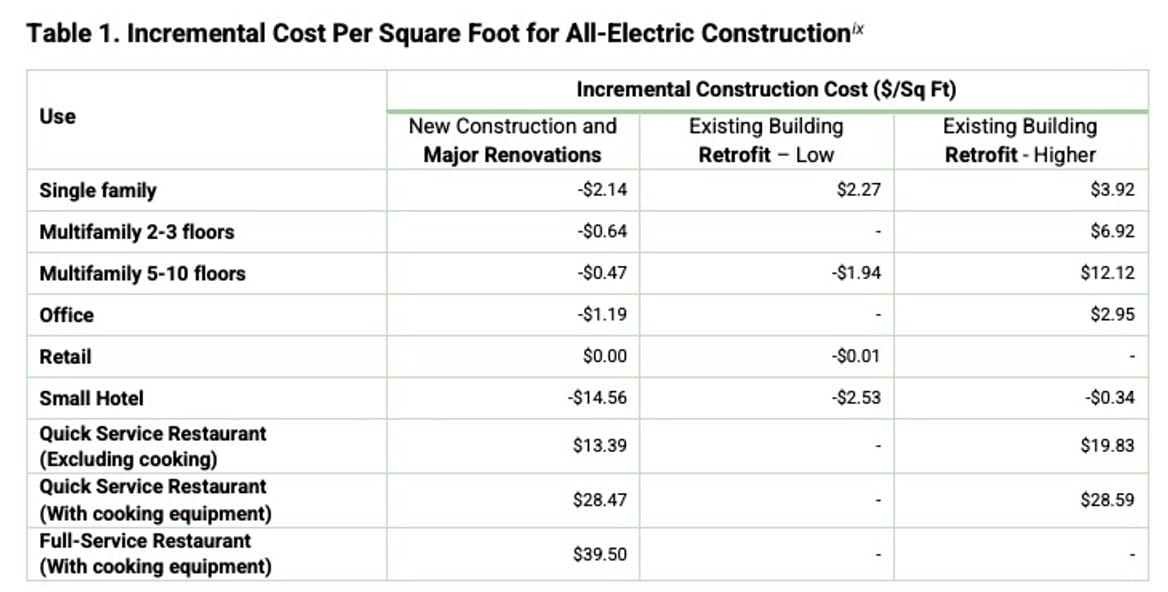
Contrast that to the higher estimated costs to switch to all-electric appliances after construction. The department estimates such retrofits would cost San Francisco homeowners an added $2 to $4 per square foot.
And all-electric retrofits are coming.
In 2023, San Francisco Bay Area air regulators passed landmark rules to phase out the sale of gas-burning water heaters by 2027 and furnaces by 2029 for single-family homes. When old combustion appliances conk out after those dates, homeowners will need to foot the bill to replace them with zero-emissions units. The same will hold for multifamily building owners by 2031.
“Developers aren’t always incentivized to think [about] who’s going to be living in this property 10 or 15 years from now,” said Tyrone Jue, director of the SF Environment Department. “And that’s where government has to step in to say … ‘Yes, we want you to build housing, but we want you to do it smartly so that we don’t end up having to carry the financial burden down the road.’”
Fossil gas also carries heavy social costs. In addition to contributing to an increasing drumbeat of climate disasters, burning fossil fuels in home appliances releases a slew of pollutants, from carbon monoxide to nitrogen oxides, that concentrate indoors and spill outdoors. These by-products can lead to respiratory disorders, cardiovascular disease, and premature death. One in eight childhood asthma cases are linked to gas stoves. All-electric equipment doesn’t emit these compounds.
“As a city, we’re responsible for the well-being of our citizens,” Comerford said.
Gas lines are also a particular liability in the earthquake-prone region. Liquefaction of the earth can sever underground pipelines, which are more prone to damage than the city’s electrical system, Jue said. In a 2020 report, utility Pacific Gas & Electric estimated that after a 7.9 earthquake, it would take up to six months to restore gas services citywide; electricity could be brought back on line in two weeks.
The all-electric renovations ordinance comes as the federal government is rolling back environmental regulations and pushing for more fossil fuel use, not less. “This is a moment for cities like San Francisco to step up,” Jue said. “And this is San Francisco drawing a clear line, not waiting for permission from Washington to protect our people, our health, and the planet.”
President Donald Trump’s new budget law repeals a key federal tax incentive for residential solar — and rooftop solar installations are about to plunge as a result.
Americans are expected to install 33% less rooftop solar next year than they would if federal incentives were still in place, per an updated analysis from Ohm Analytics. That’s a better outcome than the research firm’s earlier, gloomier forecast, which was based on a version of the law that would have also scrapped a separate tax credit that applies to leased systems.
The repeal of the 25D tax credit, which knocks 30% off the price of home solar and storage, will make the technology significantly more expensive. The incentive was originally available until 2035 but now disappears at the end of this year.
Already, residential solar is far more expensive in the U.S. than elsewhere, and high interest rates as well as recent state-level policy developments are eating further into the economics of buying panels. Even before the repeal, rooftop solar installations were declining year over year because of these trends.
In 2025, though homeowners are expected to fast-track solar purchases before the tax credit expires, Ohm expects an 8% decline in installations compared with last year. In 2026, the total gigawatts installed will shrink by 26%, it forecasts.
Rooftop solar is an important piece of the energy transition. In California, photovoltaic panels on roofs produce almost as much power as the sprawling large-scale arrays found in fields and desert areas.
But it’s also a critical way for people to hedge against utility rates, which have climbed high in recent years and are expected to rise even further as data centers demand more energy and the Trump administration stymies cheap wind and solar power. Most households that install rooftop solar see their energy bills drop. Poorer households benefit most.
Still, there are things within the industry’s control, from reining in “soft costs” to developing more virtual power plants, that can help it weather the storm — and make rooftop solar more affordable to Americans even without long-standing tax credits in place.
This analysis and news roundup comes from the Canary Media Weekly newsletter. Sign up to get it every Friday.
California is facing a severe housing shortage. And in some places, namely Los Angeles, the need for new construction is even more dire because of recent wildfire destruction.
So in late June, Gov. Gavin Newsom (D) prioritized faster construction over cleaner buildings with a law that pauses updates to state building codes for six years. It’ll also stop local jurisdictions from enacting their own stricter standards, Canary Media’s Alison F. Takemura reports. The move comes after LA suspended its all-electric building requirements to speed its post-wildfire rebuilding efforts.
As it stands, California already has some of the strongest efficiency standards in the country. But this law will make it harder for progress to continue, stopping municipalities from implementing new rules that could, for example, encourage heat-pump adoption in multifamily buildings or mandate all-electric renovations.
And it may not even help the state cut home prices or speed construction. A 2015 study showed no significant correlation between California’s efficient building codes and construction costs, while a 2019 analysis estimated that building an all-electric home cost less than a gas-powered home in most parts of the state. A more efficient home also typically means lower power bills, which translate to even more savings.
On the other coast, a Massachusetts town is further boosting the case for efficient building codes, Canary’s Sarah Shemkus reports. In 2024, the Boston suburb of Lexington banned gas hookups in new construction and adopted an efficiency-boosting building code. The move hasn’t stymied development: Over the last two years, the town of 34,000 has still permitted around 1,100 new units of housing, 160 of which will be affordable. That aligns with a 2022 RMI study that found all-electric homes in Boston are slightly less expensive to build and operate than mixed-fuel homes.
Another state will soon test the balance between affordable and clean construction, Alison reports. New York just approved an all-electric building code that bars gas and other fossil fuels in most new buildings. State officials estimate the new standards will end up raising construction costs, but the lowered energy bills they lead to should offset that increase within a decade.
Solar for none?
The U.S. EPA says it will roll back more federal clean energy funding, this time targeting $7 billion earmarked for states, cities, tribes, and nonprofits under the Solar for All program. The program was created under the Biden administration to help low- and moderate-income households tap into solar power that can help lower their electricity bills.
The clawback comes just as grant awardees were starting to spend their federal dollars. Just this week, Georgia launched a program to let homeowners lease rooftop solar panels for free. Colorado is meanwhile finalizing three programs to boost solar deployment and workforce development. And as Canary Media’s Jeff St. John reports, burgeoning projects all across the country could lose their funding, threatening new power generation that the U.S. needs if it wants to lower electricity prices and meet rising demand.
Advocates say the EPA doesn’t have the authority to claw back the money and promised on Thursday to sue, as Jeff reports in a follow-up piece.
A week of blows to renewables
It’s not just residential solar that’s in the Trump administration’s crosshairs. The administration has also issued a series of orders over the last two weeks targeting solar and wind development on federal lands and in federal waters.
Interior Secretary Doug Burgum started by ordering his department to stop “preferential treatment for wind projects” and to evaluate whether to halt wind development on federal lands altogether. The next day, the Interior Department de-designated more than 3.5 million acres of federal waters previously slated for wind development, rendering offshore wind leasing “effectively dead” in the U.S., Canary Media’s Clare Fieseler reports.
Back on land, the DOI also issued an order that would consider a power project’s “density” before it’s approved. It’s a test that wind and solar are destined to fail, as they take up more land than gas power plants to generate the same amount of electricity.
Tax credit kerfuffle: Two Republican senators fight against the Trump administration’s clampdown on wind and solar tax-credit use by placing holds on three of President Trump’s Treasury Department nominees. (Politico)
A literal moonshot: “It is about winning the second space race”: Transportation Secretary and interim NASA Administrator Sean Duffy will announce plans to build a nuclear reactor on the moon by 2030. (Politico)
Electrification is brewing: A Minneapolis coffee company is curbing its emissions with its electric commercial-scale roaster, one of just a few of its kind in the U.S. (Canary Media)
Driving change: As Illinois looks to meet ambitious EV adoption goals, utility ComEd is turning community leaders into EV ambassadors who can help convince skeptical neighbors and businesses to go electric. (Canary Media)
Corruption correction: Ohio has finally repealed consumer-funded subsidies for two 1950s coal plants first created by the power-plant bailout law at the heart of the state’s utility corruption scandal. (Canary Media)
Counting climate wins: A new report shows how local climate action like a Maine heat-pump installation campaign and the Keystone XL pipeline protests will keep millions of metric tons of carbon emissions out of the atmosphere across the U.S. (Grist)
After years of failing to rein in rapidly rising electricity rates, California lawmakers are hoping a radical new approach — and billions of dollars in state financing — can offer a solution.
Bills moving through the California Senate and Assembly would use money raised from state bonds to help pay for the hugely expensive process of expanding the power grid and making it less vulnerable to wildfires. This path would relieve some pressure on utility customers in California, because funding grid upgrades through bonds is cheaper than doing so through energy bills.
Utility costs have reached a boiling point in California, with customers of the state’s three biggest utilities — Pacific Gas & Electric, Southern California Edison, and San Diego Gas & Electric — now paying almost twice the U.S. average for their power. Nearly one in five customers of these utilities is behind on paying their electric bills, according to a May report from state regulators.
The bills — Senate Bill 254, sponsored by Sen. Josh Becker, and Assembly Bill 825, sponsored by Assemblymember Cottie Petrie-Norris, both Democrats — aim to lower electricity costs for Californians. Both include provisions that would force the big three utilities to accept public financing for a portion of the tens of billions they plan to spend on their power grids.
The two bills have been passed by their respective legislative chambers. That’s despite opposition from the big investor-owned utilities, which object to using public funding for grid infrastructure projects because they earn guaranteed profits if they invest in infrastructure themselves. The utilities have defeated previous legislative efforts that would have crimped those future profits by having the state assume a portion of the expenses.
But the electricity cost crisis has made rate reform “a top-tier issue in California,” said Matthew Freedman, senior attorney at The Utility Reform Network (TURN), a consumer advocacy group that has joined other consumer and environmental justice groups in supporting SB 254.
“This is different from what we’ve seen in the past — and the solutions being sought by the legislature are more ambitious than what we’ve seen in recent years,” he said. TURN is hoping these dynamics will allow the public-financing portions of the bills to secure support from Gov. Gavin Newsom (D) and remain in whatever electricity-affordability legislation emerges before the end of the state legislative session in September.
TURN’s analysis indicates that pulling $15 billion out of the rate base of California’s three big utilities, as SB 254 and AB 825 propose to do, could save about $8 billion over 30 years, with $7.5 billion of that savings coming in the first 10 years. That equates to about 2–3% of an average residential customer’s bill, or about $4–$5 a month, Freedman said.
“Does this solve the affordability crisis? No. There’s no silver bullet. That’s the biggest frustration we have and that many policymakers have,” he said. But it does offer a straightforward path to a quick reduction in rates, and “we’re trying to get some near-term benefits here.”
SB 254 is an omnibus of electricity-affordability policies, ranging from streamlining permitting for grid and energy projects to forcing utilities to propose investment plans that limit their spending to the broader rate of inflation. AB 825 is more limited in scope, but the two bills share a couple of key concepts for state financing of utility infrastructure.
First, both bills would shift $15 billion in grid spending from utility capital expenditures to financing via bonds — a process known as securitization. Regulated utilities have commonly used securitization to help reduce the cost of closing aging power plants and rebuilding their grids after storms, by foregoing the return on equity that utilities typically earn for capital investments and tapping the lower cost of debt available to states or state agencies.
But there’s “little precedent for securitizing future productive utility capital spending,” Julien Dumoulin-Smith, an analyst at investment firm Jefferies, wrote in a June research note. The prospect that lawmakers might force California’s major utilities to securitize some of their highly profitable grid investments has in recent months weighed down investor expectations for the firms, he wrote.
The lawmakers pushing these bills argue that it’s more important to protect Californians from unchecked rate increases than to protect utility profits.
The state’s three big utilities are collectively planning about $90 billion in new capital expenditures from 2025 to 2028, Becker noted in a June press release after SB 254’s passage by the state Senate. Securitizing $15 billion of those investments would “reduce financing costs by eliminating profit margins and lowering interest rates,” Becker said.
In particular, the bills aim to rein in the biggest driver of rate increases — the tens of billions of dollars California’s utilities are investing in hardening their grids against the risk of sparking deadly wildfires.
“We’ve asked the investor-owned utilities to do a lot of that work, and we have to make sure it’s done as efficiently as possible,” Becker said during a virtual town-hall event in June. “I think we can have a discussion today about whether that’s something that should be in rates going forward.”
A March report from the Natural Resources Defense Council, a supporter of SB 254, examined wildfire-mitigation costs at PG&E, the state’s largest utility, which has doubled rates on average over the past decade and increased them 40% above inflation since 2018. According to that analysis, about 60% of PG&E’s rate increase stemmed from wildfire-related expenses, Merrian Borgeson, NRDC’s California policy director for climate and energy, said during the June town hall.
PG&E, which was forced into bankruptcy in 2019 after its power lines sparked the state’s deadliest wildfire, is under state mandate to invest in preventing its grid from causing more conflagrations. But the utility has also notched record-breaking profits in the midst of its record-breaking rate increases — in large part because of the guaranteed return it’s earning on that wildfire-prevention work.
Customers need quick relief from bearing those costs, and “the things that you can do the fastest to reduce electric rates are to take things out of rates,” Borgeson said.
Freedman of TURN highlighted differences between the securitization approaches of SB 254 and AB 825. AB 825 would apply only to the costs of burying power lines to prevent them from sparking wildfires. These “undergrounding” projects make up a big chunk of the broader wildfire-mitigation spending, particularly for PG&E. SB 254, by contrast, would apply to wildfire mitigation more broadly, as well as to spending to expand utility grids to serve fast-growing demand for electricity from big new loads like data centers and electric-vehicle charging hubs.
But in both cases, replacing utility spending with state borrowing would significantly lower costs to utility customers, he said. First, California can borrow money at lower rates of interest than utilities can. Second, the state can spread out the costs over a longer period of time, and reduce the portion of costs borne in earlier years, compared to how utilities pass on the cost of capital investments to their customers, he said.
It’s also been done before in California. In 2019, lawmakers passed a $21 billion wildfire bill to backstop California utilities’ financial stability in the face of PG&E’s bankruptcy. That bill forbade utilities from recovering a return on $5 billion in investments in wildfire-mitigation spending, but offered them the option of securitizing that spending instead, which they accepted. That’s expected to reduce ratepayer costs by as much as $2 billion over the lifetime of those assets.
The $15 billion securitization plan in SB 254 and AB 825 is targeted at reducing utility costs and rates in the shorter term. But both bills also propose a longer-term public-financing option aimed at the state’s high-voltage transmission grid.
“The idea here is to establish a state infrastructure authority that would have the capacity to finance and own these lines,” Freedman said.
That’s not a completely novel concept. The state-run New York Power Authority has owned and managed transmission grids since the 1930s, as have federal power-marketing entities such as the Bonneville Power Administration and the Tennessee Valley Authority. More recently, New Mexico and Colorado have created transmission authorities to facilitate grid buildouts.
The California Independent System Operator, which manages the state’s grid, estimates that California must spend between $46 billion and $63 billion over the next 20 years to meet its goal of achieving a carbon-free grid by 2045. An October report from Net-Zero California and Clean Air Task Force found that “traditional investor-owned utility financing and development” of those projects “could substantially increase consumer rates,” but that a public-private partnership model could reduce those costs by up to 57%, saving utility customers as much as $3 billion per year compared to a status-quo approach.
“There are lots of institutional changes, and changes to authorities that operate in California, needed to operationalize the full range of those savings,” said Nicole Pavia, Clean Air Task Force’s director of clean energy infrastructure deployment. SB 254 and AB 825 don’t specify what form any future public-private ownership or public-financing structures for transmission might take, she noted. But both “are picking up pieces of the institutional changes that might be needed to advance some of these savings.”
The two bills take different approaches to this issue, Freedman said. SB 254 would establish a new Clean Infrastructure Authority to take on the work, while AB 825 would revitalize the California Consumer Power and Conservation Financing Authority, a now-defunct entity created after the state’s 2001 energy crisis to finance new power generation, he said.
The move to increase state authority over transmission development would not offer immediate relief to ratepayers, said Vivian Yang, an analyst at the nonprofit Union of Concerned Scientists.
“These are big projects that are regardless going to take five to 10 years,” she said. “It’s not like we can pass those public-financing bills and then the next year our rates will go down.”
Instead, it would help the state position itself to avoid yet another cost crisis in the years to come. Given the massive amount of transmission California will need over the coming decades, “having all these tools to get us there — one of which is public financing for projects — is really important,” she said. California needs to get to work now to “have these structures up and running already and use them more nimbly, and not discover 10 years out that we’re stuck using what we’ve got.”
The Trump administration has officially announced it is killing the $7 billion Solar for All program. The program had awarded grants to 60 state agencies, municipalities, tribal governments, and nonprofits across the country to help low-income households access solar power. Supporters of Solar for All are vowing to fight the move in court.
On Thursday, Environmental Protection Agency Administrator Lee Zeldin posted a video on the X social media platform stating that he was terminating the program. Solar for All was created as part of the Inflation Reduction Act’s $27 billion Greenhouse Gas Reduction Fund (GGRF), which has also been under attack by the Trump administration.
Zeldin stated that the mega-law passed by Republicans in Congress last month “eliminates billions of green slush-fund dollars by repealing the Greenhouse Gas Reduction Fund.”
Referring specifically to Solar for All, Zeldin said, “EPA no longer has the authority to administer the program, or the appropriated funds to keep this boondoggle alive. With clear language and intent from Congress in the One Big Beautiful Bill, EPA is taking action to end this program for good.”
Defenders of Solar for All challenge Zeldin’s interpretation of the One Big Beautiful Bill, or HR 1, and the intent of its provisions.
“It is absolutely ludicrous to suggest that HR 1 rescinded these funds, because they were all under legally obligated grant awards when the bill was signed,” said Jillian Blanchard, vice president of climate change and environmental justice at Lawyers for Good Government, a nonprofit coalition of attorneys, law students, and activists that’s challenging other EPA funding cuts. “HR 1 only rescinded unobligated grant funds,” she told Canary Media on Thursday.
That’s an important distinction, she said. Those unobligated grant funds amounted to only $19 million, as determined by the Congressional Budget Office (CBO) when it conducted its analysis of the pending legislation’s overall financial impact. The vast majority of the funds, the office found, were already committed under legally binding contracts to the parties awarded grants during the Biden administration.
But in a court case challenging the EPA’s effort to claw back $20 billion in funds for other GGRF programs, administration officials have claimed that HR 1 terminates the government’s obligation to meet any of its contractual obligations.
Attorneys for nonprofit groups fighting EPA’s attempt to claw back their grants argued that the law clearly states that only “unobligated balances of amounts made available to carry out that section … are rescinded.”
The attorneys also noted that Sen. Shelley Moore Capito, the West Virginia Republican and chair of the Senate Committee on Environment and Public Works, stated during a congressional debate before the bill passed that funding “that’s already been obligated and out the door, that’s a decision that’s final,” and that arguing the law would claw back obligated funding is “a ridiculous thought.”
Sen. Sheldon Whitehouse (D-R.I.) pointed out this same discrepancy in a July press release attacking EPA’s characterization of the law. “Trump’s DOJ is continuing its mischief by falsely claiming Republicans’ Big Beautiful-for-Billionaires Bill claws back $17 billion from GGRF, even though the CBO score for the unobligated funds was $19 million — what was left to oversee the program after the grant funds had been obligated — and Republicans made clear that their rescissions only touched unobligated funding,” Whitehouse wrote.
The Solar for All program is meant to deliver energy-bill savings of $350 million over the next five years to 900,000 low-income and disadvantaged households and deploy 4 gigawatts of solar generation capacity. In the past few months, a handful of grantees had begun issuing awards to low-income housing projects, municipal facilities, nonprofits, and low-income homeowners.
“Communities promised relief from punishing energy costs are now left in the dark,” Zealan Hoover, a former EPA senior advisor under the Biden administration, told Canary Media. “Nearly a million families will pay hundreds of dollars more each year for their electricity bill because the Trump administration killed a program that would have more than paid for itself.”
Michelle Moore, CEO of Groundswell, a Washington D.C.-based nonprofit that is administering a $156 million Solar for All grant aimed at developing large-scale solar and battery projects in Southeastern states, said that ending the program would run counter to President Donald Trump’s pledge to lower energy prices.
“I would hope [the Office of Management and Budget] could find the funding to cover EPA staff time to help keep President Trump’s campaign promise to cut bills in half and keep energy affordable for American families, which this program does,” she told Canary Media.
Energy storage is having a moment — but the batteries that are taking off today only have enough juice to provide a few hours of grid power. Developers technically could stack up more batteries for longer-term storage, but that gets prohibitively expensive. For a renewables-dominated grid to ride out days of poor solar production or even just an entire night, a breakthrough in cost-effective, longer-term storage is needed.
Over the last couple decades, venture capitalists have recognized this transformative possibility and heaped billions of dollars into the sector known as long-duration energy storage, or LDES. They have little to show for their efforts. The startups that haven’t gone bankrupt have built some factories and early installations, but have not built any particularly large-scale projects, at least in the U.S.
A few weeks ago, I saw something in the desert outside Reno, Nevada, that got me thinking the investors and startups may have been barking up the wrong tree all along.
Former Tesla Chief Technology Officer JB Straubel unveiled a surprising new project in June at the Tahoe campus of his lithium-ion recycling company, Redwood Materials. Instead of ripping apart old electric vehicle battery packs, his engineers arranged them across a patch of desert and hooked them up to an adjacent solar field. This assemblage now stores so much clean power that it can run a small on-site data center, rain or shine, night or day.
In other words, instead of inventing a brand-new technology tailored for long-term storage, Redwood made it way cheaper to stack enough time-tested lithium-ion batteries to accomplish that goal.
Unveiling this new business line, Straubel wasn’t just diversifying his revenue streams. He was staking claim to the long-duration storage market writ large.
“We’re confident this is the lowest-cost storage solution out there,” Straubel said. “Not only just lower than new lithium-ion batteries, but lower than compressed-air energy storage, lower than iron-air, lower than a number of these other ones that carry a little more technology risk.”
As he spoke, Straubel pointed at a bar graph depicting the costs of those types of LDES technology, as well as thermal storage, pumped-hydro storage, and flow batteries. Naturally, the chart showed his used batteries clocking in cheaper than all of them.
It’s a big claim. Second-life battery development is even newer than the LDES field; prior to Redwood, only a handful of companies, like B2U Storage Solutions and Element Energy, had built large-scale second-life storage plants, and those were just in the last few years. The sector has a lot of work to do to convince customers and financiers that the gently used battery packs can be trusted to hold up over years of service. And with new lithium-ion packs getting ever cheaper, the discount offered by used batteries may prove tenuous.
Still, Straubel’s first operating project, which holds 63 megawatt-hours of energy storage, is already bigger than any novel battery installation in the U.S. If Straubel takes this concept mainstream, it could revolutionize the arms race for long-duration storage — and radically improve the odds of running the economy on a largely renewable grid.
At the June event, Straubel essentially asserted that his band of desert engineers, in just a few months of tinkering, has outmaneuvered the researchers and companies working on long-duration for decades.
That deserves some scrutiny — but even pinpointing the costs of the competition is challenging.
“There are a lot of flavors of long-duration storage. What all of them have in common is that actual deployments have been very limited up until now,” said Pavel Molchanov, who analyzes cleantech companies for financial services firm Raymond James. “To make any clear-cut statements about which particular flavor is cheaper than any other would be quite premature.”
Redwood says its second-life battery installations cost less than $150 per kilowatt-hour today, for systems that can deliver power over 24 to 48 hours. The company’s datapoints on the prices of other battery types were drawn from BloombergNEF’s 2024 analysis of the LDES field, augmented with Redwood’s internal estimates for what a complete iron-air system would cost today, since that technology isn’t yet commercially available.
Iron-air is under development, most famously, by Straubel’s former Tesla Energy compatriot Mateo Jaramillo at Form Energy, a VC darling that’s raised more than $1.2 billion to date. Redwood calculated iron-air costs at higher than $150 per kilowatt-hour, but Form has stated its intentions to sell batteries below $20 per kilowatt-hour when its factory reaches full production scale.
It’s worth noting that not all these technologies are directly comparable, because companies design and market them at different durations based on their technical sweet spots. If a technology works especially well at, say, 12 hours duration, the company might not even sell it for 48-hour configurations.
“Part of the issue with comparing long-duration storage systems and prices is that every company will give you their price point for a different duration,” said James Frith, a longtime battery analyst now at VC firm Volta Energy Technologies. “Then you’re thinking, how do I normalize this? How do we get to a base point that is comparable amongst the technologies?”
Epistemological issues aside, Redwood accurately diagnoses that the LDES sector’s struggle to deliver real installations at super-low cost leaves an opening for new competitors.
Brand-new lithium-ion batteries aren’t economically viable at longer durations, though their limits keep expanding as battery prices fall.
“Lithium-ion storage systems with longer durations require more battery cells, making the system capital-intensive and less economically competitive compared to emerging long-duration storage alternatives,” said Evelina Stoikou, head of battery technology and supply chain research at BloombergNEF.
Pumped-hydro and compressed-air energy storage work for longer durations, but they are huge, billion-dollar infrastructure projects of the sort that don’t get built anymore in the U.S. (Canadian company Hydrostor is attempting to break that curse with a $1.5 billion, 500 MW/4,000 Mwh compressed air project in California; if it gets permits to build, it might be online by 2030.)
Flow batteries — which store energy in tanks of liquid electrolytes — have been kicking around for decades with some success in China, where they benefit from government favor. In the U.S., they’ve not gained much traction.
Meanwhile, many LDES startups have made the strategic error of designing exotic storage solutions to eke out a few more hours, under the incorrect assumption that lithium-ion would never be able to compete at four, then six, and then eight hours.
Take ESS, which has developed an iron-based flow battery since 2011: Despite leaning into “long-duration” branding, the company was selling an Energy Warehouse with a bit over six hours duration, and only this year announced a “strategic shift to the 10+ hour product.” (Its board members had to throw in more cash last month to sustain the company through that shift, and gamely agreed to forgo personal compensation for the year.)
The LDES companies most vulnerable to competition from Redwood are the ones that aren’t actually very long-duration, and which haven’t gotten big enough to make their products cheaper.
That’s not to say the other LDES contenders are left quaking in their boots.
“We’re a long way away from proof that second-life batteries are a proper utility-grade asset, capable of 20 years of daily cycling,” said Ben Kaun, who for years analyzed LDES technologies for the Electric Power Research Institute and now works for battery startup Inlyte Energy. “I don’t see an existential threat to LDES.”
The sector has even been showing signs of life, at least compared to its dismal track record from the preceding decade. Form completed its factory in Weirton, West Virginia, and broke ground on its first commercial deployment, in Minnesota, last summer. The company plans to deliver its first batteries to the project in the coming weeks, for commissioning this fall. Over in the Netherlands, a Dutch startup called Ore Energy recently installed a small 100-hour system of its own iron-air battery, based on research at the Delft University of Technology.
Flow batteries have built up considerable installed capacity in China, but that trend hasn’t gotten much coverage in English-language press, said Eugene Beh, CEO and cofounder of California-based flow-battery startup Quino Energy. His strategy is to leverage the now-mature supply chain for flow-battery equipment but to drop in an electrolyte based on quinones, commonly used in clothing dyes, instead of the more expensive vanadium that’s popular in China.
Italian startup Energy Dome has moved swiftly from demo to commercial operations with an iconoclastic design: It stores energy by compressing carbon dioxide in a controlled environment; decompressing it turns a turbine and generates electricity. After building a pilot and a commercial project in Sardinia, Energy Dome just announced an equity investment from Google for an undisclosed amount and a commitment to build its systems to power Google’s data center expansion around the world.
These more out-of-the-box LDES companies might take solace in a few limitations that second-life battery developers must overcome to mount a serious challenge.
Second-life companies take hundreds of batteries from different manufacturers, with different patterns of wear and tear, then operate them all in concert. If that was easy, more people would be doing it by now. Firms that get this wrong could start fires, and fire safety is one of the key arguments used against lithium-ion installations, both by rival technologists and the general public.
Then again, Straubel has as much experience as anyone with the inner workings of lithium-ion batteries. At Tesla, he built the nation’s leading electric-car company and a wildly successful stationary-storage business with the Powerwall and Megapack.
Then there’s the question of longevity. The batteries were pulled out of vehicles for a reason: usually due to their capacity degrading, though other problems develop with age, like higher internal resistance, which makes batteries heat up during discharge. If second-life packs need to be swapped out too frequently, it undercuts the ease and cheapness of the model.
That leaves the matter of supply. Success in second-life depends on a steady and cheap source of gently used EV packs. Here Redwood has a unique advantage, in that the company was constituted to collect the nation’s battery waste and recycle it. Straubel said Redwood was receiving less than 1 gigawatt-hour of used EV packs two years ago, and now is pulling in more than 5 GWh per year.
The available supply of used EV packs is “going to follow roughly the same curve as electric vehicle adoption, but lagging by, let’s say, 10 years,” Frith said. “So we are going to start seeing the volume of packs growing, and I think the real volumes start to kick in closer to 2030.”
Indeed, he added, the growth in volume of used EV packs could parallel the growth of demand for long-duration storage: Few customers buy it now, but many analysts expect demand to grow by the end of the decade as renewables saturate the grid.
It’s too soon to know if used EV batteries will actually wipe the floor with the more unconventional long-duration battery technologies. But the scale and price point of Redwood’s first project announces them as a force to be reckoned with in this arena.
In doing so, Redwood puts a new spin on an energy-storage maxim that venture capitalists keep forgetting, or simply ignoring: Lithium-ion always wins.
Challengers that rely on different chemistries have to build up from negligible production scale and convince customers to take a chance on a design that few people have seen before. It’s a clear uphill battle.
Lithium-ion batteries, in contrast, command an unmatched and ever-expanding scale of industrial production, mostly in China but increasingly in the U.S. too. That manufacturing juggernaut unlocks incremental gains from economies of scale and continual innovation. It also confers consumer confidence, because the technology has such a clear track record of performance.
“Compared to most experts’ predictions, the costs have gone down faster and the performance has improved faster for lithium-ion than people predicted 10 years ago,” said Jeff Chamberlain, who helped the Department of Energy license battery technology to General Motors and LG Chem back in the late 2000s, and now invests in storage technologies as CEO of Volta Energy Technologies.
Nonetheless, investors continued to bet that the streak would end, and they could own a piece of the transformational tech that would triumph for longer-term storage.
“What a lot of startups and investors are doing is assuming the LDES market will exist and it will be enormous, and they’re assuming lithium-ion won’t solve the problem,” Chamberlain said. “I believe that is a very, very bad assumption.”
Over the last decade, lithium-ion has steadily chipped away at use cases where new battery inventions were supposed to win out. New lithium-ion is starting to push into six-hour configurations and beyond, said Stoikou, from BloombergNEF. Global average pricing for turnkey grid storage averaged $165 per kilowatt-hour in 2024, per the data firm’s 2024 survey.
Now, the cost savings from reusing lithium-ion packs accelerate the chemistry’s push into the long-duration market — something that would be a big win for grid-decarbonization efforts, while delivering the LDES hopefuls yet another stinging loss.
Clarifications were made on August 6 and August 7, 2025: This story has been updated to reflect Eugene Beh’s full title and to note that Hydrostor is attempting to build a large-scale compressed air project in California.
A surge of housing development in a Boston suburb is providing evidence that natural-gas bans and strict energy-efficiency standards do not slow new construction or make it more expensive. Indeed, these guidelines can even boost the growth of affordable housing, say local advocates.
In 2024, Lexington, Massachusetts, banned gas hookups in new construction and adopted a stringent building code that requires high energy-efficiency performance. Yet these regulations have not stopped the town of roughly 34,000 from permitting some 1,100 new units of housing — 160 of which will be affordable — over the past two years.
“Opponents said, ‘It’s going to cost so much, you’re going to stop the development of affordable housing.’ But that clearly wasn’t the case,” said Mark Sandeen, a member of the town select board and the board of the Lexington Affordable Housing Trust.
As Massachusetts aims to get to net-zero carbon emissions by 2050, the state has for several years prioritized policies that encourage the transition away from fossil fuels, particularly natural gas, which heats about half of the state’s homes. In 2022, Massachusetts launched a pilot program allowing 10 communities — including Lexington — to prohibit the use of fossil fuels in new construction and major renovations. In late 2023, utilities regulators issued an order that makes explicit the state’s goal of getting off natural gas, and lays out strategies and principles for reaching this goal.
Detractors, however, have consistently argued that requiring or even heavily encouraging all-electric construction would make housing more costly and difficult to build at a time when Massachusetts is facing an acute housing shortage. In 2022, then-Gov. Charlie Baker, a Republican, memorably said the idea of fossil fuel bans gave him “agita,” so worried was he that such municipal regulations would suppress housing growth.
Similar battles have played out across the country, from California to New York.
There is plenty of evidence that electrified, highly efficient homes don’t need to come with a price premium.
A 2022 study by think tank RMI found that, in Boston, all-electric homes are slightly less expensive both to build and to operate than mixed-fuel homes — and that was before Massachusetts’ investor-owned utilities adopted lower wintertime rates for homes with heat pumps. In 2023, Massachusetts-based advocacy group Built Environment Plus found that building larger multifamily and affordable housing developments “net-zero ready” — that is, highly efficient and with all-electric heating — costs about 4% less up front than the conventional approach.
After Lexington changed its zoning rules in 2023 to allow more multifamily development, its energy regulations did not, as naysayers had feared, deter developers from taking advantage. The planning board has approved nine projects, ranging from a proposal to redevelop an unused commercial space into a seven-unit building, to a complex combining 312 residential units with 2,100 square feet of retail space.
The new construction will include both rental units and condos available to purchase that will, in total, increase available housing in town by 9%. Much of the new housing will be market-rate, and Lexington — where the median condo went for $915,000 in the first quarter of 2025 — is not an inexpensive place to live.
However, most of the construction driven by the new zoning is required to make 15% of its units affordable. On top of these private projects, the town has decided to develop a municipally owned property into a 40-unit affordable housing development, bringing the total number of affordable units on the horizon to about 200.
The municipal project will include four residential buildings designed to be energy-efficient and to minimize the square footage of halls and other common areas, which will reduce the cost of heating and cooling these spaces. Solar panels on the roofs will offset the electricity consumed by the building’s heat pumps, said Dave Traggorth, principal with Causeway Development, the company chosen to develop the property.
“Ultimately, what the tenant is paying for in their electric bill is really just cooking and lights,” he said. “It really reduces the utility bills for residents.”
All of these new projects — market-rate and affordable — will be prohibited from using fossil fuels to run furnaces or other appliances because of the town’s requirement that new construction be fully electric.
The town has also adopted an optional, more rigorous version of the state building code that requires new, multifamily projects over 12,000 square feet — which applies to most of those in the pipeline in Lexington — to build to passive house standards, which require a very well-sealed building envelope and dramatically reduced energy use compared to a conventionally built structures.
“This is what you can do at the local level,” said Lisa Cunningham, cofounder of climate advocacy organization ZeroCarbonMA.
While Lexington is a particularly active town, the other nine communities that have banned fossil fuels in new construction have all reported that the rules have posed no obstacle to development, Cunningham said. Restrictive zoning and antidevelopment sentiment among residents are much more pressing problems, she said.
For the eventual residents, the benefits go beyond the knowledge that their homes are helping cut emissions. Homes designed to passive house standards use far less energy than those that are conventionally built, creating ongoing savings for homeowners and tenants, and have been found to generally have better indoor air quality. When the power goes out, these well-sealed buildings can keep interior temperatures comfortable for days.
It is no accident that residential developers were ready to jump when opportunities opened up in a town with stringent efficiency and electrification rules. Massachusetts has been laying the groundwork for years, said Lauren Baumann, director of sustainability and climate initiatives for the Massachusetts Housing Partnership, a nonprofit that works to expand affordable housing.
“There has been this deliberate effort to develop an ecosystem to support this kind of construction,” she said.
In 2019, the Massachusetts Clean Energy Center awarded $1.73 million in grants to eight affordable, multifamily projects to help accelerate the adoption of passive house standards in multifamily construction by demonstrating that the approach makes financial sense. That same year, the state’s energy-efficiency program administrator, Mass Save, launched an initiative offering money to multifamily projects for feasibility studies, energy modeling, and analyses of post-construction energy performance.
These incentives gave architects and contractors a lower-risk way to become familiar with a new approach to building. And familiarity, in this case, bred knowledge, skills, and enthusiasm.
“Those early project pilots really did give people the experience they needed in order to feel comfortable,” Baumann said. “We just saw an explosion of interest.”
Traggorth has seen this evolution in his work. Five years ago, he said, if he approached a contractor to discuss building to passive house standards, he was often greeted with confusion. Now, “every contractor that’s building multifamily has a couple of projects that have been passive house certified,” he said. “They have learned their lessons.”
Alicia Brown, director of the Georgia Bright Coalition, wants people to know that the $7 billion Solar for All program is starting to bring affordable solar power to her home state — even as the Trump administration threatens to kill it.
With the $156 million Solar for All grant the coalition won last year, it’s installing no-cost rooftop solar for low-income homeowners and expanding a two-year-old pilot program that offers low-cost solar and battery installations for thousands more residences. It’s also planning to back community solar projects and is helping finance solar and batteries at churches that promise to use the cheap power to lower utility bills for disadvantaged households and provide shelter during grid outages.
Now this program and others being actively developed by state agencies, municipalities, tribal governments, and nonprofits that received Solar for All grants are in jeopardy. The Environmental Protection Agency, which administers the grant program, is preparing to send letters to all 60 awardees informing them that their funding will be terminated, according to news reports this week citing anonymous sources.
The National Association of State Energy Officials (NASEO), a group representing the state agencies responsible for managing a large chunk of Solar for All funding, also widely circulated an email warning that the EPA could be on the brink of ending the program.
“We do not have any additional details or validation of the news that has been reported,” NASEO President David Terry wrote in the email, which was shared with Canary Media. “Yet, the information received yesterday comes from a credible source.” (NASEO did not immediately respond to requests for comment.)
Cutting Solar for All funding would be a mistake, said Michelle Moore, CEO of Washington, D.C.–based nonprofit Groundswell. Over the next five years, the program promises to deliver more than $350 million in annual electric bill savings to more than 900,000 low-income and disadvantaged households — desperately needed relief in a time of high and rising utility costs.
And the more than 4 gigawatts of solar power the program aims to bring online, much of it backed up by batteries, could help utilities across the country meet growing demand at a time when the Trump administration and Republicans in Congress have undermined the policies supporting clean energy growth.
Groundswell is using its $156 million Solar for All grant to launch the Southeast Rural Power Program, open to municipal utilities and rural cooperatives across eight Southeastern states to develop more than 100 megawatts of distributed solar and battery projects.
Those projects could cut electricity bills in half and improve local resilience for more than 17,000 households. That’s a vital source of new grid capacity for a region facing unprecedented growth in demand for electricity, Moore said.
“This country is short on power right now. We need every electron we can get,” she said. Terminating Solar for All at this stage would equate to “this administration raising electricity bills for more than 1 million families. Now is not the time.”
Solar for All, an initiative of the Inflation Reduction Act’s $27 billion Greenhouse Gas Reduction Fund (GGRF), had its funding frozen in January as part of a broader attack on Biden-era climate and environmental programs.
In the face of court orders declaring these freezes unlawful, in February the EPA reopened funding for Solar for All and other congressionally mandated programs. Since then, Georgia Bright hasn’t experienced any difficulty accessing its Solar for All funds, Brown said.
But because of the way that reimbursement is structured under the program, the coalition and other Solar for All awardees need the EPA to continue to make funds available to cover ongoing expenses. “It’s not like there’s $156 million in our bank account,” she said.
Other EPA-administered programs haven’t fared so well. EPA Administrator Lee Zeldin is still blocking $20 billion in funding for the broader GGRF program and is appealing federal court orders to release the money. EPA is also facing a class-action lawsuit demanding it release the billions of dollars in environmental justice block grants it terminated.
Solar for All has been something of a bright spot amid these roadblocks, Brown said. In recent months, grantees like Georgia Bright have begun rolling out their first rounds of funds.
In May, Vermont’s Department of Public Service announced $22 million in grants for low-income-housing solar projects. Last month, Michigan’s Office of Climate and Energy announced eight projects, ranging from an agrivoltaics installation near a municipal airport to solar panels on a multifamily building serving low-income seniors. And the Nevada Clean Energy Fund, a nonprofit green bank, last month announced its first project — nearly $1 million to help a sober living facility in Reno install rooftop solar.
“It seems like this program has bipartisan support — it certainly does in Nevada — because there’s a big need for it. Reducing energy costs is important, particularly in our economic environment,” said Kirsten Stasio, CEO of the Nevada Clean Energy Fund. “If an affordable housing owner needs to pay more for their utility bills, it means they are paying less on supportive services for their tenants.”
The EPA’s initial funding freeze was concerning, said Chris Walker, head of national policy and programs for Grid Alternatives, the country’s largest free solar installation nonprofit and prime contractor for more than $300 million in Solar for All grants. Still, “we were confident we were on a solid legal footing to continue the work, and continued staffing and contracting processes, with a bit of nervousness about what might be coming,” he said.
Now, as Grid Alternatives prepares to launch its first Solar for All projects, he said, “We’re in capacity-building mode and compliance mode.”
Rumors that the EPA plans to terminate Solar for All have been swirling for months, said Jillian Blanchard, vice president of climate change and environmental justice at Lawyers for Good Government, a nonprofit coalition of attorneys, law students, and activists that’s challenging other EPA funding cuts.
“There are many, many Solar for All grantees doing everything in their power to move things forward,” she said. “But EPA is not making it easy.”
Cutting off Solar for All grants would almost certainly draw a legal challenge, given that the funds were awarded by the EPA last year under contracts that cannot be terminated without cause.
“If leaders in the Trump administration move forward with this unlawful attempt to strip critical funding from communities across the United States, we will see them in court,” Kym Meyer, litigation director for the Southern Environmental Law Center, told Canary Media. “We have already seen the immense good this program has done on the ground, and we won’t let it be snatched away to score political points.”
Complicating matters, Blanchard said, is the megalaw passed by Republicans in Congress last month, which officially repealed statutory authority for the GGRF and rescinded unspent funds from the program. The law, however, does not claw back obligated funds, she said.
An EPA spokesperson declined to say if the agency intends to terminate Solar for All grants, but told Canary Media in a Tuesday email that “with the passage of the One Big Beautiful Bill, EPA is working to ensure Congressional intent is fully implemented in accordance with the law.”
Blanchard said that language in the megalaw clearly indicates that the intent of lawmakers was to retain obligated spending from the GGRF. “If EPA does this unilaterally, it will be pulling a complete bait and switch on the American people, increasing utility bills, and flouting congressional intent,” she said.
Terminating Solar for All funds wouldn’t just harm the communities burdened by high and rising electricity prices, said Sachu Constantine, executive director of nonprofit advocacy group Vote Solar. It would also hurt utilities struggling to meet rising electricity demand.
A growing body of research shows that low-income neighborhoods and communities of color face greater risks of power outages and grid failures, partly due to decades of underinvestment in the grids that serve them. Solar for All “targets frontline underinvested communities, which means it’s targeting weak spots on the grid,” Constantine said. “It’s infrastructure in the right places for the right people.”
And solar and batteries are the right technology to solve the problem, he contended. Solar panels and lithium-ion batteries are not only the cheapest and fastest-to-deploy sources of new grid supply; they’re also capable of lowering peak electricity demands that drive the lion’s share of utility costs, by serving as virtual power plants.
“When we don’t have to deploy the most expensive peaker [power plants], when we can better utilize the distribution lines, we’re saving the cost for everyone,” he said. “We’re taking the entire system and making it run better.”
That’s a role Georgia Bright wants to play with its community-benefits solar program, Brown said. Last month, the Georgia Public Service Commission approved a long-term resource plan from Georgia Power, the state’s biggest utility, which has been criticized by environmental and consumer advocates for extending the life of aging coal-fired power plants and opening the door to building up to 8.5 gigawatts of new fossil gas–fired turbines.
But the plan also includes a pledge from Georgia Power to develop a pilot program that will seek up to 50 megawatts of solar and battery capacity from customers. Georgia Bright worked to get that program included in the utility’s plan, Brown said — and it plans to use its community-benefits solar program to help churches, nonprofits, businesses, and multifamily housing properties install the solar and batteries to participate in it.
“I think we’ll hit the 50 megawatts pretty quickly — and the commission is open to raise that limit,” she said. “They recognize if you need to serve all this new load, you can’t wait on natural gas plants that have a five-year backlog to get a turbine.”
Groundswell’s Southeast Rural Power Program offers similar fast-start options for utilities struggling to meet growing demand for power, Moore said. “It’s a straightforward way to work across the Southeast in very diverse states with very diverse needs.”
SECO Energy, a rural electric cooperative in Florida, is one of the potential partners for Groundswell’s new program. About 80,000 of SECO’s roughly 250,000 customers are low and moderate income, and “Solar for All checks a lot of the boxes for us to serve that segment of the population,” SECO CEO Curtis Wynn said.
“We’re in a high-growth area, and during the last two or three days, the heat index was over 100 degrees — it puts a strain on our system,” he said. “If there’s a way we can use grant dollars to buy down the cost of generation today that’s going to remain stable in the next 20 years in a rising-cost environment, that’s a huge advantage.”


.svg)
