

 Back
Back
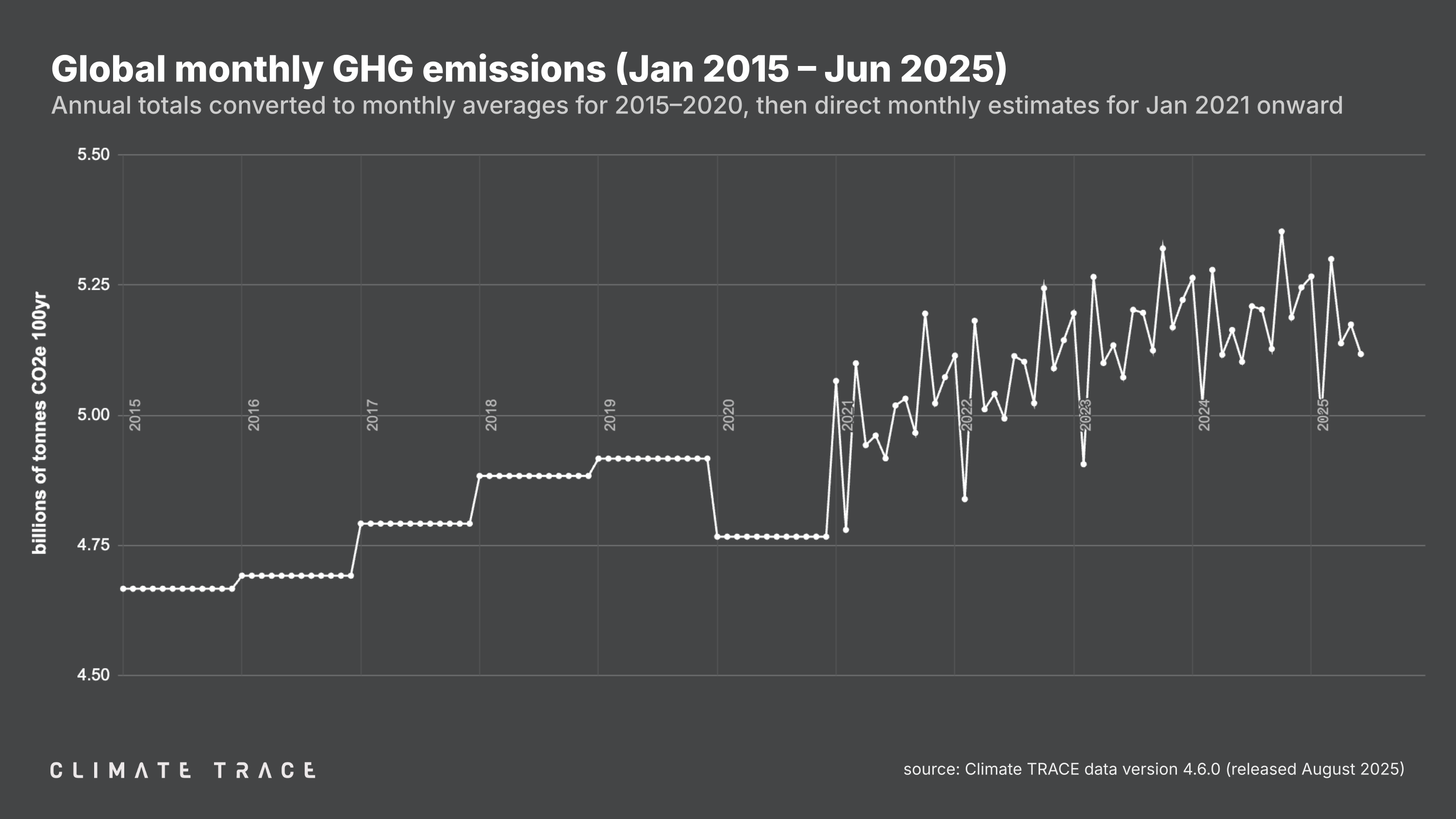
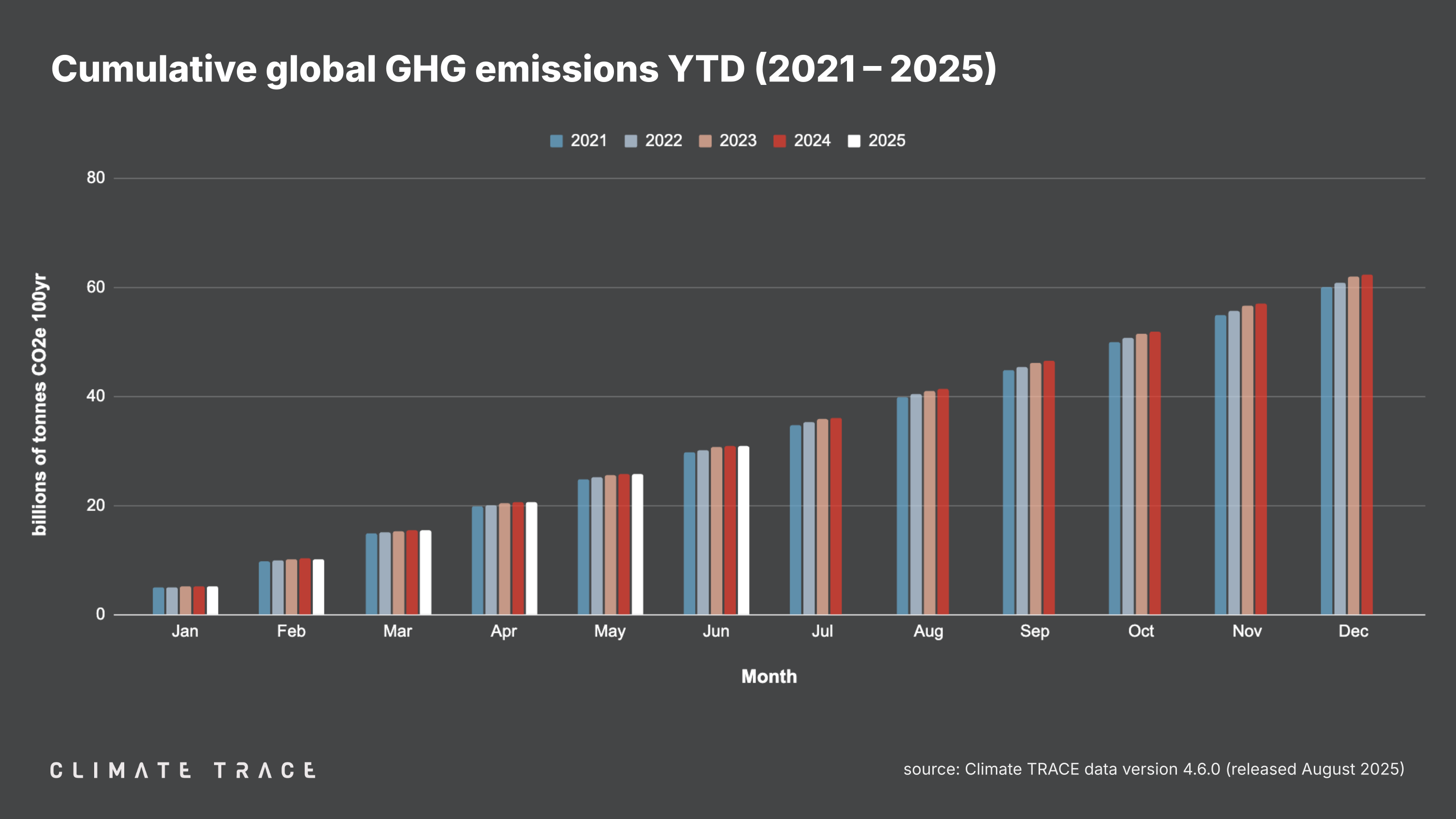
August 28, 2025 – Today, Climate TRACE reported that total global emissions in the first half of 2025 are 30.99 billion tonnes CO₂e. This is 0.13% higher than emissions were in the first half of 2024. Global greenhouse gas emissions for the month of June 2025 totaled 5.12 billion tonnes CO₂e. This represents an increase of 0.29% vs. June 2024. Global methane emissions in June 2025 were 34.82 million tonnes CH₄, an increase of 0.49% vs. June 2024.
Data tables summarizing emissions totals for June 2025 by sector, country, and top 100 urban areas are available for download here.
Lookback: Global Greenhouse Gas Emissions for the First Half of 2025
In the first half of 2025, the sector driving the most growth in emissions was fossil fuel operations, where emissions rose by 1.5% (an increase of 77.65 million tonnes of CO₂e). The United States accounted for more than half of that increase. Manufacturing emissions also rose in the first half of 2025, growing by 0.3% (an increase of 18.75 million tonnes of CO₂e), led by increases in India, Vietnam, Indonesia, and Brazil.
Meanwhile, global power sector emissions saw the biggest decline in the first half of 2025, falling by 0.8% (a decrease of 60.27 million tonnes of CO₂e), driven almost entirely by declines in China and India, where power emissions were 1.7% lower and 0.8% lower than their totals in the first half of 2024, respectively.
The first half of 2025 shows small but positive progress on decarbonization in China, Mexico, and Australia. China’s emissions decreased 45.37 million tonnes CO₂e, or 0.51% compared to the first half of 2024. Mexico’s emissions decreased 7.78 million tonnes CO₂e, or 1.71% compared to the first half of 2024. Australia’s emissions decreased 6.56 million tonnes CO₂e, or 1.51% compared to the first half of 2024. However, some of the world’s other major emitting economies, including the United States, India, the EU, Indonesia, and Brazil, saw emissions rise in the first half of 2025.
– United States emissions increased by 48.57 million tonnes CO₂e, or 1.43% compared to the first half of 2024;
– India emissions increased by 4.44 million tonnes CO₂e, or 0.21% compared to the first half of 2024;
– European Union emissions increased by 2.90 million tonnes CO₂e, or 0.15% compared to the first half of 2024.
– Indonesia emissions increased by 3.06 million tonnes CO₂e, or 0.39% compared to the first half of 2024;
– Brazil emissions increased by 9.84 million tonnes CO₂e, or 1.24% compared to the first half of 2024.
Greenhouse Gas Emissions by Country: June 2025
Climate TRACE’s preliminary estimate of June 2025 emissions in China, the world’s top emitting country, is 1.46 billion tonnes CO₂e — an increase of 0.92 million tonnes of CO₂e or 0.06% vs. June 2024.
Of the other top five emitting countries:
– United States emissions increased by 4.89 million tonnes CO₂e, or 0.86% year over year;
– India emissions declined by 0.11 million tonnes CO₂e, or 0.03% year over year;
– Russia emissions increased by 0.95 million tonnes CO₂e, or 0.38% year over year;
– Indonesia emissions increased by 0.43 million tonnes CO₂e, or 0.33% year over year.
In the EU, which as a bloc would be the fourth largest source of emissions in June 2025, emissions declined by 1.80 million tonnes CO₂e compared to June 2024, or 0.58%.
Greenhouse Gas Emissions by Sector: June 2025

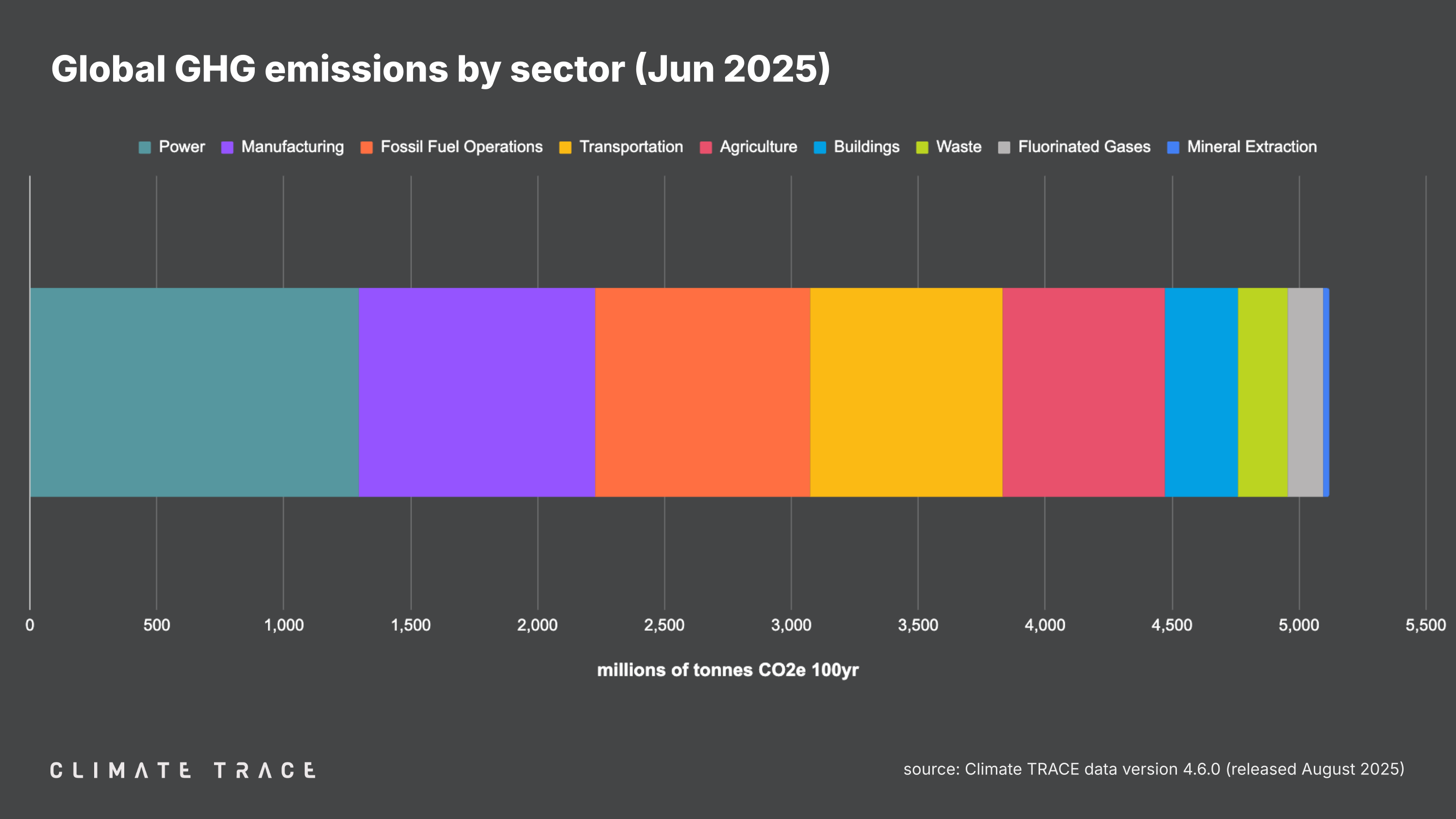
Greenhouse gas emissions increased in June 2025 vs. June 2024 in fossil fuel operations, manufacturing, transportation, and waste, and decreased in power. Fossil fuel operations saw the greatest change in emissions year over year, with emissions increasing by 1.85% as compared to June 2024.
– Agriculture emissions were 641.40 million tonnes CO₂e, unchanged vs. June 2024;
– Buildings emissions were 285.59 million tonnes CO₂e, unchanged vs. June 2024;
– Fluorinated gases emissions were 137.71 million tonnes CO₂e, unchanged vs. June 2024;
– Fossil fuel operations emissions were 846.19 million tonnes CO₂e, a 1.85% increase vs. June 2024;
– Manufacturing emissions were 929.05 million tonnes CO₂e, a 0.02% increase vs. June 2024;
– Mineral extraction emissions were 23.22 million tonnes CO₂e, unchanged vs. June 2024;
– Power emissions were 1,297.34 million tonnes CO₂e, a 0.56% decrease vs. June 2024;
– Transportation emissions were 759.10 million tonnes CO₂e, a 0.77% increase vs. June 2024;
– Waste emissions were 197.77 million tonnes CO₂e, a 0.26% increase vs. June 2024.
Greenhouse Gas Emissions by City: June 2025
The urban areas with the highest total greenhouse gas emissions in June 2025 were Shanghai, China; Tokyo, Japan; New York, United States; Houston, United States; and Los Angeles, United States.
The urban areas with the greatest increase in absolute emissions in June 2025 as compared to June 2024 were Pittsburgh, United States; Xinyu, China; Tokyo, Japan; Baotou, China; and Algeciras, Spain. Those with the largest absolute emissions decline between this June and last June were Leipzig, Germany; Anqing, China; Duren, Germany; Houston, United States; and Anchorage, United States.
The urban areas with the greatest increase in emissions as a percentage of their total emissions were Kombissiri, Burkina Faso; Gambat, Pakistan; Bitilta Zebraro, Ethiopia; UNNAMED, Sudan; and Oviedo, Spain. Those with the greatest decrease by percentage were Leipzig, Germany; Duren, Germany; Wolfsburg, Germany; Atebubu, Ghana; and Evansville, United States.
RELEASE NOTES
Revisions to existing Climate TRACE data are common and expected. They allow us to take the most up-to-date and accurate information into account. As new information becomes available, Climate TRACE will update its emissions totals (potentially including historical estimates) to reflect new data inputs, methodologies, and revisions.
With the addition of June 2025 data, the Climate TRACE database is now updated to version V4.6.0. This release incorporates the most recent FAOSTAT and CEDS data in applicable sectors. The release also reflects updated methodology for non-GHG emissions from glass, cement, and lime production; the addition of N2O emissions across agriculture subsectors and additional refinements to agriculture emissions factors; updated North America and Europe data for Q4 2024 in petrochemicals and oil and gas refining; updated methodology and data for cement and steel production to reflect updated emissions factors; and the addition of 56 steel plants to our database.
A detailed description of data updates is available in our changelog here.
To learn more about what is included in our monthly data releases and for frequently asked questions, click here. All methodologies for Climate TRACE data estimates are available to view and download here. For any further technical questions about data updates, please contact: coalition@ClimateTRACE.org.
To sign up for monthly updates from Climate TRACE, click here.
Emissions data for July 2025 are scheduled for release on September 25, 2025.
About Climate TRACE
The Climate TRACE coalition was formed by a group of AI specialists, data scientists, researchers, and nongovernmental organizations. Current members include Carbon Yield; CTrees; Duke University’s Nicholas Institute for Energy, Environment & Sustainability; Earth Genome; Former Vice President Al Gore; Global Energy Monitor; Hypervine.io; Johns Hopkins University Applied Physics Lab; OceanMind; RMI; TransitionZero; and WattTime. Climate TRACE is also supported by more than 100 other contributing organizations and researchers, including key data and analysis contributors: Arboretica, Carnegie Mellon University’s CREATE Lab, Global Fishing Watch/emLab, Michigan State University, Open Supply Hub, and University of Malaysia Terengganu. For more information about the coalition and a list of contributors, click here.
Media Contacts
Fae Jencks and Nikki Arnone for Climate TRACE
Glassmaking has dramatically evolved in the thousands of years since ancient artisans crafted their first decorative beads and perfume bottles. But the underlying recipe remains virtually the same: Combine sand, sodium carbonate, and limestone, then blast the ingredients with scorching heat in a kiln or furnace.
Today, the vast majority of that heat is supplied by burning fossil fuels. Whether manufacturers are turning glass into windows, beverage bottles, smartphone screens, or coatings for solar panels, their methods require lots of energy to reach superhigh temperatures and, as a result, can be very carbon-intensive.
Global glassmakers in recent years have begun working to curb their emissions, spurred by environmental laws and the growing demand for low-carbon products. Companies are testing and deploying new furnace technologies that get their heat from electricity — not fossil gas or heating oil — or from alternative fuels such as hydrogen and biogas.
The latest of these emerging efforts comes from Bavaria, Germany, where the multinational firm Schott recently began building a large-scale electric melting tank inside its existing plant in Mitterteich. The tank is the first of its kind for the type and amount of glass it’s making, and it will run primarily on renewable energy sourced from the grid to turn materials into molten glass.
Schott says its electric tank could slash greenhouse gas emissions from the melting process alone by 80% owing to the reduction in fossil gas use. The 40-million-euro ($47 million) pilot tank is expected to fire up in early 2027 and will produce specially engineered glass tubing for syringes, vials, and other pharmaceutical products.
Jonas Spitra, Schott’s head of sustainability communications, said that replacing fossil fuels with electrified technology — while still meeting strict quality requirements for specialty glass — marks “one of the most challenging yet decisive steps on the industry’s path to decarbonization.”
Schott, which operates in over 30 countries, will use the experiences from its all-electric tank initiative “as a foundation for expanding electrification to other sites, wherever technically and economically feasible,” he told Canary Media.
The German pilot project is moving forward just as a few ambitious low-carbon glass initiatives in the United States have fallen into limbo. In May, the Trump administration’s Department of Energy canceled awards worth roughly $177 million for projects aiming to demonstrate cleaner glassmaking methods in California and Ohio, forcing manufacturers to reevaluate their plans.
“Domestic glass manufacturers across the country are advancing energy-efficient technologies, reducing emissions, and working to try and keep jobs onshore,” Scott DeFife, president of the Glass Packaging Institute, said in a June 6 statement in response to the DOE’s decision. “The Department should lean into glass, not ignore it.”
Worldwide, manufacturers made more than 150 million metric tons of glass in total in 2022. Although glass is used across many sectors, it is produced on a smaller scale than other carbon-intensive materials. Cement production, for instance, surpassed 4 billion metric tons in 2023, while steel production reached nearly 2 billion metric tons that year.
Still, glassmaking remains a significant source of planet-warming gases and local air pollutants like nitrogen oxides. And the challenge of slashing those emissions is essentially the same one vexing other heavy industries: figuring out how to reach hot enough temperatures to make materials without cooking the planet in the process.
Chemical producers are pilot-testing their own electric furnaces to make important compounds like ethylene, which is the building block of many plastic products. Cement startups are developing electricity-driven processes and thermal storage systems to replace traditional kilns. Global steelmakers, meanwhile, are investing in technologies that sidestep the need to use coal, such as hydrogen-based ironmaking facilities and electric arc furnaces.
For glass, the biggest hurdle to decarbonization lies in the melting process, Schott’s Spitra explained.
Glass furnaces require temperatures of between 1,200 and 1,700 degrees Celsius (2,192 and 3,092 degrees Fahrenheit) — hotter than lava — to liquefy the raw materials and mix in recycled glass. The process is responsible for about two-thirds of total carbon dioxide emissions from glass production. Most of that CO2 comes from burning fossil fuels, though some emissions result from the chemical reactions that happen when heating up sodium carbonate (soda ash) and limestone.
In a conventional furnace, gas is injected into a combustion chamber to melt the ingredients into a glowing orange liquid. In an electric version, electrodes pass currents through a conductor to generate heat. Today, the industry mostly uses electric equipment only for smaller-scale furnaces or to supplement the fossil-fuel-based heat inside larger furnaces — a step known as “electric boosting.”
Facilities that make high-volume products like container glass and windows are trickier to fully electrify. Existing electric designs have struggled to operate with the same consistency and flexibility as gas furnaces, and they can’t incorporate as much recycled material into the glass mix. Electric furnaces also tend to wear down and need replacing about twice as fast as their gas-burning counterparts, according to glass industry experts.
In Germany, Schott is aiming to address those problems with its new industrial-scale melting tank, which must also meet the exacting standards for bubble-free, high-quality pharmaceutical glass. The initiative, which Schott began developing in 2021, is partly funded by the German government and a European Union–backed program to decarbonize energy-intensive industries in Germany.
The company is investing in electrification in part to meet European climate regulations, including a CO2 emissions cap for heavy industrial sectors. But it’s also responding to the demand from pharmaceutical customers that are working to reduce their supply-chain emissions. Schott views decarbonization as a “strategic opportunity to strengthen its competitiveness,” Spitra said.
Beyond the technical issues, a few other barriers stand in the way of electrifying glassmaking at a wider scale.
In some locations, the local grid may be unable to support a major increase in electricity use, requiring companies and utilities to upgrade that infrastructure or build more wind, solar, and other electricity resources. For producers of mass-market packaging like soda bottles, it can be harder to convince beverage companies to pay more for low-carbon glass if it means raising the sticker price of the final product, especially if the competition is cheap plastic containers.
Another challenge for U.S. glassmakers in particular is that switching to electricity very likely means paying higher utility bills, making it harder to justify ditching fossil gas.
Sonya Pump, the global sustainability director for Ohio-based O-I Glass, said that gas pricing is one of the key factors the company weighs when evaluating low-carbon furnace technologies — along with potential technical constraints or risks to its manufacturing capabilities. O-I Glass makes billions of glass containers every year in facilities in nearly 20 countries, and the criteria it considers vary by market, as well as the type and quantity of glass it’s producing.
For that reason, in the U.S., “a fully electric melter is not currently the best solution for our business,” she said. “Though, in other geographies — areas in Europe, for example — energy pricing, carbon costs, and intense interest from our customers in emerging sustainability solutions make for analyses that look very different.”
In central France, O-I Glass is investing $65 million to build a hybrid-electric melter that can use up to 70% electricity and is set to come online in 2026. Pump said her team is also learning from its participation in electrification projects conducted through the nonprofit consortium Glass Futures and from other industry efforts. At the same time, O-I Glass is replacing some of its older furnaces in the U.S. and globally with modern systems that use oxygen and waste heat to reduce facilities’ total fossil-fuel use.
The manufacturer recently set a goal of slashing its overall greenhouse gas emissions by 47% by 2030, relative to 2019 levels, in addition to boosting its use of electricity from renewables and increasing the use of recycled glass.
O-I Glass had planned to rebuild an aging furnace in Zanesville, Ohio, and combine five cutting-edge technologies — including for electric boosting, preheating materials, and recovering waste heat — to see how much they could offset gas consumption when working together. The project was slated to receive up to $57.3 million from the DOE. Now that the federal funding has been canceled, the company is considering its next steps, Pump said.
Other initiatives to electrify glassmaking or test replacing gas with hydrogen are also now “slightly paused” under the Trump administration, said Matthew Kirian, director and technical program manager of the Northwest Ohio Innovation Consortium. The nonprofit works with O-I Glass and other manufacturers such as solar-panel-maker First Solar to advance innovation within the region’s long-standing glass industry.
“On the energy and fuel side of things, it’s hard to set a firm strategy, especially for the next two to three years, because of federal policy that is so clear … that combustion is king,” Kirian said.
For now, he added, glass manufacturers are largely focusing on other strategies to lessen their environmental impact, including improving the energy efficiency and operating performance of existing facilities and working to increase recycling rates for glass containers — only about 30% of which get recycled nationwide — so that less material winds up in landfills and more is melted into fresh glass.
“Their sustainability goals aren’t going away,” Kirian said of the glassmakers. “We’re hoping to really move the needle for generations to come.”
States are ramping up efforts to get residents to switch from fossil-fuel-fired heating systems to all-electric heat pumps. Now, they’ve got a big new tool kit to pull from.
Last week, the interagency nonprofit Northeast States for Coordinated Air Use Management, or NESCAUM, released an 80-page action plan laying out key strategies to turbocharge heat-pump deployment. Individual states are already putting many of these tactics to the test.
California, Colorado, Maine, Maryland, Massachusetts, New Jersey, New York, Oregon, Rhode Island, and the District of Columbia together committed to ambitious heat-pump adoption goals last year. Washington state joined the pact last week. Their targets: By 2030, heat pumps will make up 65% of the sales of residential heating, air conditioning, and water heating equipment. By 2040, that percentage is to climb to 90%.
The goals are essential for addressing climate change. Buildings are directly responsible for 13% of U.S. carbon emissions, in part due to the fossil fuels burned on-site to heat indoor air and water. All-electric heat pumps can do those jobs running on clean power.
The NESCAUM action plan comes as the Trump administration clings tenaciously to fossil fuels. In recent months, the federal government has rolled back energy-efficiency standards for appliances, imposed chaotic tariffs that are raising costs for consumers, and put an early expiration date on the $2,000 federal tax credit that helps homeowners afford heat pumps.
Despite these headwinds, the report shows that “states are still finding creative ways to move forward,” said Emily Levin, policy and program director for NESCAUM.
HVAC heat pumps are routinely two to four times as efficient as gas furnaces, capable of heating and cooling interiors using the same physics that refrigerators employ to chill your cucumbers. Heat-pump water heaters work the same way and are three to five times as efficient as gas water heaters. By eschewing fossil fuels, these technologies improve air quality and typically save people money over the long term, even if, on average, they cost significantly more up-front than conventional heating systems. (At least one startup, though, is trying to change that.)
Heat pumps are slowly catching on. In the U.S., the units outsold gas furnaces by their biggest-ever margin last year, but their share of the market is still modest. Citing data from the Air-Conditioning, Heating, and Refrigeration Institute, a trade association, Levin said that in 2021, heat pumps accounted for about 25% of the combined shipments of gas furnaces, heat pumps, and air conditioners, the three largest reported HVAC categories. In 2024, they’d risen to about 32%.
“No matter how you look at it, there are still a lot of gas furnaces being sold, there are still a lot of one-way central air-conditioners being sold — all of which could really become heat pumps,” Levin said.
Produced in consultation with state agencies, environmental justice organizations, and technical and policy experts, the NESCAUM report lays out a diverse set of more than 50 strategies — both carrots and sticks — covering equity and workforce investments, obligations to reduce carbon, building standards, and utility regulation. A wide range of decision-makers, often in collaboration, can pull these levers — from utility regulators to governor’s offices, state legislatures, and energy, environment, labor, and economic development agencies. Here are six recommendations from the report that stand out.
NESCAUM’s Levin stressed that the report is “a menu — not a recipe.” Each state will need to consider its own goals and constraints to pick the approaches that fit it best, she added.
Still, “I see [heat-pump electricity] rates as one of the areas that’s most promising,” Levin said. Massachusetts’ reforms “are really going to change their customer economics to make it more attractive to switch to a heat pump.”
When done right, rate design also avoids the need for states to find new funding. “You’re not raising costs on anybody, you’re only reducing costs,” Levin said. At a time when households are seeing energy prices rise faster than inflation, the tactic could have widespread political appeal, she noted.
NESCAUM plans to check back in with states and report out on their progress each year, Levin said. “The cool thing about our work is that we bring states together to learn from one another,” she added. “Part of making this transition happen more rapidly is lifting up the things that are really working well.”
After years of failed attempts, California lawmakers have cleared the way to create an electricity-trading market that would stretch across the U.S. West. Advocates say that could cut the region’s power costs by billions of dollars and support the growth of renewable energy. But opponents say it may make the state’s climate and clean-energy policies vulnerable to the Trump administration.
Those are the fault lines over AB 825, also known as the “Pathways Initiative” bill, which was signed into law by Democratic Gov. Gavin Newsom on Sept. 19 as part of a major climate-and-energy legislative package. The law will grant the California Independent System Operator (CAISO), which runs the transmission grid and energy markets in most of the state, the authority to collaborate with other states and utilities across the West to create a shared day-ahead energy-trading regime.
Passage of this bill won’t create that market overnight — that will take years of negotiations. CAISO’s board wouldn’t even be allowed to vote on creating the market until 2028.
But for advocates who’ve been working for more than a decade on plans for a West-wide regional energy market, it’s a momentous advance. “We’ve shot the starting gun,” said Brian Turner, a director at clean-energy trade group Advanced Energy United, which was outspoken in support of the legislation.
Today, utilities across the Western U.S. trade energy via bilateral arrangements — a clunky and inefficient way to take advantage of cheaper or cleaner power available across an interconnected transmission grid. An integrated day-ahead trading regime could drive major savings for all participants — nearly $1.2 billion per year, according to a 2022 study commissioned by CAISO.
That integrated market could create opportunities for solar power from California and the Southwest and wind power from the Rocky Mountains and Pacific Northwest to be shared more efficiently, driving down energy costs and increasing reliability during extreme weather.
Lower-cost power more readily deliverable to where it’s needed could also reduce consumers’ monthly utility bills — a welcome prospect at a time of soaring electricity rates.
The regional energy market plan is backed by a coalition that includes clean-energy trade groups such as Advanced Energy United and the American Clean Power Association; environmental groups including the Sierra Club, Union of Concerned Scientists, and the Natural Resources Defense Council; business groups including the California Chamber of Commerce and the Clean Energy Buyers Association; and the state’s major utilities. It also has the backing of U.S. senators representing California, Oregon, and Washington, all states with strong clean-energy goals.
Assemblymember Cottie Petrie-Norris, a Democrat who authored AB 825, said in a statement following its passage that it “will protect California’s energy independence while opening the door to new opportunities to build and share renewable power across the West.”
But consumer advocates, including The Utility Reform Network, Consumer Watchdog, and Public Citizen, say the bill as passed fails to protect that energy independence. The Center for Biological Diversity and the Environmental Working Group share their concerns. They fear a new trading market will allow fossil fuel–friendly states like Idaho, Utah, and Wyoming to push costly, dirty coal power into California — and give an opening to the Trump administration to use the federal government’s power over regional energy markets to undermine the state’s clean-energy agenda.
The arguments for a day-ahead energy-trading market can be boiled down to a simple concept, Turner said — bigger is better. Being able to obtain power from across the region could reduce the amount of generation capacity that individual utilities have to build. And tapping into energy supplies spanning from the Pacific Ocean to the Rocky Mountains would allow states undergoing heat waves and winter storms to draw on power from parts of the region that aren’t under the same grid stress, improving resiliency against extreme weather.
A Western trading market could also serve as a starting point for even more integrated activity between the dozens of utilities in the region that now plan and build power plants and transmission grids in an uncoordinated way. A 2022 study commissioned by Advanced Energy United found that a regional energy organization could yield $2 billion in annual energy savings, enable up to 4.4 gigawatts of additional clean power, and create hundreds of thousands of permanent jobs.
CAISO proposed this Extended Day-Ahead Market (EDAM) concept six years ago as an expansion of the real-time energy trading it already conducts with utilities across the West. CAISO’s EDAM scheme is competing with another prospective day-ahead market being promoted by the Southwest Power Pool, a regional grid operator based in Arkansas that serves 14 Midwest and Great Plains states.
For advocates of a Western market, the chief challenge has been to design a structure that doesn’t give up California’s control over its own energy and climate policies, but allows other states and their utilities a share of decision-making authority over how the market works. Taking a lead on that design work has been the West-Wide Governance Pathways Initiative, a group of utilities, state regulators, and environmental and consumer advocates.
Regional-market boosters tried and failed to pass enabling legislation in California in 2017 and 2018 in the face of opposition from environmental groups that feared the plan would clear the way for coal-fired power to come in from other states. Labor unions representing California utility workers also opposed those earlier bills on the grounds that cheaper out-of-state power could lead to less clean energy being built in California.
But many of these prior opponents, including the Sierra Club and key unions, came around to support the latest plan.
With the passage of AB 825, “we’re looking at a fairly rapid and clear rollout of the organization, so that Western states and utilities can begin to get engaged,” Turner said.
But by engaging in a regional energy market, California could risk losing some control over its climate and clean-energy progress, critics say. They argue that the final version of AB 825 doesn’t have enough protections against this outcome.
“We’re strongly opposed,” said Matthew Freedman, staff attorney at The Utility Reform Network (TURN). Previous versions of the bill “had a bunch of provisions we thought would have protected California’s sovereignty and prevented the federal government from weaponizing its authority. Most of those protections were stripped from the bill, inexplicably.”
In particular, in May, TURN and its allies pushed to add an amendment that would have created an oversight council including California lawmakers that would have had the authority to pull the state out of the market if they determined it would raise energy costs or work against the state’s carbon-emissions goals.
“It’s about retaining the state’s sovereignty,” said Jamie Court, president of Consumer Watchdog. “This is our last political check on when we get into the market and when we get out of the market.”
But the provisions in that amendment were “poison pills” for other states considering membership in the market, said Merrian Borgeson, California policy director for climate and energy for NRDC, which supported the legislation. “That would have made it far too unstable.”
The final version of AB 825 still gives California lawmakers the authority to pull the state out of the regional day-ahead market, said Turner of Advanced Energy United — just not via the hair-trigger structure that opponents had sought. “At any time, the Legislature could say, ‘This market is no longer in the interest of California. We’re going to order the Public Utilities Commission to order the utilities to stop participating in this market,’” he said.
The bill’s authors argue that they got the balance right. State Sen. Josh Becker, a Democrat whose bill initially contained the Pathways proposal before it was shifted into AB 825, said that the final structure “provides the accountability that some folks wanted but that’s also enticing to market participants.”
However, TURN and Consumer Watchdog say that the risks outweigh the benefits — particularly if an expanded market exposes the state to federal interference. The Trump administration has been using federal emergency powers to prevent regional grid operators from closing coal plants set for retirement, and it may seek to force the Federal Energy Regulatory Commission to abandon its historically apolitical approach to governing regional energy markets, which could “frustrate key state environmental, resource-planning, reliability, or other public-interest policies,” Freedman said.
“Why California should give up its governance over that regional market is a mystery to me,” he said. “We have no faith that federal agencies will act with good faith or common sense or the law.”
Turner at Advanced Energy United disagrees with that assessment. “CAISO is currently a FERC-regulated market, and this will not increase its exposure to FERC regulation,” he said.
In the end, AB 825 won the support of what Becker described as a “broad and unprecedented coalition spanning environmental organizations, labor, business, and consumer advocates.”
In fact, joining with other states might actually strengthen California’s position against Trump administration overreach, Turner argued. “We understand the federal government may try to distort the free market in ways that benefit their preferred technologies,” he said. “There is a very credible argument to be made that joining shoulder to shoulder with other states improves our ability to defend ourselves against those kinds of things.”
Small solar-panel kits that can be assembled as easily as an Ikea bookcase and plugged into a regular residential outlet could be coming soon to New Hampshire and Vermont. Lawmakers and advocates in both states are preparing legislation that would make these plug-in solar systems accessible to residents who don’t have the space, money, or inclination to install a larger, conventional rooftop array.
“It’s really about energy affordability,” said Kevin Chou, cofounder of Bright Saver, a nonprofit that advocates for the adoption of plug-in solar. “It’s about access for people who wanted solar but haven’t been able to get it.”
These systems — also called “portable” or “balcony” solar — generally come in kits that even a novice can put together at home. They plug into a standard outlet, sending the power they generate into a home’s wires, rather than drawing electricity out.
Unlike rooftop arrays, plug-in systems don’t generate enough power to meet all, or even most, of a household’s needs, but they offset enough consumption to pay for themselves within four or five years, even without incentives like tax credits or net metering, Chou said. Models now on the market start at about $2,000. If the equipment becomes more popular and prices come down, the payback period could get even shorter.
“You don’t need any subsidies to make this work,” Chou said. “The pure economics are so attractive, it’s one of the best investments you can make.”
These systems have taken off in Germany, where more than a million have been deployed, but have been much slower to catch on in the United States.
Recently, though, the idea has gained traction in the U.S. In March, Utah lawmakers, working with Bright Saver, unanimously passed a law authorizing and regulating the equipment, making it the first state to lay out the welcome mat for plug-in solar. Last month, a Pennsylvania state representative announced plans to introduce a similar law, and Bright Saver is having conversations with lawmakers in about a dozen additional states about possible legislation, Chou said.
All of the legislative proposals follow the same principles as Utah’s law: They would define a new class of small, portable solar systems, and establish the right of households to use the systems without submitting applications or paying fees to the state or utilities. They also define safety standards for the systems, including that they be certified by Underwriters Laboratories, or UL, a company that sets standards and provides safety certifications for a wide range of products.
At the moment, two manufacturers make plug-in solar systems with inverters that have been certified as complying with safety requirements, Chou said. Because the market for portable solar is so new, however, UL has not developed standards for entire systems. Bright Saver and other plug-in solar supporters have been working with the company on this issue and expect a standard to be released in the next month or two, Chou said.
Other startups are waiting in the wings, hoping to launch their own products next year, once the questions about UL standards are resolved, he added.
“Bottom line: Once Vermont’s legislation passes, there will be existing manufacturers ready to sell into the state immediately, along with new entrants waiting for additional UL clarity, who are also preparing to launch,” Chou said.
Supporters hope the benefits of plug-in solar — lowered electricity costs, freedom to make personal energy choices — will help the idea gain support even in states not known for their embrace of renewable energy, and despite federal efforts to slow or stop renewable energy progress. The early and robust acceptance of the technology in deep-red Utah has bolstered this vision.
“I am optimistic that, as in Utah, it’s going to be seen as a commonsense way to just get out of the way and let people do good things,” said Ben Edgerly Walsh, climate and energy program director at the Vermont Public Interest Research Group, an organization backing Vermont’s expected plug-in solar bill.
In New Hampshire, a swing state known for its “live free or die” libertarian streak, Democratic state Sen. David Watters also thinks this dynamic might work in the technology’s favor, despite the state’s historical lack of support for measures boosting solar use.
“We’re really kind of stuck in a rut with anti-renewable-energy sentiment in the House,” Watters said. “This seemed like something that would fit into the ethos of people being able to make individual choices.”
Watters, a member of the state Senate Energy and Natural Resources Committee, worked with local advocacy group Clean Energy New Hampshire to author a rough draft of a plug-in solar bill based on Utah’s new law. It will be refined in the coming months and formally introduced in the legislature in January.
Notably, Watters said, his proposal would not stop homeowners associations or landlords from imposing their own rules on members and tenants.
“Their authority is not taken away,” he said. “For this state, that’s crucial.”
In Vermont, two Democratic state legislators — Sen. Anne Watson, chair of the Senate Committee on Natural Resources and Energy, and Rep. Kathleen James, chair of the counterpart committee in the House — are championing a plug-in solar bill based on model legislation drafted by Bright Saver. Watson is particularly excited for the potential of plug-in solar to reach low-income residents and renters.
“This creates access for folks who might otherwise not have the authority to put something on their roof, or who might need something a little more flexible,” she said.
Vermont, a decidedly left-leaning state, has long welcomed renewables. The state’s governor, Phil Scott, however, is a Republican who has shown reluctance to spend public money on clean energy. Further, the legislature lost its veto-proof Democratic majorities during the last election, so prospects for forward movement on energy and climate issues have been dimmed this year.
However, Watson has already heard a lot of positive feedback from her fellow lawmakers, even though the bill won’t be taken up until the legislature reconvenes in January. Indeed, several colleagues came to her with similar proposals before learning she was already working on it. She has also had initial conversations with the Scott administration and found it willing to consider the idea, she said.
“While I can’t say they are necessarily for it, the reception I’ve received so far is that they are open and interested in learning more,” she said. “I am hoping for broad support.”
Revolution Wind can officially resume. But unlike the last time President Donald Trump ordered construction on an offshore wind project to pause, relief came through the courts rather than politicking.
A federal judge on Monday ruled in favor of the Danish energy giant Ørsted, whose $6.2 billion Rhode Island project was halted last month by the Interior Department without, as the judge put it, any “factual findings.” A similar stop-work order that froze construction on New York’s Empire Wind was lifted by Trump officials in May following one month of heavy lobbying — and reported backdoor deal-making — by lawmakers and diplomats.
Judge Royce Lamberth, a Reagan-era appointee serving the U.S. District Court for the District of Columbia, granted a motion for a preliminary injunction sought by Revolution Wind to resume turbine construction while its complaint against the Interior Department works its way through the courts, which could take years. The project is 80% complete, and Ørsted released a statement on Monday saying workers will restart “as soon as possible.”
Monday’s decision marked a victory for Revolution Wind and could have broader legal ramifications for Trump’s ongoing war against offshore wind energy, given that several projects are still tangled up in litigation. And, if the recent ruling is any indication, the Trump administration may have a hard time convincing judges that walking away from already-approved wind farms makes sense.
“The Trump Administration’s erratic action was the height of arbitrary and capricious, and failed to satisfy any statutory provisions needed to halt work on a fully approved and nearly complete project. It was not a close call,” Connecticut’s Attorney General William Tong, a Democrat, stated in response to Lamberth’s decision.
Twelve other high-profile lawsuits are actively challenging Biden-era approvals for eight U.S. wind farms, according to the research firm ClearView Energy Partners. Traditionally, the government defends projects it’s already greenlit. Legally, however, it can pick and choose which approvals to stand up for.
For example, three of those projects — New England Wind, SouthCoast Wind, and the Maryland Offshore Wind Project — could soon lose their federal approvals. None of the three have started construction yet, but in the past month, government officials have filed documents in court for each, trying to undo approvals granted by the Biden administration.
“These other cases are different procedurally, but [the Revolution Wind ruling] shows that the courts are taking this seriously and that the Trump administration took these actions without sufficient justification,” said Nick Krakoff, a senior attorney for the Conservation Law Foundation.
The latest blow came on Thursday, when government lawyers filed a motion to reverse its approval of SouthCoast Wind, a massive 141-turbine project slated for federal waters near Massachusetts’s coastline. Krakoff said that the legal argument is nearly identical to one filed in the U.S. District Court of Maryland the week prior seeking to take back approvals from the Maryland Offshore Wind Project.
Both filings invoke a new legal interpretation of the Outer Continental Shelf Lands Act that argues that the Interior Department must weigh other ocean activities — like commercial fishing and Coast Guard operations — in an “absolutist approach,” said Krakoff, to evaluate potential conflicts with wind farms.
The standard interpretation, employed for almost a decade by past administrations and already upheld in a 2024 court decision, instructs agencies to take a more balanced approach to evaluating multiple ocean users.
“It’s not unprecedented for a new administration to switch positions. But it is unprecedented to seek to remand a permit because of it,” said Krakoff, who called the Trump-era interpretation of the law a “coordinated attack” on thousands of clean energy jobs.
Oddly, the Trump administration appears to be defending some wind projects at the center of these legal challenges while trying to tank the three others.
For example, on Sept. 8, the Interior Department’s Bureau of Ocean Energy Management filed a letter signalling that it wants to dismiss a lawsuit brought by the anti-wind group Protect Our Coast NJ that challenges New York’s Empire Wind.
Then there is the exceptional case of Virginia. Earlier this month, E&E News reported that House Speaker Mike Johnson (R) publicly defended Coastal Virginia Offshore Wind, which is the only offshore wind farm currently being built in a Republican-led state. ClearView’s analysts believe this GOP support may explain why the Trump administration has not tried to remand approvals for the Virginia project in response to a lawsuit brought by the Heartland Institute and other right-leaning think tanks challenging its construction. Instead, on Friday, government lawyers asked the judge for a 90-day extension on filing a report on the Virginia project’s status.
Being inconsistent in when and how it deploys new legal interpretations could backfire for the Trump administration.
On Monday, Lamberth told government lawyers that “mandating the immediate pause to construction of a project whose approval the Bureau continues to defend in other cases is the height of arbitrary and capricious.”
Meanwhile, Democratic lawmakers are clearly frustrated that most of the offshore wind projects in Trump’s crosshairs are in solidly blue states at a moment when they have little power in Congress to fight back. Many Democrats see the courts as the best hope for surmounting the administration’s continued efforts to block the development of wind power, which they view as necessary for meeting growing electricity demand.
“One of our most important roles right now is to illustrate to people that the actions taken by this administration are creating shortages and … spikes in your [electricity] prices. Second is the litigation pathway,” Sen. Brian Schatz, a Democrat from Hawaii, said during a press call on Monday.
The longtime climate hawk discussed new data showing that electricity prices in the U.S. have risen by 10% since Trump took office. Lawmakers from both sides of the aisle have proposed legislation that would streamline energy project permitting, but that is not a near-term solution for wind developers, Schatz said, adding that litigation is the faster route towards “success.”
Revolution Wind’s stop-work order had been bleeding its developers of “more than $2 million per day,” according to court filings, and posing a risk to New England’s future grid reliability.
“The time frame to get a new law in place and enforce that new law is unlikely to match up with the time frame of a developer who is almost invariably working on borrowed money and can’t wait three and a half years while we sort ourselves,” said Schatz.
For Revolution Wind, Monday’s legal victory may only be temporary — federal officials could appeal the ruling. A spokesperson for the Justice Department declined to comment. A similar but separate lawsuit challenging Revolution Wind’s stop-work order, brought by the attorneys general of Rhode Island and Connecticut, is winding its way through the courts. Last week, the feds requested that this case be transferred to the U.S. District Court in D.C. so that it can be consolidated with the developers’ case.
If the 704-megawatt project reaches completion, its carbon-free electricity will feed into New England’s regional grid, serving utility customers who just endured a winter where power bills skyrocketed.
Funding for Rhode Island’s energy-efficiency programs could be cut by more than $42 million next year in an effort to rein in residents’ soaring power bills. That rollback would deprive the state of more than $90 million in benefits and potentially eliminate hundreds of jobs while creating only modest up-front savings, a new analysis finds.
Rhode Island Energy, the utility that administers the state’s energy-efficiency offerings, has proposed to slash spending on that front by 18% compared to last year and more than 30% compared to the budget originally projected in the nonbinding three-year plan introduced in 2023. If approved, the cuts will save the average household $1.87 per month, according to Rhode Island Energy.
The result of these changes, according to climate action nonprofit Acadia Center, would be more expensive electricity and more exposure to volatile natural gas prices in the long run.
“Energy efficiency is a tool for suppressing supply costs, for suppressing infrastructure costs in the long-term,” said Emily Koo, Acadia Center’s program director for Rhode Island and one of the authors of the group’s analysis. “I am not seeing our leaders think beyond the immediate.”
Rhode Island has traditionally been a leader in energy-efficiency programming. Over the past 15 years, the state has repeatedly placed among the top 10 states in the American Council for an Energy-Efficient Economy’s annual energy-efficiency scorecard. Since 2009, the state has spent more than $2 billion on efficiency incentives and services, yielding more than $6 billion in environmental and social benefits.
Now, however, the dynamics of energy markets are creating new obstacles. Nationwide, electricity costs have gone up at twice the rate of inflation over the past year, and gas prices have increased by more than four times the inflation rate. Rhode Island, like other New England states, has the added difficulty of already having some of the highest electricity rates in the country. Add in cold Northeastern winters, and the state is girding for an expensive season ahead.
As in neighboring states, regulators, elected officials, and utilities in Rhode Island are scrambling for ways to provide some relief for residents and businesses. These efforts have increasingly looked to the bill fees that fund renewable energy incentives and energy-efficiency programs as possible targets for quick, if small, bill reductions. In Maine, for example, leaders from both sides of the aisle have sought to lower incentives for customers and community solar developments that send power back to the grid, and in Massachusetts, utility regulators ordered energy-efficiency administrators to cut $500 million from a planned $5 billion three-year budget.
Now, Rhode Island Energy is proposing rollbacks of its own, saying that its latest plan prioritizes customer affordability. The company has the support of the Rhode Island Division of Public Utilities and Carriers, which points to the growth in accounts with overdue utility bills to bolster its argument that the changes will provide needed relief to consumers.
“There is simply a financial limit as to how much cost the ratepayers can bear,” the department wrote in its public comments on the proposal.
Advocates, however, say the approach is short-sighted.
“This is weaker. It’s a retreat,” said Larry Chretien, executive director of the nonprofit Green Energy Consumers Alliance, which opposes the proposed cuts. “It just feeds into the narrative — that we don’t accept — that ratepayers aren’t seeing benefits from energy efficiency.”
Rhode Island’s energy-efficiency offerings include home energy assessments, weatherization services, rebates on energy-saving appliances and heating and cooling systems, and contractor training. Residents and businesses that take advantage of these programs generally save money by reducing their energy use.
The programs also create savings for the average consumer, whether or not they participate. Because the improvements slow energy consumption, they allow utilities to build less pricey infrastructure, the cost of which is passed on to customers. Efficiency measures can also lower peak demand, reducing the need to buy costlier, dirtier power from peaker plants. In Rhode Island, efficiency programs lowered electricity use 5% between 2005 and 2024; without these interventions, use would have increased 15%, according to an annual state report.
Advocates, therefore, argue that Rhode Island Energy’s plan to shrink energy-efficiency spending won’t actually result in more affordable power in the long run.
“You spend money on energy efficiency or you’re going to spend even more money on power supply,” said Forest Bradley-Wright, state and utility director for the American Council for an Energy-Efficient Economy.
Acadia Center’s analysis also finds that more than 800 jobs in the energy-efficiency sector could be at risk if the cuts are adopted.
The draft plan has been through multiple iterations; the most recent version was released on Sept. 5. The state energy-efficiency council is expected to vote on the proposal at its Sept. 25 meeting. The plan will then go to utility regulators for final approval.
Advocates say they intend to keep pushing for high funding levels until the process concludes.
“The benefits we’re experiencing today are already translating into lower bills,” Bradley-Wright said. “There’s a track record of success, but let’s not take it for granted.”
Since 2021, the Sierra Club has been grading U.S. utilities on their commitment to a clean-energy transition. While most utilities have not earned high marks on the group’s annual scorecards, as a whole they had been showing some progress.
That’s over now. The latest edition of the Sierra Club’s “The Dirty Truth” report finds that the country’s biggest electric utilities are collectively doing worse on climate goals than when the organization started tracking their progress five years ago. This year they earned an aggregate grade of “F” for the first time.
With only a handful of rare exceptions, U.S. utilities have shed the gains they made during the Biden administration. Almost none are on track to switch from fossil fuels to carbon-free energy at the speed and scale needed to combat the worst harms of climate change.
“It’s very disappointing to find we’re at a lower score than in the first year,” said Cara Fogler, managing senior analyst at the Sierra Club, who coauthored the report. But it’s not entirely unexpected.
Utilities had already begun slipping on their carbon commitments last year, in the face of soaring demand for electricity, according to the 2024 “Dirty Truth” report, largely in response to the boom in data centers being used to power tech giants’ AI goals. But the anti-renewables, pro–fossil fuels agenda of the Trump administration and Republicans in Congress has pushed that reversal into overdrive.
“We have a new federal administration that’s doing everything in their power to send utilities in a direction away from cleaner power,” Fogler said. “They’re doing away with everything in the Inflation Reduction Act that supported clean energy. They’re straight-up challenging clean energy, as we’ve seen with Revolution Wind,” the New England offshore wind farm that’s now under a stop-work order. “And they’re doing everything in their power to keep fossil fuels online” — for example, through Department of Energy actions that force coal, oil, and gas plants to keep running even after their owners and regulators had agreed on retirement dates.
But utilities also bear responsibility for not doing more to embrace technologies that offer both cleaner and cheaper power, Fogler said. “From a cost perspective, from a health perspective, from a pollution perspective, there are so many reasons to build more clean energy and fewer fossil fuels. Unfortunately, we’re seeing that utilities are much less concerned about doing the right thing for the climate and their customers.”
For its new “The Dirty Truth” report, the Sierra Club analyzed 75 of the nation’s largest utilities, which together own more than half the country’s coal and fossil-gas generation capacity. The report measures utilities’ plans against three benchmarks: whether they intend to close all remaining coal-fired power plants by 2030, whether they intend to build new gas plants, and how much clean-energy capacity they intend to build by 2035.
As of mid-2025, the utilities had plans to build only enough solar and wind capacity to cover 32% of what’s forecast to be needed by 2035 to replace fossil-fuel generation and satisfy new demand. While 65% of the utilities have increased their clean-energy deployment plans since 2021, 31% have reduced them.
Meanwhile, commitments to reduce reliance on fossil fuels have taken a big step backward as utilities have turned to keeping old coal plants running and are planning to build more gas plants to meet growing demand. As of mid-2025, the utilities had plans to close only 29% of coal generation capacity by 2030, down from 30% last year and 35% in 2023.
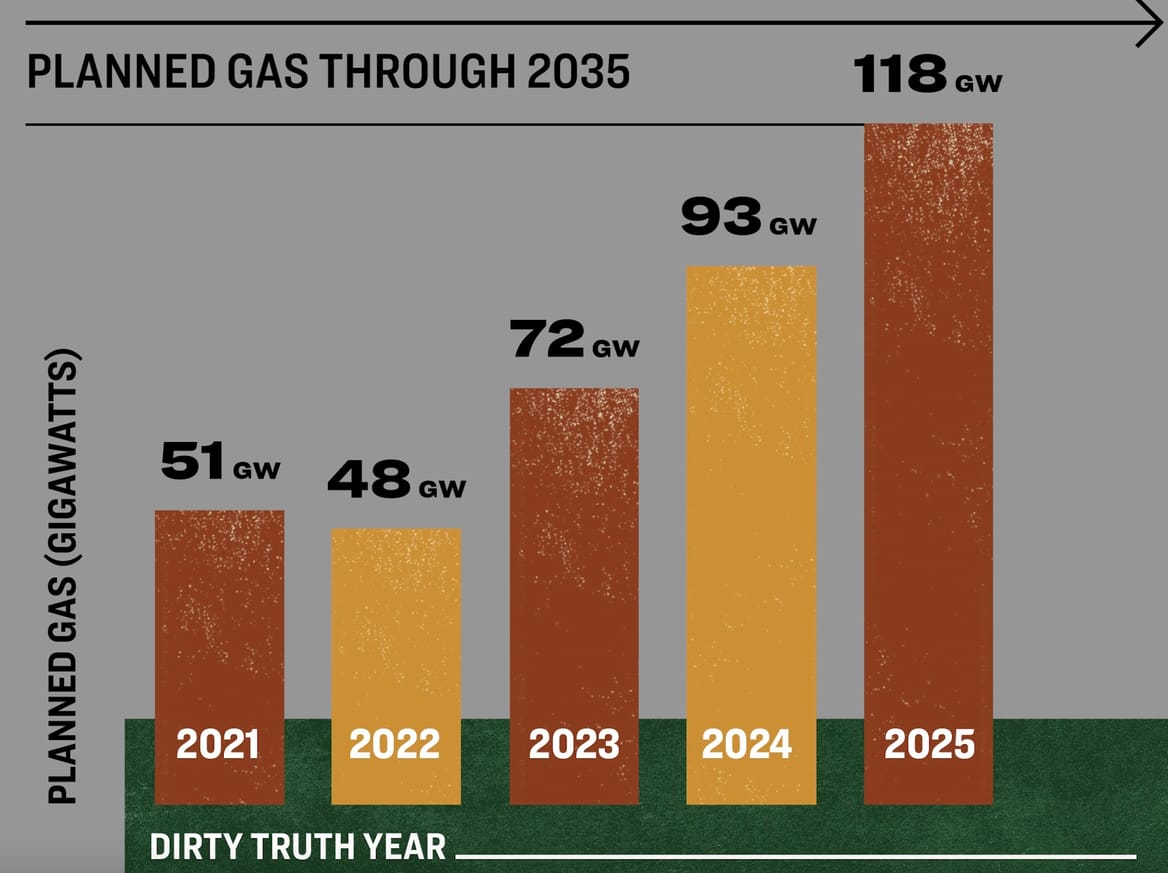
And the amount of gas-fired generation capacity the utilities plan to build by 2035 spiked to 118 gigawatts as of mid-2025. That’s up from 93 gigawatts in 2024, and more than twice the 51 gigawatts planned in 2021.
That expanding appetite for new gas-fired power has been supercharged by the surge in forecasted electricity demand across much of the country — data centers are the primary driver of that growth. But much of that expected data-center demand is speculative. And the lion’s share of it is premised on the idea that the hundreds of billions of dollars in AI investments from tech giants like Amazon, Google, Meta, and Microsoft as well as AI leaders like OpenAI and Anthropic will end up earning those companies enough money to pay off their costs — a risky bet.
The Sierra Club is among a growing number of groups demanding that utilities and regulators proceed with caution in building power plants to serve data centers that may never materialize. Forecasted data-center power demand is already driving up utility rates for everyday customers in some parts of the country, and the new gas power plants now in utility plans aren’t even built yet.
“There is some load we’re naturally going to see — there’s population growth, lots of beneficial electrification we want to see happen,” said Noah Ver Beek, senior energy campaigns analyst at the Sierra Club and another coauthor of the report. “But we also want utilities to be realistic about load-growth projections.”
Unfortunately, booming demand growth gives utilities “more cover” to invest in polluting assets, Fogler said. Utilities earn guaranteed profits on the money they spend building power plants and grid infrastructure, which gives them an incentive to avoid questioning high-growth forecasts or seeking out lower-cost or less-polluting alternatives.
Some of the most aggressive fossil fuel expansions are planned for the Midwest and Southeast, including by Dominion Energy in Virginia, Duke Energy in North Carolina, and Georgia Power.
Even the handful of utilities that have previously earned high marks for clean-energy and coal-closure commitments in past “Dirty Truth” reports have slipped. Fogler highlighted the example of Indiana utility NIPSCO, which earned an “A” in the past four reports but only a “B” in the latest, largely due to its plan to rely on gas power plants to meet expected data-center demand.
NIPSCO has “no plans to pursue the high-load-growth scenario until they see contracts signed and progress made,” Fogler said — a prudent approach that avoids burdening customers with the costs of new power plants built for data centers that may never come online, she said. “The problem? Their high-load-growth scenario calls for all new gas. There should be more clean options.”
Most utilities are not capitalizing on the solar and wind tax credits that are set to disappear in mid-2026 under the megalaw passed by Republicans in Congress this summer, she said. Only a handful of utilities, such as Xcel Energy in Colorado and Minnesota, are accelerating their clean-energy deployments to take advantage of those tax credits. “We want more utilities to take that period of certainty and speed up what they’ve already planned.”
Going big on clean energy is also the only way to quickly add enough generation capacity to meet growing demand forecasts and contain rising utility costs, Ver Beek noted. Utilities and major tech companies are pinning their near-term capacity expansion plans on new gas plants, despite the yearslong manufacturing backlogs for the turbines that power those plants and rapidly rising turbine costs.
“From a cost perspective, from a climate perspective, we want to see utilities advocating for getting as much clean energy online as they can,” he said.
Across California, hundreds of homes and businesses have signed up their solar panels, batteries, EVs, and appliances to be part of “virtual power plants” — networks of scattered energy resources that utilities can control to stave off blackouts and cut electricity prices.
Now, utilities are exploring another way to leverage VPPs: Strategically concentrating the systems in certain areas could let the companies defer expensive upgrades to nearby poles, wires, and other infrastructure. But first, utilities need to be 100% sure they can count on customer-owned assets without risking the grid’s reliability.
That’s the challenge that Northern California utility Pacific Gas & Electric is taking on with a pilot program it is running this summer and fall. PG&E has years of experience operating virtual power plants to reduce stress across the statewide grid. But the new Seasonal Aggregation of Versatile Energy (SAVE) program is testing how customers’ batteries and home energy controls can meet grid needs more precisely, down to the neighborhood level.
PG&E hasn’t said how many households it enlisted for the pilot, but in a March press release, the utility said it aimed to enroll up to 1,500 residential customers with solar-charged batteries from companies including Sunrun and up to 400 customers with smart electrical panels from startup Span.
The local “distribution” grids that serve those customers operate under a variety of conditions, including moments of peak demand that push some of the systems to their limits. Using home batteries and energy controls to delay upgrading those grids could make a big dent in the high and rising costs of electricity in California. In fact, a recent analysis indicates tapping the state’s nation-leading fleet of rooftop solar, backup batteries, and EVs for this task could save billions of dollars in grid upgrade costs.
PG&E isn’t delaying upgrades on the parts of the grid it’s testing just yet, said Trevor Udwin, the utility’s VPP and grid optimization manager. But the SAVE project will inform next steps to start doing this kind of proactive, VPP-integrated grid planning at a larger scale.
“At some point, we need to build trust,” Udwin said. “That means someone’s signing something” — a commitment to deliver the grid relief needed during specific times — ”and that a distribution planner is changing their operations based on that commitment.”
Distribution networks are distinct from the huge transmission lines that move the energy produced by power plants over long distances. Local distribution infrastructure instead carries power from substations — the big, fenced-in collections of equipment that lower the voltage of transmission-fed power — along main feeder lines, and eventually to the wires that connect to neighborhoods, homes, and businesses.
Until recently, utilities lacked technologies like smart meters and grid sensors to let them see what’s actually going on on those parts of their grids. That visibility is important, because these distribution networks have unique and fluctuating needs and characteristics — or load shapes, in industry parlance —that determine where and when they may be experiencing problems.
Without that transparency, the traditional utility fix has been to overbuild the system to reduce risks of overloads. But that’s getting expensive as demand for electricity rises. U.S. utilities invest more capital in their distribution grids than in any other part of their business, and those costs are increasing rapidly.
It could be much cheaper to instead get a cluster of customers to use less energy or send solar or battery power back to the grid during the handful of hours a particular distribution system is overloaded.
To test that capability, PG&E and its SAVE partners are using Sunrun’s batteries and Span’s smart electrical panels to modify how homes participating in the pilot consume and provide electricity to match the hour-by-hour constraints of the grid they’re connected to.
That’s an inherently time- and location-specific challenge, since different grid substations and circuits “may have very different load shapes, and they may peak differently at different hours,” Udwin said. And right now, very few utilities have deployed the data-collecting technology needed to reliably coordinate those interactions across their low-voltage distribution networks.
That technology, referred to as a distributed energy resource management system, or DERMS, does exist. California’s big utilities have run multiple DERMS pilot projects over the years, and PG&E has built a DERMS system that it’s using to manage a handful of EV charging hubs and utility-scale batteries participating in “load flexibility” pilots.
But PG&E hasn’t yet integrated that DERMS platform with the communications and controls technology it’s deploying with its SAVE partners, Udwin said. Instead, for this summer’s tests, PG&E is “building communications with the aggregators,” he said, interfacing with software from Lunar Energy and Tesla to control the batteries, and with Span’s software that keeps whole-home energy use below certain thresholds.
All of that software will be tasked with making sure homes with batteries, panels, and other equipment work together to add power or reduce draws at moments when that section of the grid is expected to experience excessive loads. But it also has to make sure it doesn’t leave customers unable to use their batteries and appliances when they need to, Udwin noted.
PG&E and its SAVE partners want to make sure they’re “serving their customers best, and that the load-shaping won’t negatively impact them,” Udwin said. To make that easier, PG&E is delivering its partners week-ahead and day-ahead load shape requests, he said. That gives Sunrun and Span an opportunity to prepare their customers for lengthy demands on their resources.
“They’re taking a really big risk with us,” he said. “I’m thrilled our partners are taking this leap.”
California was one of the first states to push utilities to integrate customer-owned solar, batteries, and flexible EV chargers and appliances into grid planning. Colorado, Hawaii, Illinois, Massachusetts, Minnesota, New York, and others have enacted similar policies over the past decade. The idea is to capture the grid value of distributed energy resources — solar, batteries, EVs, and smart thermostats, water heaters, and appliances that can shift when they use electricity — that homes and businesses are already buying.
Lots of utilities are already using these technologies to reduce system-wide electricity peaks. In fact, demand-response programs have existed for decades. But beyond a handful of projects, utilities have yet to leverage VPPs as a way to defer investments in their distribution grids.
Utilities don’t have much time to act on this opportunity for savings, said Aram Shumavon, CEO of grid analytics company Kevala. Even with these kinds of targeted VPPs in place, overloaded grid circuits will need to be upgraded sooner or later, he said. And once they are, VPPs can no longer defer those costs, evaporating the potential savings.
Missing out on those savings could hurt. A 2023 study by Kevala found that upgrading California’s distribution grids without deploying tech and programs to prevent EV charging from overloading local circuits could cost the state’s three big investor-owned utilities around $50 billion by 2035. Managing EVs to avoid those overloads, by contrast, could cut that price tag roughly in half, according to more recent studies.
Those savings should more than cover whatever utilities need to pay EV owners to commit to those managed charging constraints, Shumavon said. Eventually, the rising electricity demand from all those new EV-owning customers will increase utility revenues enough to cover those new grid costs, lowering rates for customers at large, he added.
To be clear, the lack of uniformity across different parts of the grid makes it hard to pinpoint the precise value of the VPPs the SAVE program is testing. Assessing that value is exceedingly complicated, given the enormous number of variables involved.
VPP advocates argue that utilities and regulators should avoid getting bogged down in those calculations and err in favor of encouraging customers to lend their spare power to help the grid. A new report from Kevala and think tank GridLab found that California could cut energy costs for consumers by up to $13.7 billion by 2030 by fully utilizing distributed resources like EVs and solar panels to defer grid upgrades.
However, utilities need to be able to prove out that a VPP’s benefits outweigh the expense of paying customers for access to their energy resources, Udwin said. “We want to find ways to shape for everything we can shape for — and do so cost-effectively. That’s the rub.”
PG&E is targeting low-income and disadvantaged communities for at least 60% of its SAVE test cases, Udwin said. There’s a sound rationale for that: Data shows that utilities have underinvested in the distribution infrastructure that serves these communities, which has restricted their ability to access rooftop solar and EV charging.
At the same time, PG&E is focusing on parts of the grid where its SAVE partners already have a concentration of customers. California has more rooftop solar, behind-the-meter batteries, and EVs than any other state, which provides a fertile field of latent resources to tap into, said Yang Yu, Sunrun’s director of business development for distributed power plants (another term for VPPs).
“Deploying assets in a small territory can make it difficult [for VPP programs] to reach scale, even with strong customer incentives like a free battery,” he said. But Sunrun has “a ton of assets already deployed,” he said. “That means that, within a specific region — say a substation or even specific feeders — we may have enough penetration at some point to do a local-level peak-load management.”
That’s not just more cost-effective than upgrading utility grids — it’s also faster. “We can stand up a [distributed power plant] in six months,” he said, which is what Sunrun has done for PG&E’s SAVE program.
We’re in the midst of a global solar revolution. Don’t believe it? Just look at the latest numbers.
In the first six months of this year, the world built 64% more new solar energy capacity than it did in the first half of 2024, according to think tank Ember. The 380 gigawatts’ worth of solar installed through June of this year is roughly equal to the amount of solar installed in all of 2021 and 2022 combined.
The story of this global solar boom is, really, the story of solar growth in China.
The country, which is the world’s largest producer of solar equipment and most other clean-energy technologies, on its own deployed 256 GW of new solar over the first half of this year — more than two-thirds of the global total. That’s double the amount it installed during the same period last year.
China’s rapid buildout of solar is welcome news. The country emits more planet-warming greenhouse gases than any other, in large part because it burns prodigious amounts of coal to produce electricity for its 1.4 billion citizens. But solar and other renewables are now putting enough of a dent in the country’s coal use that some analysts expect China’s overall emissions to decline this year.
Outside of China, the rest of the world installed just 15% more solar capacity in the first half of this year than it did in the first half of last year.
The two next-biggest solar installers over this time period were India, at 24 GW, and the U.S., at 21 GW. The U.S. is still managing to push solar to new heights despite the Trump administration’s attacks on clean energy.
Overall, solar provided just 7% of electricity generated around the globe last year. That percentage needs to increase — fast — so the world can ditch fossil fuels and bend the emissions curve downward. Luckily, solar has so far proven up to the challenge of growing at an astonishing rate.


.svg)
