

 Back
Back
NextEra Energy is one of three U.S. energy companies to win backing from the Department of Energy to revive shut-down nuclear plants to meet soaring power demand.
A third shuttered U.S. nuclear power plant is set to attempt a comeback with hefty support from the federal government.
On Tuesday, the U.S. Department of Energy said it closed a loan of up to $1.9 billion to NextEra Energy to help finance the restart of the Duane Arnold Energy Center in Iowa, which shut down six years ago. The company aims to begin producing electricity from the 615-megawatt power plant by early 2029.
The loan was finalized by the department’s renamed Office of Energy Dominance Financing, known as the Loan Programs Office under past administrations. The office previously closed a $1 billion loan to restart Constellation Energy’s Crane nuclear plant in Pennsylvania and a $1.52 billion loan to revive Holtec International’s Palisades plant in Michigan.
All three of these decades-old nuclear plants shut down in recent years owing to the high costs of repairing and relicensing the facilities. Competition from natural gas and increasingly low-cost renewable energy also soured operators and utilities on atomic power.
But with electricity demand surging across the U.S., due in large part to the data center boom, power plant owners are looking to give their mothballed facilities a second chance — something that’s never been done before in the U.S.
Holtec’s Palisades plant is poised to become America’s first nuclear restart as early as this year. The firm has hit several snags along the way on the first-of-a-kind project, causing it to miss its original target of early 2026. But in July, it reached a “watershed moment” by completing all major renovations for its reconstruction of the plant’s single 800-MW reactor. Last week, Holtec said it achieved another historic milestone: beginning the process of loading nuclear fuel into the reactor vessel. It faces a contractual deadline to complete the restart by March 2027.
If Holtec is successful in getting Palisades back online, it could help pave the path for reviving the country’s other shuttered reactors.
NextEra Energy, for its part, is still working to secure licensing approvals from the U.S. Nuclear Regulatory Commission to return Iowa’s only nuclear plant to service. Last fall, the company signed a 25-year agreement with Google to supply electricity from Duane Arnold, which will help power the tech giant’s growing cloud-computing and AI infrastructure in the state.
“By bringing new generation online to serve new demand, we can strengthen the grid, create hundreds of good-paying jobs and help ensure Iowa families and businesses are not asked to bear the costs of growth,” John Ketchum, president and CEO of Florida-based NextEra Energy, said in a Tuesday news release.
While federal loans for nuclear restarts began under the Biden administration, the Trump administration has leaned heavily into supporting nuclear, even as it cancels funding and blocks development of other clean energy sources. In June, the Office of Energy Dominance Financing announced a $17.5 billion loan initiative to help energy companies buy nuclear equipment and build 10 new large-scale reactors in the next few years.
The moves come amid growing bipartisan support in the U.S. for nuclear power, which can provide carbon-free electricity around the clock. Several Democratic-led states with moratoriums on nuclear power have in recent months walked back their restrictions as they seek low-emission sources of electricity that can supplement solar and wind and reduce strain on the grid.
The Duane Arnold reboot is expected to supply enough power for nearly 500,000 homes and create nearly 1,500 jobs during construction, while supporting over 400 permanent positions during operations.
“New nuclear development and the restart of Duane Arnold will meet our growing energy demand while also providing hundreds of good-paying jobs throughout the state,” Iowa’s Republican Gov. Kim Reynolds said on Tuesday.
Roanoke City Public Schools is building the state’s first solar-plus-storage systems to keep emergency shelters going during extreme weather and cut down on costs.
As climate change intensifies, communities around the country are looking for ways to better prepare for extreme weather, from ice storms to heat waves. In Roanoke, Virginia, nestled in the Blue Ridge Mountains, that starts with the schools.
For years, the Roanoke City Public Schools district has been installing solar panels to lower electricity bills, minimize its carbon footprint, and teach students about clean tech. Now, the district is set to be the first in the state to invest in storage, with a solar-and-battery-powered microgrid at each of its two high schools, which double as official disaster shelters.
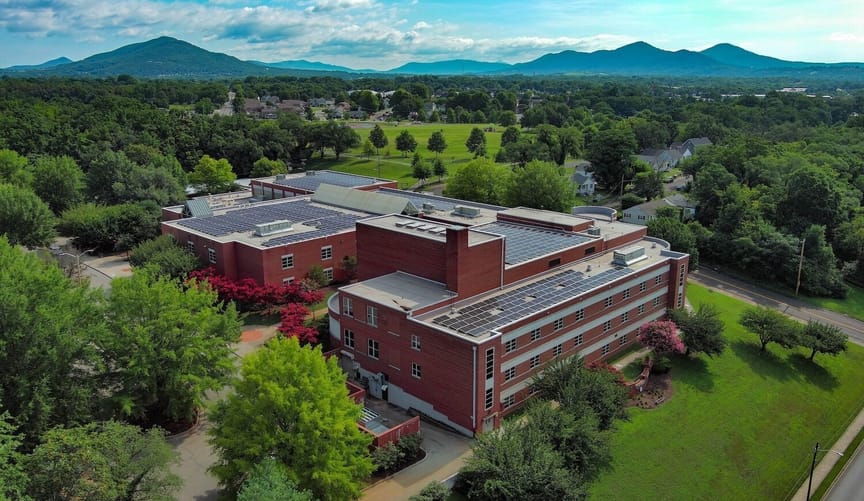
“They’ll run on the battery until such time as it’s discharged,” said Jeff Shawver, senior director of school plants for Roanoke City Public Schools. “Then the diesel generators are cut on. Then, the next day, the sun comes up, and you start charging the battery again. It just keeps the cycle going.”
Due to be installed by the end of the year, the storage systems will be among just a handful of batteries at school buildings around the country, according to Generation180, a national nonprofit headquartered up the interstate in Charlottesville. The dearth of sustainable microgrids at schools is problematic in the wake of natural disaster, since they account for 60% of all FEMA-designated relief shelters in Virginia and half of those nationwide.
“Schools are also the hubs where citizens vote, where groups gather, and now increasingly where neighbors need to huddle or seek shelter during emergencies,” said Tish Tablan, senior program director at the nonprofit and a former teacher. “So they’re just critical parts of our communities.”
The microgrid is funded partially by a grant from the state’s Department of Emergency Management and a donation from commercial solar installer Secure Solar Futures. “The grant has been around for a few years,” Tablan said. “They are the first to utilize it for a solar microgrid instead of diesel.”
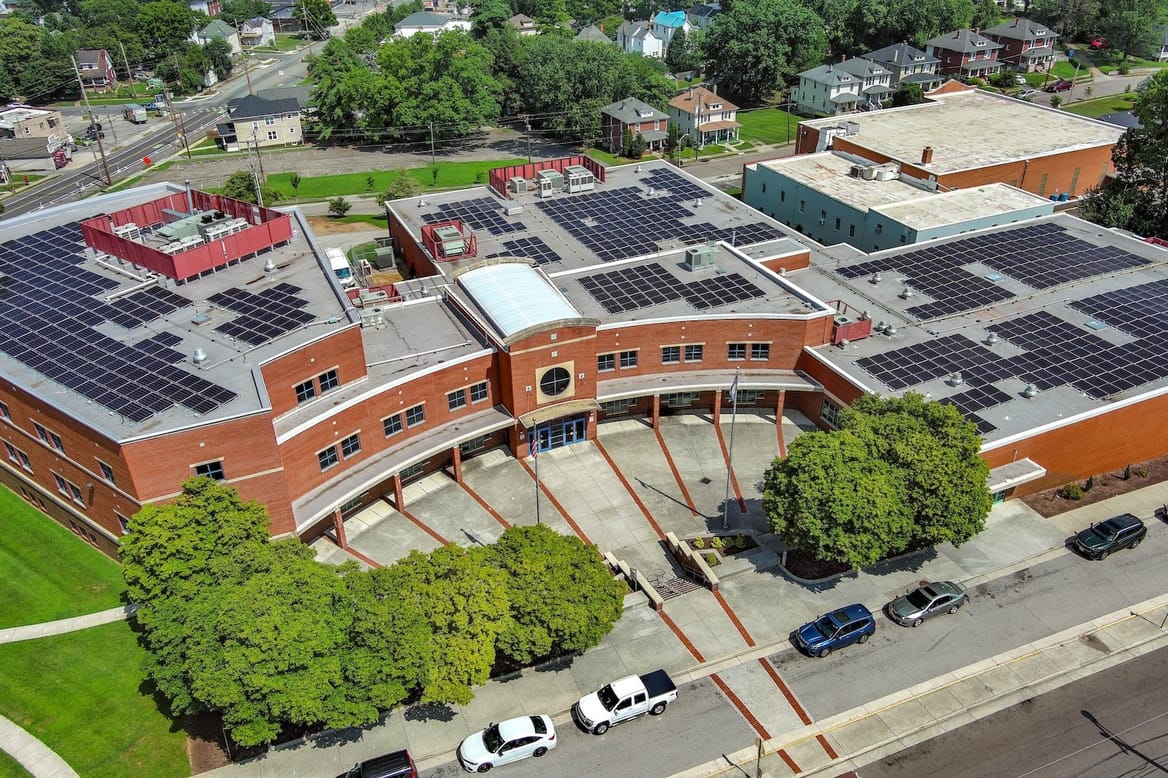
The school district’s foray into batteries fits with its track record on solar. Serving some 14,000 students, the district leads the state on solar energy installations among schools, with nearly 9.4 megawatts planned for or already atop 29 rooftops and other sites.
The solar arrays are poised to cover 44% of the schools’ energy needs, cutting the school system’s electric bills by more than $22 million over 35 years. Because many installations come with new roofs, they’ll also help the district avoid $24 million in capital costs.
“We’re going to end up with most of our schools with at least a 25-year warranty on the roofs,” Shawver said. “For any facility manager, trust me: That’s a happy day for that person.”
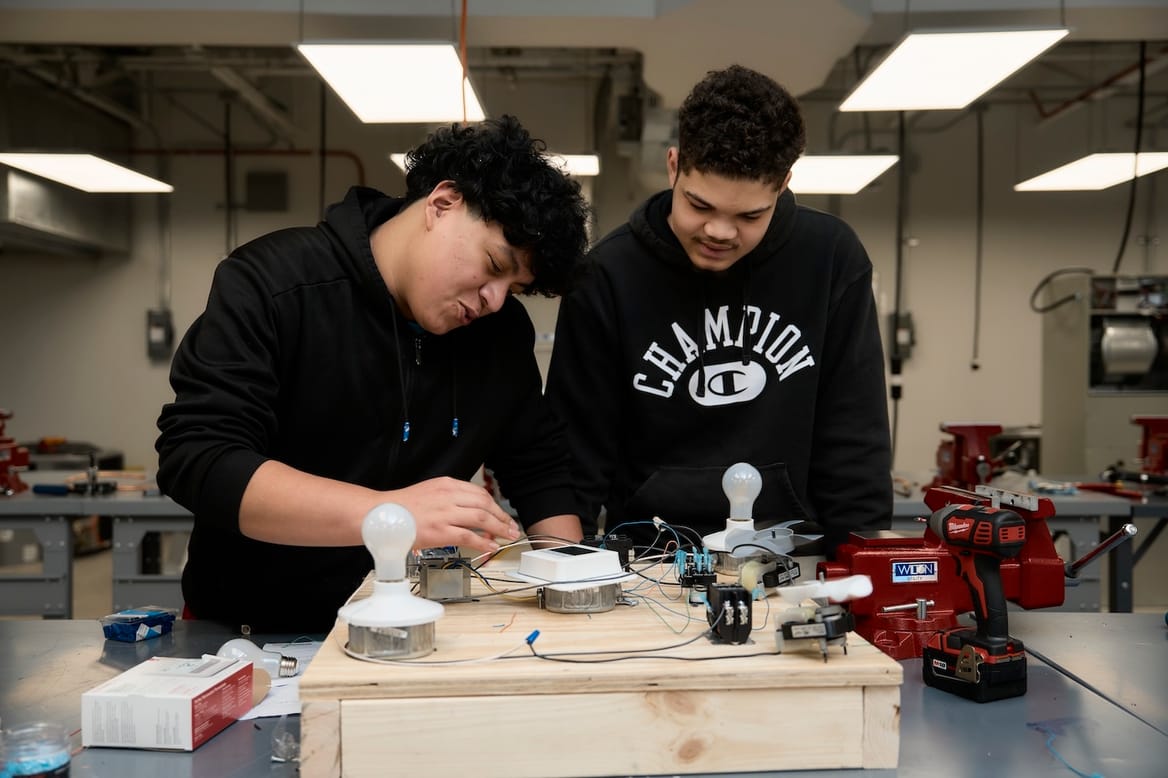
The installations also enable hands-on training for teachers and students in clean energy careers and technical educaton, and help minimize its climate footprint.
“It all works in tandem,” said Claire Mitzel, communications director for Roanoke City Public Schools. “We want our schools to be safe. We want them to be sustainable. We want our students to have access to high-quality learning environments.”
With their vast square footage, ample flat roof space, and relatively low energy needs after the sun goes down, schools are well suited for solar arrays. But installations didn’t really take off in Virginia until this decade, when schools got the ability to buy power from third parties other than investor-owned utilities, as well as the chance to sell excess solar power back to the grid.
“That’s what makes it doable,” said Shawver, who began negotiations with utility Appalachian Power back in 2018. “It’s been a long journey for us.”
Today, Virginia’s K–12 schools rank 8th in the nation for solar power capacity, according to Generation180, with 83 megawatts on 236 campuses — the vast majority of installations owned by third-party companies. Nearly half the state’s solar-powered schools came online after 2020, when the solar-school-friendly policies were cemented in the Virginia Clean Economy Act.
Still, there’s plenty of room for growth — especially as electricity rates rise in the data center capital of the world. Generation180 data shows that California is far and away the national leader when it comes to solar on schools, with almost 900 megawatts. New Jersey, whose population is similar to Virginia’s, has the second-most school-solar capacity, with over 300 megawatts — three and a half times the amount in Old Dominion.
State leaders could take their cues from California, which requires all new school buildings to be equipped with solar and storage. And they could provide more funds, as Maryland, Massachusetts, and Pennsylvania do, for schools to invest in solar arrays.
But even without such support, Virginia schools have a big opportunity to install more sustainable microgrids. Tablan notes that the state grant program that Roanoke is using to help pay for its storage system is taking applications now.
“They just opened up a new round of funding,” she said. “They have $2.5 million available for fiscal year ’27.”
China has more solar capacity online than coal capacity. It’s a remarkable milestone, but the fossil fuel still generates far more electricity than solar does.
Solar is beating coal in China. Sorta. But also not at all.
Let me explain.
An eye-popping new chart made the rounds this week. It shows a line representing solar energy in China rising improbably over the last decade, until at last it overtakes another line that represents the nation’s vast coal fleet. One article featuring this chart came with the following headline: “Solar surpasses coal in China, becomes top power source.”
This is exactly the type of chart a person concerned about climate change could hope to see — one that would have defied the imagination of analysts and onlookers even a few years ago. It proves that the nation has been taking serious steps to clean up its coal-heavy grid, contra those who use China’s enormous emissions to justify climate complacency elsewhere.
But it’s also a bit misleading. While there’s nothing wrong with the data — solar really has overtaken coal in terms of capacity — the story is more complicated than a tidy chart can express.
To understand why, you’ll have to bear with some technical definitions. Capacity is the key word here: It’s a measure of the absolute maximum output a power plant can produce. But plants don’t run at full tilt, and experts use a metric called capacity factor to express how much electricity a facility actually produces compared with its potential output.
In China, coal has an average capacity factor of around 50%. Solar’s is only 14%.
That means China still generates way, way more electricity from coal than from solar panels, even though solar’s capacity now outweighs coal’s. At current capacity factors, China’s solar fleet would need to be about 3.5 times bigger than its coal fleet in order to generate more electricity.
The yawning gap between capacity and generation is, in part, the result of physical differences between coal and solar. You might have heard that solar only works during the day?
But in China, a big piece of the story is also underutilization. The country has built solar — and wind — so quickly that it is struggling to metabolize the renewable energy sources into its grid. The nation doesn’t have enough power lines to bring electricity to where it’s needed, or enough batteries to absorb all the energy that isn’t immediately used.
Due largely to these constraints, China had to curtail — or leave unused — more than one-quarter of its wind and solar power in the first half of this year. As a result, 360 terawatt-hours of carbon-free power went to waste, an amount larger than the U.K.’s entire electricity use last year.
So, yes, solar has won the capacity race in China, and that is a truly remarkable milestone. But the real race — the one that measures actual electrons generated — is still coal’s to lose.
1.5 degrees is off the table without carbon removal
The United Nations warned this week that the world will soon surpass the 1.5 degree Celsius warming target set by the Paris Agreement. This was evident to climate scientists monitoring the situation, but nevertheless marks a symbolic — and grim — milestone for efforts to mitigate the worst effects of climate change.
Now, the U.N. says, the only way to stay below the 1.5 degree threshold is to pull vast amounts of carbon dioxide out of the atmosphere and bury it underground. Large-scale carbon removal and sequestration is a largely unproven practice, and one that lacks a clear economic logic — the industry today rests largely on corporate benevolence from the likes of Microsoft, Stripe, Shopify, and other major companies. If the approach is technically capable of scaling up, it will still likely require government support to reach the levels the U.N. says are necessary.
Carbon removal may eventually save the day. Or it may not. What’s certain, however, is that the world needs to radically reduce the use of fossil fuels — and build a lot more carbon-free energy and vehicles.
California wraps up a chaotic legislative session
State lawmakers in California, which often sets the pace for climate policy in the U.S., passed dozens of energy and climate bills this session — including several we’ve reported on targeting
These bills, and many others, now head to Democratic Gov. Gavin Newsom’s desk.
But perhaps the more important story is what didn’t pass this year. The biggest deal: the collapse of last-minute efforts to reform the regulations that expose California utilities to potentially ruinous wildfire liability. Other notable legislative misses: Lawmakers were unable to secure funding for the state’s most successful virtual power plant — or to save about $200 million for a program that helps schools upgrade HVAC systems. —Jeff St. John
Want more California updates? Sign up for Jeff’s new newsletter, California Wire.
Guzzling less gas: China’s oil consumption dropped by 9% in the second quarter of this year compared with the same period in 2025 as more residents turned to EVs and public transit amid the war in Iran, causing overall emissions to fall by 1%. (Carbon Brief)
Battery boon: A new study shows that EV batteries last longer than expected, retaining about 90% of their original capacity even after more than 90,000 miles. (InsideEVs)
Battery boom: The U.S. built a record 20.2 GWh of battery storage in the second quarter of 2026, with most of that capacity coming from utility-scale installations. (Canary Media)
Let’s make a deal: Democratic governors are increasingly urging data center developers to offer community benefit agreements as backlash to their construction expands. (Politico)
Garden State solar: New Jersey Gov. Mikie Sherrill (D) signs a law officially authorizing residents to use plug-in solar panels, joining eight other states. (Gothamist, Canary Media)
Geothermal growth: Next-generation geothermal company Fervo Energy signs a major deal with Google, which will purchase nearly 400 MW of power from its Cape Station project in Utah. (Canary Media)
Fighting dirty for clean energy: A super PAC is fighting dirty on behalf of clean energy during this primary season — and is now targeting its first Democrat after a string of successes in GOP primaries. (Canary Media, Canary Media)
Investors spent a record amount in the first half of 2026 on projects that combine renewable energy — mostly solar — with batteries.
Peanut butter and jelly. Batman and Robin. Solar and storage. Some things just go together, and that’s why investors around the world are pouring more and more money into projects that pair rows of solar panels with boxes of grid batteries on the same site.
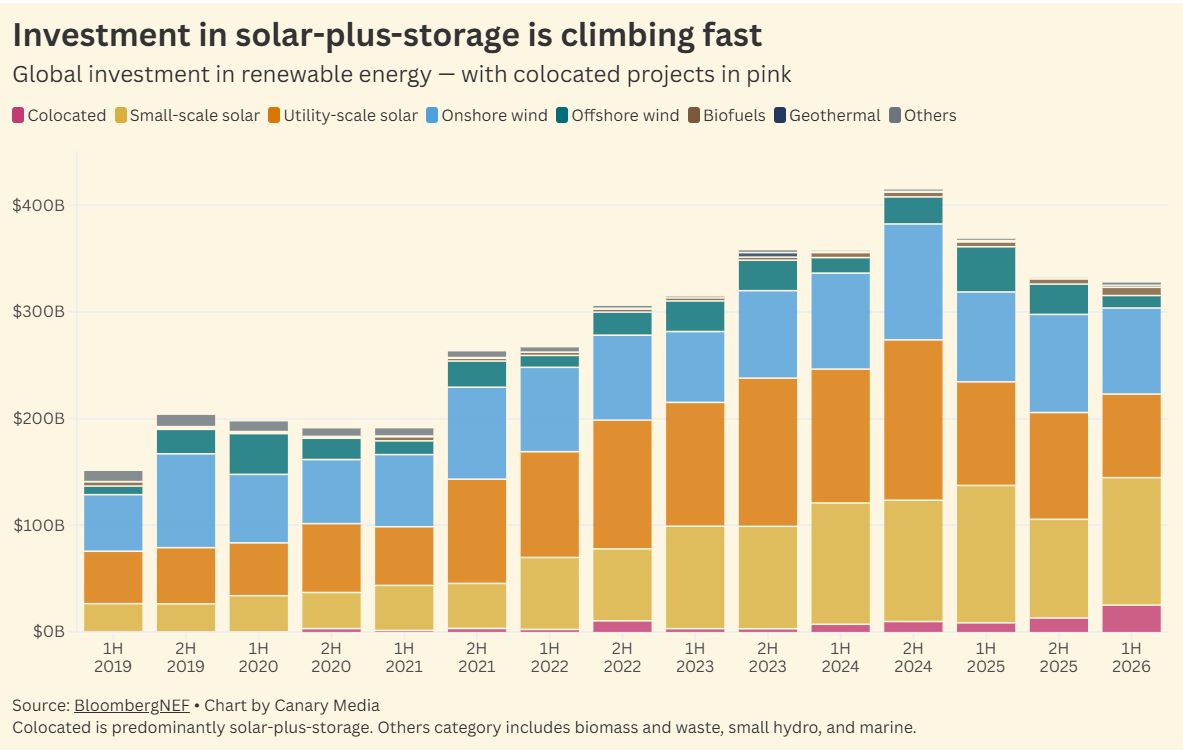
Colocated renewable energy projects attracted a record $25 billion of investment in the first half of 2026, according to new global data from BloombergNEF. While that category includes any combination of solar, wind, and storage, it’s dominated by solar-plus-storage.
The $25 billion is nearly double the previous record, set in the second half of 2025 — a jump that reflects the rapidly growing interest in batteries.
Solar’s biggest weakness is its up-and-down power generation. Solar farms produce no power at night (duh) and a ton of energy on sunny afternoons — fluctuations that often don’t align with demand. Adding storage to the mix helps solve that problem, allowing a project to act more like a traditional on-demand power plant that ramps up or down depending on power prices and the grid’s energy needs.
BNEF notes that the U.S. is one of the leading countries when it comes to investment in colocated solar-plus-storage. That makes sense: The grid battery sector is thriving in the U.S., just notching its best quarter ever for installations as the cost of battery cells falls and developers get more comfortable with the tech. Nearly half the storage capacity added last quarter was built alongside solar farms.
Although global spending on colocated projects jumped, the sector accounts for a relatively small chunk of overall renewable energy investment — a topline figure that stayed stagnant between the first half of this year and the second half of 2025. Investment in offshore wind, in particular, plummeted over that time period, with BNEF noting that factors like poor auction results in Denmark and Germany cut into the number of projects able to close financing in recent months.
Still, BNEF concludes that “the numbers show that the broader growth story for renewables remains intact.” But in order to bring down planet-baking pollution even as demand for energy spikes, the world will need overall clean-energy investment — not just that for colocated projects — to grow fast.
The plant will cut CO2 emissions compared to traditional coal furnaces. But Hyundai’s use of gas and resulting pollution show the messiness of cleaning up steel.
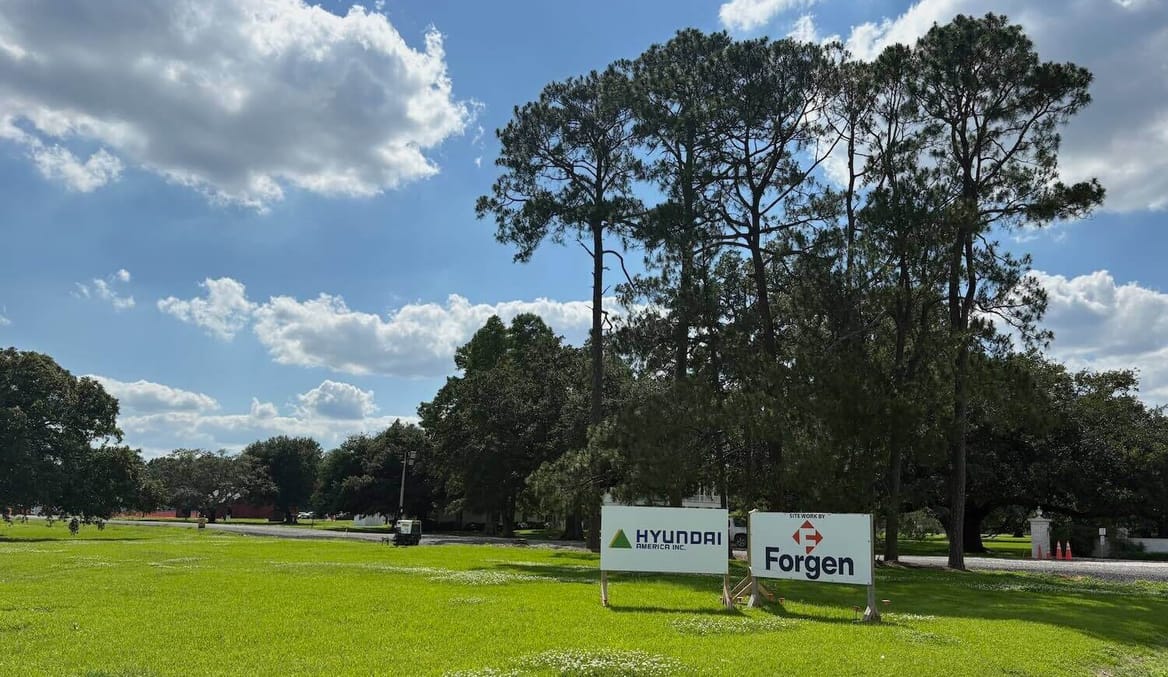
Hyundai is set to break ground in southern Louisiana this week on a nearly $6 billion steel mill, which may become the lowest-carbon facility of its kind in the U.S.
On Friday, the Korean industrial giant will hold a ceremony at the project site, where the fields of a former sugarcane plantation have been cleared for the major work ahead. Hyundai’s plant will initially run on natural gas when it opens in 2029 — making it significantly less carbon-intensive than the aging coal-fueled mills that produce most of America’s automotive steel.
Yet the facility is hardly a perfect blueprint for decarbonizing steel production, given that it will still produce planet-warming emissions and other harmful air pollution.
Most of the Louisiana plant’s emissions will come from the gas-burning furnace that turns iron ore into direct-reduced iron — which then gets melted into steel in an electric arc furnace. The project is one of several huge new developments in Ascension Parish, where rural communities along the Mississippi River are increasingly being hemmed in by industrialization.
“Even though Hyundai has tried to sell this as a clean and green project, we know from their own numbers that this facility would be a major source of just about every type of pollution that the state regulates,” said Kimberly Terrell, a New Orleans–based research scientist with the Environmental Integrity Project’s Center for Applied Environmental Science.
That pollution includes emissions of nitrogen oxide, particulate matter, and sulfur dioxide, each of which is known to cause respiratory problems and other serious health issues, she told reporters ahead of Friday’s groundbreaking.
Terrell said she believes the plant’s draft environmental permit downplays the steel mill’s potential impacts on nearby air quality. Local residents have also voiced concerns that the project is moving forward before the Louisiana Department of Environmental Quality has the chance to rigorously review and issue a final air permit.
“Development should improve our communities, not leave families wondering what the long-term cost will be to their children,” said Courtney Harris, a program manager for Rural Roots Louisiana and a resident of Donaldsonville, the nearest city to Hyundai’s steel mill site.
Hyundai-Posco Louisiana Steel, the U.S.-based subsidiary of Hyundai Steel, said the company has “made every effort to ensure that our project meets environmental standards and complies with all applicable regulatory requirements. We respect the permitting process and will continue to follow all required procedures as it moves forward,” according to Ascension Business Report. (Hyundai didn’t return Canary Media’s request for comment.)
The steelmaker could drastically reduce both air and carbon pollution in Louisiana by replacing the gas with green hydrogen — which is made from renewable electricity and water, and whose only byproduct is water vapor. When Hyundai first unveiled the project in early 2025, it indicated the plant would use the carbon-free fuel and become a “catalyst for the hydrogen ecosystem” in the Bayou State.
However, Hyundai’s plans for switching to hydrogen remain nebulous, and the broader market for green hydrogen continues to face major cost and logistical hurdles. The manufacturer has offered little clarity about its hydrogen ambitions in its state permit applications and in previous responses to Canary Media.
But Hyundai’s gas-fueled mill will nevertheless be much cleaner than traditional coal-based steelmaking. The company says its steel products will have a carbon footprint that’s 70% lower than those produced using conventional methods.
That may be the best the U.S. can get right now, experts say.
Earlier efforts to pursue hydrogen-based steelmaking have stalled in the face of economic headwinds and the Trump administration’s hostility toward clean energy. Cleveland-Cliffs, which got a $500 million Biden-era grant to install hydrogen-ready technology, says it will instead use the funding to upgrade a coal-fueled blast furnace in southern Ohio.
As manufacturers look to boost domestic steel production — driven by tariffs and increasing demand — they’re primarily planning to build gas-fueled ironmaking furnaces like Hyundai’s.
U.S. Steel, for example, says it will invest nearly $2 billion to build a direct-reduced-iron plant at its Big River Steel site in Arkansas, where four electric arc furnaces already melt down scrap steel. In Minnesota, the mining company Mesabi Metallics is considering installing such a furnace at its giant operation in the Iron Range.
“The industry is naturally moving towards [direct-reduced-iron] based production for cost and efficiency reasons, leveraging low-cost natural gas that we have in the United States,” said Nick Yavorsky, a senior associate on the iron and steel team at RMI, a clean energy think tank.
“We’re still not at the point where hydrogen-based steelmaking is cost-competitive with incumbent fossil methods,” he said.
Even so, new facilities can be designed in ways that avoid locking companies into using natural gas for decades and help ease the transition to hydrogen, Yavorsky wrote in a July analysis with Kaitlyn Ramirez, who leads the RMI team. That could include leaving land available for hydrogen-producing electrolyzers and working with utilities early on to secure renewable energy supplies — as well as taking cues from Hyundai’s project, which will deploy hydrogen-ready furnace technology and electrify certain steps of steel processing.
“Planning for flexibility [around hydrogen] will ultimately have the potential to position the U.S. as a real leader in this space,” Ramirez said.
North Plains Connector has earned backing from the Energy Department and utilities, and could deliver huge cost and reliability benefits — if states give it the OK.
Michael Skelly knows it’s hard to build a huge transmission line that connects different regions of the grid. He has spent a decade trying to get one up and running.
But Skelly, now CEO of Grid United, thinks his current attempt to build a first-of-its-kind transmission line is on the right track. And he’s gotten a consortium of utilities from Minnesota to Oregon, and officials in the U.S. Department of Energy through both the Biden and Trump administrations, to back it up.
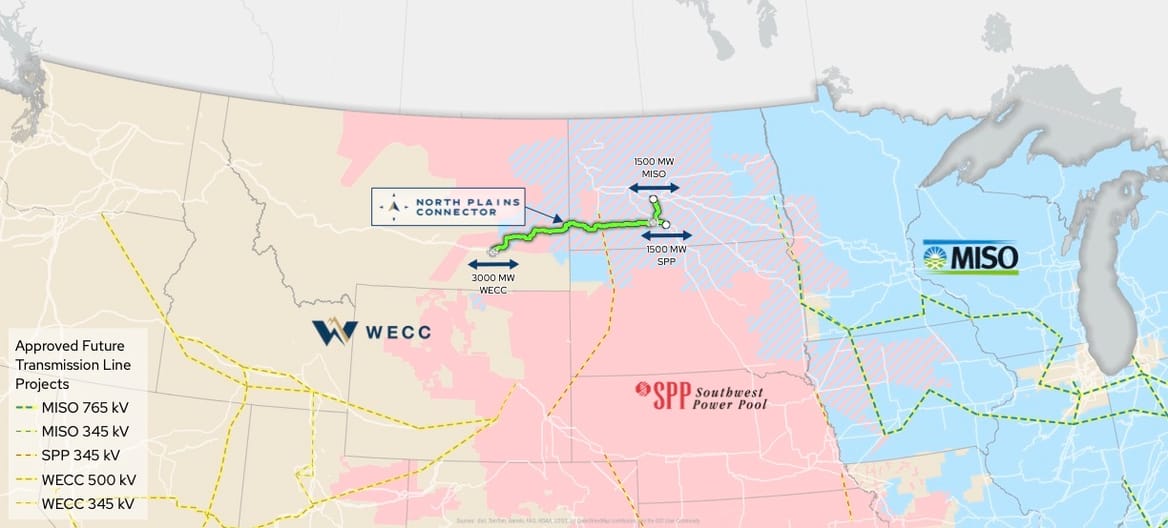
Grid United’s North Plains Connector will be a 420-mile, 3-gigawatt high-voltage direct current (HVDC) link between Montana and North Dakota. It will require an estimated $6 billion in investment across both states, and won’t be completed until 2032 at the earliest.
When it’s done, North Plains Connector will be able to share power between three grid regions spanning three time zones across the U.S. West, Great Plains, and Upper Midwest. Today, such region-spanning connections are extremely rare. But study after study has shown they can yield major benefits that extend far beyond the states the line transects.
“If you connect two grids whose peak moments are at two different times, you create an ability for the grids to lean on one another,” Skelly said.
The reliability and cost benefits that could flow from linking entire regions are almost certainly substantial. But it’s hard to quantify all the good that can come from such links when they have never existed before — and utilities and regulators want to be able to clearly define long-term benefits before they approve major investments.
Grid United’s solution is to front the costs for getting the project off the ground while trying to convince utilities to join in paying for a portion. Financing from the DOE is helping immensely with navigating these early costs and risks — and in getting utilities on board.
Back in 2024, the DOE awarded a $700 million grant to the consortium, including Grid United and the Montana Department of Commerce, which is the lead agency for administering the award. And last week, the DOE published a final environmental impact statement for the project, helped along by a federal interagency process launched under the Biden administration.
The Trump administration has continued to work with Grid United, even as it has clawed back or delayed billions of dollars in other Biden-era grants and terminated a $4.9 billion DOE loan for the Grain Belt Express, another massive HVDC line meant to carry wind and solar energy from the Great Plains to states farther east.
For North Plains Connector, having that federal money available “is quite helpful to the utilities that are participating in the project as they go through regulatory approvals,” Skelly said. Regulators “want their states to get their fair share, if you will — and they also want customers whose utilities are paying for the project to not have to pay for the whole thing.”
This combination of the DOE and Grid United taking on the early costs and risks has given a growing list of utilities enough confidence to make at least conditional commitments to pay for a piece of the project once it’s finished.
Some of them are directly involved in the states where it’s being built, such as Minnkota Power Cooperative and NorthWestern Energy. While others — such as Allete Energy and Great River Energy in Minnesota, Portland General Electric in Oregon, and Puget Sound Energy in Washington state — are joining up to earn a share of the reliability and cost benefits that will flow indirectly from the project and across the grid regions it will link.
Those far-off utilities don’t need to draw power directly from the end points of the HVDC line to gain the benefits, said Gretchen Kershaw, chief operating officer at consultancy Grid Strategies, which is not involved in the project. That’s because HVDC lines enable two-way flows of power that can energize and backfill shortfalls across entire regional grid networks.
Being able to tap into generation well beyond their borders makes it easier for utilities to deal with disruption or demand spikes caused by intense weather events like winter storms or heat waves. That’s one of the benefits cited for North Plains Connector in last month’s draft National Transmission Needs Study, the most recent in a series of DOE reports highlighting the value of these kinds of interregional connections.
“The most reliable and resilient system will have diversity in generation supply, both in terms of types of generation and location,” said Kershaw, who previously worked as a senior adviser to the DOE’s Grid Deployment Office, which was the source of the North Plains Connector grant but disbanded by the Trump administration last year. “You’re essentially able to make the system bigger, with generators and customers on both sides, and weather systems that are different at both ends.”
Those are some of the benefits that drew Allete to partner on the North Plains Connector project in 2023.
“We knew this energy transformation happening in our nation is going to require people to go well beyond the boundaries of their previous business and service territories,” said Julie Pierce, vice president of strategy and planning for the utility and energy company.
Allete owns Minnesota Power, a utility serving about 150,000 customers, as well as renewable energy subsidiaries including wind farms in North Dakota, which happen to be connected with a decades-old HVDC line to its Minnesota territory.
Allete is also part of a group of utilities that developed a large-scale, multi-utility grid-expansion plan in the early 2000s, which helped lay the groundwork for billions of dollars in additional regional transmission buildouts in the Midwest, Pierce said.
A key step in convincing other utilities to sign on is figuring out how to measure the new interregional line’s resource adequacy value. That’s the term of art for how utilities ensure they can keep their grids running during times of high demand, power plant outages, severe weather, or other emergencies.
“It’s so massive, it’s hard to put boundaries around what it’s going to enable,” Pierce said. “How do you value the ability to keep lights on in the Upper Midwest when there’s a storm coming through, but you’re able to import that solar from California?”
That work has some clear starting points, she said. Utilities can start to incorporate the reliability value of their share of the line into the integrated resource plans they file with state regulators, which lay out how much new generation and grid investment they need to make over the next decade or more.
North Plains Connector has its work cut out for it beyond measuring resource adequacy. Before it can break ground, it must make agreements with landowners along the path of the line, secure state and local permits, and win final regulatory approvals from both states it passes through.
“These projects take many years to put together,” Skelly said.
Indeed, high-profile transmission lines like the SunZia project from New Mexico to California and the Champlain Hudson Power Express from Canada to New York City have taken more than a decade from inception to completion. Many transmission projects fail to overcome hurdles. Skelly’s previous company, Clean Line Energy Partners, shut down in 2019 after failing to complete five power lines to carry 16.5 GW of wind power across the Midwest.
But if North Plains Connector can get connected, “the project will be online for 30 years,” he said. “What does generation in America look like in 2050? I don’t know. But it’s very likely we have very different demand profiles in each system, and whatever generation we have in that time, we’ll be better able to optimize if we have a great grid to lean on.”
Rhode Island Gov. Dan McKee is the first Democrat targeted by the Invest in Tomorrow Coalition, which has notched wins against clean energy foes in GOP primaries.
The troubled reelection campaign of Rhode Island Gov. Dan McKee is facing a new obstacle: a super PAC determined to take down foes of clean energy.
The Invest in Tomorrow Coalition has declared McKee its first Democratic target, following campaigns against three Republican primary candidates, all of whom lost their races. The political action committee announced this week that it is spending $500,000 to air ads opposing McKee in advance of the Sept. 9 Democratic primary. The campaign will be run by the state-level political action committee Invest in America’s Future.
McKee has repeatedly linked rising utility bills to clean energy. His budget proposal this spring included measures that would have delayed the state’s transition to 100% renewable energy by nearly two decades and slashed energy-efficiency spending by more than 20%. State lawmakers in June blocked these efforts, but a few weeks later McKee vetoed legislation that would have required owners of large buildings to track and report their energy use.
“We are on a mission to ensure that there are consequences for politicians in both parties who scapegoat renewable energy for their own failures,” said Invest in America’s Future spokesperson Chris Coffey. “McKee might believe that blaming clean energy is a convenient way to deflect responsibility for Rhode Island’s affordability crisis, but by the time primary day comes around, we will ensure that every single Rhode Islander knows exactly where the buck stops.”
McKee’s chances at keeping his seat were already shaky, with a recent poll putting him 38 percentage points behind his primary challenger, former CVS executive Helena Foulkes. His lack of support has largely been attributed to the hasty closure in 2023 of the Washington Bridge, a major span in the tiny state, and the long delay before rebuilding began.
Invest in Tomorrow, however, wants its involvement to send a message: Oppose clean energy and we will do everything we can to oppose you.
Invest in Tomorrow was founded after the Trump administration — with the help of congressional Republicans — unraveled clean-energy incentives created by the Inflation Reduction Act. Its goal is to threaten clean energy opponents with the kind of electoral consequences long wielded by the gun lobby and oil interests.
The group’s first three targets were all congressional Republicans: Rep. Chip Roy, who was running for state attorney general in Texas; Rep. Andy Ogles, who was seeking reelection in Tennessee; and Rep. Ralph Norman, whom ITC targeted in his bid for South Carolina’s Republican gubernatorial nomination in June and then again in the recent race for the late Sen. Lindsey Graham’s seat. All three lost their races.
The ads ITC pays for generally do not reflect the group’s focus on climate and clean energy issues. Instead, it deploys messages it thinks will be most effective against an individual candidate. Ads opposing Roy painted him as insufficiently loyal to President Donald Trump, for example. The spots running against McKee accuse him of mismanaging the Washington Bridge closure and of doing financial favors for his donors.
McKee is not the only Democratic governor to consider tempering climate commitments in the face of high prices and anxious constituents. Most prominently, New York Gov. Kathy Hochul has rolled back the state’s once-ambitious emissions-reduction goals.
McKee, however, has been perhaps the most pugnacious on the topic. He declared in July that anyone who argues against his proposals wants residents to have higher bills and is “advocating for their own personal self-interests.”
“If you wanted to take an action to show the Democratic governors that they need to get in line on the issue of climate, McKee is a good choice,” said Christian Roselund, a leader with nonprofit advocacy group Climate Action Rhode Island. “I’ve been trying to find a Democratic governor with a worse record on the climate than Dan McKee, and I’m not sure there is one.”
The geothermal startup will supply 400 MW from its Cape Station project to a Google data center in Utah. An initial phase of the project will come online this fall.
Fervo Energy inked a landmark deal to supply Google with nearly 400 megawatts of clean electricity from the startup’s geothermal project in southwest Utah.
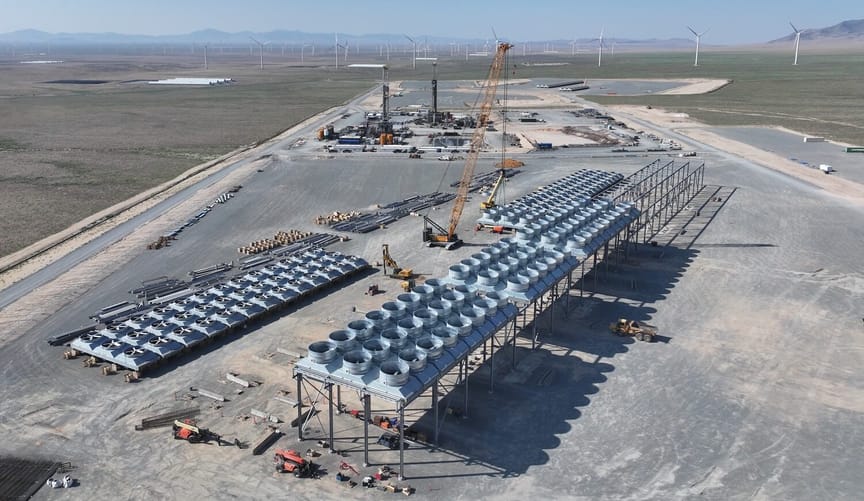
The agreement is the largest of its kind for a next-generation geothermal system — an emerging technology that involves drilling deep into hot, dry rock to use underground heat for producing power. Fervo is investing over $2 billion to build what could become the biggest such system in the world when it is completed in 2028.
Securing customer contracts is an essential step for a novel project like Fervo’s Cape Station. Without a clear buyer, it can be difficult to attract financing for first-of-a-kind facilities, even if they promise transformative benefits for the power sector. Fervo, which went public in May, saw its shares jump 15% on Tuesday morning following news of the Google power deal.
Houston-based Fervo is now developing the first, 100-MW phase of Cape Station and expects to start generating test power from a 33-MW unit in the fourth quarter of this year. The deal with Google supports the buildout of the second, 400-MW phase, which is slated to be up and running in about two years.
Google said it intends to buy the geothermal power for a potential data center in Utah.
“As demand for reliable electricity grows, customers like Google need energy resources that can be deployed at scale, operate around the clock, and deliver where power is needed,” Tim Latimer, Fervo’s CEO and co-founder, said in a Tuesday news release.
The companies did not disclose PPA terms. Phase 1 of Fervo’s Cape Station is set to deliver power at $7,000 per kilowatt, while Phase 2 should come in at $5,500 per kW, Sarah Jewett, Fervo’s chief operating officer, previously told Canary Media.
Geothermal energy generates just 0.4% of total U.S. electricity today. Conventional geothermal relies on natural features like hot springs, limiting where such facilities can go. Fervo is part of a rapidly growing effort to deploy innovative tools and techniques — often derived from oil and gas drilling — to access the earth’s heat in more diverse places.
The startup has been working with Google in this pursuit for years.
In 2021, the two companies signed an agreement to develop a next-generation geothermal project. Two years later, Fervo turned on its 3.5-MW commercial pilot plant in Nevada. The first-of-a-kind facility is still the largest operating “enhanced geothermal system” in the country — though another firm, Sage Geosystems, recently began producing power from its 3-MW, next-gen pilot project in Texas.
Before Tuesday, Fervo and Google had previously signed a 115-MW power purchase agreement with the Las Vegas–based utility NV Energy to develop more geothermal for the tech giant’s data centers in Nevada.
Google said it hasn’t determined where it will build the Utah data center that will run on Cape Station’s power.
“Even though right now we don’t have clarity yet on how this will service a data center … we know that it will be a foundational building block of power generation for a data center presence in Utah,” Lucia Tian, Google’s director of advanced energy technologies, told The Wall Street Journal on Tuesday.
Under the new deal, Google has the option to expand its Cape Station agreement by around 600 MW by June 2030. The tech company and Fervo also have a deal in place allowing Google the right of first refusal to purchase up to 3 GW of electricity from certain new geothermal power plants the startup develops.
The outlook for storage construction keeps getting brighter as everyone from the Trump White House to clean energy advocates to AI giants clamors for more.
There’s never been a better time to build energy storage in the U.S. than right now.
Grid batteries — which sop up power when it’s abundant and discharge that energy when it’s needed — have been ascendant for a decade, as the price of the underlying lithium-ion cells fell precipitously. Bolstered by plummeting costs and increasing familiarity with the tech, developers started building bigger and in more parts of the country.
Now, the U.S. power sector has added more battery capacity in the second quarter of this year than any quarter ever, according to a report out today from the Solar Energy Industries Association and Benchmark Mineral Intelligence. Even as the wind and solar industries face uncertain futures, the outlook for continued battery growth is so strong that Benchmark Minerals upped the prediction for cumulative installs through 2030 by 11.5% from its previous report, issued just three months ago.
The 20.2 gigawatt-hours of battery capacity built from April through June represents one-tenth of the nation’s entire grid storage capacity. Seven of the new projects mustered at least 1 GWh or more of storage capacity, reflecting developers’ rising appetite for megabatteries.
To contextualize the numbers, the second-quarter installations can inject 6.7 gigawatts of instantaneous power onto the grid — equivalent to nearly seven big old-school nuclear reactors, but without the decade-plus wait time for construction. That comparison has its limits, though, because nuclear plants can generate around the clock, whereas batteries must refill and discharge.
Batteries can make a huge difference in places where the grid is stretched thin, and can be built quickly and closer to centers of energy consumption than new fossil-fuel-burning plants with their smokestacks and emissions.
Those qualities make the tech attractive in places where capacity is scarce, which happens to include California, Texas, the Southeast, the mid-Atlantic, the Northeast, and just about anywhere else. AI data center developers are turning to batteries to ensure they can keep the algorithms running during peak demand hours. And solar developers leverage batteries to turn their clean electrons into a more valuable on-demand resource; 44% of the new storage capacity was built alongside solar plants.
This widespread zeal for batteries extends to the Trump White House, which revoked wind and solar subsidies last year but kept Biden-era tax incentives for batteries. As the executive branch found novel and often legally dubious means to thwart wind and solar construction, it has left battery developers to go about their business.
Recently, the administration has more proactively encouraged the battery industry, loaning $490 million dollars to a battery project in Puerto Rico as well as funding efforts to reshore the supply chain for critical minerals used to make the tech. Energy Secretary Chris Wright, who regularly blasts solar power on his official platforms, recently stopped by the Maine site of a novel iron-air battery that Form Energy plans to build, with help from Department of Energy grant funding.
An observer unencumbered by historical nuance might conclude that Trump is the battery president, and that no president has done more for batteries than he. SEIA even gestures in that direction, noting in its press release that large-scale storage nearly doubled during the first year and a half of the second Trump term, and that 74% of the second-quarter storage additions happened in states that voted for him — like Texas, Utah, and newly minted battery storage powerhouse Arizona.
The reality is these outcomes took years to build up to. Technologists tinkered with batteries in big boxes; California mandated its utilities buy storage and subsidized it for smaller customers; Texas wildcatters took big risks on early battery investments and made windfall profits; and companies like LG and Tesla built huge factories to solidify domestic battery supplies. Now, all that hard work is paying off with installations on a scale we’ve never seen before.
The Demand Side Grid Support program was given no money for next year, though supporters blocked an effort that could have disbanded the VPP altogether.
California Gov. Gavin Newsom’s administration has blocked an effort to keep the state’s most successful virtual power plant program funded through next year.
State budget language finalized last week does not authorize additional money for the Demand Side Grid Support program, one of the biggest VPPs in the country. Friday was the last day for bills to be published before being voted on by the Aug. 31 deadline for this year’s legislative session.
But that budget language also excluded a plan from Newsom, a Democrat, to shift control of the program from the California Energy Commission to the California Public Utilities Commission, which DSGS supporters feared could lead to it being dismantled entirely.
That means that while “there is no guaranteed funding for the program for next year, at the very least it wasn’t outright gutted,” said Brandon García, California policy director for Advance Energy United, a clean energy trade group that reported the outcome of the DSGS negotiations on Friday.
Newsom’s office did not immediately respond to a request for comment.
A spokesperson for Democratic state Sen. Josh Becker, a DSGS supporter and author of several virtual power plant bills that passed both houses of the legislature last week, confirmed that the $70 million “we were hoping to use for DSGS over the next couple of years was not agreed on” in the final budget bills. At the same time, leaving the program under control of the California Energy Commission “does allow us an opportunity to take this issue up early next year, potentially with a new administration,” the spokesperson said.
Still, that’s cold comfort for the companies participating in the program, which pays households and businesses willing to turn down power use or share solar power stored up in batteries at times when California’s grid is under stress.
Since it was launched in 2022, DSGS has grown to include around 130,000 homes equipped with batteries and nearly 75,000 homes with smart thermostats and flexible load devices. The performance of its rooftop solar–charged batteries has been particularly noteworthy; a July 2025 test yielded roughly 476 megawatts of grid capacity over two hours, in what utility Pacific Gas & Electric called “the largest test of its kind ever done in California — and maybe the world.”
All told, DSGS has brought online more than a gigawatt of collective capacity to relieve costly stresses on the state’s power grid, García said.
Absent an intervention from lawmakers and California’s next governor sometime next year, “we don’t anticipate there being any more money for this program,” García said.
And without secure funding, it’s unclear how companies like Sunrun, Tesla, Leap, Renew Home, and others participating in DSGS will be able to pay their customers to help the grid.
That’s unfortunate, because DSGS stands out in a state that’s largely failed to tap into its nation-leading supply of rooftop solar–charged batteries and electric vehicles as an alternative to utility investments in power plants and transmission lines, said Sachu Constantine, executive director of nonprofit advocacy group Vote Solar.
“We should pursue every avenue available to use these resources that customers and companies have already invested in, that are already providing invaluable resources for the grid,” he said.
Similar programs regulated by the CPUC and administered by utilities have largely failed to thrive. That includes the CPUC’s Emergency Load Reduction Program, another approach to enlisting customers to relieve grid stresses that was created alongside DSGS in response to California’s grid emergencies from 2020 to 2022.
Paying customers with solar-charged batteries, smart thermostats, and remote-controllable EV chargers can also help lower utility bills for residents who don’t have those devices.
That’s because a large portion of the costs being passed on to customers of California’s three major utilities, which now charge among the highest rates in the continental U.S., are driven by the need to pay for fossil-fueled power plants and invest in grid infrastructure to meet peaks in grid demand.
By cutting funding for DSGS, California may be undermining a more economical way to defer those costs “at a moment when utilities are earning record profits and bills are going up, reliability is in question, and we’re continuing to prop up old, outmoded resources that don’t make sense for the future,” Constantine said.
Despite the potential cost savings, DSGS had its budget cut in 2024 and 2025, and was allocated no money in Newsom’s January budget proposal, leaving it at risk of being unable to pay participants this year. Early this summer, lawmakers were able to negotiate a transfer of $27 million from another program to keep DSGS running through 2026, García told Canary Media.
But lawmakers couldn’t overcome opposition from the Newsom administration to secure funding to pay DSGS participants in 2027. The final budget bills drafted by the legislature on Friday failed to include a proposal from Senate Democrats that would have shifted $70 million from another California Energy Commission program to cover those costs.
“We’re incredibly disappointed the administration rejected the legislature’s proposal to fund DSGS. It’s baffling,” García said.
García warned that DSGS participants don’t have much time to wait. “Even if the next incoming administration wants to fund DSGS, if they wait until June, I don’t know how many participants will be around to enroll in that program,” he said.


.svg)
