

 Back
Back
Back in the summer of 2024, Minnesota utility Xcel Energy proposed a novel approach to building virtual power plants, the networks of rooftop solar systems, home batteries, and other energy equipment that can operate in tandem to reduce strain on the electric grid.
Instead of working with other companies to cobble together solar arrays and batteries at homes and businesses — the traditional model for VPPs — Xcel wanted to install, own, and control those devices itself, using its grid expertise to deliver a better bargain for its customers at large.
Now, a year and a half later, the plan is in — and clean energy advocates, solar industry groups, and state agencies say it doesn’t live up to Xcel’s promises.
In filings with the Minnesota Public Utilities Commission, these groups say Xcel’s Capacity*Connect (C*C) plan, unveiled in October, is likely to be slower, more costly, and less impactful in relieving grid stresses and energy costs than the customer-centered VPP programs already in place or being rolled out — including one by Xcel in Colorado.
As Minnesota’s Office of the Attorney General wrote in its initial comments, “Although Xcel suggests that C*C is uniquely innovative, it may simply be a uniquely expensive way to accomplish the same thing other states have accomplished for less ratepayer money.”
Xcel is asking for permission to spend at least $152 million to deploy 50 megawatts of batteries, and up to $430 million for 200 megawatts, through 2028. Those costs will be borne by its customers. And as capital expenditures, they will offer the utility a guaranteed profit on every dollar spent — a perk Xcel wouldn’t get if it relied on the traditional VPP model.
In its petition to regulators, Xcel says the plan is a first step in learning how to best integrate distributed energy resources across its grid, as called for by state utility policy for the past decade. It also argued that “non-utility-owned resources could deliver, at best, a portion of the anticipated system and customer benefits.”
Backers of this utility-led approach include Jigar Shah, a Biden administration Department of Energy official who has long championed the value of using batteries and other distributed energy resources — DERs in the jargon — as an alternative to big, costly, and hard-to-build power plants and transmission lines.
“For the first time in my professional career, we have a utility company formally agreeing with the fact that distributed power plants are essential to maintaining reliability and meeting load growth,” Shah wrote in a December LinkedIn post. “This is a huge win for our entire industry, and efforts by industry groups to torpedo this proposal can’t see the forest for the trees.”
But John Farrell, co-director of the nonprofit consumer advocacy group Institute for Local Self-Reliance and a longtime utility critic, argues that Xcel Energy is trying to monopolize the grid value of solar and battery systems, which customers are already willing to pay for to save money and provide backup power.
Utility ownership might be an acceptable alternative if it could be done faster and cheaper than the VPPs being put together by solar and battery installers like Sunrun, Tesla, and a host of other companies, Farrell said. But “if utilities are supposed to be so good at this, why is the cost-benefit analysis underwater?” he asked. “And why is it so slow?”
Logan O’Grady, executive director of the Minnesota Solar Energy Industries Association, doesn’t want to be too critical of Xcel’s plan. After all, his group and other solar advocates have spent years pushing utilities to rely more on rooftop solar, backup batteries, and other DERs. It hasn’t been easy. Utilities have long been leery of the reliability of these technologies, and instead prefer tried-and-true grid upgrades and utility-controlled equipment.
“This has been a tricky one, because for 10 years, people on our side have been saying to the commission and utilities, there’s value in the distribution system — you should invest there,” he said.
That argument is backed by an analysis from the DOE, promoted by Shah during his tenure, that found rooftop solar systems, backup batteries, electric vehicles, smart thermostats, and grid-responsive water heaters could provide 80 to 160 gigawatts of VPP capacity by 2030 in the U.S. That would be enough to meet 10% to 20% of the nation’s peak grid needs and save utility customers roughly $10 billion in annual grid costs.
“So when [Xcel’s] proposal first came out, in one sense it was like, ‘They’re finally listening to us,’” O’Grady said. “But in another sense it was, ‘They’re going too far by proposing only utility ownership.’”
That’s a significant departure from the status quo, the Minnesota Solar Energy Industries Association, Coalition for Community Solar Access, and Solar Energy Industries Association trade groups wrote in comments to the Minnesota PUC. “Traditional VPPs are technology-agnostic portfolios of customer-sited and third-party-owned resources,” they wrote. “Participation is open, competitive, and decentralized.”
By contrast, Xcel’s C*C plan would rely completely on utility-owned batteries of between 1 and 3 megawatts, the kind that usually come in shipping containers. Xcel plans to pay an undisclosed amount to businesses or nonprofits willing to host those batteries on their properties. But rather than connecting the equipment in those customers’ buildings, the utility would instead connect the batteries directly to its grid, preventing them from providing emergency backup power to participating customers.
To secure customers willing to host those batteries, Xcel Energy has proposed hiring Sparkfund, a company founded in 2013 that has promoted the “distributed capacity procurement” concept that forms the basis of the C*C plan. Xcel’s plan marks its first stab at implementing distributed capacity procurement.
But deploying utility-owned batteries via a single commercial partner is “unprecedented in VPP programs and raises significant competitive-market concerns,” the solar trade groups wrote.
Chris Villarreal, president of consultancy Plugged In Strategies and former director of policy at the Minnesota PUC, shares those concerns. In comments filed on behalf of the R Street Institute, a free market–oriented think tank where he serves as an associate fellow, Villarreal recommended that regulators reject the plan or, at a minimum, “ensure Xcel does not exercise monopoly power at the expense of other competitive and potentially lower-cost alternatives.”
“There are a couple of things that annoy me about this from a practical perspective,” Villarreal told Canary Media. “One is the exercise of monopoly power over competitors.” Xcel is proposing to give Sparkfund access to grid and customer data that “no competitor would be able to get” without signing nondisclosure agreements, he said. “Meanwhile, we have community solar gardens, solar developers, storage developers, that want to do the same thing.”
This lack of grid transparency is troubling, O’Grady said, given Xcel’s track record of making it difficult for customers and third-party developers to add batteries and community and rooftop solar to its grid. “Minnesota has a grid-congestion problem, and lack of utility investment to solve that problem,” he said.
At the very least, Xcel should subject its battery systems to the same process third-party developers and customers must go through to connect to the grid, O’Grady said. Under the C*C plan, “they circumvent that entire waitlist to interconnect — and that doesn’t seem fair.”
State regulators anticipated these concerns. The Minnesota PUC’s 2024 order allowing Xcel Energy to pursue the C*C plan required the utility to compare the costs and benefits with those of “alternative models” using customer and third-party-owned resources.
But Xcel Energy appears to have short-shrifted that requirement, said Erica McConnell, a staff attorney at the nonprofit Environmental Law & Policy Center. Instead of offering a cost comparison, Xcel asserted in its petition that “anything less than full operational control and visibility of these assets — which will operate functionally as part of our system — could present safety risks for our employees and the public and could create cybersecurity risks for our system.”
These statements appear to ignore the experience of other utilities managing VPP programs, McConnell said. In essence, she said, the utility dismissed the prospect of alternative approaches by saying, “‘It’s dangerous if we let other parties do it.’ That’s disappointing to us. We need alternative pathways.”
Xcel Energy disputes that it ignored regulators’ instructions. The utility lacks “quantitative information” on those alternatives, and “would need to speculate on these costs and benefits, which would inevitably lead to unresolvable disputes,” it wrote in reply comments.
Xcel also highlighted that it’s offering customers and third-party developers other pathways to add solar and batteries to its grid, including its long-running community solar program and incentives for backup batteries. Nearly all of the more than 1.3 gigawatts of distributed solar and storage on Xcel’s system in Minnesota is owned by third parties, it noted.
But the C*C program is focused on solving a much broader range of challenges on its grid, which requires greater precision than Xcel can achieve from customer-owned batteries, the utility said. It argues that it needs such rigorous control over the systems to cut costs and improve overall grid reliability for customers at large, in what it called a “marked shift in distributed energy policy.”
Critics have their doubts, however, about whether the benefits of Xcel’s plan will outweigh the costs.
The Minnesota Office of Attorney General wrote in its comments that it supports efforts to meet the state’s carbon-cutting goals while keeping rising energy and grid costs in check. But it also asked regulators to put a “hard cap” on Xcel’s spending, noting that it “stands to be a quite expensive program.”
Xcel’s C*C budget calls for spending up to $430 million for deploying 200 megawatts of batteries, it wrote, which equates to $2,150 per kilowatt of battery installed — well above typical costs for grid batteries.
It’s also more expensive than what Xcel Energy intends to spend on a gas-fired “peaker” power plant it’s planning to build in Lyon County, Minnesota, the office noted. That’s despite data from DOE’s VPP report indicating that typical VPP capacity can be more than 40% cheaper than that of conventional peaker plants, which run only at times of extremely high demand.
And Xcel’s proposed budget is well above what the Public Service Co. of Colorado, Xcel Energy’s utility in that state, intends to spend on its proposed Aggregator Virtual Power Plant pilot program. That program will pay third-party aggregators that equip customers with resources — including batteries, smart thermostats, smart water heaters, smart heat pumps, and EV chargers — that can inject electricity onto the grid or reduce power use. It is targeting 125 megawatts of capacity for a five-year budget of $78.5 million, or roughly $625 per kilowatt.
Xcel says these comparisons don’t tell the whole story. The Colorado program covers only five years of payments to aggregators, while the Minnesota program is modeled to cover the cost of assets for 20 years, Xcel spokesperson Theo Keith told Canary Media in an email. “When you model both programs over 20 years, their costs are similar.”
“Capacity*Connect will be more complex to operate and coordinate than the Colorado [program],” Keith added, because it’s designed to do more than simply reduce peak electricity demands across the entire grid.
Instead, C*C is meant to target particular points on the utility’s distribution grid that might otherwise need costly upgrades. This is the portion of the system that, unlike giant transmission lines that cover long distances, brings power directly to homes and businesses. Costs related to the distribution grid are the single biggest driver of rising utility bills in the U.S.
“Through the deployment of distributed batteries, we (and thus our customers) will save more money by avoiding more expensive grid upgrades than the payments made to program participants,” Keith wrote.
But Xcel’s plan will take years to use its batteries for this kind of deferral. Its initial phase will limit them to reducing systemwide energy and capacity costs — the same kind of task that demand-response programs have been doing for decades. Not until “Phase 3” of its plan, set for between 2028 and 2031, will Xcel “seek opportunities to stack additional distribution value streams,” like finding ways for batteries to defer costly grid upgrades.
Delaying that work doesn’t sit well with nonprofit groups such as the Environmental Law and Policy Center, Vote Solar, Solar United Neighbors, and Farrell’s Institute for Local Self-Reliance. In their comments, they asked the Minnesota PUC to require Xcel to set a mid-2027 deadline to “take concrete steps to advance distribution value” — and to set up a way for third-party and customer-owned technologies to participate.
The Minnesota Department of Commerce concurred. In its comments to regulators, it laid out a series of changes that it and clean energy advocacy groups agreed Xcel should make to its plan to more quickly take on the advanced grid services it’s currently proposing to delay for years to come.
For one, the department recommended that regulators require Xcel to target its batteries to fix known reliability issues or “defer specific, budgeted infrastructure investments” on the distribution grid — something that utilities in California, Massachusetts, and other states are doing in pilot projects.
Another recommendation for Xcel that’s being done by other utilities is to use its batteries to make room on congested parts of the grid for more customer-owned or community solar to come online. That could help solve the long-standing interconnection bottlenecks that rooftop and community solar providers have been complaining about.
Shannon Anderson, a policy director at the nonprofit Solar United Neighbors, which helps households organize to secure cheaper rooftop solar, highlighted one big difference between the approaches taken by Xcel in Minnesota and in Colorado. In Colorado, the utility’s VPP approach is guided by a law passed by the state legislature in 2024. Minnesota lacks such a policy; a VPP bill failed to pass last year, although its sponsors plan to reintroduce the legislation this year.
“The Minnesota story is part of a national trend,” said Anderson, who is leading Solar United Neighbors’ work with a coalition sponsoring VPP legislation in multiple states. “The more legislative direction can give them guidance and political support, the better.”
President Donald Trump has made it quite clear how he feels about state laws that aim to make fossil fuel companies pay for damages caused by climate change. An executive order issued in April compared these efforts — known as climate superfund laws — to extortion. The administration has since sued New York and Vermont, the two states with these measures on the books.
This hostility, however, has not stopped a growing number of state legislatures from taking up their own climate superfund proposals. Last month, legislative committees in Maine and New Jersey advanced bills. Lawmakers in Illinois, Oregon, and Rhode Island are also considering such legislation. Connecticut lawmakers plan to add their state to the list.
Why do the proposals continue to multiply despite steadfast federal opposition? Because the law and the science are both on their side, proponents say. And because it’s just fair.
“Climate superfund laws are based on the principle that if you make a mess, you clean it up,” said Jamie Flynn, a visiting fellow at the Conservation Law Foundation. “It’s kindergarten-level ethics.”
States, municipalities, and tribal governments have tried a variety of strategies for holding oil and gas companies responsible for the problems created by their products. Some have sued, accusing fossil fuel interests of deceiving the public or investors by concealing the hazards of burning hydrocarbons. Others have filed antitrust cases, accusing major companies of colluding to dominate the market, leaving customers locked into climate-damaging products.
Climate superfund laws take a different, arguably more practical approach, by pointing to very visible storm and flooding impacts, and demanding compensation. While the details vary from state to state, climate superfund bills all have a similar framework. They call for the state to tally up expenses incurred by climate change — which could include both recovery costs and protective measures — and then to divide the total among major fossil fuel suppliers and start collecting the money.
The money collected would alleviate the burden on taxpayers by repaying states for past recovery efforts — the cleanup Vermont had to undergo after catastrophic flooding in 2023, for example — and by covering future resilience projects, like wetlands restoration.
“Taxpayers right now are footing the bill for all of it,” said Rhode Island state Rep. Jennifer Boylan, a Democrat, one of the sponsors of the state’s bill. “The folks that are responsible are not contributing, and it’s just not fair.”
Opponents — which include fossil fuel companies, attorneys general from oil-producing states, and, of course, the Trump administration — have deployed several arguments against these laws.
The broadest is that these measures interfere with the federal government’s attempts to unleash American energy dominance by penalizing fossil fuel companies. Others claim that consumers would see prices go up as a result of the added costs. They also argue that the laws constitute an attempt to regulate greenhouse gas emissions, which has historically been under federal authority.
It’s also worth noting that superfund laws make sense only if you accept the overwhelming scientific consensus that greenhouse gas emissions are warming the planet and thus leading to more destructive weather. The Trump administration rejects this premise. Last Thursday, the U.S. Environmental Protection Agency repealed the scientific finding that greenhouse gases are a harm to public health and welfare, which has underpinned the federal government’s ability to regulate greenhouse gases for the last 16 years.
Still, lawmakers and advocates behind these bills believe that the law backs them up.
Climate superfund laws are modeled on the federal Superfund program, which was established in 1980 to hold corporations financially accountable for cleaning up soil contamination they had caused. The program was challenged repeatedly, but courts upheld the law time and again — a precedent that is encouraging to proponents of climate superfund legislation.
“You can see why this law was attractive when thinking about greenhouse gas emissions and climate,” said Kirt Mayland, a visiting professor at Vermont Law and Graduate School. “The hope is that courts will provide the same protection as they did for the conventional Superfund.”
The strength of this approach, he said, is that the laws and bills do not target federally regulated emissions, despite opponents’ claims. Climate superfund bills focus not on what’s happening in the atmosphere but rather on what’s happening on the ground: observably flooded towns and storm-damaged businesses.
Opponents have played up concerns that it would be difficult to accurately quantify the contributions greenhouse gases make to climate change and then properly allocate responsibility among multiple parties. Supporters, however, say there are ways to do just that.
The Carbon Majors Database is a collection of data about the historic emissions of 178 of the world’s largest oil, gas, coal, and cement producers, including private and public companies as well as entire countries. Using this information, the growing field of attribution science can connect emissions to climate impacts and even, in some cases, to specific storms, heat waves, or other extreme weather events, said Carly Phillips, a research scientist at the Union of Concerned Scientists.
“The science is really robust around the magnitude and scope of emissions that can be traced,” she said. “It really provides a template to answer those kinds of questions.”
Phillips said that she would welcome engagement and dialogue around the science, but that she is not hearing any good-faith skepticism from opponents. Instead, she sees only a wholesale rejection of attribution science, aimed, she believes, at delaying climate action as long as possible.
The lawsuits targeting New York and Vermont will take some time to resolve, and are likely to end up in the U.S. Supreme Court, Mayland said. In the meantime, neither state has yet assessed any charges under the laws. Still, continuing to push these new bills, even in the face of federal and industry hostility, could increase their eventual chances of success, proponents say.
In Rhode Island, where climate superfund legislation has been introduced for a second year in a row, lawmakers are learning more about how the proposal works, and the idea is gaining support, Boylan said. Ongoing conversations about the idea will help pave the way for adoption when some of the legal questions are resolved, said Connecticut state Rep. Steve Winter, a Democrat who plans to support his state’s climate superfund bill.
“There’s no doubt that legal challenges to Vermont and New York’s legislation create a cloud of uncertainty, but I don’t think that should stop us from advancing the public conversation,” he said. “It’s that important.”
The economics of clean energy “just get better and better”, leaving opponents of the transition looking like “King Canute”, says Chris Stark.
Stark is head of the UK government’s “mission” to deliver clean power by 2030, having previously been chief executive of the advisory Climate Change Committee (CCC).
In a wide-ranging interview with Carbon Brief, Stark makes the case for the “radical” clean-power mission, which he says will act as “huge insurance” against future gas-price spikes.
He pushes back on “super daft” calls to abandon the 2030 target, saying he has a “huge disagreement” on this with critics, such as the Tony Blair Institute.
Stark also takes issue with “completely…crazy” attacks on the UK’s Climate Change Act, warns of the “great risk” of Conservative proposals to scrap carbon pricing and stresses – in the face of threats from the climate-sceptic Reform party – the importance of being a country that respects legal contracts.
He says: “The problems and woes of this country, in terms of the cost of energy, are due to fossil fuels, not due to the Climate Change Act.”
The UK should become an “electrostate” built on clean-energy technologies, says Stark, but it needs a “cute” strategy on domestic supply chains and will have to interact with China.
Beyond the UK, despite media misinformation and the US turn against climate action, Stark concludes that the global energy transition is “heading in one direction”:
“You’ve got to see the movie, not the scene. The movie is that things are heading in one direction, towards something cleaner. Good luck if you think you can avoid that.”
Carbon Brief: Thanks very much for joining us today. Chris, you’re in charge of the government’s mission for clean power by 2030. Can you just explain what the point of that mission is?
Chris Stark: Well, we’re trying to do something radical in a short space of time. And maybe if I start with the backstory to that, Ed Miliband, as secretary of state, was looking for a project where he could make a difference quickly. And the reason that we are focused on clean power 2030 is because it is that project. It has all the characteristics of something that you can do quickly, but which has long-term benefits.
What we’re trying to do is to accelerate a process that was already underway of decarbonising the power system, but to do so in a time when we feel it’s essential that we start that journey and move it more quickly, because in the 2030s we’re expecting the demand for electricity to grow. So this is a bit of a sprint to get ourselves prepped for where we think we need to be from 2030 onwards. And it’s also, coming to my role, it’s the job I want to do, because I spent many years advising that you should decarbonise the economy by electrifying – and stage one of that is to finish the job on cleaning up the supply.
So it’s kind of the perfect project, really. And if you want to do clean power by 2030, [the] first thing is to say we’re not going to take an overly purist approach to that. So we admit and are conscious – in fact, find it useful – to have gas in the mix between now and 2030. The challenge is to run it down to, if we can, 5% of the total mix in 2030 and to grow the clean stuff alongside it. So, using gas as a flexible source, and that, we think is a great platform to grow the demand for electricity on the journey, but especially after 2030 – and that’s when the decarbonisation really kicks in.
So it’s a sort of exciting thing to try and do. And if you want to do it, here comes the interesting thing. You need the whole system, all the policies, all the institutions, all the interactions with the private sector, interactions with the consumer, to be lined up in the right way.
So clean power by 2030 is also the best expression of how quickly we want the planning system to work, how much harder we want the energy institutions like NESO [the National Energy System Operator] and energy regulator Ofgem to support it – and how we want to send a message to investors that they should come here to do their investment. Turns out, it’s a great way of advertising all of that and making it happen. And so far, it’s working great.
CB: Thanks. So do you still think it’s achievable? We’re sitting in “mission control”. You’ve got some big screens on the wall. Is there anything on those screens that’s flashing red at the moment?
CS: So, right behind you are the big screens. And it’s tremendously useful to have a room, a physical space, where we can plan this stuff and coordinate this stuff. There’s lots of things that flash red. There’s no question. And it’s an expression of it being a genuine mission. This is not business as usual. So you wouldn’t move as quickly as this, unless you’ve set your North Star around it. And it does frame all the things that, especially this department is doing, but also the rest of government, in terms of the story of where we are.
We’re approaching two years into this mission and – really important to say – if the mission is about constructing infrastructure, it’s in that timeframe that you’ll do most of the work, setting it up so that we get the things that we think we need for 2030 constructed.
We’re already reaching the end of that phase one, and we did that by first of all, going as hard and as fast as we could to establish a plan for 2030, which involved us going first to the energy system operator, NESO, to give us their independent advice. We then turned that into a plan, and the expression of that plan is largely that we need to see construction of new networks, new generation, new storage and a new set of retail models to make all of that stick together well for the consumer.
Phase one was about using that plan to try and go hard at a set of super-ambitious technology ranges for all the clean technologies, so onshore wind, offshore wind, solar [and] also the energy storage technologies. We’ve set a range that we’re trying to hit by 2030 that is right at the top end of what we think is possible. Then we went about constructing the policies to make that happen.
Behind you on the big screens, what we’re often doing is looking at the project pipeline that would deliver that [ambition]. At the heart of it is the idea that if you want to do something quickly by 2030, there is a project pipeline already in development that will deliver that for you, if you can curate it and reorder it to deliver. And therefore, the most important and radical thing that we did – alongside all the reforms to things like contracts for difference and the kind of classic policy support – is this very radical reordering of the connection queue, which allows us to put to the front of the queue the projects that we think will deliver what we need for 2030 – and into the 2030s.
Then, alongside that, the other big thing, and I think this is going to be more of a priority in the second phase of work for us, is the networks themselves. We are trying to essentially build the plane while it flies by contracting the generation whilst also building the networks, and of course, doing this connection queue reform at the same time. That is, again, radical, but the programme of investment in infrastructure and in networks is genuinely once in a generation and we haven’t really done investment at this scale since the coal-fired generation was first planned. We think a lot about 88 – we think – really critical transmission upgrades. We really need them to be on time, because the consumer will see the benefit of each one of those upgrades.
CB: You already talked about electricity demand growing as the economy electrifies. Do you think that there’s a risk that we could hit the clean power 2030 target, but at the same time, perhaps meeting it accidentally, by not electrifying as quickly as we think – and therefore demand not growing as quickly?
CS: So, an unspoken – we need to clearly make this more of a factor – an unspoken factor in the shape of the energy system we have today has been an assumption, for well over 20 years, really, that demand for electricity was always going to pick up. In fact, what we’ve seen is the opposite. So for about a quarter of a century, demand has fallen. Interestingly, the system – the energy system, the electricity system – generally plans for an increase in demand that never arrives. We could have a much longer conversation about why that happened and the institutional framework that led to that. But it is nonetheless the case.
I think we are at the point now where we are starting to see the signal of that demand increase – and it is largely being driven by electric vehicle uptake. The story of net-zero and decarbonisation does rest on electrification at a much bigger scale than just electric cars. So part of what we’re trying to do is prepare for that moment.
But you’re absolutely right, if demand doesn’t increase, the biggest single challenge will be that we’ve got a lot of new fixed costs and a bigger system – on the generation side and the network side – that are being spread over a demand base that’s too small. So, slightly counter-intuitively, because there’s a lot of coverage around the world about the concern about the increase in electricity demand, I want that increase in electricity demand, but I also want it to be of a particular type. So if we can, we want to grow the demand for electricity with flexible demand, as much as possible, that is matching – as best we can – the availability of the supply when the wind blows or the sun shines. That makes the system itself cheaper.
The more electricity demand we see, the more those fixed costs that are in the system – for networks and increasingly for the large renewable projects – the more they are spread over a bigger demand base and the lower the unit costs of electricity, which will be good, in turn, for the uptake of more and more electrification in the future. So there’s this virtuous circle that comes from getting this right. In terms of where we go next with clean power 2030, a big part of that story needs to be electrification. We want to see more electricity demand, again, of the right sort, if we can. More flexible demand and, again, [the] more that that is on the system, the better the system will operate – and the cheaper it will be for the consumer.
CB: So, the UK has among the highest electricity prices of any major economy. Can you just talk through why you think that is – and what we should be doing about it?
CS: Yeah, there’s a story that the Financial Times runs every three months about the cost of electricity – and particularly industrial electricity prices. Every time that happens, we slightly wince here, because it’s largely the product of decades of [decisions] before us.
We do have high electricity prices and we absolutely need to bring them down. For those industrial users, we’ve got a whole package of things that will come on, over the next few months, into next year, that will make a big difference, I think. For those industrial users, [it will] take those energy prices down very significantly, probably below the sort of prices that you’ll see on the continent, and that, I hope, will help.
But we have a bigger plan to try and do something about electricity prices for all consumers. I think it’s worth just dwelling on this: two-thirds of electricity consumption is not households, it’s commercial. So the biggest part of this is the commercial electricity story – and then the rest, the final third, is for households. The politics of this, obviously, is around households.
You’ve seen in the last six months, this government has focused really hard on the cost of living and one of the best tools – if you want to go hard at it, to improve the cost of living – is energy bills. So the budget last year was a really big thing for us. It involved months of work – actually in this room. We commandeered this room to look solely at packages of policy that would reduce household bills quickly and landed on a package that was announced in the budget last year, that will take £150 off household bills from April. That’s tremendous – and it’s the sort of thing that we were advising when I was in the Climate Change Committee – because the core of that is to take policy costs off electricity bills, particularly, and to put them into general taxation, where [you have] slightly more progressive recovery of those costs.
But there’s not another one of those enormous packages still to come. What we’re dealing with, to answer your question, is a set of system costs, as we think of them, that are out there and must be recovered. Now we’ve chosen, in the first instance, to move some of those costs into general taxation. The next phase of this involves us doing the investments that we think we need for 2030, which will add to some of those fixed costs, but doing so because we are going to facilitate a lower wholesale price for electricity, that we think will at least match and probably outweigh those extra costs.
That opens up a further thing, which I think is where we’ll go next with this story, on the consumer side, which is that we want to give the opportunity to more consumers – be they commercial or household – to flexibly use that power when it’s available, and to do so in a way that makes that power cheaper for them.
You most obviously see that in something we published just a few weeks ago, the “warm homes plan”, which, in its DNA, is about giving packages of these technologies to those households that most need them. So solar panels, batteries and eventually heat pumps in the homes that are most requiring of that kind of support, to allow them to access the cheaper energy that’s been available for a while, actually, if you’re rich enough to have those technologies already. That notion of a more flexible tech-enabled future, which gives you access to cheaper electricity, is where I think you will see the further savings that come beyond that £150. So the £150 is a bit like a down payment on all of that, but there’s still a lot more to come on that. And in a sense, it’s enabled by the clean power mission.
You know, we are moving so quickly on this now and maybe the final thing to say is that as we bring more and more renewables under long-term contracts – hopefully at really good value, discovered through an auction – we will be displacing more and more gas. If you look back over the last two auctions, it’s quite staggering, 24 gigawatts [GW] – I think it is maybe more than that – we’ve contracted through two auction rounds. The amount of gas we’re displacing when that stuff comes online is a huge insurance [policy] against the next price spike that [there] will be, inevitably, [at] some point in the future for gas prices. There’s usually one or two of these price spikes every decade. So, when that moment comes, we’re going to be much better insulated from it, because of these – I think – really good-value contracts that we’re signing for renewables.
CB: We’ve seen quite a few public interventions by energy bosses recently – just this week, Chris O’Shea at Centrica, saying that electricity prices by 2030 could be as high as they were in the wake of Russia invading Ukraine. Just as a reminder, at that point, we were paying more than twice as much per unit of electricity as we’re paying now – or we would have been if the government hadn’t stepped in with tens of billions in subsidies. Can I just get your response to those comments from Chris O’Shea?
CS: Well, listen, Chris and I know each other well. In fact, he’s a Celtic fan, he lives around the corner from me in Glasgow and he comes up for Celtic games regularly. So I do occasionally speak to him about these things. I don’t think he’s right on this. To put it as simply as I can, our view is very definitely that as we bring on the projects that we’re contracting in AR6 [auction round six], AR7 and into AR8 and 9, as those projects are connected and start generating, we are going to see lower prices. That doesn’t mean that we’re complacent about this, but we’ve got, I would say, a really well-grounded view of how that would play out over the next few years. And you know, £150 off bills next year is only part one of that story. So I’m much more optimistic than Chris is about how quickly we can bring bills down.
CB: This government was obviously elected on a pledge to cut bills by £300 from 2024 to 2030. Do you think that’s achievable? You talked about £150 pounds. That’s half…
CS: Well if Ed [Miliband, energy secretary] were here, he would remind you it was up to £300. And of course, that matters. But yes, I do think – of course – I think that’s well in scope. I don’t want to gloss over this, though; there are real challenges here. We are entering a period where there’s a lot of investment needed in our energy system and our power system.
I think there’s a hard truth to this, that any government – of any colour – would face the same challenge. You cannot have a system without that investment, unless you are dicing with a future where you’re not able to meet that future demand that we keep referring to. So I think we’re doing a really prudent thing, which is approaching that investment challenge in the right way, to spread the costs in the right way for the consumer – so they don’t see those impacts immediately – and to get us to the to the situation where we’re able to sustain and meet the future demands that this country will have, in common with any other country in the world as it starts to electrify at scale. That’s what we should be talking about.
We have really tried to push that argument, particularly with the offshore wind results, where we were making the counter case, that if you don’t think that offshore wind is the answer for this, then you need to look to gas – and new gas is far more expensive. In a world where you’re having to grow the size of the overall power system, I think it’s very prudent to do what we’re doing. So the network costs, the renewables costs that are coming, these are all part of the story of us getting prepared for the system that we need in the future, at the best possible price for the consumer. But of course, we would like to see a quicker impact here. We’d like to see those bills fall more quickly and I think we still have a few more tools in the box to play.
CB: There’s an argument around that the clean power mission is, in fact, part of the problem, or even the biggest problem, in driving high bills. Do you think that getting rid of the mission would help to cut bills, as the Tony Blair Institute’s been suggesting?
CS: I have a huge disagreement with the Tony Blair Institute on this. I mean, step back from this. The word mission gets bandied around a lot and I am very pleased that this mission continues. Mission government is quite a difficult thing to do and we’re definitely delivering against the objectives that we set ourselves. But it’s interesting just to step back and understand why that’s happening. We deliberately aimed high with this mission because if you are mission-driven, that’s what you should do. You should pitch your ambitions to…the top of where you think you can reach, in the knowledge that you shouldn’t do that at any price. We’ve made that super clear, consistently. This is not clean power at any price. But also in the knowledge that if you aim your ambitions high, in a world where actually most of the work is done by the private sector, they need to see that you mean it – and we mean it.
There’s a feedback loop here that, the more that the industry that does the investment and puts these projects in the ground, the more that they see we mean it, the more confident they are to do the projects, the more we can push them to go even faster. And Ed, in particular, has really stuck to his guns on this, because his view is, the minute you soften that message, the more likely it is [that] the whole thing fails.
So occasionally, you know – our expression of clean power is 95% clean in the year 2030 – occasionally you get people, particularly in the energy industry itself, say, “wow, you know, maybe it’d be better if you said 85%”. The reality is, if you said 85%, you wouldn’t get 85%, you would get 80%, so there’s a need to keep pushing the envelope here, because if we all stick to our guns, we’ll get to where we need to get to.
And that message on price, I have to say that was one of the best things last year, is that Ed Miliband made a really important speech at the Energy UK conference, to say to the industry, we will support offshore wind, but only if it shows the value that we think it needs to show for the consumer. And the industry stepped up and delivered on that. So that’s part of the mission. So that’s a very long way of saying I think it’s daft – like, super daft – to step back from something that’s so clearly working now.
CB: The Conservatives, in opposition, are claiming that we could cut bills by getting rid of carbon pricing and not contracting for any more renewables. They say getting rid of carbon pricing would make gas power cheap. What’s your view on their proposals and what impact would it have if they were followed through?
CS: Well, look, carbon pricing has a much bigger role to play. We absolutely have to have carbon pricing in the system and in this economy, if you want to make progress on our climate objectives. It also has been a very successful tool, actually sending the right message to the industry to invest in the alternatives – the low-carbon alternatives – and that is one of the reasons why this country is doing very well, actually, cleaning up the supply of electricity – quite remarkably so actually, we really stand out. I think it’s a great risk to start playing around with that system.
My main concern, though, is that the interaction with our friends on the continent [in the EU] does depend on us having carbon pricing in place. A lot of the stuff that I read – and not particularly talking about the Conservative proposals here at all, actually – but some of the commentary on this imagines a world where we are acting in isolation. Actually, we need to remember that Europe is erecting – and has erected now – a carbon border around it. Anything that we try to export to that territory, if it doesn’t have appropriate carbon pricing around it, will simply be taxed.
I think we need to remember that we’re in an interconnected world and that carbon pricing is part of that story. In the end, we won’t have a problem if we remove the fossil [fuel] from the system in the first place, that’s causing those costs. I think we’re following the right track on this. In a sense, my strategy isn’t to worry so much about the carbon pricing bit of it. It’s to displace the dirty stuff with clean stuff. That strategy, in the end, is the most effective one of all. It doesn’t matter what the ETS [emissions trading system] is telling you in terms of carbon pricing or what the carbon price floor is, we won’t have to worry at all about that if we have more and more of this clean stuff on the system.
CB: Just in terms of that idea that gas is actually really cheap, if only we could ignore carbon pricing. What do you think about that?
CS: Well, gas prices fluctuate enormously. The stat I always return to, or the fact that was returned to, is that we had single-digits percentage of Russian gas in the British system at the time that Russia invaded Ukraine, but we faced 100% of the impact that that had on the global gas price – and the global gas price spiked to an extraordinary degree after that. I’m afraid that is a pattern that is repeated consistently.
We’ve had oil crises in the past and we’ve had gas crises – and every time we are burned by it. The best possible insulation and insurance from that is to not have that problem in the first place. What we are about is ensuring that when that situation – I say when – that situation arises again, who knows what will drive it in the future? But you cannot steer geopolitics from here in the UK. What you can do is insulate yourself from it the next time it happens.
Clean power is largely about ensuring that in the future, the power price is not going to be so impacted by that spike in prices. Sure, there’s lots of things you could do to make it [electricity] cheaper, but these are pretty marginal things, in terms of the overall mission of getting gas out of the system in the first place.
CB: Another opposition party, Reform, thinks that net-zero is the whole problem with high electricity prices. They’re pledging to, if they get into government, to rip up existing contracts with renewables. To what extent do you think the work that you’re doing now in mission control is locking in progress that will be very difficult to unpick?
CS: Well, it’s important to say that we do not start from the position that we’re trying to lock in something that a future government would find difficult to unwind. I mean, this is just straightforwardly an infrastructure challenge, in terms of what…we would like to see built and need to see built. And yes, I think it will be difficult to unwind that, because these are projects we want to actually have in construction.
We don’t want to find ourselves – ever – in the future, in the kind of circumstance that you might see in the US, where projects are being cancelled so late that actually they end up in the courts. So look, it’s not my job to advise the Reform Party and what their policy is on this. But all I would say is that all this sort of threatening stuff, that is about ripping up existing contracts, has a much bigger impact than just the energy transition. This has always been a country that respects those legacy contracts. I’m happy that it would be very difficult to change those contracts, because we [the government] are not a counterparty to those contracts. The Low Carbon Contracts Company was set up for this purpose. These are private-law contracts between developers and the LCCC. It would be extraordinarily difficult to step into that – you probably would need to take extraordinary measures to do so – and to what end?
I suppose my objective is simply to get stuff built and, in so doing, to demonstrate the value of those things, even if you don’t care about climate change. In the end, we’re bringing all sorts of benefits to the country that go beyond the climate here. The jobs that go with that transition, [the] investment that comes with that and, of course, the energy security that we’re buying ourselves by having all of this domestic supply. It’s hard to argue that that is bad for the country. It seems to me that that, inevitably, will mean that we will lock in those benefits into the future, with the clean power mission.
CB: One of the things that’s been happening in the last few years is that solar continues this kind of onward march of getting cheaper and cheaper over time, but things like offshore wind, in particular – but arguably also gas power [and] other forms of generation – have been getting more expensive, due to supply chain challenges and so on. Do you think that means the UK has taken the wrong bet by putting offshore wind at the heart of its plans?
CS: I mean, latitude matters. It is definitely true that, were we in the sun-belt latitude of the world, solar would be the thing that we’d be pursuing. But we are blessed in having high wind speeds, relatively shallow waters and a pretty important requirement for extra energy when it’s cold over the winter. And all that stuff coincides quite nicely with wind – and in particular, offshore wind. So I think our competitive advantage is to develop that. There are plenty of places, particularly in the northern hemisphere, [but] also potentially places like Japan down in Asia, where wind will be competitive.
The long future of this is, I tend to think, in terms of where we’re heading, we are going to head eventually – ultimately – to a world where the wholesale price of this stuff is going to be negligible, whether it’s solar or wind. Actually, the competitive challenge of it being slightly more expensive to have wind rather than solar is not going to be a major factor for us. But we can’t move the position of this country – and therefore we should exploit the resources that we have. I think it’s also true that there’s room in the mix for more nuclear – and yes, we have solar capacity, particularly in the south of the country, that we want to see exploited as well.
Bring it all together, that idea of a renewables-led system, with nuclear on the horizon, is just so clearly the obvious thing to do. I don’t really know what the alternative would be for us if we weren’t pursuing it. It’s a very obvious thing to do. Solar has this astonishing collapse in price over time. We’re in a period, actually, where [solar’s] going slightly more expensive at the moment because some of the components, like silver, for example, are becoming more expensive. So, a few blips on the way, but the long-term journey is still that it will continue to fall in price.
We want to get wind back on that track. The only way that happens and the only way that we get back on the cost-saving trajectory is by continuing to deploy and seeing deployment in other territories as well. We are a big part of that story. The big auction that we had recently for offshore wind [was a] huge success for us, that’s been noticed in other parts of the world. We had the North Sea summit, for example, in Hamburg.
Just a few weeks ago, we were the talk of the town, because we have, I think, righted the ship on the story of offshore wind. That’s going to give investors confidence. Hopefully, we can get those technologies back on a downward cost curve again and allow into the mix some of the more nascent technologies there, particularly floating offshore wind. We’ve got a big role to do some of that, but it’s all good for this country and any other country that finds itself in a similar latitude.
CB: The UK strategy is – you mentioned this already – it’s increasingly all about electrification. Electrotech, as it’s being called, solar, batteries, EVs, renewables. Do you think that that is genuinely a recipe for energy security, or are we simply trading reliance on imported fossil fuels for reliance on imports that are linked to China?
CS: So there’s a lot in that question. I mean, the first thing to say, I’ve been one of the people that’s been talking about electrostates. Colleagues use the term electrotech interchangeably, essentially, but the electrostates idea is basically about two things. These are the countries of the world that are deploying renewables, because they are cheap, and then deploying electrified technologies that use the renewable power, especially using it flexibly when it’s available. The combination of those two things is what makes an electrostate.
Yes, that’s quite good for the climate – and that’s obviously where I’ve been most interested in it. It’s also extraordinarily good for productivity, because you’re not wasting energy. Fossil fuels bring a huge amount of waste – almost two-thirds, perhaps, of fossil-fuel energy is wasted through the lost heat that comes from burning it. You don’t get that with electrotech. So there’s lots of good, solid productivity and efficiency reasons to want to have an electrostate and a system that is based – an economy that’s based – more on electrotech.
You’ve come now to the most interesting thing, which is inherent in your question, which is, are we trading a dependency on increasingly imported fossil fuels for a dependency on imported tech? And I do think that is something that we should think about. I think underneath that, there are other issues playing out, like, for example, the mineral supply chains that sit in those technologies.
I think we in this country need to accept that some of that will be imported, but we should think very carefully about which bits of that supply chain we want to host and really go at that, as part of this story. So I want us to be an electrostate. I want to see us adopt electrotech. I also want us to own a large part of the supply chain.
Now, offshore wind is an obvious example of that. So we would like to see the blade manufacturing happening here, but also the nacelles and the towers. It’s perfectly legitimate for us to go for that. That’s the story of our ports and our manufacturing facilities. I think it is also true that we should try and bring battery manufacturing to the UK. It’s a sensible thing to have production of batteries in this territory. Yes, we wouldn’t sew up the entire supply chain, but that is something we should be going for.
Then there are other bits to this, including things like control systems and the components that are needed in the power system, where we have real assets and strength, and we want to have those bits of the supply chain here too. So, you know, we’re in a globalised world. I don’t think it’s ever going to be the case that we can, for example, avoid the Chinese interaction. I don’t think that should be our objective at all, but I think it’s really important that our industrial strategy is cute about which bits of that supply chain it wants to see here and that is what you see in our industrial strategy.
So as we get into the next phase of the clean power mission, electrification and the industrial strategy that sits alongside that, I think, probably takes on more and more importance.
CB: I want to pan out a little bit now and you obviously were very focused, in your previous role, on the Climate Change Act. There’s been quite a lot of suggestions – particularly from some opposition politicians – that the Climate Change Act has become a bit of a straitjacket for policymaking. Do you think that there’s any truth in that and is it time for a different approach?
CS: We should always remember what the Climate Change Act is for. It was passed in 2008. It was not, I think, intended to be this sort of originator of the government’s economic plans. It is there to act as a sort of guardrail, within which governments of any colour should make their plans for the economy and for broader society and for industry and for the energy sector and every other sector within it. I think to date, it’s done an extraordinarily good job of that. It points you towards a future. A lot of the criticism of the Climate Change Act, I find completely…crazy. It has not acted as a straitjacket. It has not restricted economic growth. The problems and woes of this country, in terms of the cost of energy, are due to fossil fuels, not due to the Climate Change Act.
But I think it is also true to say that as we get further along the emissions trajectory that we need to follow in the Climate Change Act, it clearly gets harder. And you know, the Act was designed to guide that too. So what it’s saying to us now is that you have to make the preparations for the tougher emissions targets that are coming, and that is largely about getting the infrastructure in place that will guide us to that. If you do that now, it’s actually quite an easy glide path into carbon budgets five and six and seven. If you don’t, it gets harder, and you then need to look to some more exotic stuff to believe that you’re going to hit those targets.
I think we’ve got plenty of scope for the Climate Change Act still to play the role of providing the guardrails, but it doesn’t need to define this government’s industrial policy or economic policy – and neither does it. It should shape it – and I think the other thing to say about the Climate Change Act is it has definitely shown its worth on the international stage. It brings us – obviously – influence in the climate debate. But it has also kept us on the straight and narrow in a host of other areas too, not least the energy sector.
We have shown how it is possible to direct decarbonisation of energy, while seeing the benefits of all that and jobs that go with it, and investment that comes with it, probably more so than any other country, actually. So a Western democracy that’s really going to follow the rules has seen the benefits from it. I want to see that kind of strategy, of course, in the power sector, but I want to see us direct that towards transport, towards buildings and especially towards the industries that we have here. Reshoring industries, because we are a place that’s got this cheap, clean energy, is absolutely the endpoint for all of this.
So I’m not worried about the Climate Change Act, as long as we follow the implications of what it’s there for. You know, we’ve got to get our house in order now and get those infrastructure investments in place and in the spending review just last year, you could see the provision that was made for that – Ed Miliband [was] extraordinarily successful in securing the deal that he needed. This year, of course, we will have to see the next carbon budget legislated. That’s a lot easier when you’ve got plans that point us in the right direction towards those budgets.
CB: I wanted to ask about misinformation, which seems to be an increasingly big feature of the media and social-media environment. Do you think that’s a particular problem for climate change? Any reflections on what’s been happening?
CS: I suppose I don’t know if it’s a particular problem for climate change, but I know that it is a problem for climate change. There may well be similar campaigns and misinformation on other topics. I’m not so familiar with them. But it’s a huge frustration that it’s become as prevalent and as obvious as it is now. I mean, I used to love Twitter. You and I would interact on Twitter. I would interact with other commentators on Twitter and interact with real people on Twitter…But that’s one of the great shames, is that platform has been lost to me now – and one of the reasons for that is it’s been engulfed by this misinformation. It is very difficult to see a way back from that.
Actually, I don’t know quite what leads it to be such a big issue, but I think you have to acknowledge that climate change and probably net-zero have taken on a role in the “culture wars” that they didn’t previously have, or if they did, it wasn’t as prevalent as it is now. That is what feeds a lot of this stuff. It’s quite interesting doing a job like this now [within government], because when we were at the Climate Change Committee, I felt this stuff more acutely. It was quite raw. If someone made a real, you know, crazy assertion about something. Here – maybe it’s the size of the machine around government – it causes you to be slightly more insulated from it.
It’s been good for me, actually, to do that, because it means you just get your head down and get on with it, because you know, at the end of it, you’re doing the right thing. I think in the end, that’s how you win the arguments. Actually, it’s not to shoot down every assertion that you know to be false. It’s just to get on with trying to do this thing, to demonstrate to people that there’s a better way to go about this. That is largely what we’ve been trying to do with the clean-power mission, is try not to be too buffeted by that stuff, but actually spend, especially the last two years – it’s hard graft right – putting in place the right conditions. Hopefully now, we’re in a period where you’re going to start to see the benefits of that.
CB: Final question before you go. Just stepping back to the big picture, how optimistic do you feel – in this world of geopolitical uncertainty – about the UK’s net-zero target and global efforts to avoid dangerous climate change?
CS: I’m going to be very honest with you, it’s been tough, right? There was a different period in the discussion of climate when I was very fortunate to be at the Climate Change Committee and there was huge interest globally – and especially in the UK – on more ambition. It did feel that we were really motoring over that period. Some of the things that have happened in the last few years have been hard to swallow.
[It’s] quite interesting doing what I do now, though, in a government that has stayed committed to what needs to be done in the face of a lot of things – and in particular the Clean Power mission, which has acted as sort of North Star for a lot of this. It’s great – you see the benefit of not overreacting to some of that shift in opinion around you, [which] is that you can really get on with something.
We talked earlier about the industry reaction to what we’re trying to do on clean power. You do see this virtuous circle of government staying close to its commitments and the private sector responding and a good consumer impact, if you collectively do that well. I think the net-zero target implies doing more of that. Yes, in the energy system, but also in the transport system and in the agriculture system and in the built environment. There’s so much more of this still to come.
The net-zero target itself, I think, we are getting beyond a period where net-zero has a slogan value. I think it’s probably moved back to being what it always should have been, really, which is a scientific target – and in this country, a statutory target that guides activity.
But I don’t want to gloss over the geopolitical stuff, because it’s striking how much it’s shifted, not least because of the US and its attitudes towards climate. It is slightly weird then to say that, well, that has happened at a time when every day, almost, the evidence is there that the cleaner alternative is the way that the world is heading.
As we talk today, there’s the emission stats from China, which do seem to indicate that we’re getting close to two years of falls in carbon dioxide emissions from China. That’s happening at a time when their energy demand is increasing and their economy is growing. That points to a change, that we are seeing now the impact of these cleaner technologies [being] rolled out. So I suppose, in that world, that’s what I go back to, in a world where the discussion of climate change is definitely harder right now – no doubt – and the multilateral approach to that has frayed at the edges, with the US departing from the Paris Agreement. I wish that hadn’t happened, but the economics of the cleaner alternative that we’re building just get better and better over time – and it’s obvious that that’s the way you should head.
Pete Betts, who I knew very well, was for a long time, the head of the whole climate effort – when it came to the multilateral discussion on climate. I always remember he said to me – and this was before he was diagnosed and sadly died – he said look, it’s all heading in one direction, this stuff, you’ve just got to keep remembering that. The COP, which is often the kind of touch point for this – I know you go every year, Simon – you know, he said, I always remember Pete said this, “you’ve got to see the movie, not the scene”. The movie is that things are heading in one direction, towards something cleaner. Good luck if you think you can avoid that – King Canute standing, trying to make the waves stop, the waves lapping over him. But the scene is often the thing that we talk about, if it’s the COP or the latest pronouncement from the US on the Paris Agreement. These are disappointing scenes in that movie, but the movie still ends in the right place, it seems to me, so we’ve got to stay focused on that ending.
CB: Brilliant, thanks very much, Chris.
This story is from Floodlight, a nonprofit newsroom that investigates the powerful interests stalling climate action. Sign up for Floodlight’s newsletter here.
From her home in Donaldsonville, Louisiana, less than 3 miles from the world’s largest ammonia plant, Ashley Gaignard says the air itself carries a chemical edge.
The odor, she said, is sharp and lingering. Years ago, when her son attended an elementary school about a mile from the massive CF Industries ammonia production facility, he would begin wheezing during recess, she recalled. His breathing problems eased only after he transferred to a school several miles farther away.
“I’m not against progress,” Gaignard said. “We are against development that poisons and displaces and disregards human life.”
Now, along Louisiana’s Mississippi River corridor, fertilizer giant CF Industries and other companies are placing multibillion-dollar bets on “blue ammonia” — a product made from fossil fuels but with extra technology to capture planet-warming gases and pipe them underground for storage.
To date, no commercial-scale blue ammonia plants are operating — but more than 20 have been proposed nationwide, according to Oil and Gas Watch. Four of the largest such plants are slated for Louisiana, in communities already saturated with petrochemical pollution.
An extensive review by Floodlight found no evidence that existing carbon capture projects anywhere in the world have achieved anything close to the emissions cuts companies like CF Industries are promising. Permit documents, meanwhile, show that the proposed plants combined could be allowed to discharge more than 2,800 tons each year of air pollutants (not greenhouse gases), including more than 400 tons of ammonia.
Classified as a highly hazardous chemical, ammonia can damage the lungs and hurt the skin, eyes, and throat. In the air, it can form fine particles that are linked to increased risks of heart disease and stroke, and can be deadly — particularly for children, older adults, and people with heart or lung disease.
The Louisiana plants would also be allowed to release carcinogens, including benzene and formaldehyde.
The companies proposing those plants — CF Industries, Air Products, Clean Hydrogen Works, and St. Charles Clean Fuels — have said their operations will provide an abundant source of clean fertilizer and clean energy to global markets, including countries whose climate and trade policies favor low-carbon fuels. They’ve also said they’ll create nearly 840 permanent jobs and millions in new tax revenue for local communities while prioritizing public health and safety.
“We are designing the facility with advanced emissions controls, robust monitoring systems, and strong operational practices to minimize impacts,” said Chandra Stacie, the director of community relations for St. Charles Clean Fuels. “Our goal is to operate responsibly and be a constructive, long-term partner.”
Environmental advocates, scientists, and community members, however, say the new ammonia plants would delay the phaseout of fossil fuels — and bring substantial air pollution and safety risks to places that have long borne the health costs of America’s industrial economy.
While the historic streets of Donaldsonville recently served as the backdrop to the 2025 blockbuster “Sinners,” the town’s real-life drama is far less cinematic.
Donaldsonville lies at the center of Cancer Alley, a chemical corridor between Baton Rouge and New Orleans known for its elevated health risks and dense concentration of petrochemical plants and refineries.
Now, this stretch of Louisiana is also ground zero for a new build-out: four proposed blue ammonia plants, with several more planned for Texas.
So, why the Gulf Coast?
South Louisiana has abundant natural gas for ammonia production and ports that connect to international shipping routes.

The state offers an existing pipeline network, a seasoned chemical-industry workforce, and political leaders who have consistently favored industrial development. The companies proposing ammonia plants can also tap generous state and federal incentives, including more than $2 billion in federal tax credits for carbon capture projects.
The Inflation Reduction Act, former President Joe Biden’s signature climate law, allows companies to collect up to $85 for each ton of carbon captured and permanently stored.
And the state of Louisiana is offering developers millions more in grants and tax breaks designed to spur economic development.
Mark Jacobson, a professor of civil and environmental engineering at Stanford University who has studied carbon capture systems for years, said there’s little to be gained — and much to lose — from making ammonia this way.
“These plants increase air pollution, they increase global warming … they increase not only energy costs but total social costs, and so there’s zero benefit — except to the people who are taking the subsidies to implement these projects,” he said.

The scale of subsidies for the proposed Louisiana ammonia plants is “off-the-charts outrageous” — and amounts to a bad deal for taxpayers, said Greg LeRoy, executive director of Good Jobs First, a nonprofit that tracks and analyzes economic development projects. The plants are unlikely to deliver anything close to $2 billion a year in public benefits, he said.
“It can only be accurately called a massive transfer of wealth from U.S. taxpayers to corporate shareholders,” he said.
Ammonia has long been a workhorse of the global economy, quietly underpinning modern agriculture. It’s the key ingredient in nitrogen fertilizer, and demand is expected to grow as global food production strains to keep pace with population growth.
Now, producers say it could play a far larger role — not just as fertilizer but as a climate-friendly fuel for ships and power plants.
When it’s burned as a fuel, ammonia doesn’t emit carbon dioxide (though it can produce nitrous oxide, a greenhouse gas roughly 270 times more potent than carbon dioxide).
It can also be burned with other fuels in power plants or potentially used to store hydrogen for shipping and later conversion for use in fuel cells.
But the process commonly used to make ammonia carries a heavy climate cost.
Most production relies on hydrogen derived from natural gas, a process that releases carbon dioxide. Enormous amounts of energy — typically from fossil fuels — are then used to force hydrogen and nitrogen to combine under extreme heat and pressure.
Nitrogen fertilizer plants in the U.S. released more than 46 million tons of heat-trapping gases in 2021 — roughly the emissions of nine million cars running for a year — according to a report by the Environmental Integrity Project. Globally, almost 2% of carbon dioxide emissions come from making ammonia — or as much as the energy system emissions of South Africa, according to the International Energy Agency.
That’s where carbon capture comes in. The companies planning blue ammonia plants say they will isolate most of the carbon dioxide released, piping it deep underground for permanent storage.
Those claims are unlikely to hold up, said Cornell University professor Robert Howarth, an expert on greenhouse gas emissions and ammonia pollution.
“Is the industry correct in saying that they can produce a really, really low emissions fuel using natural gas as their original feedstock?” he asked. “The answer is no. It’s just never been done, and I don’t think it can be done.”
The majority of existing carbon capture facilities trap less than 60% of carbon dioxide, according to a 2023 review by the Institute for Energy Economics and Financial Analysis. “No existing project has consistently captured more than 80% of carbon,” the institute found.
Blue hydrogen — a prerequisite for blue ammonia — “is neither clean nor low-carbon,” and pursuing it would divert time and money from more effective climate solutions, the institute concluded.
In an email to Floodlight, Air Products spokesperson Christina Stephens said the company is “very confident in our proprietary technology that allows us to capture 95 percent of the CO2 emissions.” She did not elaborate.
Stacie, the St. Charles Clean Fuels representative, said its facility’s design will be “conducive to high capture rates.”
Experts also note that carbon capture itself is typically powered by natural gas, adding emissions and undercutting its climate benefits.
Compounding the problem are emissions of methane, a far more potent greenhouse gas than carbon dioxide. Methane is frequently emitted during drilling, processing, and transport of natural gas. More escapes in the process used to extract hydrogen for ammonia production.
Total methane emissions from the fertilizer industry could be more than 140 times higher than official estimates, one 2019 study found.
Stephens, the Air Products spokesperson, said the company believes previous research related to methane leakage has flaws that led to inaccurate conclusions.
Stacie, meanwhile, said St. Charles Clean Fuels will monitor and verify methane emissions through “operations control and third-party verification consistent with emerging best practices.”
Even if blue ammonia plants deliver the climate benefits their backers promise — benefits that experts dispute — their local impacts could still be substantial.
In 2024, the CF Industries Donaldsonville plant — near Gaignard’s house — released more toxic air pollutants than all but one other industrial site nationally, according to EPA data. The 7.1 million pounds of ammonia the plant released that year would more than fill the New Orleans Superdome, according to Kimberly Terrell, a research scientist for the Environmental Integrity Project.
Emissions from the planned blue ammonia plants could worsen respiratory health, Terrell said, with impacts extending far beyond the plant sites.
“I would be concerned about increasing asthma rates long term,” she said.
Ascension Parish, where three of the proposed blue ammonia plants would be built, hosts more than two dozen industrial facilities and already has the second highest amount of air emissions in the country, according to EPA data.
So the prospect of new ammonia plants in Ascension Parish worries Twila Collins.
She has lived her entire 55-year life in Modeste, a historic, predominantly Black community along the Mississippi River. If CF Industries gets its way, a massive ammonia plant would rise roughly a mile from her home.
Her message for the company is blunt: “Leave us alone and find somewhere else to go where there’s nobody living, so you won’t disrupt a community.”
Industrial pollution already drifts into her neighborhood, bringing smells “like a landfill,” she said, and a new ammonia plant would add another layer of pollution — and another set of health risks.
In a 2024 report, CF Industries said its employees “regularly maintain, replace, and update equipment” to reduce emissions.
But under its draft permit for the Blue Point plant, the company would be allowed to release more than 1,100 tons of air pollutants each year — equivalent to the weight of more than 27 fully loaded tractor trailers. That includes more than 140 tons of ammonia and more than 580 tons of carbon monoxide.
Collins said she can name more than 30 people in Modeste who suffer from cancer or respiratory problems. The issue is deeply personal. She herself has struggled with cancer. And in 2002, her 9-year-old son died of an asthma attack. He had struggled with asthma all his life, but Collins still wonders whether the industrial pollution surrounding Modeste helped trigger the attack that killed him.
She also worries about what could go wrong if something fails — an accident, a leak, or worse — because ammonia production and carbon dioxide transport involve well-documented industrial risks.
CF Industries’ Donaldsonville plant has a history of deadly accidents: A 2000 explosion and fire killed three workers and injured at least eight others, and a 2013 blast killed one worker and injured eight more.
This past November, an explosion at another CF Industries plant in Yazoo City, Mississippi, led to an ammonia leak and prompted the evacuation of nearby residents.
While supporters emphasize the economic boost and high-paying jobs the projects could bring, many local residents have turned out at public hearings to oppose them.
So many people packed a hearing room on the St. Charles project in 2024 that it had to be canceled and rescheduled in a larger venue.
Some of the public fears have centered on the carbon dioxide pipelines that would be needed to make the projects work.
Air Products, for instance, has proposed piping millions of tons of carbon dioxide 38 miles to be stored a mile underneath Lake Maurepas. The project would be “the world’s largest permanent carbon dioxide sequestration endeavor to date,” according to the Louisiana Department of Economic Development.
At a November public hearing on the project, Air Products vice president Andrew Connolly said the company has an “unsurpassed safety record.”
“All pipelines will be monitored 24-7, and we will meet or exceed all pipeline regulations,” he said.
More than 300 people turned out for that public hearing, according to Dustin Renaud, a spokesperson for the environmental law group Earthjustice. Among the more than 50 people who spoke, all but three opposed the project.
Opponents have warned of what could happen if a carbon dioxide pipeline ruptures, as happened in 2020 in Satartia, Mississippi. That disaster sent 45 people to the hospital and left some residents unconscious in their homes and cars. Starved of oxygen, cars stalled or couldn’t start, making evacuation difficult.
The Air Products pipeline would run within half a mile of Sorrento Primary School, an elementary school in Ascension Parish with more than 600 students. An expert hired by Earthjustice concluded that a pipeline rupture could endanger the schoolchildren, along with residents of a nearby subdivision.
Stephens, the Air Products spokesperson, said the company will run the pipeline deeper than is required by code in the school’s vicinity. The pipeline will also have more shutoff valves than required, she said.
“We have a long safe history of operating the largest hydrogen pipeline network in the world right here in Louisiana,” she wrote.
Stacie, the St. Charles Clean Fuels representative, said the company will incorporate “detection systems, automated shutdowns, mechanical integrity programs, and emergency response planning” — consistent with federal rules and “lessons learned from prior incidents.”
Still, some residents worry.
“We don’t have a good evacuation route,” said St. James Parish resident Gail LeBoeuf, who co-founded the environmental justice group Inclusive Louisiana. “If something would happen, we would just be stuck like Chuck.”
The companies behind the blue ammonia projects have said they will bring jobs and millions of dollars into the state economy — a message that has found a receptive audience in the state capital and some city halls.
CF Industries did not respond to Floodlight’s questions about its proposed plant, while Clean Hydrogen Works declined to answer questions.
Amid public opposition, Louisiana Gov. Jeff Landry in October announced a moratorium on new carbon capture projects. The order halted the state’s review of new permits for projects that would inject carbon dioxide underground, while allowing existing applications to continue — including the blue ammonia projects already underway.
In touting the CF Industries proposal last April, Landry noted that the company has been operating in the state for more than 50 years. “We don’t get to grow food in this country without the hard work of CF Industries and its employees,” he said.
The oil and gas industry — which has strong ties to the ammonia and fertilizer industries — has for years been Landry’s largest industrial sector donor. It has contributed more than $1.1 million to his campaigns, according to data from FollowTheMoney.org.
Donaldsonville Mayor Leroy Sullivan has also spoken out in favor of the proposals by CF Industries and Clean Hydrogen Works.
“The benefits outweigh the things they’re saying,” he told WBRZ last year.
“These plants are safer. They’re better for the economy than some of the other industries that may be in the area.”
Sullivan previously worked at CF Industries for 26 years. In 2000, he was badly injured in an explosion at the Donaldsonville plant and spent more than a month recovering in a burn unit.
“It almost killed me,” he said at a public hearing last year on the Ascension Clean Energy proposal.
Neither Sullivan nor Landry responded to Floodlight’s requests for interviews.
For her part, Gaignard feels let down.
“What hurts the most is we’re watching the leaders that we elected … support these companies instead of supporting the community,” she said.
There are cleaner ways to make ammonia.
Instead of extracting hydrogen from natural gas and then trying to capture the CO2, producers can use renewable electricity to split water into hydrogen and oxygen. That “green hydrogen” can then be combined with nitrogen to make what’s known as “green ammonia.”
At least one large-scale green ammonia plant is already operating. In Chifeng, China, a facility powered by wind turbines and solar panels began industrial-scale production in 2025. By 2028, the plant is expected to produce 1.5 million tons of green ammonia annually.
In the U.S., developers have proposed green ammonia plants in Texas, Nebraska, Oklahoma, and Washington.
“Instead of making this big labyrinth of pipes and equipment and sending CO2 everywhere and using more energy, you can simply produce that hydrogen with electricity from solar and wind,” said Jacobson, the Stanford professor.
In the debate over blue ammonia, the stakes are high.
For ammonia producers, the projects promise billions in federal tax credits and a foothold in emerging energy markets. They also offer oil and gas companies a way to delay the phaseout of fossil fuels, critics say.
“It’s a great way to lock in oil and gas infrastructure … Something that we should be getting away from, as opposed to locking in for years and years to come,” said Alexandra Shaykevich, a research manager at the Environmental Integrity Project who tracks oil and gas projects.
For residents along Louisiana’s Cancer Alley, the stakes are more immediate. They’re being asked to live with new plants, new pipelines, and new risks in places that have already absorbed decades of pollution.
But Gaignard plans to keep fighting for her community.
“I don’t look at this as red and blue and the left and the right,” she said. “We need to start looking at humanity.”
Floodlight is a nonprofit newsroom that investigates the powers stalling climate action.
On 12 February, US president Donald Trump revoked the “endangerment finding”, the bedrock of federal climate policy.
The 2009 finding concluded that six key greenhouse gases, including carbon dioxide (CO2), were a threat to human health – triggering a legal requirement to regulate them.
It has been key to the rollout of policies such as federal emission standards for vehicles, power plants, factories and other sources.
Speaking at the White House, US Environmental Protection Agency (EPA) administrator Lee Zeldin claimed that the “elimination” of the endangerment finding would save “trillions”.
The revocation is expected to face multiple legal challenges, but, if it succeeds, it is expected to have a “sweeping” impact on federal emissions regulations for many years.
Nevertheless, US emissions are expected to continue falling, albeit at a slower pace.
Carbon Brief takes a look at what the endangerment finding was, how it has shaped US climate policy in the past and what its repeal could mean for action in the future.
The challenges of passing climate legislation in the US have meant that the federal government has often turned instead to regulations – principally, under the 1970 Clean Air Act.
The act requires the EPA to regulate pollutants, if they are found to pose a danger to public health and the environment.
In a 2007 legal case known as Massachusetts vs EPA, the Supreme Court ruled that greenhouse gases qualify as pollutants under the Clean Air Act. It also directed the EPA to determine whether these gases posed a threat to human health.
The 2009 “endangerment finding” was the result of this process and found that greenhouse gas emissions do indeed pose such a threat. Subsequently, it has underpinned federal emissions regulations for more than 15 years.
In developing the endangerment finding, the EPA pulled together evidence from its own experts, the US National Academies of Sciences, Engineering and Medicine and the wider scientific community.
On 7 December 2009, it concluded that US greenhouse gas emissions “in the atmosphere threaten the public health and welfare of current and future generations”.
In particular, the finding highlighted six “well-mixed” greenhouse gases: carbon dioxide (CO2); methane (CH4); nitrous oxide (N2O); hydrofluorocarbons (HFCs); perfluorocarbons (PFCs); and sulfur hexafluoride (SF6).
A second part of the finding stated that new vehicles contribute to the greenhouse gas pollution that endangers public health and welfare, opening the door to these emissions being regulated.
At the time, the EPA noted that, while the finding itself does not impose any requirements on industry or other entities, “this action was a prerequisite for implementing greenhouse gas emissions standards for vehicles and other sectors”.
On 15 December 2009, the finding was published in the federal register – the official record of US federal legislation – and the final rule came into effect on 14 January 2010.
At the time, then-EPA administrator Lisa Jackson said in a statement:
“This finding confirms that greenhouse gas pollution is a serious problem now and for future generations. Fortunately, it follows President [Barack] Obama’s call for a low-carbon economy and strong leadership in Congress on clean energy and climate legislation.
“This pollution problem has a solution – one that will create millions of green jobs and end our country’s dependence on foreign oil.”
The endangerment finding originated from a part of the Clean Air Act regulating emissions from new vehicles and so it was first applied in that sector.
However, it came to underpin greenhouse gas emission regulation across a range of sectors.
In May 2010, shortly after the Obama EPA finalised the finding, it was used to set the country’s first-ever limits on greenhouse gas emissions from light-duty engines in motor vehicles.
The following year, the EPA also released emissions standards for heavy-duty vehicles and engines.
However, findings made under one part of the Clean Air Act can also be applied to other articles of the law. David Widawsky, director of the US programme at the World Resources Institute (WRI), tells Carbon Brief:
“You can take that finding – and that scientific basis and evidence – and apply it in other instances where air pollutants are subject or required to be regulated under the Clean Air Act or other statutes.
“Revoking the endangerment finding then creates a thread that can be pulled out of not just vehicles, but a whole lot of other [sources].”
Since being entered into the federal register, the endangerment finding has also been applied to stationary sources of emissions, such as fossil-fuelled power plants and factories, as well as an expanded range of non-stationary emissions sources, including aviation.
(In fact, the EPA is compelled to regulate emissions of a pollutant – such as CO2 as identified in the endangerment finding – from stationary sources, once it has been regulated anywhere else under the Clean Air Act.)
In 2015, the EPA finalised its guidance on regulating emissions from fossil-fuelled power plants. These performance standards applied to newly constructed plants, as well as those that underwent major modifications.
This ruling noted that “because the EPA is not listing a new source category in this rule, the EPA is not required to make a new endangerment finding…in order to establish standards of performance for the CO2”.
The following year, the agency established rules on methane emissions from oil and gas sources, including wells and processing plants. Again, this was based on the 2009 finding.
The 2016 aircraft endangerment finding also explicitly references the vehicle-emissions endangerment finding. That rule says that the “body of scientific evidence amassed in the record for the 2009 endangerment finding also compellingly supports an endangerment finding” for aircraft.
The endangerment finding has also played a critical role in shaping the trajectory of climate litigation in the US.
In a 2011 case, American Electric Power Co. vs Connecticut, the Supreme Court unanimously found that, because greenhouse gas emissions were already regulated by the EPA under the Clean Air Act, companies could not be sued under federal common law over their greenhouse gas emissions.
Widawsky tells Carbon Brief that repealing the endangerment finding therefore “opens the door” to climate litigation of other kinds:
“When plaintiffs would introduce litigation in federal courts, the answer or the courts would find that EPA is ‘handling it’ and there’s not necessarily a basis for federal litigation. By removing the endangerment finding…it actually opens the door to the question – not necessarily successful litigation – and the courts will make that determination.”
The official revocation of the endangerment finding – initially posted to the EPA’s website – was published in the federal register on 18 February.
It states that the ruling will be effective from 20 April.
It is set to face no shortage of legal challenges. The state of California has “vowed” to sue, as have a number of environmental groups, including Sierra Club, Earthjustice and the National Resources Defense Council.
Dena Adler, an adjunct professor of law at New York University School of Law, tells Carbon Brief there are “significant legal and analytical vulnerabilities” in the EPA’s ruling. She explains:
“This repeal will only stick if it can survive legal challenge in the courts. But it could take months, if not years, to get a final judicial decision.”
At the heart of the federal agency’s argument is that it claims to lack the authority to regulate greenhouse gas emissions in response to “global climate change concerns” under the Clean Air Act.
In the ruling, the EPA says the section of the Act focused on vehicle emissions is “best read” as authorising the agency to regulate air pollution that harms the public through “local or regional exposure” – for instance, smog or acid rain – but not pollution from “well-mixed” greenhouse gases that, it claims, “impact public health and welfare only indirectly”.
This distinction directly contradicts the landmark 2007 Supreme Court decision in Massachusetts vs EPA. (See: What is the ‘endangerment finding’?)
The EPA’s case also rests on an argument that the agency violated the “major questions doctrine” when it started regulating greenhouse gas emissions from vehicles.
This legal principle holds that federal agencies need explicit authorisation from Congress to press ahead with actions in certain “extraordinary” cases.
In a policy brief in January, legal experts from New York University School of Law’s Institute for Policy Integrity argued that the “major questions doctrine” argument “fails for several reasons”.
Regulating greenhouse gas emissions under the Clean Air Act is “neither unheralded nor transformative” – both of which are needed for the legal principle to apply, the lawyers said.
Furthermore, the policy brief noted that – even if the doctrine were triggered – the Clean Air Act does, in fact, supply the EPA with the “clear authority” required.
Mark Drajem, director of public affairs at NRDC, says the endangerment finding has been “firmly established in the courts”. He tells Carbon Brief:
“In 2007, the Supreme Court directed EPA to look at the science and determine if greenhouse gases pose a risk to human health and welfare. EPA did that in 2009 and federal courts rejected a challenge to that in 2012.
“Since then, the Supreme Court has considered EPA’s greenhouse gas regulations three separate times and never questioned whether it has the authority to regulate greenhouse gases. It has only ruled on how it can regulate that pollution.”
However, experts have noted that the Trump administration is banking on legal challenges making their way to the Supreme Court – and the now conservative-leaning bench then upholding the repeal of the endangerment finding.
Elsewhere, the EPA’s new ruling argues that regulating emissions from vehicles has “no material impact on global climate change concerns…much less the adverse public health or welfare impacts attributed to such global climate trends”.
“Climate impact modelling”, it continues, shows that “even the complete elimination of all greenhouse gas emissions” of vehicles in the US would have impacts that fall “within the standard margin of error” for global temperature and sea level rise.
In this context, it argues, regulations on emissions are “futile”.
(The US is more historically responsible for climate change than any other country. In its 2022 sixth assessment report, the Intergovernmental Panel on Climate Change said that further delaying action to cut emissions would “miss a brief and rapidly closing window of opportunity to secure a liveable and sustainable future for all”.)
However, the final rule stops short of attempting to justify the plans by disputing the scientific basis for climate change.
Notably, the EPA has abandoned plans to rely on the findings of a controversial climate science report commissioned by the Department of Energy (DoE) last year.
This is a marked departure from the draft ruling, published in August, which argued there were “significant questions and ambiguities presented by both the observable realities of the past nearly two decades and the recent findings of the scientific community, including those summarised in the draft CWG [‘climate working group’] report”.
The CWG report – written by five researchers known for rejecting the scientific consensus on human influence on global warming – faced significant criticism for inaccurate conclusions and a flawed review process. (Carbon Brief’s factcheck found more than 100 misleading or false statements in the report.)
A judge ruled in January that the DoE had broken the law when energy secretary Chris Wright “hand-picked five researchers who reject the scientific consensus on climate change to work in secret on a sweeping government report on global warming”, according to the New York Times.
In a press release in July, the EPA said “updated studies and information” set out in the CWG report would serve to “challenge the assumptions” of the 2009 finding.
But, in the footnotes to its final ruling, the EPA notes it is not relying on the report for “any aspect of this final action” in light of “concerns raised by some commenters”.
Legal experts have argued that the pivot away from arguments undermining climate science is designed with future legal battles over the attempted repeal in mind.
As mentioned above, a number of groups have already filed legal actions against the Trump administration’s move to repeal the endangerment finding – leaving the future uncertain.
However, if the repeal does survive legal challenges, it would have far-reaching implications for federal efforts to address greenhouse gas emissions, experts say.
In a blog post, the WRI’s Widawsky said that the repeal would have a “sweeping” impact on federal emissions regulations for cars, coal-fired power stations and gas power plants, adding:
“In practical terms, without the endangerment finding, regulating greenhouse gas emissions is no longer a legal requirement. The science hasn’t changed, but the obligation to act on it has been removed.”
Speaking to Carbon Brief, Widawsky adds that, despite this large immediate impact, there are “a lot of mechanisms” future US administrations might be able to pursue if they wanted to reinstate the federal government’s obligation to address greenhouse gas emissions:
“Probably the most direct way – rather than talk about ‘pollutants’, in general, and the EPA, say, making a science-specific finding for that pollutant – [is] for Congress simply to declare a particular pollutant to be a hazard for human health and welfare. [This] has been done in other instances.”
If federal efforts to address greenhouse gas emissions decline, there will likely still be attempts to regulate at the state level.
Previous analysis from the University of Oxford noted that, despite a walkback on federal climate policy in Trump’s second presidential term, 19 US states – covering nearly half of the country’s population – remain committed to net-zero targets.
Widawksy tells Carbon Brief that it is possible that states may be able to leverage legislation, including the Clean Air Act, to enact regulations to address emissions at the state level.
However, in some cases, states may be prevented from doing so by “preemption”, a US legal doctrine where higher-level federal laws override lower-level state laws, he adds:
“There are a whole lot of other sections of the Clean Air Act that may either inhibit that kind of ability for states to act through preemption or allow for that to happen.”
The Trump administration’s decision has received widespread global condemnation, although it has been celebrated by some right-wing newspapers, politicians and commentators.
In the US, former US president Barack Obama said on Twitter that the move will leave Americans “less safe, less healthy and less able to fight climate change – all so the fossil-fuel industry can make even more money”.
Similarly, California governor Gavin Newsom called the decision “reckless”, arguing that it will lead to “more deadly wildfires, more extreme heat deaths, more climate-driven floods and droughts and greater threats to communities nationwide”.
Former US secretary of state and climate envoy John Kerry called the decision “un-American”, according to a story on the frontpage of the Guardian. He continued:
“[It] takes Orwellian governance to new heights and invites enormous damage to people and property around the world.”
An editorial in the Guardian dubbed the repeal as “just one part of Trump’s assault on environmental controls and promotion of fossil fuels”, but added that it “may be his most consequential”.
Similarly, an editorial in the Hindu said that Trump is “trying to turn back the clock on environmental issues”.
In China, state-run news agency Xinhua published a cartoon depicting Uncle Sam attempting to turn an ageing car, marked “US climate policy”, away from the road marked “green development”, back towards a city engulfed in flames and pollution that swells towards dark clouds labelled “greenhouse gas catastrophe”.
Conversely, Trump described the finding as “the legal foundation for the green new scam”, which he claimed “the Obama and Biden administration used to destroy countless jobs”.
Similarly, Al Jazeera reported that EPA administrator Zeldin said the endangerment finding “led to trillions of dollars in regulations that strangled entire sectors of the US economy, including the American auto industry”. The outlet quoted him saying:
“The Obama and Biden administrations used it to steamroll into existence a left-wing wish list of costly climate policies, electric vehicle mandates and other requirements that assaulted consumer choice and affordability.”
An editorial in the Washington Post also praises the move, saying “it’s about time” that the endangerment finding was revoked. It argued – without evidence – that the benefits of regulating emissions are “modest” and that “free-market-driven innovation has done more to combat climate change than regulatory power grabs like the ‘endangerment finding’ ever did”.
The Heritage Foundation – the climate-sceptic US lobby group that published the influential “Project 2025” document before Trump took office – has also celebrated the decision.
Time reported that the group previously criticised the endangerment finding, saying that it was used to “justify sweeping restrictions on CO2 and other greenhouse gas emissions across the economy, imposing huge costs”. The magazine added that Project 2025 laid out plans to “establish a system, with an appropriate deadline, to update the 2009 endangerment finding”.
Climate scientists have also weighed in on the administration’s repeal efforts. Prof Andrew Dessler, a climate scientist at Texas A&M University in College Station, argued that there is “no legitimate scientific rationale” for the EPA decision.
Similarly, Dr Katharine Hayhoe, chief scientist at the Nature Conservancy, said in a statement that, since the establishment of the 2009 endangerment finding, the evidence showing greenhouse gases pose a threat to human health and the environment “has only grown stronger”.
Dr Gretchen Goldman, president and CEO of the Union of Concerned Scientists and a former White House official, gave a statement, arguing that “ramming through this unlawful, destructive action at the behest of polluters is an obvious example of what happens when a corrupt administration and fossil fuel interests are allowed to run amok”.
In the San Francisco Chronicle, Prof Michael Mann, a climate scientist at the University of Pennsylvania, and Bob Ward, policy and communications director at the Grantham Research Institute, wrote that Trump is “slowing climate progress”, but that “it won’t put a stop to global climate action”. They added:
“The rest of the world is moving on and thanks to Trump’s ridiculous insistence that climate change is a ‘hoax’, the US now stands to lose out in the great economic revolution of the modern era – the clean-energy transition.”
Federal regulations and standards underpinned by the endangerment finding have been at the heart of US government plans to reduce the nation’s emissions.
For example, NRDC analysis of EPA data suggests that Biden-era vehicle standards, combined with other policies to boost electric cars, were set to avoid nearly 8bn tonnes of CO2 equivalent (GtCO2e) over the next three decades.
By removing the legal requirement to regulate greenhouse gases at a federal level from such high-emitting sectors, the EPA could instead be driving higher emissions.
Nevertheless, some climate experts argue that the repeal is more of a “symbolic” action and that EPA regulations have not historically been the main drivers of US emissions cuts.
Rhodium Group analysis last year estimated the impact of the EPA removing 31 regulatory policies, including the endangerment finding and “actions that rely on that finding”. Most of these had already been proposed for repeal independently by the Trump administration.
Ben King, the organisation’s climate and energy director, tells Carbon Brief this “has the same effect on the system as repealing the endangerment finding”.
The Rhodium Group concluded that, in this scenario, emissions would continue falling to 26-35% below 2005 levels by 2035, as the chart below shows. If the regulations remained in place, it estimated that emissions would fall faster, by around 32-44%.
(Notably, neither of these scenarios would be in line with the Biden administration’s international climate pledge, which was a 61-66% reduction by 2035).

There are various factors that could contribute to continued – albeit slower – decline in US emissions, in the absence of federal regulations. These include falling costs for clean technologies, higher fossil-fuel prices and state-level legislation.
Despite Trump’s rhetoric, coal plants have become uneconomic to operate in the US compared with cheaper renewables and gas. As a result, Trump has overseen a larger reduction in coal-fired capacity than any other US president.
Meanwhile, in spite of the openly hostile policy environment, relatively low-cost US wind and solar projects are competitive with gas power and are still likely to be built in large numbers.
The vast majority of new US power capacity in recent years has been solar, wind and storage. Around 92% of power projects seeking electricity interconnection in the US are solar, wind and storage, with the remainder nearly all gas.
The broader transition to low-carbon transport is well underway in the US, with electric vehicle sales breaking records during nearly every month in 2025.
This can partly be attributed to federal tax credits, which the Trump administration is now cutting. However, cheaper models, growing consumer preference and state policies are likely to continue strengthening support.
Even if emissions continue on a downward trajectory, repealing the endangerment finding could make it harder to drive more ambitious climate action in the future. Some climate experts also point to the uncertainty of future emissions reductions.
“[It] depends on a number of technology, policy, economic and behavioural factors. Other folks are less sanguine about greenhouse gas declines,” WRI’s Widawsky tells Carbon Brief.
19/02/2026: This article was updated to include information about the publication of the official revocation of the endangerment finding in the federal register.
Hi everyone and welcome. My name is Matias Sundine. I am the editor-in-chief of Warp News and the founder of Warp Institute, a foundation I started a few years ago. Warp Institute is part of Project Energy Society, and the goal there is to use the logic from how the internet is built and apply that to the energy system, the energy grid. This means you will end up with an abundance of energy, and not just any energy, but clean green energy. We think that will really shift the mindset of humanity because we are, of course, super dependent on energy. We have always been and we still are, because it is expensive or damaging to the planet. But that is changing now with technology.
If you put these things together and, as I said, borrow the logic from the internet, we think we can get to an abundance of energy. When you have an abundance of energy, when you do not have to think about the last drop of energy and how we are going to use it, that would shift how we think about things and the things we do. We will do many new things that we thought would be unimaginable today. The leader of this project is Yunas Spirishon and he and his team in Lund have been working on this. I heard this idea from Yunas three years ago and immediately understood this was really something, because when you have dropping costs on solar and batteries and all that, you see the components are already there but everything is getting less expensive. I immediately understood this was a really good idea and a really good theory, but so far it had been a theory. A good one, but still a theory. Now it is not a theory anymore. Recently in Lund, Yunas, you pushed a button and something happened.
Yes, exactly. Matias, thank you for having this call and thank you for supporting us over the last three years. We believe that Energy Society is really the next paradigm shift. This last Saturday we took a really important step because we now have the world’s first operational energy net, as we call it, between two different buildings. We have a freedom cable between them. They are two separate buildings owned by two different real estate companies. There is an office, some apartments, a gym, a lot of mobility spaces like parking spaces, and also a grocery store. They are connected with an independent parallel electrical grid, or as we call it, the freedom cable. There is an energy router in each building. There is solar and there are batteries on both sides, and they can now exchange electricity without paying for distribution, which today is the largest cost component of the Swedish electrical system and is planned to increase dramatically due to large investments in the traditional grid. Apart from the cable and the routers, we now also have the energy router operating system, or OS, because sharing energy is sharing love. It talks to the network management system, which then talks to the BSS OSS system. My company, via ROPA, is thrilled to become the world’s first Energyet operator, helping the real estate companies that make these investments not only with the project but also with running it daily, managing the system and the interactions between these local nodes and the traditional electrical grid. All the key components are here and we have verified them. Everything works and we are ready to start scaling this. One key aspect is exactly what you talked about, Matias: hyperscale. Everything we use is commercial off-the-shelf components. The critical thing that made this practical and financially viable is that the power electronics in the routers are the same components used in electric vehicles. These are the components that transfer energy from a charger to a car battery. They are price-effective and commercially available. By comparison, upgrading a transformer in the traditional Swedish grid can take five to seven years. If we are in a pinch and pay extra for transport, we can get these power electronic components in five to seven hours. The cost difference is about a thousand to one in distribution.
One story from the development team shows exactly what Warp News is about, the exponential development of hyperscale components. We started in the low-voltage space, which in the EU means one thousand volts and below, operating at 800 DC volts because that was the maximum of the components. During the process, a new generation of power electronics from chargers became available. Apparently, humans do not like to wait, so we now have 1500 volt DC components we can use. Even before serial production, the amount of energy we can transfer on the same freedom cable has basically doubled because we are on the right technical trajectory and price performance curve. As vehicles, chargers, buildings, neighborhoods, and cities adopt this, volumes increase and prices drop further. It is surprising that many people miss this. Battery costs have dropped 90 percent in ten years and will continue to drop as production increases.
If you compare this to the internet, we are at a stage similar to ARPANET. Instead of four university nodes, we have these two connected real estate nodes, but it is a full technology stack. The energy protocol is published, open, and free, just like IP. Anyone can build a compatible energy router. We believe hundreds or thousands of people should produce their own routers and let the best win. What is best varies. We can have diversity of vendors, local production, and independent energy systems that can still share resources with neighbors and larger networks without distribution cost if desired. In Sweden, which already has one of the best and cheapest grids in Europe, it is profitable to build this parallel architecture. If it works here, it should work in many places worldwide. In the US, more than 11,000 projects are waiting to connect to the traditional grid, which would double production, and 90 percent are wind, batteries, and solar because they are cheaper and easier. Energy net can also be built super robust. The traditional grid is too sensitive. With internet architecture applied to energy, there is no single point of failure. It becomes super resilient.
This has changed my thinking. At first, I saw abundance and positive effects. Today, with Russia’s war against Ukraine and geopolitical uncertainty, this project has become very important for security. Thousands of small networks are far more resilient than a centralized grid. Even if cut off, you still have some electricity, which makes a huge difference in crisis or war. It is important for Europe’s security and competitiveness.
Now that we are live with real deployments, the next step is to scale. Just as Sweden pioneered modern broadband and digital telephony by combining innovation with new infrastructure, we can break the gridlock in the traditional grid. Filling suitable Swedish roofs with solar could generate over 50 terawatt hours per year, while Sweden consumes about 150 terawatt hours annually. This clean, cheap, resilient local energy is market-paid, not subsidized. It frees capacity in the traditional grid for industrial and transportation transition. It is the cheapest, fastest, and most secure way to accelerate the green transition. If it works in Sweden, it can work even better in many other European grids and eventually worldwide with policy adaptations. Who does not love clean green energy that you can run independently in your backyard together with your neighbors?
If you want to follow developments in the Energy Society, we report on them regularly at Warp News. Sign up for our free newsletter at warpnews.org to receive updates once a week. Thank you very much, and thank you Yonas for chatting with us. Remember, Energy Society will be built by all of us together. Energyet is an open free standard and you can start building your own energy independence right now.
See more from Canary Media’s “Chart of the Week” column.
Not convinced the energy transition is actually happening? Take a look at how much cash is flowing toward fossil fuel–free technologies.
Investors poured a record amount of money into the energy transition last year: $2.3 trillion worldwide, according to new figures from research firm BloombergNEF. That number represents spending on everything from renewables and batteries to power grids and electric vehicles.
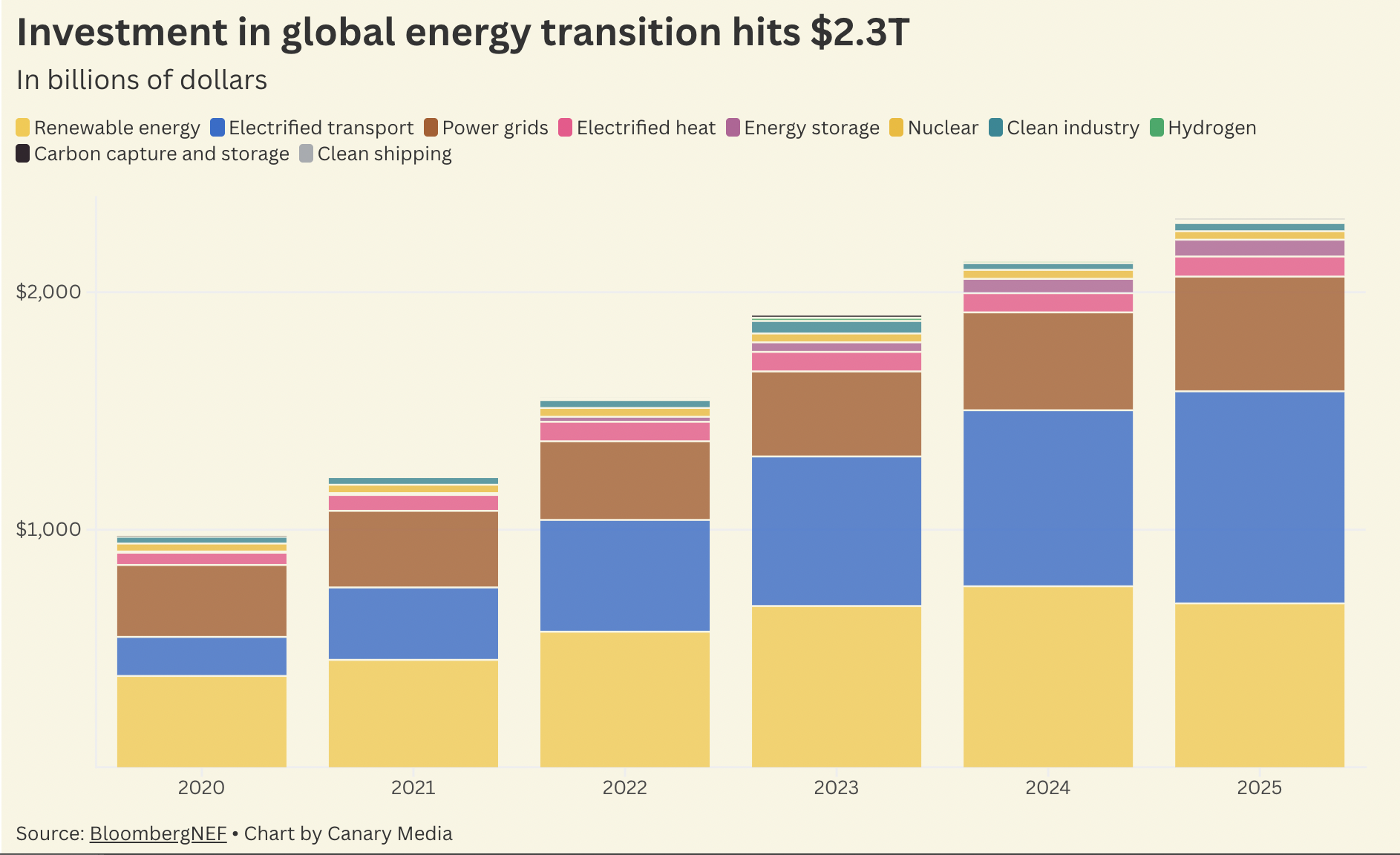
Global investment in the energy transition has broken records over and over again in recent years, and for good reason. Wind turbines, solar panels, and batteries are fast and increasingly cheap to install. Grid operators are scrambling to build out their systems as the world’s demand for electricity skyrockets, driven in large part by the AI data center boom. Meanwhile, electric cars are becoming hugely popular in places like China, where they are often cheaper than gas-fueled vehicles, and Norway, which has long-standing policies incentivizing car buyers to go electric.
Let’s dig a little deeper into the numbers on spending. Investment in clean energy and the grid outpaced the amount spent on fossil fuel supply in 2025 — marking the second year in a row that has happened. And investment in fossil fuel supply dropped last year for the first time since 2020, with BNEF reporting a $9 billion decline from 2024.
Now for the less-great news. Investment in the energy transition is growing overall, but more slowly than it used to —and right when the world needs it to accelerate.
Last year, it rose by only 8% — less than the 12% jump in 2024 and much less than the 22% one in 2023. Plus, while investment in sectors like clean industry and energy storage increased, the amount for renewable energy specifically declined by nearly 10%, something BNEF attributes to uncertainty caused by new power market rules in China. Even so, the Asian country is by far the largest market for energy transition investment, followed by the European Union and then the U.S.
Despite those slips, growth is growth — and the global shift to cleaner energy isn’t stopping just because of recent headwinds in the U.S. and beyond.
This analysis and news roundup come from the Canary Media Weekly newsletter. Sign up to get it every Friday.
“🚨Single. Largest. Deregulatory. Action. EVER. Incoming: TOMORROW!”
That quote comes from an X post made by U.S. Environmental Protection Agency Administrator Lee Zeldin on Wednesday. Sure enough, the next day, Zeldin officially unveiled the subject of this WrestleMania-esque hype: The Trump administration has revoked the scientific basis for the federal regulation of greenhouse gas emissions in America.
For 16 years, a scientific determination known as the “endangerment finding” has served as the backbone of U.S. policies to reduce emissions, allowing the EPA to put limits on planet-warming and health-harming pollution from vehicles, power plants, and other industrial sources of greenhouse gases.
There’s no doubt this will go to the courts. In fact, the finding itself has its roots in the legal system. Back in 2007, the Supreme Court ruled that the EPA had the authority to regulate greenhouse gases under the Clean Air Act — but only if the agency found that the gases were a threat to public health and welfare. In 2009, the EPA furnished overwhelming evidence in support of that point.
As The New York Times reports, a court battle seems to be precisely what the Trump administration wants. That would allow its lawyers to try to convince the conservative-majority Supreme Court to overturn the 2007 decision, thus dealing a more lasting blow to climate policy, as opposed to revoking the endangerment finding, which a Democratic administration would swiftly reverse.
There’s a reason the administration is relying on a legal strategy rather than contesting the science, Inside Climate News points out: The Trump EPA’s attempts to argue with the climate science have been “laughed out of the room,” Meredith Hankins, legal director for NRDC’s federal climate program, told the publication. (This has not stopped top Trump officials like Interior Secretary Doug Burgum from insisting on Fox News, in between breathless praise of “beautiful, clean coal,” that CO2 is merely plant food.)
Environmental advocates unanimously blasted the decision, highlighting how it would not only harm efforts to fight climate change, but threaten public health and affordability, too.
“Most people have never heard of this safeguard — the ‘endangerment’ finding — but repealing it sends a clear message: this government doesn’t care,” David Widawsky, U.S. director of research group World Resources Institute, said in a statement. “The bottom line is that repealing these protections will make everyday life more expensive, more risky and more uncertain for Americans.”
A quick analysis from the research firm Rhodium Group attempted to quantify the exact impact the decision will have on U.S. climate efforts. It found that national emissions will still fall even if the finding is permanently repealed, thanks to the rapid growth of cheap clean energy, but that decarbonization will be more sluggish.
Put simply, repealing the endangerment finding will slow climate progress at the exact moment the world needs it to speed up.
Coal gets another wave of federal support
The federal government unleashed another raft of pro-coal moves this week, aimed at keeping aging power plants running past their prime.
First, on Tuesday, the EPA granted coal-plant owners an extension on cleaning up toxic coal ash. The EPA had previously required owners to start cleaning up inactive coal ash storage sites — which can leech dangerous pollutants into groundwater — by mid-2029, but now they’ll have until early 2032.
The same day, the Tennessee Valley Authority — the federally owned utility whose board is now packed with Trump appointees — announced plans to keep two of its four coal-fired power plants running instead of retiring them in 2035.
And to wrap up the week, Trump ordered the Defense Department to buy more coal-fired power and announced that the Department of Energy would award $175 million to upgrade several aging coal plants. (The details on how this will work are … fuzzy.)
Puerto Rico’s grid crisis reaches a Super Bowl–size audience
If you watched Bad Bunny’s Super Bowl halftime performance on Sunday, you saw a swirling celebration of Puerto Rican culture — and a statement about the island’s fragile power grid.
After a few minutes graced by Lady Gaga, a real wedding, and people dressed as sugarcane, things quite literally turned dark. As Bad Bunny sang his 2022 song“El Apagón” (“The Blackout”), he and some dancers climbed electric poles as the lights flickered and sparks flew.
It was a high-profile reminder that Puerto Rico’s power grid has been in shambles since 2017’s Hurricanes Irma and Maria, Canary Media’s Maria Gallucci reports. Even without major weather events, Puerto Rican utility customers face an average of 27 hours of power grid interruptions each year — and recent Trump administration cuts aren’t helping. Distributed solar and battery systems have shown promise in keeping the lights on and power costs low, but with federal assistance stripped back, most residents are still unable to tap in.
Spinning up success: Offshore wind performed as well as gas power plants and better than coal in January, shoring up the Northeast’s power grid through a brutal cold spell. (Canary Media)
The offshore wind fight continues: Interior Secretary Doug Burgum says the Trump administration plans to appeal five rulings that allowed offshore wind farm construction to continue. (Bloomberg)
Natural gas disconnect: Experts say the Trump administration’s push to expand natural gas exports doesn’t mesh with its promise to curb skyrocketing power prices back in the U.S. (Canary Media)
Coal’s mounting cost: The net cost of keeping a Michigan coal plant open has reached $135 million since President Trump ordered the facility to stay online in May 2025. (MLive)
Powerful pivot: At least 10 North American EV battery plants are being revamped to instead produce grid batteries for energy storage systems. (Financial Times)
Renewables under attack: A bill making its way through Ohio’s legislature would essentially ban wind and solar development in the state — one of several similar attempts around the U.S. (Canary Media)
Heat-pump troubleshooting: Icy crusts kept some heat pumps from performing their best during recent bouts of extreme cold, but experts recommend owners take a few easy steps ahead of storms to keep their systems running. (Canary Media)
Data center crackdown: The White House has reportedly drafted a pact with tech giants that would have them make public commitments to ensure that their data centers don’t raise household power prices, stress water supplies, or hurt grid reliability. (Politico)
Heat pumps outsold fossil gas–fired furnaces in the U.S. yet again last year.
That’s the fourth year in a row — a testament to Americans’ sustained appetite for the zero-emissions appliances crucial to weaning buildings off planet-warming fossil fuels.
In 2025, 12% more air-source heat pump units shipped in the U.S. than gas furnaces, the next most-popular heating appliance, per data released today from the industry trade group Air-Conditioning, Heating, and Refrigeration Institute.
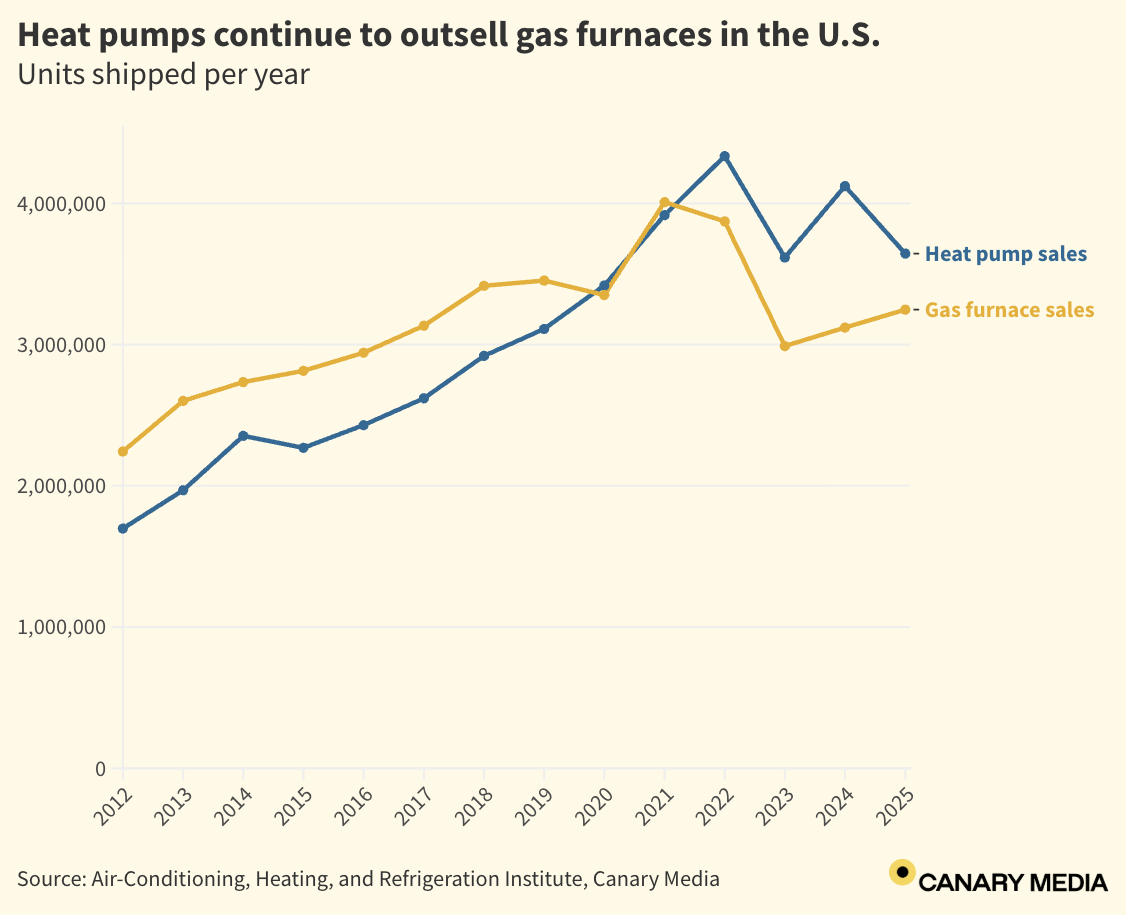
Now, that doesn’t necessarily mean that more households are installing the über-efficient appliance instead of furnaces; one home may need multiple heat pump units to replace a single furnace.
And not all the data was good news for the climate. Shipments of gas-powered units ticked upward last year to 3.2 million, while heat pump sales fell to 3.6 million.
But these are year-to-year fluctuations, and the broader trend is still toward heat pumps, experts told Canary Media.
Given the health, comfort, efficiency, and climate benefits of the tech, a complete transition to heat pumps feels inevitable, said Ryan Shea, manager in the carbon-free buildings team at nonprofit RMI. “I think the only question is … how fast the transition happens, not if.”
Electric heat pumps are two-way air conditioners that offer both space cooling and heating. They’re a critical tool to eradicating carbon pollution from buildings, which account for more than one-third of U.S. greenhouse gas emissions. Because the tech is two to four times as efficient as fossil-fueled systems, heat pumps also save most households money on their energy bills — a winning attribute as more Americans grapple with a cost-of-living crisis.
So why the dip in heat pump shipments last year?
A combination of factors, from tariffs to higher interest rates to a sluggish construction market, was likely to blame, according to experts.
A changeover in refrigerants also played a role. For years, heat pumps and air conditioners utilized the hydrofluorocarbon refrigerant R-410A, which has a strong global-warming potential. But as of Jan. 1, 2025, federal law has required newly manufactured systems to use a less polluting class of refrigerants, called A2Ls.
At least some distributors stocked up on the equipment in 2024, so they’d be ready if customers asked for their broken heat pumps or ACs to be replaced with the same models, said Kevin Carbonnier, senior manager of market intelligence at the nonprofit Building Decarbonization Coalition. That led to a backlog of extra inventory in 2025.
But the refrigerant and market factors “are temporary headwinds,” said Wael Kanj, research manager at electrification advocacy nonprofit Rewiring America. “I don’t think they change the fundamentals. Heat pumps are still the most efficient and comfortable way to heat and cool the home.”
Standing in the way of a total heat-pump takeover has long been their price tag. In 2024, Rewiring America estimated that for a medium-size home, a central heat-pump system costs a median of $25,000. A comparable gas furnace plus central AC system can cost roughly half that.
Even for the same building, contractors may provide hugely varying estimates. Last year, heat-pump research firm Laminar Collective found that for one 2,000-square-foot abode in the Boston area, installers’ quotes for a whole-home heat-pump system could differ by more than $10,000.
The Trump administration has worked against making the tech more affordable. Last year, it terminated home-energy tax credits that reduced the cost of an air-source heat pump by up to $2,000, and of a ground-source, or geothermal, heat pump by an uncapped dollar amount up to 30% of the cost.
Some federal funding to boost heat pumps continues to flow, however, including a $200 million grant to Denver-area local governments. Several states — including California, Georgia, New York, and Indiana — have also been able to tap into an $8.8 billion grant program created under the Biden administration to launch home energy rebate programs that help low- and median-income households afford heat pumps.
Even without the tax credits, thousands of incentive programs that lower the upfront costs of electrification still exist at state, local, and utility levels, Kanj said. Rewiring America and the North Carolina Clean Energy Technology Center offer online tools so that households can find available credits.
State and local governments are also pursuing creative ways to help heat pumps take off. New England and California have launched multipronged initiatives to raise public awareness and get heating, ventilation, and air conditioning contractors on board. Massachusetts has implemented a lower winter electricity rate for heat pump owners. New York City, which has an all-electric standard for new buildings, launched a $38.4 million program earlier this month to deploy window heat pumps in affordable housing. And California legislators are considering a bill that would cut red tape for homeowners looking to install these electric appliances.
Investors are backing innovation in this space. The Vancouver-based startup Jetson, for example, just raised $50 million to scale its direct-to-consumer approach, which it says cuts installation costs in half.
And although U.S. heat-pump sales didn’t break any annual records in 2025, the tech did quietly achieve a major milestone: In September, more heat pumps shipped than central ACs for the first time.
“It’s really exciting to see the market moving in that direction,” Shea said.
The Building Decarbonization Coalition’s Carbonnier hopes that in the next year or two, “we’ll see it fully cross over” — the way heat pumps overtook gas furnaces four years ago.
Startup CarbonQuest already proved it could snatch carbon emissions from the gas-fired boilers that heat New York City high-rises. This year, it’s moving into a big new market: carbon capture for the fossil-fueled engines that generate power in remote or campus settings around the world.
Tourmaline, Canada’s largest natural gas producer, collects gas at its Banshee plant near Edson, Alberta. It uses compressors to move the gas through the pipeline network and runs gas-burning engines — akin to supersize versions of what propels a truck — to power those compressors. Now, Canary Media has learned, Tourmaline has contracted with CarbonQuest to capture carbon emissions from an engine driving its compressors, proving out a new use for the technology.
Over the next 10 months, the startup is assembling its equipment into easily transportable containers at a factory in Spokane, Washington, prior to installation at Banshee. The machinery will hook up to the engine’s exhaust stream and use a process called vacuum pressure swing absorption to pull out and collect carbon dioxide. While elsewhere, CarbonQuest’s CO2 has been turned into concrete, here it will go down an existing well for permanent sequestration underground.
The carbon capture industry stands out among climatetech sectors for its distressing frequency of technological disappointments and outright fraud. CarbonQuest, which launched in 2019 and raised $20 million in Series A funding last year, differentiates itself from such dubious company by making humble promises and following through. Its first commercial installation has been capturing boiler emissions in a 30-story apartment building near New York City’s Lincoln Center since early 2022, and the company is now hooking up its fifth system to clean up gas heating in the metropolis.
Carbon capture, which collects carbon dioxide from smokestacks — and the related field of direct air capture, which grabs trace amounts from the air — has struggled with energy requirements: Burning too much electricity to isolate the carbon dioxide undercuts the climate case for doing so in the first place. Rather than jump to massive-scale carbon capture (with massive energy needs), CarbonQuest has chosen to hone its tech at a level that others thought was too small to bother with, said Anna Pavlova, senior vice president for strategy, market development, and sustainability.
“Our goal is to help us move faster to reducing emissions,” Pavlova said. “That’s what we’re trying to prove. And we’re trying to prove it on maybe not the gigantic scale, but the good-enough scale where results still matter.”
Compressors might not be well known outside the industry, but they play a crucial role in the pipeline network that supplies much of America’s home heating, plus 40% of U.S. power generation today. Some regions depend far more on gas: Even the climate-hawk states of New England, for instance, use gas for 55% of their electricity. There’s a tangible climate benefit in reducing emissions from infrastructure that is very much needed for the foreseeable future.
Indeed, U.S. natural gas pipelines make use of more than 5,400 compressors — all systems that CarbonQuest could theoretically slash emissions from with the tech it’s bringing to Canada.
The Alberta installation also portends impact far beyond the niche of gas pipeline compressors. With this project, CarbonQuest jumps from knowing how to decarbonize boilers to knowing how to decarbonize engines, Pavlova said. That’s crucial, she added, because “engines are in many places.”
The type of engines that run compressors serve small-scale power generation all over the place: university campuses, hospitals, industrial sites, and, increasingly, AI data centers that want to produce their own electricity behind the meter. CarbonQuest’s first boiler installation grabs about 1,000 metric tons per year. Soon, its equipment will process 1,500 metric tons per year from the compressor engine, Pavlova said.
This will mark the first time CarbonQuest is including a “metal-organic framework” absorbent — a material engineered by the company Captivate Technology to capture carbon more efficiently. Anything CarbonQuest can do to suck up more pollution with less energy helps make the process more scalable.
Pavlova is particularly excited to prove that this technology can work effectively at the carbon dioxide concentrations that come out of gas engines. Gas boilers typically produce exhaust that’s 8% to 10% carbon dioxide, she said, whereas the engine exhaust will be only about 5% CO2. (Larger gas turbines and coal power plants have even lower concentrations, part of why carbon capture hasn’t worked well for them.)
This is just a stepping stone, however. CarbonQuest got the project’s $4.1 million budget funded by grants from Alberta and the Canadian National Gas Innovation Fund, and the equipment will be able to catch only a small portion of the compressor site’s emissions. But it will put the technology to the test in a real commercial setting, and CarbonQuest will get paid via a long-term service agreement to keep its system in good functioning order. The startup is already working to close “fully commercial” deals for gas compression engines in the U.S., Pavlova said.
To deliver on that potential, CarbonQuest needs to line up customers that care about reducing emissions and find other ways to monetize carbon capture, either through regulatory credits for sequestration or by creatively reusing the carbon itself. Neither option is particularly outlandish these days: The commodity price for carbon dioxide is quite high now, and the federal tax credit for carbon capture survived the Trump administration’s budget law. The trick has been finding people who can actually do the capturing part.


.svg)
