

 Back
Back
One big automaker is questioning whether hybrids are a stepping stone on the way to zero-emission vehicles — or something more permanent.
With a lot of the country still lacking high-speed charging stations, range anxiety can be a real concern for rural Americans. And if you don’t have a driveway or accessible place to plug in, charging at home isn’t easy either.
The Biden administration is working on the first part of that dilemma, including with a new round of funding to build EV chargers announced last week. In the meantime, many automakers and experts see plug-in hybrids that combine a taste of electric driving with a combustion engine as a stepping stone to fully electric cars.
Consumers seem to agree: U.S. hybrid sales shot up 45% in the first quarter of this year, while EV sales slowed a tad, according to MotorIntelligence.com. But at a conference last week, Ford CEO Jim Farley suggested those surging sales are changing his long-term view of hybrids, Reuters reports.
“We should stop talking about it as transitional technology,” Farley said of hybrids. “Many of our hybrids in the U.S. are now more profitable than their non-hybrid equivalent.”
But there’s a big problem with sticking with hybrids for too long, as General Motors’ CEO Mary Barra noted at the same conference. “It’s not the end game because it’s not zero emission,” Barra said, doubling down on her company’s promise to fully transition to EVs.
On average, gas cars emit more than 350 grams of carbon per mile driven over their lifetime, while hybrids emit around 260 grams per mile, MIT researchers have found. EVs are meanwhile responsible for about 200 grams per mile, when you take into account the emissions tied to building a car and producing the electricity they run on.
And even better? Swapping out as much driving as possible for walking, public and public transit.
🏭 We’re good on fossil fuels: The world already has enough planned fossil fuel projects in the pipeline to cover predicted energy demand through 2050, a study finds, suggesting countries should halt new permits. (The Guardian)
🚌 Jumpstarting electric school buses: The Biden administration announces nearly $900 million for 500 school districts across the country to buy clean buses, most of them electric, in the latest round of Bipartisan Infrastructure Law funding. (Canary Media)
💰 Investing in green: Clean energy and transportation investments totaled a record high of $71 billion in the first quarter of the year. (Utility Dive)
🚧 Clean innovation’s holdup: The CEO of the nation’s largest residential solar company discusses how the company is trying to innovate in a sector held back by the utility industry’s “slow and no” culture. (Energy News Network)
💨 No excuses on methane cuts: A study of U.S. EPA data finds reported methane emissions from U.S. gas extraction dropped 37% between 2015 and 2022 even as production surged, suggesting the industry can curb leaks without limiting production. (Canary Media)
🚗 Problematic EV origins: U.S. environmental justice advocates turn their attention to the Congo, where the industry mining cobalt essential to electric vehicle batteries is ripe with worker exploitation. (Capital B)
🌡️ Heating up: An analysis of death certificates finds that 2023 was a record year for heat-related deaths and illnesses, especially in Arizona, Texas and other southern states. (Associated Press)
🏠 Hey, I’m weatherizin’ here: New York launches the country’s first energy rebate program supported by federal Inflation Reduction Act funds, which will help low-to-moderate-income homeowners make energy efficient upgrades. (Utility Dive, Gothamist)
Solar developers will pay a premium to build projects on prime farmland under new rules in the works in Maine.
The state Department of Agriculture, Conservation and Forestry is drafting the rules based on a 2023 law that authorized it to collect extra fees from developers whose projects impact at least 5 acres of “high-value agricultural soils,” which regulators will define in rulemaking underway this summer.
The program could involve a range of new fees for different kinds of farmland and project impacts, with money being set aside for “farmland conservation and solar mitigation projects.” Proponents hope the rules will push renewable energy development toward areas with less conservation value.
“We would much rather see balanced solar siting than full-out moratoriums on solar energy development,” said Shelley Megquier, the policy and research director for Maine Farmland Trust, which supported the legislation authorizing the new rules.
Critics, though, say the rules unfairly single out solar based only on anecdotal evidence of the industry’s impact on farmland. A recent report by the American Farmland Trust projected that low-density housing and other types of urban sprawl threaten to swallow more than 53,000 acres, or 5% of all Maine farmland, by 2040.
The law also authorized the development of a similar scheme for wind and transmission projects that affect certain kinds of fish and wildlife habitat.
Some advocates say the new fees single out renewables without clear evidence that a use like solar puts prime farmland more at risk than any other kind of development.
“The narrative around this has really been: how can we protect high-value farmland from solar development?” said Lindsay Bourgoine, the policy director for ReVision Energy, a major New England solar developer. “ReVision has a really big concern about the lack of data around that narrative.”
Maine’s climate plan includes a goal of moving to 100% renewable electricity by 2040, and also aims to put 30% of the state’s land into conservation easements, including for farming, by 2030.
The state has already built close to a gigawatt of solar, most of it in smaller-scale projects. The five-acre minimum covered by the new compensation fees can support about a megawatt of solar.
Bourgoine’s company estimates that even if all of Maine’s existing solar projects under 5 megawatts had gone on prime agricultural lands, it would cover less than half a percent of all such land across the state. A recent report from the Center for Rural Affairs estimated a similar proportion for solar in Midwest states.
Groups that supported Maine’s new fee rules agreed that they hope legislators and state policymakers will turn their focus in the near future to both gathering more land-use data, and to considering expanding mitigation tools to uses that may be more common, such as housing, commercial development or roads.
“If we’re talking about environmental impacts, we’re requiring mitigation of the one type of development that is benefiting the environment,” said conservation biologist and GIS manager Sarah Haggerty of Maine Audubon, which supported the bill to create the clean energy fee programs.
Absent better data, Megquier said farmers and farm conservation groups like hers can only go on what they observe — which is “farmland being converted for solar production in pretty large amounts,” she said.
“Some of that (is) what we would categorize as really high-value farmland, where unfortunately it’s being lost to agricultural production,” she said. “There may be farmers that would be interested in accessing that land to grow food for our communities.”
Andy Smith and his partner run The Milkhouse dairy farm in Monmouth, Maine. They have their own small solar array and sit close to a power substation, and so have fielded extensive interest from solar developers who want to rent and build on some of their land. Some have offered more than $1,000 an acre for a 30-year lease, he said.
Smith said he’s strongly supportive of an energy transition and sees frequent effects of increasing weather extremes on his farm. But he said solar is tough competition for farmers who lease or buy space from other landowners, often to grow hay to feed dairy cows like Smith’s.
“If young people are trying to buy farmland, and they’re competing with solar developers, they’re not going to be able to buy farmland,” he said.
For farmers that affirmatively want solar on their land, Megquier’s group hopes the new fee structure will incentivize projects to go on “marginal” land that’s less productive, unforested or disconnected from large active growing areas.
“We hope that … this rulemaking takes those sorts of complexities into account,” she said. “We would want to see permitting for a solar development that supports current agricultural operation as sort of fast-tracked or, in some way, expedited.”
ReVision supports a similar outcome.
“We would just say that a landowner should have the default ability to be able to site solar on their property if the purpose of it is for revenue diversification to keep the farm in operation,” Bourgoine said.
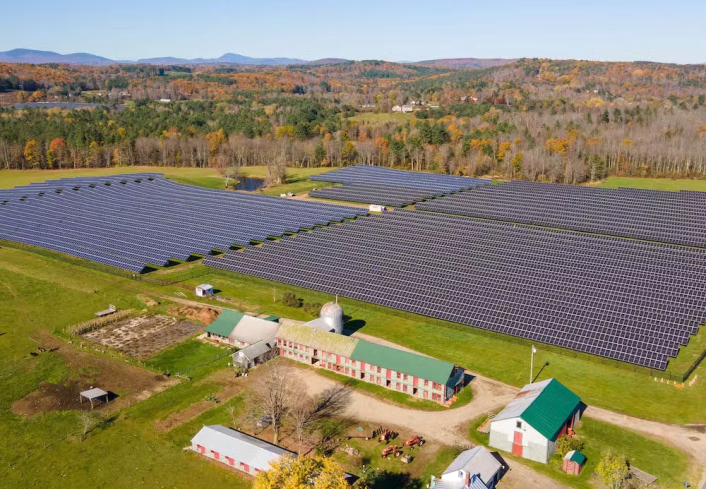
Evelyn Norton is one such landowner. Her father raised dairy cows and harvested hay to feed them on her family’s farm in Livermore Falls, Maine. As that business declined and her dad got older, Norton said she realized, realistically, that she and her sister “were not going to be out on the tractors haying… and so we realized we needed to figure out what else we could do to bring income into the farm.”
Numerous solar developers had contacted the family about putting an array on their land. Many were eyeing a particular flat, treeless area, close to grid infrastructure, with sandy soil. It had been the least productive plot for hay on the farm, Norton said.
“Someone referred to it as a Walt Disney solar farm property,” Norton said. “It was just like it was designed to be a solar array.”
Her family worked with ReVision to build a community solar array on that 20 acres, covering about 15% of the farm’s total area. The grass beneath the panels is grazed by sheep, and the array provides power to five school districts — a nod to Evelyn’s mother, who was a long-time teacher.
Annual lease payments now provide the farm’s largest source of revenue, supplemented by various other agricultural uses, such as tree-growing and a farmer who rents space for his cattle.
“We’re still wanting to stay as a one-unit farm and not have to sell off piece by piece. This allows us to do that,” Norton said. “It gives us the security to know that 135 acres is protected because of the 20 acres.”
Norton worries that the new fee structure, if not designed with the right exceptions, could prevent some farmers from using solar as she did to keep her farm viable.
Some advocates said they hope the rules will primarily help balance solar development costs so that farmland isn’t automatically the cheapest option.
Smith, the dairy farmer in Monmouth, said he hopes at least the new fees will encourage development on “lower-quality soils.” But it’s easier said than done — these soils may be less well drained, for example, and contain areas classified as wetlands, leading to more regulatory complications.
“It just often feels like, you know, a (good) solar site is going to be on well drained soil with southern exposure, which is also the best farmland there is,” he said.
“We sincerely hope that this effort will not have a chilling effect… and, in some cases… could assist solar companies in terms of the predictability,” Megquier said. “The current structure is really not a structure. It’s very … project-to-project. And that is not to the benefit of advancing our conservation goals, nor is it to the benefit of advancing our renewable energy goals.”
Under the new rules, regulators will have to define “dual-use agricultural and solar production,” such as agrivoltaics projects where crops and solar are co-located. Megquier hopes the new fees will incentivize this approach.
For Smith, dual-use methods are the best hope for easing rural and neighbor backlash to solar energy, which he worries will slow its growth as a tool for fighting climate change.
“It would really suck if the whole solar industry got like a black eye because of developing these open spaces,” he said.
Haggerty, with Maine Audubon, said increasing costs for building on farmland could make more costly solar sites — including brownfields and developed spaces — more appealing for builders by comparison.
“It may very well be that this legislation balances out some of those costs, you know — if you’re gonna have to mitigate… ag land or wildlife habitat, maybe it makes that brownfield more affordable, and it’s not as much cheaper to go elsewhere,” she said. “That’s one of the things that we hope to see.”
The state is currently gathering stakeholder input on a draft farmland rule expected out this summer. The Maine legislature will have to approve the eventual fee structures, which will apply to solar arrays that begin construction after Sept. 1, 2024.
GEOTHERMAL: Eversource will begin operating a unique, $14 million pilot project this week: the nation’s first utility-operated underground thermal energy network connecting buildings around Framingham, Massachusetts. (Canary Media)
BIOENERGY: A Rhode Island bioenergy facility that was supposed to be providing a Canadian refinery with renewable natural gas by last summer still hasn’t finished construction, leaving both its future and the refinery’s climate goals in jeopardy. (CBC)
POLICY: Pennsylvania’s House holds a hearing over a bill that would restructure the state board responsible for handling federal energy incentives to let it finance energy projects itself. (Penn Live Patriot-News)
FOSSIL FUELS:
GRID:
BUILDINGS: New Hampshire is among the roughly two dozen states fighting proposed federal regulations around new energy efficiency standards for stoves, cooktops and ovens. (Nebraska Examiner)
ELECTRIC VEHICLES:
TECH: Some climate tech experts say Massachusetts has the right combination of innovation and accessible capital to cultivate a successful climate tech hub on a global scale. (ABC News)
SOLAR: A vertical farming company opens a large strawberry farming warehouse entirely powered by solar energy in New Jersey. (Food Bev Media)
COMMENTARY: The head of a New York climate justice coalition argues against implementing the Clean Fuel Standard, citing the failure of similar policies in California that he says hurt disadvantaged communities. (City Limits)
GRID: Amid concerns about how data center growth will affect the grid, Microsoft says it is committed to “paying its own way” when it comes to potential upgrades to power a planned Wisconsin facility. (WPR)
ALSO: Ohio regulators approve new transmission charges for AEP Ohio that consumer advocates say will sharply increase residential customers’ bills. (Dayton Daily News)
HYDROGEN: Minnesota-based 3M is investing in research that aims to lower the costs of producing green hydrogen and make it more competitive with renewables and fossil fuels. (Star Tribune)
OIL & GAS: Marathon seeks to remove air pollution permit limits and increase production at a Detroit refinery that has previously violated air quality laws multiple times. (Bridge Detroit)
CLIMATE: Michigan Republicans criticize the state attorney general’s effort to recruit private-sector attorneys to help pursue climate lawsuits against major fossil fuel companies. (Michigan Public)
PIPELINES: The U.S. Army Corps of Engineers is holding a pair of hearings today in Wisconsin on Enbridge’s request to reroute a portion of Line 5 around tribal land in northern Wisconsin. (Journal Sentinel)
POWER PLANTS:
SOLAR: Converting farmland to commercial solar projects could be a sticking point in the upcoming federal Farm Bill, though advocates say solar and farming can coexist under agrivoltaics practices. (E&E News, subscription)
EFFICIENCY:
ELECTRIC VEHICLES:
GRID: Grid-enhancing technology that could expand existing power lines’ capacity is catching on worldwide but struggling in the U.S. as utilities shy away from high upfront costs. (E&E News)
ALSO:
CLEAN ENERGY:
CLIMATE: Oil and gas corporations ask the U.S. Supreme Court to block lawsuits brought by states seeking to hold the industry liable for billions of dollars of climate change-caused damage. (Los Angeles Times)
GEOTHERMAL: A Massachusetts utility this week will launch the nation’s first utility-operated underground thermal energy network. (Canary Media)
POLITICS:
ELECTRIC VEHICLES: Car dealers say they’re seeing more blue-collar electric vehicle buyers as federal incentives and price drops make EVs more affordable. (New York Times)
NUCLEAR: U.S. Energy Secretary Jennifer Granholm calls for the construction of 98 more nuclear plants on the scale of new units at Georgia Power’s Plant Vogtle. (Associated Press)
PIPELINES: Federal records identify roughly 130 potential problem areas revealed during testing of the Mountain Valley Pipeline earlier this spring, raising further concern about the pipe’s integrity. (Roanoke Times)
EFFICIENCY: Attorneys general from 23 states threaten legal action if the Biden administration moves forward with new energy-efficiency standards on stoves, cooktops and ovens. (Nebraska Examiner)
HYDROGEN: Minnesota-based 3M is investing in research that aims to lower the costs of producing green hydrogen and make it more competitive with renewables and fossil fuels. (Star Tribune)
CLIMATE: Oil and gas corporations ask the U.S. Supreme Court to block lawsuits brought by Hawaii, California and other states seeking to hold the industry liable for billions of dollars of climate change-caused damage. (Los Angeles Times)
ALSO: An energy think tank calls on California regulators to reduce carbon cap-and-trade allowances, saying doing so would trigger deeper emissions cuts and help the state reach climate goals. (E&E News, subscription)
OIL & GAS: A peer-reviewed study finds industrial air pollution contributes to low birth weights in New Mexico, with the effects most pronounced in the San Juan and Permian Basin oil and gas fields. (news release)
UTILITIES:
COAL:
SOLAR:
GRID:
MICROGRIDS: A California university plans to install a solar-plus-battery microgrid expected to be able to power the campus for up to two days. (news release)
STORAGE:
TRANSPORTATION:
Activists pushing San Diego to take over the city’s investor-owned utility aren’t letting last year’s defeat of a similar effort in Maine deter their goal of establishing a nonprofit power company. They recently submitted petitions bearing more than 30,000 signatures from residents who want the City Council to let voters decide the matter this fall.
Advocates say a municipal takeover of San Diego Gas & Electric would deliver cheaper rates and a faster, more affordable, and more equitable transition to clean energy. Still, the measure faces long odds from skeptical council members who have twice rejected similar proposals.
The campaign is the first public power ballot initiative since 70 percent of voters in Maine rejected a proposal to take over the state’s two largest utilities. A group called Power San Diego delivered several cardboard boxes filled with petitions to the San Diego city registrar’s office on May 14. If just over 24,000 of the signatures on those documents are deemed valid, the Council will have to decide whether to put the question to voters in the next election.
What’s happening in Southern California reflects growing frustration with the high rates and lackluster service investor-owned utilities often provide — and a desire to accelerate the green transition. Similar campaigns are afoot in Rochester, New York and San Francisco, and Empire State lawmakers recently introduced a bill to buy out Central Hudson Gas & Electric and create a public power authority.
“Across the country, people are talking about public ownership of energy,” Sarahana Shrestha, a New York state assembly member who co-sponsored the bill, told Grist. “If we want a just transition — taking care of workers, and making sure that it’s affordable and brings benefits back into communities — there’s no effective way of doing that while you’re still answering to shareholders.”
San Diego residents pay some of the nation’s highest electricity rates, and by one estimate, more than a quarter of customers are behind on their payments. (The utility has attributed its high rates to the cost of everything from wildfire prevention to building transmission lines and other clean energy infrastructure.) Takeover advocates say the move would save residents 20 percent on their utility bills because a nonprofit model eliminates the need to provide shareholders with a return. It estimates the cost at $3.5 billion, citing a study commissioned by the city last year.
That analysis found that the utility’s 700,000 customers who live within the city of San Diego could save 13 to 14 percent annually if the city bought the utility’s grid assets for $2 billion and created a municipal utility. The math is less favorable if the cost of the buyout goes up, however; at a price of $6 billion, ratepayers could face additional costs of $60 million over the first decade but see long-term savings after 20 years.
San Diego Gas & Electric vehemently opposes the effort and has backed the political action committee Responsible Energy San Diego to block it. The organization calls itself “a coalition of diverse San Diego leaders” fighting “a reckless ballot initiative to force a government takeover of the energy grid.” The utility has contributed well over $700,000 to the committee, according to records on the San Diego Ethics Commission website.
That’s more than twice what Power San Diego has raised and reflects a dynamic in which political action committees supported by Maine’s two investor-owned utilities received 34 times more money than public power advocates. Activists there say that allowed the utilities to finance a robust campaign of advertising and misinformation to defeat the referendum.
San Diego Gas & Electric has hired Concentric Energy Advisors, the same consultants who helped defeat the effort in Maine. The company’s study commissioned by the San Diego utility estimated the cost of a public takeover of the grid at $9.3 billion.
Matt Awbrey of Responsible Energy San Diego told Grist the city should address other priorities like affordable housing rather than a proposal “to create a new government-run utility that has no plan, budget, or verifiable cost estimates.” He said the cost of the takeover likely would bring “higher taxes, higher electric bills, and/or cuts to essential city services we all depend on.”
Power San Diego intended to gather 80,000 signatures by July, which would have placed the proposal on November’s ballot. But it lacked the funding for such an effort and decided to seek 30,000 signatures, or roughly 3 percent of registered voters. That would require the City Council to vote on whether to put the matter to voters.
Dorrie Bruggeman, senior campaign coordinator for Power San Diego, doesn’t expect the council to do that; it already has rejected such a proposal on two occasions, with council members calling for greater detail on costs and projected revenues. Council President Sean Elo-Rivera is among those with reservations.
“I have no love for corporate monopolies reaching into the pockets of everyday working people,” he told the local news outlet La Jolla Light. “But this is a very complex and important issue and I don’t think this is baked enough to go to the voters.”
Regardless of any qualms the council may have, Bill Powers, chair of Power San Diego, said his organization has prompted an important discussion within the community and sparked voter engagement on the issue. The next step is getting policymakers behind the idea.
“If we can get a couple of council members that are open to public power, if we can get a mayor who is open to public power, which we’ve had in the past, then the movement isn’t dependent on the endpoint of a ballot initiative,” Powers said.
Such campaigns are gaining momentum elsewhere. Public power advocates in Rochester, New York, want the city to evaluate the costs and benefits of a municipal utility. In San Francisco, city officials are currently working with the California Public Utilities Commission to determine how to set a fair price for Pacific Gas & Electric’s distribution grid, in the hopes of creating a citywide public power system.
On May 17, New York Assemblymember Shrestha and State Senator Michelle Hinchey introduced a bill to create the Hudson Valley Power Authority, a public power entity that would buy out Central Hudson Gas & Electric. The utility has drawn criticism for its high rates and a string of billing failures since 2021. If the measure passes, the Hudson Valley Power Authority would seek to lower rates, improve service, and hasten the green transition while protecting labor rights.
Joe Jenkins, Central Hudson’s director of media relations, told Grist the proposed takeover would involve “significant hidden costs, loss of jobs, and loss of tax revenue for towns and schools,” adding that rates for municipal utilities in New York are nearly 9 percent more expensive than those of investor-owned utilities.
Shrestha said the legislation reflects her constituents’ growing interest in public power. Her office has hosted seven town halls this past year to discuss energy democracy. “People are so fed up with getting bills that are inconsistent and late,” she said. “People are really excited about learning how we can actually get public power done.”
GRID: Weather-related power outages, such as those that recently struck Texas, are happening more frequently as storms intensify and an aging electric grid struggles to keep pace with demands. (CNN)
ALSO:
CLIMATE: An analysis of death certificates finds that 2023 was a record year for heat-related deaths and illnesses, with Texas, Oklahoma, Louisiana, and Arkansas among the hotspots where rates surged. (Associated Press)
UTILITIES:
COAL: Clean energy advocates are finding success in Louisiana and elsewhere arguing that coal is more costly than renewables and that ratepayers shouldn’t have to pay for uneconomical power plants. (New York Times)
ELECTRIC VEHICLES:
EMISSIONS: Savannah, Georgia, has seen its electricity-related greenhouse gas emissions decline over the last two decades even as its population grew, but transportation emissions are rising. (Savannah Now)
OIL & GAS:
SOLAR:
STORAGE: Lynchburg, Virginia’s city council approves siting agreements for two major battery energy storage systems that include money for the fire department to buy training and equipment. (News & Advance)
POLICY: A Virginia Department of Energy official will serve as executive director of a newly revived state commission tasked with studying energy-related legislative proposals. (Virginia Mercury)
COMMENTARY: North Carolinians would pay the cost of Duke Energy’s proposed natural gas plant build-out through heightened utility bills and worsened health, air and water, an advocacy group writes. (Appalachian Voices)
SOLAR: A conservation group’s new report identifies roughly 300,000 acres of polluted brownfield properties and former coal mining sites in Indiana that could host solar projects. (WFYI)
ALSO: Scientists at Iowa State University and elsewhere look for ways to blend solar power and agricultural production, such as at a project outside Lawrence, Kansas, where developers plan to incorporate sheep grazing. (Harvest Public Media)
OHIO:
GEOTHERMAL: A Minnesota school district is reducing its energy use with a geothermal system even after installing air conditioning for the first time. (Sahan Journal)
OIL & GAS: An Ohio nonprofit oil and gas watchdog group says the industry is increasing water withdrawals and waste production during hydraulic fracturing, becoming less efficient as well production declines. (Times Leader)
ELECTRIC VEHICLES:
EMISSIONS: Michigan agriculture regulators will monitor ozone levels in eight counties to help avoid elevated smog levels during the summer. (Bridge)
CLEAN ENERGY: Former Wisconsin Lt. Gov. Mandela Barnes forms a new organization to help connect residents and businesses with clean energy funding available under the Inflation Reduction Act. (UpNorthNews)
COMMENTARY:
This story was originally published by Canary Media.
Over the past three years, an unusually broad coalition has come together to champion a new way to finance and build community-solar-and-battery projects in California. It includes solar companies, environmental justice activists, consumer advocates, labor unions, farmers, homebuilder industry groups, and both Democratic and Republican state lawmakers — a rare instance of concord in a state riven by conflicts over rooftop solar and utility policy.
Supporters say the plan, known as the Net Value Billing Tariff, could enable the building of up to 8 gigawatts of community-solar-battery projects over the coming decades, all of which would be connected to low-voltage power grids that sell low-cost power to subscribing households, businesses, and organizations.
But on Thursday, the California Public Utilities Commission voted 3–1 to reject the coalition’s plan. Instead, it ordered the state’s major utilities — Pacific Gas & Electric, Southern California Edison, and San Diego Gas & Electric — to restructure a number of long-running distributed solar programs that have failed to spur almost any projects in the decade or more they’ve been in place.
Critics warn that these utility-backed plans won’t create a workable pathway to expanding a class of solar power that has become a major driver of clean energy growth in other states and a key focus of the Biden administration’s energy equity policy.
They also fear that the CPUC’s reliance on state and federal subsidies to boost the economic competitiveness of these existing failed community-solar models might jeopardize the state’s ability to even qualify for the $250 million in community-solar funding that the Biden administration has provisionally offered it.
“We are cheating ourselves out of the benefits of community solar and storage with this decision,” said Derek Chernow, western regional director for the Coalition for Community Solar Access (CCSA), which represents companies and nonprofits that advocate for community solar.
Since CCSA devised the NVBT in 2021, it has won “unprecedented bipartisan broad-based support from stakeholders that don’t typically come together and see eye to eye on clean energy issues,” Chernow said.
The plan the CPUC cobbled together from utility proposals, by contrast, lacks “any support — broad-based or otherwise,” he said.
CPUC President Alice Busching Reynolds defended the decision to reject the NVBT at Thursday’s meeting. She pointed to other existing California programs that assist low-income households and multifamily buildings in obtaining solar, and noted that the CPUC’s plan will expand an existing community-solar program that offers low-income customers a 20 percent reduction on their bills.
She said that the NVBT program was too costly a way to bring new solar-and-battery resources to the state, compared to the large-scale energy projects being contracted by utilities and community energy providers.
“California is really at an inflection point where we must use the most cost-effective clean energy resources that provide reliability value to the system,” Reynolds said.
Backers of the NVBT hold a very different view. Since March, when the CPUC unveiled its proposed decision to reject the NVBT, there has been broad public outcry. Letters protesting its proposal have flooded into the CPUC from community-solar advocacy groups, environmental organizations, commercial real estate companies, farmworker advocacy groups, farming industry associations, and Republican and Democratic state lawmakers.
The CPUC issued a revised proposed decision on Tuesday, ahead of Thursday’s vote, which differed little from the initial March proposal. The only major change was the removal of a legal argument claiming that the NVBT violates federal law — a theory that was met with widespread incredulity and was rebutted by three former chairs of the Federal Energy Regulatory Commission in letters to the CPUC.
The Utility Reform Network (TURN), a nonprofit that advocates for utility customers, has warned that the CPUC’s community-solar plan will “favor large utility companies by ensuring solar program development costs are incurred by home builders, renters, and other solar community participants,” while failing to offer lower-income customers a chance to reduce their fast-rising electric bills by subscribing to lower-cost solar power.
And 20 lawmakers who supported AB 2316, the 2022 state law that ordered the CPUC to create an equitable and affordable community-solar program, have told the CPUC that its failure to support the NVBT could mean the state falls short on its clean energy and climate goals.
“Transmission-scale renewables face significant siting, interconnection, and transmission challenges,” creating the risk that utilities won’t be able to hit the aggressive clean energy procurement targets set by the CPUC, the lawmakers wrote in a September letter. “Small, distribution-sited community solar and storage projects have incredible potential as we modernize and expand our transmission system.”
Speaking at Thursday’s CPUC meeting, Assemblymember Chris Ward, the San Diego Democrat who authored AB 2316, called the CPUC’s pending decision “a dismissal of California’s need for clean, reliable, and affordable energy.”
“After agreeing with nearly all stakeholders that the state’s existing community renewables programs are not workable, the proposed decision has opted to repeat these mistakes by creating an outdated, commercially unworkable program that will result in no new renewable energy projects or energy storage,” he told the CPUC commissioners, all of whom were appointed by Governor Gavin Newsom (D).
California leads the country in rooftop solar and stands behind only Texas in utility-scale solar-and-battery farms. But its community-solar projects make up less than 1 percent of the 6.2 gigawatts of community solar that have been built in the 22 states with policies that support this form of solar development. That’s largely because the community-solar programs that have existed in California for more than a decade have been unattractive to solar developers, financiers, and would-be subscribers.
The earliest programs, which targeted commercial and industrial customers, charged a premium over standard utility rates, making them undesirable. Later programs created for lower-income and disadvantaged communities have been stymied by limits on how many megawatts’ worth of projects can be built and the size of individual projects, as well as onerous rules that require projects serving disadvantaged communities to be located within five miles of those customers.
Designed to remove those barriers, the NVBT was modeled on a community-solar program created by New York that has led to more than 2 gigawatts of projects in that state. That structure allows community-solar projects to earn steady revenues from the power they produce based on a complex calculation of benefits. Those benefits include helping to meet state climate goals, bringing clean power to underserved customers, and, importantly, helping to support utility grids by, for example, avoiding the cost of securing power during the rare hours of the year when utility grids face the greatest stress.
Unlike California’s existing community-solar programs, the NVBT would incentivize projects to add batteries to store and shift solar power from when it’s in surplus to when it’s most needed on the grid.
And under AB 2316, any new community-solar-and-battery projects in California must provide at least 51 percent of their capacity to serve low-income residential customers at prices that reduce their electricity bills — a valuable option for low-income households, renters, and other utility customers that can’t access rooftop solar.
“We’re very interested in seeing renters have access to community-solar projects,” said Matt Freedman, a staff attorney at TURN. “And we’re excited that the California statute requires at least 51 percent of the benefits go to low-income customers. We think that’s revolutionary — that we’re putting low-income customers first in line to receive the benefits of these projects.”
To date, California’s community-solar programs have subsidized lower-income customers through funds drawn from utility ratepayers at large or from the state’s greenhouse gas cap-and-trade program. NVBT backers hoped the structure they proposed would allow projects to earn enough money in their own right to support reduced rates for lower-income customers.
But all the revenues and benefits of community-solar-battery projects under the NVBT rely on a common factor, Freedman said: being able to tap into the same value structure that dictates what rooftop-solar-equipped customers served by California’s three major utilities earn for their solar power. That structure is called the avoided-cost calculator, and AB 2316 explicitly cited it as the metric that the CPUC should use to determine the value of community solar, he said.
The CPUC’s decision rejected that reading of the law, however. Instead, it agreed with the state’s big utilities that the solar-and-battery projects that the NVBT would finance could increase costs on some of the state’s utility customers in excess of the value those projects would provide to customers at large.
To reach that conclusion, the CPUC didn’t compare the cost and value of community-solar-and-battery projects against the value assigned to rooftop solar systems and other distribution-grid-connected clean energy resources. Instead, it compared their value against wholesale “avoided-cost” rates of electricity generated by power plants, utility-scale solar-and-battery farms, and other large-scale resources.
Those resources provide power that’s much cheaper on a per-kilowatt-hour basis than power from community-solar-battery projects, which face higher land and construction costs connected to building in more populous areas, and which can’t match the economies of scale achieved by solar-and-battery farms in the hundreds of megawatts apiece.
But by choosing that comparison point, the CPUC also dismissed the value that distributed community-solar projects can provide by delivering power much closer to customers than far-off power plants and solar farms connected by expensive high-voltage transmission lines, Freedman said.
A better comparison, he suggested, would be against a form of solar-and-battery power that community projects could actually supplant to significant economic benefit — the solar systems all new homes and many new commercial and multifamily buildings must include under California building codes.
That’s why the California Building Industries Association trade group has been a strong supporter of the NVBT. CBIA estimates that the state’s building codes will require the addition of 250 to 400 megawatts of new solar per year over the coming decade to keep up with the pace of residential construction. Community solar and batteries under the NVBT could be a much cheaper way to meet those requirements — but only if developers have a program that makes building those projects economically viable.
It’s hard to see how the CPUC’s newly enacted Community Renewable Energy Program (CREP) structure will make that possible.
In essence, the CPUC has ordered utilities to restructure two existing tariffs that allow distributed energy projects to sell their power to utilities at wholesale avoided-cost rates: the Renewable Market Adjusting Tariff (ReMAT) program, which allows projects of up to 3 megawatts, and the Public Utility Regulatory Policies Act (PURPA) Standard Offer Contract, which allows projects of up to 20 megawatts.
But the low prices and short contract terms for these structures have been extremely unattractive to clean energy developers. No project has been completed under the “standard offer contract” structure since 1995, and only one 3-megawatt solar-only project has been built under ReMAT since 2021, Freedman said.
It’s hard to envision lenders or investors backing a solar project with such an unclear pathway to profitability, CCSA’s Chernow said. What’s more, neither of those tariffs reward projects that invest in batteries to store solar power when it’s not as valuable for the grid and discharge it during times of grid stress, he said.
“You don’t get the scalability, you don’t get the growth, you don’t get the storage — you don’t get all of the avoided-cost benefits that were originally set up with the Net Value Billing Tariff,” he said.
To make matters worse, both of those programs are meant to supply lower-income customers with solar power that can reduce their electricity bills, Freedman said. But retail electricity rates in California are five to six times higher than the wholesale rates that the CPUC would allow these projects to earn.
To make up for that discrepancy, the CPUC has ordered utilities to use “external funding or incentives” to offer credits to subscribing customers that are structured in a way that doesn’t increase their utility energy costs. Low-income customers, which must make up at least half of all subscribers, “will receive no less than 20 percent” bill credits.
But at present, the only money the CPUC has identified for these external sources is $33 million in state-approved funding available for community-solar usage and storage-backed renewable-generation programs. Beyond that, Thursday’s decision orders utilities to look to federal investment tax credits and a set of programs created by the Inflation Reduction Act to spur investment and lending in underserved communities, including the U.S. Environmental Protection Agency’s $7 billion Solar for All program.
Last month, EPA announced 60 provisional recipients of that funding. California is set to receive $249 million, pending approval of how it plans to spend the money — including a commitment to ensure that low-income customers who participate will be able to lower their electricity bills by at least 20 percent compared to what they were paying before.
CPUC President Reynolds noted at Thursday’s meeting that “while we’re still waiting for guidance from U.S. EPA, we hope to use a significant portion of this funding to support projects and subscribers in this new program.”
But NVBT advocates say it’s far from clear that the programs that will evolve from the CPUC’s decision will provide the underlying utility tariff structures that could allow that federal funding to jump-start a commercially viable community-solar market. In fact, CCSA has calculated that the $249 million in federal funding would allow only about 50 megawatts of community-solar-and-battery projects to achieve economic viability under the CPUC’s proposal and still achieve the Solar for All program’s low-income energy-cost reduction targets, Chernow said.
That’s a far cry from the gigawatts of solar-and-battery projects financed and built by independent developers on a cost-effective basis that the NVBT could have incentivized to be built. But Freedman pointed out that even that relatively small-scale expansion might not be possible if developers decline to participate due to lack of clear long-term economics.
“Even if the state gets the commitment from the money, will we be able to spend it? If you design a program that developers don’t subscribe to, and there are no resources under the program, there’s no draw on the program,” he said.
CPUC Commissioner Darcie Houck, who voted against the decision, echoed some of these concerns at Thursday’s meeting. “The reliance on funding that may or may not be available in the future puts the program either at risk of failing or potentially having to have ratepayers cover the full cost of the program going forward,” she said. Houck was outvoted by commissioners John Reynolds and Karen Douglas and CPUC President Reynolds, with commissioner Matt Baker recusing himself.
Chernow said the CCSA planned to “work within the CPUC’s process to try to fix this as much as we can.” But without significant changes, he warned that the structure set by Thursday’s order stood little chance of spurring the kind of community-solar growth happening in other states.
The U.S. Department of Energy has set a goal of building 25 gigawatts of community solar by 2025, a fivefold increase from today. But Chernow fears the country as a whole “can’t get to these federal goals without California — and California can’t get there with this proposed decision.”


.svg)
