

 Back
Back
CLEAN ENERGY: The world’s largest ever climate survey finds 54% of Americans want a quick transition from fossil fuels to clean energy, among the smallest majorities among counties polled. (The Guardian)
ALSO:
NUCLEAR: Congress overwhelmingly passes a bill to boost the development and building of advanced nuclear projects, marking a rare bipartisan energy win. (E&E News)
WIND: An energy company opens a 184 MW wind project in Mississippi, bucking the Southeast’s resistance to onshore wind power to supply energy to Amazon for regional data centers and logistics hubs. (Canary Media)
SOLAR:
ELECTRIC VEHICLES:
GRID:
HYDROPOWER: The Biden administration acknowledges that federally operated hydroelectric dams on the Columbia River have harmed salmon and the tribal nations reliant on them, bolstering efforts to decommission the facilities. (Associated Press)
PUBLIC LANDS: Wyoming and Utah file a lawsuit seeking to block the federal Bureau of Land Management’s new public land rule that puts conservation on a par with energy development, saying it threatens their resource-based economies. (WyoFile)
Have you had a conversation with ChatGPT, experimented with Google’s email-answering generator, or used an AI-enhanced search on Bing or Facebook? All those AI-enabled activities take a lot more data processing than a regular internet search or scroll. And more data processing means more data centers — and more electricity to power them. Analysts predict these facilities, which house servers that send and store tons of data, could account for as much as 9% of U.S. energy demand by 2030.
Virginia has earned the nickname of “Data Center Alley,” as it’s home to servers that see about 70% of global internet traffic, according to the Wall Street Journal. But as more devices connect to the internet and as AI drives up data demand, data center developers are looking for new places to locate these facilities.
With its cooler climate, abundant water, and relatively mild weather, the Midwest may serve that niche, the Energy News Network reports. And clean energy advocates say data centers could help juice renewable energy development; Microsoft, for example, has promised to build renewables in Wisconsin to help make up for the power its planned data centers will use. Former coal plants and industrial facilities also make good homes for data centers since they’re already connected to the power grid.
But data center proliferation across Virginia and the Southeast is also provides a cautionary tale for clean energy. Utilities across the region have announced plans to build new gas plants and keep coal plants open longer, often citing data centers’ energy needs as part of their reasoning.
Read more about the promise and perils of a Midwest data center boom at the Energy News Network.
💸 Where climate funding goes: More than three quarters of the Inflation Reduction Act’s $34 billion of announced investments have gone to congressional districts represented by Republicans who voted against it, an analysis finds. (CNN)
⚛️ Small nuclear fires up: The U.S. Energy Department announces $900 million for small nuclear reactor development, which along with a bipartisan federal bill to reduce fees and speed permitting could boost the industry. (E&E News, The Hill)
🚘 Benefits for EV buyers: U.S. electric vehicle buyers have received more than $1 billion in point-of-sale rebates since the Treasury Department launched the instant incentives in January, discounting an estimated quarter of the 600,000 EVs sold so far this year. (E&E News)
🌊 Whatever floats your solar panel: Covering around 10% of the world’s lakes and reservoirs with floating solar panels could generate enough electricity to power the United Kingdom four times over, and could be used to cover all power use in some small countries, scientists find. (Grist)
⏳ What’s the holdup? Supply chain and interconnection delays are stalling large renewable energy projects across the Midwest, despite new efforts in Minnesota, Illinois and Michigan to speed up permitting. (Inside Climate News)
🏠 Use ‘em or lose ‘em: Inflation Reduction Act funding for home energy rebates will likely remain mostly unspent until after the November election; Trump allies have indicated he would revamp the program and jeopardize the funding if he is elected. (E&E News)
🛣️ Lining up grid wins: An organization pushing to build transmission lines along highways recently scored a legislative win in Minnesota, and now looks to expand the policy to other states. (Canary Media)
🔋 FERC fills up: The U.S. Senate confirms three nominees to the Federal Energy Regulatory Commission, filling the five-member board as it prepares to guide the nation’s grid buildout. (E&E News)
🛢️ Ten years later: Federal regulators approve the long-delayed Mountain Valley Pipeline to enter service after a decade of regulatory, legal and on-the-ground battles. (Roanoke Times)
A new analysis says Vermont is not on track to meet its 2025 target for reducing greenhouse gas emissions, with declines in thermal fossil fuel use driven mostly — though not entirely — by warming winters.
The study, released last month by the Vermont nonprofit Energy Action Network, also shows signs of progress: Though rising temperatures are still the main driver of lower heating fuel sales, weatherization and electric heat pump adoption are starting to have a greater impact.
“Vermont’s efforts… are, ironically, being aided by the very global heating that we are working to do our part to help minimize,” the study says. “Relying on warmer winters to reduce emissions from fossil heating fuel use is not a sustainable strategy. … What [the warming trend] means for temperatures — and therefore fuel use — in any given year is still subject to variation and unpredictability.”
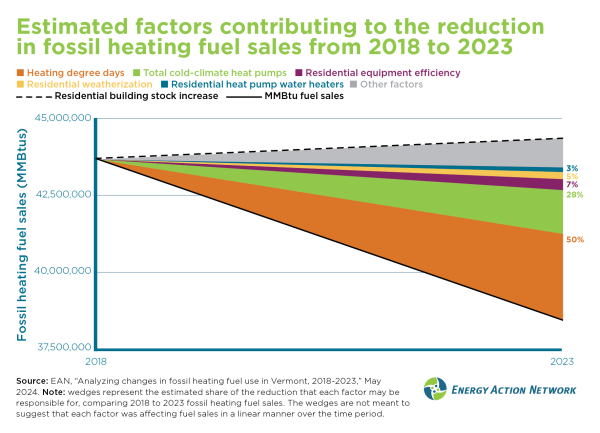
Like most other New England states, Vermont relies heavily on heating oil and, to a lesser degree, propane and utility gas, to heat buildings. This makes the building sector a close second to transportation in terms of the biggest contributors to planet-warming emissions in Vermont and many of its neighbors.
Vermont’s statutory climate targets, adopted in 2020, aim to cut these emissions by 26% below 2005 levels by next year, with higher targets in the coming decades.
“It’s technically possible” that Vermont will meet its thermal emissions goal for next year, but “at this point, primarily dependent on how warm or cold the fall and early winter heating season is at the end of 2024,” EAN executive director Jared Duval said. The transportation sector would need to see a nearly unprecedented one-year decline.
On the whole, EAN says it’s “exceedingly unlikely” that Vermont will meet its 2025 goal.
EAN found that heat pump adoption and weatherization are not happening fast enough, and what’s more, the current trend sets Vermont up for a Pyrrhic victory at best: Rising temperatures in the upcoming heating season would have to be at least as pronounced as in last year’s record-warm winter in order to reduce fuel use enough to meet the 2025 target for the thermal sector.
Either way, warming alone won’t get Vermont to its 2030 target of a 40% drop in emissions over 1990 levels, Duval said. The state wants to end up at an 80% reduction by 2050.
“The only durable way to reduce emissions in line with our science-based commitments is to increase the scale and pace of non-fossil fuel heating solutions and transportation solutions,” he said.
The EAN study found that fuel sales tend to decline alongside heating degree days: a measurement of days when it’s cold enough to kick on the heat. Vermont is seeing fewer of these days overall as temperatures warm.
“The reduction in fossil heating fuel sales as winters have been warming is not surprising,” Duval said. “Historically, fossil heating fuel use and therefore greenhouse gas emissions have largely tracked with heating demand, with warmer winters corresponding with less fossil fuel use and colder winters with more fossil fuel use. The good news is that’s not the whole story.”
In recent years, he said, fuel sales have begun to “decouple” from the warming trend to which they were once more closely linked. From 2018 to 2023, EAN found that Vermont fuel sales declined 12% while heating degree days only declined 8%.
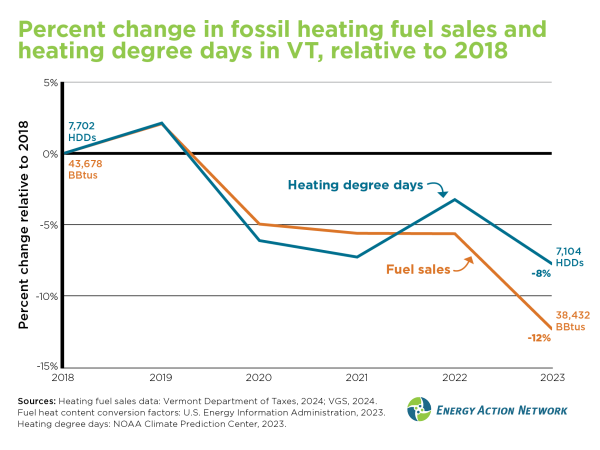
“Fossil heating fuel sales are declining even more than you would expect just from warmer winters alone,” Duval said. “And that’s because many non-fossil fuel heating solutions are being adopted.”
From 2018 to 2022, EAN found, Vermont saw a 34% increase in weatherization projects and more than 50,000 more cold-climate heat pumps installed in homes and businesses, with a 3.3% increase in the number of homes that said they use electricity as their primary heating fuel.
The upshot: The number of cold days explains 50% of Vermont’s declining fuel use from 2018 to 2023, while heat pump growth explains as much as 28% and other efficient upgrades explain a further 15%. The remaining 7% of the decline couldn’t easily be broken down and could partly be from people shifting to wood heat during periods of high fuel prices, Duval said.
“In order to achieve thermal sector emissions reduction targets without relying primarily on an abnormal amount of winter warming, significantly more displacement and/or replacement of fossil heating fuel… will be necessary,” the study says. Upgrades like heat pumps will lead to more sustainable emissions cuts, it says, “no matter what the weather-dependent heating needs in Vermont will be going forward.”
EAN is nonpartisan and doesn’t take policy positions, but research analyst Lena Stier said this data suggests that expanding Vermont’s energy workforce and tackling heat pumps and weatherization in tandem would spur faster progress on emissions cuts, while keeping costs low.
EAN based its estimates of fuel use and emissions impacts from heat pumps on the official assumptions of a state-approved technical manual, which Duval said may be overly optimistic. But Stier said the reality could differ.
“We’ve heard anecdotally that a lot of people who have installed heat pumps in their homes… are kind of primarily using them for cooling in the summer,” she said. “So our kind of assumption is that, in reality, it would be a smaller share of that (fossil fuel use) reduction coming from heat pumps.”
While fuel use declined overall in the study period, he said this came mostly from people using less heating oil specifically — propane sales actually increased in the same period.
Duval noted that propane is cheaper than oil on paper, but actually costs more to use because it generates heat less efficiently than oil does.
“Once you look at that, then heat pumps become that much more attractive,” he said.
Editor’s note: This story has been updated for clarity.
OIL & GAS: A federal judge orders BNSF Railway to pay nearly $400 million to the Swinomish Tribe for violating an easement agreement by repeatedly running 100-car oil trains across its land in Washington state. (Associated Press)
ELECTRIC VEHICLES:
TRANSPORTATION: Colorado regulators find a Denver-area transit agency failed to address escalating light rail maintenance problems that have slowed trains and stymied service. (CPR)
CLEAN ENERGY:
SOLAR:
ELECTRIFICATION: A California startup develops software aimed at helping people cost-effectively pair home electrification and rooftop solar. (Canary Media)
UTILITIES:
CLIMATE: Conservation groups call on the Biden administration to define extreme heat and wildfire smoke as major disasters and unlock relief funding for affected local governments. (Los Angeles Times)
NUCLEAR: Federal regulators seek public input on a Bill Gates-backed plan to build an advanced nuclear reactor in a Wyoming coal community. (WyoFile)
MINING: State and federal regulators approve a uranium mining firm’s proposed exploratory drilling project in western Colorado. (Resource World)
NUCLEAR: The U.S. Energy Department announces $900 million for small nuclear reactor development, with most of the funding going to teams planning to build a small reactor plant and multi-reactor project. (E&E News)
ALSO:
PIPELINES:
RENEWABLES:
STORAGE: Stanford University researchers say they’ve found a novel way to store electric energy in liquid fuels, a potential way to retain intermittent renewable energy for when it’s needed. (The Independent)
GRID: Federal energy regulators want four grid operators to prove their rules for transmission owners to pay for and profit from network upgrade rules are fair. (Utility Dive)
EMISSIONS:
ELECTRIFICATION: A California startup develops software aimed at helping people cost-effectively pair home electrification and rooftop solar. (Canary Media)
COAL: A federal rule takes effect requiring stricter limits for silica dust that’s contributed to a spike in black lung disease. (WLKY)
Southeastern Wisconsin and the Chicago area are emerging as major players in the national data center explosion, most notably with Microsoft’s $3.3 billion planned data complex near Racine, Wisconsin.
Clean energy advocates in the region say data centers pose both a risk and an opportunity, as they can put major stress on the grid, prolong the lives of coal plants and spark new natural gas plants, but also facilitate significant renewable energy investment. Wisconsin utility We Energies, for example, cited demand from data centers in its recent requests to the Public Service Commission for 1,300 MW of new gas generation. Microsoft, meanwhile, has promised to build renewables in the state while also likely creating demand for new or continued fossil fuel energy.
The organization Data Center Map shows more than a hundred data centers in the Chicago area and a handful in Southeastern Wisconsin, often located on the site of former coal plants or industrial operations. A data center is underway on the site of the shuttered State Line coal plant just across the border from Chicago in Indiana. The data center developer T5 recently announced plans for four to six data centers totaling 480 MW of capacity and costing as much as $6 billion in the Illinois town of Grayslake near the Wisconsin border, adding to data centers it already runs in the region.
Virginia has long been known as “Data Center Alley,” with about 70% of global internet traffic passing through its servers, according to the Wall Street Journal. Dominion Energy said that because of data centers, its electricity demand in Virginia could quadruple and represent 40% of total demand in the state over the next 15 years. Georgia and Tennessee have also seen much data center construction and speculation. Utilities like TVA, Duke and Dominion have announced plans to build more gas plants and keep coal plants open longer in that region, along with building renewables.
Meanwhile, some experts say the Great Lakes region is an increasingly promising spot for data centers because of its cooler climate that reduces energy demand and the availability of water.
“There is no better place” for data centers than the Upper Midwest, said Josh Riedy, who helped design North Dakota’s first tier-three data center, referring to a data center with high reliability — on a scale of one to four tiers — that includes multiple power sources. Riedy also founded Thread, a grid maintenance software company that he’s marketing as especially helpful to serve data center demand.
“The Upper Midwest can export data around the globe,” Riedy said. We’re starting to see the tide turn, it’s just natural.”
Projections abound regarding the way data centers — including those processing cryptocurrency and running AI applications — will increase energy demand nationally and end an era of stagnant load growth.
Last year, the Federal Energy Regulatory Commission predicted 4.7% load growth over the next five years, up from 2.6% previously estimated for five-year growth. Data centers “supercharged by the rise of artificial intelligence” will require between 9 and 13 more GW of electricity over the next five years, according to seven case studies analyzed in a December 2023 report by the Clean Grid Initiative, which does not include data center estimates for MISO or CAISO (California) regional transmission organizations. A McKinsey & Company report predicted 35 GW of total demand from data centers by 2030.
Load growth sparked by data centers comes on top of a shift from fossil fuels to electric heating, cooling and transportation. A 2022 report commissioned by Clean Wisconsin and RENEW Wisconsin found load growth could increase to 166% of 2022 levels with building and vehicle electrification needed to meet the state’s goals of net-zero emissions by 2050.
“Everything from data centers to manufacturing to AI to cryptocurrency,” said Sam Dunaiski, executive director of RENEW Wisconsin. “These all could be triggers for new load, and it all could be coming to Wisconsin, though it’s not unique to Wisconsin. Things like solar and battery manufacturing are coming online that ironically need new load growth too. We think the best way to meet that new load both environmentally and economically is through renewables and transmission to go along with it. This is a great opportunity for a low-cost renewable energy boom in the state.”
Along with the generation demand, Riedy noted, come needs for grid updates and resiliency, which can ultimately help the grid as a whole.
“If you’ve built and designed a data center, you know the nature of them is in many ways fundamentally different than most energized structures,” Riedy said. “Walmart, for example, is going to consume power, but it will have peaks, and constant power is important but not in the way it is to a data center. With crypto mining or AI model training, you see machines running at near peak performance around the clock. That’s producing a type of strain on the grid that has few comparisons.”
Microsoft’s energy plans — like many details about the massive data project — are not yet clear, and the company’s ambitious climate goals give advocates hope that the company will finance much new renewable generation either on-site or through power purchase agreements. The company has announced it will build a 250 MW solar array in Wisconsin.
But Microsoft will likely also purchase power from We Energies, fueling advocates’ worries about new natural gas generation and rate increases for regular customers.
The data center will be located on the sprawling site between Milwaukee and Chicago that was previously slated for an enormous LCD screen factory by the company Foxconn. That plan was repeatedly scaled back and then scrapped in the face of economic issues and local opposition.
Citizens Utility Board executive director Tom Content noted that “under state law passed for Foxconn, Microsoft is eligible for discounted market-based electricity rates. They would pay basically for the transmission and distribution, but a portion of their rates would just be set at wholesale market rate,” rather than the retail amount customers usually pay.
In February, a subsidiary of We Energies filed a plan with the Wisconsin Public Service Commission for an estimated $304 million in grid upgrades related to the Microsoft project. Public auditors filed a letter with the commission noting exemptions that allow less oversight because the project is in a special technology zone.
The Microsoft plan was touted by President Joe Biden as an example of reinvigorated Midwestern investment, but it has faced concerns about its energy and water use. Meanwhile Microsoft has faced setbacks globally in reaching its climate goals, in part because of the massive energy demand of artificial intelligence applications.
Advocates said utilities may use data centers to justify more investment that earns them a rate of return, even when it is not necessarily needed.
“We are concerned that there could be an overinflation of expected demand in order to capitalize on this trend and build more gas as a last-ditch effort,” said Ciaran Gallagher, energy and air manager for Clean Wisconsin.
“There’s a little bit of a sky-is-falling scenario here,” Dunaiski agreed. “In the early 2000s we saw this with load growth [projections] particularly around the internet. People thought the internet would cause our electricity generation needs to explode. They increased, but there were improvements that came with it — infrastructure getting more efficient, and software.”
That precedent raises questions about the rush to build out gas power to accommodate projected demand.
“Gas isn’t coal, but we shouldn’t be striving for the second worst option, for the environment or for our pocket books,” Dunaiski continued. “If we build these gas plants, customers will be paying for them for the next 20, 30 years.”
Gallagher noted that the EPA’s new rules for gas plants make new gas investments even more questionable.
“All the gas plants proposed in Wisconsin and across the country in relation to this demand from data centers will have to comply with these standards, and by 2032 either run not very often or reduce greenhouse gas emissions by 90% through carbon capture and sequestration or low-carbon hydrogen,” Gallagher said. “That prompts the question: Is it worth the price tag to build these gas plants that could become stranded assets or have to spend additional money to comply with these rules?”
Using existing renewables or zero-emissions nuclear energy to power data centers can impact customers too. Content noted that this strategy “accomplishes the decarbonization goals for the tech companies and the reliability needs for the data center. But then you’re taking the fully depreciated, mostly paid-off asset on utilities’ books and having it serve one or two customers, and then the utilities will have to backfill that with a combination of natural gas, solar, storage, wind or future nuclear to serve the rest of the customers.”
“It’s on everybody’s mind how we’re going to tackle this in a way that ensures we don’t say no to economic development, but don’t make energy costs unaffordable,” said Content, noting that data centers have been a major topic of discussion among the National Association of State Utility Consumer Advocates – including at the organization’s conference in Madison in June.
“Different states are trying different approaches,” Content said. “There’s talk of changing the way utility costs are divided up — currently among residential, industrial and commercial — and dividing it up four ways, with data centers becoming their own entity. Tech companies are pouring a lot of money into the development of these things. They have the wherewithal to contribute mightily to these projects.”
Gallagher emphasized that renewable advocates are not opposed to data centers.
“We think data centers and the economic development that they can bring are not at odds with environmental protection and climate mitigation,” she said. “This can be a low-carbon industry but only if new additional renewables are built to supply all or most of their demands. We think that’s viable if renewables are cost-competitive with gas, and pairing renewables with storage can provide the type of reliability these data centers need.”
Riedy sees renewables and gas as a necessary mix to fuel data centers. While renewables’ intermittency might be seen as a barrier, he said renewables actually could have a unique role to play in energizing data centers – especially in the Midwest.
“In the heat of the day you’re delivering, so having alternate [energy] sources to peak-shave and normalize the cost of energizing that equipment is very important,” Riedy said. “It’s leading to a change in thinking around where to place data centers, that speaks to Wisconsin, the Dakotas.
“The old way of doing things was generate power in one place, and transmit it for thousands of miles. What data centers are understanding with their insatiable and constant need for power is they are more logically placed by power generation so you can buy that off-peak power, to maintain that load consistently. Since solar and wind overproduce [at certain times], if you can harness that imbalance it’s somewhat of a win-win.”
SOLAR: New Hampshire’s legislature fails to pass a bill to allow community power programs to use up to 5 MW of local solar projects after a state energy official writes that the measure “needs more thorough vetting.” (NHPR)
ALSO:
ELECTRIC VEHICLES:
PIPELINES: A federal circuit court denies the argument of an environmental group that federal energy regulators didn’t appropriately account for emissions or New York law when they approved a pipeline expansion project in that state and Pennsylvania. (Bloomberg Law, subscription)
GAS: A top Massachusetts lawmaker prepares a bill that would require consideration of less costly or polluting alternatives before authorization of new gas service extensions. (Boston Herald)
GRID:
POLICY:
TRANSIT:
CARBON CAPTURE: A Portland ocean carbon removal startup shuts down and lays off its employees, with its chief executive saying the voluntary carbon credits market had shrunk too much in recent months for the firm to stay afloat. (Portland Press Herald)
BATTERIES: New Hampshire legislators send a bill to the governor’s desk that would ban lithium-ion batteries from being disposed in regular trash to cut down on landfill fires. (New Hampshire Bulletin)
WIND: The first American-built offshore wind service operations vessel is unveiled in Providence, Rhode Island, to work on the nearby Revolution wind project. (WPRI)
CLEAN ENERGY: More than three quarters of the Inflation Reduction Act’s $34 billion of announced investments have gone to congressional districts represented by Republicans who voted against it, an analysis finds. (CNN)
ALSO: South Korean companies have invested in electric vehicle, solar panel and battery factories in Georgia that will employ the equivalent of small towns, and officials from both the U.S. and Korea are pushing for further collaboration. (Atlanta Journal-Constitution, subscription)
OIL & GAS:
FINANCE:
OVERSIGHT: Industry groups and clean energy advocates cheer the appointments of three new members to the Federal Energy Regulatory Commission that give the five-member body a full quorum. (States Newsroom)
GRID:
PIPELINES:
ELECTRIC VEHICLES: Electric construction vehicles are slowly catching on, but charging limitations, short battery lives, and other challenges still make them impractical for bigger jobs. (Washington Post)
CARBON CAPTURE: North Dakota landowners unwilling to lease property for carbon storage raise concerns about health hazards, a lack of economic benefit and unfair treatment from the project developer. (North Dakota Monitor)
Biogas projects at wastewater plants serving Columbus and Cincinnati will offset roughly 50,000 metric tons of greenhouse gas annually, according to city officials.
The Columbus Department of Public Utilities estimates biogas cogeneration projects for its Southerly and Jackson Pike plants will reduce greenhouse gas emissions by about 34,000 and 13,000 metric tons of carbon dioxide equivalents, respectively. That’s the equivalent of taking 10,100 passenger vehicles off the road, said Robert Priestas, administrator for the department’s division of sewers and drains.
The utilities also can get back millions under the Inflation Reduction Act if they meet conditions by the end of this year.
“Climate change is upon us, right? And so we have an opportunity to actually make a difference,” said Stacia Eckenwiler, who serves as assistant administrator for the division. She spoke at the Ohio State Bar Association’s Environmental Law Institute in April.
Columbus’s wastewater utility accounts for a significant chunk of the city’s greenhouse gas emissions, she noted. A 2019 inventory report shows water and wastewater accounted for about 9% of nearly 11 million metric tons of carbon dioxide equivalents from community-wide emissions that year.
The Metropolitan Sewer District of Greater Cincinnati is also planning to use biogas to make electricity and provide heating for its Little Miami Wastewater Treatment Plant. The facility still needs to add equipment to generate and capture the biogas to shift some greenhouse gas emissions away from where wastes are now landfilled, and offset some fossil fuel emissions from energy otherwise used at the plant.
Sewage treatment plants remove solids and harmful pollutants from wastewater. Most often, the cleaned-up water goes into a river, lake or other water body near the treatment plant, generally pursuant to permits issued under the Clean Water Act. Leftover sludge containing biosolids has generally ended up in incinerators or at landfills.
Burning of biosolids releases carbon dioxide to the air, and landfilling biosolids likewise releases greenhouse gas emissions. Both options cost sewer plants money to dispose of the wastes.
Anaerobic digestion is another option. Basically, it composts the biosolids to speed up their chemical breakdown. Solids left at the end can generally be added to soil or used in other ways. The process also produces biogas, which is primarily a mix of flammable methane and carbon dioxide. Burning the methane can power an electric generator and also provide heat energy.
In contrast to methane from natural gas, which is a fossil fuel that contributes to human-caused climate change, the methane from wastewater sludge is generally considered clean energy when it’s used for electricity and heating.
The gas is generated anyway, explained Karine Rougé, CEO of Veolia North America’s Municipal Water services. So, using it works as “a perfect substitute” for fossil fuels, she said. Veolia is not involved in the Cincinnati or Columbus projects.
Beyond that offset, “the methane in natural gas is extracted from subsurface rock formations from a depleting source that cannot be replenished,” said Diana Christy, the director of the Metropolitan Sewer District of Greater Cincinnati. In contrast, biogas is renewable, “in the sense that humans always will produce waste.”
Columbus already has a composting program, which began several years ago after stricter regulations meant it could no longer use old incinerators. Now, “all of the biosolids that are produced by our facilities go back to the earth and get used again,” Eckenwiler said. Uses include compost and fertilizer for tree farms.
So far, however, the city has just burned the biogas with a flare. “It’s a wasted resource overall,” she says. That’s set to change.
Biogas projects at the Southerly and Jackson Pike wastewater treatment plants will provide “about half the energy that is necessary at each of our facilities, so it’s a pretty significant amount,” Eckenwiler said. “And that will take that reliance off the grid,” which can help at times of peak demand.
Besides advancing sustainability and the cities’ decarbonization goals, sewer utilities for Columbus and Cincinnati see the projects as a way to reduce costs and respond to shifts in regulatory requirements.
The technology for anaerobic digestion has been around for years, but it has improved recently, Christy said. “Most simply for us, the ‘why now’ is it was an economic decision and the changes in requirements for incineration that we were facing previously.”
Eckenwiler estimated Columbus’s biogas projects will save the city roughly $1 million for the two plants’ energy costs — about half of what they currently spend while biogas is otherwise vented to the air.
She also noted the federal government’s efforts to reduce emissions from the oil and gas industry. “It’s only a matter of time before wastewater utilities are going to be part of that as well,” she said.
The Inflation Reduction Act provides an added economic incentive through its changes to the federal Investment Tax Credit. Previously the credit benefited only people and organizations that paid taxes. The changes now let government units and nonprofits get money back as a reimbursement when projects are finished.
The 2022 law also expanded the Investment Tax Credit to more types of energy projects, including biogas. To qualify, biogas projects must begin construction by the end of this year. The law also provides a “safe harbor” if there’s a commitment to buy at least 5% of the necessary equipment and it is in significant fabrication by or before December 31, Eckenwiler said.
The Jackson Pike project is already under construction and should finish up by sometime next year, Eckenwiler said. The Southerly project is on track to start construction this year and should be complete by 2028.
Cincinnati plans to start construction at the Little Miami plant this year under a design-build contract that lets construction begin while various details are finalized, Christy said. The district is also evaluating the safe harbor provision and considering a purchase of equipment for $11 million before the end of this year, with expected delivery before April of 2024.
The Jackson Pike project for Columbus is estimated to cost about $30 million, Eckenwiler said. “The project at Southerly is part of a much larger project, but the cogeneration portion is about $79 million.” The Investment Tax Credit could provide rebates up to 50%. That includes bonuses for paying prevailing wages and using domestic content, as well as a bonus for projects in or next to an “energy community.”
Parts of Cincinnati’s project that qualify for the Investment Tax Credit could provide up to $50 million in reimbursements, Christy said. Whatever the amount is, “the impact of a direct cash payment from the federal government will serve to reduce the cost burden on local ratepayers as the sewer district reinvests in infrastructure to maintain levels of service and to improve the sewer system in order to better serve the community and to comply with the Clean Water Act.”
Rougé sees a broader trend towards wastewater plants using biogas for energy. In Europe, a prolonged drought and the war in Ukraine have ramped up interest in local energy production, she said. And energy costs have been a major driver in the United States, she said. A desire to boost resilience also weighs in favor of adding biogas or other onsite generation, particularly in states where grid issues already present problems, she added.
Onsite biogas projects may not be cost-effective for some smaller sewer utilities. Yet the Inflation Reduction Act’s deadline is sparking lots of conversations with Veolia’s clients, Rougé said. And even if a wastewater authority doesn’t begin a project yet, other funding support could be available, such as state revolving funds under the Clean Water Act, she said.
Wastewater treatment plants are “complex and technical places,” Eckenwiler said. “They’re also very, very cool resource recovery facilities.”
NUCLEAR: Pacific Gas & Electric disputes advocates’ claims that operating the Diablo Canyon nuclear plant until 2030 will cost $12 billion as California lawmakers propose canceling a $400 million loan for the facility. (Newsweek, Associated Press)
SOLAR:
WIND: Developers bring a 152 MW wind facility online in southeast Idaho. (Idaho State Journal)
BIOFUELS: Northwest advocates look to block a proposed wood pellet plant’s air quality permit, saying regional regulators underestimated the Washington facility’s potential harmful emissions. (news release)
CLIMATE: A civil grand jury finds San Francisco lacks a comprehensive funding plan for climate adaptation and existing infrastructure is inadequate to handle worsening floods. (Los Angeles Times)
OIL & GAS:
PUBLIC LANDS:
CARBON CAPTURE: A Western governors’ group urges the Biden administration to “promote not impede” carbon capture deployment at power plants. (WyoFile)
TRANSITION:
COAL: Documents reveal Utah Gov. Spencer Cox ignored pleas from more than a dozen local officials and agencies to veto legislation aimed at taking ownership of an aging coal plant to keep it operating beyond its scheduled retirement. (Salt Lake Tribune)


.svg)
