

 Back
Back
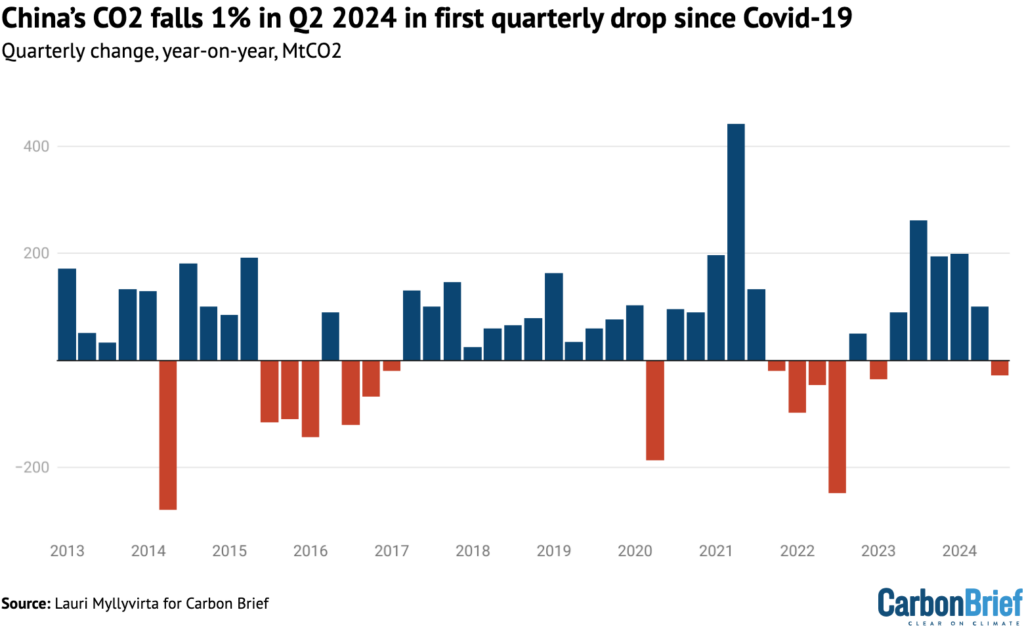
China’s carbon dioxide (CO2) emissions fell by 1% in the second quarter of 2024 in the first quarterly fall since the country re-opened from its “zero-Covid” lockdowns in December 2022.
The new analysis for Carbon Brief, based on official figures and commercial data, shows China remains on track for a decline in annual emissions this year.
This annual outlook depends on electricity demand growth easing in the second half of the year, as expected in projections from sector group the China Electricity Council.
However, if the latest trends in energy demand and supply continue – in particular, if demand growth continues to exceed pre-Covid trends – then emissions would stay flat in 2024 overall.
Other key findings from the analysis include:
A slew of recent policy developments, summarised below, hint at a renewed focus in Beijing on the country’s energy and climate targets.
Yet the precise timing and height of China’s CO2 emissions peak, as well as the pace of subsequent reductions, remain key uncertainties for global climate action.
China’s CO2 emissions fell by 1% in the second quarter of 2024, the first quarterly fall since the country re-opened from zero-Covid, as shown in the figure below.
Within the overall total, power sector emissions fell by 3%, cement production fell by 7% and oil consumption by 3%.
The reduction in CO2 emissions was driven by the surge in clean energy additions, which is driving fossil fuel power into reverse. (See: Clean energy additions on track to top 2023 record.)
However, rapid energy demand growth in sectors such as coal-to-chemicals diluted the impact of changes in the electricity sector. (See: Rapid energy demand growth.)
The additions of new clean power capacity in China have continued to boom this year.
China added 102 gigawatts (GW) of new solar and 26GW of wind in the first half of 2024, as shown in the figure below. Solar additions were up 31% and wind additions up 12% compared with the first half of last year, so China is on track to beat last year’s record installations.
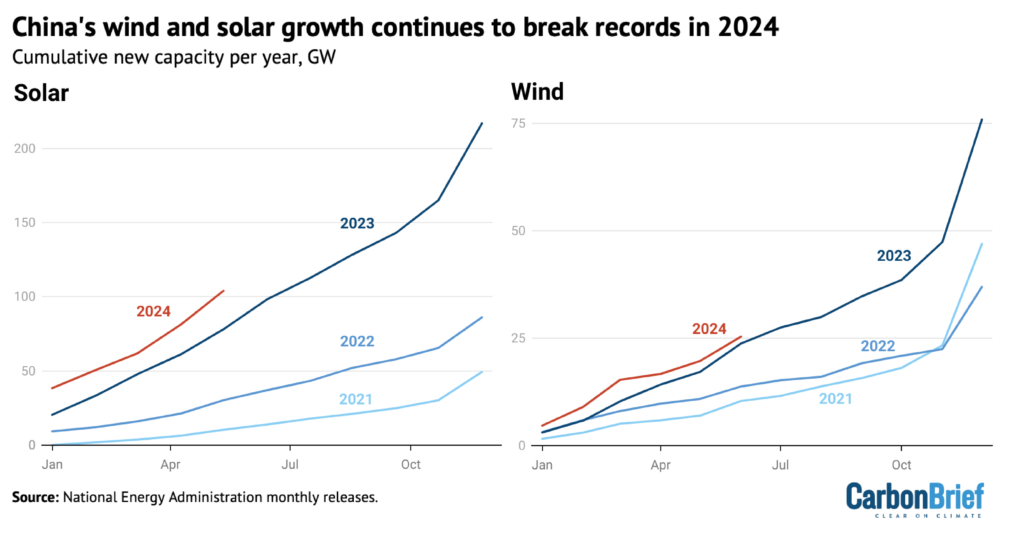
As a result of the strong capacity growth – and despite poor wind conditions – solar and wind covered 52% of electricity demand growth in the first half of 2024 and 71% since March. (The fall in wind speeds can be seen from NASA MERRA-2 data averaged for all of China.)
Indeed, the increase in power generation from solar and wind reported by the National Energy Administration in the first half of the year, at 171 terawatt hours (TWh), exceeded the UK’s total electricity supply of 160TWh in the first half of 2023.
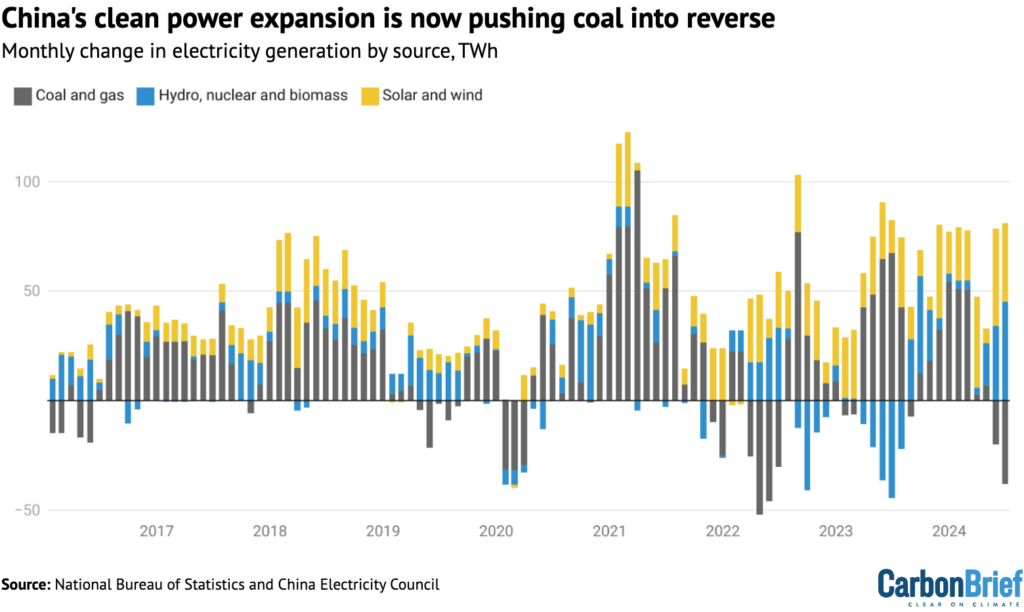
Rapid demand growth in January–February, at 11%, had outpaced even the clean energy additions. But combined with a rebound in hydropower generation, the increase in non-fossil electricity supply exceeded power demand growth in the March to June period.
These shifts are shown in the figure below, illustrating how clean power expansion started to exceed electricity demand growth in recent months, pushing coal and gas power into reverse.
After stopping the publication of capacity utilisation data by technology in May, the National Energy Administration released data in July on power generation by technology for renewable sources – solar, wind, hydro and biomass.
The NEA’s data shows renewable electricity generation covering 35% of demand in the first half of 2024 and growing 22% year-on-year. This is much higher than the previously-published National Bureau of Statistics numbers – which under-report wind and particularly solar power generation – but is closely aligned with estimates previously published by Carbon Brief.
In terms of other clean energy technologies, the production of electric vehicles, batteries and solar cells – the so-called “new-three” due to their recently acquired economic significance – continued to grow strongly in the first half of the year, at 34%, 18% and 37%, respectively.
This growth in production indicates strong demand from China and overseas. The growth of solar cell production halted in June, however.
While clean technologies continue to surge in China, energy consumption has also continued to grow at a fast rate relative to GDP. This indicates that the energy-intensive growth pattern that China followed during zero-Covid is continuing.
In the second quarter of 2024, total energy consumption increased by 4.2%, while GDP grew by 4.7%, marking an energy intensity gain of only 0.5%. This energy demand growth is much faster than the pre-Covid trend.
China’s target is an annual improvement of 2.9%, a rate that was exceeded consistently until Covid-era economic policies shifted the country’s growth pattern. Economic growth during and after zero-Covid has been reliant on energy-intensive manufacturing industries.
The main structural drivers of recent energy consumption growth were the coal-to-chemicals industry, and industrial demand for power and gas.
The coal-to-chemicals industry produces petrochemical products from coal instead of oil, supporting China’s energy security goals but at a great cost to climate goals, as the coal-based production processes have far higher carbon footprints.
China’s energy security drive and falling coal prices relative to oil prices have driven a boom in this industry. When coal supply was tight in 2022–23, the government was controlling coal use by the chemical industry to increase supply to power plants. As the coal supply situation has eased in 2024, this has enabled coal-to-chemicals plants to increase production, with coal consumption in the chemical industry growing 21% in the first half of the year.
Gas consumption increased 8.7% in the first half of the year, with industrial and residential gas consumption rising strongly, even as power generation from gas fell. Residential demand was driven up by extreme cold in the winter, however, rather than by structural factors.
On the flipside, the demand for oil products continued to fall, with a 3% drop in the second quarter that accelerated in the summer.
There are multiple factors driving the reduction: the shift to electric vehicles is contributing to the drop, with the share of EVs in cumulative vehicle sales over the past 10 years – an indicator of the mix of vehicles on the road – reaching 11.5% in June, up from 7.7% a year ago. This means that the increase in EVs cut the demand for transport fuels by approximately 4%.
The ongoing contraction in construction volumes, which is apparent in the fall in cement production, also affects oil demand, as the construction sector is a major source of demand for oil products for freight and machinery.
Another key driver is weak demand for oil as a petrochemical feedstock, which the rapidly increasing coal-to-chemicals production attempts to displace with the use of coal, albeit at a cost of increased CO2 emissions.
The contraction in construction volumes, caused by a slowdown in real estate that began in 2021, is weighing on the demand for cement and steel. Besides the direct effect of less real estate construction, local government revenues are dragged down by a fall in land sales, affecting their ability to spend on infrastructure construction.
These changes in demand for energy can been seen in the figure below, which shows contributions to the change in China’s CO2 emissions in the second quarter of this year.
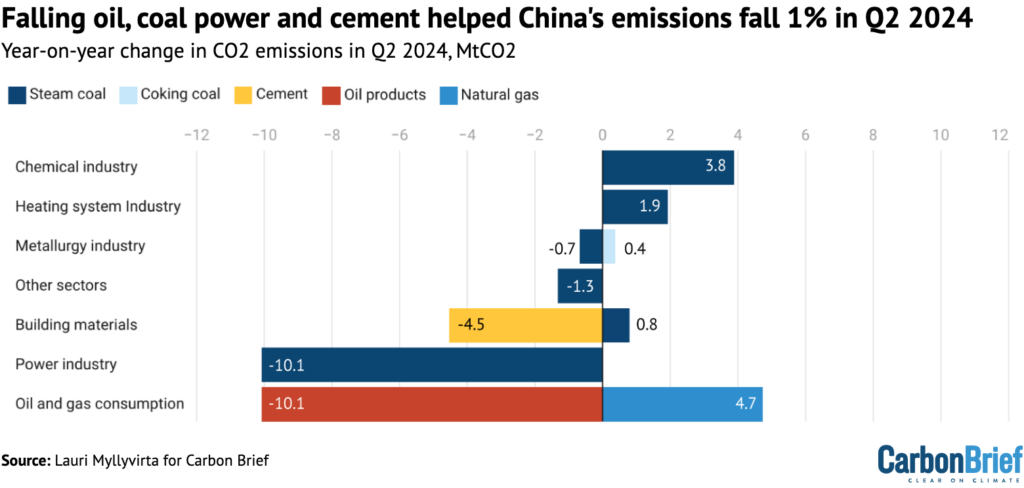
While CO2 emissions did fall in the second quarter, the rate of CO2 intensity improvements fell short of the level needed to meet China’s 2025 carbon intensity commitment.
The country’s goal is to reduce emissions relative to GDP by 18% from 2020 to 2025, with progress until 2023 falling far short of the target.
As reported GDP growth slowed to 4.7% in the second quarter, and CO2 emissions fell by 1%, CO2 intensity improved by 5.5%, short of the 7% annual improvement needed in 2024-25 to get back on track.
Improvements are also easier to achieve this year than they will be in 2025, as the rebound of hydropower from the low availability in 2022–23 helps reduce emissions. This is a one-off tailwind that is not likely to be present in 2025.
One part of the energy-intensive industry that China has been relying on to drive economic growth is the manufacturing of clean energy technologies. In response, some commentators have exaggerated the CO2 impact of Chinese factories making solar panels, EVs and batteries.
In reality, however, the manufacturing of these goods was responsible for 1.6% of China’s electricity consumption and 2.9% of its emissions in the first half of 2024, based on calculations using publicly available data.
The same calculations show that their CO2 emissions and electricity consumption increased by approximately 27% in the same period, contributing a 0.6% increase in China’s total fossil CO2 emissions and 0.4% increase in electricity consumption.
Looking ahead to the rest of this year, energy consumption growth is expected to cool. The China Electricity Council projects electricity demand growth of 5% in the second half of the year, compared with 8.1% in the first half, and the National Energy Administration expects full-year gas demand growth to moderate to 6.5–7.7%, from 8.7% in the first half.
If these projections are accurate, then the continued growth of clean energy consumption would be sufficient to push China’s CO2 emissions into decline this year.
However, the faster-than-expected energy demand growth in the first half of the year dilutes the emission reductions from the country’s record clean energy additions, and adds uncertainty to whether China’s emissions will indeed fall in 2024 compared with 2023.
If the growth rates of energy demand, by fuel and sector, seen in the second quarter of this year continue into the third and fourth quarter, with similar continuity in the growth rates of non-fossil electricity generation, then China’s emissions would stay flat in 2024 overall.
Energy consumption growth could also be moderated by a renewed policy focus on energy and climate targets. In May of this year, the State Council, China’s top administrative body, issued an action plan on energy conservation and CO2 emission reductions in 2024–25.
This plan is notable both for the unusual time period, covering the last two years of the five-year plan period, and for its high-level nature – energy conservation would normally fall under the jurisdiction of the energy and environmental regulators, rather than the State Council.
This suggests that the government recognises the shortfall against the 2025 carbon intensity and energy intensity targets. The action plan calls for meeting both of these targets, and lists numerous measures to be undertaken in response.
Yet the plan did not set numerical targets for 2024 that would be consistent with meeting the 2025 targets, which could be seen as taking a hedged approach of pushing for more action but not guaranteeing that sufficient results will be achieved.
Another State Council plan, released in late July, calls for speeding up the creation of a “dual control system” to control total CO2 emissions and emissions intensity. (Historically, China has never set numerical targets for total CO2 emissions, only aiming to limit CO2 intensity.)
According to the July release, the 15th five-year plan will set a binding carbon intensity target in the 2026-30 period, in line with previous five-year plans. For the first time, there will also be a non-binding, “supplementary” target for China’s absolute emissions level in 2030. Then, for each of the following five-year periods, there will be a binding absolute emissions target.
After the shortfall against the 2025 intensity target, the 15th five-year plan period would need to set a demanding intensity target to fulfil China’s 2030 commitments under the Paris Agreement.
The most important political meeting of the year, the “third plenum” of the Central Committee of the Communist Party, took place in July. The readout of the meeting mentioned carbon emissions reduction for the first time, but did not signal a shift to stimulating consumption. This could have driven less emissions-intensive economic growth, reducing reliance on higher-carbon manufacturing or infrastructure expansion.
The key focus of the meeting was promoting “new quality productive forces”, meaning advanced manufacturing and innovation. In practice, this likely implies a continued emphasis on manufacturing, with the potential for the energy-intensive economic growth pattern to continue.
Another indication that carbon emissions are receiving more policy emphasis is that the government appears to have stopped permitting new coal-based steelmaking projects since the beginning of 2024.
Hundreds of coal-based “replacement” projects were permitted in previous years, preparing to replace up to 40% of China’s existing steelmaking capacity with brand-new furnaces.
The shift away from new coal-based capacity is consistent with China’s target of increasing the use of electric arc furnaces – but progress towards that target had been lagging.
On coal-fired power, the government issued a new policy on “low-carbon transformation” of coal plants, aiming to initiate “low-carbon” retrofitting projects of a batch of coal power plants in 2025, with the target of reducing the CO2 emissions of those plants 20% below the average for similar plants in 2023, and another batch in 2027 aiming for emission levels 50% below 2023 average.
Under this transformation plan, emissions reductions at targeted coal plants are supposed to be achieved by “co-firing” coal with either biomass or “green” ammonia derived from renewables-based hydrogen, or by adding carbon capture, utilisation and storage (CCUS).
However, there are no targets for how many coal plants should be retrofitted, or what the incentives will be to do that, which will obviously determine the direct impact of this policy.
The impact could be small as biomass supply is limited, while the costs of ammonia and CCUS are high. For example, the International Energy Agency – among the more optimistic on power generation from biomass – sees its share rising from 2% in 2022 to 4.5% in 2035, if China meets its pledges on energy and climate IEA’s.
Furthermore, much of China’s coal-fired generation is already unprofitable, with almost half of the firms in the sector operating at a loss – even before taking on costly new measures.
The policy does however constitute Beijing’s first attempt at reconciling the recent permitting spree of new coal-fired power plants with its CO2 peaking goal for 2030, and looking for alternatives to early closure or under-utilisation of at least a part of the coal power fleet.
China’s emissions fell year-on-year in March and in the second quarter, as expected in my analysis for Carbon Brief last year.
Faster-than-expected growth in coal demand for the chemical industry, however, as well as industrial demand for power and gas, has diluted the emission reductions from the power sector, making the fall in emissions smaller than expected.
Nevertheless, China is likely still on track to begin a structural decline in emissions in 2024, making 2023 the peak year for CO2 emissions.
In order for this projection to bear out in reality, clean energy growth would need to continue and the expected cooling in energy demand growth in the second half of the year would need to materialise, with the new policy focus on energy savings and carbon emissions proving lasting.
The trends that could upset this projection include the economic policy focus on manufacturing, and the expansion of the coal-to-chemicals industry.
The surge in coal use for coal-to-chemicals is also a demonstration that even if power sector emissions begin to fall, as long as China’s climate commitments allow emissions to increase, there is the potential for developments that increase emissions in other sectors.
China has committed to updating its climate targets for 2030 and releasing new targets for 2035 early next year. These targets will be key in cementing the emissions peak and specifying the targeted rate of emission reductions after the peak – both of which have seismic implications for the global emissions trajectory and the level at which temperatures can be stabilised.
Data for the analysis was compiled from the National Bureau of Statistics of China, National Energy Administration of China, China Electricity Council and China Customs official data releases, and from WIND Information, an industry data provider.
Wind and solar output, and thermal power breakdown by fuel, was calculated by multiplying power generating capacity at the end of each month by monthly utilisation, using data reported by China Electricity Council through Wind Financial Terminal.
Total generation from thermal power and generation from hydropower and nuclear power was taken from National Bureau of Statistics monthly releases.
Monthly utilisation data was not available for biomass, so the annual average of 52% for 2023 was applied. Power sector coal consumption was estimated based on power generation from coal and the average heat rate of coal-fired power plants during each month, to avoid the issue with official coal consumption numbers affecting recent data.
When data was available from multiple sources, different sources were cross-referenced and official sources used when possible, adjusting total consumption to match the consumption growth and changes in the energy mix reported by the National Bureau of Statistics for the first quarter and the first half of the year. The effect of the adjustments is less than 1% for all energy sources, and the conclusion that emissions fell in the second quarter holds both with and without this adjustment.
CO2 emissions estimates are based on National Bureau of Statistics default calorific values of fuels and emissions factors from China’s latest national greenhouse gas emissions inventory, for the year 2018. Cement CO2 emissions factor is based on annual estimates up to 2023.
For oil consumption, apparent consumption is calculated from refinery throughput, with net exports of oil products subtracted.
COAL: An Appalachian Power official tells West Virginia regulators the utility continued to operate three coal-fired power plants that lost a combined $87 million over the last year because excessive coal inventories on site threatened worker safety. (West Virginia Public Broadcasting)
ELECTRIC VEHICLES:
SOLAR:
WIND: Federal officials mail surveys to residents on the Gulf Coast to gauge their feelings about offshore wind energy development. (KPLC)
GRID:
OIL & GAS:
CLIMATE:
HYDROGEN: Advocates worry proposed federally incentivized green hydrogen production facilities in Arizona and other arid states will further deplete already strained water supplies. (Floodlight)
GRID:
UTILITIES: Nevada regulators propose allowing NV Energy to stop charging a single statewide disaster preparedness rate so customers in the southern part of the state will not subsidize wildfire prevention in the north. (Nevada Current)
ELECTRIC VEHICLES: An Idaho sanitation company replaces its diesel-fueled garbage collection fleet with electric trucks. (Idaho Statesman)
OIL & GAS:
SOLAR:
ELECTRIFICATION: Berkeley, California’s city council votes to approve a ballot initiative that would tax large buildings that use natural gas-fueled appliances. (Daily Californian)
CLIMATE: An investigation finds Nevada officials continued to offer contracts to a startup even after its carbon emissions tracking system failed to perform as promised. (ProPublica)
POLITICS: U.S. Rep. Harriet Hageman, a Wyoming Republican, proposes removing Boulder, Colorado’s gas stations and streets, citing the progressive city’s efforts to fight climate change. (WyoFile)
BIOFUELS: A southern California city plans to upgrade its wastewater treatment plant to produce biofuels from organic waste and sewage sludge. (news release)
As Maine considers building a new toll highway to improve commutes in and out of Portland, a state climate working group is drafting strategies to reduce driving in the state.
State officials say the two efforts are not inherently at odds, but experts and advocates caution that continued highway expansion could reverse climate progress by encouraging more people to drive.
The parallel discussions in Maine raise a question that few states have yet grappled with: can governments keep expanding car infrastructure without putting climate goals out of reach?
Transportation is the largest source of greenhouse gas emissions in Maine and many other states. Electric vehicle adoption is growing, but not fast enough to solve the problem on its own, which is why an updated state climate plan is expected to include a new emphasis on public transit, walking, biking, and other alternatives to passenger vehicles.
Zak Accuardi, the director for mobility choices at the Natural Resources Defense Council, said the best way for states to invest in their road systems in the era of climate change is to not build new roads, but maintain and upgrade existing ones to accommodate more climate-friendly uses.
“The states who are taking transportation decarbonization really seriously are really focused on reducing driving, reducing traffic,” Accuardi said, pointing to Minnesota and Colorado as examples. “Strategies that help support more people in making the choice to walk, bike or take transit — those policies are a really important complement to … accelerating the adoption of zero-emissions vehicles.”
Electric vehicles have been Maine’s primary focus to date in planning to cut back on transportation emissions. Goals in the state’s original 2020 climate plan included getting 41,000 light-duty EVs on the road in Maine by next year and 219,000 by 2030. The state is far behind on these targets. The climate council’s latest status report said there were just over 12,300 EVs or plug-in hybrid vehicles in Maine as of 2023.
A 2021 state clean transportation roadmap for these goals recommended, among other things, the adoption of California’s Advanced Clean Cars II and Advanced Clean Trucks rules, which would require an increasing proportion of EV sales in the coming years.
Maine regulators decided not to adopt Clean Cars II earlier this year in a 4-2 vote. A subsequent lawsuit from youth climate activists argued the state is reneging on its responsibility to meet its statutory climate goals by choosing not to adopt such rules.
The original climate plan also aimed to cut Maine’s vehicle miles traveled (VMT), which measures how much people are driving overall, by 20% by 2030. The plan said getting there would require more transit funding, denser development to improve transit access, and broadband growth to enable remote work, but included little detail on these issues. It did not include the words “active transportation” at all.
That appears poised to change in the state’s next four-year climate plan, due out in December. Recommendations from the state climate council’s transportation working group have drawn praise from advocacy groups like the Bicycle Coalition of Maine.
The group’s ideas include creating new state programs to support electric bike adoption, including in disadvantaged communities; paving 15 to 20 miles of shoulders on rural roads per year to improve safe access for cyclists and pedestrians; and, depending on federal funds, building at least 10 miles of off-road trails in priority areas by 2030.
The group also recommended the state “develop targets related to increased use of transit, active transportation, and shared commuting that are consistent with Maine’s statutory emissions reduction goals.”
In unveiling the recommendations, working group co-chair and Maine Department of Transportation chief engineer Joyce Taylor noted community benefits from road safety upgrades to accommodate these goals.
“I think this also gets at housing and land use,” she said. “If you can get people to want to live in that community, that village, I think we could all say that it’s more economically vibrant when people are able to walk and bike in their village and feel like they can get around and it’s safe.”
The Gorham Connector project would offer a new, tolled bypass around local roads as an alternative to upgrading those existing routes, an option that’s also been studied. State officials say the new road would smooth the flow of local traffic, including public transit.
Towns like Kittery, in southern Maine, have tried to focus on a more inclusive array of transportation strategies in their local work to cut emissions from passenger vehicles.
Kittery town manager Kendra Amaral is a member of the climate council’s transportation group. She couldn’t comment on the state’s approach to the Gorham Connector, which is outside her region. But she said her town’s climate action plan, adopted this past May, “threads together” public transit, housing growth and emissions reductions.
Stakeholders who worked on the plan, she said, strongly recommended ensuring that housing is in walkable or transit-accessible places.
Amaral said the town has invested in new bus routes, commuter shuttles and road improvements to promote traffic calming and create safer bike and pedestrian access, as well as in EV growth. And she said Kittery was a model for parts of a new state law that enables denser housing development.
“We can’t expect people to reduce (emissions) resulting from transportation without giving them options,” she said. But, she added, “there is no ‘one size fits all’ solution” for every community. “I believe we have to avoid the ‘all or nothing’ trap and work towards (the priorities) that get the best results for each community,” she said.
The Maine Turnpike Authority acknowledges the proposed Gorham Connector project in the Portland area would increase driving. But paired with improvements to transit and land-use patterns, they say the proposed limited-access toll road would decrease emissions overall — though research and other cases cast doubt on this possibility.
“It’s possible for a project like this to be designed in a way that does produce favorable environmental outcomes,” Accuardi said, but “the devil is really in the details.”
For example, he said the new road’s tolls should be responsive to traffic patterns in order to effectively reduce demand. If they’re too low, he said, the road will become jammed with the kind of gridlock it aimed to avert. But set the tolls too high, and the road won’t get used enough.
He said it’s true that this kind of new access road can lead to denser housing development in the surrounding area — but the road will need to be tolled carefully to account for that increased demand.
And the proceeds from those tolls, he said, should ideally go toward new clean transportation alternatives — such as funding additional transit service or safe walking and biking infrastructure around the new toll road, helping to finance subsidized affordable housing in transit-served areas, or allocating revenues to surrounding towns that make “supportive land-use changes” to lean into transit and decrease driving.
Maine has indicated that it expects to use tolls from the Gorham Connector primarily, or at least in part, to pay for the road itself and avoid passing costs to other taxpayers.
But Accuardi said alternative strategies should see more investment than road expansions in the coming years if states like Maine want to aggressively cut emissions.
He said on average, across the country, states spend a quarter of their federal transportation funding on “expanding roads or adding new highway capacity.”
“That’s more money than states tend to spend on public transit infrastructure, and that really needs to be flipped,” he said. “We need to see states really … ramping down their investments in new highway capacity. Because, again, we know it doesn’t work.”
Last month saw another extreme weather milestone with the world’s hottest day on recent record registered on 22 July – yet another indication of the extent to which greenhouse gas emissions from human activities are changing our climate, the World Meteorological Organization (WMO) reported on Wednesday.
Global average temperatures for 13 consecutive months from June 2023 to June 2024 also set new monthly records.
“Widespread, intense and extended heat waves have hit every continent in the past year. At least ten countries have recorded daily temperatures of more than 50 degrees Celsius in more than one location,” said WMO Secretary-General Celeste Saulo.
These trends underline the urgency of the Call to Action on Extreme Heat, a new initiative launched in July by UN Secretary-General António Guterres to enhance international cooperation to address extreme heat.
“Earth is becoming hotter and more dangerous for everyone, everywhere,” stressed the UN Chief.
Extreme heat is causing a ripple effect felt right across society.
An annual 1℃ increase in temperature leads to a 9.1 per cent increase in poverty. Moreover, 12 per cent of all food produced is lost due to a lack of cooling and working hours equivalent to 80 million full-time jobs could be lost due to heat stress by 2030.
The consequences have become deathly. Nearly half a million heat-related deaths occurred each year from 2000 to 2019.
Taken together, extreme heat is tearing through economies, widening inequalities, and derailing the future of the Sustainable Development Goals.
“This is becoming too hot to handle,” said Ms. Saulo.
Listen to: ‘Heatwaves will be more frequent because of human-made climate change’ by United Nations News.
The UN chief launched the Call to Action to mitigate the dire environmental and socioeconomic consequences that are already evident.
The initiative emphasises the need for concerted effort in four critical areas: caring for the vulnerable, protecting workers, boosting resilience of economies and societies using data and science, and limiting temperature rise to 1.5℃ by phasing out fossil fuels and scaling up investment in renewable energy.
It brings together the expertise and perspectives of ten specialised UN entities, underscoring the diverse multi-sectoral impacts of extreme heat on human health, lives, and livelihoods.
“The WMO community is committed to responding to the UN Secretary-General’s Call to Action with better heat-health early warnings and action plans,” said Ms. Saulo, adding that recent estimates indicate that the global scale-up of heat health-warning systems for 57 countries alone has the potential to save around 98,000 lives per year.
OIL & GAS: A Texas lawsuit alleging Chevron and other oil companies failed to properly plug oil wells raises the question of a “colossal liability” that could fall to companies or taxpayers. (Inside Climate News)
ALSO:
GRID:
SOLAR: A Tennessee public housing authority installs solar panels on a property to house a community of veterans at risk of being homeless. (WBIR)
ELECTRIC VEHICLES: Oklahoma transportation officials collect public input on the state’s draft plan to build electric vehicle chargers and other infrastructure. (KSWO)
PIPELINES: Opponents of the Mountain Valley Pipeline praise a provision in federal legislation to create a national office of public engagement to better communicate details about the transport of natural gas. (WFDD)
UTILITIES:
CLIMATE:
COMMENTARY:
GRID: The Department of Energy awards $2.2 billion in grants to eight transmission projects that, matched with $10 billion in private investment, are expected to support 13 GW of new clean energy. (Canary Media)
ALSO:
CLEAN ENERGY: A key oversight body says nearly one-third of the carbon offset credits on the market do not meet its standards, a sign of further upheaval in a process that is already heavily criticized. (Bloomberg)
CLIMATE: The window for lawmakers to repeal the SEC’s climate-risk disclosure rule closed last week, but the policy still faces legal challenges. (Utility Dive)
OIL & GAS:
TRANSPORTATION:
HYDROGEN: Oregon advocates push back against a utility’s pilot project blending hydrogen into its natural gas distribution system in Portland, joining other critics around the region citing safety concerns, high costs and limited effectiveness at decarbonization. (Oregon Capital Chronicle, Floodlight)
NUCLEAR: Federal regulators are seeking more information about plans to sell power from a Pennsylvania nuclear plant to an Amazon data center to be located nearby. (Utility Dive)
HYDROPOWER: Hydropower associations are suing the Biden administration over new rules to protect vulnerable fish populations. (E&E News, subscription)
COMMENTARY: Advocates urge federal lawmakers to protect the Biden administration’s oil and gas leasing rules from legislative attacks, saying they help protect the West’s outdoor recreation economy from drilling’s impacts. (Colorado Sun)
HYDROGEN: Oregon advocates push back against a utility’s pilot project blending hydrogen into its natural gas distribution system in Portland, joining other critics around the region citing safety concerns, high costs and limited effectiveness at decarbonization. (Oregon Capital Chronicle, Floodlight)
UTILITIES: California Gov. Gavin Newsom proposes legislation aimed at lowering electricity bills, but has yet to disclose details. (Sacramento Bee)
GRID:
OIL & GAS:
GEOTHERMAL:
EMISSIONS:
POLITICS: A debate over the domestic uranium industry’s predicted revival dominates a Utah legislative race in the southeastern part of the state. (KJZZ)
STORAGE: Developers bring a 400 MW battery energy storage system online in southern California. (The Sun)
COMMENTARY:
Snaking under city streets, behind residential drywall and into furnaces, ovens and other appliances, natural gas pipelines are a ubiquitous presence in U.S. buildings. The question of what to do with them as the planet warms has become a serious debate — dozens of U.S. cities and states have crafted plans to reduce reliance on natural gas, and more than 20 other states have passed laws to preempt that type of regulation.
Now, utilities around the nation have begun testing a controversial idea aimed at reducing the carbon footprint of gas lines, while keeping them in place. Nearly 20 utilities have laid out plans to inject lines with a blend of gas and hydrogen, the latter of which emits no carbon dioxide (CO2) — a major greenhouse gas — when combusted. Testing such blends, these companies say, is an essential step towards understanding the practice, which they argue will help reduce emissions and fight climate change.
Deploying more hydrogen is also a federal priority — the Inflation Reduction Act created a tax credit for hydrogen production, and the Bipartisan Infrastructure Law set aside $9.5 billion to support hydrogen development.
But a federal hydrogen strategy released last year suggests blending hydrogen into gas infrastructure should focus on industrial applications. Many environmental and customer advocates agree; they argue that the use of hydrogen blends in buildings — rather than to power industries that are hard to electrify — makes little sense.
“Every dollar you’re reinvesting into the gas system could be a dollar you’re using to electrify the system,” said Nat Skinner, program manager of the safety branch of the California Public Advocates Office, an independent state office that advocates for consumers in utility regulation. “Finding the right uses for hydrogen is appropriate. But I think being really careful and thoughtful about how we’re doing that is equally important.”
Nearly 30 projects focused on blending hydrogen into gas lines that serve homes and businesses have been proposed or are in operation in more than a dozen states, Floodlight found, and many more utilities have hinted at future proposals. If all are approved, the projects as proposed would cost at least $280 million — and many utilities are asking that customers pay for them.
As regulators consider the proposals, advocates are calling for them to weigh the prudence of the investment. In California — where electric rates have climbed steeply in recent years — the Sierra Club has argued that the projects are “an inappropriate use of ratepayer funds” and “wasteful experiments.”
Hydrogen blending can be undertaken in a section of pipeline isolated from the rest of the gas network or in a larger “open” system that serves homes. Utilities can inject it in large transmission lines, which ferry gas from processing and storage locations to compressor stations, or into distribution lines, the smaller pipes that bring gas to buildings.
Because hydrogen releases only water vapor and heat when it’s burned, it’s considered a clean fuel. And unlike traditional wind and solar energy, it can produce enough heat to run industrial furnaces. Utilities have framed the fuel as a clear way to slash the emissions associated with their operations.
“These demonstration projects are an important step for us to adopt hydrogen blending statewide, which has the potential to be an effective way to replace fossil fuels,” said Neil Navin, the chief clean fuels officer at Southern California Gas (SoCalGas), in a March statement on its application for hydrogen blending pilots.
Burning hydrogen, particularly in homes, also presents certain risks. Hydrogen burns hotter than natural gas, which can increase emissions of nitrous oxide (NOx), a harmful air pollutant that can react with other elements in the air to produce damaging pollutants including small particulates and ozone.
Hydrogen is a smaller molecule than methane, the main ingredient in natural gas, and can leak more readily out of pipelines. Hydrogen is also flammable. And when certain metals absorb hydrogen atoms, they can become brittle over time, creating risks of pipeline cracks, depending on the materials the pipelines are made of.
There are also outstanding questions about how much hydrogen blending actually reduces greenhouse gas emissions.
Of the utilities that have offered details about the hydrogen source they plan to use for their pilot, roughly half plan to use “green hydrogen,” which is produced using clean electricity generated by renewable sources such as wind and solar. Today, fossil fuels power more than 90% of global hydrogen production, producing “gray hydrogen.”
Most utility blending pilots are targeting blends of up to 20% hydrogen. At those levels, research has shown that hydrogen would reduce carbon dioxide emissions by less than 10%, even when using hydrogen produced with clean manufacturing processes.
Some utilities have estimated the emissions impacts of their pilots. A CenterPoint Energy pilot in Minneapolis using blends of up to 5% green hydrogen was estimated to reduce carbon emissions by 1,200 metric tons per year, which is the approximate energy use of 156 homes. A project in New Jersey testing blends of 1% green hydrogen was estimated to reduce emissions enough to offset the energy use of roughly 24 homes.
Blending gray hydrogen may show no carbon benefit at all, according to some research. That’s in part because hydrogen produces one-third less energy by volume than natural gas, meaning three times the amount of hydrogen is needed to make up for the same unit of natural gas.
And hydrogen requires more energy to manufacture than it will later produce when it’s burned. For these reasons, some environmental groups say hydrogen is an inefficient way to decarbonize homes and businesses; some analysts have called the process “a crime against thermodynamics.”
“There are much better, readily available, more affordable ways to decarbonize buildings in the form of electrification and energy efficiency,” said Jim Dennison, a staff attorney at the Sierra Club.
Advocates including Dennison also worry that investing more in the natural gas system will delay electrification and allow utilities to keep their core pipeline businesses running. “I can see why that’s attractive to those utilities,” he said. “That doesn’t mean it makes sense for customers or the climate.”
While the climate benefits are debated, some research and active projects indicate that burning blended fuel at certain levels can be safe. For decades, Hawaii Gas has used synthetic natural gas that contains 10-12% hydrogen. Countries including Chile, Australia, Portugal and Canada have also run hydrogen blending pilots.
And although pipelines can weather when carrying hydrogen, that’s less likely for distribution lines that reach homes because those pipes are often plastic, said Bri-Mathias Hodge, an associate professor in energy engineering at the University of Colorado-Boulder.
Hodge helped author a 2022 review of technical and regulatory limits on hydrogen and gas blending. With blends below 5%, Hodge said customers are unlikely to face risks or notice a difference in how their appliances or furnaces function.
More uncertainty exists around higher blends. “I think we’re not sure if below 20% or say, from 5 to 20% is safe,” said Ali Mosleh, an engineer at the University of California-Los Angeles who is spearheading hydrogen blend pilot testing with 44 partners, including utilities, to address knowledge gaps in the state.
Although Hodge at UC-Boulder thinks electrification is the more efficient choice for homes, he said the pilots can help utilities get comfortable with blending, which may eventually be applied elsewhere. “It’s not going to really move the needle in terms of decarbonization long term, but it’s a step in the right direction,” he said.
Steven Schueneman, the hydrogen development manager at utility Puget Sound Energy, which serves about 1.2 million electric and 900,000 gas customers in Washington, said incremental approaches like utility blending pilots will signal that hydrogen is a “real industry.” That could help the fuel gain a foothold in other areas, like industrial heat and aviation.
But Schueneman also acknowledges there remains uncertainty around whether hydrogen is the most cost-effective way to decarbonize buildings.
“It’s not clear that blending hydrogen is going to be a prudent decision at the end of the day,” he said.
Puget Sound Energy has conducted two small-scale blending pilots at a test facility. In the future, the utility plans to focus its hydrogen efforts on how blends may function in power plants, rather than in buildings. The nearly 30 blending pilots Floodlight tracked include only projects focused on use in buildings, but other utilities have proposed blending hydrogen at natural gas power plants, where the blend will be burned for electricity.
Blending pilots focused on buildings have been spearheaded by some of the largest utilities in the nation as well as smaller-scale gas providers, and are being considered from coast-to-coast.
Dominion Energy, which serves 4.5 million customers in 13 states, has laid out plans for three blending pilots, in Utah, South Carolina and Ohio. National Grid, which has 20 million customers, is pursuing a project in New York. And multiple large California utilities have proposed pilot programs.
Some utilities, such as Dominion and Minnesota-based Xcel Energy, did not reply to several requests for clarification on hydrogen blending plans, or replied to only some queries about their plans. But plans from certain utilities have been detailed in regulatory filings with state utility commissions.
The pilots for which cost data are available range in price from roughly $33,000 for Puget Sound Energy’s small-scale testing (which ratepayers did not fund) up to an estimated $63.5 million for a decade-long pilot proposed by California utility Pacific Gas & Electric (PG&E), which would focus on blending 5% at the start ranging up to 20% hydrogen in transmission gas lines.
If approved, customers would pay up to $94.2 million for PG&E’s pilot, because of the rate of return utilities are able to collect from customers. California utilities are aiming to recover more than $200 million in total from customers for their proposed pilots.
California regulators have rejected some previous blending proposals from utilities, saying companies should use “every reasonable attempt to use existing and other funds before requesting new funds.” Advocates including the Environmental Defense Fund (EDF) have argued that the projects are not in the public interest, particularly amid the state’s spiking utility bills.
“Cost is an essential consideration,” said Erin Murphy, a senior attorney at EDF. “When you’re passing on costs to ratepayers, you have to demonstrate that that is a prudent investment.”
Pilots have gotten pushback in other states, including Colorado and Oregon, where projects were recently dropped or delayed, and opposition has been fierce in California, which has the most pilots proposed to date. The mayor of Truckee, California, which could host a project, submitted a comment to regulators explaining the town does not support it. And following protests at two California universities that planned to collaborate on projects, utilities downsized the plans.
After student opposition at University of California-Irvine, SoCalGas reduced the scope of the project and proposed an additional pilot in Orange Cove, a small agricultural community of about 9,500 people. Ninety-six percent of Orange Cove’s population identifies as Hispanic or Latino, and roughly 47% of residents live below the federal poverty line, according to the U.S. Census.
Some Orange Cove residents also are concerned about blending, which SoCalGas hopes to test at up to 5% hydrogen levels. Genoveva Islas, who grew up there and is the executive director of Cultiva la Salud, a public health nonprofit based in nearby Fresno, said the local approval process lacked transparency and public input.
The project is slated to sit steps away from the Orange Cove football field, near the town’s high school, middle school and community center. “In short, I would just say it is concerning,” Islas said.
In an email, the utility told Floodlight that the city “proactively asked SoCalGas to undertake this project in its community” and said it was “expected to bring socioeconomic benefits to Orange Cove.” The utility also said it hosted a community engagement meeting about the project in Spanish and English and has provided fact sheets to the community in both languages.
In Colorado, where Xcel Energy had planned to blend hydrogen in an isolated neighborhood, some residents learned of the pilot from a journalist reporting on the project.
That has made some feel like unwilling test subjects in an experiment that others, like the Sierra Club’s Dennison, say are unnecessary. “The community’s immediate reaction is that they don’t want to be guinea pigs,” Islas said. “They do not understand how this decision was made without their involvement or their consent.”
The great majority of the projects, including the one in Orange Cove, are still under review by regulators. Meanwhile, researchers are undertaking more studies to understand the technical limits of blending.
“There are a lot of unknowns,” said Mosleh from UCLA. “Some fundamental research needs to be done.”
BUILDINGS: The U.S. EPA grants $450 million to a coalition of five New England states to encourage heat pump adoption, aiming for 65% of home heating and air conditioning sales by 2030. (Canary Media)
ALSO:
GRID:
CLEAN ENERGY: Some Pennsylvania businesses say state and federal requirements are making it difficult for them to get involved in clean energy manufacturing, like a Meadville glass maker that wants to hire at least 120 workers to make solar panel glass. (Environment + Energy Leader)
TRANSPORTATION: In New York, two lawsuits aim to revive the Manhattan traffic congestion tolling program, with one claiming the governor’s indefinite pause is an unlawful use of her powers and another making a constitutional law argument. (Sierra)
LEGISLATION: New Hampshire’s governor signs several energy-related laws, including nuclear power studies, renaming an offshore wind office, and rules around involuntary retirement or decommissioning of power generation assets. (InDepth NH)
WORKFORCE: Pennsylvania’s Bucks County Community College receives a $2 million federal grant to invest in a clean energy HVAC technician program and expand a manufacturing apprenticeship. (WHYY)
WIND: As Maine seeks to put an offshore wind port on an undeveloped island that conservationists want to preserve, a reporter does a flyover of the Sear’s Island and Mack Point area to get a bird’s eye view of the current land uses. (Maine Monitor)
COMMENTARY: Massachusetts lawmakers need to reconvene their session to pass a consensus climate bill — which includes project permitting reform — or otherwise “pay a steep price” for the lack of climate action, writes the Northeast Clean Energy Council’s president. (CommonWealth Beacon)


.svg)
