

 Back
Back
OIL & GAS: Colorado regulators waive an oil and gas company’s $1.7 million fine for dozens of violations while revoking its right to operate in the state and ordering it to clean up its facilities. (Colorado Sun)
ALSO:
STORAGE: Tucson Electric Power plans a second 200 MW battery energy storage system in the southeastern part of the city to match another one under construction. (Arizona Daily Star)
GRID:
ELECTRIC VEHICLES: California officials call on the U.S. EPA to approve the state’s rule aimed at replacing diesel big rigs and other heavy trucks with electric or hydrogen vehicles. (CalMatters)
SOLAR: A California appeals court blocks a Los Angeles-area city from forcing a mobile home park to remove solar panels due to neighbors’ complaints. (Signal)
MINING:
MICROGRIDS: The Rincon Band of Luiseño Indians hires a firm to develop a 1.8 MW solar-plus-storage microgrid to power its tribal facilities in southern California. (Valley Roadrunner)
GEOTHERMAL: A Nevada city greenlights a proposed pipeline upgrade that would extend geothermal heating to a recreation center under development. (Elko Daily Free Press)
COMMENTARY:
DALTON, Ga. — Growing up in Cartersville, Georgia, Lisa Nash saw what happens to communities when factory jobs disappear. It was the 1980s and corporations were offshoring production to reduce costs and raise profits. The jobs that remained in this northwest corner of the state were typically lower-paying ones that didn’t offer the same ladder to the middle class.
“My parents and grandparents were in manufacturing, and they were the ones saying, ‘Don’t do it,’” Nash recalled.
Nash disregarded their advice, embarking instead on a long career in manufacturing — first in textiles, followed by stints in aviation, automotive, and steel. Now she’s helping to bring higher-tech, higher-paying factory work back to the corridor between Atlanta and Chattanooga.
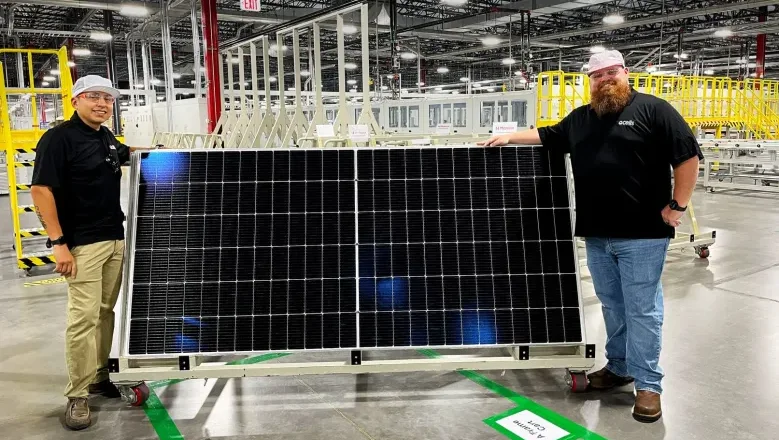
Nash is the general manager of the Qcells solar panel factory in Dalton, a town of 34,000 located 50 miles up I-75 from her hometown. It opened in January 2019, after the Trump administration imposed a fresh round of tariffs on Chinese-made panels. The Korean conglomerate Hanwha owns Qcells, and initially planned to hire several hundred people at the site, Nash told me on a recent visit to the factory. By the end of 2019, it employed more than 800.
Then, in 2020, Georgia helped elect President Joe Biden and sent two Democrats to the Senate, clinching a thin majority. Senators Jon Ossoff and Raphael Warnock got to work crafting detailed policies to promote domestic manufacturing of clean energy technologies, which China had dominated for years; they wanted solar panels and batteries made in America — specifically Georgia — instead of in China, a geopolitical rival.
Those measures made it into the Inflation Reduction Act, which passed in August 2022 — two years ago this week. The legislation created the nation’s first comprehensive policies to support domestic clean energy manufacturing. Qcells broke ground on a second facility in Dalton in February 2023. Completed that August, the expansion added two football fields’ worth of manufacturing space with four new production lines — which produce 1.5 times more solar panels than the original three lines, thanks to technological advances. Now the whole complex employs 2,000 people full time and makes 5.1 gigawatts of solar panels a year, more than any other site in the U.S.
Politicians have been promising for decades to retrain American workers and revive long-lost manufacturing, with little to show for it. Now, though, the U.S. has entered a new era on trade: Leaders of both parties have rejected the long-standing free-trade consensus and its penchant for offshoring jobs. Biden married that reshoring impulse with a desire to boost clean energy production, to both stimulate the economy and fight climate change.
This grand experiment remains in its infancy, and the success of the clean energy manufacturing revolution is by no means guaranteed. Cheap imports could outcompete even newly subsidized American products.
And if Republicans win the presidency and retake Congress, they’ve threatened to stop subsidizing low-carbon energy resources and instead double down on fossil fuel production. House Republicans — including Dalton’s representative, Marjorie Taylor Greene — have voted repeatedly and unsuccessfully to repeal the domestic manufacturing incentives in the IRA. (Greene’s press office did not respond to multiple requests for comment.)
“Donald Trump and his Republican allies promised to gut the Inflation Reduction Act if he’s reelected, so there’s a lot at stake here,” Representative Nikema Williams, who leads the Georgia Democrats, told me.
Since the IRA passed, Georgia has received $23 billion in clean energy factory investment, much of it flowing to northwest Georgia. I wanted to see what impact this is having on communities formerly hit hard by industrial decline, so I followed the money trail to Dalton earlier this summer.
I found a population that seems to like having advanced solar manufacturing in their backyard. Dalton’s solar jobs are boosting wages, invigorating the historic town center, and employing local high school graduates. Those benefits are starting to spread to nearby communities, where new solar factories are springing to life. In November, voters will weigh two very different visions of America’s energy future on the ballot, but Dalton is already reaping the rewards from slotting solar into its storied history of industrial production.
Both CSX and Norfolk Southern run Class I rail lines through Dalton, a testament to its industrial legacy, and freight trains bellow day and night.
That legacy harks back to 1900, according to local historians, when Catherine Evans Whitener sold a hand-tufted bedspread from her front porch for $2.50. The cottage industry took off in this land of forested ridges and stream-crossed valleys, and over time, local factories consolidated into global carpeting giants Shaw Industries and Mohawk Industries.
“The carpet industry was born here,” Carl Campbell, executive director of economic development at the Greater Dalton Chamber of Commerce, told me when I visited the Chamber. The New Georgia Encyclopedia states that 80 percent of America’s tufted carpet production happens within 100 miles of Dalton.
The conference room where we spoke sported large-format aerial photographs of the major factories nearby: the largest Shaw site, 650,000 square feet; and the new Engineered Floors colossus, 2.8 million square feet.
“You feel like there’s enough carpet in that building to cover the whole world,” said Campbell, who grew up in Dalton.
Dalton employment numbers peaked at 80,200 in 2006, per the Chattanooga Times Free Press. But the Great Recession crushed the homebuilding industry, cratering demand for Dalton’s carpeting products.
Dalton “was a ghost town in 2011, nothing going on because everybody was hurting,” Campbell added. From June 2011 to June 2012, Dalton notched the dubious distinction of most jobs lost of all 372 metro areas surveyed by the Bureau of Labor Statistics. By that point, one-quarter of Dalton’s pre-recession jobs had vanished, and unemployment surged to 12.3 percent.
Since then, the industry has recovered somewhat. Engineered Floors, Mohawk, and Shaw still dominate local employment, with some 14,000 jobs among them, Campbell said. Those companies have had to adapt to evolving consumer tastes, shifting from wall-to-wall carpets to hardwood and other flooring materials. They’ve also automated aspects of production, reducing the number of workers needed.
In the wake of the Great Recession, local leaders sought to diversify Dalton’s industry. The county acquired an undeveloped lot south of town, and Campbell later pushed to clear and level the site, so it was shovel-ready for some future tenant. When Trump’s solar tariffs kicked in, Campbell’s counterparts at Georgia’s Department of Economic Development sent Qcells his way.
Qcells showed up in February 2018, looking to spin up its first American solar-panel factory in less than a year. “Suddenly, we had exactly what they needed,” Campbell said.
Thus Dalton managed to bring in new industry to balance out its base of carpets and flooring. Qcells originally promised to invest $130 million and hire 525 people within five years, Campbell said.
“They did it in three months,” he added. “In terms of an economic development project, they check all the boxes: Everything they said they would do, they did it faster than they said they would do it.”
When I asked folks around town what they thought of Qcells, they kept mentioning the dozens of air-conditioning units arrayed on the factory roof, like a field of doghouses, easily visible from I-75. I later learned that Qcells brought in helicopters to install those units, which made for a bit of small-town spectacle. Still, it struck me as a surprising detail to dwell on for a business that somehow turns the sun’s rays into cheap, emissions-free electricity.
Once I crossed Qcells’ sizzling parking lot and stepped indoors, it started to make sense. Georgia gets hot, and carpet factories get hot, but the vast floors of the twin solar factories are quite literally cool places to work.
The climate control is not unique to assembling solar panels, but it is required for the sensitive, precisely calibrated product. The air conditioners are but one sign that high-tech manufacturing has arrived, and that it makes for pretty comfortable work.
I met my two tour guides, Wayne Lock and Alan Rodriguez, in the factory lobby, and they quickly confirmed the physical appeal of Qcells jobs. Lock, now a quality engineer at Qcells, previously worked in carpet manufacturing; he had to wear special heat-resistant gear to handle carpeting materials that would otherwise deliver third-degree burns. Rodriguez, an engineering supervisor at Qcells, used to apply the coating material underneath carpets.
“You’re sandwiched between the steamer and the oven, so it gets quite hot,” Rodriguez told me. Attending to those machines exposed him to temperatures that could exceed 100 degrees Fahrenheit.
Even more than Qcells’ air conditioning, though, people I spoke to kept bringing up the pay.
By offering more for zero-skill, entry-level positions than the other factories in town, Qcells started attracting workers and pushed up wages across Dalton, Campbell said: “Competition brings everybody, so everybody’s had to kind of equalize to keep employees.”
Now Qcells hourly wages for non-experienced hires start at $17.50 to $22 — that amounts to $36,400 to $45,760 a year for full-time work. Workers with experience in robotics and manufacturing can take home much more than that. Employees can raise their pay through a variety of on-the-job training, most of which involves handling and troubleshooting the in-house fleet of robots.
Lock, Rodriguez, and I walked into the newest factory, past meeting rooms with names like Naboo and Mandalore, Star Wars locales where quirky robots coexist with all manner of creatures. As we strolled across the floor, squat wheeled autonomous vehicles rolled past us down pathways marked by tape on the smooth floor, ferrying bales of materials or hauling out hulking boxes of finished panels.
“We try to stay out of their way, and if we don’t, they yell at us,” said Lock. “It’s fun.”
As we stood talking, I noticed that one such robo-buggy was waiting for us to move. Barely discernible over the background drone of machines, a female voice intoned, “Robot is moving. Please look out.” When humans hold up more time-sensitive deliveries, Lock explained, the voice switches to male and gets louder.
Other robots remain fixed in place, carrying out repetitive precision tasks. I stared, mesmerized, at one machine that split wafer-thin silicon cells in half, first scoring them with a laser, then slicing them with a concentrated jet of water. A taller machine grabbed nearly 8-foot metal frames and sliced them through the air like a master swordsman in a Kurosawa film, to slot them around glassed-in silicon panels.
Throughout the process, cameras scan cells and use artificial intelligence to shunt defective items off the line for manual correction.
In the 2019-era factory next door, humans carry out many of these tasks. Lock, though, didn’t see the robots as competitors — he said they were taking on more physically demanding jobs so the humans could step into higher-skilled roles tending to robots.
“The ergonomics are better for you,” he said, and the new lines are more productive.
When Qcells was first staffing up, it relied on Quick Start, a Georgia state program that funds worker training for new factories before they open — a major draw for executives deciding where to locate their factories.
Qcells still recruits to meet ongoing staffing needs, and it has been paying special attention to high schoolers who are graduating and looking for employment. Nash speaks passionately about Qcells’ recruitment efforts; she’s seen the civic fallout from decades when local families encouraged kids to avoid manufacturing.
“Small communities cannot thrive with kids graduating and leaving those communities to live elsewhere, to get high-paying technical jobs,” Nash said. “That’s what’s happening across the country. Bringing manufacturing back, and bringing highly automated manufacturing, is offering job opportunities where now these students are staying here.”
Some 56 percent of Dalton-area students enroll in postsecondary education within 16 months of graduating high school, said Stephani Womack, director of education and workforce development for the Greater Dalton Chamber of Commerce. For the remainder, the chamber wants to make sure family-supporting jobs are available.
For two weeks in June, Womack helped run Project Purpose, a crash course in how to start and navigate careers that pay living wages. Recent high school graduates prepped for interviews, shopped for professional clothes, and toured housing options and downtown hotspots — the kinds of places they could frequent once they join the workforce.
But the centerpiece of the program amounted to professional speed dating, as Dalton’s major employers offered tours and entry-level jobs. Last year, Dalton’s first time running Project Purpose, seven young adults completed the program, and Qcells hired one of them. This time, 18 finished, and Qcells hired 12 of them to start on July 1.
“Next year, we hope to double that, or more,” Nash said.
Several participants came in knowing about Qcells, betting that the intensive crash course would increase their odds of landing good roles there, Womack told me over a table at Garmony House, a downtown coffee shop that draws lines for its statuesque strawberry cupcakes and coffee-glazed cinnamon rolls.
“Qcells is providing a diverse set of options for our students who need to go to work but want to stay in our community,” Womack said. “They see a climate-controlled facility with entry-level opportunities — that’s exciting for them. … Manufacturing isn’t what it used to be.”
For younger people to stay in town and build a life, Dalton needs more housing, and now it’s getting its first large apartment complex in over two decades, Campbell said. In total, 900 apartment units are slated to come online from last August through this November — not enough to catch up on a long-running housing deficit, but a step in the right direction.
That renewed real estate activity is reflected in downtown Dalton’s bustling core.
Locals pack the booths at the Oakwood Cafe, perhaps the only place in America that sells a platter of egg, sausage, toast, and grits for just $3.65. Multiple microbreweries beckon, as does a plush cocktail bar, the Gallant Goat, which stocks fresh mint by the fistful to garnish its drinks. Down the road, diners can sample ceviche of shrimp shipped in from coastal Mexico, succulent chicken wings, and high-end Southern cuisine.
This spring, the plush Carpentry Hotel opened across from the Oakwood Cafe, decked out with vibrant textile art to commemorate the town’s carpeting heritage.
“That’s been big for us, getting that hotel in downtown. That’s indicative of a robust local economy that people are coming to participate in,” local real estate agent Beau Patton told me as the late afternoon sun streamed into the Gallant Goat. Patton works with Qcells employees who want to buy homes in the area. He sees the factory’s decision to locate there as “very mutually beneficial” for Qcells and Whitfield County: “What you hope is Whitfield County grows with it, and it grows with Whitfield County.”
Dalton got in early on the national clean-energy factory revival, and has already seen its solar factory push up wages, enable high school graduates to stay and start careers, and inject money into a reinvigorated downtown. Many more communities in Georgia are following close behind with their own cleantech factories, seeking a similar economic jolt.
“There is a palpable and intense sense of excitement across the state about how these manufacturing and infrastructure policies are supercharging Georgia’s economic development,” said Senator Jon Ossoff, the Georgia Democrat who authored the IRA manufacturing incentives that Qcells is tapping into. “And I would add, it’s not just the primary industrial facilities; it’s all of the secondary and tertiary suppliers and vendors and service companies and the financial services firms needed to support them.”
Qcells is building an even bigger factory compound down in Cartersville, which won a conditional $1.45 billion loan guarantee from the Department of Energy on August 8. This facility will take advantage of Inflation Reduction Act tax credits to onshore more steps of the solar supply chain: slicing silicon wafers, carving them into solar cells, and assembling finished modules with even newer robots than the ones I saw in Dalton. Until now, those high-value precursors to solar panels were shipped in from overseas. Workers in Dalton complete just the last step: assembling modules. Cartersville promises to bring the dream of American-made solar a bit closer to reality.
To achieve that dream, the industry has a few other challenges to confront. For one, 97 percent of the glass that encloses solar panels comes from China. Besides the geopolitical implications of that dependence, glass is so fragile and heavy that its shipping costs make domestic production enticing both economically and environmentally.
“We need domestic glass to have an efficient supply chain,” said Suvi Sharma, founder and CEO of solar recycling startup Solarcycle. His company is breaking ground on a combination solar-panel recycling facility and solar-glass factory in Cedartown, some 70 miles southwest of Dalton. Sharma expects to invest $344 million in the community and hire 600 full-time employees.
Compared with Dalton and Cartersville, “Cedartown is more off the beaten path — this would be the first large-scale factory going up there,” said Sharma. After years in which the population declined and young people looked elsewhere for jobs, “this enables them to keep people and bring in more people. There’s a cascading impact.”
Solarcycle will use its rail spur to ship in low-iron silica from a mine in Georgia, plus soda ash and limestone. Over time, it will supplement those raw ingredients with increasing amounts of glass the company will pull from decommissioned solar panels, including those made by Qcells. The goal is to produce enough glass for 5 gigawatts of panels per year; Solarcycle will ship the glass to nearby customers. At that point, workers in northwest Georgia will have a hand in all the major steps of solar-module production except the processing of raw polysilicon. Hanwha recently became the largest shareholder in REC Silicon to secure access to domestic polysilicon from the Pacific Northwest.
Georgia also nabbed a hefty chunk of the electric-vehicle factory buildout catalyzed by IRA incentives. Hyundai is dropping nearly $1 billion on its “Metaplant” near the deepwater port of Savannah and building an adjacent $4.3 billion battery plant with LG. Kia erected a new EV9 SUV manufacturing line at its plant in West Point, about halfway down Georgia’s border with Alabama. The first EV9 rolled off the line in June — less than two years after the IRA was signed into law.
Dalton, then, is a leading indicator of the industrial invigoration that clean energy factories are bringing to cities and towns across Georgia. People broadly appreciate it — if not for the role in combating climate change or countering China’s industrial might, then for high starting wages, comfortable working conditions, and opportunities for advancement.
But for this nascent factory boom to endure, the policies that triggered it need to stay in effect. The people of Georgia played a decisive role in spurring this manufacturing revival; this November, they’ll have an outsize role in deciding if it continues.
ELECTRIC VEHICLES: Most states now charge electric vehicle owners an annual fee to fund road upkeep, though critics say improved fuel economy in conventional vehicles has had a far bigger impact on gas tax revenue than electric vehicles. (E&E News)
EMISSIONS:
CLEAN ENERGY:
WIND: Federal officials allow Vineyard Wind to resume construction as they undertake a “controlled cutting” of the remaining bits of the broken wind turbine blade that haven’t fallen off yet. (Nantucket Current, Utility Dive)
CLIMATE: Wharton is among top business schools launching environmental, social and governance-focused programs, where they’ll learn how climate change can impact investments and other business decisions. (Inside Climate News)
STORAGE:
UTILITIES: In an agreement with Ohio’s attorney general, FirstEnergy will avoid state criminal charges in the corruption scandal surrounding a 2019 bailout law by paying a $20 million settlement — a tiny fraction of the windfall the company continues to receive from ratepayers. (Ohio Capital Journal)
OIL & GAS:
This article was originally published by Colorado Newsline.
The state commission that regulates Colorado’s oil and gas industry this week adopted its first set of rules governing geothermal drilling, taking another step towards fulfilling the broader mandate it was given as part of a legislative makeover of the agency last year. But regulators and experts say not to expect a “boom” in the new technology just yet.
The Energy and Carbon Management Commission was formerly known as the Colorado Oil and Gas Conservation Commission until lawmakers rebranded it in 2023. The name change that came with new authority to regulate emerging industries like carbon capture and so-called deep geothermal energy.
ECMC adopted its Deep Geothermal Operations rules on a unanimous 5-0 vote Monday. The 59-page addition to the agency’s rulebook outlines permitting and enforcement procedures broadly similar to those already in place for oil and gas operations, giving the commission the power to approve or deny permits to protect health and safety and ensuring that local governments have a say in the process.
While existing technologies like heat pumps involve drilling geothermal wells hundreds of feet into the ground to heat and cool homes and even entire neighborhoods, the deep geothermal industry aims to help power the electric grid by drilling thousands of feet down into much hotter pockets of the Earth’s crust. To date, the application of deep geothermal technology has been limited by a variety of factors, but some experts point to its potential to serve as a “baseload” source of clean energy to help offset the intermittency of renewables like wind and solar.
Gov. Jared Polis, who has touted geothermal energy’s potential in his “Heat Beneath Our Feet” initiative, said in a statement Monday that with the ECMC’s new rules, the state is “poised to leverage this clean, renewable energy resource.”
“Colorado has incredible low-cost renewable energy resources like geothermal that can help reduce emissions and save Coloradans money,” Polis said. “Geothermal energy can play an integral role in powering the way Coloradans live, work and play, and will help future generations.”
The feasibility of tapping into deep geothermal resources can vary widely according to local geology. A study released last month by the ECMC, the Colorado Geological Survey and Atlanta-based energy firm Teverra analyzed “geothermal utilization opportunities” and found that the Piceance Basin north of Grand Junction, the Raton Basin near Trinidad and a “localized hot spot” along the Colorado-Kansas border rank as the state’s most promising locations.
Colorado Communities for Climate Action, a coalition of 43 local governments supportive of clean energy policies, said the rules adopted by the ECMC struck an “impressive balance.”
“Local governments are optimistic about the role of deep geothermal electricity in efficiently decarbonizing Colorado’s power grid,” Emma Pinter, an Adams County commissioner and vice president of Colorado Communities for Climate Action, said in a statement. “But we have to make sure this new technology benefits all Coloradans and their environment while avoiding the damage we have seen from oil and gas development and other extractive industries.”

“Despite its promise as a clean energy source, (deep geothermal operations) will have some adverse impacts, although we don’t yet know the scope of them, and it’s important to recognize that,” Kate Burke, an assistant county attorney for Boulder County, told commissioners in a rulemaking hearing last week. “The net impacts … should be less than oil and gas, and in some instances, the scale may be smaller, but that doesn’t mean there won’t be impacts to the people, plants and animals living near the facilities.”
Geothermal Rising, a trade group representing geothermal energy companies, was “very satisfied with where the draft rules have landed,” an attorney for the group, Matt Lepore, told commissioners Monday. Lepore is a former chair of the agency who departed in 2018 and has gone on to represent the oil and gas industry in commission proceedings.
Environmental groups have urged the ECMC to follow up with a second geothermal rulemaking process to flesh out its regulations before operations ramp up. Commissioner Brett Ackerman, a former Colorado Parks and Wildlife official, said prior to Monday’s vote that it was important not to “hamper industry” at an early stage, but the agency should “appropriately address future concerns and opportunities as they arise.”
“I agree that it’s highly unlikely that there’s any pending boom of deep geothermal development,” Ackerman said. “We’re rather more at a pilot stage.”
CLIMATE: An investigation finds Oregon-based Nike’s private jets’ greenhouse gas emissions have increased since the company first pledged to reduce its carbon footprint. (Oregonian)
CLEAN ENERGY:
OIL & GAS:
COAL: An international commission considers tighter regulations on Canada coal mines accused of contaminating a river that crosses the border into Idaho. (Idaho Capital Sun)
URANIUM: Arizona’s attorney general calls on federal agencies to update a controversial Grand Canyon-era uranium mine’s decades-old environmental review and apply new science to potential groundwater impacts. (news release)
POLLUTION: California advocates support the San Diego port’s efforts to reduce pollution that disproportionately affects disadvantaged communities, but some say it may be too little too late. (Next City)
WIND: The federal Bureau of Ocean Energy Management finds proposed wind leasing off Oregon’s coast will have no significant environmental impacts. (KOBI 5)
SOLAR:
STORAGE:
COMMENTARY:
BUILDINGS: A New York start-up focused on decarbonizing big buildings from the outside with insulated, HVAC-integrated panels wins a $250,000 funding prize from a state tech competition; it plans to pilot the tech at a public housing complex. (Canary Media)
ALSO: A New York City public housing complex completed in April is the nation’s largest certified passive-house building and is serving as a model for future development elsewhere. (The Guardian/The City)
GRID:
FOSSIL FUELS: As federal investigators look to understand the cause of a gas leak and subsequent explosion at a Bel Air, Maryland, house, a reporter highlights how previous explosions have informed utility policy. (Baltimore Sun)
POLITICS: Plenty of Inflation Reduction Act funds are being spent in Pennsylvania, a political swing state, but it’s yet to be seen whether voters know where the money is coming from and if it will benefit Democrats in the presidential election. (Politico)
WORKFORCE: Demand for heat pump installation and repair in Maine is exceeding the capacity of technician training programs. (Portland Press Herald)
SOLAR:
TRANSIT: Some senior advocates say Maine housing policy needs a revamp to encourage senior housing to be built near public transit lines. (Bangor Daily News)
COMMENTARY:
RENEWABLES: Wind and solar for the first time are on track to generate more power than coal plants in the U.S. this year thanks to a surge of solar deployment in 2023. (E&E News)
SOLAR:
POLITICS:
BUILDINGS:
CLIMATE: Three Democratic Congress members ask a national insurance body to detail how it’s incorporating climate risks into the industry. (The Hill)
COAL: Wyoming leads 17 other states in a lawsuit seeking to block new U.S. EPA coal ash impoundment rules scheduled to take effect in November. (Cowboy State Daily)
CARBON CAPTURE:
HYDROGEN: A firm pauses development of a proposed hydrogen production hub in Washington state, citing uncertainty over tax incentives and a lack of affordable renewable energy. (Washington State Standard)
North Carolina regulators have approved a controversial green tariff proposal from Duke Energy, rejecting protests from critics who argue it won’t bolster the company’s transition to zero-carbon electricity.
Originally designed as a way for large electric customers to chip in extra for renewable energy projects Duke is already mandated to build, an amended tariff offered in April could allow some customers to speed up construction of new solar farms by about two years.
The revision appeared to help sway the Utilities Commission. The change, the panel said in its Jul. 31 order, is an “improvement” because the change “adds additional accelerated capacity” of renewable energy.
The revised tariff, called Green Source Advantage Choice, has backing from the Carolina Industrial Group for Fair Utility Rates, an association of some of Duke’s largest customers. The utility says it plans to formalize the program soon in the wake of the regulators’ order.
“The [commission] didn’t give us a deadline but asked that we do so when reasonably feasible,” spokesperson Logan Stewart said over email, “so it will be in the coming weeks. In conjunction, we will be working on updating the Green Source Advantage public webpage to include the new program details.”
For large customers with 100% clean energy commitments, a green tariff is a necessity in North Carolina, where Duke has a monopoly and cities, data centers and the like can’t buy clean energy directly from solar farms.
In theory, a green tariff allows a company such as Google or Amazon to spur a new supply of clean energy equal to their electric demand, with Duke acting as an administrative go-between. An earlier iteration of Green Source Advantage more or less did just that.
But the accounting got more complicated in 2021, when a bipartisan state law required Duke to cut its carbon pollution at least 95% by 2050. If the company is legally required to build scores of solar farms anyway, can a large customer legitimately claim its sponsorship of one project makes a difference?
This question of “regulatory surplus” sparked a flurry of arguments and counter-arguments before the commission for some 18 months. Duke initially claimed such “additionality” was neither feasible nor necessary, and some businesses said chipping in to support the clean energy transition was good enough for them. More than a dozen local chambers of commerce and potential customers wrote regulators in support of the original program.
But Google, the U.S. Department of Defense, and other large customers joined clean energy advocates to flag the problem of regulatory surplus, as did the Center for Resource Solutions, the nonprofit that certifies voluntary renewable energy purchase programs. Duke University, which has no connection to the utility, said it wouldn’t participate in the tariff.
The debate, along with prodding from commissioners, prompted Duke to add a “resource acceleration option” to its proposal. The alternative allows large customers to advance about 150 megawatts of solar energy each year by sponsoring projects not selected in the company’s annual competitive bidding process. Every two years, Duke gets retroactive credit for this “extra” solar as part of its compliance with the 2021 law.
Clean energy advocates believe the new option is a “small step in the right direction.” But they note it accounts for 1 gigawatt of clean energy over ten years, a fifth of the entire program. Customers who lay claim to the remaining 4 gigawatts would not be impacting the state’s transition to clean electricity, they say.
“If you’re the customer of a business who claims to support our state’s clean energy transition by participating in the program, you’re going to expect that business to be making a difference – not just subsidizing what Duke was going to do anyway,” said Nick Jimenez, senior attorney at the Southern Environmental Law Center.
The Carolinas Clean Energy Business Alliance, a group of clean energy suppliers, also criticized the acceleration option. And though the Carolina Utility Customers Association, another group of large industrial customers, didn’t oppose the amended proposed tariff, it registered skepticism.
“[Our] members have little interest in the Resource Acceleration Option,” the group said in a letter to regulators, “which would deliver electricity at a premium cost without providing the benefit of regulatory surplus-based environmental attributes that would be useful in meeting corporate environmental, social, and governance goals.”
While advocates see little good in the commission’s approval of the Green Source Advantage Choice program, they still have some faint cause for hope.
One is the so-called Clean Transition Tariff, which Duke could propose later this year. An outgrowth of a May agreement between the utility and Amazon, Google, Microsoft, and Nucor, that program could allow participating customers to spur new projects, such as solar-battery storage combos or small nuclear energy, that provide carbon-free electricity around the clock.
“This is not within the order,” said Jimenez, but the May memorandum of understanding, “is the big opportunity for something better.”
Duke says the Clean Transition Tariff would be another voluntary option for customers, not a replacement for the one just greenlighted. “We see the approval of Green Source Advantage Choice as a first step,” the company’s Stewart said, “enabling us to move forward with new tariffs like the Clean Transition Tariff.”
Maggie Shober, research director at the Southern Alliance for Clean Energy, agrees the memorandum of understanding is cause for some optimism. But she also notes that it’s only “an agreement to talk about something. It could be an opportunity,” she said, “or it could be a missed opportunity. “
And no matter what, the Clean Transition Tariff won’t cater to municipalities and other midsize customers with climate commitments. If these customers decline to pursue Green Source Advantage Choice, their only option is to wait for Duke to adjust.
Commissioner Jeff Hughes pointed to that possibility in a concurring opinion.
“Once the program offerings are launched, it will quickly become clear whether the program is as attractive as Duke asserts,” Hughes wrote. “If concerns continue and interest is modest from the outset, it is my hope that Duke will work quickly on new programs that will have a greater impact.”
GRID: The San Carlos Apache Tribe calls on the federal government to replace an aging transmission line after unusually high winds damaged it and left the northern half of the southeastern Arizona reservation without power. (Associated Press)
ALSO:
SOLAR: The federal Bureau of Land Management seeks public input on the proposed 600 MW Samantha solar-plus-storage project in eastern Nevada. (news release)
HYDROGEN:
UTILITIES: A southern Idaho utility breaks ground on a 17.5 MW natural gas peaker plant and energy research center. (Local News 8)
STORAGE: Industry observers worry a proposed 150 MW battery energy storage system in Idaho could run into opposition after a county in the state rejected a utility-scale solar project. (Power Engineering)
CARBON CAPTURE: A study finds previous estimates vastly overinflate the amount of carbon dioxide that can be stored in crops and soil, throwing an Oregon initiative relying on agricultural carbon sequestration into question. (OPB)
OIL & GAS:
TRANSPORTATION: A historic tourist railroad in southwestern Colorado converts its coal-burning steam locomotives to run on oil in an effort to reduce wildfire hazard. (KSUT)
GEOTHERMAL: Colorado regulators adopt rules for deep geothermal development after expanding their focus from oil and gas to other energy and carbon capture projects. (Colorado Politics)
COAL: Wyoming leads 17 other states in a lawsuit seeking to block new U.S. EPA coal ash impoundment rules scheduled to take effect in November. (Cowboy State Daily)
NUCLEAR: Tech companies increasingly seek to directly connect data centers to nuclear plants, a concept that has drawn opposition from some utilities that claim it would harm other ratepayers. (Canary Media, CNBC)
POLITICS:
RENEWABLES:
SOLAR:
ELECTRIC VEHICLES: The market slowdown around electric vehicles causes concern about the sector’s leading role in Georgia’s manufacturing renaissance, which one state official has called the state’s second industrial revolution. (Atlanta Business Chronicle)
WIND: Despite the depiction of toppled wind turbines in this summer’s sequel to “Twister,” researchers say turbines are generally built to withstand extreme winds and tornadoes. (E&E News)
MANUFACTURING: Around 40% of the largest manufacturing investments announced in the year after the Inflation Reduction Act and CHIPS Act have since been delayed due to market conditions and uncertainty around the next presidential administration, a news organization’s analysis finds. (Financial Times, subscription)
CARBON CAPTURE: A California nonprofit finds state plans to capture and sequester 50 million tons of carbon dioxide would require about 1,150 miles of new pipelines and other infrastructure. (Capital & Main)


.svg)
