

 Back
Back
UTILITIES: The Tennessee Valley Authority rolls out a long-term plan that presents 30 different pathways to balance energy generation with growing power demand, including the construction of between 9 GW and 26 GW of new power by 2035. (Knoxville News Sentinel)
SOLAR:
WIND: A long-delayed plan to build a 75 MW onshore wind farm in Virginia is pushed back yet another year, with plans to begin construction next year and begin generating power by 2026. (Roanoke Times)
ELECTRIC VEHICLES: A planned Hyundai electric vehicle and battery plant in Georgia that’s being supported by local, state and federal incentives sparks protests from farmers and residents concerned that it will use roughly 4 million gallons of water per day. (E&E News)
PIPELINES: An energy analyst discusses how the 580-mile Matterhorn Express Pipeline between west Texas and Houston will relieve bottlenecks and likely spur more oil and gas production in the Permian Basin. (Texas Standard)
OIL & GAS:
NUCLEAR: U.S. Sen. Joe Manchin trumpets the federal climate package’s role in a deal to restart Three Mile Island Nuclear Generating Station in Pennsylvania. (WV News)
GRID:
POLITICS: Republican governors from Louisiana, Nebraska, South Carolina and Tennessee meet in Chattanooga, Tennessee, to discuss energy efficiency, nuclear power, ethanol and the grid’s growing demand for power. (Chattanooga Times Free Press)
COMMENTARY:
Across California, the companies that are trying to build charging stations for electric trucks are being told that it will take years — or even up to a decade — for them to get the electricity they need. That’s because utilities are failing to build out the grid fast enough to meet that demand.
This poses a major problem for a state that’s aiming to clean up its trucking industry. California has the most aggressive set of truck electrification goals in the country, and compliance deadlines are coming up fast.
State legislators did pass two laws last year — SB 410 and AB 50 — ordering regulators to find ways to speed up the process of getting utility customers the grid power they need, and last week the California Public Utilities Commission issued a decision meant to set timeframes for this work.
But charging companies, electric truck manufacturers, and environmental advocates are not happy with the result. They say the decision does next to nothing to get utilities to move faster or work harder to serve the massive charging hubs being planned across the state.
“It’s shocking how little the commission did here. They basically adopted status quo timelines across the board,” said Sky Stanfield, an attorney working with the Interstate Renewable Energy Council, a nonprofit clean energy advocacy group.
California’s struggle to deal with this issue is raising doubts about not only whether the state can meet its own climate goals but also whether truck electrification targets are achievable at all. States in the U.S. Northeast and Pacific Northwest with transportation-electrification targets will also need to build megawatt-scale charging along highways. Those projects will likewise require grid capacity upgrades that take a much longer time to plan and build than charging sites for passenger vehicles.
Stanfield and IREC believe that the CPUC’s decision both is inadequate and runs counter to clear instruction from California law. SB 410 orders the CPUC to craft regulations that “improve the speed at which energization and service upgrades are performed” and push the state’s big utilities to upgrade their grids “in time to achieve the state’s decarbonization goals.”
But the state’s electric truck targets simply won’t be met if charging stations aren’t built more rapidly, Stanfield said. “No one’s going to buy a fancy EV truck that costs well over $100,000 if they can’t charge it.”
IREC isn’t alone in this perspective. Powering America’s Commercial Transportation, a consortium of major EV charging and manufacturing companies, wrote in its comments to the CPUC that the decision “does not comply with either the requirements or legislative intent” of the law.
PACT asked the CPUC to set a two-year maximum timeline for utilities to build new substations and complete the more complex grid upgrades required by large EV charging depots.
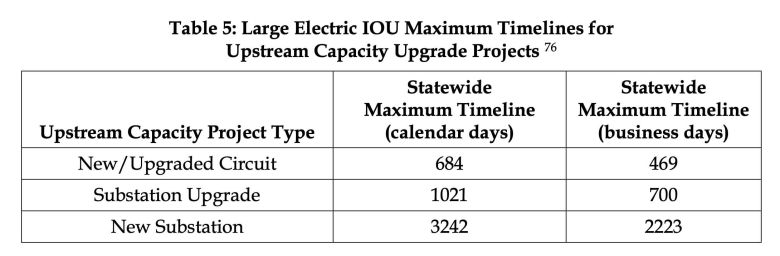
But instead, the CPUC simply had Pacific Gas and Electric, Southern California Edison , and San Diego Gas & Electric report how long these major “upstream capacity” grid projects are taking today and then used the lower average of that historical data to set maximum timelines that utilities should meet in the future.
Those timelines are much, much too long, electric truck manufacturers, charging-project developers, and clean transportation advocates say. They stretch from nearly two years for upgrading distribution circuits and nearly three years for upgrading substations to nearly nine years for building the new substations that utilities say they’ll need to power truck-charging depots currently being built.
“We’ve put in millions of dollars in the facilities we’ve already upgraded, and more that are in motion,” said Paul Rosa, a PACT board member.
As senior vice president of procurement and fleet planning at truck leasing company Penske, he is responsible for the company’s transport projects, including truck-charging projects in Southern and Central California.
But those projects represent just a fraction of the 114,500 chargers required to support the 157,000 medium- and heavy-duty vehicles that the California Energy Commission forecasts the state will need by 2030.
“If we can’t get the power, this all comes to a screeching halt,” Rosa said.
The slow and burdensome process of getting new customers connected to the grid — “energization” in CPUC parlance — isn’t a problem for just EV trucks.
PG&E has been under fire for years for failing to deliver timely grid hookups to everyday commercial and residential projects — a result, critics say, of poor planning and resource management.
The CPUC’s new decision does set a 125-business-day maximum timeline for these less complicated energizations. If those targets are met by utilities, “maximum timelines for grid connections could be reduced up to 49 percent compared to current operations,” the CPUC noted in a fact sheet accompanying the decision.
“I think the commission got it right” on these less complicated energization targets, said Tom Ashley, vice president of government and utility relations at Voltera, a company building EV charging projects across the state.
But how the commission handled the larger-scale grid upgrades — the kind needed to get EV truck-charging stations up and running — is a different story, he said. “That is where the industry is really frustrated that we didn’t get the help, and the utilities didn’t get the direction.”
The state’s Advanced Clean Trucks rule requires truck manufacturers to hit minimum targets for zero-emissions trucks as a percentage of total sales over the coming years, ratcheting from 30% of all medium- and heavy-duty vehicles by 2028 to 50% by 2030.
And California’s Advanced Clean Fleets rule requires the state’s biggest trucking and freight companies to convert hundreds of thousands of diesel trucks to zero-emissions models over the next 12 years, with earlier targets for certain classes of vehicles, including the heavy trucks carrying cargo containers from California’s busy and polluted ports.
Right now, many of the plans to build charging hubs for those trucks are stuck in grid-upgrade limbo — and the CPUC decision offers little indication it will get them unstuck.
“We’ve submitted for well over 50 projects in the past two years, looking for the right property to acquire,” said Jason Berry, director of energy and utilities at Terawatt Infrastructure. The startup has more than $1 billion in equity and project finance lined up to build large-scale charging hubs, including a network that will stretch from California to Texas along the I-10 highway, a major trucking corridor.
But of the sites Terawatt has scouted in California, “about 95% of those do not have the power we’re trying to request,” Berry said. To serve proposed charging hubs in California’s Inland Empire, utility SCE has said that it will need to expand existing substations, which takes four to five years, or build a new substation, which takes at least eight years, Terawatt said in May comments to the CPUC.
Terawatt is far from the only company facing delays. In testimony to the CPUC, Berry pointed out that Tesla has told the agency that 12 Supercharger sites with 522 charging stalls are facing delays because of capacity issues in SCE territory. A state-funded electric truck-charging project in the Inland Empire is also held up due to similar constraints.
The main problem is that large-scale charging sites can be built much faster than utilities are used to moving, Berry said. “We’re building projects, maybe ideally starting at 10 megawatts and then going to 20 megawatts,” Berry said. That’s about the same load on the grid as would be caused by an entirely new residential neighborhood or big commercial or industrial site.
But while those sites typically take years to plan and build, a new truck-charging site can go from planning to completion in less than a year.
“They have to have a mechanism to start on those things, or every single project is going to be four to five years out — which is what we’re being told on so many of these today,” he said.
The same point was made by Diego Quevedo, utilities lead and senior charging-infrastructure engineer at Daimler Truck North America, which joined fellow electric truck manufacturers Volvo Group North America and Navistar to weigh in on the CPUC proceeding.
“Trucks can be manufactured by OEMs and delivered approximately six months after receiving an order,” Quevedo said in testimony before the CPUC. But fleets won’t order trucks if they lack the confidence the utility grid infrastructure will be built and energized when the trucks are delivered.”
Utilities’ grid-capacity additions are taking from seven to 10 years to “plan, design, budget, construct, and energize,” he said. Unless those capacity expansions can be sped up significantly, “electric trucks become expensive stranded assets that are unable to charge,” he said.
California’s major utilities have a different perspective. They’ve argued in comments to the CPUC that it may be difficult or impossible to move more quickly on such complicated work.
First, as utilities have pointed out, many of the things that can slow down major grid projects are beyond their control. In a filing with the CPUC, PG&E noted that “one capacity upgrade project may face an extended timeline due to lengthy environmental assessments and permitting processes, and another may encounter challenges in acquiring materials in a timely manner due to manufacturer issues.”
IREC’s Stanfield conceded that equipment backlogs and environmental and permitting reviews are barriers to moving more quickly. “But we have to make it go faster if we want to hit our climate goals, if we want manufacturers to build clean trucks.”
And there’s an even bigger challenge to making major changes to the grid in anticipation of booming demand from EV charging: the cost involved.
“Lack of funding is the big block to meet the anticipated load growth,” Terawatt’s Berry said.
California’s utilities are already spending more than they ever have on their power grids, for myriad reasons. They are passing the costs of grid-hardening investments and integrating new clean energy into the power system on to customers in the form of electricity rates that are now the highest in the continental U.S.
Electricity rate increases are an economic and political crisis in California. Keeping them from rising any further has become the chief focus of lawmakers and regulators in the past several years. Any proposals that could raise customer bills even more face a tough battle — including plans to build grid infrastructure for electric truck-charging hubs.
SB 410 does give the CPUC permission to allow utilities to increase their spending in order to meet tighter EV-charger energization timelines. But the bill also calls on regulators to subject these requests to“extremely strict accounting.”
PG&E was the first utility to submit a ratemaking mechanism under SB 410 earlier this year. The Utility Reform Network, a ratepayer advocacy group, quickly filed comments protesting the utility’s plan to create a “balancing account” that would enable it to recover as much as $4 billion in additional energization-related spending from customers — a structure that falls outside the standard three-year “rate case” process for California utilities.
“PG&E’s electric rates and bills are now so high that they threaten both access to the essential energy services that PG&E provides and the achievement of the state’s decarbonization goals, which rely in part on customers choosing to electrify buildings and vehicles,” TURN wrote in its comments.
TURN wants the CPUC to limit the scope of SB 410’s extra cost-recovery provisions to “specific work needed to complete an individual customer connection request,” rather than the kind of proactive upstream grid investments that truck-charging advocates are calling for. TURN would prefer that those projects remain part of general rate cases, the sprawling proceedings that determine how much utilities spend on their grids.
But those general rate cases can take up to five years to move from identifying the broader, systemwide analyses of how much electricity demand is set to rise to winning regulatory approval in order to build the expensive grid infrastructure needed to actually meet those growing needs. That’s too long to wait to fix the problem, charging advocates say.
At the same time, ratepayer advocates are challenging utility efforts to expand the scope of their larger-scale plans to meet looming EV charging needs. In SCE’s current general rate case, TURN and the CPUC’s Public Advocates Office, which is tasked with protecting consumers, are protesting that the utility is overestimating how much money it needs to spend to prepare its grid from growing EV-charging needs.
Terawatt and other charging developers and electric truck manufacturers argue just the opposite — that the utility isn’t planning to spend enough over the next three years. In his testimony in the rate case, Terawatt’s Berry complained that TURN and PAO are challenging utility and state forecasts of future charging needs based on outdated data, and that failing to approve the utility’s funding request will “ensure that California fails to achieve its zero-emission vehicle goals.”
Charging advocates have also asked the CPUC to create a separate regulatory process to consider the grid buildout needs spurred by large-scale charging projects. But the CPUC rejected that concept in its decision last week, stating that “preferential treatment based on project type is prohibited by California law.”
All these conflicting imperatives leave the CPUC with tough choices to resolve the gap between charging needs and grid buildout plans, said Cole Jermyn, an attorney at the Environmental Defense Fund.
The CPUC “can and should do more here. I don’t think the timelines they set here are as strong as they could have been,” Jermyn said.
At the same time, “the commission had an incredibly difficult job here. The targets are not easy to set, and they had a very short timeline to do it.”
That’s why multiple groups have asked the CPUC to focus its next phase of work on implementing SB 410 and AB 50 on a key issue: aligning grid planning and EV charging needs.
“Part of the work here is figuring out what that proactive planning looks like,” Jermyn said. “The utility cannot wait around for customers to come to them and say, ‘We need 5 megawatts of capacity.’ They need to be looking out into the future to start proactively preparing their distribution grids for all this electrification.”
At the same time, “how do you balance that need for proactive planning and investment with ratepayer investments along the way to make sure this isn’t building assets that won’t be used and end up on someone’s bills?” Jermyn asked. That will be complicated, but, he added, “I think it’s doable — especially for a state that has such clear goals.”
SB 410 also specifically called on the CPUC to take California’s decarbonization goals into account in tackling energization delays — but last week’s decision “was relatively silent on that issue,” Jermyn said.
“This is something we think is incredibly important to be in the next phase of this proceeding, because it wasn’t in this one,” he said. “We don’t know if the timelines they set are meeting that goal or not. We should figure out if they are.”
EDF has advocated for years for utilities and regulators to approve grid spending in advance of EV charging needs, noting that such spending will end up reducing costs for utility customers in the long run.
That’s because California’s utilities don’t earn profits directly through electricity sales. Instead, their rates are structured to repay their costs of doing business. More customers buying more electricity can spread out the costs of collecting the money that utilities need to operate and invest in infrastructure, which can reduce the rates per kilowatt-hour that utilities must collect in future years.
This isn’t just a California issue. Nearly a dozen states — including Massachusetts, New Jersey, New York, Oregon, Vermont, and Washington — have adopted advanced clean truck rules. They’re not as aggressive as California’s rules, but meeting them will still require grappling with the same challenges around proactive grid planning.
Voltera’s Ashley worried that the CPUC’s decision may set a bad precedent for other state regulators on this front. “The commission has a really hard job. They’re tasked with a lot of complicated policy and execution,” he said. “And at the end of the day, they have some overarching mandates, including affordability for ratepayers,” that complicate the task.
But California also has “the most aggressive targets, goals, and statutory requirements around not just electrification of transportation but electrification of other segments” of the economy, he said. “If California doesn’t get this right, who will?”
CLEAN ENERGY: The Inflation Reduction Act has spurred more than $115 billion in clean energy manufacturing investment in its first two years, with a sodium battery plant and a solar panel factory among the latest project announcements. (Canary Media)
ALSO:
OIL & GAS:
BUILDINGS:
WIND: Opposition to offshore wind projects along the East Coast can be traced back to Robert F. Kennedy Jr.’s fight against wind turbines in the Nantucket Sound near his family’s Cape Cod estate. (Inside Climate News)
UTILITIES: Orlando, Florida’s municipal utility moves to build two new solar facilities, add battery storage and jettison 90% of its fossil fuel plants, but customers push back against plans to charge more for power during peak times and decrease solar net metering payments. (Orlando Sentinel)
ELECTRIC VEHICLES:
BATTERIES: The U.S. Energy Department awards a Colorado electric vehicle battery manufacturer $50 million as part of an effort to beef up the nation’s battery supply chain. (CPR)
ALSO: The U.S. Energy Department awards a manganese and zinc mine under development in southern Arizona $166 million to spur production of the battery metals. (Arizona Daily Star)
CLIMATE: A California report finds greenhouse gas emissions have dropped across all sectors in the state except residential and commercial, with transportation seeing the largest year-to-year decline as electric vehicle sales climb. (KTLA, news release)
ELECTRIC VEHICLES:
SOLAR:
GRID: The Western power grid reached a record-breaking peak load on July 10 even though demand was relatively moderate on California’s system. (RTO Insider, subscription)
WIND: A Hawaii wind facility’s operator says a new system designed to deter bats and prevent collisions with turbines has been successful so far. (Hawaii Public Radio)
OIL & GAS:
URANIUM: The Navajo Nation and a mining company continue working to negotiate a deal that would allow uranium ore shipments across tribal land. (AZ Mirror)
Ensuring that traditionally disinvested Black and Brown communities are not left behind is essential for a just transition away from carbon-based energy sources.
At the same time, many of these communities have vast stretches of vacant or underutilized properties, which could present opportunities for clean energy development.
For instance, in Detroit, city officials are working with DTE Energy to build 33 MW of solar arrays on vacant property around the city. Detroit’s mayor has touted the project as a way to deal with blight while producing clean energy, but neighbors are divided.
Meanwhile, in the West Woodlawn neighborhood on Chicago’s South Side, a community-based geothermal project is intentionally bypassing vacant lots, focusing instead on placing the necessary loop fields in alleyways.
“Not every block in the neighborhood even has a vacant lot that could be leveraged,” said Andrew Barbeau, president of The Accelerate Group in Chicago, which is providing technical assistance for the geothermal pilot, in an email. “Further, communities often have other ambitions for that land, whether it is new housing development, parks, greenways, or other beneficial uses.”
For Blacks in Green, the Chicago-based organization leading the geothermal project, recognition of the role of the project within a broader scope is central to an overall goal of generating economic development and a healthy environment within the community, said Nuri Madina, Sustainable Square Mile director, who serves as point person for the pilot.
“We know that the communities have been underserved. And underserved by definition means that we have not gotten our fair share of taxpayer investment in the communities. We know what our streets look like. And one of the major assets in the community, which is not really viewed as an asset, is our vacant lots,” Madina said.
Conventional geothermal systems require substantial plots of land to lay the subterranean loop fields that circulate both hot and cold water — land that is often scarce in densely populated urban areas.
But while West Woodlawn has a number of vacant lots, they are not being utilized for the project. Instead, alleys provide a potential solution for constructing geothermal loop fields, along with allowing for connection points for houses and multifamily buildings within the pilot footprint, Barbeau said.
“The good news is that based on the system design, we have more than enough capacity in the alleys to serve the load of the blocks we have modeled. The modeling also so far is showing us that the shared network model would require 20-30% less wells than if each home built their own system,” Barbeau said in an email.
Locating the bulk of the geothermal infrastructure in alleyways also sidesteps the underground congestion of existing gas, electric and water infrastructure on city streets, said Mark Nussbaum, owner and principal of Architectural Consulting Engineers in Oak Park, Illinois.
“There’s a lot of stuff happening out near the street. It doesn’t mean it’s not possible to coordinate it, but it’s just what’s nice about the alley concept is, it’s kind of unused for utilities typically,” Nussbaum said.
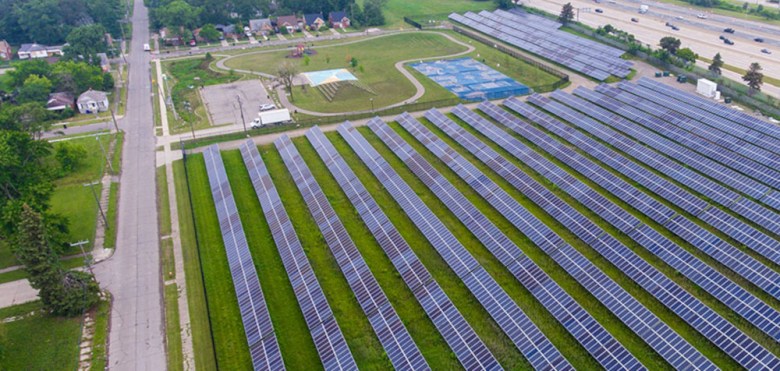
“White flight” and housing segregation have left many U.S. cities with sections of vacant or underinvested property, typically in communities populated by Black and Brown people.
With roughly 60% of the land area of Chicago, Detroit nonetheless has a much larger proportion of vacant land — approximately 19 square miles. In some neighborhoods, multiple blocks may only have a single structure remaining, if any at all.
DTE Energy’s plan to build large-scale solar arrays on some of that land is supported by some residents and municipal officials as a means to reduce illegal dumping and other nuisance crimes while working toward meeting city climate goals — and reducing utility bills for residents.
But there has also been pushback, largely focused on potential detrimental impact on property values in adjacent properties and limitations on future use of the sites themselves.
“Solar panels will disrupt and destroy entire neighborhoods. There will be no future affordable housing being built anywhere around a solar farm,” councilmember Angela Whitfield-Calloway said during a city council meeting in July, as reported by Planet Detroit.
Whitfield-Calloway also questions why municipal buildings or sites outside the city limits had not been considered for the solar arrays.
In Chicago, a battery storage facility constructed as part of the Bronzeville Microgrid project administered by electric utility ComEd generated similar debate during an extended period of community input. ComEd officials said the location of the battery facility, in the middle of a stretch of vacant plots near the South Side Community Art Center, was strategic to the overall microgrid project.
A 40-yard-long mural designed and created by local artists and mounted on the exposed long side of the battery storage facility not only serves to obscure the structure, but also to highlight prominent figures in Black history and culture. While reactions to the mural have been overwhelmingly positive, reception of the battery storage facility itself has been mixed.
“There were thorough talks with the community and the art community in Bronzeville about what they wanted, what [ComEd] planned to do [with] that battery station, because they did not want it to be an eyesore … they did not want it to just be, you know, brick walls around infrastructure,” Jeremi Bryant, a resident of Bronzeville, told the Energy News Network in February 2021.
For Bruce Montgomery, founder of Bronzeville-based Entrepreneur Success Program and a member of the advisory council for the Community of the Future, the location of the battery storage facility precluded potentially more beneficial future development for the site.
“That lot in most communities probably would have ended up being invested in as more quality residential,” Montgomery told the Energy News Network in February 2021. “But now you’ve taken it up with this box car. … You’ve got big things sitting out in the middle of a vacant lot a couple of doors down from one of the most historic locations in Bronzeville.”

For Blacks in Green, what might appear to the casual observer as a vacant lot overtaken by weeds belies its ultimate potential — as an affordable, energy-efficient residential complex, small business owned by a community resident, a much needed basic amenity like a grocery stocking fresh produce — or a native plant garden to attract pollinators.
On June 17, 2023, Blacks in Green collaborated with the Delta Institute to hold a combined Juneteenth celebration and BioBlitz to identify potential sites for green infrastructure. Experts and community residents worked side-by-side to map and measure plant life, insect populations, drainage and other elements during a walking inventory of vacant lots in the area.
In the case of West Woodlawn, installation of geothermal loop fields in its alleys — versus locating them in vacant plots — presents an opportunity to promote climate resiliency through mitigation of persistent urban flooding, by utilizing permeable pavers to replace existing concrete or asphalt, said Madina.
“All of our programs are designed to create multiple benefits,” Madina said.
Projects like the West Woodlawn community geothermal project represent a drive to revive and reinvent Chicago’s Black Wall Street within what once constituted the redline-confined boundaries of the Black population drawn to the city during the Great Migration of the 20th Century.
“In most communities, the vacant lots are really indicative of a declining community. But what we have tried to do is take that negative and turn it into something positive. So if we can take those vacant lots with weeds and debris and turn them into beautiful gardens, that is a very significant improvement in the community,” Madina said.
“So [we] could improve the quality of life, improve the spirit of the people in the community… that vacant lot can provide more than just beauty. It can provide more than just comfort for the residents. It can also provide biodiversity, it can provide pollination, it can provide food for the residents.”
Correction: A 40-yard-long mural was mounted on the side of a ComEd battery storage facility to obscure the structure and highlight prominent figures in Black history and culture. An earlier version of this story misstated its size.
This story was originally published by the Arizona Mirror
When Hualapai Spiritual Leader Frank Mapatis visits Ha’Kamwe’, the tribe’s sacred spring, to conduct any type of ceremony, the area must be completely quiet so that he can hear the water and connect with the land.
Mapatis said that as part of his traditional ways of life, when he is in prayer at Ha’Kamwe’, he hears the water sing, and when it sings, he connects with the creator to conduct ceremonies.
He has provided purification, healing and coming-of-age ceremonies at Ha’Kamwe’ for decades and visits the spring at least twice a month. The spring is also utilized for tribal members’ funeral ceremonies.
Not being able to hear the water, conduct ceremonies or provide traditional teachings to the Hualapai youth who join him during his visits to the spring are among Mapatis’ top concerns for the proposed exploratory drilling lithium project in the Big Sandy River watershed near the tribe’s sacred spring.
“It would stop me from doing ceremony,” he said about the drilling project as he testified in federal court on Sept. 17. He believes drilling in that area will traumatize the earth and water, and he would not want to use that area for ceremonial purposes due to that trauma.
Mapatis said he could continue his ceremonial practices in other places, but they would not have the same impact as doing them at Ha’Kamwe’ because of the water’s healing properties.
“It wouldn’t be as effective in other areas,” he added.
Ha’Kamwe’ is featured in tribal songs and stories about the history of the Hualapai people and their connection to the land. According to the tribe, the historic flow and spring temperature are essential for its traditional uses.
Mapatis was one of several Haluapai tribal members who testified during the Sept. 17 preliminary injunction hearing at the U.S. Federal District Court in Phoenix, where the tribe is fighting to extend the pause on drilling for the Big Sandy Valley Lithium Exploration Project for the duration of the tribe’s lawsuit seeking to block the project entirely.
The project allows a mining company to drill and test more than 100 sites across BLM land surrounding one of the Hualapai Tribe’s cultural properties, among them Ha’Kamwe’, a medicinal spring sacred to the tribe.
Tuesday’s hearing came after a federal judge granted the Hualapai Tribe’s request for a temporary restraining order against the U.S. Bureau of Land Management, temporarily freezing the exploratory drilling project.
The restraining order was granted weeks after the Hualapai Tribe filed a lawsuit against BLM, following years of the tribe actively voicing its concerns about the mining effort.
Ha’Kamwe’ is located within the Hualapai Tribe’s property known as Cholla Canyon Ranch, and the boundaries of the Big Sandy Valley project nearly surround the entire property. Only one portion of the tribe’s land does not border the drilling project.
The spring is recognized as a traditional cultural property and is eligible to be listed on the National Register of Historic Places, and the tribe’s lawsuit claims that the project’s approval violates the National Environmental Protection Act and the National Historic Preservation Act.
The lawsuit asks for full compliance with the National Historic Preservation Act (NHPA) and the National Environmental Policy Act (NEPA), which includes having the BLM take a “hard look” at the exploration activity’s environmental impacts and consider the implications of its actions on historic properties.
The lawsuit claims that BLM approved the mining project without appropriately considering a reasonable range of alternatives or taking a hard look at water resources under the NEPA and moved forward with the project without providing mitigation measures under the NHPA for Ha’Kamwe’ and other resources essential to the tribe, thus violating both acts.
Out of concern for Ha’Kamwe’, the tribe submitted multiple public comments, sent several letters of concern, and participated in tribal consultations with BLM throughout the Big Sandy Valley Lithium Exploration Project planning phase.
Big Sandy, Inc., a subsidiary of Australian mining company Arizona Lithium, leads the project and has sought approval since 2019. Arizona Lithium is not a direct party in the Hualapai Tribe’s lawsuit, but it filed a motion to intervene in the case. Humetewa granted the request in August, allowing the company to defend against the tribe’s efforts to stop the project.
BLM’s approval of the Big Sandy Valley Project allows the mining company to drill and test up to 131 exploration holes across 21 acres of BLM-managed public land to determine whether a full-scale lithium mining operation could be viable.
Throughout the hearing, several Hualapai tribal members and supporters sat in the courtroom listening to the hearing while others sat outside the Sandra Day O’Connor courthouse holding signs backing the tribe.
Hualapai tribal member Ivan Bender, 60, from Peach Springs, showed up to the courthouse in support of his community, carrying a flag that said, “Protect Ka’kamwe’. No lithium mining.”
“That spring has a life of its own,” Bender said. “The water source we’re trying to protect is part of our sacred waters.”
The preliminary injunction hearing lasted more than six hours, during which Judge Diane Humetewa heard witness testimony from all parties involved in the case as she weighed the tribe’s request to keep the drilling on hold.
Testimony surrounded the way the project would directly or indirectly impact the Hualapai Tribe’s ability to carry out their cultural and traditional ways of life at Ha’Kamwe’, and whether the drilling that will take place as part of the project will harm the water that feeds into the hot spring.
Ka-voka Jackson, the director of the Hualapai Department of Cultural Resources, was the first witness, and part of her testimony focused on how the Hualapai Tribe utilizes the area for cultural and traditional purposes — and how drilling can directly affect those practices.
Jackson told the court that tribal members often visit Ha’Kamwe for traditional practices or to gather and harvest culturally significant plants from surrounding public lands.
“That is how we connect to our ancestors,” Jackson said.
The tribe’s lawsuit states that the lithium project will create noise, light, vibrations, and other disturbances that will degrade Ha’Kamwe’s character and harm tribal members’ use of the spring for religious and cultural ceremonies.
Jackson said the project’s impacts could cause irreversible damage, affecting the water supply to the sacred springs and destroying the land.
“(It can) create a lot of negative energy and create a hostile environment,” she said.
As part of its environmental assessment, BLM listed several short- and long-term effects, including the temporary disruption to cultural practices at or near Ha’Kamwe’ and an impact on native wildlife and vegetation of up to 21 acres.
But even with these effects included in the assessment, BLM concluded that Phase 3 of the Big Sandy Valley Lithium Exploration Project would not significantly negatively impact the quality of the area, so an environmental impact statement was not needed.
“Visual, noise, and vibration effects from drilling activities would be temporary,” BLM wrote in its final report. “Coordination with and providing notice to the Hualapai Tribe of drilling activities in the vicinity of the Ha’Kamwe’ may reduce impacts to cultural practices at or near the hot spring.”
To provide the court with perspective on the distance of the drilling locations near Ha’Kamwe’, Ivan Martirosov from Navajo Transitional Energy Company testified on behalf of the defendants.
Martirosov is the project manager for the Big Sandy Valley Lithium Exploration Project with Navajo Transitional Energy Company (NTEC), a mining and energy company owned by the Navajo Nation.
NTEC entered into a mining agreement with Arizona Lithium in March. Under this agreement, the Navajo-owned company is responsible for permitting, exploration drilling, mine design, environmental assessments and development for the Big Sandy Lithium Project. NTEC has worked with Arizona Lithium since December 2022.
Martirosov is in charge of overseeing and executing the Big Sandy Lithium Project. He told the court that he walked all approved drilling sites on foot and described the site’s proximity to the Hualapai’s cultural property.
Of the 131 drill sites approved for the project, Martirosov identified 22 with a line of sight to Ha’Kamwe’, a majority located on the north side.
Martirosov said that he was restricted from accessing Ha’Kamwe, noting that the drill sites that do not have a line of sight of the cultural property were due to distance and terrain.
At the end of the day-long hearing, Humetewa ordered all parties to file briefs outlining their arguments for why the injunction should or shouldn’t be granted. She said she would issue a ruling in the near future.
During the hearing, Humetewa said that she was tasked with determining what process BLM took in connection to NEPA and their Section 106 process.
The Section 106 process seeks to accommodate historic preservation concerns through consultation among an agency official and other parties interested in the undertaking’s effects on historic properties. The consultation aims to identify historic properties potentially affected by projects and seek ways to avoid, minimize, or mitigate any adverse effects.
The process is usually conducted in four steps: initiating it, identifying historical properties within potentially affected areas, assessing any potential adverse effects on any eligible historic property, and seeking to resolve any adverse effects.
Humetewa said in court that she wants to know where in the records she can find BLM’s engagement in those processes so she can fully understand the discussion about either approving or denying the project. That way, she said, she can understand what considerations went into the final environmental assessment and the NEPA assessment.
Earthjustice Senior Attorney Laura Berglan, who is part of the team representing the Hualapai Tribe, said she feels positive because their team presented all the points they wanted.
“I think it went well and we’ll see how it turns out,” she added.
BLM’s attorneys told Humetewa that the impacts this project will have on Ha’Kamwe have been “vastly overblown,” noting how their expert clearly testified that the water and temperature will not change due to the drilling in the project.
The tribe had its own expert testify. Winfield G. Wright, a certified hydrologist and president of Southwest Hydro-Logic, said he produced a report for the tribe about the water sources that feed into Ha’Kamwe’. Wright said his analysis found that the groundwater system that flows into the hot spring is very fragile, and any disturbances around the area can disrupt the water, the chemistry and the temperature.
Wright said a mixture of shallow and deep waterways feed into Ha’Kamwe’, and the BLM’s environmental assessment simplified identifying where the water comes from by saying a confined lower aquifer feeds it.
“It’s not a confined aquifer,” he said, noting that the lower aquifer in the Big Sandy Valley is not the only source of water for the spring. “The whole valley is connected because of the fractures.”
But Peter Burck, a hydrologist with the BLM, testified that the lower fractures of the lower aquifer are a more likely source of water for Ha’Kamwe’.
Burck said that Wright’s claim the water comes from multiple sources is not conclusive. He said he did not see anything in Wright’s report that would lead him to conclude that the spring water source is a mixture of multiple flows.
He said that the likelihood of the drilling from Phase 3 of the Big Sandy Lithium Project encountering water or affecting the temperature of Ha’Kamwe’ is low.
BLM also told the court that any visual and noise disturbances from the drilling does not qualify as irreparable injury and is instead temporary.
But Jackson said her tribe made a good case that the project would cause irreparable harm because they had people testify who had already experienced it.
“This is irreparable; you can’t go back and redo ceremonies,” she said. “There’s no such thing.”
Jackson said she understands that the court wants more clarification on whether or not the BLM took the appropriate steps under the NEPA and NHPA policies before making a final decision.
“We believe that they didn’t take into consideration the effects on Ha’Kamwe’,” Jackson said, adding that it is eligible for registration on the National Historic Register and a traditional cultural property.
Jackson said it deserves a thorough process included in the NHPA and NEPA.
“I am proud of our people for sticking up for what we believe in and asserting our arguments,” she said. “Now, we just wait.”
Hualapai Chairman Duane Clarke echoed Jackson’s sentiments about how their team and tribal members presented a good case in court, and said he prays that the court’s decision goes with the Hualapai people.
Arizona Attorney General Kris Mayes filed an amicus brief before the hearing supporting the Hualapai Tribe’s request for the preliminary injunction.
“The sacred Ha’Kamwe’ spring has sustained the Hualapai people for generations, and its protection is critical for the Tribe,” Mayes said in a written statement. “The failure to properly evaluate the impact of this project on such an important water source is unacceptable.”
The amicus brief urges the court to take action to protect Arizona’s water resources from potentially irreversible damage posed by exploratory drilling near the Hualapai Tribe’s sacred spring.
“The BLM must fulfill its obligations under NEPA and fully evaluate this project’s impact on local water resources,” Mayes said. “I am proud to support the Hualapai Tribe’s efforts to protect their precious cultural and water resources.”
The amicus brief highlights the risk of irreparable harm to Arizona’s water resources if exploratory drilling is allowed to proceed without a comprehensive review. It also requests that the court grant a preliminary injunction to stop drilling activities while the case is being heard to protect Arizona’s water sources from potential compromise.
MINING: The federal Bureau of Land Management finds a proposed Nevada lithium mine’s protection plan is adequate to avoid driving an endangered wildflower to extinction. (Associated Press)
ALSO:
SOLAR:
GRID:
STORAGE: A southern California tribal nation’s proposed microgrid project becomes the first long-duration energy storage system to receive a U.S. Energy Department loan guarantee. (Utility Dive)
ELECTRIFICATION: California advocates criticize the state’s new building efficiency standards for only encouraging heat pumps and other electric appliances in new homes and businesses, not existing ones. (Canary Media)
CLEAN ENERGY: A Nevada nonprofit launches a tool aimed at expanding residents’ access to federal home electrification, rooftop solar, electric vehicle and other clean energy incentives. (Las Vegas Review-Journal)
OIL & GAS: The Navajo Nation passes legislation aimed at reducing methane emissions from oil and gas facilities on tribal land. (news release)
CLIMATE: California advocates and scientists urge voters to support a $10 billion climate bond ballot measure, saying investing in resilience will save money in the long-term. (Inside Climate News)
ELECTRIC VEHICLES: Data show California has acquired, ordered or funded more than 3,000 electric school buses, more than three times that of any other state. (Canary Media)
TRANSPORTATION:
CLEAN ENERGY: Environmental and health groups call on Microsoft to power a planned Wisconsin data center with clean energy instead of We Energies’ current proposal to build new natural gas power plants. (Wisconsin Examiner)
HYDROELECTRIC: Midwest states are largely missing out on historic federal funding to shore up aging hydroelectric dams compared to other regions that tend to have larger facilities with more residents living nearby. (Inside Climate News)
SOLAR:
COAL: Two southern Illinois coal mining towns will share $200,000 in federal funding to help prepare for installing renewable energy projects. (Southern Illinoisan)
BATTERIES: Four projects across Michigan will share $355 million in federal funding to boost the domestic production of advanced batteries and battery materials to reduce dependence on foreign suppliers. (Crain’s Detroit, subscription)
GRID: A new report calls for interconnection changes in grid operator PJM’s that would expedite battery storage projects and potentially unlock thousands of megawatts of much-needed capacity. (Utility Dive)
ELECTRIC VEHICLES: Two companies will partner to install 73 electric vehicle charging stations, including 19 fast-charging stations, in the Cleveland area by the end of the year. (WKYC)
EFFICIENCY:
BIOFUELS: A new $375 million soybean crushing plant in southeastern Kansas will also produce renewable biodiesel. (Kansas Reflector)
CLIMATE: A new digital tool from the University of Minnesota allows users to map out climate predictions based on emissions scenarios, such as how much snow cover could be lost in the coming decades. (Spokesman-Recorder)
NUCLEAR: Connstellation announces a 20-year agreement with Microsoft to buy power from Unit 1 of the Three Mile Island nuclear plant in Pennsylvania, which the company says it will restart without any public subsidies. (Philadelphia Inquirer)
ELECTRIC VEHICLES:
UTILITIES: A New York lawmaker proposes a publicly owned power utility for Erie County to lower energy costs, although incumbent utility NYSEG claims the move would result in higher costs for ratepayers. (WIVB)
RENEWABLE POWER: Ten Republican governors, including New Hampshire’s Chris Sununu, band together to oppose renewable power mandates; an advocate says the group’s call for “energy choice” is “thinly veiled code” for natural gas. (The Hill)
SOLAR: A developer wraps up the installation of a two-part rooftop solar array totaling almost 1 MW at a Windsor, Connecticut, business park. (news release)
STORAGE: The American Council on Renewable Energy says PJM Interconnection should reform an accelerated process for adding capacity to let battery storage assets tap in. (Utility Dive)
EQUITY:
BUILDINGS: Former President Donald Trump has stakes in buildings that could collectively owe millions of dollars in penalties if they don’t comply with New York City’s local building emissions law. (City Limits)
TRANSPORTATION: In the Connecticut cities of Hartford and New Haven, almost a third of households don’t own a car, leading state and local officials to issue more e-bike vouchers and consider policies that encourage more bicycling. (CT Mirror)
AFFORDABILITY: In Maine, a return to pre-pandemic funding levels for a low-income household heating bill assistance program and higher fuel prices could limit how many households can receive help. (Bangor Daily News)
Even as North Carolina continues to weaken its building energy conservation codes, a new federal rule is poised to spur the construction of thousands of energy-efficient starter homes in the state each year.
Adopted earlier this spring, the measure requires homes with certain federally-backed mortgages to meet the latest guidance for insulation thickness, window quality, and other energy-saving features — a major improvement over the state’s 2009-era floor for new residential construction.
The rule is expected to impact more than 1 in 10 new home sales in North Carolina, mostly by lower-income and first-time homebuyers. Government studies show they will pay more for improved efficiency but reap immediate cash-flow benefits from lower monthly utility bills.
“The requirements are essential for protecting low-income homebuyers and renters,” said Lowell Ungar, federal policy director of the American Council for an Energy-Efficient Economy, “lowering their energy bills, giving them more comfortable and healthier homes, and protecting them in the climate transition.”
The impact extends beyond North Carolina and will lift standards in several states where lawmakers and industry lobbyists have pushed back against energy-saving building code updates.
Ungar and his colleagues are also working to extend the requirements to the independent regulator of Fannie Mae and Freddie Mac. If they succeed, a large majority of new homes in North Carolina could be built to modern energy-savings standards — even though a 2023 state law prevents any major code updates until the next decade.
Rob Howard, who builds sustainable homes in the state’s foothills, fought against the law and now serves on the state’s Building Code Council.
“It’s the first feeling of hope that I’ve had for North Carolina since last year,” he said.
Reducing energy waste in buildings is a critical component of the clean energy transition. The most cost-effective way to do so is at the point of construction, especially in rapidly-growing North Carolina, where some 90,000 new homes are built each year, about two-thirds of them single-family units.
Yet the powerful home construction lobby has long resisted stronger requirements for energy-saving features in residential construction, influencing the state legislature, where it is a major campaign donor, and until recently, the state’s Building Code Council, a citizen commission.
Thus, while model codes are updated every three years, North Carolina’s rules remain outdated. Though the council was poised last year to bring the code in line with 2021 guidelines, lawmakers backed by developers intervened to circumvent the update, overriding a veto from Gov. Roy Cooper, a Democrat.
This year, the Republican-led legislature relaxed insulation requirements and made other changes to the building code that many experts, including the state fire marshals’ association, argued would make homes less safe. Again, Cooper vetoed the measure, and in a vote last week, lawmakers overrode him.
“The General Assembly has let the homebuilding industry make a quick buck at the expense of North Carolina families who will pay more every month in home energy costs,” Drew Ball, Southeast campaigns director at Natural Resources Defense Council, said in a statement after the vote. “This law rolls back North Carolina’s energy building codes and passes the costs on to consumers.”
But state building codes aren’t the only policies that can influence home construction.
The federal government plays a huge role in promoting homeownership by guaranteeing loans for borrowers who can only make a small down payment or may otherwise risk default.
In 2007, a sweeping energy law adopted under the George W. Bush administration required any new home purchased with backing from the Department of Housing and Urban Development or the Department of Agriculture to meet the latest model code for energy efficiency.
It wasn’t until 2015 that the Obama administration tied the loans to the 2009 model energy efficiency code. The Trump administration took no action.
The Biden-Harris administration picked up the torch last year, beginning an examination to make sure the latest model codes would bring more benefits than costs. In May of this year, officials concluded that the 2021 standards wouldn’t negatively affect the affordability and availability of housing.
“As a result of the updated energy standards, energy efficiency improvements of 37% will cut energy costs by more than $950 per year, saving homeowners tens of thousands of dollars over the lifetime of the home,” a press release from the Department of Housing and Urban Development said.
Similarly, last year an independent government lab found that the more stringent standards will add about $5,000 to the cost of the average North Carolina home, but generate a positive monthly cash flow instantly in the form of lower utility bills.
About 1 in 10 new single-family home loans per year are backed by the Department of Housing and Urban Development or the Department of Agriculture, according to the federal officials.
The Department of Veterans Affairs must update its lending rules to match those of HUD and USDA, impacting another 3% to 5% of newly built homes, Ungar estimates.
Howard, who’s building a small collection of super-efficient homes in Granite Falls, says just one of the 11 cottages so far is being financed with a loan that would be affected by the new rule.
“As a small builder who’s focused on attainable housing, I’m going to assume that a certain percentage of my buyers will qualify for the USDA loan programs,” he said. “And so of course, I want them to have the ability to participate in those. But I’ve already made the decision to build to zero-energy ready, which is currently based on the 2021 [model code]. I’m already there.”
The bigger impact of the new rule will be on large, multi-state, multi-regional builders who focus on starter homes, Howard said. “Those kinds of builders don’t want two different levels that they’re building to. They would rather have one that simplifies their entire construction process.”
With the new rule, then, builders can either adhere to the latest energy efficiency standards so that potential buyers can qualify for federal backing on their loans — or not.
“Let’s set the bar as high as possible,” said Howard, “and then builders get to choose.”
If multi-state builders choose to build all of their homes to the 2021 model code, the rule’s impact could extend beyond the roughly 15% of new stock estimated by government officials and advocates.
If advocates succeed in getting the Federal Housing Finance Agency, the regulator of Fannie and Freddie, to adopt the same standards, the effect would be even greater: the two companies ultimately end up buying over half of mortgages in the country.
“Now you’re talking about 70% of the loans in this country,” Howard said. “So that’s obviously a much broader impact.”
As they have in North Carolina, the national builder lobby claims the energy efficiency standards will add tens of thousands of dollars to construction costs. They oppose the rule that’s already finalized for the Departments of Agriculture, Housing and Urban Development, and Veterans Affairs, and they object to extending the requirements to Fannie and Freddie.
“If Fannie and Freddie were forced to comply with the 2021… mandate,” Missouri builder Shawn Woods told Congress this spring, “this would become a de facto national standard and be a massive blow to housing affordability.”
Unless Republican presidential nominee Donald Trump wins this November, the finalized rule is safe for now, advocates believe. As for the broader requirements on Fannie and Freddie, the director of the Federal Housing Finance Agency said it would study the matter and issue a decision by the end of June.
“Obviously, they did not do that,” Ungar said.


.svg)
