

 Back
Back
LITHIUM: The Biden administration greenlights the proposed Rhyolite Ridge lithium and boron mine in Nevada even though advocates insist the work will drive the endangered Tiehm’s buckwheat to extinction. (Associated Press)
OIL & GAS:
GRID: Backers of the California grid operator’s Western day-ahead power market and transmission organization expect state lawmakers to pass legislation allowing for regional governance. (RTO Insider, subscription)
HYDROGEN: Developers propose an off-grid, solar-powered green hydrogen production facility and distribution hub in California’s Inland Empire. (news release)
UTILITIES:
CARBON CAPTURE: A California county allocates $900,000 toward a project designed to convert wildfire mitigation waste into carbon-sequestering biochar. (The Union)
CLIMATE:
TRANSPORTATION: Colorado local officials and advocates urge the state to expand a proposed passenger rail line to several other communities in the western part of the state. (Vail Daily)
COMMENTARY: A Colorado journalist says a U.S. EPA enforcement action against an oil and gas operator in New Mexico may herald a new era for the San Juan Basin energy “sacrifice zone.” (Land Desk)
This story was originally published by the Iowa Capital Dispatch.
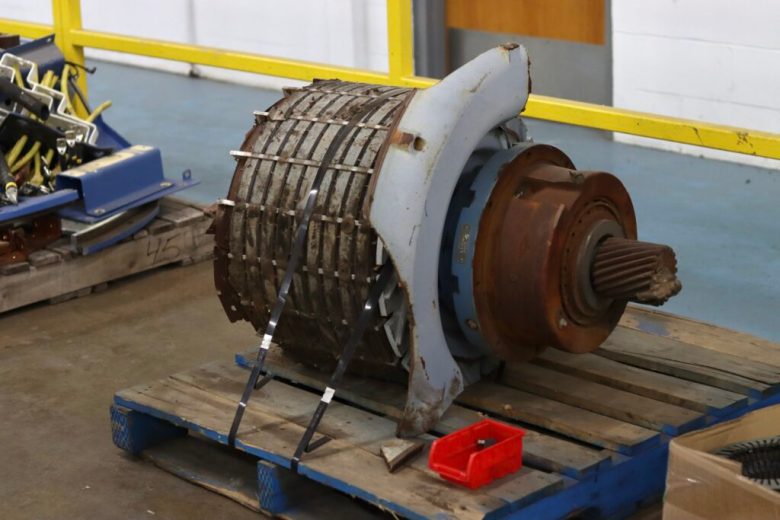
BOONE – Engineers at Critical Materials Recycling break apart circuit boards, old transmissions and decommissioned wind turbines to extract and recycle rare earth materials.
Most recycling facilities extract things like copper and aluminum from the same scraps, but few know how to break down the batteries, meaning those rare earth material components are often lost.
Rare earth materials are a series of elements with properties like conduction or magnetism that make them essential to electronics. They’re also part of the 10%-15% of wind turbine materials that are not currently recycled.
Iowa-based Critical Materials Recycling was selected by the U.S. Department of Energy as one of six companies to receive a $500,000 cash prize and $100,000 in assistance from national laboratories. Twenty projects were selected in the initial phase of the DOE prize and awarded smaller sums, $75,000, to further develop their concepts.
The $5.1 million Wind Turbine Materials Recycling prize was funded by the Bipartisan Infrastructure Law as part of its efforts to achieve a carbon-pollution-free power sector by 2035.
Dan Bina, Critical Materials Recycling president and CEO, said his company was already interested in wind turbine recycling but the DOE funding expedited and prioritized the project.
“The prize will give us the funding to be able to do that initial leg work, and we’ll build a team to make it happen much sooner and probably much better,” Bina said.
Tyler Christoffel, a technology manager for materials manufacturing and design innovation at the DOE wind energy technologies office, said a big goal of the office is to create a circular economy.
“Basically looking at the ways that we can make our materials more sustainable, be able to reuse them, make them go further,” Christoffel said.
He said about 90% of the turbines, mostly the parts made of steel and concrete, have an established recycling process.
“The work in the program was really focusing on those materials that have been hard to recycle so far, developing technologies so that you can more cost effectively recycle them and then get them into secondary markets,” Christoffel said.
Those materials include the fiber reinforced composites that make up the blades, housing components and the rare earth materials found in the turbine generators.
Christoffel said increasing recycling infrastructure and technology will help reduce waste at all stages of the turbines, from the production process, to the end of life and updating stages that occur less frequently.
Critical materials recycling is a big focus for the department across various industries, not just wind technology. Most of that research is going on at the Critical Materials Innovation Hub led by Ames National Laboratory, here in Iowa.
Ikenna Nlebedim, a scientist at the hub who worked with Critical Materials Recycling, said rare earth recycling is “a key strategy” for U.S. sustainability, security and technological advancement.
“Recycling rare earth elements is crucial for the United States, particularly in the context of wind generators, electronic waste (e-waste), and electric vehicles,” Nlebedim said. “It helps reduce the environmental damage caused by mining and processing, conserves finite resources, and supports a circular economy by reusing materials.”
Most of these minerals are mined overseas, with a majority coming from China, which spurred of the U.S. to develop better recycling capacity.
Critical Materials Recycling worked with the Ames National Laboratory to use an acid-free dissolution recycling (ADR) process that has little to no waste, saves more of the metal components and doesn’t expose technicians to dangerous acids.
Nlebedim, who led the research, said the hub invented the process in 2015 and has worked with TdVib, Bina’s other company that produces a very specific type of material used in sonar-like technologies. Bina’s team commercialized the process with its Critical Materials Recycling company.
“ADR is both environmentally friendly and efficient, eliminating the need for pre-heating and reducing pollution, making it a greener alternative to traditional methods,” Nlebedim said in a statement.
The DOE prize went to Critical Materials Recycling to apply the acid-free dissolution process to wind turbines.
The first step in the process is to break apart the various “feedstocks,” — a wind turbine, car part or other electronics brought to the company — into their components.
Computer hard drives, already shredded by the technology companies for security purposes, get tossed in a rock-tumbler like machine with a copper salt that Bina said selectively dissolves the rare earth materials and pulls them out into a solution.
The rest of the hard drive, which has copper, gold and aluminum, can go to a more traditional recycler after CMR has extracted the approximately 2% rare earth materials from the hard drives.
“We insert ourselves into the process, and actually add value, because now there’s more copper,” Bina said.
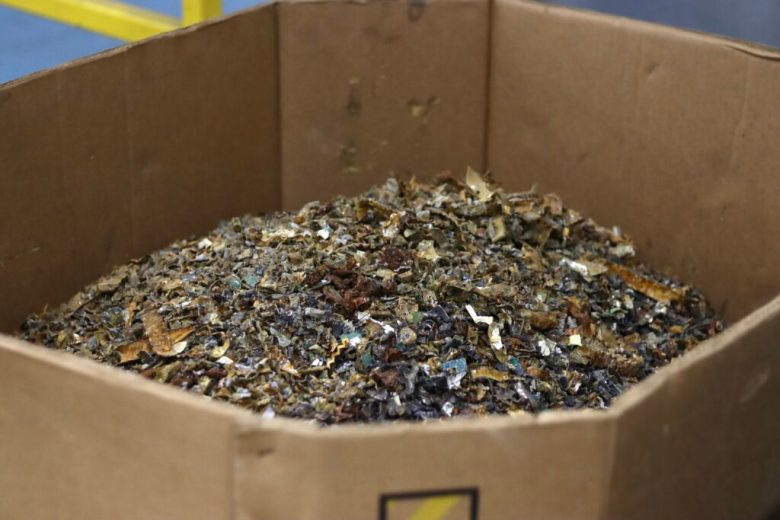
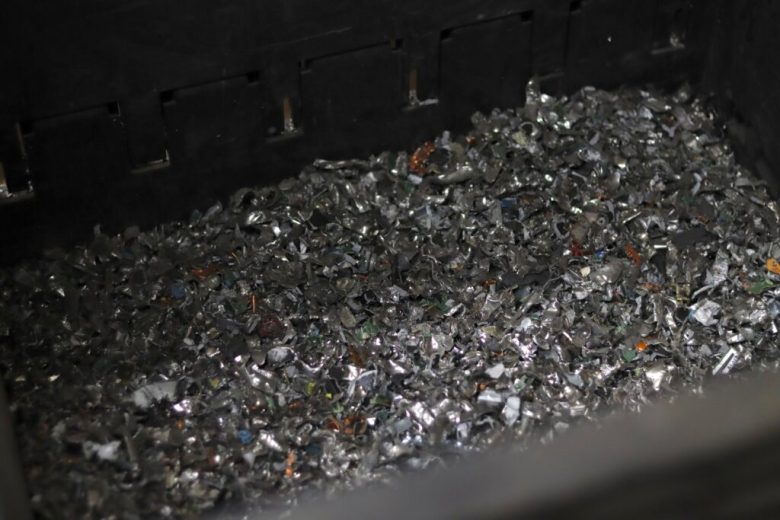
The process is more or less the same moving up the line to larger, discarded magnets and the “swarf,” which is like magnet sawdust, accumulated from cutting them to size.
Bigger items, like a transmission from a sedan or the generator of a wind turbine, have to be taken apart before they undergo the same process. Some of these magnets can also be recut and used again in various components.
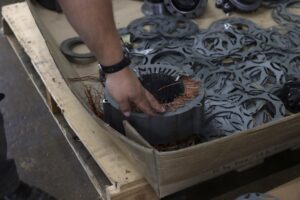
Each type of magnet has a slightly different process, but Bina said they go through a selective leaching process, like the hard drives in the copper salt tumbler, and come out as a rare earth solution.
The solution then goes through a series of tanks where it is precipitated into a solid form and cleaned to a rare earth material that Bina said is “exactly” like what a buyer would find on the open market.
Bina said the water used in the process goes through treatment and filtration and can be used again.
“We’re not using any strong acids throughout the entire process, we don’t produce any hazardous waste, and we almost have no waste whatsoever,” Bina said.
An acid process would break down everything but rare earth materials, which are typically such a small portion of the electronic that it rarely makes financial sense to do. Critical Materials Recycling pulls the copper and aluminum to sell to smelters, to make up for the cost of gathering the rare earth materials.
“In order to get the rare earth from something like this, you have to valorize everything,” Bina said.
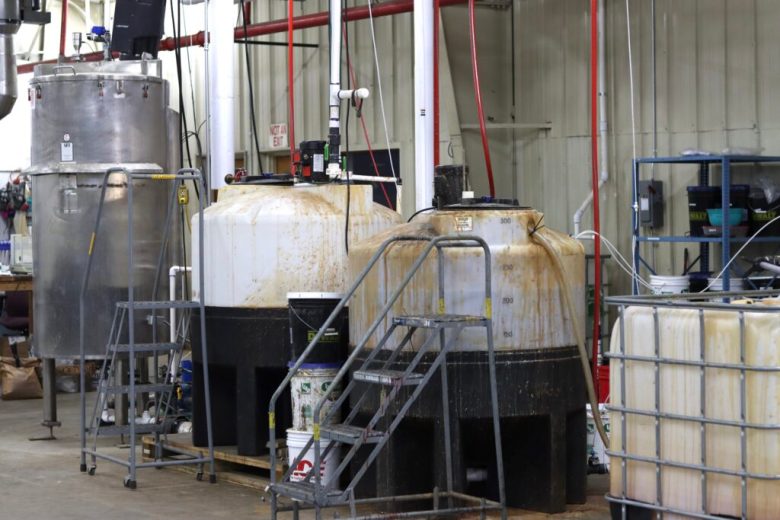
Soon, as part of the second phase of the DOE prize, Bina said his team will process several of the big, 4-megawatt or larger, turbines.
“Not just looking to see if we can do it, but actually doing it,” Bina said.
He said part of the challenge is building a team and the partnerships to operate. He doesn’t have a contract in place but has been in conversation with big energy and wind companies in Iowa to work into their decommissioning plans.

A spokesperson with MidAmerican Energy said the company was aware of Critical Materials Recycling and wrote a letter of support for its project with DOE.
“We look forward to seeing how the company develops and we embrace the potential for additional recycling and disposal options,” the statement read. “The more options, the better.”
Some of the other recipients of the DOE prize are developing processes for recycling wind turbine blades, which had proven to be rather difficult, as more than one company has run into problems processing the blades quickly enough.
MidAmerican has partnered, in the past, with a company that was later sued by the state for leaving piles of wind turbine blades, destined for recycling, around the state. MidAmerican has since partnered with another facility in Fairfax for recycling the blades.
Bina hopes wind turbines become a large part of his business, which he has plans to expand into a larger space soon. But, since wind turbines are typically decommissioned en masse at intervals of 10 or 20 years, the other items, like hard drives and swarf will be constant inputs for the plant.
“We have seen numerous pieces of these feedstocks just getting thrown away, in our eyes, the rare earth anyways, because there just isn’t that technology, that industry in place to capture them,” Bina said. “
The team in Boone is at the beginning of the growing industry.
“Rare earth recycling, five years or so ago, was unheard of,” Bina said.
Christoffel said the development of a circular economy of these expensive materials will help the U.S. to more sustainably build out expanded wind and solar infrastructure.
“It’ll provide some insulation to our supply and help us to ensure a more sustainable build out of clean energy domestically,” Christoffel said.
ELECTRIC VEHICLES: As Indiana starts to deploy $100 million in federal funding for electric vehicle charging infrastructure, an alliance wants to make sure state officials are including chargers in Black and disadvantaged communities. (Indianapolis Star)
ALSO:
UTILITIES:
COAL: Cancer rates related to air pollution are 12% higher near plants that use coal to make steel compared to national rates, and 26% higher for residents living near coke plants, a new study found. (Inside Climate News)
PIPELINES:
WIND: An Iowa county board expands a moratorium on wind turbines to include various other items such as towers and wind-measuring equipment. (Clinton Herald)
SOLAR: An installer completes construction on a 2.8 MW solar parking canopy project at the Cincinnati Zoo in Ohio. (Solar Power World)
OVERSIGHT: A Turtle Mountain Band of Chippewa citizen is running for a seat on the North Dakota Public Service Commission opposing plans for a carbon pipeline, while the incumbent Republican wants renewable developers to pay “their share” of grid infrastructure costs. (North Dakota Monitor)
GRID: Power plant owners support PJM’s proposal to delay an upcoming capacity auction by six months to craft new capacity market rules, but warn that longer delays could erode investor confidence. (Utility Dive)
BIOFUELS: Backers say extending a federal biofuel tax credit by 10 years would provide farmers economic certainty and help jumpstart the sustainable aviation fuel industry. (Michigan Farm News)
COMMENTARY: Xcel Energy’s proposal to build 800 MW of distributed solar and storage comes as the utility stifles attempts by customers to deploy distributed projects, a clean energy advocate writes. (Canary Media)
INDUSTRY: A new report links coal-powered steel plants, including one outside Pittsburgh, to increased asthma symptoms, cancer rates, and other health effects. (Inside Climate News)
NUCLEAR:
ELECTRIC VEHICLES:
GRID: Power plant owners tell federal regulators they support PJM Interconnection’s plans to delay its capacity auctions while it creates new capacity market rules but fear the pause will hurt investor confidence. (Utility Dive)
EFFICIENCY:
SOLAR: Sunrun launches a virtual power plant program with a downstate New York utility that ties together more than 300 solar-plus-storage installations. (PV Magazine)
POLITICS:
OFFSHORE WIND: GE Vernova says its offshore wind business just finished its strongest quarter in years, but the failure of a Vineyard Wind turbine blade and the company’s need to replace other components posed huge challenges. (RTO Insider, subscription; E&E News, subscription)
EMISSIONS: New York Gov. Kathy Hochul defends her pause of New York City’s congestion pricing plan even as funding for the city’s public transit system falls into further danger. (Times Union)
COAL: Tribal nations in Montana’s coal country look to clean energy to help them weather the industry’s decline, but say a lack of resources hampers efforts to tap federal transition funding. (Montana Free Press)
ELECTRIC VEHICLES: A report finds state and federal incentives and cheap leases are driving electric vehicle sales in Colorado, putting the state into second place nationally for EV adoption. (CPR)
WIND:
OIL & GAS:
POLITICS: Rep. Mary Peltola, an Alaska Democrat, says she bases her approach to oil and gas drilling and mining projects on regional Native corporations’ positions on the issues. (Alaska Beacon)
NUCLEAR: Amazon and utilities propose advanced nuclear reactors in Washington state to power the firm’s data centers in Oregon, which has a ban on new nuclear plants. (OPB)
HYDROGEN: A California startup begins manufacturing advanced alkaline electrolyzers for industrial-scale green hydrogen production at its new Silicon Valley facility. (Bloomberg)
SOLAR: A developer proposes a 425 MW solar-plus-battery storage installation to power an adjacent data center on a U.S. Navy base in California. (Data Center Dynamics)
CLEAN ENERGY: A federal report finds California leads the nation in the number of clean energy jobs, Nevada and Colorado are in seventh and eighth place, respectively, and Wyoming is last. (Yale Climate Connections)
UTILITIES: A report finds agencies have downgraded more than 100 utilities’ credit ratings due to wildfire hazard as insurance and mitigation costs have increased, leading to higher electricity rates. (Utility Dive)
CARBON CAPTURE: California researchers develop a powder that sucks greenhouse gasses from the air and traps them in its microscopic pores for use in direct-air carbon capture technology. (Deseret News)
COMMENTARY: California analysts say climate change-exacerbated heat waves, wildfires and extreme weather pose a greater threat to the outdated power grid than increasing levels of clean energy. (Utility Dive)
STORAGE: The U.S. added 5 GW of utility-scale battery storage in the first seven months of this year, bringing total installations to 21.4 GW and continuing an exponential deployment trend. (The Guardian)
ALSO:
COAL:
GRID: Power plant owners support PJM’s proposal to delay an upcoming capacity auction by six months to craft new capacity market rules, but warn that longer delays could erode investor confidence. (Utility Dive)
POLITICS:
WORKFORCE: A report finds some small states are punching above their weight in clean job creation, while some top fossil fuel-producing states are missing an opportunity to shift their economies. (Yale Climate Connections)
EMISSIONS:
MATERIALS: The U.S. Treasury Department unveils tax incentives for material extraction and producing clean energy components. (Axios)
NUCLEAR: Amazon and utilities propose advanced nuclear reactors in Washington state to power the firm’s data centers in Oregon, which has a ban on new nuclear plants. (OPB)
UTILITIES: A report finds agencies have downgraded more than 100 utilities’ credit ratings due to wildfire hazard as insurance and mitigation costs have increased, leading to higher electricity rates. (Utility Dive)
ELECTRIC VEHICLES:
EFFICIENCY: Harvard University researchers retrofitted a 1940s home with a ground-source heat pump, solar panels and other efficient technologies to show how older homes can achieve carbon neutrality. (Utility Dive)
Seventeen days after Hurricane Helene devastated Western North Carolina, tearing down power lines, destroying water mains, and disabling cell phone towers, the signs of relief were hard to miss.
Trucks formed a caravan along Interstate 40, filled with camouflaged soldiers, large square tanks of water, and essentials from pet food to diapers. In towns, roadside signs — official versions emblazoned with nonprofit relief logos and wooden makeshift ones scrawled with paint — advertised free food and water.
And then there were the generators.
The noisy machines powered the trailers where Asheville residents sought showers, weeks after the city’s water system failed. They fueled the food trucks delivering hot meals to the thousands without working stoves. They filtered water for communities to drink and flush toilets.
Western North Carolina is far from unique. In the wake of disaster, generators are a staple of relief efforts around the globe. But across the region, a New Orleans-based nonprofit is working to displace as many of these fossil fuel burners as they can, swapping in batteries charged with solar panels instead.
It’s the largest response effort the Footprint Project has ever deployed in its short life, and organizers hope the impact will extend far into the future.
“If we can get this sustainable tech in fast, then when the real rebuild happens, there’s a whole new conversation that wouldn’t have happened if we were just doing the same thing that we did every time,” said Will Heegaard, operations director for the organization.
“Responders use what they know works, and our job is to get them stuff that works better than single-use fossil fuels do,” he said. “And then, they can start asking for that. It trickles up to a systems change.”
The rationale for diesel and gas generators is simple: they’re widely available. They’re relatively easy to operate. Assuming fuel is available, they can run 24-7, keeping people warm, fed, and connected to their loved ones even when the electric grid is down. Indubitably, they save lives.
But they’re not without downsides. The burning of fossil fuels causes not just more just more carbon that exacerbates the climate crisis, but smog and soot-forming air pollutants that can trigger asthma attacks and other respiratory problems.
In Puerto Rico after Hurricane Maria, generators were so prevalent after the electric grid failed that harmful air pollution in San Juan soared above the safe legal limit. The risk is especially acute for sensitive populations who turn to generators for powering vital equipment like oxygenators.
There are also practical challenges. Generators aren’t cheap, retailing at big box stores for more than $1,000. Once initial fuel supplies run out — as happened in parts of Western North Carolina in the immediate aftermath of Helene — it can be difficult and costly to find more. And the machines are noisy, potentially harming health and creating more stress for aid workers and the people they serve.
Heegaard witnessed these challenges firsthand in Guinea in 2016 when he was responding to an Ebola outbreak. A paramedic, his job was to train locals to collect blood samples and store them in generator-powered refrigerators that would be motorcycled to the city of Conakry for testing. He had a grant to give cash reimbursements to the lab techs for the fuel.
“This is so hard already, and the idea of doing a cash reimbursement in a super poor rural country for gas generators seems really hard,” Heegaard recalled thinking. “I had heard of solar refrigerators. I asked the local logistician in Conakry, ‘Are these things even possible?’”
The next day, the logistician said they were. They could be installed within a month. “It was just a no-brainer,” said Heegaard. “The only reason we hadn’t done it is the grant wasn’t written that way.”
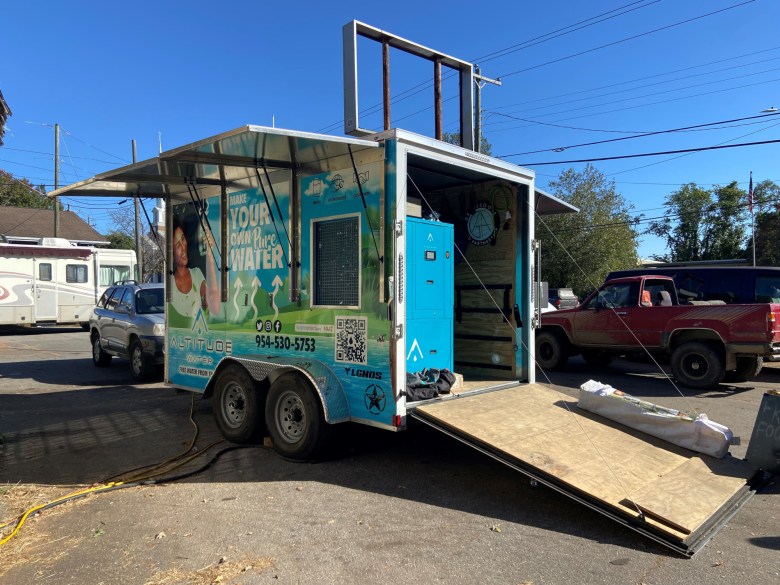
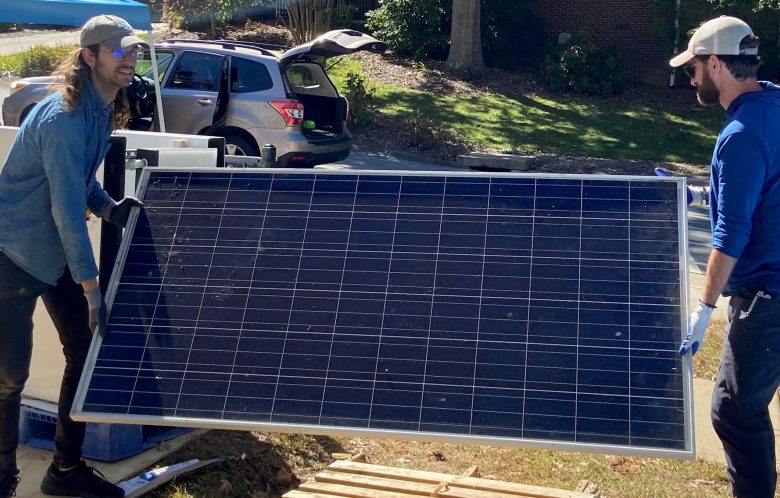
Two years later, the Footprint Project was born of that experience. With just seven full-time staff, the group cycles in workers in the wake of disaster, partnering up with local solar companies, nonprofits and others, to gather supplies and distribute as many as they can.
They deploy solar-powered charging stations, water filtration systems, and other so-called climate tech to communities who need it most — starting with those without power, water, or a generator at all, and extending to those looking to offset their fossil fuel combustion.
The group has now built nearly 50 such solar-powered microgrids in the region, from Lake Junaluska to Linville Falls, more than it has ever supplied in the wake of disaster. The recipients range from volunteer fire stations to trailer parks to an art collective in West Asheville.
Mike Talyad, a photographer who last year launched the collective to support artists of color, teamed up with the Grassroots Aid Partnership, a national nonprofit, to fill in relief gaps in the wake of Helene. “The whole city was trying to figure it out,” he said.
Solar panels from Footprint that initially powered a water filter have now largely displaced the generators for the team’s food trucks, which last week were providing 1,000 meals a day. “When we did the switchover,” Talyad said, “it was a time when gas was still questionable.”
Last week, the team at Footprint also provided six solar panels, a Tesla battery, and charging station to displace a noisy generator at a retirement community in South Asheville.
The device was powering a system that sucked water from a pond, filtered it, and rendered it potable. Picking up their jugs of drinking water, a steady flow of residents oohed and aahed as the solar panels were installed, and sighed in relief when the din of the generator abated.
“Most responders are not playing with solar microgrids because they’re better for the environment,” said Heegaard. “They’re playing with it because if they can turn their generator off for 12 hours a day, that means literally half the fuel savings. Some of them are spending tens of thousands of dollars a month on diesel or gas. That is game changing for a response.”
Footprint’s robust relief effort and the variety of its beneficiaries is owed in part to the scale of Helene’s destruction, with more than 1 million in North Carolina alone who initially lost power.
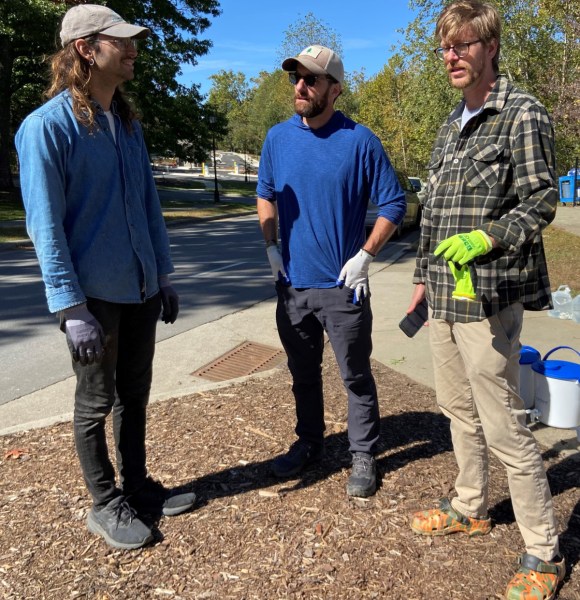
“It’s really hard to put into words what’s happening out there right now,” said Matt Abele, the executive director of the North Carolina Sustainable Energy Association, who visited in the early days after the storm. “It is just the most heartbreaking thing I’ve ever seen — whole mobile home parks that are just completely gone.”
But the breadth of the response is also owed to Footprint’s approach to aid, which is rooted in connections to grassroots groups, government organizations, and the local solar industry. All have partnered together for the relief effort.
“We’ve been incredibly overwhelmed by the positive response that we’ve seen from the clean energy community,” Abele said, “both from an equipment donation standpoint and a financial resources standpoint.”
Some four hours east of the devastation in Western North Carolina, Greentech Renewables Raleigh has been soliciting and storing solar panels and other goods. It’s also raising money for products that are harder to get for free — like PV wire and batteries. Then it trucks the supplies west.
“We’ve got bodies, we’ve got trucks, we’ve got relationships,” said Shasten Jolley, the manager at the company, which warehouses and sells supplies to a variety of installers. “So, we try to utilize all those things to help out.”
The cargo is delivered to Mars Hill, a tiny college town about 20 miles north of Asheville that was virtually untouched by Helene. Through a local regional government organization, Frank Johnson, the owner of a robotics company, volunteered his 110,000-square-foot facility for storage.
Johnson is just one example of how people in the region have leapt to help each other, said Abele, who’s based in Raleigh.
“You can tell when you’re out there,” he said, “that so many people in the community are coping by showing up for their neighbors.”
To be sure, Footprint’s operations aren’t seamless at every turn. For instance, most of the donated solar panels designated for the South Asheville retirement community didn’t work, a fact the installers learned once they’d made the 40-minute drive in the morning and tried to connect them to the system. They returned later that afternoon with functioning units, but then faced the challenge of what to do with the broken ones.
“This is solar aid waste,” Heegaard said. “The last site we did yesterday had the same problem. Now we have to figure out how to recycle them.”
It’s also not uncommon for the microgrids to stop working, Heegaard said, because of understandable operator errors, like running them all night to provide heat.
But above all, the problem for Footprint is scale. A tiny organization among behemoth relief groups, they simply don’t have the bandwidth for a larger response. When Milton followed immediately on the heels of Helene, Heegaard’s group made the difficult choice to hunker down in North Carolina.
With climate-fueled weather disasters poised to increase, the organization hopes to entice the biggest, most well-resourced players in disaster relief to start regularly using solar microgrids in their efforts.
As power is slowly restored across the region, with just over 5,000 remaining without electricity, there’s also the question of what comes next.
While there’s a parallel conversation underway among advocates and policymakers about making microgrids and distributed solar a more permanent feature of the grid, Footprint also hopes to inspire some of that change from the ground up. Maybe the volunteer fire station decides to put solar panels on its roof when it rebuilds, for instance.
“We can change the conversation around resilience and recovery by directly pointing to something that worked when the lights were out and debris was in the street,” Heegaard said.
As for the actual Footprint equipment, the dream is to create “lending libraries” in places like Asheville, to be cycled in and out of community events and disaster relief.
“The solar trailer or the microgrid or the water maker that went to the Burnsville elementary school right after the storm – that can be recycled and used to power the music stage or the movie in the park,” Heegaard said. “Then that equipment is here, it’s being utilized, and it’s available for the next response, whether it’s in Knoxville or Atlanta or South Carolina.”
NUCLEAR: Shuttered nuclear reactors in Michigan, Iowa and Pennsylvania are the country’s most obvious candidates for restarting, a nuclear expert says, adding that others in the U.S. would be long-shots. (Utility Dive)
POLLUTION: Michigan’s coal-based steel and coke facilities contribute to about 40-80 premature deaths and more than 20,000 asthma cases a year, according to a new report from an advocacy and research group. (Planet Detroit)
BIOGAS: Michigan officials approve hundreds of millions of dollars in tax-exempt bonds that would help Chevron and other entities complete several facilities that convert farm waste to renewable natural gas. (WOOD-TV8)
WIND: Zoning officials in eastern Iowa continue work on a draft ordinance for new wind regulations nearly a year and a half after enacting a moratorium on commercial projects. (Telegraph Herald)
ELECTRIC VEHICLES: An Illinois county board leader resigns from his position after taking a job with a Chinese-owned company that’s building a controversial EV battery plant there. (Chicago Tribune, subscription)
BIOFUELS: The Iowa Sierra Club calls a $1 million federal rural clean energy grant for an ethanol producer a “boondoggle.” (Iowa Capital Dispatch)
SOLAR: Minnesota loses its effort to send back to state court a case claiming a group of companies marketing loans for residential solar panels violated consumer protection laws. (Bloomberg Law, subscription)
CARBON CAPTURE: The U.S. Department of Energy awards $518 million to develop 23 carbon capture and storage projects across 19 states, which are still being negotiated and face environmental review. (E&E News, subscription)
POLITICS: Attorneys for former Illinois House Speaker Michael Madigan and his close associate plan to strongly challenge prosecutors’ theory about Madigan exchanging favorable legislation with jobs for his allies. (Chicago Sun-Times)
STORAGE: Long-duration energy storage startup Form Energy, which is developing a commercial pilot project with a Minnesota utility, recently raised $405 million in capital to scale up the company. (Utility Dive)
GRID: Illinois consumer advocates push back on Ameren’s more than $300 million rate increase request to help pay for grid infrastructure projects, saying the amount is excessive. (WEEK)
COMMENTARY:
CLEAN ENERGY: A new report highlights clean energy’s dramatic expansion over the past decade, with U.S. solar, wind and geothermal power production more than tripling since 2014. (Floodlight)
ALSO: The U.S. Energy Department announces $428 million for 14 clean manufacturing projects in areas hit hard by the closure of coal plants and mines, including $52 million for a low-carbon concrete material facility in Utah. (Axios, Canary Media)
CARBON CAPTURE: The U.S. Department of Energy awards $518 million to develop 23 carbon capture and storage projects across 19 states, which are still being negotiated and face environmental review. (E&E News, subscription)
NUCLEAR:
OIL & GAS:
SOLAR: Portable solar systems became a lifeline for North Carolina residents during lengthy blackouts caused by Hurricane Helene, especially because solar systems at schools and other community centers lacked battery storage capacity. (WFAE)
ENVIRONMENTAL JUSTICE: The company redeveloping the former site of the East Coast’s largest oil refinery agrees to cut emissions, remove contamination, and work with community groups addressing the health problems caused by pollution from the refinery. (Inside Climate News)
ELECTRIC VEHICLES:
STORAGE: Long-duration energy storage startup Form Energy raises $405 million in capital to scale up the company. (Utility Dive)
ELECTRIC VEHICLES: Washington state’s electric vehicle rebate program runs out of funds three times faster than expected after more than 6,000 residents take advantage of the incentives. (My Northwest)
TRANSPORTATION: Los Angeles officials say a plan for a “car free” 2028 Olympic Games has run up against funding shortages, potentially forcing them to scuttle some proposed transit projects. (Los Angeles Times)
COAL: The U.S. Supreme Court rejects Wyoming’s and 24 other states’ bid to pause Biden administration rules requiring power plants to slash greenhouse gas emissions, which could eventually force some facilities in the state to close. (WyoFile)
CLIMATE:
OIL & GAS:
PUBLIC LANDS: Advocates worry a second Trump administration would resume efforts to dismantle federal land management agencies, resulting in less oversight of oil and gas drilling and other development. (High Country News)
EMISSIONS: The U.S. Energy Department awards a Colorado startup $52 million to build a low-carbon concrete-material manufacturing facility in a former coal town in Utah. (Canary Media)
SOLAR:
MICROGRIDS: The U.S. Energy Department allocates $50 million to an effort to install battery-powered microgrids at California water utility sites. (news release)
NUCLEAR: Utah and other Western states team up to create economic development plans around potential advanced nuclear reactor deployment. (Deseret News)
COMMENTARY: A Colorado evangelical advocate says the “urgent crisis” of climate change should influence how Americans vote on all races and issues in November. (Colorado Newsline)


.svg)
