

 Back
Back
U.S. Steel says it will invest $1.9 billion to build a modern and lower-carbon ironmaking plant in Arkansas — marking a key expansion beyond the company’s coal-based steel mills.
The new “direct reduced iron” plant will sit alongside the sprawling Big River Steel Works, in the town of Osceola, where four electric arc furnaces melt down scrap metal with iron to make high-quality steel for vehicles and electrical equipment. Put together, the forthcoming ironmaking plant and the existing furnaces represent an emerging model for cleaner steelmaking.
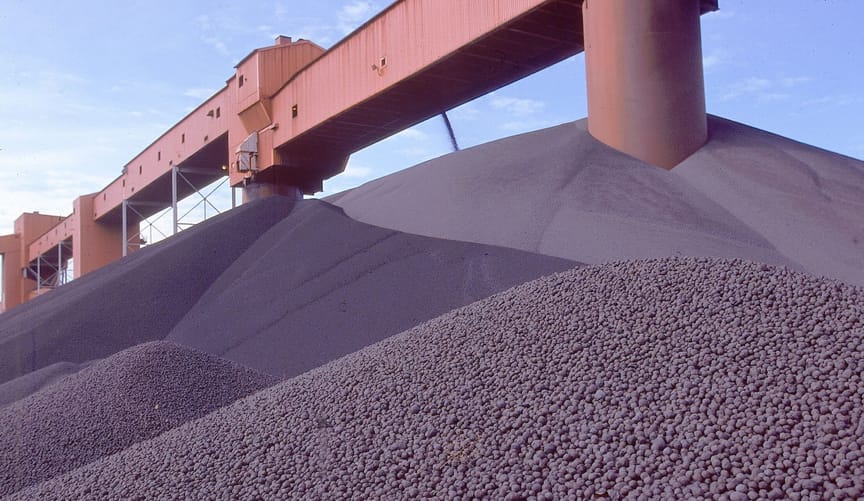
Finished iron ore pellets at U.S. Steel’s Minnesota Ore Operations (U.S. Steel)
U.S. Steel, which is owned by Japan’s Nippon Steel, announced the project on Wednesday. The parent company has committed to investing $11 billion in the U.S. by 2028 to expand its lower-emissions production as well as to extend the lives of aging blast furnaces in places like Gary, Indiana.
Blast furnaces use coal and extreme heat to transform raw iron ore into molten iron, and the process is responsible for most of the planet-warming emissions and toxic air pollution associated with the industry. The iron then flows into a neighboring furnace to be processed into sturdy steel.
Direct reduction plants, by contrast, primarily use natural gas to turn iron ore into lumps of iron. These facilities can emit about half the CO2 emissions of coal-based blast furnaces. A handful of efforts are underway globally to instead use green hydrogen, which is made with renewable energy, to produce nearly zero-emission iron.
In the United States, three gas-fueled DRI plants are already operating: in Louisiana, Ohio, and Texas. The iron they make helps strengthen and improve the quality of recycled steel. But none of those facilities is sited next to any of the nation’s 150-odd electric arc furnaces, meaning the iron must be cooled, transported, and eventually reheated.
U.S. Steel’s new DRI facility in Arkansas will be the first in the country with the ability to “hot charge” iron directly into the steel furnace while it’s still at high temperatures, a spokesperson for the manufacturer told Canary Media by email. That will allow the facilities to operate in a way similar to traditional integrated steel mills, where iron- and steelmaking happen at the same site.
“This increases efficiency and reduces electricity needs,” the spokesperson said.

An illustration of U.S. Steel’s planned DRI facility at Big River Steel Works, in Osceola, Arkansas (U.S. Steel)
The ironmaking plant will use natural gas, the company confirmed, and it will source iron ore pellets from U.S. Steel’s mine in Minnesota. Construction on the DRI facility is expected to happen across the next 30 months, with startup slated for the first half of 2029.
“Our partnership with Nippon Steel helped accelerate this investment years sooner than would have otherwise been possible,” David Burritt, president and CEO of U.S. Steel, said in a Wednesday press release.
For some green steel advocates, Nippon Steel’s 2025 acquisition of U.S. Steel represents a key opportunity to not only invest in new projects but also modernize and decarbonize its legacy operations in Illinois, Indiana, Michigan, and Pennsylvania. Steel jobs in those states have dramatically declined in recent decades as American steelmakers lost out to overseas suppliers, and as fierce competition emerged at home from steel-recycling mills in primarily Southern states.
In fact, the Arkansas expansion may accelerate that downward trend. New iron made there could potentially replace some of the metal that Big River Steel’s electric arc furnaces currently source from the Gary Works mill in Indiana, said Roger Smith, who follows Nippon Steel and U.S. Steel closely as the Asia lead for the nonprofit SteelWatch. He added that the companies have also announced plans to build a major new plant with electric arc furnaces somewhere in the United States.
“But when it gets to the rest of the legacy facilities, the things they’ve talked about to date are really largely in the category of maintenance,” Smith said during a recent green-steel panel in Chicago. At Gary Works, Nippon Steel has committed to spending around $300 million to revamp the largest of its four blast furnaces this year and another $200 million to refurbish a hot-strip mill.
Local advocates are pushing for the company to go further. Jack Weinberg, a member of Gary Advocates for Responsible Development and a former steelworker, said that replacing Midwestern blast furnaces with DRI facilities would offer a path forward for historic steel communities. That could include initially building gas-fueled ironmaking plants that later switch to using green hydrogen as supplies become available.
“We’re advocating for a transition where they don’t have to shut down the mill,” he said during the panel.


.svg)
