

 Back
Back
In the face of soaring energy demand and electric rates, battery developers across the U.S. are stepping in with massive, multihundred-megawatt systems that can cheaply dispatch power when it’s needed most.
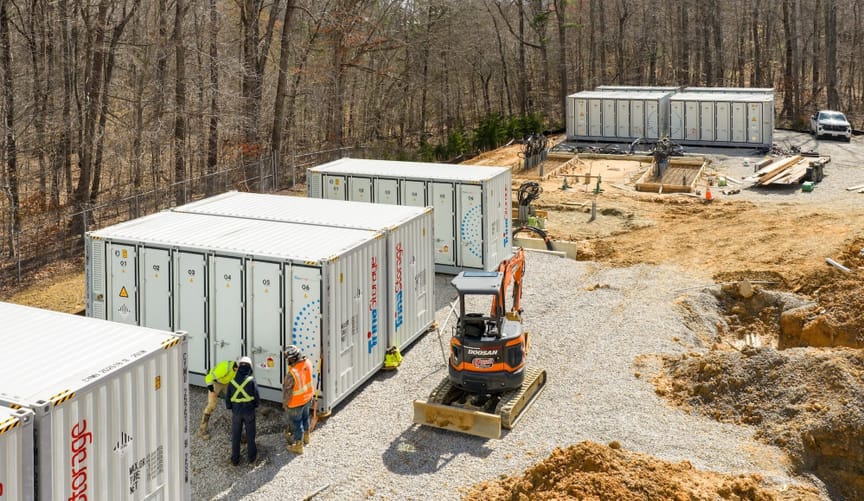
Lightshift Energy is constructing a second battery project for the city of Danville, Virginia. (Sanjay Suchak)
In the face of soaring energy demand and electric rates, battery developers across the U.S. are stepping in with massive, multihundred-megawatt systems that can cheaply dispatch power when it’s needed most.
Virginia — the world’s data center capital — is starting to catch on to the big-battery trend. But a new project by local electric providers in the state underscores that much smaller storage projects have value, too: They’re designed to fill specific community needs and — due to their size — relatively quick and low-cost to build.
The Blue Ridge Power Agency, which serves a string of nonprofit utilities in central and western Virginia, is set to go live this summer with a collection of five batteries of about 5 megawatts each. The systems will help two rural electric co-ops and the city of Salem’s utility save money by storing power when it is cheap and abundant. They can then rely on that saved-up power when high demand on the grid spikes prices.
All in all, the projects are predicted to save the member utilities $100 million over the batteries’ 20-year lifespan, addressing long-held local concerns over rising costs.
Lightshift Energy, the storage developer building the five batteries, has formed a bit of a niche working with small, member-owned utilities, said Rob Greskowiak, the company’s chief commercial officer.
These nonprofit utilities are rooted in their communities and intimately familiar with their customers and grids, Greskowiak explained. “These municipalities are like, ‘Listen, I know the 50,000 people that live here, and I know that this distribution circuit is not reliable and that our energy costs are going up,’” he said. At Lightshift, “we can find a very acute problem and solve it with 5- to 30-megawatt-sized batteries.”
Small cooperatives’ investment in storage extends well beyond Virginia. As of the first quarter of 2025, 136 battery storage projects sponsored by co-ops were underway or operational in 27 states, according to an analysis by the National Rural Electric Cooperative Association. It predicts that storage deployed by co-ops will more than triple, from 439 megawatts of capacity to 1.5 gigawatts, in the next three years.
The smaller batteries these co-ops tend to favor are cost-competitive because they avoid the need for expensive network upgrades, don’t require expensive long-lead equipment, and are sited on very small footprints, Greskowiak said.
Their minimal impact means they’re often quicker to permit and gain community acceptance than larger versions, he added. “If you’re putting in a battery that isn’t that big in a spot that already has that infrastructure, people aren’t really batting an eye on that.” The company can typically go from initial discussions with a utility to operations in 18 to 24 months, he said, significantly faster than transmission-scale assets.
The rapid setup is particularly meaningful in Virginia as data center plans flood the state and send power-demand forecasts ballooning, said Nikhil Kumar, program director at GridLab, a nonprofit that provides technical support on the clean energy transition in a range of settings. “Speed to power,” he said, “it’s in the zeitgeist right now.”
While reining in power prices is the main motivation behind the Blue Ridge Power Agency’s midsize-battery buildout, Greskowiak emphasized other advantages as well. “Battery storage is best when it acts like the Swiss army knife that everybody talks about,” he said.
A key benefit includes storing electrons from solar and wind and dispatching them when the sun fades or the breeze dies down, enabling even more renewable energy deployment. “Local homeowners, local businesses, local community solar gardens can add to that grid more sustainable energy,” he said, “because we’ve released and unlocked more capability at those substations to host more solar.”
Batteries are also getting cheaper and cheaper, with the average price of a lithium-ion battery pack dropping by nearly 80% over the last decade. And even though President Donald Trump and congressional Republicans slashed incentives for wind and solar last year, they retained the 30% credit for storage well into the next decade. “That’s another big advantage,” Kumar said.
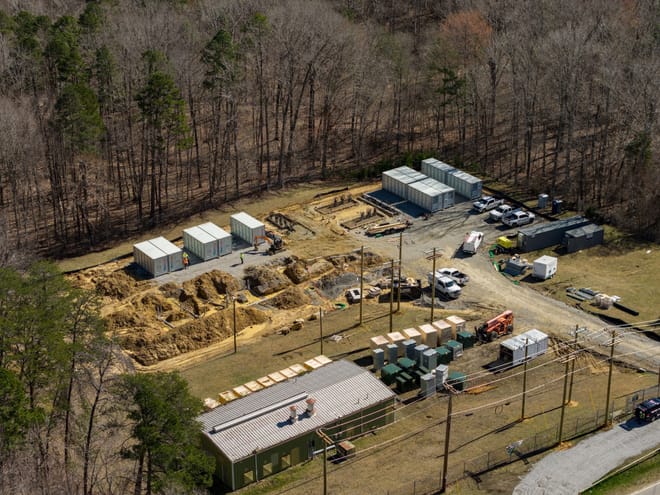
Lightshift Energy’s Danville II project (Sanjay Suchak)
The Blue Ridge Power Agency project is just the latest example of a small Virginia utility quickly deploying batteries. Lightshift has partnered with the city of Danville on two systems that total over 20 megawatts and are expected to save customers $70 million; the first went online in 2022, and the second is under construction. Last year, developers announced two similar-sized projects for a co-op on the state’s Eastern Shore.
Co-ops’ increased interest in storage comes as the state directs its two investor-owned utilities to ramp up investments, too: A law recently enacted by Gov. Abigail Spanberger, a Democrat, requires Dominion Energy and Appalachian Power to build nearly 17 gigawatts of battery storage by 2045; their former target was 3 gigawatts by 2035.
All these planned storage investments will be necessary to ease grid strain and bring down costs, Kumar said. “Especially in Virginia, with the large loads and the data center growth, we’ll need a lot of these projects to help the grid.”


.svg)
