

 Back
Back
It’s the only state that makes big utilities offer lower seasonal rates for heat pump owners, in an effort to boost adoption and create a fairer system.
Winter savings are in store for more than 65,000 Massachusetts households as two electric utilities slash their rates for heat pump owners below last year’s already discounted prices.
Last winter, Massachusetts became the first state to require major utilities to offer a lower seasonal rate for all the electricity used by households with heat pumps, highly efficient systems that can both heat and cool spaces and are essential to weaning buildings off fossil-fueled furnaces. The reduced rates saved these residents more than $37 million in total.
Now, state public utility regulators have approved National Grid’s and Unitil’s proposals for even lower winter prices, to go into effect on Nov. 1. The move, supporters say, makes using a heat pump more affordable and more accurately reflects how these homes contribute to grid-maintenance costs.
“Heat pump rates are important for customer fairness, but they’re also really important to unlock the full greenhouse-gas reduction opportunities from heat pumps,” said Alex Lopez, senior manager for regulatory policy at electrification nonprofit Rewiring America.
Accelerating heat pump adoption is a major element of Massachusetts’ plan to reach net-zero emissions by 2050. Their cost, however, has been a persistent barrier. Rebates and low-interest loans exist to help pay for the equipment up front, but the cost of operating an electric heat source as power prices soar has kept many homeowners from making the switch. Heat pump rates address this obstacle.
Massachusetts remains the only state to require major utilities to offer heat pump rates, but utilities across the country are adopting or investigating the approach. Xcel Energy has established an electric heating rate in Minnesota, and Central Maine Power recently concluded a pilot. Climate think tank Switchbox is advocating for the idea in New York and Rhode Island.
With these latest rate changes, more than half of Massachusetts households would save money by switching from natural gas heat to a heat pump, according to analysis by Switchbox. National Grid and Unitil customers who have already made the change stand to save an additional $9.8 million this winter compared to last year, Switchbox calculates.
This season’s lower prices are the result of a regulatory order telling National Grid and Unitil to change the way they calculate their heat pump rates.
For last year’s seasonal heat pump rates, National Grid and Unitil applied discounts to the distribution portion of customers’ bills, which pays for the poles and wires that carry power to consumers. The state’s third major electric utility, Eversource, did the same but also cut transmission rates, which pay to carry high-voltage power over long distances. Think of distribution and transmission as the backroads and freeways of the power system.
In the spring, regulators decided Eversource had the right idea and ordered the other two utilities to follow suit. National Grid responded with a plan to drop transmission charges from $0.055 per kilowatt-hour to $0.02 per kWh. Unitil proposed lowering its transmission rate from $0.042 per kWh to $0.015 per kWh. The state Department of Public Utilities approved the rates in July.
At these rates, a household using 600 kWh of power a month can expect their bills to drop between $16 and $21 per month in addition to the savings created by the existing discounts.
A proposal from the Massachusetts Department of Energy Resources would have also had utilities reduce some of the surcharges and fees on electric bills, but regulators did not approve the request.
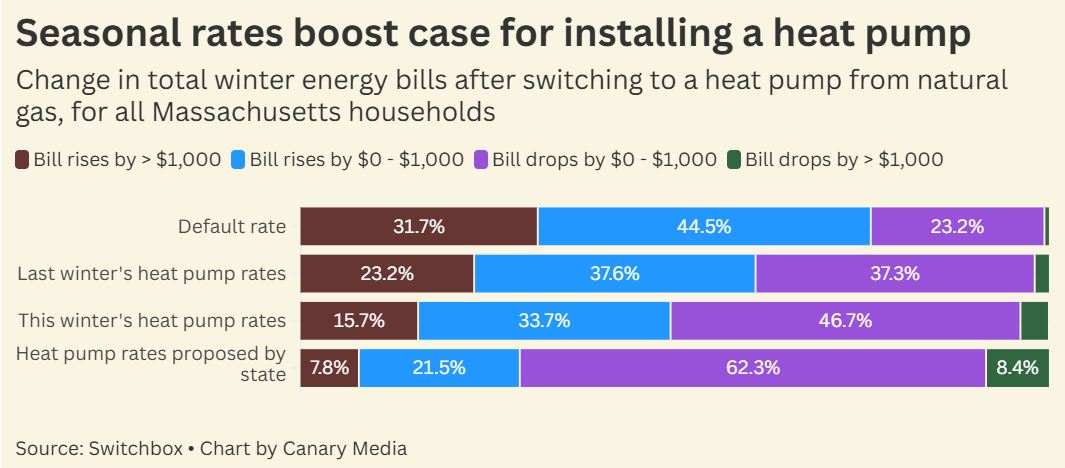
Supporters emphasize that these rates aren’t a handout for heat pump owners but are actually grounded in basic grid economics. Transmission and distribution rates — together, the delivery portion of the bill — are based on the cost of building and maintaining the grid.
However, this infrastructure is built big enough to handle all the power needed when demand is highest, typically on the hottest days of summer. In the winter, demand is much lower, so there’s plenty of room for the grid to handle the additional electron traffic created by heat pumps without added expense. So heat pump customers use more electricity and pay more in delivery charges, even though they’re not adding to utilities’ expenses.
Lowering the rate for heat pump users addresses this disparity, advocates say.
“Well over 140,000 customers were using heat pumps based on an outdated rate framework,” said Elizabeth Mahony, commissioner of the state’s Department of Energy Resources.
Heat pump rates are not a permanent solution for matching energy prices to grid demand. The logic behind them holds only as long as the grid’s peak demand days are in the summer. Grid operator Independent System Operator New England predicts the region will shift to winter peaks within the next 10 years.
Policymakers and utilities are already preparing for the change. Utilities have started rolling out advanced meters, which will allow consumers to access detailed data about their power usage. And regulators are considering a proposal to implement time-of-use rates that would be lower during times of decreased demand.
“It’s really about trying to maximize our thinking on when and how to use electricity,” Mahony said.
Two bills on Gov. Newsom’s desk would reduce hurdles to heat pumps and home solar and batteries, which could reduce fees by $1,000 or more per project.
Californians could soon find it easier and cheaper to install rooftop solar, home batteries, and energy-saving heat pumps and heat-pump water heaters.
Late last month, the state Legislature passed two first-in-the-nation bills that would streamline permitting and inspections for these clean energy home projects. Democratic Gov. Gavin Newsom has until Sept. 30 to sign the bills, the Heat Pump Access Act (Senate Bill 222) and the Remote Virtual Inspection Act (Assembly Bill 1738).
Newsom’s office declined to say which way he’s leaning. If enacted, the bills could save households hundreds of dollars to more than $1,000 in fees per environmentally friendly upgrade, according to independent analyses. The technologies all tend to reduce monthly utility bills, too.
Those savings would go a long way right now, as Californians deal with some of the highest energy costs in the nation and the federal government has clawed back support for such upgrades. President Donald Trump and the Republican-controlled Congress eliminated federal tax credits for home solar, batteries, heat pumps, and heat-pump water heaters last year.
“This is something that touches families’ pocketbooks directly,” said Nick Josefowitz, founder and chief executive of energy-affordability nonprofit Permit Power. “We’re just thrilled that the legislature in California acknowledged how important that is.”
The pieces of legislation could also nudge California closer to its climate targets. By 2030, the state has pledged to reduce planet-heating emissions by 40% from 1990 levels and to deploy 6 million carbon-slashing heat pumps.
Here’s what each bill would deliver.
Californians who want to install a heat pump or a heat-pump water heater need permits from their city or county before a contractor can legally do that work.
But “inconsistent and onerous” permitting regulations inflate project costs. The policy nonprofit San Francisco Bay Area Planning and Urban Research Association (SPUR) found that some jurisdictions require three permits — plumbing, electrical, and structural — for a heat-pump water heater, which can result in $400 in unnecessary fees.
If it becomes law, the Heat Pump Access Act would replace a patchwork of requirements across roughly 600 jurisdictions with a simpler statewide standard.
The bill requires cities of at least 5,000 and counties of at least 150,000 to offer expedited or instant permitting for heat pump projects by July 1, 2028. It also limits jurisdictions to one permit per project; caps permit fees at $150 for a heat-pump water heater and $200 for a heat pump, excepting jurisdictions that show they have higher costs to recoup; and prohibits homeowners associations from imposing their own restrictive rules or outright bans. One HOA delayed a retiree’s heat pump by seven months, causing her to miss out on almost $6,500 in incentives.
SB 222 “is going to make it so much easier for people to install heat pumps,” said state Sen. Scott Wiener (D), who authored the bill. Speeding up that process, which would make air conditioning more accessible, “is how we protect California families from extreme heat and rising energy costs.”
Cities and counties inspect permitted home upgrades to make sure they’re up to code. But doing these routine checks in person takes time and money.
Heating, ventilation, and air-conditioning contractors often find themselves waiting for two to six hours for an inspection that itself takes just five to 15 minutes, according to SPUR. The nonprofit estimates that this inefficiency, along with the inspector’s travel time and coordination work, adds $600 to $1,000 to the cost of a single heat-pump, solar, or battery project — an expense passed on to customers.
AB 1738 aims to streamline the inspection process for these and other select projects by giving homeowners the right to request an established time-saving approach: remote virtual inspections. Because they can be done with a video call on a smartphone, the scheduling is much tighter and more flexible.
For example, a plumber might install a water heater in the morning and book an inspection for that afternoon, said Timothy Wegner, who led the Placer County, California, building department, where he spearheaded its adoption of remote inspections, before retiring earlier this year. At least 19 jurisdictions in California already offer a remote option, including Berkeley, Los Angeles County, and San Diego.
The bill requires cities of more than 50,000 people and counties of at least 150,000 to offer virtual inspections by Jan. 1, 2028. However, it lets authorities require an in-person meeting when necessary. If enacted, the legislation would save Californians more than $500 million in three years based on current permit data, according to SPUR.
“A thousand bad rules and process bottlenecks that nobody ever bothered to fix caused California’s affordability crisis,” Brian Hanlon, CEO of pro-housing nonprofit California YIMBY, said in a statement. “AB 1738 fixes one of them by allowing remote inspections. That’s how you make California affordable again — fixing one dumb bottleneck at a time.”
California has long been a clean energy trailblazer. In 2022, the Golden State became the first in the U.S. to require most cities and counties to automate permitting for rooftop solar. Connecticut, Florida, Maryland, New Jersey, Texas, and Virginia have followed suit with laws streamlining home solar and storage permitting. And Maryland has also adopted one encouraging, though not requiring, jurisdictions to offer remote inspections for such projects.
“All these states are looking at each other,” Josefowitz said. Once one goes first, “it unleashes a torrent of interest.”
The climate-friendly appliances are becoming the norm among American home builders. Here are the factors driving the shift.
Heat pumps are a key way to get fossil fuels out of buildings — and the tech recently notched a win in the U.S. housing market.
2025 marked the first year that over half the apartment buildings constructed nationwide came equipped with the überefficient electric appliances, according to U.S. Census Bureau data. Buildings with heat pumps, which can both heat and cool indoor spaces, accounted for 53% of new apartment complexes, up from 46% in 2024.
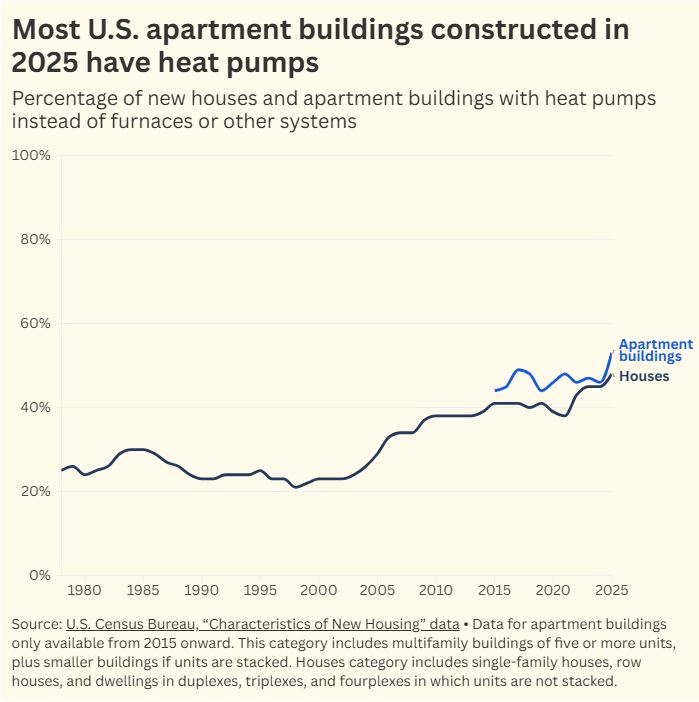
New houses, including row houses and town houses, aren’t far behind: In 2025, 48% were built with heat pumps, up from 45% in 2024.
The stats are the latest evidence that heat pumps are taking over the U.S. residential heating market. For the past four years, these devices have outsold conventional gas-fueled furnaces, which belch pollution that endangers health and warms the planet. The tech’s growing popularity is a positive sign for decarbonization, since burning fossil fuels in buildings contributes nearly a tenth of the nation’s total greenhouse gas emissions.
The data reveals another piece of good news: The majority of all homes built last year — 78% of new apartment units and 56% of new houses — had electric heating in some form, either heat pumps or less-efficient electric-resistance systems.
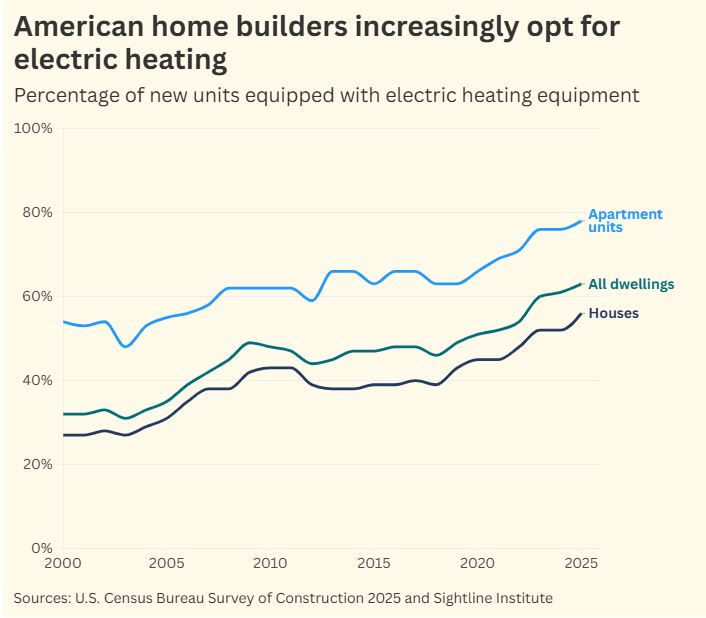
This trend toward electric heating has persisted for over two decades now, across federal administrations, though it varies regionally. For example, in the South, with its milder winters, 96% of new apartments are electrically heated; in the Northeast, it’s just 52%.
Driving the shift to heat pumps is likely a combination of factors, according to Alan Durning, executive director of the Sightline Institute, a sustainability nonprofit in the Northwest. The two that stand out, he said, are improvements to the technology and the increased demand for air conditioning during climate change–fueled heat waves. While heat pumps are pricier up front than gas furnaces, they can be competitive with a gas furnace plus central AC.
A federal tax credit expanded under the 2022 Inflation Reduction Act could have also spurred heat-pump installations. That incentive offered developers up to $5,000 per energy-efficient housing unit. But even though the credit expired last month after being axed by President Donald Trump and Republicans in Congress, developers still stand to profit by ditching gas in new buildings.
All buildings require electrical infrastructure. But hooking up to a gas pipeline on top of that adds complexity, time, and expense. New Mexico land developer John Moscato says that by skipping gas-line construction, his company reduces costs by $3,000 per lot. That adds up fast.
“In our upcoming development of 4,500 lots, we expect the savings of being all-electric to be approximately $13.5 million,” Moscato said.
Some states, like California, Colorado, and Washington, have standards that encourage new construction to go fully electric. But “red states are never going to pass laws requiring a phaseout of gas in new buildings,” Durning said.
Still, he said, policies that simply boost new housing in such states can move the needle toward cleaner buildings, since developers are increasingly likely to opt for electric heating appliances. And unlike gas bans, these laws are politically palatable, he added, pointing to recent pro-housing zoning reforms passed in deep-red Montana and Idaho. “We are getting accidental electrification,” he said.
Some legislators may “say climate change is a hoax, but they want to free the market in their cities to build more housing,” Durning said. “In red states, building more apartments will move us closer to decarbonization.”
For years, heat pumps have outsold gas furnaces in the U.S. — and now the superefficient appliances are coming for conventional ACs, too.
Summer is officially here — and more Americans than ever are cooling their homes with heat pumps.
A decade ago, two conventional air-conditioning systems were sold for every one heat pump. Now, heat pumps are on the verge of outselling standard ACs.
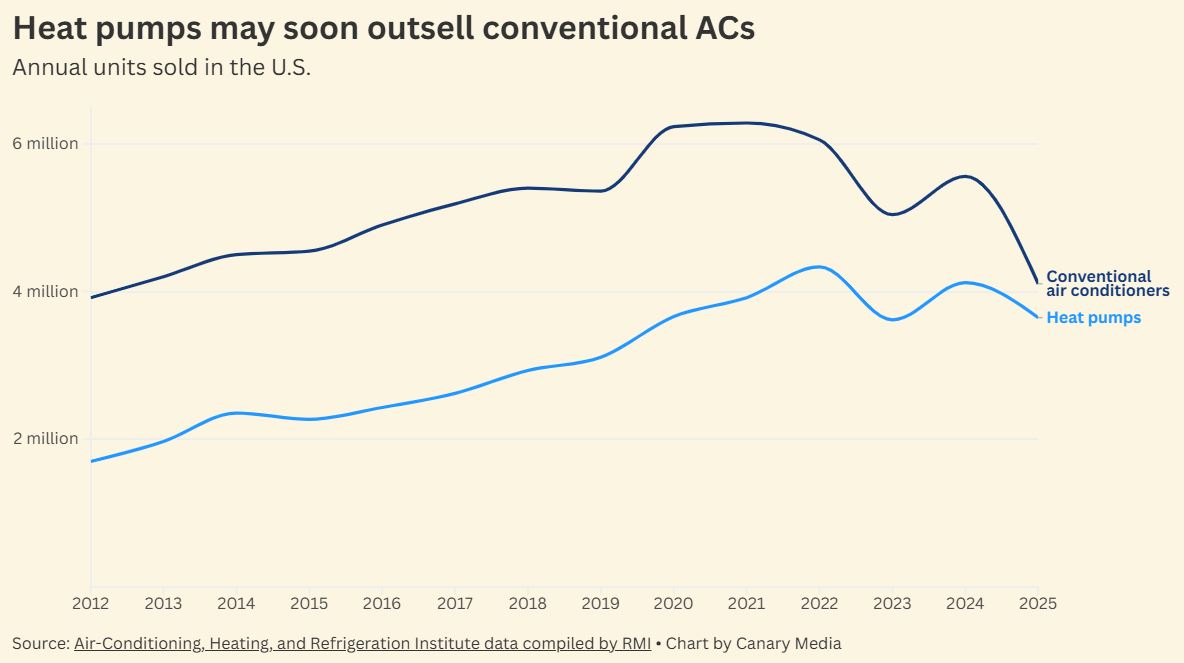
In 2025, sales of the appliances were basically tied — and heat pumps even beat air conditioners in September, a first. Through April of this year, the already-slim gap has narrowed further. Compared with the same period last year, heat pump sales are up by about 1%, while AC sales are down by nearly 8%, according to data from the Air-Conditioning, Heating, and Refrigeration Institute, a trade group.
Heat pumps are essentially reversible ACs: The same unit both heats and cools a space. They’ve long been popular in more moderate climates, like the U.S. South, but in recent years their cold-weather performance has improved, and they’ve caught on in more frigid regions, too. Heat pumps have outsold gas furnaces for four years now.
It’s a big deal that more buildings are being outfitted with heat pumps. Heating is one of the largest sources of carbon emissions in the country, and heat pumps, which are two to four times more efficient than fossil-fueled systems, offer a much cleaner way to keep a space warm. The fact that they also cool homes is a climate benefit in its own right, as extreme heat makes air-conditioning a necessity rather than a luxury.
Many states, municipalities, and utilities have incentivized the adoption of the energy-efficient, zero-emissions technology.
Sometimes these incentives come in the form of direct rebates. Other times they manifest in wonkier places, like pro-electric building codes or preferential electricity rates for homes with heat pumps. Some states, like cold and snowy Maine, have even set — and exceeded — explicit adoption targets. (For a few years, the federal government offered incentives for the appliances, too, but President Donald Trump and congressional Republicans repealed those last year.)
All of this goes to explain why the gap is closing between conventional ACs and heat pumps — and why, soon, the efficient two-way tech will overtake the old-school systems.
A new report finds that mentioning all-electric heat pumps in real estate listings delivers a sales premium. But most agents don’t note the appliance.
Would you pay more for a home with a heat pump?
You can bet I would.
I’d gladly fork over more money to bypass a gas or oil furnace, which — unlike an all-electric heat pump — spews toxic combustion by-products, runs the risk of poisoning my family with carbon monoxide, and contributes to climate change. And while heat pumps, which provide both heating and cooling, typically cost more upfront than conventional furnaces, they’re two to four times as efficient, and so could save me money in the long run.
Apparently, I’m not alone in prizing the comfort, safety, and economic benefits of these appliances.
Heat pumps give home values a boost, according to a new report by the nonprofit Smart Energy Consumer Collaborative, which studies consumer behaviors, interests, and concerns in the energy transition; 257, a customer-intelligence platform that profiles U.S. residential property characteristics for contractors, utilities, and others; and the trade group the National Association of Realtors. Their analysis showed that homeowners who install a heat pump can recoup up to a quarter of its cost just by mentioning it in real estate listings when they’re ready to sell.
While some homeowners may invest in a heat pump for its environmental bona fides, for most people, economics trumps all, said Scott Rosenberg, a co-founder and CEO of 257. “A homeowner who puts a garage on, redoes their bathroom, improves their kitchen, always thinks, ‘Am I going to get this value back?’”
By analyzing more than half a million sales of U.S. homes with ducted heat pumps from 2024 to 2025, the authors found that those with real estate listings mentioning the heat pump typically enjoyed a sales price boost of 0.6% to 1% over homes that didn’t advertise their efficient appliance. This modest lift translates to $2,300 to $3,900 per home, given a median sales price of $399,000.
“Just shy of $4K doesn’t sound like a lot of money on a home sale,” Rosenberg said. “But it’s actually a meaningful piece of the investment that you made to get the heat pump in the first place.”
In 2026, a ducted heat-pump system costs on average about $15,400, per energy marketplace EnergySage — though prices vary wildly depending on the region, a home’s size and electrical service, and local contractors, to name a few variables. A comparable gas furnace plus central AC system can cost half that, according to home services platform Angi. Mentioning a home’s heat pump in the sale listing, assuming the appliance cost around the average price, can recoup about 15% to 25% of the outlay.
Now, every home is different, and people willingly pay premiums for a wide variety of attributes, such as the floor plan, the views, and neighborhood vibes.
But Rosenberg is confident that when it comes to real estate listings, the heat-pump price bump is real, because of the approach his team used and the sheer amount of data they analyzed. 257 used a machine learning technique to cluster homes across hundreds of attributes to identify those that are nearly identical, he said. Then within those clusters, sales prices were contrasted for those homes where the heat pump was or wasn’t mentioned in the listing.
Yueming “Lucy” Qiu, an economics professor at the University of Maryland, called the report “very valuable” for helping to gauge the premium that people place on heat pumps. “I’m actually very happy that this came out,” said Qiu, who investigated the matter years ago at a smaller geographic scale.
In 2020, Qiu and her colleagues published a peer-reviewed study in Nature Energy that looked at home sales across 23 states from 2000 to 2018 for whether the presence of a heat pump improved the property’s sale prices.
Notably, to control for differences between homes that could influence price, her team looked at individual abodes that sold both before and after a heat pump was installed. They then compared the differences in sales prices (adjusted for inflation) with those for homes that hadn’t gotten a heat-pump makeover. Residences with heat pumps sold for a 4% to 7%, or $10,400 to $17,000, premium on the $240,000 average home price.
That’s a much bigger boost than the latest report identifies, but that’s because the groups investigated different questions. Qiu’s team asked, What’s the value of a heat pump? Whereas 257 asked, Once a home has a heat pump, what difference does highlighting it in the real estate listing make?
“We weren’t trying to make the case for energy efficiency, but rather to study whether it’s valued once it’s there,” Rosenberg said.
Qiu would love to see a follow-up study in which Rosenberg and colleagues analyze a subsample of homes with the methods she used in her paper. “Just as a robust check to see if, using similar methods, they find a similar magnitude [to what] we do,” she said.
Homebuyers are asking real estate agents more frequently about energy-efficient upgrades — not only for environmental reasons “but also to control and maintain their monthly costs, like their utility bills,” said Matt Christopherson, director of business and consumer research at the National Association of Realtors.
Yet Realtors often struggle to convey the benefits of energy-efficient features to clients, according to the recent report, which looked at a range of technologies. More than half of Realtors surveyed said they were “not too confident” or “not confident at all” in their ability to explain the benefits of heat pumps.
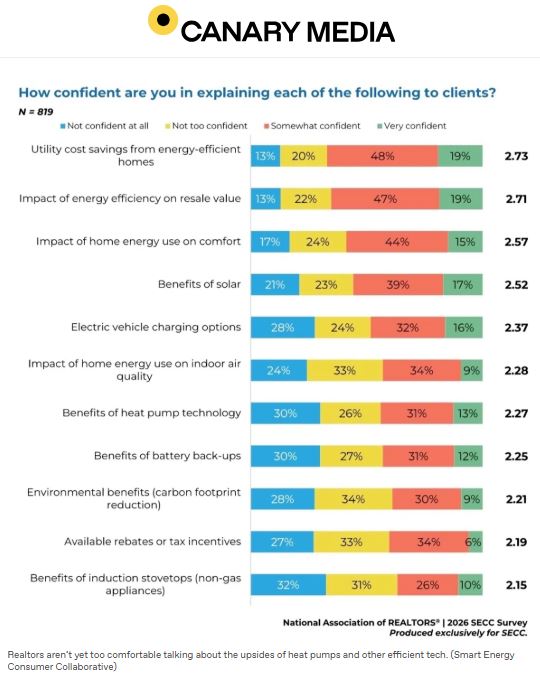
Real estate agents are the ones writing the listings, Rosenberg pointed out. In homes with a heat pump, it was mentioned in the listing just 8% of the time.
If real estate agents become more aware that potential buyers are willing to pay more for homes with heat pumps, and they lean into promoting the appliances, Rosenberg believes “that’ll have a virtuous-cycle effect of reinforcing and signaling to buyers that this is something they should pay attention to.”
Of course, some of us are already keeping our eyes peeled for listings that give heat pumps and other clean energy perks a shoutout.
Bulk buying is a tried-and-true way to get discounts on rooftop solar. Now programs aimed at heat pumps are popping up too, helping people save thousands of dollars.
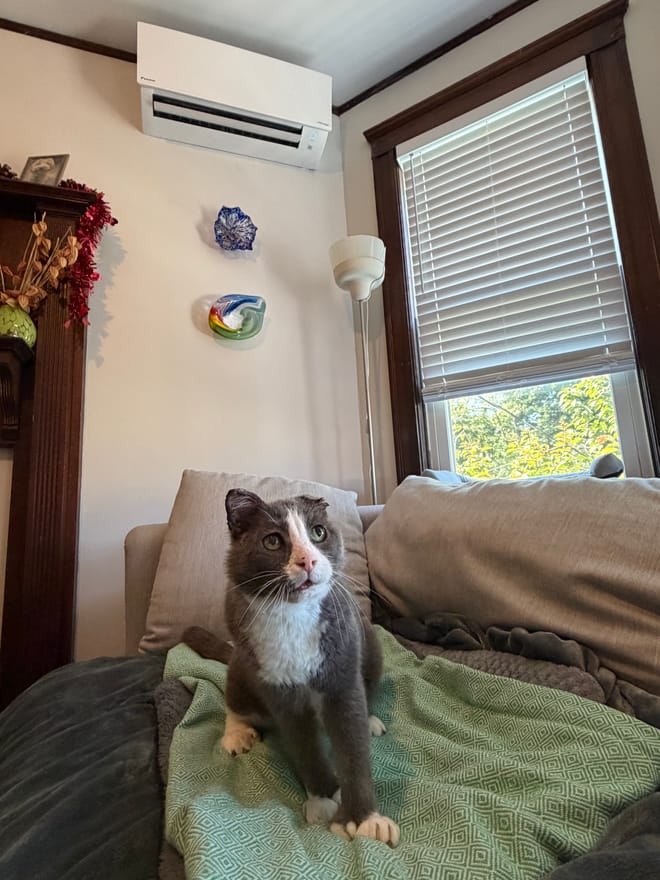
Last year, Marie Tai needed a better way to keep her condo cool. Her window air-conditioning units were borderline ineffective, even running at full blast. Summers have been getting more intense in Tai’s Boston neighborhood because of a rapidly warming climate, and she had just adopted a 16-year-old cat named Mittens, who was still recovering from being hit by a car.
Tai had already been considering a heat pump, an all-electric appliance that heats and cools spaces and lets homeowners ditch polluting fossil fuels. But three contractors had quoted her prices ranging from about $28,000 to $40,000. Tai, who heads finance and administration at Harvard University’s Project Zero, thought those estimates seemed excessive for her 1,000-square-foot, two-bedroom place. So she had hit pause on the project.
But with Mittens’ well-being front of mind, Tai renewed her heat pump search last spring. Through Facebook, she found an opportunity to participate in a program that aggregates demand, organized by Laminar Collective, a local startup that does research on the tech and coordinates installations.
These heat pump group-buy initiatives let installers purchase equipment in bulk and spend less time chasing leads, accruing savings that they can pass on to customers. Tai, tantalized by Laminar’s menu of low prices for a heat-pump setup, decided to give it a shot.
After a representative from the startup visited her home to check what heat pump size and configuration would fit her needs, Tai signed up for a ductless minisplit system for $20,000 — thousands less than even her lowest initial quote. She then also took advantage of an additional $8,500 state rebate and eight-year financing with 0% interest.
The new equipment has been life-changing, Tai said.
She no longer has to buy fuel oil for heating in the winter, and the heat pump is so efficient that last year she saved roughly $1,300 on her energy bills. In contrast to the old, noisy window ACs, the new system’s wall-mounted, air-filtering indoor units “are so quiet,” she said. Her allergy symptoms have improved. And Mittens is comfortable and doing well, she noted. “I couldn’t be happier.”
Like Tai, homeowners in communities across the U.S. are signing up for an unusual way of buying heat pumps: together. Companies, nonprofits, and local governments are increasingly offering programs that coordinate consumer demand to secure meaningful discounts of around 10% to 20%, which can translate to roughly $3,000 to $6,000 per installation. It’s like a group buying a pack of muffins at Costco rather than each buying a muffin at Starbucks.
The bulk-buy approach is taking off as the Trump administration demolishes electrification incentives. Last year, the Republican-led Congress eliminated a $2,000 federal tax credit for home heat pumps. Late last month, the administration said that it won’t allow home energy-efficiency rebates to be used by people looking to get off gas.
While heat pumps reduce pollution and typically cut owners’ energy bills, they can be a pricey proposition up front. Whole-home installations typically range from $17,000 to $30,000, depending on the property size, insulation, climate, and many other factors, according to electrification advocacy nonprofit Rewiring America.
“Even though homeowners often save significantly over time, the first quotes can bring real sticker shock,” said Cole Merrick, founder and CEO of VoltHub, an online heat-pump installation marketplace.
VoltHub and heat-pump general contractor Vayu organized a California group-buy program this spring to serve the counties of Los Angeles and Orange and the greater San Francisco Bay Area. They’re offering another one this summer.
Most heating, ventilation, and air-conditioning replacements are emergencies, and these jobs will continue to make up the majority of Vayu’s business, said founder and CEO Shreyas Sudhakar. But for households that can hold off on getting a heat pump installed, group buys are ideal, he noted.
The process entails a waiting period, which can be several weeks to about six months, as the slots fill up and the installer determines the final pricing. The installer then confirms individual quotes with customers — who can decide not to move forward without penalty — and schedules the work.
Heat pump group buys come in different forms. They can be organized at the grassroots level, offered by a contractor, or run by a third party that aggregates demand over a limited time window. Through a competitive bidding process, the third party vets qualified installers and chooses one or more to carry out the jobs.
The collective bargaining approach has succeeded in the past. Nonprofit Solar United Neighbors has led similar group buys for rooftop solar since 2007, helping thousands of households net deals on installations.
Now, the organization is partnering with iChoosr, an international company that helps households electrify, in order to get group deals for heat pumps, too. Using iChoosr’s Switch Together platform, people in select areas can sign up to unlock group discounts for the all-electric appliance, as well as solar and batteries. Since 2023, more than 5,100 U.S. homeowners have gotten their solar panels or batteries via iChoosr, which earns a fee from participating vetted installers for jobs they get through the platform, said Fred Wu, a director of community engagement for the company.
iChoosr was already running successful bulk-purchasing programs for heat pumps in the U.K. and the Netherlands, and launched its first offerings in the U.S. last year with Solar United Neighbors. They opened one program in the Colorado Front Range and another in the Washington, D.C., area in July, closed those lists in September, and finished up the installations — for about 90 households — by the end of the year.
On the heels of that success, iChoosr reran group buys in both regions this spring. More than 1,000 households have signed up expressing interest so far.
This year, the company will also launch new programs in the metro areas of Houston and Dallas, Chicagoland, and northern Arizona around Flagstaff, partnering with nonprofits and local governments at no cost to them, Wu said.
For contractors, these bulk-buy initiatives are a boon.
They cut down on the installers’ sales and marketing costs, thanks to word of mouth and publicity from third parties like iChoosr. Home electrification contractor Elephant Energy, which is working with iChoosr to deploy the Colorado heat-pump installations, saves about $300 per project, said CEO and co-founder DR Richardson. Elephant has also run its own community bulk buys across its California, Colorado, and Massachusetts markets, he noted.
Group-buy initiatives smooth out demand by allowing for planned installations when business naturally slumps. Heating, ventilation, and air-conditioning work is highly seasonal, with most people calling an HVAC technician during the first heat wave or cold snap.
“For a lot of businesses, two months will make up 70% to 80% of the revenue for the year,” said Sudhakar of Vayu. “So to be able to have some guaranteed revenue that is on the books and [can] fill downtime is really valuable.”
But heat pump group-buying programs aren’t ubiquitous yet. Wu of iChoosr recommends that homeowners who are interested but not in a rush contact city and county leaders to let them know that they’d like to get a bulk deal going in their area.
“We’re continuously trying to expand the program,” Wu said. “The first thing we need … is a local government that wants to bring this to their constituents.” These partnerships lend credibility and visibility to the group initiatives, since local governments help promote them.
Tai in Boston was grateful to be part of Laminar Collective’s heat-pump bulk buy. It not only helped her save money but also provided her time to get her questions answered without the sales pressure she felt from one-on-one solicitations. “It’s empowering,” she said. After she told her neighbor about her experience, they got their heat pump that way, too.
The tech giant signed a multiyear contract with Transaera, a startup with MIT roots, for next-gen heat pumps that will help reduce energy costs and emissions.
Amazon has signed a deal for a novel kind of rooftop heat pump that will provide all-electric heating, superefficient cooling, and cheaper energy bills at an undisclosed number of the company’s commercial buildings.
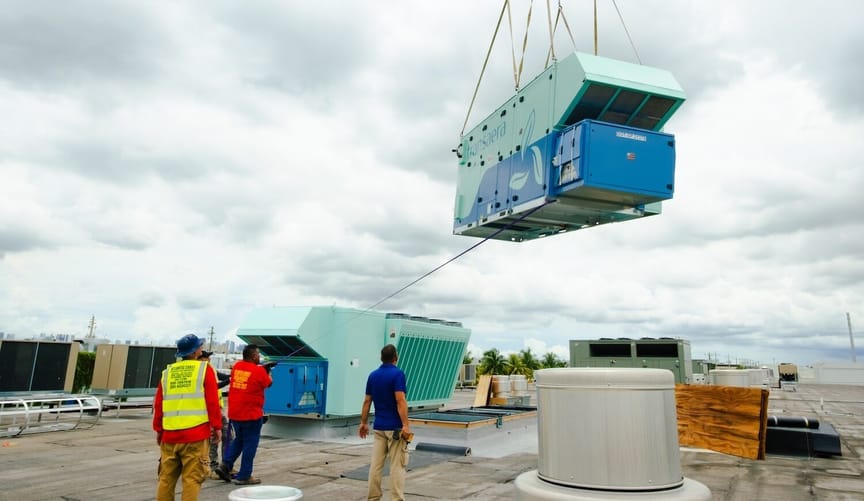
After a successful 6-month field trial at an Amazon logistics facility in hot and humid Houston, the tech behemoth signed a multiyear contract for the specially designed heat pumps with startup Transaera, based in Somerville, Massachusetts. Heat pumps are air conditioners that can work in reverse to provide emissions-free heating, too.
Amazon declined to reveal how many units it has ordered, what it’s paying, and where it would install them, but did say the heat pumps would help the company hit its target of net-zero emissions by 2040.
“At Amazon, we seek technologies that support our Climate Pledge goal,” Asad Jafry, the company’s director of global energy, sustainability, and automation, said in a statement. “This new collaboration supports expanding use of Transaera technology within our global network of buildings.”
Roughly 40% of energy used in U.S. commercial buildings — including big-box stores, schools, grocery shops, offices, hospitals, and hotels — goes to heating and cooling them. Typically performing those functions are packaged heating, ventilation, and air-conditioning units on rooftops. Think big white boxes on flat roofs.
The majority of those units in use today are gas-fired. Even though heat pumps are two to four times as efficient as gas systems, less than 15 percent of the 6 million or so commercial buildings in the country used the electric option in 2024, according to the U.S. Department of Energy.
Two years ago, the agency launched a public-private partnership to bring next-generation heat pumps to market by 2027. Despite the Trump administration’s war on efficiency, the program looks to be on track. And Transaera is one of the participants.
Noah Gabriel, project manager at the decarbonization nonprofit New Buildings Institute, called Amazon’s news “excellent.”
“Awareness of these technologies is still pretty low,” said Gabriel. “Anything that’s expanding from pilot to scaling is going to be really helpful for the market.”
At the Houston facility, Transaera’s tech proved its biggest selling point, according to Sorin Grama, the startup’s CEO and one of its three co-founders, all of whom studied or taught or did both at MIT: Their heat pump can cool buildings using 40% less energy than conventional systems do. The trick? Dehumidifying the air before cooling it.
Warm air “holds” more water than cold air. (Ah, physics.) So ACs naturally provide dehumidification. But conventional systems “typically have to overcool the air” to wring out excess moisture, which drives up energy costs, according to Ankit Kalanki, who leads global initiatives to turbocharge cooling tech for clean energy think tank RMI and has worked with Transaera in the past. (The startup is a member of the tech accelerator program Third Derivative, founded by RMI and the nonprofit New Energy Nexus.)
By midcentury, global demand for air conditioning is expected to nearly triple from 2022 levels, to a staggering 18,000 terawatt-hours, Kalanki noted. That’s more than the entire electricity demand of the U.S., China, India, Germany, and Japan combined.
Transaera’s heat pump could be “a huge game-changer,” Kalanki said. The more efficient electric tech gets, the more easily society can transition to 100% carbon-free energy on fewer solar, wind, and battery plants.
Like other rooftop heat pumps, Transaera’s product costs about 20% more than a conventional unit and has a payback of two to three years, Grama told Canary Media. A whole building equipped with these heat pumps, which last 10 to 15 years, could save millions of dollars over that period, he noted.
Making these efficiency gains possible is a Nobel Prize–winning class of materials: metal-organic frameworks. Under a microscope, they look like clumps of melded sugar cubes. While the material can have thousands of different chemical compositions, Transaera uses a proprietary recipe “that is really good at soaking up water molecules.”
The startup coats a thin layer of this hydrophilic framework on a wheel with a honeycomb structure that air can flow through, Grama explained. As the wheel spins, it sucks moisture from sodden outdoor air before it’s cooled, thus reducing energy use while delivering fresh, conditioned air to improve the health and comfort of a building’s occupants.
Transaera makes the dehumidification portion of the heat pump, and it partners with an unnamed U.S.-based manufacturer that builds the rest of the system. The startup has previously announced $15 million in seed and grant funding. In addition to Amazon, ProFood Properties has installed two Transaera heat pumps at its commercial kitchen in Hialeah, Florida.
Depending on demand, the startup plans to produce hundreds of units per year by 2028. Ultimately, Grama hopes to tailor the tech for individual households, too.
Transaera’s innovation, he said, “applies really well to any size of air conditioner.”
If the U.S. is going to decarbonize, tens of millions of homes across the nation will need to make the switch from fossil fuel furnaces and boilers to all-electric heat pumps. California alone has set a goal to deploy 6 million of the superefficient appliances by 2030.
But such retrofits can be complicated to navigate and cost thousands of dollars more than purchasing new fossil fuel equipment.
That has some companies looking to design heat pumps that are easier and cheaper to install. Today, one of those firms, San Francisco–based Merino Energy, announced the launch of its flagship product, the Merino Mono.
The Merino heat pump is a single-room system, as opposed to the popular ducted and ductless whole-home systems. A key feature is that, unlike whole-home heat pumps, the Mono doesn’t require a large outdoor unit to move heat into or out of living spaces. Instead, it’s installed through the exterior of a building, and the portion that would normally live outdoors is tucked into the unit itself.
Merino is offering its heat pumps for a flat rate of $3,800, which — unusually — includes the cost of professional installation. A certified contractor can get the system up and running in under an hour, according to the company.
“The price tag to do regular ductless is just way too high. This really drops the cost,” said Owen Krebs Grimsich, founder and CEO of 1-888-Heat-Pumps, an installation partner with Merino Energy.
Krebs Grimsich’s company will soon deploy Merino heat pumps at a 10-unit building. “If we were to have done ductless, we would have had to open up a whole bunch of walls and put these outdoor units in really funky places. And then we would’ve had to run the electrical in really weird ways, because you have to connect the indoor and outdoor units,” he said. But with the Merino heat pumps, “it just immediately became a very quick and easy project.”
The Mono was born of necessity, said Merino co-founder and CEO Mary-Ann Rau.
In 2023, Rau, a former firmware engineer at tech giant Apple and ductless heat-pump startup Quilt, tried to get a heat pump system installed at her 1906 Victorian home in San Francisco’s Bernal Heights neighborhood. But the complex job was quoted at $40,000. She couldn’t justify that price point, she said.
Soon after, Rau met up for coffee with her neighbor Brad Hall, a former hardware designer at financial platform Square and director of mechanical engineering at window heat-pump startup Gradient. His path to heat-pump ownership had dead-ended, too, thanks to high upfront costs and space constraints. So Rau and Hall decided to found Merino Energy in 2024 to create the product they both wanted.
Fast-forward to today. Each co-founder has at least one prototype Merino heat pump at home.
“We both are living on the product, which is how we know that it solves our pain points and validates that it can solve a lot of other homeowners’ pain points as well,” Rau said. She added that covering the majority of her home with the Mono would come out to less than half the $40,000 she was quoted for a ductless system.
The co-founders were largely inspired by an existing heat-pump design: packaged terminal heat pumps, Rau said. Commonly found in hotels and hospitals, these units combine all components in one container installed through a building’s wall.
Although this type of heat pump can cost less than $1,000 and is relatively simple to use in new construction, putting it in existing buildings typically requires cutting through load-bearing studs, Rau said. Contractors have to take special care to structurally reinforce the compromised wall, adding cost and complexity.
The geometry of the Mono leaves studs intact. Installers drill two vents, each 6 inches in diameter, between the studs of an exterior wall. These holes allow the Mono to exchange thermal energy with the ambient air. What’s visible indoors is a sleek, white air handler.
Like other room heat pumps, the Merino units plug into a standard 120-volt wall outlet. At max, it can pull 900 watts and serve a 350-square-foot space, Rau said. Installing a flock of them can allow a home to avoid an expensive electrical service upgrade that a ductless system might incur, she added.
The unit is particularly well-suited to urban buildings with limited outdoor space and restrictive property rules, Rau said, such as historic homes, condos, and accessory dwelling units. The product is designed for mild and moderate climates like California’s. New York City, by contrast, is using cold-climate window heat pumps from Gradient and Midea to decarbonize public housing. And last year, Boston also contracted Gradient, paying $5,450 per heat pump.
Rau said the Mono is being made in China but declined to name the manufacturer. She also punted on how much the two-person startup has raised from investors, though PitchBook put the figure at just under $1.8 million.
Merino already has its first retrofit project underway. Novin Development selected the startup to deploy its heat pumps in Civic Center Apartments, which will house low-income residents in Richmond, California, Rau said.
1-888-Heat-Pumps is outfitting the building’s 48 studio units with a heat pump each. His team is able to complete four to five installations per day, Krebs Grimsich said. He expects to finish the job by the end of this week.
So far, six contractors have partnered with Merino, according to the startup. It’s aiming to train many more in the coming months.
The company is first targeting California before expanding geographically, according to Rau. The Golden State could prove an especially fertile testing ground as it works to transform the market for room heat pumps.
Individuals who reserve a Merino Mono with a $38 deposit can get their heat pump as soon as this winter, Rau said. If demand materializes, the startup will be ready, she added: “This year alone, we could manufacture up to 50,000 units if we needed to.”
Oregon has made heat pumps the default appliance for cooling new homes.
Last month, the state Building Code Division’s Residential and Manufactured Structures Board voted 7–1 to adopt energy-efficiency standards that encourage builders equipping new homes with air conditioning to use dual-purpose heat pumps instead of conventional central ACs.
The rules could ultimately boost statewide adoption of electric heat pumps, a tech that provides not only cooling but emissions-free heating, too. Heat pumps are 200% to 400% as efficient as conventional gas furnaces, and using them to heat homes is often cheaper than using fossil-fueled appliances.
“The code update is an upgrade in both comfort and affordability,” Eleanor Ponomareff, city council president of Talent, Oregon, said in a statement. “The increased energy savings for new construction will benefit every Oregonian who moves into one of these new homes for years to come.”
Oregon has ushered in the new rules as the Trump administration and Republican-controlled U.S. House of Representatives try to undo or undermine efficiency efforts meant to reduce reliance on fossil fuels and lower energy costs for Americans.
In January, the U.S. Department of Justice sued to block two California cities’ bans on gas hookups in new construction. Last week, the House passed a bill that would limit the Department of Energy’s authority to set energy conservation standards for household appliances. The chamber then green-lit another bill to repeal programs created under the Biden administration to spur broader adoption of heat pumps and energy-saving measures.
Meanwhile, momentum for state and local building standards that embrace electrification with heat pumps is growing across the U.S., according to Ted Tiffany, senior technical lead of the nonprofit Building Decarbonization Coalition. “Today, approximately 25% of the country lives in a jurisdiction that either requires or encourages zero-emission buildings,” he said.
In Oregon in particular, local climate laws and commitments helped set the stage for the new rules, according to David Heslam, executive director of the nonprofit Earth Advantage.
Under state law, standards for new residential buildings need to reduce energy use by at least 60% from the 2005 standards by 2030. Heat pumps will help the state get there, per the Oregon Department of Energy in a letter of support for the rules, which will be phased in starting this October.
In Oregon, where utility rates for more than 1.4 million customers have jumped by about 50% since 2020, the latest building code will reduce the energy use of a typical 2,500-square-foot home by 27% compared with the 2023 version of the code. That cut will result in a savings of $171 per year, the Building Code Division estimates.
To be fair, energy-slashing approaches required under the new standards are expected to increase the cost of building a new residence. But, for that typical 2,500-square-foot structure, the bill savings they generate would allow them to pay for themselves in about 15 years.
This estimate assumes that relevant costs stay fixed. If heat pumps continue to get cheaper and more efficient, or if piped gas prices continue to grow faster than electricity prices, the savings could be even greater.
Oregon building code staff pointed out before the board voted at the Feb. 18 meeting that the new rules aren’t a mandate to adopt heat pumps. They don’t require all homes to have air conditioning — and thus to put in the clean-heat tech. Developers can moreover choose to install gas furnaces with ducted AC units, so long as they meet the updated efficiency standards, which are measured by energy-use intensity.
“But it’s going to cost more to build that home [to comply with the code] because heat pumps are so much more efficient,” said Jonny Kocher, building regulations lead at think tank RMI.
Under the updated rules, heat pumps also don’t need to be sized to cover a home’s total heating demand but rather its typically smaller cooling load. A fossil-fuel furnace could still be used as a backup heating source, for instance.
With its latest building standards, Oregon joins California, Colorado, New York, and Washington in encouraging superefficient heat pumps in new homes. (New York has delayed enforcement of its all-electric buildings code while the law mandating it is in litigation.)
Energy-efficiency standards that encourage heat pumps appear to be working, Kocher noted. For example, the Northwest Energy Efficiency Alliance found that when Washington moved from its 2015 code to the stronger 2018 code, permits for electric space heating in single-family homes rose from 20% to a whopping 88%, with heat pumps accounting for 81% of those permits.
The three West Coast states are “building a market for heat pumps,” which could ultimately help drive costs down, Kocher said.
Still, states could push their regulations further, he noted. Most of these efficiency efforts have focused only on new construction, even though major renovations and additions also fall under building codes’ purview.
There’s one notable example that could prove instructive: When California updated its energy-efficiency standards in 2024, it was the first in the nation to include a provision that commercial building owners replace broken ACs with heat pumps. The state stopped short of extending that concept to homes, but at least 13 California cities have since adopted such rules.
Washington state could be the first to encourage ACs to be replaced with heat pumps in existing buildings when it votes on its code update later this year, according to Kocher.
Developers often don’t have an incentive to install efficient equipment in homes; they’re not the ones paying its energy bills, he noted. But building standards help redress the imbalance, reducing health- and planet-harming pollution — and saving residents money in the long run.
Heat pumps can save households money on their utility bills and are essential to cutting carbon emissions. The catch? The superefficient appliance can cost thousands of dollars more than a new gas furnace.
Zero Homes aims to change that. The startup just raised $16.8 million to make it cheaper and easier for homeowners to switch to heat pumps.
Founded in 2022, the Denver-based company can scope and size the all-electric systems without ever stepping foot inside a customer’s home. Its digital platform cuts the cost of a heat pump installation by 20% on average, with much greater savings common in hard-to-reach rural areas, according to Grant Gunnison, Zero Homes’ founder and CEO.
Prelude Ventures led the Series A funding round. “Homeowners want comfort, and they want it easy,” Matt Eggers, Prelude’s managing director, said in a statement. “Zero Homes has built the missing digital infrastructure for home upgrades, making it dramatically easier for millions of homeowners to adopt efficient, modern systems without friction.”
The first step in getting a heat pump is sizing: figuring out how big a system needs to be to efficiently and comfortably heat and cool a home. It’s crucial to get that right. A wrong-size system can lead to worse comfort, bigger energy bills, a shorter appliance lifespan, and a greater risk of health-harming black mold.
Historically, quoting a heat pump system’s size has been a hands-on job. Most heat pump installers visit a home to conduct what’s called a Manual J assessment: the gold standard method to determine how much heating and cooling a building requires to keep occupants comfortable. An in-person visit adds time and expense before customers have even committed to a project. And that, according to Gunnison, unnecessarily inflates heat pump costs.
Reducing those “soft costs” is especially important now, as utility bills rise nationwide. Electricity and piped gas prices are the biggest drivers of overall inflation.
The startup aims to cut project costs by eliminating the need for an in-person Manual J step with software. By using the company’s free phone app, an individual can take photos and videos of their home and receive a heat pump quote, with all applicable rebates and tax credits included. Once a homeowner agrees to the price, Zero Homes schedules a vetted contractor to get the system up and running.
Beyond reducing costs, this has the added benefit of being less disruptive to customers than the traditional, on-site procedure, which requires a homeowner to coordinate with an HVAC contractor.
“We want to … be nationwide,” said Gunnison, a former general contractor and an MIT-trained engineer who once worked on satellite communications and remote imaging at NASA.
To achieve that scale, Zero Homes relies on partnerships with independent installers that it subcontracts with. Currently, the company operates in Colorado, Massachusetts, Minnesota, Illinois, and California.
Zero Homes’ approach has gained some traction. The U.S. Department of Energy validated the startup’s remote assessments in 2024, Gunnison reported. The Air Conditioning Contractors of America also that year approved the startup’s software as a tool to perform the organization’s trademark Manual J calculations remotely.
Gunnison declined to share whether the company was profitable, but he did say that its revenue had grown by a factor of 10 from 2024 to 2025. Customer service calls on the installations it has managed are “very low,” he added. And Zero Homes’ installer network has expanded to nearly 100 contractor businesses.
“We get rid of a lot of the overhead that costs them a lot of time and heartache, so that they can be successful,” Gunnison noted. “We don’t charge them for leads; [we] fill their calendars.”
A number of utilities and power co-ops, including ComEd, Great River Energy, and Tri-State Generation and Transmission Association, have hired Zero Homes to deploy heat pumps in their service territories. A couple of local governments have also expressed confidence in the company: Chicago partnered with Zero Homes as part of its Green Homes program, and Colorado is giving the business a $745,000 boost through its economic development office to expand its Denver-area operations.
Several other startups around the country are specializing in heat pump installations, such as Elephant Energy, Tetra, Forge, Quilt, and Jetson — which recently raised $50 million to get its in-house-designed heat pump into more buildings.
Gunnison plans to use the new infusion of capital to double his company’s 25-person headcount this year and improve its software capabilities, he said.
It used to take Zero Homes several days to provide a quote to a homeowner who had submitted a scan. Now that process is complete in about one day. By the end of 2026, the startup aims to slash that time to 30 minutes, Gunnison noted.
“Once we can consistently deliver that, then we will very, very rapidly expand geographically.”


.svg)
