

 Back
Back
So far this year, it has built more battery capacity than any state besides Texas. But political shifts could complicate the long-term growth trajectory.
California and Texas have led the charge on America’s grid battery revolution. Now, a third state is racing to catch up: Arizona. The Grand Canyon State installed more battery capacity than every state besides Texas over the first half of 2026, per a Canary Media analysis of U.S. Energy Information Administration data.
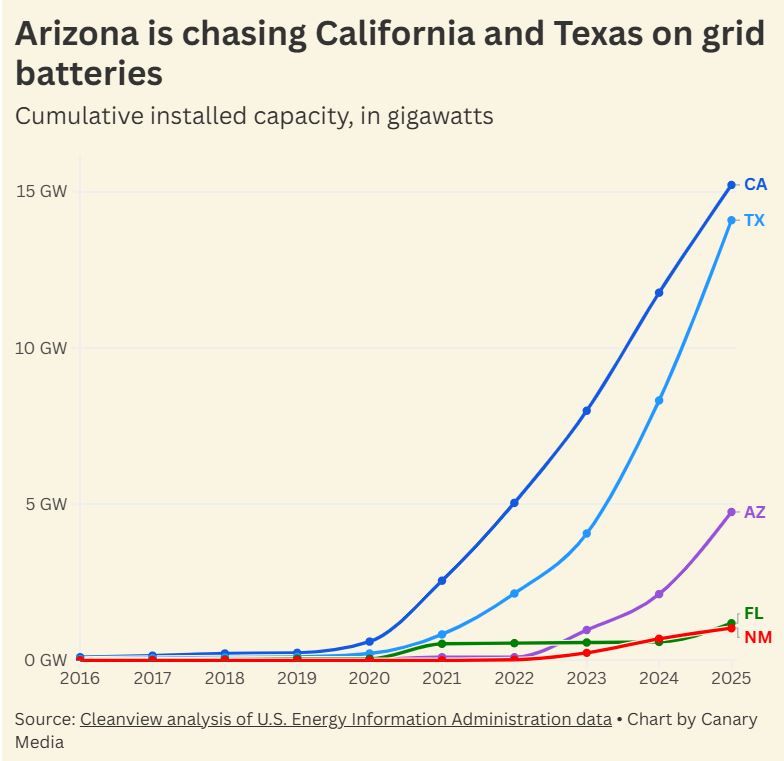
It’s the continuation of a trend from last year, when Arizona also edged out California in both storage and utility-scale solar additions. In recent months, Arizona welcomed three new battery projects with 250 megawatts/1 gigawatt-hour of storage each — Beehive, Catclaw, and Pediment — plus several smaller ones.
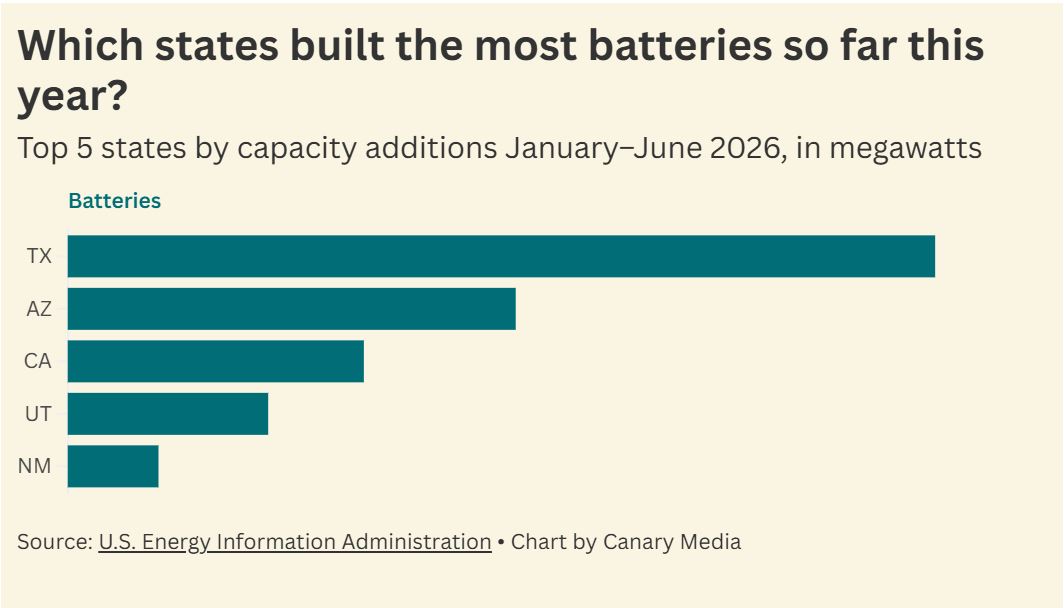
Arizona also effectively tied Florida for the second most solar installations in the first half of this year (again following Texas) and rounded out its portfolio with 300 MW of gas power and 500 MW of wind.
To be clear, Texas and California still have far more solar and storage plugged into their grids. Battery storage has already helped both states avoid grid shortages heading into heat waves or cold snaps, and pushed wholesale prices down by offsetting more costly gas power with cheap solar generation stored from sunnier hours. But Texas and California were the only states that had managed to unlock perennial multi-gigawatt battery construction until now.
Arizona is currently expanding the map of grid storage dynamism — though some renewable energy advocates worry that a recent turn against clean energy in the state could cause the growth to fizzle out.
Texas and California are special cases. Texas lets batteries compete in an open, deregulated market for energy, and investors flooded in when they saw there was good money to be made. California painstakingly funded years of storage policies to complement the state’s grid decarbonization goals, mandating that utilities invest in batteries while making new gas plants nearly impossible to build.
Arizona doesn’t have a Texas-style free market for energy; its customers are served by a handful of vertically integrated monopoly utilities, namely Arizona Public Service (APS), Tucson Electric Power, and the Salt River Project. Nor does the state boast a California-style mandate or policy apparatus. Indeed, the state’s elected board of utility regulators just went out of its way to eliminate the meager renewable-energy target that had been on the books for two decades.
But Arizona does have ample sunshine and clear, dry weather, making solar the obvious winner for cheapest kilowatt-hour of electricity. In such places, a rapid buildout of solar projects leads to diminishing returns — unless you use batteries to store up surplus solar during the sunniest hours of the day.
To properly understand the boom in battery construction today, one must look back to market conditions around five years ago, when the utilities were awarding the contracts for these plants, said Autumn Johnson, executive director of the Arizona branch of the Solar Energy Industries Association.
In 2018, the Arizona Corporation Commission chastised APS for relying too heavily on gas power plants in its long-term planning, prompting the company to take batteries seriously as a cost-effective source of peak power. The Biden administration passed the Inflation Reduction Act in 2022, solidifying a decade’s worth of tax credits for installing solar and batteries. Within a few years, all the state’s major utilities had pledged to decarbonize their fleets by mid-century.
The wave of storage projects built in recent years is the result of contracts the utilities signed in those heady times, Johnson said.
But the political landscape in Arizona and nationally has shifted since then, casting a pall over the future of the state’s solar and storage buildout.
The Trump administration gutted Biden’s climate law last year, though it preserved tax credits for batteries specifically. APS abandoned its own climate goals. The utility regulator is picking performative fights with clean energy instead of pushing the utilities to be more ambitious. The state legislature this year proposed “a record number of terrible energy bills,” Johnson said, including ones to mandate that 85% of electricity capacity come from dispatchable or baseload sources (not intermittent renewables) and to label wind and solar farms a “public nuisance” if they fall within 4 miles of a residential property.
And while the utilities can’t change the fundamental economics of solar and batteries, they can change how they assign contracts, Johnson noted.
APS, the biggest battery builder in the state, said in a July planning session that it was excluding four-hour duration batteries from modeling for its long-term energy plans, limiting the options to those with six to eight hours of duration. Four-hour batteries have in recent years become the standard type of peaker plant getting built in California and Arizona, but now APS seems to be taking them off the table. Adding more hours of energy discharge provides greater coverage for the grid but increases construction costs.
“Given all the changes, will we keep our top spot in five years?” Johnson asked of Arizona’s energy storage leadership. “I’m not sure it will be a long-lived reign at the top.”
At the very least, construction will continue at a rapid clip through 2026, according to the EIA data, anchored by the nearly finished Maricopa Energy Center, which includes a 550-MW/2.2-GWh-hour battery. Seven battery projects are already under construction for 2027 completion, ranging from 100 MW to 300 MW. Utilities will need to be signing new contracts now to keep the momentum going into the 2030s.
Trump officials touted the storage and EV plant as an example of “energy dominance,” underscoring increasing bipartisan acceptance of grid batteries.
LANSING, Mich. — The Trump administration has made clear its disdain for electric vehicles and clean energy. Yet at the grand opening of South Korea–based LG Energy Solution’s latest battery manufacturing facility, Interior Secretary Doug Burgum cheered the factory as a fulfillment of the president’s agenda.
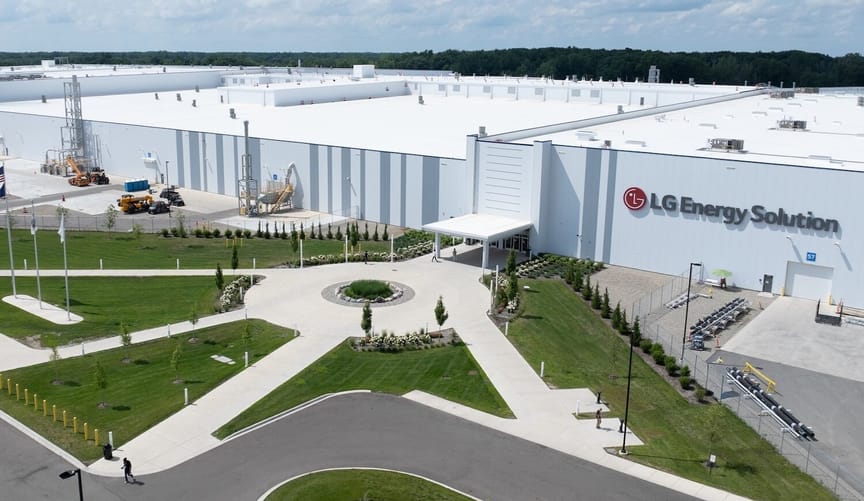
“That’s the American energy dominance in action, which is more jobs, strong allies, secure supply chains — and right here, that’s happening,” Burgum said Tuesday during the Lansing factory’s opening ceremony.
LG executives have framed the plant’s opening in similar terms, echoing the administration’s focus on energy security and the importance of making the tech in the U.S., given that China produces most of the world’s batteries.
And like many of its peers in the industry, LG has adapted wide swaths of its Lansing site, originally meant only for EV batteries, to make what is proving to be a more politically palatable technology: energy storage systems for power grids.
“No matter which side of the aisle you’re on, there’s a desire to have energy independence and to meet load growth,” said Devon Wilson, vice president of sales and marketing for LG’s U.S. energy storage division.
LG invested more than $2 billion into building its new Lansing plant, which currently employs 900 people and plans to hire approximately 800 more.
Once at full capacity next year, the facility is expected to produce more than 35 gigawatt-hours of battery cells annually, according to Anthony O’Donovan, the plant’s operations director. That would make it one of the biggest domestic plants producing cells, which are the individual building blocks of battery systems, LG Energy Solution spokesperson Phil Lienert confirmed.
From Lansing, the cells will go to plants across the country — including both to clients and to one of LG’s own facilities in Holland, Michigan — to be connected together to form battery modules, which are then arranged into battery packs, Lienert said.
This domestic network of battery manufacturing is very new, and arriving just as battery energy storage systems themselves grow at a rapid clip. The U.S. didn’t make any of its own battery cells until 2025, when companies including LG added a total of 20 GWh of manufacturing capacity, according to the U.S. Energy Storage Coalition, an industry group.
By the end of this year, the coalition expects that figure to increase nearly fivefold, to 96 GWh of cell production capacity.
The Lansing facility was first announced in 2022 as part of Ultium Cells, a joint venture between LG and General Motors to source battery cells for the Michigan automaker’s EVs.
By 2024, however, consumer interest in EVs was lagging, and President Donald Trump vowed on the campaign trail to slash federal support for the vehicles. At the end of that year, GM sold its stake in the Lansing factory to LG, making the Korean company the site’s full owner.
The Trump administration has since eliminated the $7,500 tax credit for consumers who purchase EVs and canceled more than $700 million in federal funds for battery and EV manufacturing projects. (It did, however, preserve tax credits for clean energy manufacturing facilities and for the installation of stationary storage systems.)
By the end of 2025, dozens of battery and EV manufacturing projects were canceled nationwide, totaling more than $21 billion in lost investment, according to a report from E2, a clean energy advocacy group. Michigan, which had banked on exactly these types of projects to grow its economy, given its automotive prowess, was hit the hardest.
So, LG leaders decided to embrace a more promising sector: energy storage.
In the last few years, energy demand in the U.S. has surged in part because of the massive data centers being built for the artificial intelligence boom. Battery storage systems are well-positioned not only to swiftly meet tech companies’ demand for power, but also to absorb the sharp dips and spikes in energy usage inherent to AI data centers, Wilson said.

“It’s a great situation for us,” Wilson said. “We’ve seen an explosion in the size of the ESS [energy storage system] market, so we’ve really been able to grow our demand.”
In just four years, the amount of battery storage capacity in the U.S. has increased nearly tenfold, from 4.7 gigawatts in 2021 to 43.6 gigawatts at the end of 2025, according to the U.S. Energy Information Administration.
This year, developers have already built 8.2 gigawatts of battery storage nationwide, according to the EIA — a statistic that Michigan Gov. Gretchen Whitmer, a prominent Democrat, hailed as “amazing” at the opening of LG’s Lansing factory.
She also referenced Michigan’s “historic clean energy law” that requires 2.5 gigawatts of battery storage, which are often installed alongside solar farms to help stretch the carbon-free energy into other times of the day, by 2030.
“Michigan is poised to take advantage of this growth,” Whitmer said.
In line with market shifts, the Lansing plant has diversified so that it will produce roughly half EV battery cells and half energy storage cells, according to Bob Lee, the North American president of LG Energy Solution.
The EV battery cells will no longer go to GM, but to Toyota. And the plant will produce nickel-manganese-cobalt cells, which are more energy-dense, according to LG’s press release.
Meanwhile, the energy storage cells have been contracted by a variety of offtakers, including renewable-project developer Terra-Gen and Korean clean energy manufacturer Qcells, LG spokesperson Lienert said. These cells will be lithium-iron phosphate, which isn’t as energy-dense as other chemistries but has less of a fire risk.
Next year, as the Lansing facility ramps up, it is also expected to supply Tesla’s Megapack 3 factory in Houston, an agreement that Lienert confirmed but would not elaborate on.
First reported by Reuters last summer, the $4.3 billion LG-Tesla deal was officially announced in March — but by the Trump administration as part of its focus on energy security, not by the companies.
Now that it’s up and running, the Lansing facility joins LG’s growing portfolio of cell manufacturing sites. The Korean company still runs two Ultium EV battery plants with GM, one in Tennessee, another in Ohio.
Last year, LG expanded its flagship Michigan site in Holland, which in 2012 became the first in the U.S. to make EV batteries, to also produce energy storage battery cells and packs.
And this March, LG held a grand opening for its facility in Windsor, Ontario — the first commercial-scale battery manufacturing plant in Canada as well as the company’s largest North American plant, Lienert said.
“We’ve almost got a perfect latitudinal line now that extends from Holland through Lansing to Windsor,” Lienert said. “We think of this as being the belt of ESS battery manufacturing for North America.”
As the legislative session nears an end, lawmakers push ahead bills that aim to stop AI centers from raising utility costs and spur builders to opt for clean energy.
California, with its sky-high electricity prices, isn’t facing the same influx of data centers that many other states are. But the massive facilities are still being built and proposed in California — and legislators are racing to stop them from pushing up utility rates and pollution.
Two major data center bills passed a key committee last week as California’s legislative session nears its close at the end of this month. Senate Bill 886 aims to prevent data centers from raising utility costs for other consumers, while SB 887 would incentivize developers to invest in clean energy and nearby communities.
Data centers have lawmakers nationwide walking a fine line. Voters are increasingly worried about the facilities’ impacts on energy affordability and the environment, but the industry also promises jobs and economic benefits. State Sen. Steve Padilla, the Democrat who penned both California bills, says his proposals would rein in the sector without stifling it completely.
“People are asserting that it’s a binary choice” on data centers — “you can either ban them all, which is some communities’ reaction, or you can have zero regulation,” said Padilla, whose bills were inspired by a high-profile conflict between a data center developer and residents in a county he represents.
“I think we can walk and chew gum at the same time,” he said. “We can protect consumers and communities, and support infrastructure that supports tech companies and jobs.”
SB 886 takes on the first part of that equation. It would require the California Public Utilities Commission to set rules for data centers of at least 25 megawatts to fully cover the costs they impose on customers of the state’s three major utilities. Data centers would pay for the new power generation and grid upgrades they need, along with a “reasonable share” of the fees utilities collect for wildfire mitigation, environmental programs, and other social initiatives.
This is not a new approach, with many states already enacting similar “large load tariffs.” Along with these requirements, SB 886 would create a mandatory demand-response program that forces data centers to stop pulling power from the grid during supply-demand emergencies. Similar mandates are under consideration in places like Texas and the 13-state region served by grid operator PJM Interconnection.
SB 887, meanwhile, would offer expedited state environmental review for data centers “if they commit to high standards and serving communities,” Padilla said. Data centers seeking this special treatment must get 100% of their hourly electricity consumption from carbon-free resources within five years, 75% of it newly built. And they’ll need to draw from zero-carbon backup power — most likely batteries — when the grid is under stress, rather than using diesel generators, which are installed by almost all data centers. Developers would also have to pay for grid interconnection costs in advance and commit to a community benefits plan.
Although California has yet to see the massive, gigawatt-scale data centers being built in some states, several larger-scale projects are in the works near Silicon Valley. Those include Microsoft’s 48-megawatt data center in San Jose, developer Stack Infrastructure’s 77-megawatt data center in Hayward, and, most recently, Google’s 250-megawatt research and development center in San Jose.
More data centers are coming. Northern California utility Pacific Gas & Electric has 10 gigawatts of demand from data centers in its pipeline over the next 10 years, equivalent to what’s needed to power roughly 7.5 million homes. PG&E says that load growth will create billions of dollars in tax revenue and — more important to its customers — lower electric bills by 10% or more “by spreading fixed costs across more energy usage.”
Environmental and consumer groups are skeptical. The Union of Concerned Scientists warned in a May report that the state “currently has too few protections to ensure data center costs are not passed along to ratepayers.”
“The data center developers don’t really care about costs,” said Matthew Freedman, senior staff attorney with The Utility Reform Network, a consumer advocacy group that supports SB 886 and SB 887. “They’re focused entirely on speed of development, and on proximity to Silicon Valley.” Meanwhile, PG&E and the state’s other investor-owned utilities earn guaranteed profits based on how much money they invest in capital infrastructure, giving them little incentive to control those costs, he said.
Although SB 886 has won the support of utility worker unions, PG&E opposes it. In an email to Canary Media, company spokesperson Paul Moreno said the bill would “introduce rigid, duplicative requirements that conflict with existing regulatory processes, risk higher costs for customers, and delay critical infrastructure needed to serve the state’s growing energy demand. We continue to work with lawmakers to improve the bill, so it better supports affordability, reliability and equitable cost allocation for all customers.” PG&E has taken no position on SB 887.
Both bills face pushback from the Data Center Coalition, a trade group representing major data center developers, natural gas generator company ERock, and business organizations. The groups wrote in a March letter that data centers shouldn’t be “singled out” for different treatment from other big power-using customers. They also fear that SB 886’s demand-response mandate could force them to curtail computing operations relied on for critical health care and government services.
Meanwhile, the coalition argues that SB 887’s clean power requirements are virtually impossible for data centers to meet. “We don’t see it as a streamlining mechanism, because those standards are not attainable,” said Khara Boender, Western government affairs director for the group.
It’s unclear how Gov. Gavin Newsom (D) will respond to bills opposed by politically powerful utilities and tech companies. Last year, Newsom vetoed a bill that would have required data centers to report their water usage. And Padilla said his 2025 proposal to create a new rate class for data centers was watered down to a “study” bill requiring the utility commission to examine and report on their energy cost impacts.
But the politics are shifting. A recent poll commissioned by Net-Zero California, a Sacramento-based environmental policy group that supports SB 886 and SB 887, found that 70% of voters in the state oppose data centers in their communities, and that 74% want to see requirements for data centers to cover their costs and use clean energy. Newsom recently told reporters that “it’s absolutely essential and appropriate that these hyperscalers pay their fair share,” citing Google and Microsoft specifically.
Padilla said he expects SB 886 and SB 887 will pass in the state Senate and Assembly before the end of the legislative session this month. Newsom has until the end of September to sign bills into law.
While solar and EV sales cratered after the Republican Congress eliminated federal tax credits, batteries bucked the trend. Here’s why.
Last fall, as generous federal incentives for consumer cleantech were set to expire, people raced to lock in good deals on EVs and rooftop solar. Then, this year, sales cratered.
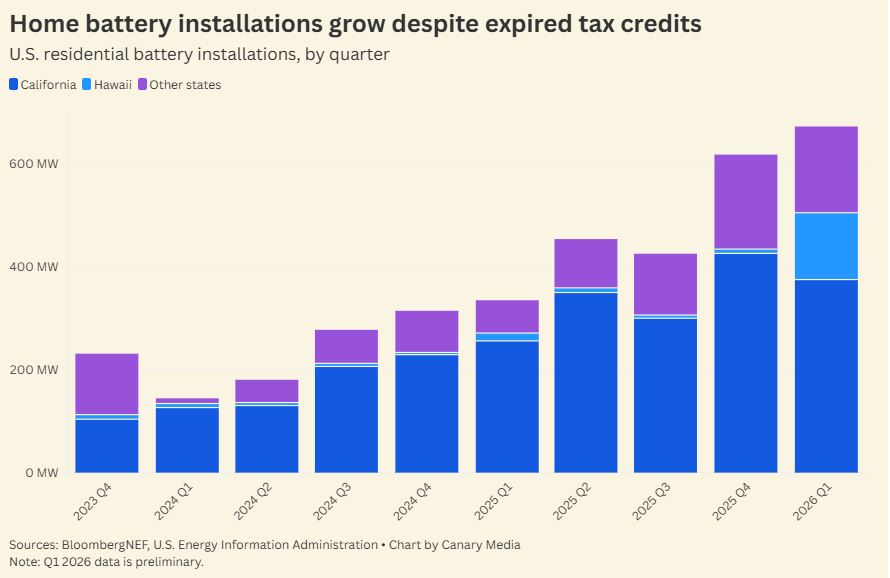
But home batteries bucked the trend. Federal tax credits for residential storage expired at the end of last year, prompting record sales in Q4 of 2025 — and then sales climbed even higher in the first quarter of 2026, per a BloombergNEF analysis of U.S. Energy Information Administration data. Homeowners installed a total of 673 megawatts of battery storage in Q1 of this year.
A few factors explain the market’s resilience. There’s the zeitgeisty reason: Across the nation, utility bills are high and rising, and batteries, typically paired with rooftop solar, offer people the ability to radically reduce their reliance on the centralized grid. There’s also the wonky explanation: State policies meant to spur home battery adoption are now doing just that.
Adoption is highest in the states where these factors — high electricity costs and supportive policy — coincide. California has since 2023 incentivized households to pair storage with solar, and in both 2024 and 2025 the state accounted for around three-quarters of home battery installations nationwide. Meanwhile, Hawaii, which has the highest electric bills in the country, created a new storage incentive program last year that resulted in a surge of installations in Q1 of this year, per BNEF.
The rising adoption comes even as the rooftop solar market struggles. Last year’s Republican tax and spending bill, the One Big Beautiful Bill Act, eliminated long-standing tax credits that knocked 30% off the price of both rooftop solar and storage systems. As a result, BNEF expects that this year residential solar installations will fall to their lowest level since 2020.
The stubborn growth of residential energy storage is another reminder that batteries are fast becoming a critical part of the U.S. electricity story. Large-scale batteries, for which Republicans actually preserved tax credits in last year’s law, are being built at a blistering pace. Expect home battery adoption to keep climbing, too.
Firms that enlist homes to reduce energy demand — and costs — have long complained that utility data rules prevent them from helping in PJM. FERC agrees.
A recent ruling from federal regulators will let virtual power plants help meet surging energy demand in the county’s biggest energy market.
Late last month, the Federal Energy Regulatory Commission ordered PJM Interconnection to accept statistical sampling as a valid method for measuring the reliability of programs tapping into demand-response and virtual-power-plant programs, which pay customers to turn down energy use as needed. The decision requires the grid operator to reconsider strict data rules that had prevented providers of this carbon-free resource from participating in PJM’s constrained energy-capacity market.
In its decision, FERC ruled in favor of Voltus, which runs demand-response and virtual-power-plant programs, and the Mission:data Coalition, a nonprofit advocacy group, and against PJM’s desire to preserve its status quo.
FERC agreed with Voltus and Mission:data that, under its current rules, PJM is losing out on at least 4.9 gigawatts of capacity — the equivalent of several large power plants — “at a time when PJM is experiencing unprecedented load growth driven in part by hyperscale data center development, threatening reliability.”
Booming power demand from data centers and bottlenecks in power plant construction are not just threatening reliability in PJM but also driving up energy costs for the 67 million people it serves across 13 states. FERC found it would be “unjust and unreasonable” to allow the current rules to stand.
Last month’s ruling caps a yearslong fight from providers of demand-response and virtual-power-plant services.
“This is a huge win, and we’re really optimistic that it will unlock hundreds of megawatts of residential load over the next several years,” said Marissa Galizia, Voltus’ senior director of partnerships. FERC’s order makes clear that “PJM has the power to change the rules even while utilities aren’t providing the data,” she said.
At issue was PJM’s concern about relying on third-party demand-response aggregators to reduce household electricity demand when needed. PJM insisted that Voltus and other demand-response firms must furnish detailed evidence that participating households actually cut power when prompted to do so. Specifically, PJM required smart-meter data, which is collected in the service territories of most utilities PJM covers.
If firms could not produce that data, PJM would not count on — or pay for — that demand-response capacity to show up during times of peak demand.
But for the most part, demand-response firms could not get their hands on that data. That’s because, as Voltus and Mission:data argued to FERC, most of the major utilities in PJM territory have failed to make that data from their digital smart meters readily available.
It’s a catch-22. And as a result, PJM has missed out on gigawatts of demand-response capacity that could have helped alleviate the reliability and cost crunch it faces — and aggregator firms have been essentially locked out of the lucrative capacity market.
Utilities blame states’ data privacy regulations for their conservative management of smart-meter data. FERC doesn’t get to tell states how to manage those data privacy and data access rules, but it can compel PJM, which it has jurisdiction over, to accept alternative forms of data.
That’s what FERC did in the July decision.
Given the “significant barriers to obtaining interval meter data,” FERC told PJM to allow aggregators to use a statistical sampling method that the grid operator had relied on before smart meters existed. PJM also still allows this method for customers that don’t have smart meters. In light of those facts, FERC found that “statistical sampling is a valid method to approximate load reductions when interval meter data is not reasonably available.”
Both PJM staff and Monitoring Analytics, its independent market monitor, protested that letting demand-response companies use statistical methods could undermine reliability.
Monitoring Analytics argued that allowing statistical sampling would “degrade PJM’s ability to maintain resource adequacy and to correctly determine efficient capacity market prices through supply and demand.”
FERC disagreed, citing evidence presented by Mission:data and Voltus showing that statistical sampling can be as or more accurate than methods that use metered data when applied to large numbers of homes, as opposed to single large customers like factories.
The order won’t take effect immediately. FERC directed PJM to launch a proceeding to work with stakeholders to find a method that parties could agree on, with initial plans due within 45 days of FERC’s order.
“We’re going to be working with our partners to submit answers to the questions and propose what we’d like to see,” Voltus’ Galizia said. “Generally, we’d like to make it as easy as we can while guaranteeing that that process is as accurate as possible.”
FERC’s ruling comes at a tense time for PJM. Over the past year, the Trump administration and state governors have attacked the grid operator for failing to mitigate the huge increase in capacity market prices that are driving up utility rates and driving public anger against utilities and data center developers.
“I hope the decision sends a message to PJM and its stakeholders,” said Ken Schisler, chief legal and regulatory officer at CPower, a demand-response company that brought a similar complaint that FERC rejected in 2024 for lack of evidence. “The message is to stop the nonsense and to remove barriers that are keeping demand response from growing in the market.”
Michael Murray, president of Mission:data, hopes the ruling will also add fuel to his decade-long effort to make utilities and state regulators unblock smart-meter data that technically belongs to customers.
FERC’s order doesn’t address the underlying state-by-state data-access barriers that Mission:data is working on — the agency doesn’t have the jurisdiction to do so even if it wanted to.
Still, Murray hopes it will push state regulators to revisit their data-access policies, since “states may not like the remedies that FERC comes up with in this case or in other cases.”
And more broadly, he said, it’s the first time the agency has acknowledged just how critical this issue is.
“FERC has finally recognized that what I’ll call data blocking is not just an artifact of state privacy laws, and it’s not something to just ignore and say, ‘Oh this is just a state matter,’” he said. “They definitely said that it rises to a Federal Power Act matter.”
The Department of Energy has canceled or stalled funding for thousands of projects that would improve the country’s stressed grid — and not just in blue states.
In Wisconsin, utility Alliant Energy has called off a project meant to reduce power outages in disadvantaged and tribal communities, after the Trump administration terminated a federal grant that would have supported it.
In California, the Sacramento Municipal Utility District, which has deployed and upgraded hundreds of thousands of advanced smart meters, has not received any reimbursement from the U.S. Department of Energy for the work since October, when the Trump administration declared it was killing grants that it described as fueling “the Left’s climate agenda.”
And in the upper Midwest, a consortium of regional grid operators, utilities, and state agencies is still waiting for $464 million in DOE funds meant to help build high-voltage transmission lines to reduce grid congestion — although the agency in charge of the project says the funding will soon be restored.
Across the country, hundreds of such projects to improve grid reliability and make electricity more affordable face a highly uncertain future — the result of Trump administration actions that have slowed the outflow of billions of dollars of DOE funds to a trickle.
Some of those projects in “blue states” were targeted as political retribution, as recent reporting from The New York Times has made clear. A handful of grant awardees in this category have won favorable court rulings, and more are seeking legal redress.
But many others are suffering from the DOE’s broader failure to carry out work that Congress has tasked it to do, according to groups that have been monitoring the agency since the start of last year. In red and blue states alike, the DOE is forcing thousands of grantees to undergo a laborious review process, so even projects that have not been officially terminated are stuck, unable to determine when or if they’ll start getting the money they’re owed.
According to an April report from the DOE Alumni Network, a group of former agency employees, the DOE has announced the termination of 356 awards totaling $12.5 billion since January 2025, and has threatened to terminate 303 additional awards worth $12.2 billion.
But the DOE has also stalled projects for “a large number of awardees who have never appeared on any list,” the report found. “This means the agency is not moving forward to resolve disputes, finalize conditional awards, or respond to continuation applications, leaving projects in administrative limbo and functionally freezing promised funds.”
“DOE both overtly canceled a set of projects, then had this pattern of behavior where for 15 months they stopped actively managing projects,” said one former DOE official. “Projects can’t proceed to the next stages and get their next tranche of funding.”
The former official, who asked not to be named, described a pattern of stalling, stonewalling, and “ghosting” utilities, state governments, energy companies, and nonprofit groups awarded grants under the Biden administration.
Many of those projects have been caught up in a process the DOE announced in May 2025 to review all financial assistance “on a case-by-case basis to identity [sic] waste of taxpayer dollars, protect America’s national security and advance President Trump’s commitment to unleash affordable, reliable and secure energy for the American people.”
Then, in October, the DOE announced the “termination of 321 financial awards supporting 223 projects” — all of them tied to states that voted for Kamala Harris in the 2024 election. The DOE’s termination announcement came right after Russ Vought, director of the White House Office of Management and Budget, declared in a social media post that the administration would cancel “nearly $8 billion in Green New Scam funding.”
Canary Media reached out to a subset of DOE grantees that had won funding from the Grid Resilience and Innovation Partnerships (GRIP) program created by the 2021 bipartisan infrastructure law. The DOE issued a total of more than 100 GRIP grants — in October 2023, August 2024, and October 2024 — for projects to enlarge the grid, harden it against extreme weather, build microgrids to protect vulnerable communities, and deploy technologies to integrate solar, wind, EVs, and batteries.
Some of the GRIP projects involve expanding clean energy and serving disadvantaged communities, two bugbears of the Trump administration. But many more are straightforward grid improvement projects that need federal dollars to reduce the costs borne by utilities and regional or state agencies.
The largest of these is in California. In 2024, the DOE awarded a $630.6 million grant aimed at upgrading more than 100 miles of high-voltage power lines in the state with advanced power cables capable of carrying more electricity along existing transmission corridors, a project estimated to be capable of delivering about $200 million in savings from improved energy efficiency. That project appeared on the termination list in October, and the DOE has not disbursed money for it, according to federal records, though negotiations for resuming funding are underway.
This uncertainty appears to apply to the majority of GRIP projects, according to Emlyn Bottomley, founder of the consultancy High Road Analytics, which focuses on workforce development, and a former Department of Labor deputy policy director in the Biden administration.
According to his tracking of federal spending, of the roughly $11.4 billion in DOE funds obligated to grid infrastructure and resilience — a category that includes GRIP program funds — $9.1 billion remains “at risk,” with funding stalled or timelines for completion shortened. That’s compared with $400 million in grants that have been canceled outright and $1.3 billion not yet disbursed but showing no signs of being stalled.
“It’s a shame these projects are being held up or canceled, especially since the case for them is fairly bipartisan — spanning national security, economic competitiveness, and cost and affordability,” Bottomley said.
All of the GRIP projects required partners to provide matching funds at an amount at least equal to the money DOE is providing, the former DOE official added. “You’re talking about folks putting hundreds of millions of dollars on the line. People have skin in the game for these awards.”
Many of the GRIP grantees contacted by Canary Media declined to comment, citing ongoing discussions with DOE. Others reported that they are no longer pursuing the projects as described in their grant applications, at least not with the help of DOE money.
The latter is the case for Alliant Energy’s Smart Power Automation in Rural Communities (SPARC) project, which won a $50 million grant in late 2024 to add grid visibility and control devices to 140 grid circuits in disadvantaged and tribal communities served by subsidiary Wisconsin Power & Light — a utility in a blue state.
Those devices could allow the utility to quickly find and isolate faults on its grid, cutting power outages in targeted communities by up to 50%. They could also support grid-management software to help integrate more renewable and distributed energy, and potentially expand wireless communications access to these remote areas.
Alliant “voluntarily withdrew” from the grant award process in April, six months after its grant was terminated by the DOE, Alliant spokesperson Melissa McCarville told Canary Media. The agency has disbursed no funds to the project, according to federal records.
Alliant is “actively pursuing many of the goals that were outlined in the SPARC project,” McCarville wrote in a May email, but as part of a 10-year strategic plan with no set timeline. “While the grant did provide valuable funding, it also required a significant investment, and we want to ensure our contributions are properly prioritized,” she wrote.
Still, at least one grant-funded project in a blue state is proceeding despite the absence of DOE funds.
That’s the case for the Sacramento Municipal Utility District, which serves the state’s capitol and environs. In 2023, SMUD won a $50 million grant to support a project to deploy 200,000 smart meters and grid devices and underlying software controls to “improve grid reliability, resilience, visibility and efficiency,” utility spokesperson Gamaliel Ortiz told Canary Media in an email.
SMUD has carried out much of that work, which includes close to $100 million in utility spending, and has received almost $33 million in reimbursements from DOE, according to federal records. However, SMUD “has not received reimbursement for any costs incurred after the grant was cancelled on October 10, 2025,” Ortiz wrote. “We remain committed to this critical work and stay flexible as we evaluate how the loss of grant funding may impact the project timeline.”
In other blue states, some grants have been canceled and others are still under negotiation. In Oregon, utility Portland General Electric has recently learned that the DOE may reinstate a previously terminated $50 million grant to support next-generation “grid edge computing” devices, utility spokesperson John Farmer told Canary Media in an August email. That project had received only $1.2 million in DOE funding, according to federal records.
The purpose of the project was to integrate batteries, EVs, and community solar into its grid to “improve resilience, enable the integration of distributed energy resources, and maximize customer investments in home energy solutions.”
“PGE is evaluating the benefits and risks of reinstating the grant,” Farmer told Canary Media. The utility “recognizes that there are inherent risks of additional and changing demands by the DOE as the administration’s priorities change.”
At the same time, PGE remains in discussion with the DOE on a $250 million grant to build a high-voltage transmission line with the Confederated Tribes of Warm Springs, Farmer wrote. “Without this funding, we would lose the opportunity to offset those costs with external dollars, which could limit how efficiently we can advance needed grid improvements.”
Red state projects are also being held up because the grantee is located in a blue state. Such is the case of the aforementioned $464 million DOE grant for the Joint Targeted Interconnection Queue project to build new transmission lines between the Midcontinent Independent System Operator and Southwest Power Pool, two grid operators spanning nearly a dozen Midwestern states.
The $464 million GRIP grant was meant to bolster $1.3 billion in matching funds from utilities in the region to enable nearly 30 gigawatts of new generation to be built in Iowa, Kansas, Minnesota, Missouri, Nebraska, North Dakota, and South Dakota. All but one of those states voted for Donald Trump in the 2024 election — but the Minnesota Department of Commerce, the entity awarded the grant, is in a blue state.
In May, the Minnesota Department of Commerce announced that the DOE “will honor its $464 million grant,” which will “unlock more than $1 billion in additional private investment and provide communities across the region with economic and infrastructure benefits.”
A DOE spokesperson told Canary Media in a July email that the DOE has conducted its review of GRIP projects based on a “number of criteria,” including whether it has “achieved the milestones set forth in the terms of the award,” whether it “remains technically and economically feasible,” and whether it “continues to effectuate the purpose of the program or the Department’s priorities.”
The spokesperson added that “none of the termination decisions were based on political considerations.” That statement is belied by court testimony reported by The New York Times last month, in which a DOE lawyer stated that none of the October grant terminations were “based on any programmatic, statutory, cost-reduction or performance-based factor,” and that all but one of them “had a recipient location and/or at least one place of performance in a state that awarded its electoral votes to Kamala Harris in the 2024 election and has two Democratic-caucusing senators.”
During a series of congressional hearings in April, Energy Secretary Chris Wright stated that the DOE’s review of more than 20,000 grants was almost complete, and that more than 80% of grantees had received notice that their awards could proceed as is or with modifications.
But an Alumni Network analysis of DOE data shared with Congress showed that the DOE’s review both failed to restore the vast majority of projects caught up in the “blue state” termination action in October and failed to address the hundreds of projects that have never been officially terminated but remain unable to secure funds.
The revelation of the DOE’s explicit targeting of blue states for grant termination spurred 39 Senate Democrats to sign a letter to Wright and Vought demanding the immediate restoration of funding for DOE projects terminated in October.
“Once an Administration begins punishing Americans for how they vote,” the senators wrote, “the threat extends far beyond these projects: no state, community, business, or worker can trust that the federal government will apply the law fairly.”
A correction was made on Aug. 12, 2026. The story initially stated that a DOE grant to the California Energy Commission was terminated. That grant appeared on a list of grants targeted for termination, but was not officially terminated, according to the CEC.
The startup, newly valued at $13 billion, is now manufacturing batteries in Texas. It offers an affordable way for homeowners to get backup power and it helps the grid too.
Home battery startup Base Power seems constitutionally incapable of standing still. After raising $1 billion last October, the Texas company has raised another $1 billion, and upped its valuation from $4 billion to $13 billion.
The latest investment, led by Ribbit, Addition, Valor Equity Partners, and JPMorganChase’s Strategic Investment Group, amounts to one of the largest validations so far for the theory that small-scale energy devices can play a role in meeting the nation’s ravenous demand for new power.
Households could easily spend more than $10,000 to buy their own batteries, but Base Power installs unusually powerful batteries at customers’ homes for an up-front fee ($95 to $695, depending on location) plus an ongoing electricity supply subscription. This model lets more homes access emergency backup power when the grid goes down, and cheaper power on normal days. In exchange, Base Power uses those energy storage systems to provide power to the grid when it’s most stressed — a service that makes money for the company.
Clean energy advocates have called for this kind of distributed energy model for years, saying that generating and storing power in homes and businesses can make more sense than relying on an increasingly expensive centralized grid, if only someone would compensate the systems properly. The market has been slow to heed their calls. But now AI companies are paying top dollar for energy wherever they can find it, and the idea of controlling thousands of dispatchable home batteries lights up investors like never before.
“There’s a real need on the grid for capacity in Illinois and Texas and frankly everywhere else in the U.S. now,” said Base Power co-founder and Chief Operating Officer Justin Lopas. “Distributed batteries are a way that we can add meaningful capacity to the grid.”
In less than three years of operating, Base Power has installed batteries at 17,000 homes, mostly in Texas but recently in Illinois as well. With the ability to provide more than 500 megawatt-hours of power, that aggregated fleet stores as much energy as one of the large utility-scale batteries you could find in the Texas countryside or the California desert. But those projects take years of development and permitting before they can enter construction, while Base Power installers add multiple batteries in a day.
The new funding will equip Base Power to expand its team and increase the rate of installs, Lopas said. But the company has also been working to speed deployments another way: by taking over its own supply chain.
Base Power has been installing batteries that were manufactured to its specifications by a “non-China” overseas supplier, Lopas said. Now, the company has multiple production lines up and running in the former Austin American-Statesman newspaper building in Austin, Texas. This means products can come off the line and go right on a truck for delivery, instead of getting shipped in from overseas.
Base Power’s engineers finessed their design to make life easier for the company’s in-house installers. Many home batteries are mounted on walls, but Base Power has decided to go a different route.
“Ours are installed on the ground, not the wall,” Lopas said. “That simplifies the install, and you don’t have to carry different screws for brick and stone and siding and all this other stuff.”
Base Power has a contract to begin sourcing domestic battery cells by the end of the year, and already buys all the data-processing “smart” components for the battery systems from the U.S., to improve cybersecurity. That also sets up the company to avoid bureaucratic snarls around electronics from China; the White House recently banned new foreign inverters on national security grounds.
The new Base Core model coming off the line in Austin also packs more of a punch in terms of energy. It can push 20 kilowatts of instantaneous power, and stores nearly 40 kilowatt-hours. That’s far beyond the conventional format popularized by the Tesla Powerwall, which discharges 5 kilowatts and stores 14 kilowatt-hours. Customers can stack more than one Base Core for even more storage.
“Our financial model is very aligned with our customers,” Lopas said. “They want as long a duration of backup as they can get, and we want to put as much energy as we can on the home.”
Now the company has a vast war chest to hire more installers, who will each install more energy capacity per visit. Different states are working on mechanisms to nudge AI hyperscalers to pay for distributed energy to meet some of their capacity needs. Those policies are in their infancy, but Base Power sees plenty of runway to grow using the current market rules in Texas and Illinois, Lopas said. The startup also works with utilities to set up home battery networks to solve grid problems, a model that could scale in the states that lack a Texas-style competitive power market.
The 1-GWh battery project in Ohio will help suppress power prices and reduce grid strain from a nearby data center hub. The region could use a lot more systems like it.
Just northeast of Columbus, Ohio, the leafy Main Street of New Albany gives way to lush green fields and agrarian ponds — but soon the countryside transitions into mile after mile of enormous white boxes that emit a low hum. This patch of former farmland has become one of the densest clusters of AI computing in the nation, recently joined by Intel, which is constructing a $28 billion computer-chip factory at the northern end of the industrial bloc.
All of this requires a tremendous amount of electricity, but the area falls within the multistate market managed by PJM Interconnection, which has consistently struggled to bring new power plants online even as demand booms. The resulting power price spike has drawn the ire of both Republican and Democratic governors, who are demanding that PJM and tech giants figure out how to stop data centers from driving up costs for everybody around them. No less than the White House is pushing AI companies to “build, bring, or buy new power supply.”
A huge battery that just began construction in the heart of the New Albany computing cluster could model a way to accomplish that task.
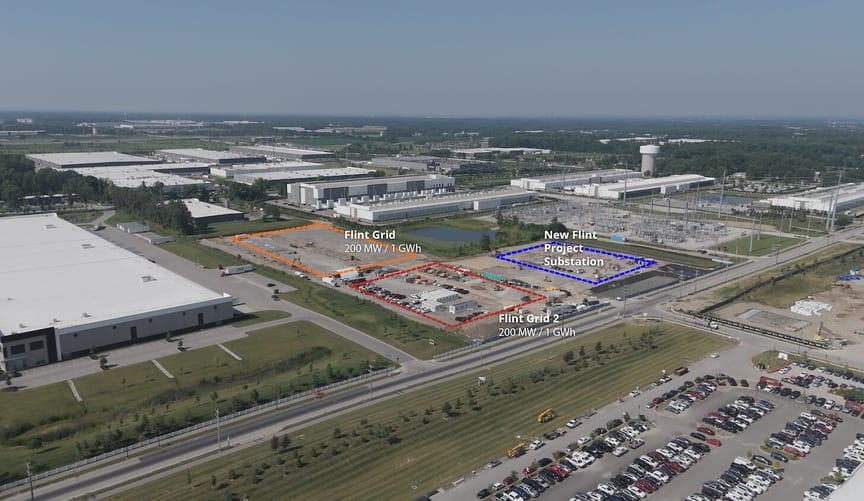
Developer Eolian announced on Wednesday that it’s broken ground on its Flint Grid battery project. The first phase is due online by June of 2027, and will be able to inject 200 megawatts for up to five hours straight into an electrical substation that serves the computing hub. With 1 gigawatt-hour of storage capacity, this battery won’t just be the biggest on the 13-state PJM market; it’ll be the biggest battery east of the Mississippi.
The system will help lower electricity prices by charging up when energy is cheap and abundant and dispatching that stored power onto the grid at times of peak demand — exactly what big batteries have been doing for years in places like California and Texas.
“There are things that have been in progress for a long time, designed to solve these very problems,” said Eolian CEO Aaron Zubaty, in response to the “snowballing narrative” that the grid can’t keep up with demand.
Batteries have set new installation records in the U.S. year after year, swiftly becoming the nation’s top pick for on-demand capacity and beating out new gas plant construction. But construction has clustered in the West, and developers have struggled to make inroads in the Midwest or the densely populated Eastern Seaboard. However, now that those areas face tremendous AI data center growth, they could use the instantaneous power that massive batteries provide.
Eolian can deliver that in New Albany because the firm got started a decade ago, taking calculated risks that seem to have paid off.
“This isn’t just some random 200 megawatts,” Zubaty said. “This is 200 megawatts at the epicenter of one of the largest industrial buildouts ever seen in our country, and by putting it at this spot, it will actually allow more stuff to get built.”
Zubaty didn’t originally have Ohio top of mind for his clean energy ambitions. By the early 2010s, northern Virginia led the nation in data center density, and Zubaty wanted to develop solar farms near those major energy consumers. But he ran into obstacles finding enough land. Solar development had to contend with northern Virginia’s horse farms and suburban subdivisions, and further west from Dulles airport, you hit the Appalachian Mountains.
“Where do the mountains end? A little bit east of Columbus,” Zubaty said.
Central Ohio was already growing in population and economic vitality, Zubaty noted, anchored by a skilled workforce and The Ohio State University. And it had a lot of open space that could accommodate new growth if the titans of the internet wanted to branch out from northern Virginia.
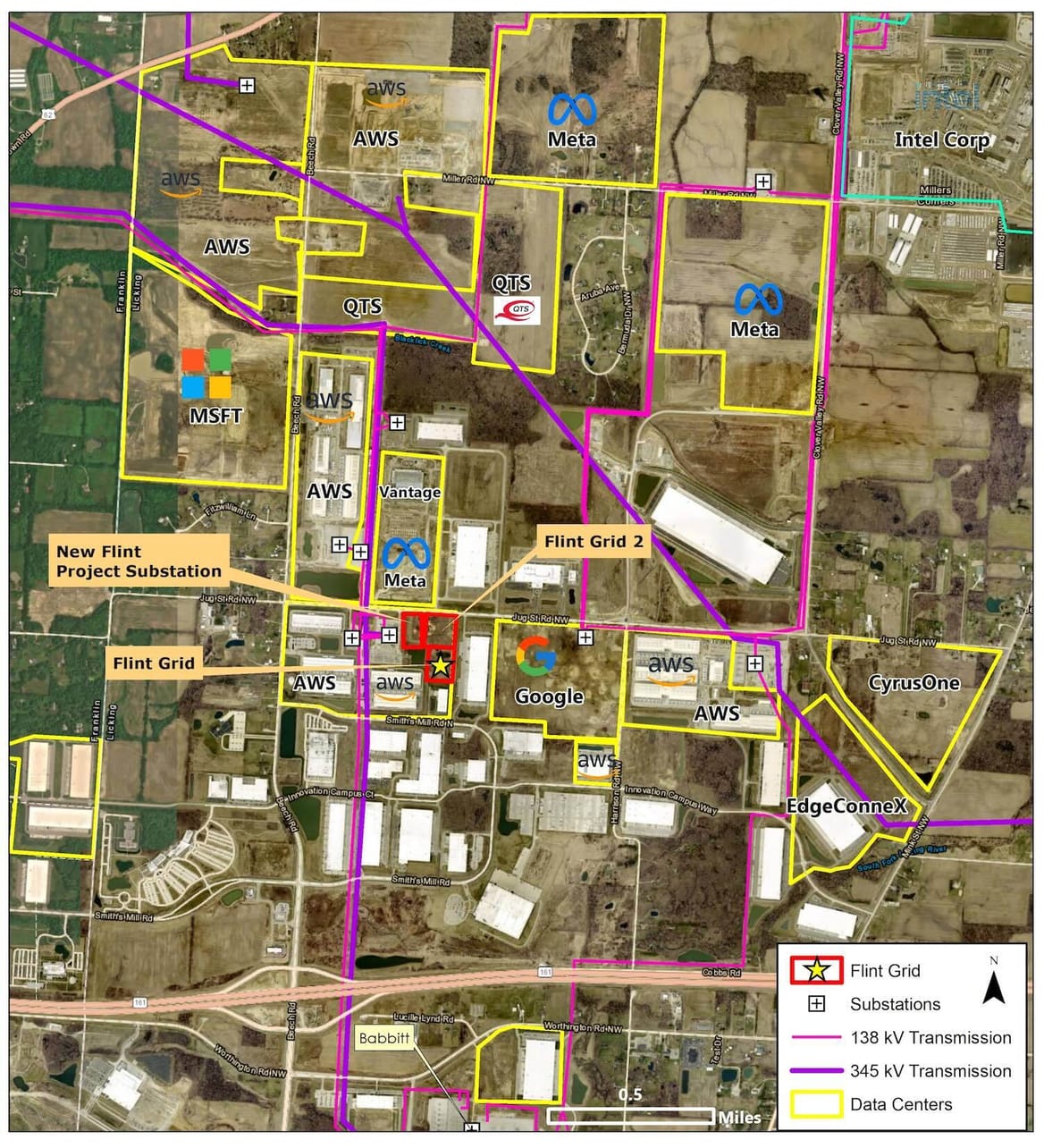
“We started doing land research, looking at where we could build solar in proximity to the Columbus metro area,” Zubaty recalled. “Lo and behold, we stumbled upon a couple obscurely named LLCs that were buying up a bunch of land at substations, and it was Amazon.”
Amazon Web Services opened its first data center outside New Albany in 2016. That kicked off a frenzy of tech companies buying the larger parcels of land nearby. One smaller tract — with an old house, lots of foliage, and a small pond — got left behind in the land race as data center companies bought all the property around it. The owners agreed to sell to Eolian, which considered the acreage well suited for a battery plant.
Today, that house is gone, and the once-peaceful parcel is fully surrounded by looming warehouses filled with servers. Crucially, it abuts a substation owned by utility AEP that receives power from a high-voltage transmission line and feeds it to a lower-voltage line that loops through the data center region. That potent grid backbone is what makes it possible for the area to host so much computing — and gives the battery a means of charging up.
After securing the land, Eolian got to work on permits, interconnection to the grid, and approval from the Ohio Power Siting Board. At the time, PJM’s power prices were quite low, offering little incentive for companies to build new power plants, even as “we were watching this massive amount of data center development unfold at a really epic scale,” Zubaty said.
By 2025, Eolian was ordering transformers and other long-lead-time equipment, even though it lacked a deal to sell power to one of the many corporate customers operating nearby. In December, Zubaty had sufficient confidence in the project to bid it into PJM’s capacity auction, which would award contracts for power delivered for one year starting on June 1, 2027. The auction hit the maximum possible price, signalling that long-simmering demand had unquestionably outstripped supply in PJM.
That win started a clock ticking to build out the site, because “there’s a massive financial penalty to bidding and then not showing up,” Zubaty said. (Eolian also plans to add a second phase of the same size by 2029.)
Typically, power plant investors want to see decades of revenue commitments in order to finance construction. PJM, though, only offers one year of certainty for that capacity payment.
Eolian took the risk of building in the hopes that further contracts will materialize.
Now, it looks increasingly likely that one of the many hyperscalers in the area could sign a deal that lets it take credit for the battery project’s contributions to PJM capacity. This could offset that customer’s need to buy power at sky-high market rates, but it also may become necessary to operate at all.
Tech giants are under tremendous political pressure to figure out how to meet their electricity needs without burdening the power system overall, especially in PJM territory. The White House’s Ratepayer Protection Pledge has pushed leading AI companies to say they will cover their own energy costs. New York state recently froze data center construction for a year, giving itself time to make rules to prevent the development from driving up electricity costs, and other liberal states are considering similar measures.
Should hyperscalers look for a well-situated battery to help meet their needs, they won’t find many. PJM can’t wind back the clock and ask for more developers to have applied for grid connection and secured land near future AI hubs eight years ago. Nor is there any indication PJM will soon refine its rules to allow the kind of flourishing of batteries seen in Texas’ competitive wholesale market.
But once one developer shows it’s both possible and valuable to build big batteries in the region, the sheer pressure to meet the AI moment may carry more batteries through the impasse.
A just-issued national security ban appears to exclude existing inverters for solar and battery projects — but future models could face restrictions, experts say.
Citing national security concerns, the Trump administration has banned the import and domestic use of new power inverters made outside the United States. The move could throw sand in the gears of gigawatts’ worth of planned solar, wind, and battery installations — projects that make up the vast majority of new electricity being built in the country.
On Tuesday, the Federal Communications Commission announced it had updated its “Covered List” to include “connected power inverters produced in foreign countries.” The list includes equipment and services considered to pose a threat to national security, meaning that these inverters “are generally prohibited from receiving FCC authorization to be imported, marketed, or sold in the U.S.,” the agency stated.
However, the ban currently applies only to future new models of inverters, not those already available in the market or being installed today — a distinction that could limit the immediate impact on the clean energy industry.
The FCC stated that its action was prompted by a “White House-convened Executive Branch interagency body with appropriate national security expertise,” which determined that foreign-made inverters, “regardless of the nationality of origin, “‘pose unacceptable risks to the national security of the United States or the safety and security of United States persons.’”
Inverters — devices that convert direct current electricity into alternating current suitable for transmission over power grids — are an irreplaceable component of utility-scale solar, battery, and wind power projects, home solar and battery systems, electric vehicles chargers, heat pumps, and other electricity systems.
The vast majority of inverters in use today are connected to communications networks, which puts them under FCC regulatory purview. And most inverters used in large-scale solar projects are built outside the U.S. — many of them in China, which has been the primary target of national security concerns.
The FCC’s new restrictions do come with that important caveat, though: They only “apply to new device models.” That qualification appears to exclude foreign inverter models that have previously won FCC approval.
The FCC also specified that the new restriction “does not impact a consumer’s continued use of devices they previously acquired,” or “prevent retailers from continuing to sell, import, or market relevant models approved previously through the FCC’s equipment authorization process.”
Those two statements have tempered some of the more drastic interpretations of the potential impact of the FCC’s announcement among energy industry market participants.
“In our world, investors are currently seeing this as kind of a non-event” due to this interpretation, John Miller, a managing director and energy transition policy analyst at investment bank TD Cowen, told Canary Media in a Wednesday morning email. “If either of those conditions were to change, this becomes a much bigger issue.”
This point was echoed by Julien Dumoulin-Smith, head of equity research for power, utilities, and clean energy at investment firm Jefferies, in a Wednesday morning statement. “[T]his has a minimal impact today. There seems latitude to continue to purchase existing inverter models on the market,” he wrote.
On the other hand, Dumoulin-Smith pointed out that any Trump administration steps to restrict new models of foreign-made inverters could create a “long, gradual shift in market share.”
Threats of the Trump administration targeting foreign inverters were first reported in late June by Reuters, which cited unnamed sources stating that a ban on Chinese-made inverters was in the works.
Last year, Reuters reported that technology experts investigating Chinese inverters had discovered communications devices that could be a security risk, citing anonymous sources. Later in 2025, Republicans in the House of Representatives wrote a letter to Commerce Secretary Howard Lutnick asking him to use the Commerce Department’s authority to “block future imports of Chinese equipment used in critical infrastructure nationwide.”
Chinese companies such as Sungrow and Chint Power Systems provide the majority of inverters for utility-scale clean energy and battery projects in the U.S., while U.S.-based Enphase Energy and Israel-based SolarEdge provide the majority of inverters for residential rooftop solar systems.
The FCC’s update targets any new inverters not made in the U.S., including those that U.S.-based companies produce in other countries. That could encompass inverters from other major providers to the solar market, such as Germany-based SMA Solar Technology and Austria-based Fronius International, as tracked by clean energy consultancy Wood Mackenzie.
If the FCC’s ban were to be expanded to include inverters currently being manufactured and sold for use in the U.S., the impact could be drastic. The U.S. built 50 gigawatts of new wind, solar, and battery capacity in 2025, more than any year prior, making up roughly 92% of new generating capacity. And the U.S. Energy Information Administration forecasts these trends will continue in 2026, with solar set to provide 51% of the new utility-scale electricity capacity, batteries 28%, and wind 14%.
In the immediate future, projects likely won’t have to abandon the inverters they’ve already purchased or plan to install, said Joe Shangraw, a solar research analyst at Wood Mackenzie. But he also cautioned that, as with any other industry, “eventually, currently approved products will become obsolete.”
That means inverter manufacturers will ultimately have to bring new products to market and submit them for FCC approval, at which time they’ll have to contend with the agency’s new rules. At that point, any inverters made outside the U.S. will be barred from sale and use unless they undergo a distinct conditional approval or waiver process, he said.
Shangraw also noted that the need to bring new products to the market could be accelerated if the federal government sets new requirements on cybersecurity, grid functionality, or other inverter capabilities.
“If that would require a significant hardware or software update, that would be something where you’d have to request some permissive change from the FCC, or ask for a totally new FCC ID” designating a new model of device for the agency’s review, he said. “So it’s certainly relevant and impactful — probably not in the next couple of months but in the next year or so.”
This growing uncertainty over the federal government’s classification of foreign-made inverters could increase industry interest in securing domestic inverter supplies, he said. On that front, “the storage space looks a lot healthier,” with companies such as U.S.-based EPC Power and Tesla operating significant domestic manufacturing capacity, and others such as Spain-based Power Electronics scaling up U.S. manufacturing.
Residential solar inverters are “in a good place,” Shangraw said, with SolarEdge, Enphase, and Tesla providing about 80% of the U.S. market needs. But the domestic manufacturing capacity for solar inverters for utility-, commercial-, and industrial-scale projects is less clear, he said, given that Chinese inverter makers hold about 60% of U.S. market share in that sector.
Large-scale solar developers could hope to earn waivers from the FCC on foreign-made inverters from non-Chinese companies such as SMA and Power Electronics, he noted. They could also anticipate expanded domestic manufacturing from U.S.-based Nextpower, which is acquiring the inverter and power conversion business of Spain-based Zigor and its U.S. subsidiary Apex Power; or from GE Vernova, which has opened an inverter factory in Pittsburgh and could expand capacity there, he said.
“The main thing is, we don’t know how impactful this is until we learn a bit more about the timeline for when these actual changes to the requirements” for existing inverters might occur that would “force companies to release new products,” he said. “I’d say if this was a hard deadline, and if there were no new imports allowed, we’d be in trouble.”
As tech firms look to build their own gas generators, a new report reveals that likely won’t be enough to avoid a hefty power shortfall in the coming years.
It’s no secret that data centers are slated to bring stunning levels of new power demand to the grid in the coming years.
Report after report has tried to put a number on just how much electricity these facilities will actually use, and BloombergNEF joined the chorus this week. Its report projects that U.S. data centers will consume 20% of the country’s power in 2035, up from 5.9% today.
In all, data centers will consume as much as 194 gigawatts of power in 2035, the report estimates. That’s nearly double the amount BloombergNEF forecast back in December, and it’s more than the firm’s analysts expect the power grid to be able to accommodate.
So what’s a data center developer to do? Well, if you’re Elon Musk, you buy a company that’s operating tons of mobile gas and diesel generators that can provide your data centers with power that’s not connected to the grid.
Federal records unearthed last week by Electrek show that in May, the xAI founder bought APR Energy, a Florida company that runs more than a gigawatt of these portable fossil-fueled turbines. These generators can be installed in just a few days, as opposed to a traditional gas plant, which may take years to build.
This isn’t a new avenue for xAI. Since last August, the company has been using diesel generators propped on truck beds to power its Colossus 2 data center project outside Memphis. A lawsuit from the NAACP and its allies alleges the turbines are running without required permits and releasing tons of pollution that harms nearby, majority-Black communities.
Other data center projects are turning to gas, too, or hope to do so in the future. In Ohio, Meta uses modular gas turbines to power servers that, as of June, are stacked up in temporary tents. Some developers want to construct more permanent fossil-fuel solutions: Google, for example, has proposed building its very own utility-scale gas plant alongside a data center in Nebraska.
But experts are casting doubt on just how much off-grid gas power that tech firms will actually be able to build. Among the challenges: Gas turbines are in short supply, and so is the workforce needed to maintain them, as the clean energy industry veteran Jigar Shah noted in an episode of Latitude Media’s Open Circuit podcast.
BloombergNEF projects that even if the grid can accommodate 7 GW of new data center demand each year — the all-time record — and if many hyperscalers install their own gas turbines, the sector will still face a 19-GW shortfall by 2035. For perspective, a standard large-scale nuclear power plant produces about 1 GW of power, and it’s going to be a gigantic undertaking to fulfill the Trump administration’s goal to build 10 of those in the coming years.
Of course, no one knows for sure just how much power data centers will actually end up needing. Data centers could get way more efficient as their processors improve. The AI boom could peter out. Or maybe, just maybe, we’ll unlock the miracle clean power source that is commercial nuclear fusion and use it to meet all our massive electricity needs — but I wouldn’t hold my breath.
Trump’s ill-timed efficiency rollbacks
America’s war with Iran isn’t letting up, and neither is the energy shortage the conflict has brought upon much of the world.
Energy-efficiency measures could provide one salve to the crisis, but in the U.S., they’re getting ever harder to access. Over the past few months, the Trump administration has scaled back a bevy of programs that make home weatherization and other utility-bill-cutting improvements more affordable. Incentives that helped people trade fossil fuel appliances for electric alternatives are dead, for one.
Even free advice hasn’t survived. The Department of Energy’s website used to be full of tips for lowering your power bills, like how to find and plug drafts in your home. But as Grist reports, those guides disappeared by early July — just in time for a grid-straining heat wave to set in across the country.
State legislatures go easier on renewables
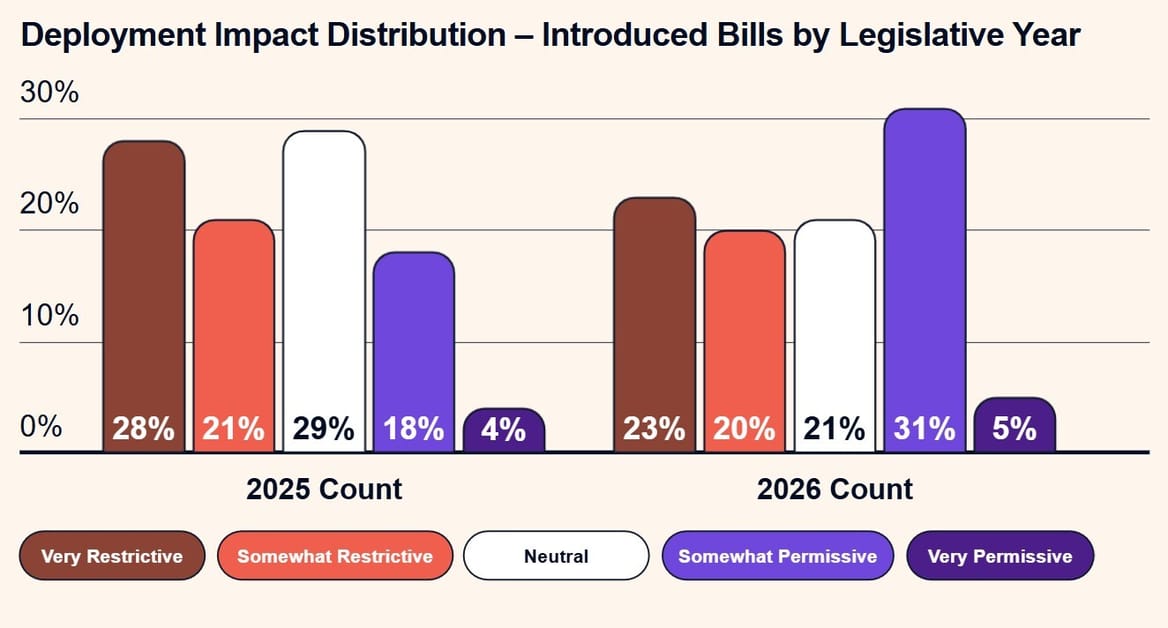
Last year, state legislatures had clean energy in their crosshairs. Lawmakers throughout the country introduced more than 300 bills related to renewable energy siting in 2025, and nearly half of them would have made it harder to build solar, wind, and battery storage projects.
Luckily for renewables, just 10 of those restrictive measures actually became law. But this year is shaping up to be brighter, according to the Siting Solutions Project. While lawmakers introduced 86 measures to rein in solar, wind, and battery permitting in 2026, just one has become law. That record is likely to stick, as most state legislative sessions have already concluded for the year.
Meanwhile, a handful of pro-renewables permitting and siting policies made it into law this year in both Democratic- and Republican-run state legislatures, reports Canary Media’s Jeff St. John. That includes measures that aim to curb local bans on renewables, speed review processes, and set best practices for cleaning up retired solar and battery projects.
Where to buy balcony solar: A few companies are finding their footing in America’s emerging balcony solar market, with some German firms expanding sales to the States, and U.S. solar manufacturers potentially getting involved soon. (Canary Media)
Iran war strain continues: The world has found ways to adapt without oil from the Strait of Hormuz, but experts predict that fallout from a continued closure could be more severe as countries’ emergency stockpiles near depletion. (Grist)
International nuclear deal: The Trump administration signs a deal with Saudi Arabia that paves the way for nuclear power construction in the country — an arrangement that’s likely to benefit U.S. nuclear developer Westinghouse. (Washington Post, New York Times)
Pumping up iron: Mesabi Metallics sees green steel as a path to revitalize Minnesota’s Iron Range, and it’s rolling out a $2.5 billion plan to mine and produce iron that’s key to lower-emissions steelmaking. (Canary Media)
Coal’s climbing costs: Pushback to the Trump administration’s coal-plant stay-open orders grows, with Wisconsin’s governor saying the costs to utility customers could hit $117 million in coming years, and a Colorado analysis estimating costs over $87 million. (Wisconsin Public Radio, Colorado Sun)
Wind allies unite: A coalition of 18 states and Washington, D.C., looks to join a wind industry lawsuit fighting the Department of Defense’s blockade on onshore wind permitting. (Canary Media)
Digging deeper: Geothermal veteran Ormat Technologies is venturing into the industry’s next generation with projects that can unlock energy where natural geothermal resources don’t exist. (Canary Media)


.svg)
