

 Back
Back
Utility customers will pay the price — literally — if the Trump administration continues to unnecessarily force fossil-fueled power plants to stay open in the name of grid reliability, energy experts and regulators warn.
An April executive order from President Donald Trump tasks the Department of Energy with taking unilateral authority to obligate power plants to keep operating, even after utilities, states, and regional grid operators have spent years making sure they’re safe to close.
Last week, in response to the order, the DOE released a report that claims current power plant retirements and additions put the country at massive risk of blackouts by 2030. It calls for “decisive intervention” to prevent that outcome. The agency has already used emergency powers to halt the closure of the J.H. Campbell coal plant in Michigan and the Eddystone oil- and gas-burning plant in Pennsylvania.
Energy Secretary Chris Wright stated in an opinion piece published by The Economist this week that the administration’s goal is “expanding our supply of reliable energy” and “delivering more secure energy to Americans more cheaply.”
But energy analysts say the report uses worst-case scenarios to reach its conclusions, mainly by ignoring the hundreds of gigawatts of new generation — almost all of it solar, batteries, and wind power — slated to come online in the near future. Meanwhile, state regulators and environmental and consumer groups have challenged the DOE’s stay-open orders, arguing it overstepped sound grid-planning policy and precedent to solve a grid “emergency” that it has manufactured.
Ordering aging fossil-fueled power plants to stay open would force utility customers to pay billions of dollars for some of the least efficient and least reliable power plants on the grid — not to mention those worst for the climate and the health of nearby communities.
Coal has shrunk from nearly half the country’s electricity generation in 2008 to only about 15% at the start of this year, a trend driven primarily by competition from cheaper fossil gas and renewables. A June report from think tank Energy Innovation found that coal power was 28% more expensive in 2024 than in 2021, meaning consumers spent about $6.2 billion more last year than they would have for the same amount of electricity three years prior.
It’s difficult to predict how much more expensive power could get if the DOE forces additional fossil-fueled plants to stay open. But Gabriella Tosado, a senior associate on RMI’s carbon-free electricity team, offered an estimate using the think tank’s modeling for states where data is available.
RMI ran a “100% self-commitment” analysis to calculate the increase in customer costs that would come from running all coal plants at “maximum availability” throughout the year, using 2024 data. “Nationally, running coal plants more often last year would have increased customer costs by $15 billion,” or a roughly 3% increase in total annual U.S. power-sector costs, she said.
“If operators of coal plants could make more money by running coal plants more often, they would,” she said. “Running them more will only distort market prices and drive up costs for families and small businesses.”
Alison Silverstein, an energy analyst and former adviser to the Public Utility Commission of Texas and the Federal Energy Regulatory Commission, agreed. “If even an investor-owned utility wants to retire an old fossil plant, that’s telling you it’s extraordinarily expensive and highly unreliable, and they don’t think their regulators are going to give them enough money to keep the plant open,” she said.
Indeed, many U.S. utilities are operating coal plants that can’t compete on cost with gas-fueled facilities and renewables. This practice, known as “uneconomic dispatch,” allows utilities to continue to collect the costs of fuel and operations from customers to pay off their investment in the power plant, but increases the amount that customers pay for power, according to multiple studies over the past decade.
All told, think tank RMI estimates that this kind of “uneconomic dispatch” of coal plants has already put U.S. electricity consumers on the hook for $24 billion in excess expenditures from 2015 to 2024. For utility customers nationwide, including those served by utilities with little or no coal-fired power, that averages out to $9 per year. But for customers of utilities that own the most expensive-to-run coal plants, the added charge is as high as $200 a year.
Making more aging fossil-fueled power plants stay open would only further inflate these costs borne by utility customers, at a time when energy prices are already slated to soar due to Trump administration policies.
It’s especially costly to utility customers when long-running plans to close down a power plant are abruptly reversed. That’s exactly what’s happened with the J.H. Campbell plant, one of the two facilities the Trump administration has ordered to stay open in recent months.
In its case, the additional expenses associated with the sudden reversal may range from tens of millions of dollars to “close to $100 million,” said Dan Scripps, chair of the Michigan Public Service Commission, which regulates utilities in the state. That’s in addition to whatever costs come from operating the plant down the line.
The DOE’s order to keep the plant running through August came eight days before its scheduled May 31 retirement under a plan that has been in the works since 2021, Scripps explained. The utility that owns J.H. Campbell, Consumers Energy, had “exhausted their supplies of coal and other things required to run a coal plant,” he said, meaning it had to pay more expensive spot-market prices to secure them at such short notice. The utility also had to “scramble to make sure the plant was staffed,” since many employees had already been assigned to other jobs or planned to retire.
Consumers Energy might have to go through this disruptive process all over again when the initial stay-open order expires next month. Under Section 202(c) of the Federal Power Act, the DOE can only force plants to keep running under emergency circumstances for 90 days at a time, but it’s allowed to issue more such orders with no advance warning.
“I think the sense was we could get through the summer, but if we were going to do this on 90-day cycles, at some point you have to do the repairs necessary to keep this plant — or any plant — in good working condition,” Scripps said. “With a known retirement date for the past three years, a lot of that work hasn’t happened.”
Continuing to run J.H. Campbell also undermines plans to build the new generation that makes it safe to close old power plants. To enable the shutdown of J.H. Campbell, Consumers Energy bought a 1.2-gigawatt gas-fired power plant and continued to build and contract for utility-scale solar power and battery storage.
All of these decisions were made under the longstanding regulatory compact that puts grid-reliability planning and utility regulation in the hands of states and regional operators. Those processes are “driven by data, driven by best practices, and subjected to robust scrutiny from states and other market participants,” Scripps said. For the DOE to overrule all of that work “is what’s most concerning to states.”
Cost anxieties aside, critics of the DOE’s actions insist its interventions are unnecessary because current grid-planning methods already ensure power plants won’t close if doing so will unduly increase the risk of outages. Regional grid operators have in recent years used their existing authority to delay power plant closures to maintain reliability. Utilities have also punted on or withdrawn plans to retire coal plants in the face of booming electricity demand from data centers, factories, and electric vehicles.
The DOE’s report last week doesn’t specify what actions the agency plans to take to deal with grid reliability. But Trump’s April executive order, titled “Strengthening the Reliability and Security of the United States Electric Grid,” calls on the agency to create a “protocol to identify which generation resources within a region are critical to system reliability,” and to use “all mechanisms available under applicable law,” including its Section 202(c) authority, to prevent any“critical” generator from closing.
“The question on everyone’s mind is, ‘Is this a one-off? Or is there something more sweeping that will come out of that review?’” Scripps said. “I think we’re still waiting on that.”
In the meantime, 108 power plants remain set to close by the end of Trump’s term, including 25 coal plants, according to a June analysis by The New York Times. It’s unclear if the DOE intends to permit those closures to move ahead.
“I’ve heard that from some of my colleagues from across the region, that when looking at plant retirements, if there’s a sense that DOE would force you to run it anyway, maybe you hold off,” Scripps said. “That’s the wrong way to do grid planning. But you don’t want your customers paying more than they should.”
2025 is a pivotal moment for climate action. Countries are submitting new climate commitments, otherwise known as "Nationally Determined Contributions" or "NDCs," that will shape the trajectory of global climate progress through 2035.
These new commitments will show how boldly countries plan to cut their greenhouse gas (GHG) emissions, transform their economies, and strengthen resilience to growing threats like extreme weather, wildfires and floods. Collectively, they will determine how far the world goes toward limiting global temperature rise and avoiding the worst climate impacts.
A few countries, such as the U.S., U.K. and Brazil, have already put forward new climate plans — and their ambition is a mixed bag. But it's still early: Many more countries, including major emitters like the EU and China, have yet to reveal their NDCs and are expected to do so in the coming months.
We analyzed the initial submissions for a snapshot of how countries' climate plans are shaping up so far and what they reveal about the road ahead.
A decade ago, the world was headed toward 3.7-4.8 degrees C (6.7-8.6 degrees F) of warming by 2100, threatening catastrophic weather, devastating biodiversity loss and widespread economic disruptions. In response, the Paris Agreement set a global goal: limit temperature rise to well below 2 degrees C (3.6 degrees F) and strive to limit it to 1.5 degrees C (2.7 degrees F), thresholds scientists say can significantly lessen climate hazards. Though some impacts are inevitable — with extreme heat, storms, fires and floods already worsening — lower levels of warming dramatically reduce their severity. Every fraction of a degree matters.
To keep the Paris Agreement's temperature goals within reach, countries agreed to submit new NDCs every five years. These national plans detail how (and how much) each country will cut emissions, how they'll adapt to climate impacts like droughts and rising seas, and what support they'll need to deliver on those efforts.
Countries have gone through two rounds of NDCs so far, in 2015 and 2020-2021, with their commitments extending through 2030.
While the latest NDCs cut emissions more deeply than those from 2015, they still fall short of the ambition needed to hold warming to 1.5 or 2 degrees C. If fully implemented (including measures that require international support), they could bring down projected warming to 2.6-2.8 degrees C (4.7-5 degrees F). And without stronger policies to meet countries' targets, the world could be heading for a far more dangerous 3.1 degrees C (5.6 degrees F) of warming by 2100.
Now the third round is underway, with countries expected to set climate targets through 2035.
These new NDCs are expected to reflect the outcomes of the 2023 Global Stocktake, which was the first comprehensive assessment of global climate progress under the Paris Agreement. In addition to bigger emissions cuts in line with holding warming to 1.5 degrees C, the Stocktake called on countries to act swiftly in areas that matter most for addressing the climate crisis — especially fossil fuels, renewables, transport and forests — and to do more to build resilience to climate impacts.
2025 NDCs are also an opportunity to align near-term climate action with longer-term goals. Over 100 countries have already pledged to reach net-zero emissions, most by around mid-century. Their new NDCs should chart a course toward achieving this.
Under the Paris Agreement's timeline, 2025 NDCs were technically due in February. As of late May, only a small proportion of countries had submitted them, covering around a quarter of global emissions.

These early movers include a diverse mix of developed and developing nations from different regions and economic backgrounds.
Among the G20 — the world's largest GHG emitters — only five countries submitted new NDCs so far: Canada, Brazil, Japan, the United States and the United Kingdom. (Since submitting its NDC, the U.S. announced its intention to withdraw from the Paris Agreement.)
Several smaller and highly climate-vulnerable countries have also stepped forward, including Ecuador and Uruguay in Latin America; Kenya, Zambia and Zimbabwe in Africa; and island states such as Singapore, the Marshall Islands and the Maldives.
That means close to 90% of countries have yet to submit their new NDCs.
There are several reasons for this. The last round of NDCs was pushed back by a year due to the COVID-19 pandemic, giving countries only four years to prepare new plans. Geopolitical tensions, ongoing conflicts and security concerns have further complicated progress. Many smaller developing nations are also facing capacity constraints as they work to complete biennial climate progress reports and new national adaptation plans (NAPs), also due this year.
Most countries are now expected to present their new NDCs by the UN General Assembly in September.
Compared to previous targets, the NDCs submitted so far have made a noticeable but modest dent in the 2035 "emissions gap": the difference between where emissions need to be in 2035 to align with 1.5 degrees C and where they're expected to be under countries' new climate plans.
If fully implemented, new NDCs are projected to reduce emissions by 1.4 gigatons of carbon dioxide equivalent (GtCO2e) by 2035 when compared to 2030. Looking only at unconditional NDCs (those that don't require international support), this leaves a remaining emissions gap of 29.5 GtCO2e to hold warming to 1.5 degrees C. When conditional NDCs (those that do require international support) are included, this gap shrinks to 26.1 GtCO2e.


Much of the progress in narrowing the gap comes from major emitters that have already submitted new NDCs — most notably the U.S., Japan and Brazil. Given their large emissions profiles, their new commitments account for the majority of the reductions seen so far.
While this marks progress, it's far from what's needed to keep global warming within safe limits. Getting on track to 1.5 or even 2 degrees C would require much steeper cuts than what's currently on the table.
However, this is not the full picture.
Many of the world's largest emitters have yet to submit their 2035 targets. The remaining G20 countries alone account for about two-thirds of global GHG emissions. This makes their forthcoming NDCs especially important: The scale and ambition of these commitments could meaningfully narrow the emissions gap — or, if they fall short, leave the world locked into a trajectory that puts global temperature targets out of reach.
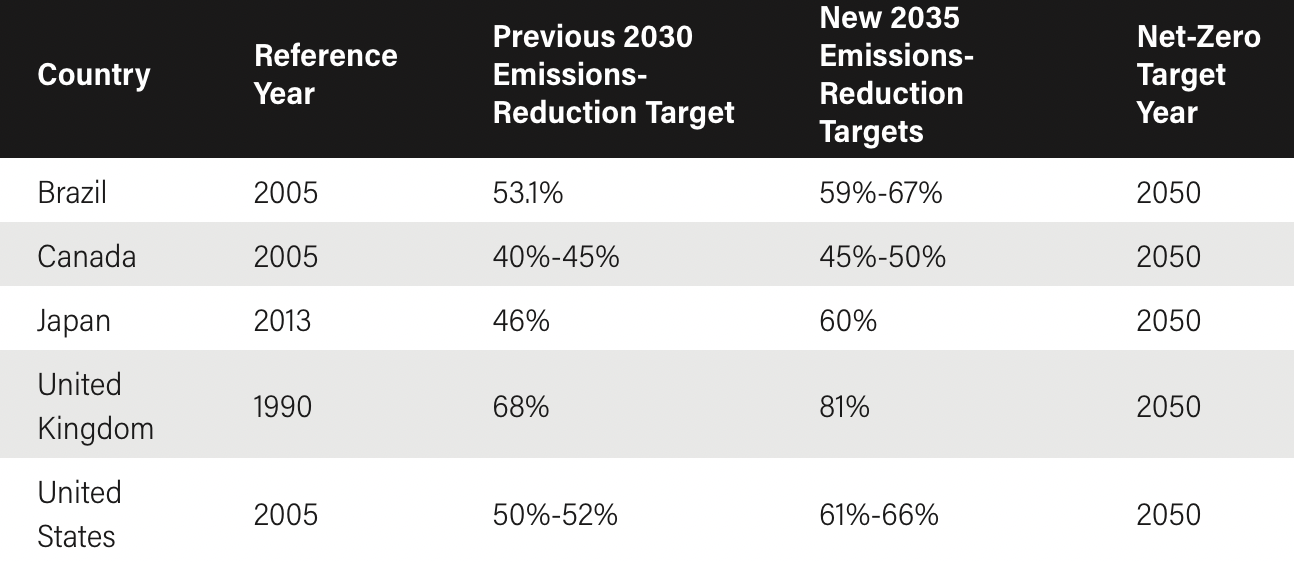
Among the countries that have submitted new NDCs so far, the United Kingdom stands out for its ambitious climate trajectory. Following the recommendations of its Climate Change Committee, the U.K. has set a bold target to reduce emissions 81% by 2035 from 1990 levels. This rapid decline in the coming decade would put the country on track toward its net zero goal by 2050, based on realistic rates of technology deployment and ambitious but achievable shifts in consumer and business behavior.
Other countries, such as Japan and the United States, have opted for a "linear" approach toward net zero — meaning if they drew a straight line to their net-zero target (for example, 0 GtCO2e in 2050), their 2030 and 2035 targets would fall along it, reflecting a constant decline in emissions each year. Japan aims to cut emissions 60% from 2013 levels by 2035, while the United States has pledged a 61%-66% reduction from 2005 levels by 2035.
Despite the U.S. withdrawing from the Paris Agreement, undermining climate policies and attempting to dismantle key government institutions, its NDC target may still provide a framework for climate action at the state, city and local levels, as well as for future administrations. Many of these entities have already rallied around the new NDC and are committed to making progress toward its targets.
However, the linear approach Japan and the U.S. are taking to emissions reductions — as opposed to a steeper decline this decade — risks using up a larger share of the world's carbon budget earlier and compromising global temperature targets.
Brazil presented a broader range of emissions targets in its NDC, committing to a 59%-67% reduction by 2035 from 2005 levels. These two poles represent a marked difference in ambition: A 67% reduction could put Brazil on track for climate neutrality by 2050, while a 59% reduction falls short of what's needed to meet that goal. It is unclear which trajectory the government intends to pursue, leaving Brazil's true ambition in question. The NDC also omits carbon budgets for specific sectors (such as energy, transport or agriculture), which would clarify how it plans to meet its overarching emissions goals. However, Brazil committed within its NDC to develop further plans outlining how each sector will contribute to its 2035 target.
Elsewhere, Canada made only a marginal increase to its target, shifting from a 40%-45% emissions reduction by 2030 to 45%-50% by 2035 from 2005 levels. This falls short of the recommendation from Canada's own Net-Zero Advisory Body, which called for a 50%-55% reduction by 2035 — and warned that anything below 50% risks derailing progress toward the country's legislated net-zero goal by 2050. While every increase in ambition counts, such incremental changes do not match the urgent pace of progress needed among developed and wealthy economies like Canada.

Several early trends are starting to emerge among the new NDCs. While these initial submissions offer valuable insights, they don't yet reflect the full picture; deeper analysis will be needed as more NDCs come in throughout the year.
Almost all of the 22 NDCs submitted thus far include 2035 mitigation measures. The exception is Zambia, which reiterated its previous 2030 pledges in a provisional NDC (although this may still be revised to include 2035 mitigation measures).
Of the other 21 submissions, 20 countries expressed their 2035 targets as emissions-reduction goals. The exception was Cuba, which instead committed to increasing renewable electricity generation to 26% and improving energy efficiency by 2035.
Seventeen of the 20 countries with emissions-reduction goals set economy-wide reduction targets for 2035, as encouraged by the Global Stocktake, covering all sectors and greenhouse gases. The remaining few — smaller developing countries such as the Maldives and Nepal — submitted targets that cover only specific sectors or gases.
Under the Paris Agreement, developed countries are required to submit economy-wide targets, while developing countries are encouraged to work toward them over time. In Nepal's case, for instance, a lack of comprehensive data limited its ability to define an economy-wide target or fully assess the impact of its policies.
Despite clear scientific evidence and UN decisions urging stronger 2030 targets, only four countries — Saint Lucia, Nepal, Moldova and Montenegro — have strengthened their 2030 emissions pledges. For example, Montenegro revised its emissions-reduction target from 35% to 55% by 2030 compared to 1990 levels, and set a 60% emissions-reduction target by 2035.
Notably, none of the wealthier, high-emitting and more developed countries have strengthened their 2030 targets — despite having the greatest capacity and responsibility to take the lead on slashing emissions.
In the face of worsening climate impacts, 16 of the 22 countries that have submitted new NDCs strengthened their adaptation commitments — continuing a trend seen in previous rounds. Countries are prioritizing adaptation across sectors such as food and water systems, public health and nature-based solutions.
Ecuador, which is particularly vulnerable to heavy rainfall and floods, prioritized action to build resilience of its water resources, human health and settlements, as well as its natural heritage. Some developed countries are also prioritizing adaptation action in their NDCs. Canada, which has witnessed devastating wildfires in recent years, cited its National Adaptation Strategy, which provides a framework for disaster resilience, biodiversity, public health and infrastructure.
Some countries' NDCs also recognize the critical role that subnational actors — such as cities, states and regions — play in shaping and delivering climate action.
Eleven of the newly submitted NDCs come from countries that have endorsed the Coalition for High Ambition Multilevel Partnerships (CHAMP). The CHAMP initiative — launched in 2023 by the COP28 Presidency, in partnership with Bloomberg Philanthropies and with the support of WRI and other partners — aims to strengthen collaboration between national and subnational governments on climate planning and implementation. As part of this commitment, 75 countries pledged to consult with and integrate subnational priorities and needs into their NDCs. Of the 11 endorsing countries that have submitted new NDCs, four explicitly mentioned CHAMP.
Brazil's NDC in particular recognizes the critical role subnational governments play in delivering national climate goals. Referred to as "climate federalism," it highlights an instrument designed to support the integration of climate action into planning and decision-making across all levels of government: federal, state and municipal.
As countries submit new NDCs for the first time since the Global Stocktake in 2023, a clearer picture is emerging of how governments are embedding sector-specific action into their new climate plans. From detailed emissions-reduction targets to broader policy frameworks, most NDCs are setting out concrete steps to cut emissions across sectors that largely drive climate change, such as energy, transport and forestry.
Some countries — such as Switzerland, the UAE, Kenya and Zimbabwe — have included sector-specific emissions-reduction targets directly in their NDCs. Switzerland's targets, for instance are aligned with its Climate and Innovation Act, with plans to cut emissions by 66% in buildings, 41% in transport and 42.5% in industry by 2035 compared to 1990 levels. Kenya, on the other hand, has set an ambitious target to achieve 100% renewable electricity generation in the national grid by 2035.
Others, like the United Kingdom, Brazil, Singapore, the Marshall Islands and Canada, have focused on elaborating national policies and strategies that respond to the Global Stocktake's priority areas. The U.K.'s NDC highlighted its Clean Power 2030 Action Plan to fully decarbonize electricity by 2030; the Warm Homes Plan to boost energy efficiency in residential buildings; and reaffirmed its plans for phasing out internal combustion engine vehicles by 2030.
Countries such as Brazil and New Zealand have committed to developing detailed sectoral strategies as a next step to support NDC implementation. Brazil plans to update its national climate strategy by mid-2025, breaking it down into 16 sectoral adaptation plans and seven mitigation plans. New Zealand committed to publishing its emissions-reduction plan for 2031-2035 in 2029, which will set out sectoral mitigation strategies to help deliver on its NDC.
As more countries prepare to submit their new NDCs, attention will focus on whether they follow the trend of outlining sector-specific actions to meet their broader emissions targets. In particular, the spotlight will be on how countries plan to contribute to the transition away from fossil fuels — the single largest driver of the climate crisis.
We have yet to see new NDCs from many major emitters, including the European Union, China and India. All three have demonstrated climate leadership in various ways, and their actions will set the tone for future climate efforts. While these three are in the spotlight, attention will also be on other key countries — such as Indonesia, Mexico and Australia -— that are critical to reducing the global emissions gap.
The EU is still working to set a 2035 emissions target for its new NDC, which will hinge on its longer-term 2040 target. Last year, the European Commission recommended cutting emissions 90% by 2040 — a move that's seen as beneficial for enhancing industrial competitiveness in clean technologies, strengthening energy security and cutting energy costs. Some EU member states have suggested following a linear trajectory between the 2030 and 2040 targets, which would imply a 72.5% reduction by 2035 if the 90% target for 2040 gets adopted.
However, European member states have yet to adopt the 90% target. Ongoing discussions could see the EU's target weakened to address concerns from heavy industry and agriculture. The delay in finalizing the EU's 2040 target is also putting its NDC timeline at risk, raising the possibility of missing the expected September submission date.
As the world's largest emitter, China's NDC will be critical to keeping global temperature goals within reach. The country has already made major strides in clean energy, leading the world in solar power and electric vehicle deployment. However, a surge in coal plant approvals post-pandemic has raised concerns about its path toward net zero by 2060.
China's 2035 emission target will be the first in a post-peak emissions context. Studies aligned with 1.5 degrees C and China's net-zero pledge suggest the need for sharper cuts by 2030 and continued deep reductions through 2035. In this context, some research suggests that China could reduce CO2 emissions 30% by 2035 (compared to 2020) on the way to achieve its net zero target by 2060.
President Xi Jinping announced in April that China will submit its updated NDC ahead of the UN climate summit (COP30) this November, covering all sectors and greenhouse gases. This marks a notable shift for the country: Its previous NDCs covered only CO2, but China's non-CO2 emissions alone place it among the world's top 10 emitters.
Unlike other major economies, India has some of the lowest per capita emissions, and its national emissions are still growing as the country works to eradicate poverty and achieve development goals. This means its emissions are not expected to decline by 2035, though some studies suggest earlier declines are needed. Rapid advances in renewable energy and clean technology offer a significant opportunity for the country to accelerate its low-carbon transition while also ensuring energy security and economic competitiveness.
Strengthening renewable energy commitments in India's next NDC — building upon its domestic target of 500 GW by 2030 — could chart a pathway for sustainable growth, while also delivering co-benefits like cleaner air and enhanced energy security.
The UN climate change body (UNFCCC) will release an NDC synthesis report ahead of this year's COP30 climate summit, assessing the collective impact of the new pledges submitted to that point. While this report will solidify where we're headed in relation to the Paris Agreement's temperature goals, the storyline is already clear: New NDCs will not put the world on track to limit warming to 1.5 degrees C.
The emissions gap is likely to remain dangerously wide, and the report will reaffirm what we already know — that much greater ambition and action are needed. Still, the findings will serve as a key input for this year's climate conference, where countries will decide on next steps to narrow that gap. They must address what comes after NDCs, grappling with how to turn ambition into action and keep a safer future within reach.
Ultimately, putting forward strong plans — and fulfilling them — are essential levers: not only for limiting warming, but for safeguarding the health, prosperity and security of current and future generations.
Editor’s note: A correction was made on June 3, 2025 to reflect an update in the underlying data. New conditional NDCs are estimated to reduce emissions by 1.4 GtCO2e by 2035 rather than 1.5 GtCO2e.
Wildfires in Canada — forcing mass evacuations in Manitoba and prompting urgent calls for assistance from First Nations leaders in Saskatchewan — have intensified as heat, drought, and atmospheric conditions collide, during the last week of May 2025.
Climate change is fueling this early-season heat, making high temperatures in parts of central Canada at least five times more likely than they would be in a world without climate change.
Note: This event may continue beyond May 30. Use the Global Climate Shift Index map to stay updated on heat in your region.
Dr. Kristina Dahl, VP of Science at Climate Central, said:
"When temperatures reach a CSI level 5 across such a large area, it’s not just unusual—it means this kind of heat would be incredibly unlikely without climate change," said Dr. Kristina Dahl, VP of Science at Climate Central. "These conditions, which set the stage for dangerous wildfires, will only become more frequent and more severe if we continue burning fossil fuels."
Kaitlyn Trudeau, senior research associate for climate science and wildfire expert at Climate Central, said:
"Climate change-driven heat dries out vegetation and sets the stage for wildfires. Combine that with persistent drought and a locked-in high-pressure system, and you have a perfect storm—one that’s becoming more common as we continue to burn fossil fuels and heat the planet."
To request an interview with a Climate Central scientist, please contact Abbie Veitch at aveitch@climatecentral.org.
The Climate Shift Index uses peer-reviewed methodology and real-time data to estimate how climate change has increased the likelihood of a particular daily temperature.
When we emit carbon dioxide (CO2) into the atmosphere, most of it stays there for centuries or millennia. This means that CO2 emitted even a century ago has contributed to the rising temperatures we see today.
In other words, how much the climate warms depends on how much cumulative CO2 is emitted over time.
The chart shows the ten countries with the largest share of the world’s historical emissions, based on cumulative emissions from fossil fuels and industry since 1750.
The United States has contributed the most, accounting for almost one quarter. This is followed by China and Russia.
As 2023 came to a close, scientists had hoped that a stretch of record heat that emerged across the planet might finally begin to subside this year. It seemed likely that temporary conditions, including an El Niño climate pattern that has always been known to boost average global temperatures, would give way to let Earth cool down.
That didn’t happen.
Instead, global temperatures remain at near-record levels. After 2023 ended up the warmest year in human history by far, 2024 is almost certain to be even warmer. Now, some scientists say this could indicate that fundamental changes are happening to the global climate that are raising temperatures faster than anticipated.
“This shifts the odds towards probably more warming in the pipeline,” said Helge Goessling, a climate physicist at the Alfred Wegener Institute in Germany.
One or two years of such heat, however extraordinary, doesn’t alone mean that the warming trajectory is hastening. Scientists are exploring a number of theories for why the heat has been so persistent.
The biggest factor, they agree, is that the world’s oceans remain extraordinarily warm, far beyond what is usual — warmth that drives the temperature on land up, as well. This could prove to be a temporary phenomenon, just an unlucky two years, and could reverse.
“Temperatures could start plummeting in the next few months and we’d say it was just internal variability. I don’t think we can rule that out yet,” said Zeke Hausfather, a climate scientist at Berkeley Earth. But he added, “I think signs are certainly pointing toward fairly persistent warmth.”
But some scientists are worried the oceans have become so warm that they won’t cool down as much as they historically have, perhaps contributing to a feedback loop that will accelerate climate change.
“The global ocean is warming relentlessly year after year and is the best single indicator that the planet is warming,” said Kevin Trenberth, a distinguished scholar with the National Center for Atmospheric Research.
Other factors are temporary, even if they leave the world a bit hotter. One important one, scientists say, is that years of efforts to clean up air pollutants are having an unintended consequence — removing a layer in the atmosphere that was reflecting some of the sun’s heat back into space.
Whatever the mix of factors or how long they last, scientists say the lack of clear explanation lowers their confidence that climate change will follow the established pattern that models have predicted.
“We can’t rule out eventually much bigger changes,” Hausfather said. “The more we research climate change, the more we learn that uncertainty isn’t our friend.”
Experts had been counting on the end of El Niño to help reverse the trend. The routine global climate pattern, driven by a pool of warmer-than-normal waters across the Pacific, peaked last winter. Usually about five months after El Niño peaks, global average temperatures start to cool down.
Often, that’s because El Niño is quickly replaced with La Niña. Under this pattern, the same strip of Pacific waters become colder than normal, creating a larger cooling effect on the planet. But La Niña hasn’t materialized as scientists predicted it would, either.
That leaves the world waiting for relief as it confronts what is forecast to be its first year above a long-feared threshold of planetary warming: average global temperatures 1.5 degrees Celsius warmer than they were two centuries ago, before humans started burning vast amounts of fossil fuels. (Formally crossing this threshold requires at least several years above it.)
The year 2023 is the current warmest year on record at 1.48 degrees Celsius above the preindustrial average. However, 2024 is expected to be at least 1.55 degrees, breaking the record set the year before. Last year’s record was further above the expected track of global warming than scientists had ever seen, by a margin of more than three tenths of a degree. This year, that margin is expected to be even larger.
While changes in temperatures of a degree or less may seem small, they can have large effects, Trenberth said.
Like “the straw that breaks the camel’s back,” he said.
That includes increasing heat and humidity extremes that are life-threatening, changing ocean heat patterns that could alter critical fisheries, and melting glaciers whose freshwater resources are key to energy generation. And scientists say if the temperature benchmarks are passed for multiple years at time, storms, floods and droughts will increase in intensity, too, with a host of domino effects.
Compared with past years when El Niño has faded, the current conditions are unlike any seen before.
A look at sea surface temperatures following three major El Niño years — 2024, 1998 and 1983 — reveal that a La Niña-like pattern was evident in all three years, with a patch of cooler-than-average conditions emerging in the equatorial Pacific Ocean.
But in 2024, the patch was narrow, unimpressive and dwarfed by warmer-than-average seas that cover most of the planet, including parts of every ocean basin.
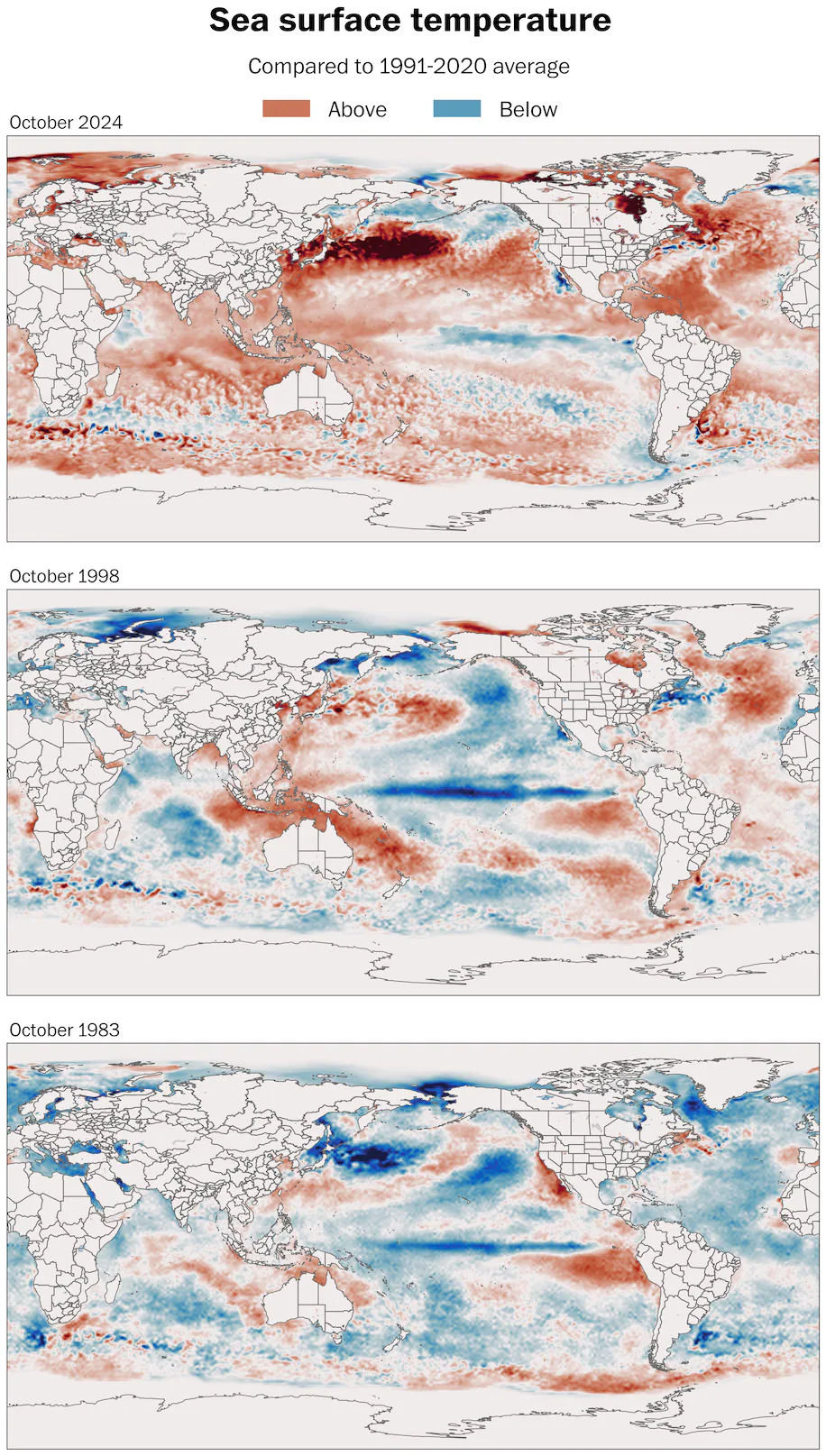
Known as marine heat waves, these expansive blobs of unusual oceanic heat are typically defined as seas being much warmer than average, in the highest 10 percent of historical observations, across a wide area for a prolonged period. Strong to severe marine heat waves are occurring in the Atlantic, much of the Pacific, the western and eastern Indian Ocean, and in the Mediterranean Sea.
In October, ocean temperatures at that high threshold covered more than a third of the planet. On the other end, less than 1 percent of the planet had ocean temperatures in the lowest 10 percent of historical values.
Warm and cold ocean temperature extremes should more closely offset each other. But what’s happening is a clear demonstration that oceans, where heat accumulates fastest, are absorbing most of Earth’s energy imbalance. Warm extremes are greatly exceeding cold ones.
That’s a problem because what happens in the ocean doesn’t stay in the ocean.
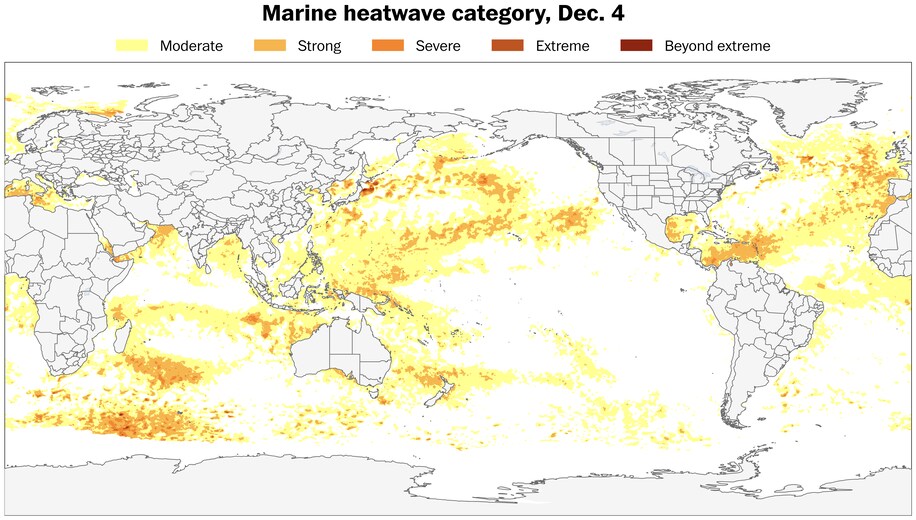
Because ocean water covers more than 70 percent of Earth, what happens there is critically important to temperatures and humidity on land, with coastal heat waves sometimes fueling terrestrial ones. Weather systems can sometimes linger, producing persistent sunny and wind-free days and bringing ideal conditions for marine heat wave development. These systems can sometimes straddle the land and the ocean, leading to a connected heat wave and transporting humidity.
Trenberth said increasing heat in the oceans, particularly the upper 1,000 feet, is a major factor in the relentless increases in average surface temperatures around the world.
And changes in ocean heat content can affect not just air temperatures, but sea ice, the energy available to storms and water cycles across the planet.
Research has begun to unpack what else may be triggering such changes in global heat.
One recent study found that a reduction in air pollution over the world’s oceans may have contributed to 20 to 30 percent of the warming seen over the North Atlantic and North Pacific, said Andrew Gettelman, a scientist at the Pacific Northwest National Laboratory and the study’s lead author.
Restrictions on sulfur content in the fuels used by shipping liners, put in place in 2020, have dramatically reduced concentrations of sulfur dioxide particles that tend to encourage cloud formation. Though it means lower pollution levels, with fewer clouds, more solar radiation is hitting the oceans and warming them.
A study released Tuesday found that a decline in cloud cover likely contributed to perhaps 0.2 degrees Celsius in previously unexplained warming that hit the planet last year. Goessling and colleagues think that was the product of cleaner shipping emissions, as well as a positive feedback loop in which warming close to Earth’s surface leads to reduced cloud cover, which leads to even more warming.
The study found that in 2023, planetary albedo — the amount of sunlight reflected back into space by light-colored surfaces including clouds, snow and ice cover — may have been at its lowest since at least 1940.
There have also been questions about the roles other factors may be playing, such as an increase in stratospheric water vapor after a 2022 volcanic eruption.
But Earth’s systems are so complex that it’s been impossible to parse what exactly is happening to allow the surge in global temperatures to persist for so long.
“Is this just a blip, or is this actually an acceleration of the warming?” Gettelman said. “That’s the thing everyone is trying to understand right now.”
This year is widely expected to be the warmest year on record, driven largely by the huge stores of ocean heat.
And for now, seasonal model guidance keeps the foot on the accelerator into early 2025, as far as widespread warmer-than-average seas go.
Because of record ocean heat and global temperatures, atmospheric circulation patterns, jet streams and storm tracks across the planet will change. Temperature records will continue to be set.
How big these changes are partly depends on how much warming occurs in the year ahead. But that is unclear because the cooling that usually follows El Niño still hasn’t arrived.
.webp)
It’s possible that normal planetary variations are playing a bigger role than scientists expect and that temperatures could soon begin to drop, said Hausfather, who also works for the payments company Stripe.
Even without the cooling influence of a La Niña, a stretch under neutral conditions, with neither a La Niña nor an El Niño, should mean some decline in global average temperatures, he said.
At the same time, if this year’s unusual planetary warmth doesn’t slow down into 2025, there would be nothing to prevent the next El Niño from sending global temperatures soaring — the starting point for the next El Niño would be that much higher. Whether that happens later in 2025 remains to be seen.
But the lack of clarity isn’t a promising sign when some of the most plausible explanations allow for the most extreme global warming scenarios, Hausfather said.
“The fact that we don’t know the answer here is not necessarily comforting to us,” he said.
NATURAL GAS: Federal regulators reinstate their approval of a natural gas pipeline expansion in Maryland, New Jersey, and Pennsylvania, declining to assess the possible impact of the greenhouse gas emissions associated with the project. (Utility Dive)
OFFSHORE WIND: President Trump’s anti-wind executive order will likely pause three of the four offshore wind developments in progress off the coast of New Jersey, experts say. (New Jersey Monitor)
TRANSMISSION:
ELECTRIC VEHICLES: Vermont is the latest state to impose a fee on owners of electric vehicles to make up for lost gas tax revenue, an approach that has been implemented in at least 39 states. (New York Times)
GRID: Public utility regulators in Pennsylvania gather ideas for how to stabilize the state’s “precarious” electric supply as the grid faces rising demand from data centers and growing risks from extreme weather. (Philadelphia Inquirer)
NUCLEAR: New Hampshire’s Seabrook Station nuclear power plant was not damaged in an earthquake that shook New England yesterday. (InDepthNH)
RENEWABLES: Plans are moving forward for a renewable energy generation project on a former Maryland dairy farm owned by the U.S. Navy, though some neighbors are concerned about the possible disturbance of agricultural land. (Capital Gazette, subscription)
HYDRO: A judge’s ruling does nothing to answer questions about the environmental violations an aging hydropower dam in Maine must resolve before it can receive needed permits to continue operations. (Maine Public)
TRANSIT: New York City launches a program allowing food delivery workers to trade in gas mopeds and e-bikes that are not certified for fire safety for new certified e-bikes, as part of an attempt to reduce the fire risks posed by uncertified batteries. (NBC New York)
ELECTRIFICATION:
COMMENTARY:
Second update of the “Indicators of Global Climate Change” research initiative with contributions from MCC. The 1.5-degree Celsius threshold is all but breached.
05.06.2024
Global heating caused by humans is advancing at 0.26 degrees Celsius (°C) per decade – the highest rate since records began, according to research by over 50 leading international scientists. They find that in 2023, global surface temperatures were 1.43°C above their pre-industrial levels, with human activity accounting for 1.3°C of that figure. The “Indicators of Global Climate Change” research initiative is being led by the University of Leeds, and supported by the Berlin-based climate research institute MCC (Mercator Research Institute on Global Commons and Climate Change). The indicator report has now been published in the renowned journal Earth System Science Data.
The report finds that the high rate of heating is driven by consistently high greenhouse gas emissions, equivalent to 53 billion tonnes of CO2 per year. On the other hand, the certain degree of human-caused cooling from particles in the atmosphere is decreasing due to improvements in air quality. High greenhouse gas emission levels are also affecting Earth’s energy balance: ocean buoys and satellites are tracking unprecedented flows of heat into oceans, ice caps, soils and the atmosphere. This flow of heat is 50 percent higher than its long-term average.
“The analysis comes as climate experts meet in Bonn to prepare the ground for the COP29 climate conference in Azerbaijan,” highlights Jan Minx, head of the MCC working group Applied Sustainability Science, and a co-author of the study. “By providing this second data update, we aim to help close the information gap, particularly when climate indicators are changing rapidly.” The authoritative source of scientific information on the state of the climate is the UN’s Intergovernmental Panel on Climate Change (IPCC), but its next major assessment will not happen until around 2027.
According to the new report, the 1.5°C threshold noted in the Paris world climate agreement is all but breached. The central estimate for the remaining carbon budget – how much carbon can be released into the atmosphere to give a 50 percent chance of keeping global temperature rise within 1.5°C – is 200 gigatonnes of CO2 by the start of 2024. This is 60 percent less than 2020, when the IPCC had calculated it at around 500 gigatonnes. (Note: these figures are not comparable with those used in the MCC Carbon Clock, where the annual emission rate is for CO2 only, and the contribution of other greenhouse gases to global heating is subtracted before calculating the remaining carbon budget. Furthermore, the budget is calculated with reference to a 67 rather than 50 percent probability of complying with the temperature limit.)
Piers Forster, Director of the Priestley Centre for Climate Futures Leeds and lead author of the study, says: “Even though climate action has slowed the rise in greenhouse gas emissions, global temperatures are still heading in the wrong direction and faster than ever before. Our analysis is designed to track the long-term trends caused by human activities. Last year, when observed temperature records were broken, natural factors were temporarily adding around 10 percent to the long-term warming.” William Lamb, researcher at MCC and lead author of the study’s emissions section, says: “Until we dramatically reduce deforestation and the combustion of coal, oil and gas, greenhouse gases will continue to accumulate in the atmosphere and drive climate impacts.”
The indicator report is accompanied by an open-data, open-science “Climate Change Tracker” platform. The tracker provides easy access to the key climate indicators.
Further information:
CLIMATE: Earth saw its hottest year on record in 2024, exceeding the previous year’s record and prompting a “red flag” warning from climate scientists as the planet surpassed the Paris Agreement’s 1.5°C warming threshold for the first time. (Associated Press)
SOLAR: Texas and California led the way on the record-breaking additions of 34 GW of new solar and 13 GW in battery storage across the U.S. last year, as 96% of all new generation capacity in 2024 was carbon-free. (Canary Media)
POLITICS:
GRID:
ELECTRIC VEHICLES: Analysts expect electric vehicle sales to jump 30% this year, even though the incoming Trump administration and its threat of tariffs and rolling back the EV tax credit and other incentives could slow the industry’s growth. (Associated Press)
OIL & GAS: Colorado regulators adopt first-in-the-nation rules requiring natural gas gathering and compression facilities to cut greenhouse gas emissions, but advocates say they lack enforcement parameters. (Colorado Sun)
COMMENTARY: Clean fuel standards can make states more independent from the federal government and generate revenue to fund electric vehicle charging infrastructure, the head of a Michigan business group writes. (Utility Dive)
EMISSIONS: Maine has become the latest state to sue major oil and gas companies, alleging they withheld information about the environmental impact of fossil fuels in order to pursue profit. (New York Times)
OFFSHORE WIND: A French energy company has paused its plans to build an offshore wind farm off New York and New Jersey for at least four years, citing President-elect Donald Trump’s opposition to wind as a major factor. (New York Post)
NUCLEAR:
FOSSIL FUELS
CLIMATE
TRANSMISSION:
ELECTRIC VEHICLES: A Vermont aviation company successfully completes a flight of its first electric plane, while the airport in nearby Plattsburgh, New York has been selected as the site for a test flight of the largest fully electric aircraft ever to take to the skies. (VTDigger, NBC5)
GRID: Advocates ask federal regulators to require a private equity firm planning to buy four power plants in PJM territory to disclose whether it plans to sell the energy to data centers, amid concerns the purchase could lead to “unreasonable rates” for customers. (Utility Dive)
COAL: Research out of Johns Hopkins confirms the presence of coal dust in a Baltimore neighborhood near a coal terminal, backing up residents claims that the particles coat their homes and cause health problems. (Baltimore Sun, subscription)
EFFICIENCY: A Michigan-based startup fabricating vacuum-insulated glass for highly efficient windows has opened a new manufacturing plant and secured nearly $83 million in capital and grants to scale up. (Canary Media)
TRANSPORTATION: Environmental advocates and health professionals call on Illinois regulators to adopt stricter tailpipe emission rules for cars and trucks that are modeled off of California’s and exceed national standards. (Chicago Tribune)
ELECTRIC VEHICLES:
SOLAR:
CARBON CAPTURE: A $2 billion carbon capture project at a North Dakota coal plant has been delayed after a key sponsor backs out and financing remains unclear. (E&E News, subscription)
UTILITIES: Investor-owned utilities in Indiana are seeking significant rate increases the “likes of which we’ve never seen,” consumer advocates say, to pay for clean energy and grid infrastructure upgrades. (Post-Tribune)


.svg)
