

 Back
Few places in California are as unforgiving for driving an electric car as the remote and sparsely populated Imperial Valley.
Only four fast-charging public stations are spread across the valley’s vast 4,500 square miles just north of the US-Mexico border, according to the U.S. Department of Energy. That means if you’re Greg Gelman — one of only about 1,200 Imperial County residents who own an electric car — traveling almost anywhere is a maddening logistical challenge.
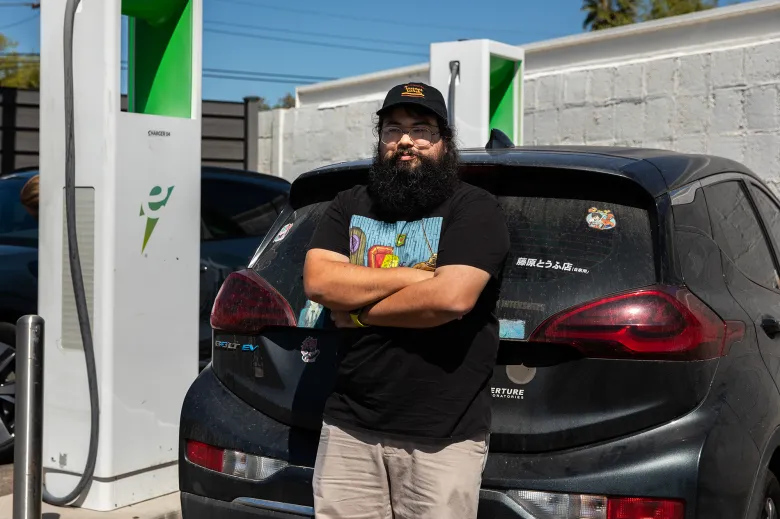
“It’s been, I won’t say a nightmare, but it’s been very, very, very inconvenient,” Gelman said on a recent afternoon as he charged his all-electric Mercedes-Benz at a charging station in a Bank of America parking lot in El Centro. “Would I do it again? No.”
California’s electric charging “deserts” like the Imperial Valley pose one of the biggest obstacles to the state’s efforts to combat climate change and air pollution by electrifying cars and trucks.
Experts say the slow installation of chargers in California’s remote regions could jeopardize the state’s phaseout of new gas-powered cars. Under the state’s mandate, 35% of sales of 2026 models must be zero-emissions, ramping up to 68% in 2030 and 100% in 2035.
Nestled in the desert in California’s far southeast corner, Imperial County ranks dead last in electric car ownership among California counties with populations of 100,000 or more, according to a CalMatters analysis of 2023 data. Only 7 out of every 1,000 cars are battery-powered there, compared with 51 out of every 1,000 statewide.
High poverty and unemployment are a major factor in the region’s slow transition to electric cars, but its lack of public chargers are a big drawback, too.
People living in rural, low-income regions like the Imperial Valley have the least access to electric car chargers, according to a state Energy Commission analysis. More than two-thirds of California’s low-income residents are a 10-minute drive or longer from a publicly available fast charger.
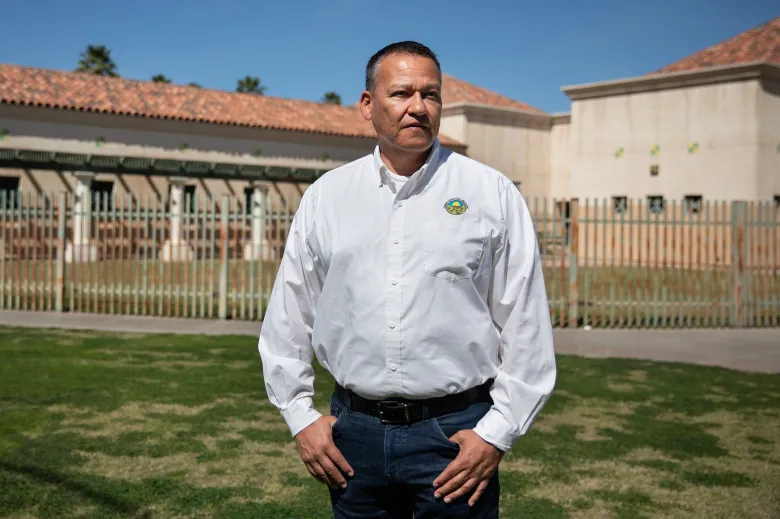
Luis Olmedo, executive director of El Comite Civico del Valle, a nonprofit advocating for environmental justice, has battled for years against the Imperial Valley’s unhealthy air. Now he is making a bid to become its go-to supplier of charging stations for zero-emissions cars.
Olmedo isn’t waiting for businesses or the state to make chargers a reality in Imperial County. Instead, his group has embarked on a $5-million, high-stakes crusade to build a network of 40 fast chargers at various locations. It’s an open question whether his somewhat quixotic endeavor will succeed.
Electric car chargers “are an opportunity for us to be able to breathe cleaner air,” Olmedo said. “It’s about equity. It’s about justice. It’s about making sure that everybody has chargers.”
Esther Conrad, a researcher at Stanford University who focuses on environmental sustainability, said getting chargers in places like Imperial County is critical to California’s effort to transition to electric vehicles in an equitable way. Apartment dwellers and others who don’t have charging at home need nearby and reliable places to charge.
“When you have a rural community that’s low-income and distant from other locations, it’s incredibly important to enable people to get places where they need to go,” Conrad said.
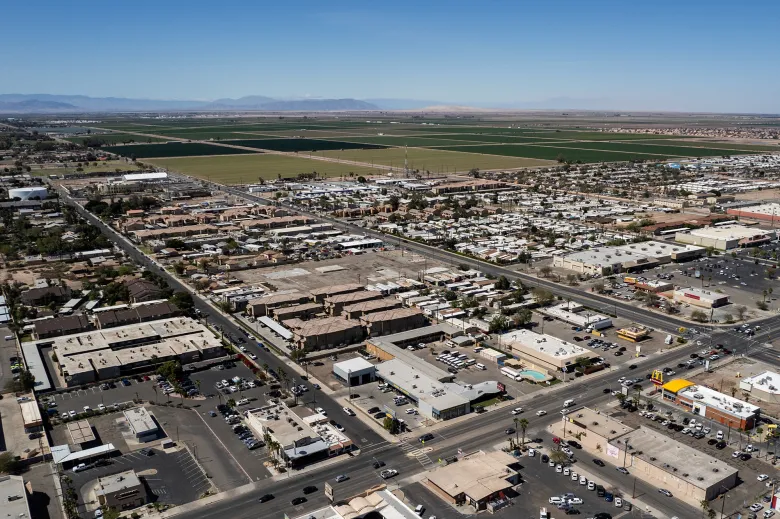
A car is essential for traversing Imperial County, which is the most sparsely populated county in Southern California.
Its neighborhoods are vast distances from urban centers that provide the services that residents need: El Centro — its biggest town, home to about 44,000 people — is much closer to Mexicali, Mexico, than it is to San Diego, which is about a two-hour drive away, or Riverside, nearly three hours. Its highways and roads cross boundless fields of lettuce and other crops that give way to strip malls, apartments and suburban tracts — and then even more crops and open desert.
If you drive an electric car the 109 miles from El Centro to Palm Springs, your route takes you through farmland, desert and around California’s largest lake, the Salton Sea, which is also one of its biggest environmental calamities.
The Salton Sea has been receding in recent years, causing toxic dust to blow into Imperial Valley towns. The region’s air quality is among the worst in the state, with dust storms and a brown haze emanating from agricultural burning and factories in the valley or from across the border in Mexicali, a city of a million people.
About 16% of Imperial County’s 179,000 residents have asthma, higher than the state average. The air violates national health standards for both fine particles, or soot, as well as ozone, the main ingredient of smog; both pollutants can trigger asthma attacks and other respiratory diseases.
More than 85% of Imperial County’s residents are Latino, and Spanish is widely spoken here. Agriculture is a major employer, and many businesses are dependent on cross-border trade and traffic from Mexico. The county’s median household income is $53,847, much lower than the statewide median, and 21% of people live in poverty.
Now the discovery of lithium, used to manufacture EV batteries, at the Salton Sea has the potential to transform the region’s economy. State officials say the deposit could produce 600,000 tons a year, valued at $7.2 billion, and assist the U.S. as it tries to foster a domestic electric car industry that rivals China’s.
But Olmedo worries that when the mineral is removed from the valley, it won’t meaningfully change people’s livelihoods or their health. He points to examples in the developing world where local people have been left behind as extractive industries take what they need.
“We’re about to extract, perhaps, the world’s supply of lithium here, yet we don’t even have the simplest, the lowest of offerings, which is: Let’s build you chargers,” Olmedo said.
Last year, electric cars were only 5% of all new cars sold in Imperial County, compared with 25% statewide. Getting chargers into low-income and rural places will become more and more important as California struggles to meet its ambitious climate targets.
The Energy Commission estimates that California will need 1.01 million chargers outside of private homes by 2030 and 2.11 million by 2035, when more than 15 million electric cars are expected on the roads. So far the state has only about 105,000 nonprivate chargers.
Nick Nigro, founder of Atlas Public Policy, which researches the electric car market, said charging companies won’t locate chargers in regions with few electric vehicles.
“You need revenue, and if the EVs aren’t there, then your customers aren’t necessarily there, so you do have a legitimate chicken and egg problem,” Nigro said. “We have to look to public policy to help that market failure.”
The Biden administration will invest $384 million in California’s electric car infrastructure over five years. And state officials are investing almost $2 billion in grants for funding zero-emission vehicle chargers over the next four years, including some special grants in rural, inland areas for up to $80,000 per charger. Olmedo says the funding has been insufficient so he’s had to turn to donations and other sources of funding.
Patty Monahan, one of five members of the California Energy Commission, said “it’s particularly important that we see chargers” in the Imperial Valley and other low-income counties with poor air quality.
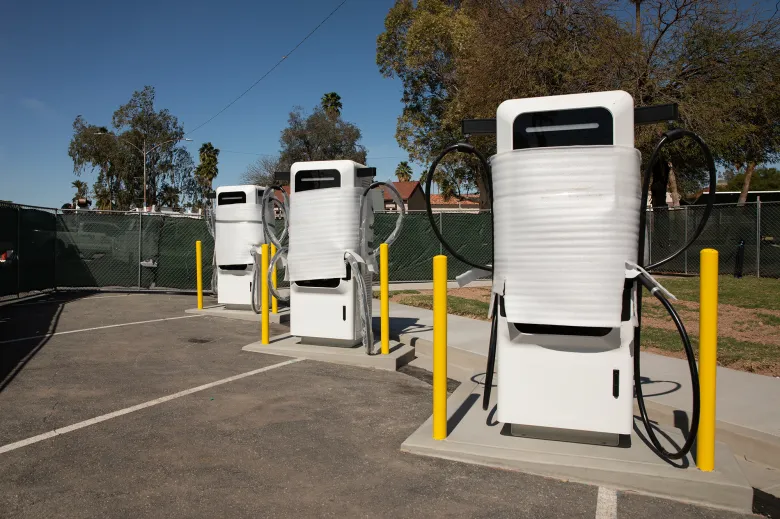
Imperial Valley has only four fast-charging stations open for public use, where chargers are capable of juicing batteries up to 80% in under an hour, according to the U.S. Department of Energy. Three are in El Centro, with one exclusively for Teslas; another is in the border town of Calexico and was recently installed by El Comite. Six other stations offer only slower chargers.
Olmedo envisions a network of 40 publicly accessible chargers throughout the valley. El Comite is expecting funding from the California Energy Commission, and has received donations from Waverley Streets Foundation, the United Auto Workers and General Motors. The group is seeking more state funding.
Olmedo acknowledged that he is facing a slew of challenges with his project, including some local opposition and the high cost of installation and maintenance.
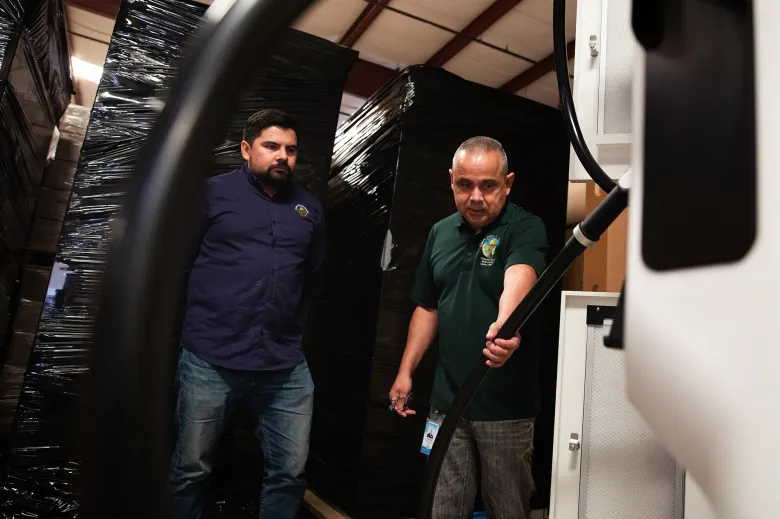
At a warehouse in the city of Imperial where El Comite stores the chargers, Jose Flores, project manager for the group’s charging initiative, said he and three colleagues spent four days in Santa Ana, about 200 miles north, at a facility managed by BTC, the company that makes the chargers that El Comite is installing.
They received training on installation and maintenance techniques, and discussed how not all chargers can be used by all electric vehicles. He learned about payment and cooling systems, and that the chargers might need more frequent maintenance because of Imperial Valley’s harsh desert conditions.
“We’re like a testing ground because we have poor air quality here due to the Salton Sea and being in a desert,” he said.
El Comite installed its first charger at its Brawley headquarters in 2022. Last December, El Civico pressed ahead with a more ambitious project: Four of their fast chargers are now operating in a park in the border town of Calexico.
Chris Aldaz, 35, a U.S. Postal Service worker who lives in Calexico, charges at home, but at times uses chargers at the group’s Brawley headquarters that people can use for free. It is a Level 2, which can take several hours to charge.
“The reason why I wanted to get an EV was that it was cheaper,” Aldaz told CalMatters. “I don’t want to be spending all this money on gas, and on maintenance, and it was better for the environment.”
Nevertheless, Olmedo’s electric car chargers have become a local political issue.
Maritza Hurtado, Calexico’s ex-mayor, and coordinator of a City Council recall campaign, said it was inappropriate for El Comite to have built four electric car chargers in a downtown park. The chargers were a distraction “from our police needs and our actual community infrastructure needs,” Hurtado said at a public hearing at the county’s utility, the Imperial Irrigation District, in January. She declined to speak to CalMatters.
“We had no idea they were going to take our parkland,” Hurtado said at the hearing. “It is very upsetting and disrespectful to our community for Comite Civico to come to Calexico and take our land.”
Olmedo hopes that the chargers ultimately will be something the county’s Latino community takes pride in.
“Put this in perspective: It’s a farmworker-founded organization, an environmental justice organization, that is building the infrastructure. It’s not the lithium industry. It’s us, building it for ourselves.”
Data journalist Erica Yee contributed to this report.
In 2022, decades of advocacy by the Louisiana Environmental Action Network to address poor air quality near industrial facilities took a significant leap forward.
That’s when the Biden Administration awarded more than $50 million through the Inflation Reduction Act to increase air quality monitoring in some U.S. communities historically overburdened by pollution.
A year later, LEAN, a nonprofit environmental advocacy group, got $500,000, which it used to deploy a fleet of mobile air monitoring vehicles. For three months earlier this year, the cars cruised up and down the Mississippi River, collecting continuous air quality data along a 300-mile route in southwest Louisiana known as “Cancer Alley.”
MaryLee Orr, LEAN’s executive director, has called the project a “dream” come true for her and the organization she founded in 1986.
“I get teary-eyed because for me, it’s been a lifetime of trying to find this kind of technology that communities could have,” Orr said during a virtual community meeting in January to roll out the project.
Now Louisiana will likely become one of the first states to push back on such community-led efforts. A Republican-backed bill headed to the governor’s desk will implement standards prohibiting data collected through some community air monitoring programs like LEAN’s from being used in enforcement or regulatory actions tied to the federal Clean Air Act.
“(Lawmakers) are making one hurdle after another to stop communities and discourage them from collecting any data by saying even if you collected it, we’re not going to count it; it’s not going to be important,” Orr said.
The industry-backed bill passed the House Wednesday on a 75-16 vote. The amended version returns to the Senate Monday, where an earlier version passed by an overwhelming majority.
What’s happening in Louisiana could be an indication of what’s to come elsewhere. A similar measure is up for consideration in the West Virginia Legislature.
Meanwhile, millions more in IRA grants are up for grabs for community-based groups, state, local and tribal agencies to do their own air monitoring in low-income and disadvantaged areas.
Localized air monitoring efforts allow marginalized communities overburdened by polluting industries to force transparency about the air they breathe and push state leaders to hold industry more accountable for harmful emissions.
Proponents of the new standards in Louisiana frame it as an attempt to bring more uniformity and standards to community air monitoring. But in a letter to one lawmaker, Region 6 Environmental Protection Agency Administrator Earthea Nance said the law would conflict with federal law, which states that “various kinds of information other than reference test data … may be used to demonstrate compliance or noncompliance with emission standards.”
Environmental advocates view the bill as a way to protect industry’s bad actors.
“The petrochemical industry is working with Louisiana legislators to inhibit community air monitoring because they know full well that they are polluting the air,” said Anne Rolfes, director of the Louisiana Bucket Brigade.
Since it was established in 2000, the Louisiana Bucket Brigade has offered residents living near industrial facilities a low-cost, air monitoring tool approved by the U.S. EPA. The group’s name comes from the industrial-size buckets that contain monitoring equipment that members use to collect their own air samples around industrial facilities in their neighborhoods.
“It shows that they are scared of science and scared of the facts,” Rolfes said. “The power is on our side.”
Sen. Eddie Lambert, R-Gonzalez, whose legislative district includes three of the most heavily industrialized parishes in southeast Louisiana, sponsored the bill. It mandates that any air monitoring data used for enforcement and regulation must come from the most up-to-date EPA-approved equipment.
Analysis of that data can now only be conducted by labs approved by the state, which currently lists 175 accredited labs.
According to Stacey Holley, chief of staff for the Louisiana Department of Environmental Quality, the accreditation process can take between nine months and a year. The time is shorter for labs and research facilities wanting to amend their existing accreditation, she said.
Lambert did not return multiple emails or calls seeking comment on his bill. During a previous committee hearing, Lambert said the measure would ensure the public had accurate air quality information in this “age of the internet and disinformation.”
The Louisiana Chemical Association said the new standards don’t stop anyone from doing community air monitoring.
“Senator Lambert’s bill encourages that any air monitoring being conducted by individuals or organizations adhere to basic standards that EPA and LDEQ follow when testing air quality in the community,” Greg Bowser, president and chief executive officer of the statewide lobbying group, said in a statement. “These are the same standards a facility must meet when it complies with air monitoring requirements under their approved permits.”
Opponents say they need to do their own monitoring because the LDEQ is apathetic to concerns around air quality and the agency is slow to respond to spikes in pollutants detected by community air sensors.
“Essentially, every time a community member reports an air quality problem, whether it’s a dust cloud or toxic odors, DEQ doesn’t respond immediately,” said Kim Terrell, a research scientist and director of community engagement at the Tulane Environmental Law Clinic in New Orleans. “Part of that is that the agency is underfunded and understaffed. And part of that is that responding to residents’ complaints aren’t as big of a priority as they should be.”
Holley did not respond to inquiries related to those allegations.
In earlier committee testimony, Terrell said community-based air monitoring provides the best indication of air quality within certain geographical areas. She told lawmakers that reliable data can come from sources besides what the bill deems as the “gold standard” of air quality monitoring.
“There are other types of monitoring technologies that can provide useful data beyond the very limited techniques that are required in that bill,” she said.
Rolfes views the new standards and the most recent actions of Republican Gov. Jeff Landry, who took office in January, as troubling signs that Louisiana leaders want to dial back accountability and enact a pro-oil and gas industry stance.
“The legislators involved in this are showing us that … the petrochemical industry is worth more than the health of people in this state,” she said.
LDEQ’s air monitoring system consists of 40 stationary air quality sensors across a sprawling state that has among the highest emissions of toxic and greenhouse gasses in the country.
Terrell said LDEQ’s monitors are often insufficient to capture “real time” air quality data because many are too far away from “fence line” communities, don’t measure certain harmful pollutants or are unable to detect spikes depending on their position and wind flow.
She added that the kind of 24-hour, seven days a week air monitoring LEAN’s program did is a way to bridge those gaps.
LEAN was among four entities awarded a total of $2.4 million for community air monitoring in Louisiana. The other recipients were LDEQ, the Louisiana State University Health Foundation and the Deep South Center for Environmental Justice.
Adrienne Katner, associate professor at LSU’s School of Public Health, said the new standards won’t directly impact the nearly $500,000 the university received for a project collecting air quality data for a road construction project along Interstate 10 and the Claiborne Expressway in New Orleans.
But, added Katner, “We are concerned it might affect how we release the data should one of the community groups we work with want to take that data and file a complaint about air quality in the area.”
LEAN spent about $250,000 in 2023 to hire Aclima, a San Francisco-based pollution mapping company, which used its fleet of mobile air monitoring vehicles — Orr calls them “Harry Potter cars” — to collect samples around the clock for three months. The route included more than 20 cities in south Louisiana along the Mississippi, many of them majority Black and overburdened by industrial pollution.
The Aclima monitors sucked in air every second and uploaded the data for its science team to analyze and map for the public. The mobile monitors measured carbon dioxide, carbon monoxide, fine particulates, nitrogen dioxide, ozone, black carbon and at least five other toxic emissions.
Earlier this year, LEAN’s mobile monitoring detected a methane leak in St. Charles, Louisiana that Orr said would have likely gone unnoticed. LEAN alerted state officials about it.
Orr said a full report of Aclima’s findings would be released in the coming months.
“I think there are going to be some surprises for people,” she said. “I think there are some areas where maybe people wouldn’t have expected things to be high, and they are. And then I think there’s places where you thought there might be huge, bigger numbers, and there weren’t.”
Should the governor sign Lambert’s bill into law before then, the findings likely would be disregarded by LDEQ. That’s because Aclima — named one of Time magazine’s 100 Most Influential Companies for its hyperlocal air pollution and greenhouse gas mapping — is not listed among the laboratories accredited through LDEQ.
Orr said LEAN has no plans to abandon its citizen monitoring effort. The group will use the rest of the IRA funds to install stationary air sensors.
“They’re saying they are not taking away air monitoring, but it seems like they want to take the teeth out of it,” Orr said. “They’re taking away the thing that seems to scare the people who are behind this bill, and that’s people having the right to know what they’re being exposed to.”
Floodlight is a nonprofit newsroom that investigates the powerful interests stalling climate action.
OIL & GAS: A Navajo Nation resident and advocate pushes back against an oil and gas company’s proposal to convert a water well into a wastewater injection site near his family’s home. (Capital & Main)
ALSO:
CLIMATE: California Gov. Gavin Newsom touts $11 billion in climate projects funded by the state’s greenhouse gas cap-and-trade program over the last decade, but critics say the efforts haven’t done enough to reduce pollution. (Los Angeles Times)
SOLAR:
CLEAN ENERGY:
UTILITIES: An Arizona nonprofit prepares to help a growing number of Phoenix residents pay their utility bills after experiencing unprecedented demand for the aid last summer. (ABC 15)
COAL: Mining companies in Wyoming hint at potential layoffs at Powder River Basin facilities after larger-than-expected production decreases. (WyoFile)
HYDROGEN: A company breaks ground on a $550 million green hydrogen production hub in Arizona. (Hoodline)
ELECTRIC VEHICLES:
TRANSMISSION:
COMMENTARY: A California editorial board urges Los Angeles leaders to make climate goals legally enforceable and “not mere aspirations to be shrugged off by finger-pointing bureaucrats.” (Los Angeles Times)
NUCLEAR: In New York, the decommissioning company that owns the former Indian Point nuclear plant sues the state for not letting it dump radioactive wastewater into the Hudson River. (Times Union)
WORKFORCE: Maine’s governor vetoes a bill tying union labor with clean energy projects on state land, noting that it was unclear to her the types of jobs that would be required to use union workers. (Portland Press Herald)
POLICY: Even though New York has set ambitious climate goals, the state’s most recent budget didn’t include any significant measures to move the needle on climate action. (City Limits)
TRANSIT:
WIND:
BUILDINGS: Rhode Island regulators consider conditions they might apply to a potential operations extension of a Portsmouth liquefied natural gas facility that was intended as a temporary back-up for Aquidneck Island’s energy supply — including a ban on new gas hook-ups on the island. (Providence Journal)
TIDAL: Federal regulators grant an eight-year license to the Marine Renewable Energy Collaborative to pilot the use of tidal turbines in the Cape Cod Canal in Bourne, Massachusetts. (news release)
SOLAR:
ELECTRIC VEHICLES: New Hampshire’s Henniker School District purchases four electric school buses using funds from the U.S. EPA’s Clean School Bus Program. (Concord Monitor)
BIOFUELS: Berlin, Connecticut, residents are frustrated and disgusted with the pungent smell wafting from a food waste-to-biofuel facility, in addition to noise pollution complaints. (NBC Connecticut)
ELECTRIC VEHICLES: A $4 billion electric vehicle battery manufacturing plant taking shape in a rural Kansas town is fueling speculation about whether a nearby low-income housing community could be sold for redevelopment. (Wichita Eagle)
OHIO:
BIOFUELS: The nation’s first ethanol plant to use carbon capture and storage launches a new program aiming to provide premium prices to corn farmers who grow low-carbon crops. (North Dakota Monitor)
CLEAN ENERGY: Missouri clean energy advocates accuse Ameren of slow-walking its long-term clean energy plans and prolonging its reliance on coal. (First Alert 4)
GEOTHERMAL: Minnesota is among a growing number of states with cities rolling out underground geothermal networks to help meet all-electric building standards and emission-reduction targets. (Canary Media)
CLIMATE: The Quad-Cities area can expect to see more intense flooding and hotter temperatures under climate models that anticipate rising carbon emissions, according to a new climate study. (Cedar Rapids Gazette)
TRANSPORTATION: Illinois Democrats propose legislation that would create a transit agency to oversee public transportation in northeastern Illinois and provide an additional $1.5 billion for public transit. (Sun-Times)
OIL & GAS:
UTILITIES: The new president of AES Indiana says improving customer service and grid reliability are two top priorities in her new role. (Indianapolis Business Journal)
COMMENTARY:
OIL & GAS: A company agrees to pay New Mexico $24.5 million to resolve air pollution violations related to flaring methane and other associated gasses at its oil and gas facilities in the Permian Basin. (Associated Press)
ALSO:
NUCLEAR:
UTILITIES:
WIND: A California court rules that a lawsuit seeking to block a proposed wind facility in Shasta County will be heard by an out-of-area judge. (Record Searchlight)
SOLAR: Western Colorado residents continue to push back on a proposed utility-scale solar installation, saying it would “industrialize” the rural area. (Telluride Daily Planet)
GEOTHERMAL: California offers $30 million in tax credits to a geothermal power and lithium extraction project near the Salton Sea. (news release)
ELECTRIC VEHICLES: An analysis finds California must upgrade its grid capacity by about 25% to accommodate projected power demands from growing numbers of electric vehicles. (Tech Xplore)
CLIMATE:
COAL: Powder River Basin coal production for the first quarter of 2024 fell 21% from the previous year. (Cowboy State Daily)
MINING: A uranium mining company plans to expand exploratory drilling at its proposed project in Wyoming’s Powder River Basin. (news release)
COMMENTARY: Advocates urge Colorado lawmakers to pass legislation regulating facilities that convert plastics to fuel, saying their pollution disproportionately harms underserved communities. (Colorado Newsline)
OIL & GAS: Major oil and gas companies have donated millions of dollars to universities for climate initiatives that often resulted in research affirming their policy positions, a congressional report finds. (Axios)
ALSO: California’s petroleum industry mounts a multi-pronged campaign to block legislation aimed at easing oil and gas pollution’s burden on underserved communities. (Inside Climate News)
TRANSPORTATION:
SOLAR:
CLIMATE:
PIPELINES: The rupture of a Louisiana pipeline that released 107,000 gallons of carbon dioxide raises concerns about similar issues among opponents of a proposed carbon pipeline in South Dakota. (Verite News, SDPB)
RENEWABLES:
MANUFACTURING: The developer of a low-emissions aluminum plant receiving $500,000 in federal funding is considering sites in Kentucky and surrounding states, which could mean a huge influx of jobs and nearby renewable energy development. (Grist)
EFFICIENCY: New federal water heater efficiency regulations will generate more energy savings than any single previous appliance rule, the U.S. Energy Department says. (Utility Dive)
As a mother and former truck driver, Ticole Smith, better known as Colah B Tawkin, has experienced both being unhoused and receiving international recognition through her popular podcast Black in the Garden.
From her home base in Atlanta and through her collaboration with Atlanta public radio station WABE, Atlanta Botanical Garden, and speaking engagements across the country, Tawkin works to (re)connect Black and Brown people in primarily — but not exclusively — urban environmental justice communities with their innate connection to the natural world as a means of resilience against disinvestment and climate change.
It’s well established that BIPOC communities disproportionately bear the dual burden of disinvestment and adverse environmental impacts from the effects of climate change. At the same time, the climate movement lacks diversity — specifically, leadership remains overwhelmingly White, and to a somewhat lesser extent, male. Added to the mix is a persistent and inaccurate perception that people of color, and especially Black folks, don’t care about environmental issues, and are fundamentally disconnected from nature.
“There is no relationship more sacred than that between Black folks and the natural world. Within the roots and branches of trees, Black folks find mirrors to their deep ancestral strength and resilience. These earthly wonders narrate our lives, weather our storms and bear witness to histories untold. They remind us of who we once were, and who we are meant to be,” said Tawkin during a recent virtual interactive presentation with the Morton Arboretum, located in the Chicago suburb of Lisle, Illinois.
Events like these are par for the course for Tawkin, who represents one of a handful of Black female advocates in the environmental realm.
“There’s not a lot of Black people doing the kind of stuff that I do. So naturally, when the word gets around where [environmental organizations] are trying to figure out, ‘How do we diversify our programming?’, my name tends to come up at the top of the list,” Tawkin said during an interview.
Tawkin also views herself as a pioneer — her very presence a challenge not only to the predominantly White composition of the environmental movement, but also active resistance among White people who refuse to embrace change.
“Being a Black woman in a world that I know does not really represent me in a very robust way makes me feel like a pioneer, and pioneers are revered when we’re looking in hindsight at history and people who started something. But we don’t so closely consider what the experience of a pioneer is like, and how they had to be the first person to venture into a territory that very well could have been hostile.
“I don’t feel like there is a lot of hostility on a frequent basis, but I do know, at the very least [there are] people who see what I’m doing and know what I’m capable of and they’re not okay with that … [but] I do not think about those people. I think about who does want to support me,” Tawkin said.
Tawkin’s work with the Black in the Garden podcast and related endeavors reflect not only a deep and longstanding love of nature, but a recognition of a need for greater Black, Brown and Indigenous presence in the green movement.
“I’ve always had a vision for this from the start, so failure was never an option,” she said. ‘That’s precisely why I chose the name Colah B Tawkin — because I’m always talking. It’s a stage name that reflects my readiness to start the podcast. When you hear my name, you know exactly what I do.”
She also aimed high, targeting her podcast for the national public broadcasting market and structuring the format and the length of her show accordingly. That has paid off with a newly announced partnership with Atlanta-based WABE, which will distribute the show online as part of the NPR Podcast Network.
“When I started Black in the Garden, I knew 1000% that it would be a successful platform,” she said. “I knew that it would resonate with those who it resonated with.”
“There was no gardening programming that I felt spoke to me, and I recognized that there’s an opportunity for me to start one … there are so many of these stories that are specifically related to our relationship with the land and agriculture and horticulture that really are so just grossly undertold,” Tawkin said.
“I remember in the beginning … people don’t ask me this no more, but in the beginning, Black people would ask me, well, ‘Why Black in the Garden? Like, don’t you want to be relatable to everybody?’ And that put me straight into Toni Morrison mode, and I was just like, we get to tell our stories about us because it’s us and we want to make sure that it’s reaching us. And so, I was intentional from the beginning and including ‘Black’ in the title,” Tawkin said.
And while her audience of “soil cousins” enthusiastically bridges racial and other categories, her focus remains firmly on embracing Black people and overcoming decades of generational hurt from slavery, Jim Crow, redlining and other manifestations of racism — including, she says, “some darker aspects to our relationship with nature.”
“That was why I discussed lynchings in the in the talk that I did … What am I going to talk about if I’m going to emphasize Black people’s relationships with trees?” Tawkin said. “The good, the bad, and the ugly was literally the first thought that came up … and then when I thought about the bad, I was just like, oh no, it gets real bad.
“But it cannot be overstated that nature is just what it is. It’s a very neutral thing.”
Disinvestment in environmental justice communities represents a significant driver of generational pain among Black, Brown and Indigenous communities. The work of stakeholder-based organizations is essential in working toward healing this generational hurt, Tawkin said.
At the same time, she said, nonprofit organizations — as well as government at all levels — also bear a level of responsibility in providing financial and other resources to address these challenges.
“So in order to be able to cope with all of the challenges that come with attaining liberation, and just get through it to actually enjoy liberation, resilience is kind of like the fuel, or it’s the fuel,” Tawkin said. “What other choice do we have besides to be resilient?”
During her presentation for the Morton Arboretum, Tawkin explained that witness trees, such as The Survivor Tree in Oklahoma City, serve as living reminders of significant points in history.
“They are often found near sites of historical significance, and serve as living witnesses to events, such as slavery, civil rights, struggles, and African American settlements, and so much more when you consider the age of trees,” Tawkin said.
The survivor tree sits near the site of the 1995 Oklahoma City bombing, and was almost chopped down to recover evidence of the deadly terrorist attack.
“We may be able to identify or not identify, but rather find, like blast shards, bullets, or something that could penetrate a tree, could actually be lodged in that tree,” Tawkin explained.
For Tawkin, trees — and specifically witness trees — also bear a vital role in promoting resiliency, especially among people of color, who often create and maintain spiritual rituals in green spaces.
“There are trees that are connected to different cultures across the diaspora and different parts of the world that have deep spiritual meaning. People of color and Indigenous people in particular have these spiritual kinds of practices that are connected to trees,” she said.
“The ritual literally takes place with the tree being a physical … Basically, it’s a sanctuary,” Tawkin said.
The Oklahoma survivor tree “absorbed some physical evidence” of the explosion, not only “witnessing the events that it was there for, but the spirits around it, like people are dying around it,” Tawkin said during a subsequent interview. “It’s easy to believe that these spirits are able to connect with or merge into the tree.”
As an example, she cited a particular tree located at the Fairchild Botanic Garden in Miami, whose presence and its network of thick sprawling roots swirling along the ground around its trunk draws many visitors who come specifically to conduct spiritual rituals.
“When we were talking about that particular tree, [people] were telling me how it has a lot of spiritual significance to many people just around that physical area. And so people would come into the garden, but they would be coming for that tree in order to engage in certain spiritual rituals,” Tawkin said.
“What better example do we have of what resilience looks like than an ancient tree, a witness tree?”
For Tawkin, her appearance is also an essential element to appealing to young people, and to providing representation in the green space for people who look like her.
“I’m showing up the way that I show up … for those who need to see someone who looks as much like either themselves or someone who they know, someone who they can relate to doing the thing,” Tawkin said.
“I’m youngish, so I like to show up with like my hairstyle in a certain way and have my nails done in a certain way and show up with a sense of style that resonates with young people, because they’re just not going to pay as much attention to the person with the washed up polo shirt and the khakis on and some busted up shoes.
”Young people really are very instrumental in how our culture moves. And they are not respected enough for that. I get that. And so there’s a way to relate to kids, ‘cause like they just have a sixth sense about knowing when someone’s being real with them or not,” Tawkin said.
That connection is a key part of Tawkin’s broader vision.
“Not only is it necessary to have Black people of color, Black people, Black youth involved, not only is it necessary to have them interested in nature and involved with it, and taking up the reins and being the future keepers of the Earth, but it’s also important to understand how to connect with them,” she said.
“Because if we’re not connecting with them in a real way, then they’re not going to be interested in it.”
SOLAR: The U.S. EPA announces $7 billion in Solar for All grants for 60 projects expanding solar power access in low- and middle-income communities. (Associated Press)
ALSO: California grid operators look to exports, added transmission and battery storage to tame the deepening “duck curve” resulting from a growing solar power glut. (Washington Post)
CLIMATE: The White House launches a website that lists openings and accepts applications for the Climate Corps jobs and training program. (NPR)
MANUFACTURING: The U.S. Energy Department announces the first 35 projects receiving a total of nearly $2 billion in tax credits meant to accelerate clean energy manufacturing and emissions-reducing industrial projects. (E&E News, subscription; news release)
ELECTRIC VEHICLES: Workers at a Tennessee Volkswagen plant that makes electric vehicles overwhelmingly vote to unionize, handing the United Auto Workers a major breakthrough in its push to organize Southeast auto factories. (Chattanooga Times Free Press)
OIL & GAS:
OFFSHORE WIND:
GRID:
OHIO: FirstEnergy donated $2.5 million to a dark money group backing Ohio Gov. Mike DeWine’s campaign, according to newly released records. (Floodlight/USA Today)
POLICY: Several environmental organizations sue two Maine state agencies for failing to protect residents from climate change, citing a lack of compliance with greenhouse gas emissions reduction targets and the recent failure of new clean car rules. (Portland Press Herald, Bangor Daily News)
ALSO: Connecticut’s legislature is considering four major climate bills right now, but observers say not all will make it to a vote. (CT Mirror)
SOLAR:
HYDROPOWER: A developer argues in court that Maine didn’t explain well enough why it rejected a permit needed for federal regulators to relicense a Kennebec River hydroelectric dam. (E&E News, subscription)
OFFSHORE WIND:
GRID: While construction continues on the $6 billion Champlain Hudson Power Express transmission line, slated to bring 1.25 GW of hydropower from Canada to New York City, some groups still hold concern for the impact on Native lands. (Business Insider)
FOSSIL FUELS:
TRANSIT:
BUILDINGS: Efficiency Vermont creates a new calculator to show state residents all the incentives, rebates, programs and offers available for them to make green home upgrades. (WCAX)


