

 Back
It is easy to overlook the low-rise, cream-colored building on Chicago’s Motor Row, a historic district that was a hub for auto dealers in the early 1900s.
Yet the newly purchased headquarters for Bronzeville Community Development Partnership at 2416 S. Michigan Ave. plays both a symbolic and substantive role in fulfilling the organization’s mission of promoting clean energy and community-driven development in this predominantly Black, environmental-justice neighborhood on Chicago’s South Side.
“We want to be able to tell the story of the Great Migration and how we are replicating that age of innovation here in the 21st century, with the transition away from fossil fuels to beneficial electrification,” said Billy Davis, general manager for JitneyEV + EVCharge, one of the partnership’s initiatives. “Not just in commerce and transportation but culturally in the arts as well.”
Since its foundation in 1989 as the Abraham Lincoln Center Business Council, BCDP has strived to promote sustainable economic development in Bronzeville.
The Bronzeville Microgrid, which the organization developed in collaboration with utility ComEd, is one of BCDP’s main clean energy initiatives. As Chicago’s first neighborhood-scale system of its kind, the microgrid services more than 1,000 buildings with solar panels, batteries, and fossil gas–fired generators.
Another major initiative, through the JitneyEV + EVCharge program, is to expand EV adoption among Black and Brown drivers to reduce carbon emissions and other pollution, which have been disproportionately concentrated in environmental justice communities.
BCDP also advocates for the construction of public charging stations throughout the city’s South and West sides, where many communities lack access to such infrastructure.
This work, in addition to sustainability-focused development and cultural tourism projects, reflects a holistic approach to mitigating the adverse effects of disinvestment and climate change in environmental justice communities.
“What happens when a community transforms infrastructure, heritage, and innovation from vision to reality? In Bronzeville, 2024 was the year we proved that sustainable development isn’t just a concept—it’s a lived experience,” wrote Paula Robinson, president of BCDP and managing member of Bronzeville Partners LLC, in a January social media post. “This year, we didn’t just talk about change. We powered it—literally and metaphorically.”
BCDP moved into its current headquarters in June 2024 after purchasing the building with a grant from the state of Illinois, which included funding for a solar array and EV charging infrastructure. The organization also received a City of Chicago Climate Infrastructure Fund grant for energy-efficiency improvements to the building. JitneyEV + EVCharge was awarded a grant from that fund for purchasing EVs and installing charging infrastructure, according to Davis.
The complex, which is still being fitted out, includes a garage for JitneyEV; a visitor center and community meeting space; and spaces for the Urban Innovation Center, Innovation Metropolis, Bronzeville Studio, and the Bronzeville-Black Metropolis National Heritage Area, all of which are affiliates of the larger BCDP collective.
Owning the building allows BCDP to bring the various aspects of its work under a single umbrella and eliminates vulnerability to the whims of a landlord. At the same time, the building serves as a tangible symbol of the organization’s focus on self-sufficiency and self-determination, which is especially relevant in the present political environment.
In Motor Row’s heyday in the early 20th century, Chicago was home to multiple electric vehicle companies. And modern app-based rideshare services operate much like jitneys — taxi-like services that flourished in African American communities that conventional taxicabs often refused to serve. BCDP has married the two histories in its JitneyEV + EVCharge program, which aims to provide the community with an all-electric rideshare service and expand access to public EV charging stations.
BCDP recently purchased its first electric vehicle for the rideshare service and plans to purchase an electric passenger van in the future. BCDP also intends to install a public DC fast charging station on the outside of its new headquarters and a Level 2 charger inside the building’s garage for its own vehicles, according to Davis.
“The building that we are in, the building that we own, was once home to electric automobile manufacturing companies at the turn of the 20th century,” Davis said, adding that it housed showrooms for Detroit Electric, Chalmers Motor Co., and Cadillac.
“So, it just resonates somewhat, that we are returning home, so to speak,” Davis said.
Once it is fully operational, JitneyEV’s rideshare service will be especially useful in helping to fill in gaps in public transit in Bronzeville, which like much of the city’s South and West sides, is underserved by public transportation.
BCDP is also adding its input into initiatives like the Chicago Transit Authority Better Streets for Buses plan, which aims to expand clean transportation options and develop safer streets in communities of color.
”If you’re gonna electrify your bus fleet, why would you launch the 20 or 30 new electric buses anywhere other than in a Justice40 community where the air quality is poorest, where the need for a clean energy transportation solution is greatest?” Davis said, referring to the Biden administration program that aimed to ensure that Black, Brown, and Indigenous communities would receive a substantial proportion of allotted federal funds and other resources.
In 2024, BCDP participated in the National Renewable Energy Laboratory’s Clean Energy to Communities program, which supports community-led projects. BCDP also collaborated with NREL, Argonne National Laboratory, and local universities to launch the EV Institute, according to Davis.
The EV Institute, still under development, has been tasked with empowering the community to implement mobility and transportation equity. For example, there are plans to provide in-person and online education about the benefits of electric vehicles, according to Davis.
This holistic view reflects BCDP’s forward-thinking approach to electrifying transportation, said Julia Hage, manager of the transportation team at the Center for Neighborhood Technology in Chicago, which works with BCDP on its clean energy and community development initiatives.
Like many environmental justice community organizations, BCDP is taking the lead on its own initiatives around economic development, resiliency, and climate mitigation, Hage said.
While welcoming technical assistance and financial resources from outside organizations, environmental justice–based community organizations are nonetheless taking a more assertive approach toward self-determination. The Center for Neighborhood Technology has embraced its supporting role in empowering environmental justice communities to take their rightful seats at the clean energy transition table, Hage said.
“Oftentimes with these different progressions of technology and transportation, the communities are left behind because they’re not included in these conversations,” Hage said. “A lot of harm has been done to communities because of top-down planning decisions.”
Beyond collaborating with BCDP on transportation electrification, Hage said her organization is pulling the group into transportation equity work, too.
This approach was evident in a recent “EV 101” information session that the Center for Neighborhood Technology conducted to educate community-based organizations on how to promote electric vehicle adoption, in which BCDP acted as both a participant and a subject-matter expert.
“[BCDP was] able to also provide information to other CBOs, which I thought was a really cool benefit of having a cohort of community-based orgs,” Hage said. “No matter where they were in their journey of electrification or clean transportation, they could share with each other things that they knew from their experience.”
While the Center for Neighborhood Technology and BCDP have multiple sources of funding outside the federal government, the sudden inability to rely on federal funding has made it harder for them to carry out their mission.
“That’s part of our story now, too. We’re going to continue this decarbonization even in the face of all these cutbacks,” Davis said. “We have community engagement programs that are now on hold that we were relying on for this year and the summer. That won’t happen, at least not in a timely manner, but we’re going to do this anyway because we’re using mostly city and state funds.”
The federal government’s abrupt cancellation of promised funds has had a profound impact on the broader environmental justice community that the Center for Neighborhood Technology and BCDP are a part of. In the resulting atmosphere of uncertainty, many of these organizations are questioning any future reliance on the federal government, Hage said.
“The really alarming thing is, we’re seeing these full-on pauses and stop-work orders; resources that have been already allocated are being told to stop,” Hage said. “Some speculate like, ‘Oh, it’s just to confuse us. It’s just to make us scramble. They’ll have to go back on this. There’s no way.’ And there’s other folks who are kind of like, ‘We can’t even trust this money anymore.’ We’re still just kind of on edge, like, ‘Hey, is this going to happen?’”
One potential strategy is to advocate for state and local clean energy regulations and carbon-free transportation initiatives, along with increased emphasis and reliance on state-level organizations, such as the Illinois Environmental Protection Agency, Hage said.
“I am sure organizations right now don’t want to find themselves in this situation,” Hage said. “And I’m sure that they will want to redirect their focus on ‘What are grants that won’t be suddenly paused or suddenly taken away from us?’ And that’s why I think the focus on state and local resources is in conversation. Though, a lot of state money comes from the federal government. So, it’s kind of about ‘How do we best utilize this money while we have it?’”
The federal government’s purge of environmental justice data makes it harder to direct resources to where they are most needed. Nonetheless, BCDP and other environmental justice–focused organizations are determined to continue moving forward while acknowledging the significance of the challenges ahead.
“The freezing of federal grants and loans previously appropriated by Congress has been disruptive and is being challenged in court as unlawful overreach. The ultimate impact, therefore, is not yet fully known,” Davis said in an email.
“However, we remain undaunted in our work advancing renewable energy and clean transportation as economic and workforce development opportunities that make our communities healthier, safer, more livable and sustainable.”
This story was originally published by Capital B, a nonprofit newsroom that centers Black voices and experiences. To read more of Adam Mahoney’s work, visit Capital B.
Ninety years ago, President Franklin D. Roosevelt and South Carolina Gov. Ibra Blackwood worked together to bring electricity to rural South Carolina. But to build the power plant that would make it happen, they destroyed the homes of 900 Black sharecropping families. With them, 6,000 graves — including those of formerly enslaved people — were removed or desecrated.
Today, as South Carolina races to power its digital future, history seems to be repeating itself, with Black communities once again paying the price for progress.
Last year, the parent companies of Facebook and Google pledged more than $4 billion for new data centers in South Carolina. Every email you send, question you ask ChatGPT, or Instagram post you share relies on these centers. However, on this new digital frontier, the health and safety of Black communities are at risk.
While state officials work to craft legislation to attract these new projects, residents and community advocates say this will ramp up environmental hazards, increase utility bills, and exacerbate health disparities. Meanwhile, experts say, the economic promise of AI remains a mirage for Black communities, widening wealth gaps and displacing workers.
“Most Black households, especially rural ones in the South, are not using AI or as much computing power, but they are having to pay for that demand in both money and dirty air,” said Shelby Green, a researcher at the Energy and Policy Institute.
South Carolina is joining other states, like Texas and Illinois, with proposals to reopen at least two power plants in rural Black communities to run these new projects. Rural communities have begun to attract tech companies for data centers due to their low population densities, ample open space, and relatively lower energy and land costs.
Energy experts argue that the growing electricity demands from data centers are prolonging America’s dependence on dirty energy sources. Nationwide, at least 17 fossil fuel generators scheduled for closure are now delayed or at risk of delay, and about 20 new fossil fuel projects are being planned to meet data centers’ soaring energy demands. By 2040, South Carolina projects the need for four new fossil fuel power plants.
At a protest last year, Audrey Henderson, a resident of one of the towns facing the prospect of a polluting power plant, said she fears the impacts on her and her neighbors’ properties.
“My forefathers worked hard to get that property; that we have land. I have children in New York to get land when I pass away. Grandchildren and so forth and so on,” she said. The fact “they could just come in here, give us a couple of dollars, and take our land and put pipelines into it. Then we also have well water, just stuff going into the wells is very disheartening, and I’m really concerned.”
Across the country, low-income Black communities face the harshest pollution exposure from these plants, while Black workers are disproportionately in roles most vulnerable to AI and automation. A McKinsey & Co. analysis warns that if AI growth continues at its current pace, the wealth gap between Black and white households could widen by $43 billion annually within the next two decades because of disparities in who it serves.
Compounding these issues, data centers are expected to use 12% of the nation’s energy by 2028, a 550% increase from last year. An artificial intelligence search using ChatGPT, for example, uses anywhere from 10 to 30 times more energy than a regular internet search.
“The energy demand, data centers, and where the energy sector is going should not come at the expense of low-income and Black communities,” said Xavier Boatwright, an activist who has worked on environmental issues in rural South Carolina for years.
In South Carolina, officials predict data centers will drive 70% of the state’s increased energy use, with subsidies already raising utility bills for consumers. Through his canvassing across the state, Boatwright said he now regularly sees rural mobile home communities where people are paying more for their utility bills than mortgages because of this increase.
“It’s kind of like if you go out and your employer is paying for your dinner, and you order the fanciest stuff on the menu,” explained Green, who researches how rising utility bills are pushing Southern Black communities into poverty. “You don’t really have to worry about how expensive it is because it’s not coming out of your pocket. That’s how these companies are operating; they’re not holding the risk associated with increasing electricity costs and these new power plants — you are.”
In majority-Black, poor rural Fairfield County, the state is proposing to reopen a stalled nuclear plant that has long been a symbol of broken promises and financial strain for residents. Advocates warn that restarting this decades-long gamble could further burden a population already facing systemic neglect. Billions of taxpayer dollars and rising energy costs are at stake, yet the benefits of the project seem unlikely to reach those facing the worst consequences.
In South Carolina, and across the country, statistically, Black people use the least amount of electricity, yet experience the highest energy burden — meaning a larger share of their income goes toward energy bills.
In the other case, a Black stronghold in Colleton County celebrated the monumental victory of closing a coal-fired power plant in their neighborhood, which was connected to poor health outcomes for residents. Now, the state proposes to convert that very site into a gas-fired power plant to meet the energy demands of data centers. Every year, the pollution from natural gas plants is responsible for approximately 4,500-12,000 early deaths in the U.S., studies show.
“If you mapped all of the existing power plants in South Carolina, they’d follow the old path of one of the foundational pillars of the American economy through South Carolina: plantations and enslaved labor,” Boatwright said. “We’ve seen the repeated pattern of these threats in our community.”
With this boom, tech companies like Google are making huge profits by securing special deals with utility companies.
Google’s head of data center energy, Amanda Peterson Corio, said Google’s energy supply contracts undergo “rigorous review” by utility regulators and are crafted “to ensure that Google covers the utility’s cost to serve us.”
Yet, last year, the company inked a deal in South Carolina to pay less than half the rate that households pay for electricity.
These low rates, combined with tax breaks and state-approved subsidies, are used to lure big tech companies. However, these deals force local families and households to cover the cost of building extra power plants, meaning everyday customers end up footing the bill.
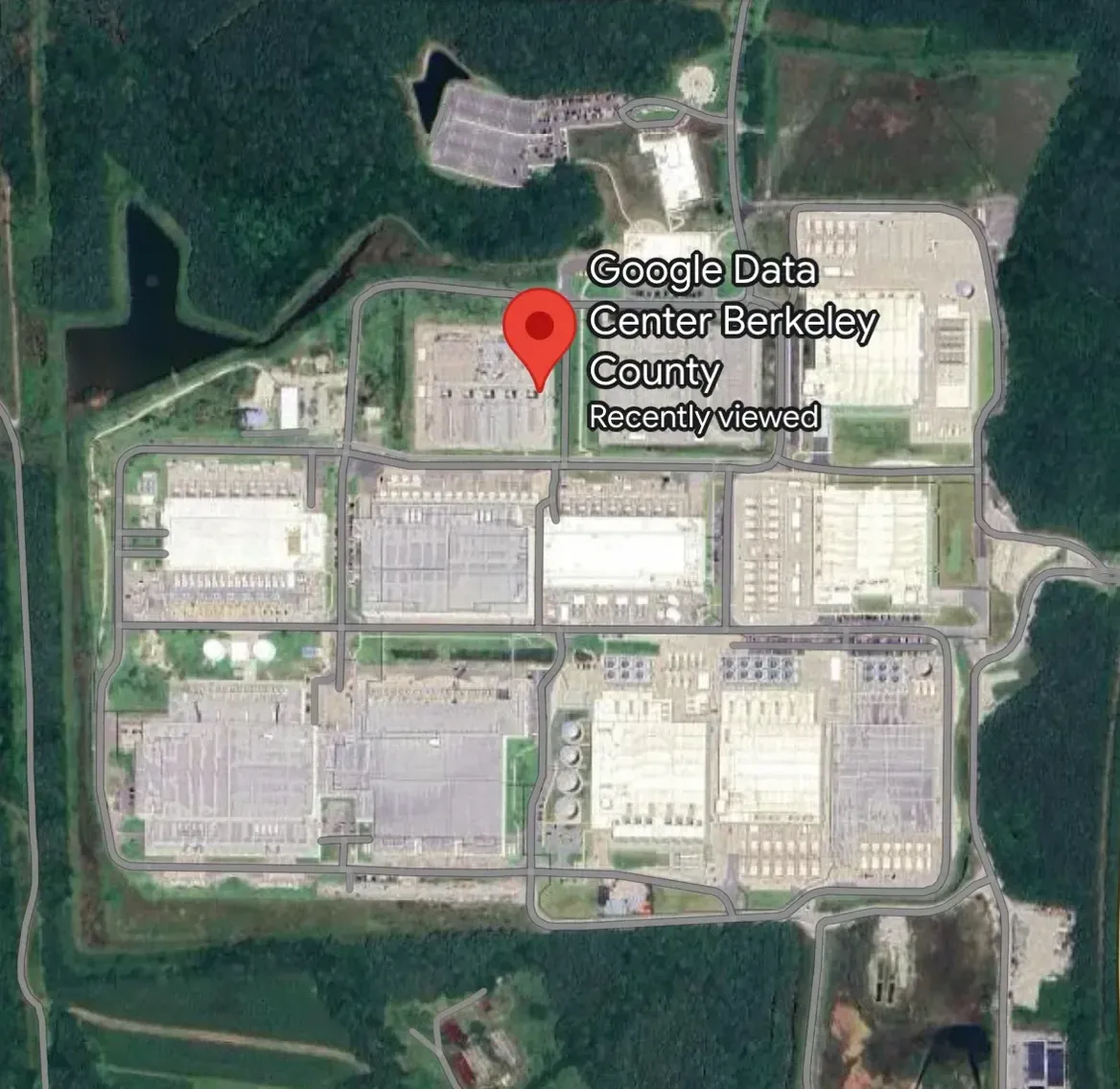
A data center is a combination of massive warehouses packed with rows of servers and high-tech gear that stretch longer than football fields, all humming away to store and manage the digital data we use every day. They’re so massive, for example, that Google’s first South Carolina data center, which opened in Berkeley County in 2009, uses the equivalent electricity of roughly 300,000 homes and the amount of water of at least 9,000 homes. As of 2021, it was also powered by more fossil fuel based energy sources than any of Google’s two dozen other data centers nationwide.
This uneven situation leads to a growing gap between corporate savings and community expenses, with everyday people shouldering the extra burden. Black communities, in particular, tend to face higher utility costs and, as a result, are more likely to have their power shut off for missed payments. Along the East Coast, monthly utility bills are expected to increase as much as $40 to $50, mainly due to data centers.
South Carolina legislators — Democrats and Republicans — have implored the state’s regulators to rethink discounts and other subsidies, but the push has not made waves so far.
“Current residential ratepayers are going to pay a lot, lot more because of data centers that bring almost no employees,” Chip Campsen, a Republican South Carolina state senator, said at a legislative hearing last September. Tech companies must “participate in paying the capital costs for building the generating capacity for these massive users of energy.”
This issue ties into broader government policies aimed at boosting American technological growth and making the United States a leader in artificial intelligence. The Trump administration, for example, has signaled that it might bypass some environmental regulations to speed up projects like data centers and power plants. The new leader of the Environmental Protection Agency, Lee Zeldin, has said making “the United States the Artificial Intelligence capital of the world” will be one of his five guiding pillars, along with making it easier for tech and manufacturing companies to invest in the American economy.
Near Jenkinsville, South Carolina, half-built nuclear reactors — remnants of the long-stalled V.C. Summer project — tower over a Black community where three out of four live in poverty. They stand as a stark reminder of a $9 billion investment that never produced power. Despite customers still footing the bill for this abandoned venture to the tune of multiple utility bill increases, the state-owned utility company Santee Cooper is now inviting proposals to complete one or both units. Supporters argue that reviving the project would add 2,200 megawatts to the grid — enough to power hundreds of thousands of homes — and help meet surging energy demands driven by tech giants. Recent inspections by the state’s Nuclear Advisory Council have deemed the site in excellent condition, bolstering growing legislative support.
Researchers say it would be the first and only nuclear project to restart after being halfway built. Critics caution that history warns against overly ambitious nuclear bets that can lead to decades of delays, spiraling costs, and additional burdens on customers. They contend that immediate, incremental investments in solar power and battery storage could offer a safer, more adaptable path forward rather than reinvesting in a risky long-term gamble. Currently, nuclear energy is about four times more expensive to produce than solar energy.
Last year, the state was granted over $130 million from the Biden administration for solar projects, but the funding is now in limbo under the Trump administration.
The Black-led South Carolina Energy Justice Coalition has spent years advocating for solar and wind energy in rural Black communities. “Every citizen is worthy of that type of energy by virtue of just being a human being,” Shayne Kinloch, the group’s director, said last year.
Along the banks of the Edisto River in the heart of South Carolina, a former coal-fired power plant — closed in 2013 — is poised for a dramatic transformation. Dominion Energy and Santee Cooper plan to convert the site into one of the nation’s largest gas-fired power stations, a move approved by the state’s Public Service Commission. Designed to produce up to four times the energy of the old plant, this project is a central part of efforts to retire remaining coal facilities by 2030 and transition toward a future of “reliable, affordable, and increasingly clean energy,” the companies said.
However, environmental advocates and legal experts warn that this expansion of gas infrastructure may echo a troubling legacy where vulnerable communities bear the brunt of environmental and economic risks. Shifting from coal to gas plants isn’t environmentally or cost-effective, opponents say, because while gas produces slightly less pollution than coal, it still contributes significantly to greenhouse gas emissions. It also comes with high infrastructure and maintenance costs.
This month, the state’s House of Representatives approved legislative changes that would weaken oversight of gas power plants. Joining Republicans, South Carolina’s Legislative Black Caucus Chairwoman Annie McDaniel, a Democrat representing the county home to the nuclear plant, voiced support for the legislation.
McDaniel did not respond to Capital B’s request for comment.
The changes, if passed by the state’s Senate, would allow the groups to bypass rigorous environmental reviews when proposing projects. Supporters claim these measures are necessary to meet rising energy demands from tech-driven growth. Critics argue this could sideline investments in renewable alternatives like solar and battery storage and raise the risk of rising costs, delays, and potential noncompliance with federal pollution standards.
“Instead of investing in more risky energy generation and infrastructure, they should be investing in energy solutions like solar and storage,” Boatwright said, “but utilities are choosing the most expensive and environmentally risky.”
NUCLEAR: The Navajo Nation agrees to allow Energy Fuels to transport uranium ore across tribal land from the company’s Grand Canyon-area mine to its Utah mill. (AZ Mirror)
ALSO: Wyoming lawmakers kill legislation that would have encouraged the federal government to establish an interim nuclear waste repository in the state, citing concerns it would end up being permanent. (WyoFile)
UTILITIES:
COAL:
SOLAR:
CLEAN ENERGY: Hawaii Gov. Josh Green signs an order aimed at accelerating clean energy targets and setting a goal of 50,000 distributed solar and battery installations by 2030. (Maui Now)
STORAGE: A Utah utility and a firm look to develop 70 MW of demand response capacity using flywheel energy storage systems. (news release)OIL & GAS: The U.S. EPA reports seven methane super-emission events over one week near oil fields and refineries in a southern California county. (KBAK, news release)
BIOFUELS:
CARBON CAPTURE: Northwestern New Mexico officials hope a direct air carbon capture hub proposed for the area will replace declining coal industry jobs. (New Mexico Political Report)
COMMENTARY: Colorado labor advocates say a new pro-clean energy union coalition aims to tackle the climate crisis while ensuring green jobs also prioritize workers. (Colorado Newsline)
CLIMATE: Montana’s Supreme Court upholds a landmark climate ruling saying the state’s fossil fuel-friendly permitting policies violate residents’ constitutional right to a clean environment. (Associated Press)
ALSO: Portland, Oregon’s city council votes to spend $300 million from its clean energy fund to install solar on low-income homes, build 230 net-zero energy housing units, decarbonize city vehicles and other climate projects. (OPB)
OVERSIGHT: The U.S. EPA greenlights California rules banning new gasoline-powered car sales by 2035 and establishing cleaner engine standards for heavy-duty trucks, drawing advocates’ praise and industry criticism. (Los Angeles Times)
OIL & GAS:
HYDROGEN: The U.S. Energy Department unveils plans to conduct environmental reviews for proposed hydrogen hubs in California and the Northwest. (E&E News, subscription; Oregon Capital Chronicle)
SOLAR:
TRANSPORTATION: The U.S. Transportation Department awards $49.7 million to the proposed Cascade high-speed rail project that would link Portland to Seattle and other Northwest cities. (KOIN)
COAL: A family files a lawsuit accusing a New Mexico coal mine of negligence that contributed to the 2022 death of a contract welder at the facility. (Cibola Citizen)
HYDROPOWER:
NUCLEAR: California startup Oklo signs on to provide a data center developer with up to 1,200 MW of power from its advanced nuclear reactors currently in development. (Utility Dive)
PUBLIC LANDS: An advocacy group files a lawsuit accusing Utah’s governor and attorney general of violating the state constitution with a legal bid to seize control of 18 million acres of “unappropriated” federal lands within its boundaries. (news release)
SOLAR: A Kentucky nonprofit is building net-zero homes with energy efficient construction and rooftop solar panels to lower energy costs for low-income residents, including in a housing development for survivors of the state’s 2022 floods. (Kentucky Lantern)
ELECTRIC VEHICLES:
OIL & GAS:
WIND: An emerging Texas wind company cites “fast-growing demand” for renewable energy from oil and gas producers in the Permian Basin as they move to decarbonize and upgrade power to their growing operations. (CleanTechnica)
STORAGE: Dominion Energy proposes a liquified natural gas storage facility in southern Virginia, while another company is leasing 85 acres in an industrial park for a lithium-ion battery storage facility. (Virginia Business)
EMISSIONS: Two Georgia military bases are at the forefront of the armed forces’ push to reduce emissions and counter climate change, including one that’s been described as the Defense Department’s “first net-zero energy base.” (Columbus Ledger-Enquirer)
BIOGAS:
NUCLEAR: Amazon signs an agreement with Dominion Energy to research the use of small modular nuclear reactors at an existing Virginia nuclear power plant. (Virginia Business)
CLIMATE:
GRID: Georgia officials schedule an open house to discuss a company’s plans to build a new transmission line. (WSAV)
UTILITIES: Southern Company is partnering with the Atlantic magazine’s marketing research team to discuss the energy transition in what an expert calls “nothing more than a propaganda effort.” (DeSmog)
POLITICS: West Virginia U.S. Sens. Joe Manchin and Shelley Moore Capito say the energy industry is headed in the right direction as it moves toward renewables and new technology while also producing more fossil fuels. (WV Metro News)
COMMENTARY: South Carolina-owned utility Santee Cooper should modulate its proposed rate increase with carve-outs that incentivize energy efficiency and renewables, writes a climate advocate. (Post and Courier)
ELECTRIC VEHICLES: As Indiana starts to deploy $100 million in federal funding for electric vehicle charging infrastructure, an alliance wants to make sure state officials are including chargers in Black and disadvantaged communities. (Indianapolis Star)
ALSO:
UTILITIES:
COAL: Cancer rates related to air pollution are 12% higher near plants that use coal to make steel compared to national rates, and 26% higher for residents living near coke plants, a new study found. (Inside Climate News)
PIPELINES:
WIND: An Iowa county board expands a moratorium on wind turbines to include various other items such as towers and wind-measuring equipment. (Clinton Herald)
SOLAR: An installer completes construction on a 2.8 MW solar parking canopy project at the Cincinnati Zoo in Ohio. (Solar Power World)
OVERSIGHT: A Turtle Mountain Band of Chippewa citizen is running for a seat on the North Dakota Public Service Commission opposing plans for a carbon pipeline, while the incumbent Republican wants renewable developers to pay “their share” of grid infrastructure costs. (North Dakota Monitor)
GRID: Power plant owners support PJM’s proposal to delay an upcoming capacity auction by six months to craft new capacity market rules, but warn that longer delays could erode investor confidence. (Utility Dive)
BIOFUELS: Backers say extending a federal biofuel tax credit by 10 years would provide farmers economic certainty and help jumpstart the sustainable aviation fuel industry. (Michigan Farm News)
COMMENTARY: Xcel Energy’s proposal to build 800 MW of distributed solar and storage comes as the utility stifles attempts by customers to deploy distributed projects, a clean energy advocate writes. (Canary Media)
SOLAR: Western Shoshone tribal members in Nevada push back on the Biden administration’s federal land solar plan, saying it puts a sacred massacre site proposed for national monument status in the path of energy development. (Las Vegas Review Journal)
PUBLIC LANDS: Advocates warn a second Trump administration would shrink or eliminate national monuments in the West, reopening fragile lands to oil and gas drilling, mining and other development. (Los Angeles Times)
OIL & GAS: An oil-shipping firm agrees to pay $3.3 million to settle an environmental group’s lawsuit alleging the firm discharged petroleum coke pollutants into the San Francisco Bay. (Bay City News)
CLEAN ENERGY: The Biden administration proposes tweaking tax rules to make tribal-owned firms eligible for direct cash payments for clean energy projects. (E&E News, subscription)
UTILITIES:
GRID:
CLIMATE:
LITHIUM: A California lawmaker calls on Imperial County to rework a plan for dividing up lithium-related revenues, saying it does not comply with state law. (KPBS)
ELECTRIC VEHICLES: Trucking industry groups file a lawsuit seeking to block implementation of California’s clean fleets rules and zero-emission vehicle mandates. (Road & Track)
MINING: Wyoming lawmakers propose streamlining permitting for proposed rare earth element mines. (WyoFile)
More than seven years after New Hampshire regulators first approved the idea of using community solar to create savings for low-income households, electric bill discounts are finally on the horizon for the first batch of participants.
“There has been this rhetoric that we want solar to benefit low-income people, but whenever we try to propose programs that will make that happen, they’ve been immensely slow to roll out,” said Sam Evans-Brown, executive director of the nonprofit Clean Energy New Hampshire. “But despite being frustrated, I am really glad this is finally happening.”
The state energy department is reviewing seven proposals for community solar arrays that will allocate a portion of the credits they receive for sending power onto the grid to low-income households in the form of credits on their monthly bills. The projects selected will work with the utilities to identify customers receiving discounted rates, who will be automatically enrolled in the program.
Community solar is widely considered an important strategy for extending the benefits of renewable energy to people unable to take advantage of rooftop solar. Nationally, some two-thirds of households can’t install solar panels, generally because they don’t own their home, don’t have a suitable roof, or can’t afford the cost of the array, said Kate Daniel, Northeast regional director for the Coalition for Community Solar Access. Those obstacles are particularly challenging for low-income households, which are more likely to rent, need costly roof repairs, or lack the cash or credit scores needed to pay for panels, she added.
Community solar, on the other hand, allows these households to buy renewable energy, supporting climate action and saving money. Recent research from the Lawrence Berkeley National Laboratory found that community solar users have, on average, 23% lower incomes than rooftop solar adopters and are six times more likely to live in multifamily homes, suggesting community solar helps increase adoption of solar among these populations.
Many states — including New Hampshire’s northeastern neighbors like Massachusetts and New York — have created programs to encourage the development of community solar projects that provide financial benefits to low-income households. But New Hampshire is falling behind: A recent report by the National Renewable Energy Laboratories, a federally funded research center, identifies New Hampshire as the state with the smallest share of its solar production going to disadvantaged households.
“We really have to ask ourselves why that is,” Evans-Brown said.
The first mandate for utilities to develop a program using community solar to benefit low-income households came as part of the order establishing the state’s current net metering system in 2017. Before a program could get off the ground, the state legislature passed a 2019 bill boosting the net metering rate for community solar projects serving low-income households, and the state suspended the earlier requirement until 2021, declaring it could be redundant given the new bill.
In 2021, the state asked for — and received — an additional suspension until July 2022, arguing that it had only finalized the eligibility rules for the net metering adder in September 2020, and therefore the utilities should not have to develop their own programs until the adder had a full two years to potentially spark development.
Then, in July 2022, the legislature passed a bill requiring the creation of a new community solar program including projects totalling up to six megawatts of capacity each year, each providing at least 25% of the credits it generates to low- or moderate-income customers. Customers will be automatically enrolled, but given ten days to opt out.
This program opened for proposals in December 2023, with a deadline of February 29, 2024. The state is now reviewing the seven proposals it received. If the applications total more than the six-megawatt cap, priority will be given to projects proposing greater benefits for low-income households.
“We are hammering out some of the final details with the utilities before we make the official designations,” said Joshua Elliott, director of policy and programs for the New Hampshire energy department. “Once we get the details of the processes finalized, we expect this process to move far more quickly in the future.”
There are elements of the program to like, advocates said.
Traditionally, it has been difficult for solar developers to cost-effectively find and recruit low-income customers for community solar. New Hampshire’s strategy of working with utilities to automatically enroll households that have already been identified streamlines the process. The state’s plan to review the program each year is also a strength, said Kirt Mayland, a visiting professor at the Institute for Energy and the Environment at Vermont Law and Graduate School.
Uncertainties remain, however. Enrolling customers from the utilities’ electric assistance programs may be more efficient for developers, but it runs the risk of missing a lot of low-income households that are eligible for the discounted rate but not signed up. To reach the largest possible number of potential subscribers, a program should also accept households enrolled in other means-tested programs, like Medicaid or SNAP, or even simply allow customers to self-attest their qualifying income.
“The evidence on states with self-attestation has found there is very little fraud — it really does get over the barriers,” said Daniel, who is not very familiar with the New Hampshire program but has worked extensively with community solar in best practices.
The small size of the program could mean small savings for each participating household, Mayland said.
“There’s a concern about how much money is actually getting placed on the low-income customer’s bill — sometimes it doesn’t blow you away,” he said. “It’s to be determined whether it’s an effective program to help out the low-income community in New Hampshire.”
COURTS: An environmental group sues Vermont’s natural resources secretary over allegedly breaking a state climate solutions law by using a data model that is “technically and mathematically insufficient” to claim the state was on track to meet a 2025 emissions deadline with no further legislative action needed. (VT Digger, Seven Days)
RENEWABLE POWER: A New York energy siting office issues final permits for a 240 MW solar project in St. Lawrence County and a 147 MW onshore wind facility in Steuben County. (news release)
SOLAR:
EMISSIONS: A new report finds that industrial and transportation activities create roughly two-thirds of all the greenhouse gas emissions in Pennsylvania’s Lehigh Valley. (Morning Call)
NUCLEAR:
GRID:
WORKFORCE:
GEOTHERMAL: A geothermal company raises $40 million in a Series C round led by Google Ventures and plans to relocate from Mount Kisco, New York, to Arlington, Virginia. (DC Inno)
Ensuring that traditionally disinvested Black and Brown communities are not left behind is essential for a just transition away from carbon-based energy sources.
At the same time, many of these communities have vast stretches of vacant or underutilized properties, which could present opportunities for clean energy development.
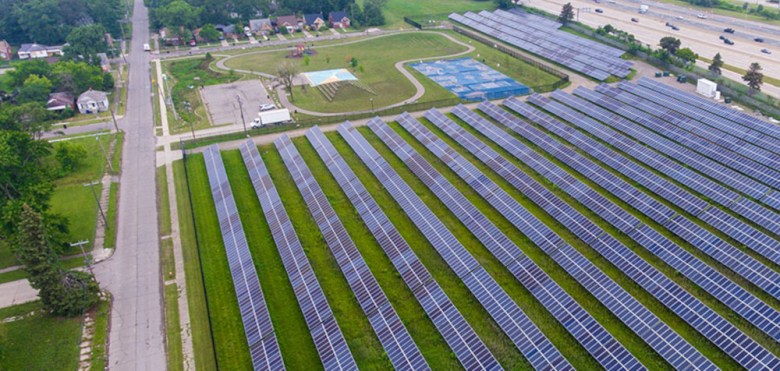
For instance, in Detroit, city officials are working with DTE Energy to build 33 MW of solar arrays on vacant property around the city. Detroit’s mayor has touted the project as a way to deal with blight while producing clean energy, but neighbors are divided.
Meanwhile, in the West Woodlawn neighborhood on Chicago’s South Side, a community-based geothermal project is intentionally bypassing vacant lots, focusing instead on placing the necessary loop fields in alleyways.
“Not every block in the neighborhood even has a vacant lot that could be leveraged,” said Andrew Barbeau, president of The Accelerate Group in Chicago, which is providing technical assistance for the geothermal pilot, in an email. “Further, communities often have other ambitions for that land, whether it is new housing development, parks, greenways, or other beneficial uses.”
For Blacks in Green, the Chicago-based organization leading the geothermal project, recognition of the role of the project within a broader scope is central to an overall goal of generating economic development and a healthy environment within the community, said Nuri Madina, Sustainable Square Mile director, who serves as point person for the pilot.
“We know that the communities have been underserved. And underserved by definition means that we have not gotten our fair share of taxpayer investment in the communities. We know what our streets look like. And one of the major assets in the community, which is not really viewed as an asset, is our vacant lots,” Madina said.
Conventional geothermal systems require substantial plots of land to lay the subterranean loop fields that circulate both hot and cold water — land that is often scarce in densely populated urban areas.
But while West Woodlawn has a number of vacant lots, they are not being utilized for the project. Instead, alleys provide a potential solution for constructing geothermal loop fields, along with allowing for connection points for houses and multifamily buildings within the pilot footprint, Barbeau said.
“The good news is that based on the system design, we have more than enough capacity in the alleys to serve the load of the blocks we have modeled. The modeling also so far is showing us that the shared network model would require 20-30% less wells than if each home built their own system,” Barbeau said in an email.
Locating the bulk of the geothermal infrastructure in alleyways also sidesteps the underground congestion of existing gas, electric and water infrastructure on city streets, said Mark Nussbaum, owner and principal of Architectural Consulting Engineers in Oak Park, Illinois.
“There’s a lot of stuff happening out near the street. It doesn’t mean it’s not possible to coordinate it, but it’s just what’s nice about the alley concept is, it’s kind of unused for utilities typically,” Nussbaum said.
“White flight” and housing segregation have left many U.S. cities with sections of vacant or underinvested property, typically in communities populated by Black and Brown people.
With roughly 60% of the land area of Chicago, Detroit nonetheless has a much larger proportion of vacant land — approximately 19 square miles. In some neighborhoods, multiple blocks may only have a single structure remaining, if any at all.
DTE Energy’s plan to build large-scale solar arrays on some of that land is supported by some residents and municipal officials as a means to reduce illegal dumping and other nuisance crimes while working toward meeting city climate goals — and reducing utility bills for residents.
But there has also been pushback, largely focused on potential detrimental impact on property values in adjacent properties and limitations on future use of the sites themselves.
“Solar panels will disrupt and destroy entire neighborhoods. There will be no future affordable housing being built anywhere around a solar farm,” councilmember Angela Whitfield-Calloway said during a city council meeting in July, as reported by Planet Detroit.
Whitfield-Calloway also questions why municipal buildings or sites outside the city limits had not been considered for the solar arrays.
In Chicago, a battery storage facility constructed as part of the Bronzeville Microgrid project administered by electric utility ComEd generated similar debate during an extended period of community input. ComEd officials said the location of the battery facility, in the middle of a stretch of vacant plots near the South Side Community Art Center, was strategic to the overall microgrid project.
A 40-yard-long mural designed and created by local artists and mounted on the exposed long side of the battery storage facility not only serves to obscure the structure, but also to highlight prominent figures in Black history and culture. While reactions to the mural have been overwhelmingly positive, reception of the battery storage facility itself has been mixed.
“There were thorough talks with the community and the art community in Bronzeville about what they wanted, what [ComEd] planned to do [with] that battery station, because they did not want it to be an eyesore … they did not want it to just be, you know, brick walls around infrastructure,” Jeremi Bryant, a resident of Bronzeville, told the Energy News Network in February 2021.
For Bruce Montgomery, founder of Bronzeville-based Entrepreneur Success Program and a member of the advisory council for the Community of the Future, the location of the battery storage facility precluded potentially more beneficial future development for the site.
“That lot in most communities probably would have ended up being invested in as more quality residential,” Montgomery told the Energy News Network in February 2021. “But now you’ve taken it up with this box car. … You’ve got big things sitting out in the middle of a vacant lot a couple of doors down from one of the most historic locations in Bronzeville.”

For Blacks in Green, what might appear to the casual observer as a vacant lot overtaken by weeds belies its ultimate potential — as an affordable, energy-efficient residential complex, small business owned by a community resident, a much needed basic amenity like a grocery stocking fresh produce — or a native plant garden to attract pollinators.
On June 17, 2023, Blacks in Green collaborated with the Delta Institute to hold a combined Juneteenth celebration and BioBlitz to identify potential sites for green infrastructure. Experts and community residents worked side-by-side to map and measure plant life, insect populations, drainage and other elements during a walking inventory of vacant lots in the area.
In the case of West Woodlawn, installation of geothermal loop fields in its alleys — versus locating them in vacant plots — presents an opportunity to promote climate resiliency through mitigation of persistent urban flooding, by utilizing permeable pavers to replace existing concrete or asphalt, said Madina.
“All of our programs are designed to create multiple benefits,” Madina said.
Projects like the West Woodlawn community geothermal project represent a drive to revive and reinvent Chicago’s Black Wall Street within what once constituted the redline-confined boundaries of the Black population drawn to the city during the Great Migration of the 20th Century.
“In most communities, the vacant lots are really indicative of a declining community. But what we have tried to do is take that negative and turn it into something positive. So if we can take those vacant lots with weeds and debris and turn them into beautiful gardens, that is a very significant improvement in the community,” Madina said.
“So [we] could improve the quality of life, improve the spirit of the people in the community… that vacant lot can provide more than just beauty. It can provide more than just comfort for the residents. It can also provide biodiversity, it can provide pollination, it can provide food for the residents.”
Correction: A 40-yard-long mural was mounted on the side of a ComEd battery storage facility to obscure the structure and highlight prominent figures in Black history and culture. An earlier version of this story misstated its size.


