

 Back
Back
See more from Canary Media’s “Chart of the Week” column.
The U.S. is the world’s largest exporter of liquefied natural gas — and the war in the Middle East is about to bring massive profits to its gas producers.
As the war destabilizes oil and gas production in the region, LNG prices have shot up globally. Qatar — a U.S. ally and the world’s second-largest LNG supplier — halted production of the fuel on Monday after Iranian drones targeted its energy facilities in retaliation for ongoing U.S. and Israeli strikes. The country accounts for one-fifth of the global LNG supply, and the vast majority of its output goes to Asia.
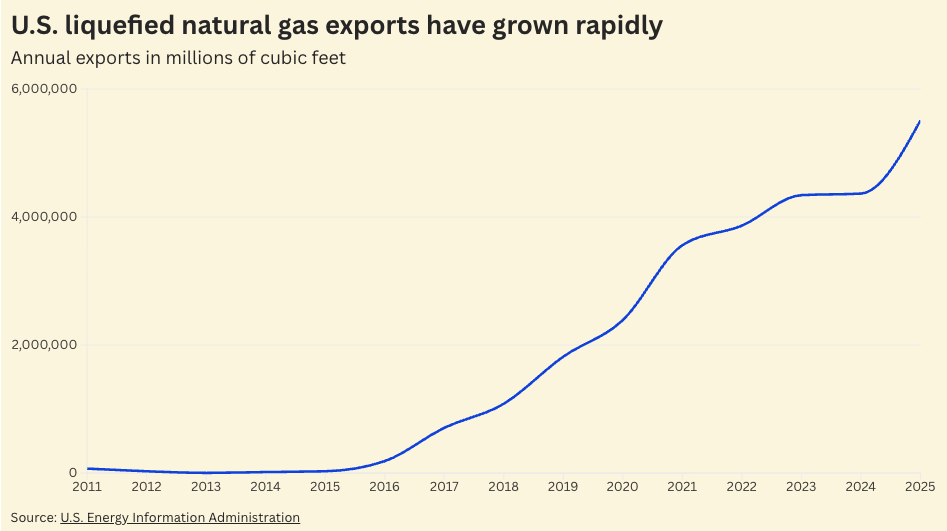
Analysts say American suppliers could be in for a windfall as desperate international buyers bid top dollar to secure what fuel is available. U.S. LNG export terminals are already operating at full bore, so there is unlikely to be a surge in the volume of gas sent abroad — just in the profits firms rake in on each shipment.
Already, the effects of the energy shock are rippling across the world.
In India, the government began rationing natural gas on Tuesday. Meanwhile, Taiwan, which gets 40% of its electricity from LNG and imports heavily from Qatar, said it will take immediate measures that include sourcing more gas from the U.S.
In Europe, natural gas prices have risen less sharply than in Asia but still enough to exacerbate energy affordability problems in the region, which was plunged into an energy crisis following Russia’s 2022 invasion of Ukraine. After mostly quitting Russian gas, Europe has come to rely heavily on LNG from the U.S., though in recent months it has sought to diversify through deals with Qatar and other countries as the Trump administration threatened to annex Greenland.
Since returning to power last January, the Trump administration has pushed to further expand the nation’s lead in LNG exports, despite warnings from analysts that doing so will drive up costs at home. Before the war broke out, the U.S. Energy Information Administration forecast that natural gas prices would climb for Americans in 2027 in part due to expanding LNG exports. The country is already on track to double its LNG export capacity by 2029.
Amid this expansion, Trump has been pressuring allies from Japan to the EU to buy even more U.S. natural gas. But the war only strengthens the case against a deeper dependence on LNG. The more a country relies on shipped-in energy, the more vulnerable it is to global shocks like the one unfolding now.
Renewables, in contrast, are a source of refuge. You install them once and for decades they produce electricity that, though tied to the weather, is completely insulated from global energy markets. Just look at Europe: The region doubled down on wind and solar following the Russian gas crisis, not because of concern for the climate but because of a desire to make its energy system as self-sufficient as possible.
Now, yet another war underscores the perils of relying on imported energy in an increasingly volatile world.


.svg)
