

 Back
Back
See more from Canary Media’s “Chart of the week” column.
President Donald Trump claimed in his Tuesday night State of the Union speech that Americans worry that “we are winning too much” under his administration. That assessment does not apply to everyone in the U.S., judging by recent public opinion polls, but it rings surprisingly true for the clean energy sector in 2026.
Each year around this time, the federal government releases its expectations for new power plant construction. The latest data drop shows clean energy is going to dominate this year, just as it has for many years running. Even as the Trump administration has employed novel and at times legally dubious means to block renewable energy growth, the power sector keeps choosing clean energy again and again — attracted by its low costs, speed to build, and climate and environmental benefits.
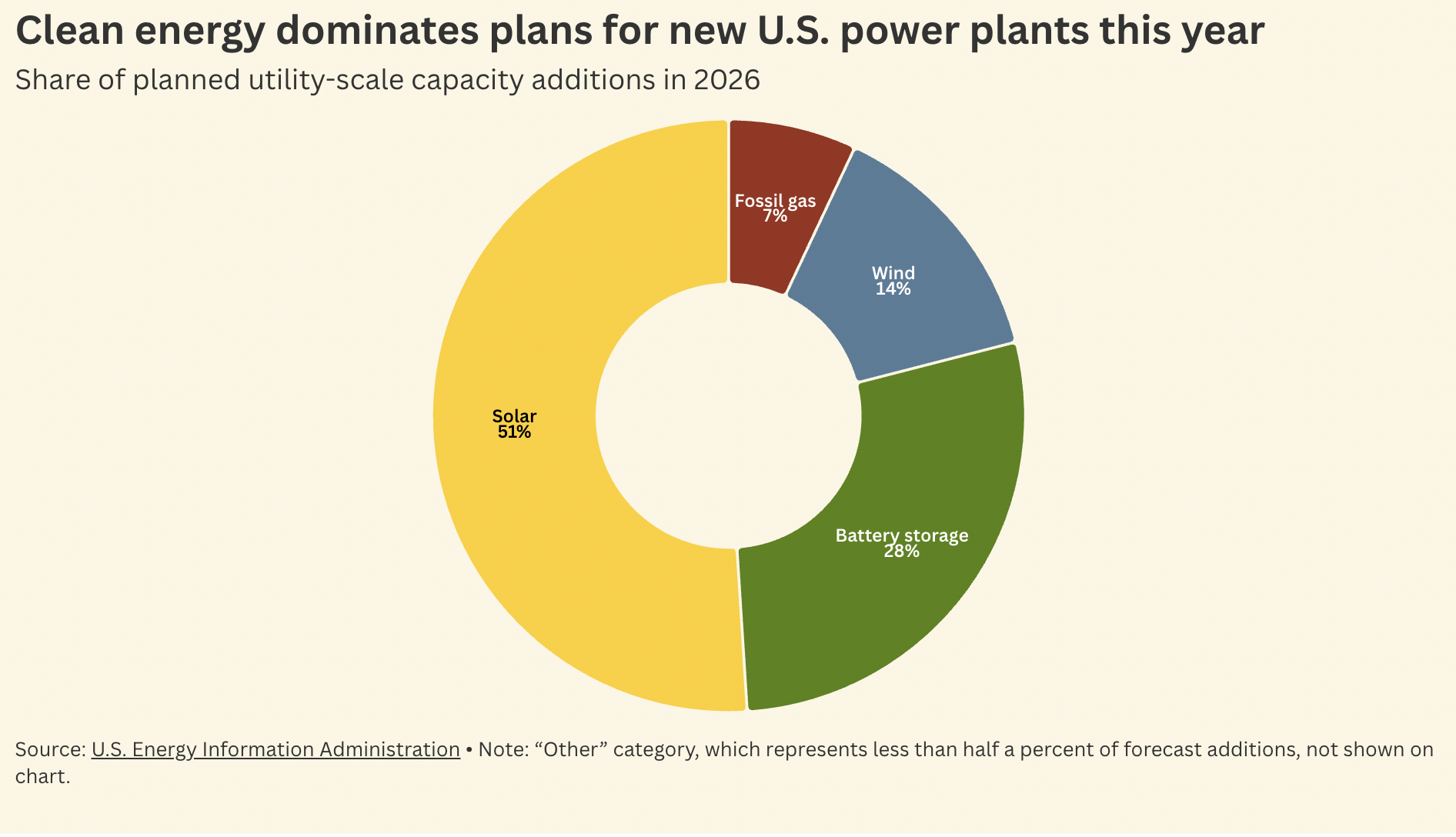
This year, solar will provide 51% of the new utility-scale electricity capacity slated to come online, batteries will deliver 28%, and wind will add 14%, according to the U.S. Energy Information Administration. Fossil gas, one of the polluting fuels most supported by the Trump administration, makes up only 7% of that new capacity. Coal, the other polluting fuel favored by the White House, does not appear in the ranks of power plants under construction.
This clean energy success is all the more notable because of the massive amount of total power plant capacity that developers are set to build in 2026: 86 gigawatts, more than the U.S. has ever added in a year. The U.S. constructed 33 GW less in 2025, which was the biggest yearly power plant build-out since 2002. Clean power plants are consuming nearly all of a vastly expanded pie, while gas gets a scant sliver.
Still, gas dominates the existing power plant fleet, producing about 40% of annual generation, compared with less than 10% percent from solar. But the renewable energy source’s odds of dethroning gas improve with each year that solar delivers such a lopsided share of new construction. In California, home to the world’s fourth-largest economy, ascendant solar generation is poised to imminently eclipse the gradually declining portion provided by gas.
The Trump administration’s anti-renewables machinations could slow this trend in coming years. Courts threw out an order to stop construction at five fully permitted offshore wind farms, but an effective blockade on new permits for projects touching federal lands could kill or delay installations that would otherwise get built in the late 2020s. Even so, solar developers hope they can keep the success going by serving the AI sector’s overwhelming demand for quick-turnaround power sources.
Whatever tumult comes after 2026, the U.S. will face the situation with tens of gigawatts of brand-new solar, wind, and batteries in its arsenal.


.svg)
