

 Back
Back
Sunny Arizona closed out 2025 as the second-biggest state for battery and solar construction. Now, a policy that helped kick-start this success could be going away.
The Arizona Corporation Commission, the elected body that regulates utilities, unanimously voted in early March to eliminate the state’s renewable portfolio standard. The policy, which the commission set in 2006, called for 15% renewable electricity by 2025. The state hit that target; thus, in the words of Commissioner Kevin Thompson, it was time to move beyond “mandates that have outlived their useful life.”
The commissioners — all of whom are Republicans — critiqued the mandate for costs it imposed: It pushed utilities to sign long-term contracts for renewable energy years ago, when it was more expensive than it is now, and added surcharges on customers’ bills to pay for those contracts and for incentives for households to adopt clean energy.
State leaders around the country are searching for tools to bring down soaring electricity costs for their constituents. Arizona’s decision has parallels in many Democratic-led states that are currently targeting surcharges from their own climate policies in the name of improving affordability.
Crucially, it’s not clear whether the end of Arizona’s renewables standard will noticeably lower customers’ bills, given that utilities are still beholden to those long-term contracts they signed a while ago with renewable energy developers.
These concerns took on new pertinence Monday, when State Attorney General Kris Mayes, a Democrat, filed for a rehearing of the decision, charging that the commission failed to complete “the legally required economic analysis.” That gives the regulators 20 calendar days to grant or deny a rehearing. The repeal needs a sign-off from the attorney general to officially take effect, so this opposition could complicate that typically uneventful procedure.
Mayes, who is running for reelection this fall, sat on the commission back when it created the renewables mandate. Back then, it pursued the mandate in the interest of affordability: “An increased reliance on local free energy resources will avoid the negative impacts of energy cost run-ups as were experienced in 2005” after Hurricane Katrina and other storms destroyed swaths of U.S. fossil fuel infrastructure, the commission noted at the time. In the last decade, the same regulatory body chastised utilities for investing too heavily in gas power, and it developed a 100% clean energy standard for the state (though the commissioners ultimately voted down their own proposal).
Today, Arizona’s renewables market is booming, and the operating plants aren’t going to disappear just because the mandate might. But with utilities embracing big gas investments to keep pace with soaring demand, the mix could slip back below 15% renewables.
As Arizona’s power demand rises faster than nearly anywhere else in the country, electricity consumers there need effective, rather than symbolic, tools to contain costs.
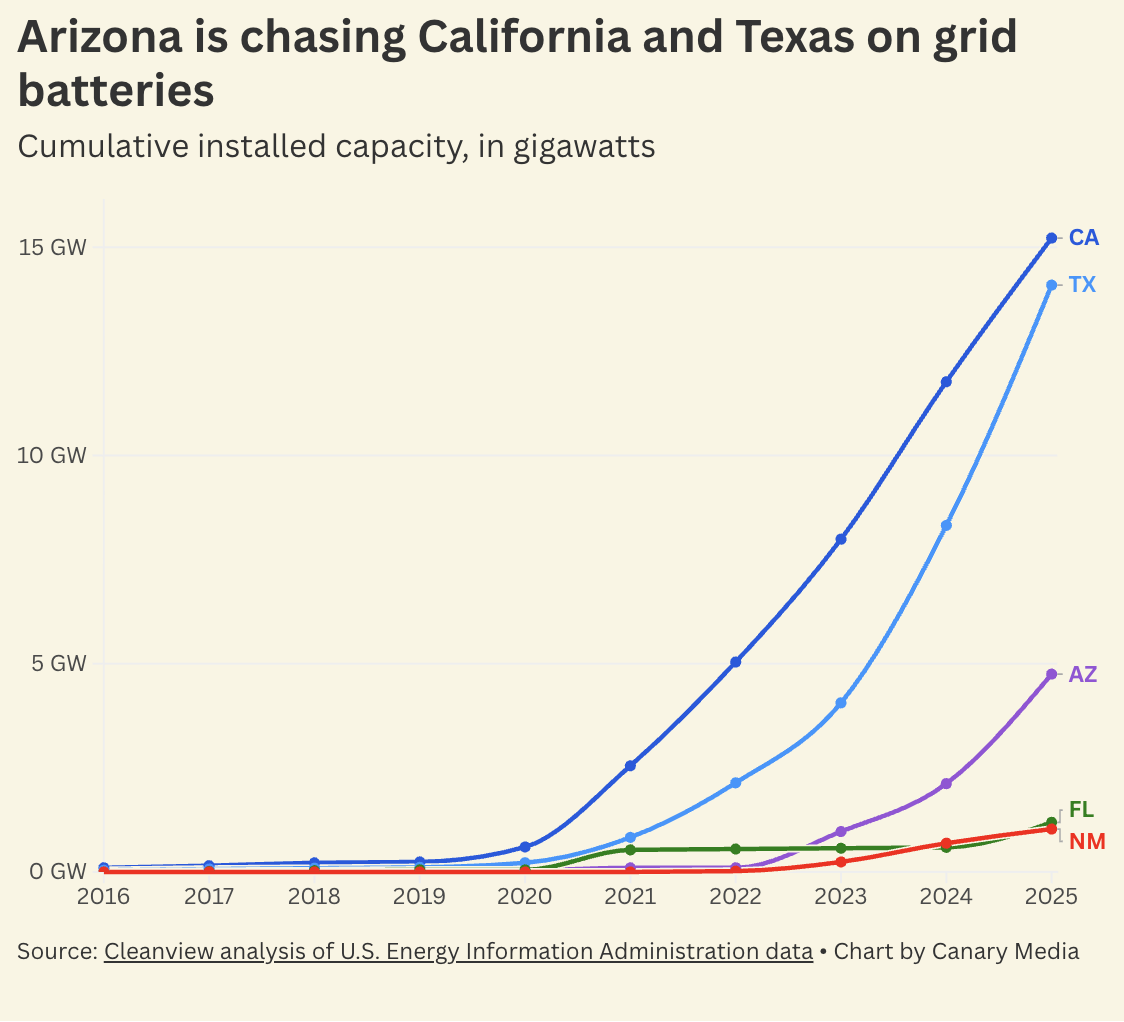
One thing that is undeniable: Clean energy has been crushing it in Arizona lately. The state holds the third-highest grid battery capacity (after California and Texas) and the fourth-highest solar capacity (after California, Texas, and Florida). Indeed, Arizona more than doubled its battery fleet from 2024 to 2025, hitting 4.7 gigawatts and growing at a much faster rate than the two leading battery states.
Overall, Arizona gets about 44% of its electricity from natural gas, a fuel that is not harvested within the state and must be imported from elsewhere in the country. Coal used to rule the roost but has declined to marginality over the last decade. The Palo Verde nuclear plant outside Phoenix has cranked out steady carbon-free power since the 1970s and now accounts for 26% of the state’s production. There’s a little bit of hydropower and wind, but solar — which generates roughly 16% of Arizona’s electricity — drives all the clean growth, with help from the lithium-ion batteries storing it for post-sunset hours.
Arizona has plenty to offer a solar or battery developer. Its desert environment furnishes ample sunshine, and there’s a lot of space to build. The state doesn’t have an open energy market like Texas does, but its utilities have proactively solicited competitive bids for new electricity supplies and handed out contracts to developers who bring winning solar and storage proposals. Indeed, Arizona Public Service, the biggest power company in the state, set an internal corporate goal back in 2020 to get 100% clean electricity by 2050 — and gained ample experience in contracting for clean energy. But it abandoned that ambitious target in August, choosing to extend the life of a major coal plant and invest more in gas infrastructure amid soaring demand.
For decades, Phoenix has attracted a steady influx of residents who like the affordable real estate and dry desert air, and aren’t deterred by the occasional bout of triple-digit heat. More recently, the region has also drawn a spate of data centers: Arizona hosts 2 gigawatts of active data centers, according to independent analyst Michael Thomas.
That’s just a taste of what might be coming. Thomas noted in a January post that Arizona Public Service has 30 GW of proposed data centers in its queue for grid connection, several times more than the utility’s peak demand record of 8.5 GW. That gargantuan mismatch is reason enough to doubt that much of the proposed buildout will ever materialize. Still, the utility has already mobilized to construct a 2-GW gas plant to keep pace with this new demand.
The propulsive growth in consumption creates new urgency for clean energy in terms of both planet-warming emissions and affordability. The state’s progress on cleaning up its electricity supply could slow or reverse if renewables stall out just as utilities fast-track constructing fossil fuel plants. And an assertive clean-energy expansion could help keep prices lower in a period of tight supply. That’s especially true as the turbines used in gas plants get more expensive amid yearslong supply chain backlogs. Furthermore, since Arizona lacks its own gas supplies, consuming more of the fuel requires building more pipelines and shipping more dollars out of state.
At this pivotal moment for Arizona’s energy outlook, details included in the Arizona Corporation Commission’s decision cast doubt on whether customers will save much money from the end of the mandate.
The regulators focused their criticism on costs imposed on customers over the years by the surcharges utilities levied to fulfill the renewables mandate. The implication was that eliminating the mandate would therefore lower people’s bills going forward.
But that rhetoric doesn’t match the facts in the official proceeding, said Autumn Johnson, who argued against the repeal as the leader of the state affiliate of the Solar Energy Industries Association.
The commission’s economic impact statement does say that utilities “may see some marginal savings” from forgoing the administrative work involved in complying with the requirements. However, it notes, one utility indicated that “most renewable-related costs will continue due to long-term contractual and programmatic obligations, which may limit overall savings.”
The rule changes don’t eliminate American contract law. Utilities will still have to pay for contracts they signed years ago, and those costs will continue to be recovered as surcharges, a commission spokesperson confirmed. Utilities had already fulfilled the requirement, so it wasn’t likely to force their hand in signing new deals. Even if it did, solar and battery proposals today compete extremely well on the cost of power; an extra nudge to pick the cheapest source of new kilowatt-hours should not unduly raise costs on consumers.
“What does it say to the country, what does it say to the industry, if even this tiny, anemic RPS [renewables portfolio standard] that’s honestly embarrassing, even that we have a problem with?” Johnson said. “This is just to signal that you don’t like renewables, which I think is really not smart from an economic development standpoint.”
As for why sitting regulators might want to signal such a thing, two of the regulators quoted in the press release are running for reelection in November, with a primary on July 21. Kevin Thompson and Nick Myers are facing primary challenges from state legislators Ralph Heap and David Marshall, who are campaigning to “stop the Green New Deal” and “oppose harmful rate hikes.” This vote gives the incumbents something to talk about to show they are working on affordability while pruning what they see as government overreach.
It’s also possible that the repeal, if enacted, won’t materially damage the pace of the clean energy buildout, since the mandate wasn’t driving that buildout anymore. Excising the old policy enables renewables developers to make a clearer case that they’re winning on the merits, not because of state favoritism.
Still, Arizona’s retreat on its renewables policy coincides with other forces acting against the clean energy industry. Local jurisdictions in the state are passing ordinances that could stymie solar and battery development through restrictive permitting, Johnson said. The Trump administration is phasing out tax incentives for wind and solar installations and holding up permitting for projects on public lands. Arizona’s rooftop solar market has contracted since the state lowered the rate of compensation for customers who send power from their panels back to the grid, and imposed what Johnson called “punitive fees” on those households.
In sum, Johnson hopes the recent clean-energy success story continues in Arizona, but stressed that this outcome is not guaranteed.
“You can’t maintain a third ranking for storage and fourth or fifth ranking for solar if you continue to do things that are antagonistic to those industries,” Johnson said.
Now, the fate of the renewables policy hangs on the wrangling between the attorney general and the commissioners, as election-year politics spices up the usually mild world of utility regulation.


.svg)
